
What a family holds of a sister is not always kept in one place: her ashes may rest with one person while a lock of her hair sits with another. A sister ashes hair diamond is a single lab grown diamond grown partly from carbon recovered from both a small portion of her cremated remains and a little of her hair, blended with lab carbon, and typically completed within six to ten months.
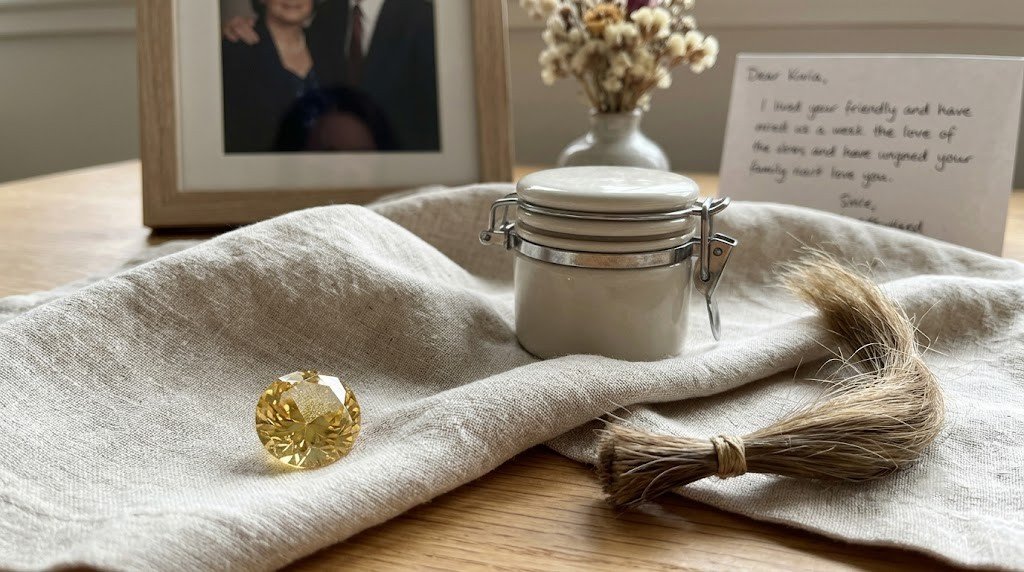
Table of Contents
What Is a Sister Ashes Hair Diamond?
A sister ashes hair diamond is one stone with two personal sources. Carbon is recovered from a measured amount of her ashes and from a small quantity of her hair, purified, and then grown into a single crystal, typically together with supplemental carbon supplied by the laboratory.
Physically, the result is a diamond like any other lab grown diamond. It has the same lattice, the same hardness and the same grading scale. What makes a sister ashes hair diamond distinctive is purely its origin: two different traces of one person, joined in one object.
The idea of a sister ashes hair diamond sounds unusual at first, and it is a less familiar request than a stone from ashes alone or hair alone. Not every provider offers it, and those that do may describe it differently, so asking directly whether a laboratory accepts two materials for one order is the sensible first step.
Combining is not a requirement and not an upgrade. A stone from one material is complete on its own. A sister ashes hair diamond is simply one more arrangement a family can choose when both materials are available and both feel meaningful.
Why Would a Family Combine Ashes and Hair?
The reasons families consider a sister ashes hair diamond are as varied as the families themselves, and none needs justifying. Some that come up:
- The materials are held by different people. Her ashes may sit with whoever holds authority over them, while a sibling kept a lock of her hair. A blend lets both sides of the family contribute.
- The ash portion offered is very small. If whoever holds her ashes is comfortable releasing only a spoonful or two, adding hair may let the family proceed without asking for more.
- Both materials carry meaning. Hair can feel tied to her everyday life, and ashes to her final rest. Some families want a stone that holds both.
- Several siblings each want to take part. One person contributes the hair they saved; another arranges the ash portion; the cost is shared.
- A single heirloom is the goal. Rather than several smaller stones, the family prefers one sister ashes hair diamond that can be worn and later passed on.
What a sister ashes hair diamond should not be chosen for is a belief that it puts “more of her” into the stone. No published percentage exists for blended stones, so that assumption cannot be confirmed in advance.
Who Needs to Agree to Each Material?
A blend can involve two separate permissions, and they may rest with different people. That is the single most important practical difference between a sister ashes hair diamond and a stone from one material.
For her ashes, the person with legal authority over her remains needs to agree. In many states the order runs from a spouse or registered partner, through adult children and then parents, before it reaches siblings. The sequence varies between states, and her own written wishes or a designated agent can change it.
For her hair, the answer depends on where the hair is. Hair collected from her body at a funeral home would generally need the same person’s agreement as the ashes. Hair already separated, such as a saved lock or brush strands, may count as one of her belongings, which can form part of her estate under rules that vary by state. Her executor, or whoever is settling her affairs, is the person to consult.
So a sibling who holds a lock of her hair and hopes for a sister ashes hair diamond may still need two conversations: one with whoever holds the ashes, and possibly one with her executor about the hair. Get both agreements in writing, and expect a careful provider to ask for them before accepting either material.
If the people involved disagree, pausing is wiser than pressing. Grief is uneven, and an arrangement everyone has accepted is easier to live with later.
How Can a Sibling Raise a Sister Ashes Hair Diamond With the Family?
Gently, and with specifics. If you hold her hair but not her ashes, the request to whoever holds the ashes is smaller than it may sound: a spoonful or two, with everything else staying exactly where it is. Offering the lock you saved as part of the stone can also make the idea feel shared rather than taken.
A few things that can ease the conversation:
- Bring the provider’s custody process and release form, so nobody is asked to agree to something unseen.
- Explain that adding hair does not mean asking for more ash; if anything, it may mean asking for less.
- Ask whether they would like a say in the cut or setting, or would like a stone of their own.
- Treat “not yet” as a genuine answer. A sister ashes hair diamond can wait, because sealed ashes and dry, stored hair both keep.
If faith matters to the person holding her ashes, a conversation with their own faith leader about dividing cremated remains may need to come before anything else. That conversation belongs to them, and it is worth respecting whatever it concludes.
How Are Two Materials Handled in the Laboratory?
Ash and hair are chemically very different. Cremated remains are mostly bone mineral, chiefly calcium phosphate, with usable carbon at roughly 0.5% to 4% by weight. Hair is built from keratin and is roughly half carbon. Extraction has to deal with each material on its own terms before any carbon can be combined into a sister ashes hair diamond.
| Step | Her ashes | Her hair |
|---|---|---|
| Arrival | Logged and given an identifier | Logged, weighed and given an identifier |
| Extraction | Mineral content separated away in an oxygen free, multi stage process | Non carbon parts of the keratin driven off in a controlled process |
| Purification | Carbon refined to about 99.9% or higher | Carbon refined to about 99.9% or higher |
| Combining | Varies by provider: ask when and how the two carbon sources are joined | Varies by provider: ask when and how the two carbon sources are joined |
| Graphitization | Heated to roughly 2,500 to 2,700°C into graphite | Heated to roughly 2,500 to 2,700°C into graphite |
| Growth | Grown, typically with supplemental lab carbon, mainly by HPHT at about 6 to 8 GPa and 1,400 to 2,500°C | Same growth cell, same crystal |
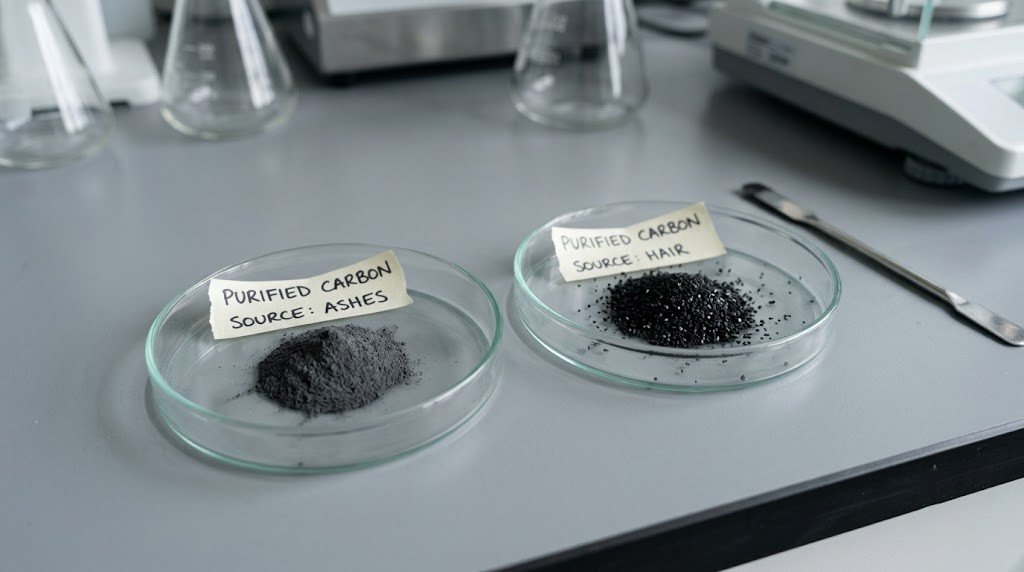
After growth, the rough crystal is cut and polished, may receive an optional color treatment where a provider offers one, and is documented. Each column mirrors a single material process: the ash only laboratory sequence and the hair only laboratory sequence are each described on their own.
For a sister ashes hair diamond, the combining row is the one to press on. Some laboratories may keep the two materials apart until after purification; others may describe a different sequence. There is no industry standard to point to, so the provider’s own written description is what counts. For a slower look at the laboratory itself, how a stone is made from her ashes and hair together follows each step in order.
What 5 Checks Should a Sister Ashes Hair Diamond Pass on Paper?
With two materials, documentation matters more, not less. Before agreeing to a sister ashes hair diamond, ask the provider to confirm these five points in writing:
- Both materials are recorded on arrival. The intake record should list ash and hair separately, each with its received weight and its own identifier or a shared order number.
- Both authorizations are on file. The provider should hold written consent from whoever controls her ashes, and any agreement needed for the hair.
- The combining step is described. You should know at what stage the two carbon sources are joined and that no other family’s material enters the process.
- Supplemental carbon and any treatment are disclosed. The paperwork should say lab carbon was added and whether any irradiation was used for color.
- The origin certificate names both sources. An in house origin certificate should state that the stone was grown from carbon recovered from her ashes and her hair; it is separate from any independent grading report.
An independent grading report, if you want one, describes the stone’s quality using the cut, color, clarity and carat framework that gemological labs share. It is usually optional, is typically priced separately, and says nothing about origin. The origin certificate does that job.
How Much of a Sister Ashes Hair Diamond Is Her Carbon?
No published percentage exists for a blend. Industry figures describe ash only stones, where personal carbon from ash typically accounts for something like 10% to 15% of the finished mass, and a few providers quote figures nearer 3%. That figure is about ash alone and cannot be carried over to a blended stone.
For hair, and for a sister ashes hair diamond combining both, no comparable finished stone percentage has been published. Hair’s higher carbon content does not translate into a known share of the crystal, because the laboratory still decides how much supplemental carbon the growth requires.
What is certain is that her carbon from both sources is genuinely present, grown permanently into the lattice alongside lab carbon. What is not accurate is any description of the stone as made of her alone, or as containing no added carbon.
So ask each provider, in writing, what share of the finished mass they expect to come from her ashes and her hair combined. A clear figure, or a clear explanation of why one cannot be given, tells you more than reassurance. Whether such a stone is really made from her ashes and hair is examined closely on its own page.
Does Adding Hair Change the Size or Color?
Not in any way you can plan around. The finished carat weight reflects the length of the growth run, and your family picks that size when ordering; neither the amount nor the mix of material you send changes it. Adding hair to ash does not make a sister ashes hair diamond larger or faster.
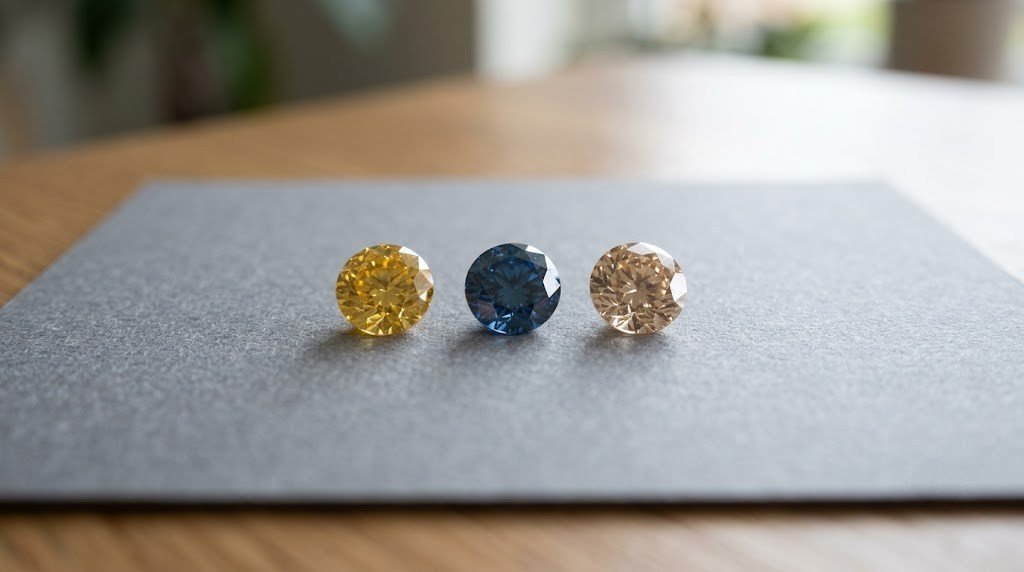
The color of a sister ashes hair diamond behaves the same way. It depends on which trace elements end up in the crystal during growth; nitrogen gives a yellow cast and boron a blue one, while a colorless result means excluding both, at extra cost. Memorial stones tend toward yellow, blue and champagne.
Blending does not shift that range in a predictable direction. Her hair color has no known link to the stone’s shade, and the result cannot be chosen or matched from either material. Where a provider offers treated colors such as red, green or black through irradiation, that is a separate, disclosed choice.
If cut, setting or treated color are decisions you get to make, base them on what she enjoyed and what the wearer will use every day rather than on any convention about sisters.
How Much Material Is Needed From Each Source?
For ash only stones, laboratories typically ask for a few tablespoons up to about 4 oz, roughly 100 g. For hair only stones, a small lock or a few grams is the usual request. Both are provider variable figures.
For a sister ashes hair diamond, ask the provider what it needs from each material. Some may accept less of each than a single material order would require; others may ask for each material’s standard minimum. There is no industry rule, so get the figure for your order in writing.
Two points help when talking with whoever holds each material. First, the amount is small either way, so the urn, the plot, or the saved lock stays largely intact. Second, ask whether unused ash and unused hair are returned, and to which person, since they may have come from different households.
If you would like the logistics of collecting, packing and sending both materials set out step by step, the practical route to turn sister ashes and hair into a diamond covers it in sequence.
What Do Cost and Timing Look Like for a Sister Ashes Hair Diamond?
General 2026 industry ranges apply, with price driven mainly by carat and color:
| Carat range | Typical industry price | Notes |
|---|---|---|
| Roughly 0.10 to 0.25 ct | Around $1,500 to $3,500 | Smallest sizes offered |
| Half a carat to one carat | Around $5,000 to $15,000 | A colorless stone is priced well above a yellow, blue or champagne one |
| Two carats to five or more | Around $20,000 to $75,000 or higher | Longest growth times |
These are not any one company’s prices. Ask whether handling two materials changes the quote for a sister ashes hair diamond, and ask for the full total, since independent grading, engraving, fancy cuts and settings are usually extra.
Laboratories typically quote six to ten months once they hold the material, stretching to about twelve for stones above two carats or specialty colors. With a blend, ask whether that clock starts when the first material arrives or the second. Gathering two agreements can add weeks before anything ships.
If siblings are sharing the cost, write down who owns the finished stone and who will keep it.
Can Each Sibling Have a Blended Stone?
Sometimes. Because each stone needs only a small amount of each material, more than one sister ashes hair diamond may be possible from the same ashes and the same lock, if both sources stretch far enough and everyone who must agree is comfortable.
Families take many forms. She may leave one sibling or several, a twin, half siblings, step siblings, or siblings who were raised apart. Each relationship was its own. One sibling may want a blend, another a hair only stone, another nothing at all, and every choice is valid.
For multiple orders, ask the provider whether each stone is processed and documented separately, whether material can be reserved for a later order, and how leftover ash and hair are returned.
When Might One Material on Its Own Fit Better?
A sister ashes hair diamond is not always the right answer. If her ashes are fully available and nobody holds hair, an ash only stone is simpler, with one authorization and a published personal carbon range; the guide to a stone grown from her ashes explains that route.
If the ashes are not available to you, perhaps because whoever holds them prefers to keep them intact or because she was buried, hair alone may be the gentler path. It needs no cremation and only a few grams. The guide to a stone grown from her hair covers sources, permission and handling.
And if the only reason for blending is a hope that two materials make the stone more fully hers, it may be worth pausing. Without a published blend percentage, that hope cannot be measured. A single material stone is no less real. For broader context on how this category of keepsake developed, general background on memorial diamonds is a helpful starting point.
Frequently Asked Questions
Can a sister ashes hair diamond be made if different relatives hold each material?
Yes, provided each person who needs to agree does so in writing. Whoever holds legal authority over her ashes must consent to that portion, and her executor or that same person may need to agree to the hair, depending on state rules.
What percentage of a sister ashes hair diamond is her carbon?
No published figure exists for ash and hair blends. The often quoted 10 to 15 percent applies to ash only stones. Ask each provider for its expected share from both materials combined, in writing, before you place an order.
Does adding hair make the diamond bigger?
No. Carat size depends on growth time in the press, which follows the size you choose. Adding hair to a small ash portion does not enlarge the stone or speed it up, although it may help a family proceed with less ash.
How should a sister ashes hair diamond be documented?
The intake record should list both materials with their weights, both authorizations should be on file, the combining step should be described, supplemental carbon and any treatment disclosed, and the origin certificate should name both her ashes and her hair.
Will the stone’s color reflect her hair?
No. Her hair color has no known link to the stone’s shade, which is set by trace elements like nitrogen and boron present as the crystal grows. Memorial stones lean toward yellow, blue and champagne, and nobody can choose, match or predict the result.
Does every provider offer a sister ashes hair diamond?
Not necessarily. A blended order is a less familiar request than ash alone or hair alone, and providers differ in whether they accept two materials for one stone. Ask directly, and get the provider’s description of its process in writing.
Final Thoughts on a Sister Ashes Hair Diamond
There is something fitting about a stone that needs more than one person’s care to exist. A blend can mean that the people holding different parts of her have talked, agreed, and contributed something together.
That same feature is what makes the paperwork matter. Two materials mean two intake records, possibly two authorizations, and a combining step you should understand before you consent. A sister ashes hair diamond made with all of that in writing is a stone you can trust as well as treasure.
If a blend turns out not to fit, nothing is lost. Ashes alone or hair alone can lead to a stone every bit as meaningful.
Learn More About Sister Memorial Diamonds
- Sister Ashes Diamond: The Complete Guide for when ash is the material available
- Sister Hair Diamond: The Complete Guide for when hair is the material available
- How to Turn Your Sister’s Ashes and Hair Into a Diamond for collecting and sending both materials
- How a Memorial Diamond Is Made From Your Sister’s Ashes and Hair for the laboratory sequence for a blend
- Is a Memorial Diamond Really Made From Your Sister’s Ashes and Hair? for what the paperwork can show
Talk With Memorial Diamond
If your family is weighing a sister ashes hair diamond and would like to talk through permissions, quantities or documentation first, Memorial Diamond is here to help. Start a conversation at memorialdiamond.us whenever it suits you; asking a question carries no obligation.