
Some people end up with both because of how the year went, a lock kept early, a portion of remains later.
A memorial diamond made from partner ashes and hair is not one process. Each material is purified on its own track, ash to recover the 0.5% to 4% carbon it holds, hair to recover roughly half its weight in carbon, and each is graphitized separately at about 2,500 to 2,700°C. The two tracks meet only when both charges enter a single HPHT growth cell at roughly 6 to 8 GPa. Five stages in total.
That meeting point is the whole story of a memorial diamond made from partner ashes and hair. Everything that can be separately evidenced about the two materials happens before it, and nothing can be after.
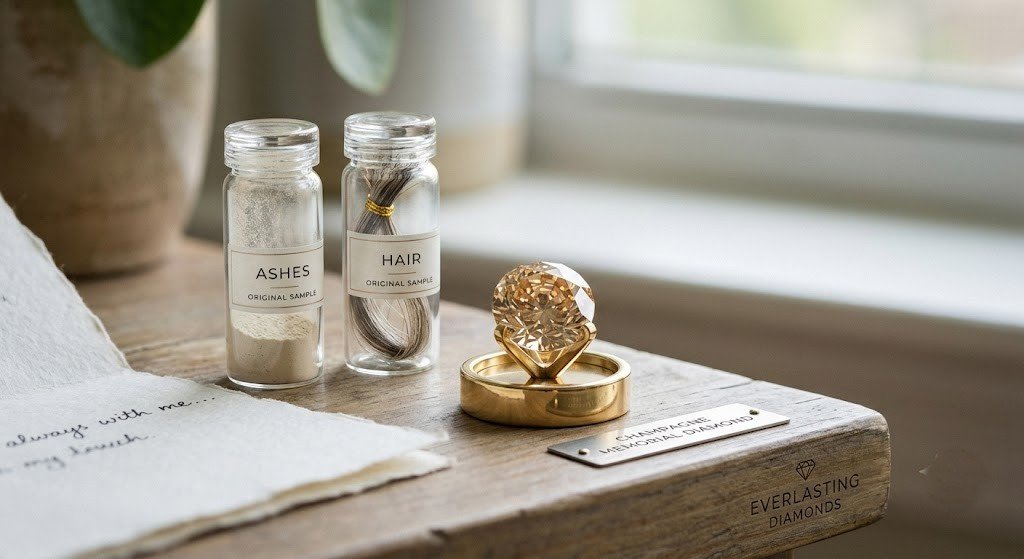
Table of Contents
Why Two Materials Means Two Separate Tracks
Ash and hair are not the same chemical problem, and nothing in the making of a diamond made from partner ashes and hair pretends they are.
Cremated remains are mostly calcium phosphate, which is bone mineral. The usable carbon inside that comes to roughly 0.5% to 4% of ash by weight, which means extraction is a long subtraction. Most of what you send is removed as mineral residue. Hair is keratin, roughly 50% carbon by weight, so extraction there is comparatively quick and far less lossy.
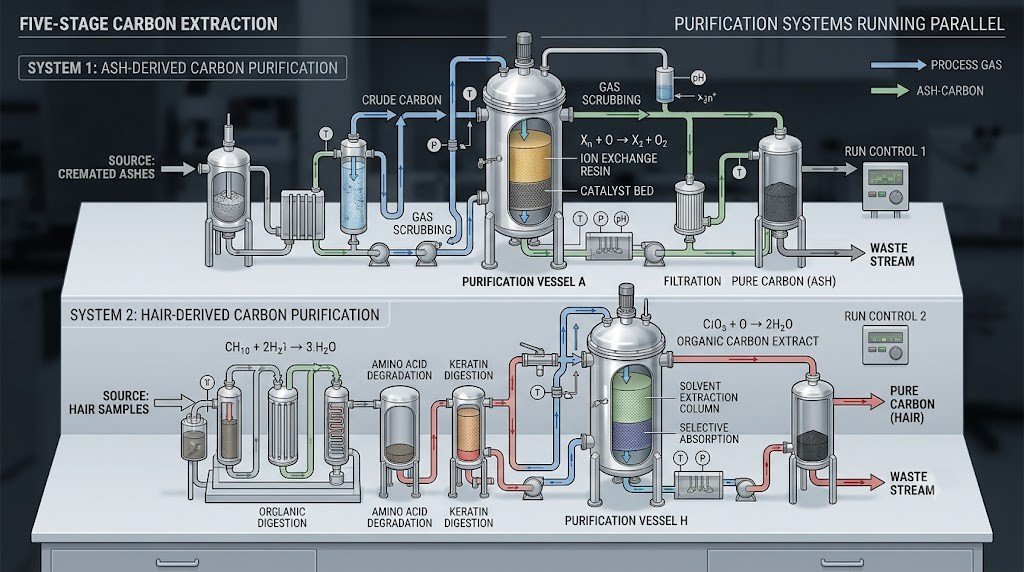
Two materials with yields that differ by more than an order of magnitude cannot be purified in the same vessel on the same settings. So a memorial diamond made from partner ashes and hair begins as two parallel operations that happen to be running for the same person, and for the same stone, at the same time.
That is not a complication to be apologized for. It is the reason a diamond made from partner ashes and hair can have its two materials separately weighed, separately logged, and separately accounted for right up to the moment they are combined. This provides more evidence, not less, than a single material stone can offer.
The Five Stages of a Memorial Diamond Made From Partner Ashes and Hair
1. Two intakes. The portion of ashes and the lock of hair arrive and are logged independently. This means separate weights, separate identifiers, and ideally separate dated photographs. Ask for two records rather than one combined receipt. This is where a diamond made from partner ashes and hair gains the documentation that makes it different from a single source stone.
2. Two purifications. Each material is heated in a controlled, oxygen free process that strips away everything that is not carbon, reaching roughly 99.9% or higher purity. The ash track loses the overwhelming majority of its submitted mass. The hair track loses roughly half. Two batches of purified carbon come out, still separate. At this stage a diamond made from partner ashes and hair still has two independently verifiable histories.
3. Two graphitizations. Each purified batch is heated to about 2,500 to 2,700°C and converted into graphite, the feedstock form a diamond press can use. There are now two graphite charges, still distinguishable because they are still in different containers, not because anything about them is chemically different.
4. One growth cell. Both charges, combined with supplemental lab grown carbon, are loaded into a single HPHT growth cell around a tiny diamond seed and held at roughly 6 to 8 GPa and 1,400 to 2,500°C for weeks to months. This is the convergence point, and it is the only one.
5. One stone, cut and graded. The rough crystal is cut and polished, then assessed against the same cut, color, clarity, and carat standards used for any diamond, ideally by an independent third party laboratory. One stone comes out. A diamond made from partner ashes and hair has no ash half and no hair half.
Where Do the Two Tracks Actually Converge?
For a diamond made from partner ashes and hair, convergence happens at stage four. Both graphite charges are weighed into the growth cell alongside the supplemental lab carbon, and the cell is sealed.
Up to that moment, everything is separable. Two weights at intake. Two purification runs with two batch records. Two graphite charges sitting in two containers with two identifiers. A memorial diamond made from partner ashes and hair has, at that point, a paper trail with two distinct branches, each traceable back to a different material and a different day.
The instant the cell is sealed and pressurized, those branches end. Carbon purified from ash and carbon purified from hair are the same element in the same form. Graphite is graphite, whatever it used to be part of. They do not layer, settle, or occupy separate regions of the crystal. They dissolve into the same molten metal flux and deposit onto the same seed, atom by atom, in no particular order.
| Stage | Ash Track | Hair Track | What Can Be Separately Evidenced |
|---|---|---|---|
| 1. Intake | Portion weighed, logged, identified | Lock weighed, logged, identified | Two weights, two dates, two identifiers |
| 2. Purification | Long subtraction. Most mass removed as mineral | Shorter run. Roughly half the mass retained | Two batch records, two yields |
| 3. Graphitization | Ash derived carbon to graphite at 2,500 to 2,700°C | Hair derived carbon to graphite at 2,500 to 2,700°C | Two charges, two container records |
| 4. Growth Cell | Charge loaded with lab carbon | Charge loaded with lab carbon | Nothing after this point. The cell is sealed. |
| 5. Cutting and Grading | One stone | One stone | The stone’s own 4Cs, and nothing about origin |
After Convergence, Can Anyone Tell the Two Apart?
No. This is the part of a diamond made from partner ashes and hair worth stating plainly, because a reader who suspects it and is never told clearly may assume the worst.
Once both charges are in the growth cell, no test performed on the finished diamond can identify which carbon came from the ashes, which came from the hair, and which came from the supplemental lab feedstock. A grading report will not show it. A gemologist with a loupe will not see it. There is no analysis of a diamond made from partner ashes and hair that separates the sources, because after purification there is nothing left to separate. There are only carbon atoms, chemically identical regardless of what they used to be part of.
That also means nobody can verify a stated proportion after the fact. If a stone is described as using both, the honest meaning of that statement is that both entered the process and both are recorded as having done so. It does not mean both are measurable in the finished crystal.
Two consequences follow for anyone considering a diamond made from partner ashes and hair, and they are the practical reason to read this before starting rather than after.
The first is that the value of the two track structure in a diamond made from partner ashes and hair is entirely upstream. Insist on the separate records while the tracks are still separate, because the window closes at stage four and does not reopen.
The second is that any provider claiming to demonstrate the split in a finished stone is claiming something that is not physically available. That is a useful test of how the rest of their answers should be read.
So What Can Be Documented About a Diamond Made From Partner Ashes and Hair?
Quite a lot, as long as you ask for it in the right window. What can be documented is every fact created before the cell was sealed.
- Two intake records, each with its own date, weight, identifier, and ideally a photograph of the material as received.
- Two purification batch records, tying each identifier to a specific run rather than to a general statement that material was processed.
- Two graphitization records, confirming both charges existed as separate feedstock before loading.
- A cell loading record naming both identifiers and the supplemental lab carbon added. This is the single most important document for a memorial diamond made from partner ashes and hair, because it is the last one that mentions two sources.
- An origin or authenticity document that names both submissions explicitly, rather than referring vaguely to submitted material.
- A grading report, which describes the stone’s quality and says nothing at all about origin. The two documents answer different questions and neither substitutes for the other.
Neither track yields the volume a growth run consumes, not separately and not added together. Both purified batches are made up with lab grown carbon before the cell is sealed, which means the personal carbon in a diamond made from partner ashes and hair is real, traceable to two named submissions, and still a minority of the crystal’s mass. Any description that implies otherwise is describing a stone that does not exist.
Does Using Both Materials Change the Stone Itself?
Not in a way anyone can see, and it is better to know that now.
Color. Trace elements drive color. Nitrogen can contribute toward yellow, boron can contribute toward blue, and colorless material requires the absence of both. Both ash and hair are organic sources that bring trace elements with them, so a memorial diamond made from partner ashes and hair sits in the same realistic range as a single material stone. Yellow, blue, or champagne are possible, while colorless material can require more process control and typically costs more. Nobody can forecast a precise shade from either material or from the combination.
Size. For a diamond made from partner ashes and hair, carat is bought as growth time, not as quantity of material. Submitting two materials instead of one does not produce a larger stone, and does not shorten the run.
Timeline. Industry wide, the whole sequence typically runs six to ten months, sometimes twelve for larger or specialty color stones. Two purification tracks can add a little at the front end if they are run sequentially rather than in parallel. The press is where almost all of the months live, and the press does not care how many sources fed it.
Quality. A diamond made from partner ashes and hair is graded on exactly the same 4Cs as any other stone. There is no separate scale, no allowance, and no penalty.
Can the Two Tracks Become Two Separate Stones Instead?
Yes, and this is the option most people do not realize they have until someone says it out loud.
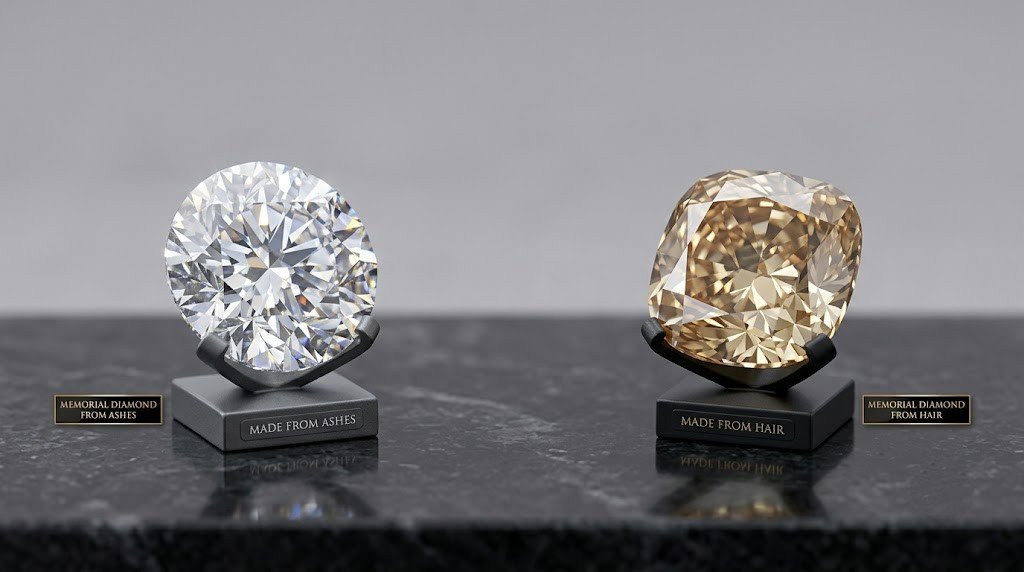
If the two materials never enter the same growth cell, they never converge. This means they stay separately evidenced permanently. An ash grown stone and a hair grown stone, each with its own intake record, its own batch history, and its own origin document, preserve a distinction that a diamond made from partner ashes and hair gives up at stage four by design.
There are real trade offs, and they run in both directions.
- Two stones cost more than one. Each needs its own growth run, and growth time is the dominant cost in every memorial diamond. Two half carat stones will not cost what one half carat stone costs.
- Two stones take the same time, not twice as long, if the runs happen in parallel. Sequential runs would change that answer considerably.
- Two stones can go to two people. This is often the deciding factor. One stone has to live somewhere. Two can be shared without anyone having to give anything up.
- One stone concentrates everything. For many people that is precisely the point, and the loss of separability is a price they are glad to pay.
- You can also do one of each and keep the rest. A memorial diamond typically uses only a portion of the available material, so choosing one route now rarely forecloses the other later.
The question to sit with is not which option is more meaningful. Both follow the same physics. The question is whether the distinction between the two materials is something you want to be able to point at in ten years. If it is, a diamond made from partner ashes and hair is the wrong shape for it, and two stones are the right one. If it is not, one stone is simpler and cheaper.
Why Families Choose Both Anyway
Knowing that the combination is invisible in the finished stone does not make a diamond made from partner ashes and hair pointless, and it is worth being clear about why.
The reason for a diamond made from partner ashes and hair is usually circumstantial rather than symbolic. A lock of hair was kept at some point, from a haircut before an illness, from a hospital stay, or from a drawer nobody had cleared. A portion of ashes became available later. Using both is less a decision than an acknowledgment that both exist and neither felt right to leave out.
Sometimes it is about standing. Who controls a person’s remains is settled state by state rather than by any nationwide statute, and a written direction left by your partner can shift it again on top of that. The standing does not attach to a partner as a matter of course, and it attaches least reliably where the relationship had no recognition in law or was not known to everyone. Hair may be the material you can act on without permission. Ashes may become available only later, or only partly. A diamond made from partner ashes and hair sometimes reflects that sequence rather than a plan.
And sometimes it is simply that the two materials represent different periods, one from when your partner was alive, one from after. That is a real reason. It does not need to be measurable in the crystal to be true.
What matters is that the reason is yours, and that the record describes what actually happened.
Frequently Asked Questions About a Memorial Diamond Made From Partner Ashes and Hair
Are the ashes and hair processed together?
No. In a diamond made from partner ashes and hair, each material is purified and graphitized on its own track, because their carbon yields differ by more than an order of magnitude. The two only meet when both graphite charges are loaded into a single growth cell.
Can a lab prove both materials were used?
Not from the finished stone. Proof exists only as records created before the growth cell was sealed. These include two intake logs, two batch records, and a cell loading document naming both identifiers. Ask for those specifically.
Can I choose the proportion of each material?
You can specify how much of each is submitted and have those weights recorded. What you cannot do is verify a proportion in the finished crystal, because purified carbon carries no marker of its origin.
Does using both materials make the diamond more genuinely my partner’s?
Not measurably. A diamond made from partner ashes and hair draws real personal carbon from both sources, and both are blended with lab grown carbon to reach a viable volume. What changes is the documentation, which traces two submissions instead of one.
Will it cost more than a single material stone?
A diamond made from partner ashes and hair can add process steps, and some providers price that separately. Size, color, and whether an independent grading report is included drive cost far more than the number of source materials.
What if one material turns out to be unusable?
Ask what happens before you send anything, whether the run proceeds on the remaining material, whether you are told first, and what is recorded. This is a question to settle in advance, not one to discover partway through.
Final Thoughts on a Memorial Diamond Made From Partner Ashes and Hair
The honest shape of a memorial diamond made from partner ashes and hair is two lines that run parallel for four fifths of their length and then become one line permanently. Almost everything you might want proven about the two materials is provable while those lines are apart, and none of it is provable afterward.
So the useful work happens early. Two records at intake, two batch records, and one loading record that names them both. Ask for those while asking still changes something. After the cell is sealed, the only honest answer anyone can give you about which carbon came from where is that the paperwork says so, which is a good answer, provided the paperwork exists.
Learn More About Partner Memorial Diamonds
- Partner Ashes and Hair Diamond: The Complete Guide
- How to Turn Your Partner’s Ashes and Hair Into a Diamond
- How a Memorial Diamond Is Made From Your Partner’s Ashes
- How a Memorial Diamond Is Made From Your Partner’s Hair
- What Is a Memorial Diamond? The Complete Guide
Talk With Memorial Diamond
If you have both materials and want to understand how each would be handled, reach out to Memorial Diamond and ask what gets recorded at each intake and what the cell loading document will say. Those are the questions worth asking while the two tracks are still separate.