
There is usually a drawer nobody opens on purpose. A comb, a hair tie, an envelope someone sealed years ago.
A partner hair diamond is a real, lab grown diamond grown in part from carbon extracted from your partner’s hair. Hair is roughly 50% carbon by weight, against 0.5% to 4% for cremated ashes, so only a small lock is needed, and because no cremation is involved at any stage, a partner hair diamond is possible whether your partner was buried, cremated, or is still living.
That last clause is the whole reason a partner hair diamond has its own guide.
This page is published by Memorial Diamond, which grows memorial diamonds, so there is a commercial interest sitting underneath it. The most useful thing it can do is tell you the things a sales page would leave out.
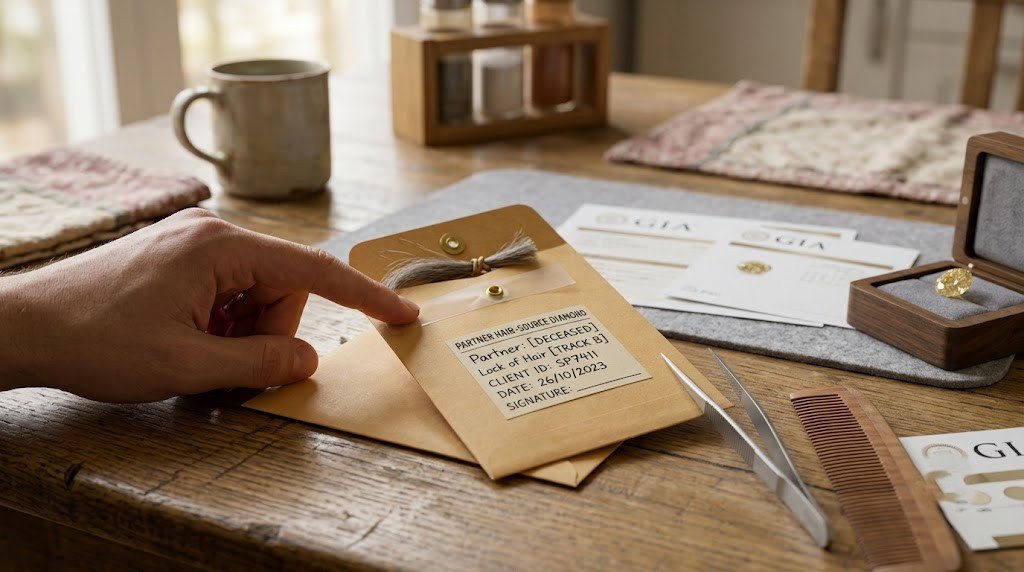
Table of Contents
Why a Partner Hair Diamond Needs No Cremation at All
Hair is built from keratin, a protein that is roughly 50% carbon by weight. Cremated remains are mostly calcium phosphate, the mineral structure of bone, with usable carbon making up somewhere between 0.5% and 4% of ash by weight, depending on the person and the cremation itself.
That gap is why the two routes need such different amounts of material, and it is also why one of them has a precondition the other does not have. An ashes diamond requires that a cremation happened. A partner hair diamond requires only that hair exists somewhere, in some form, and that it is dry.
Nothing about how a partner hair diamond is actually grown changes. The carbon is purified to roughly 99.9%, converted to graphite, and grown into a crystal under pressure. What changes is the entry point: hair is a carbon source that was available while your partner was alive and stays available afterward regardless of what was decided about their body.
Most guides treat the no cremation point as a footnote about convenience. For a partner hair diamond it is frequently the entire decision, and the next section is why.
What Changes When Cremation Is Not the Route
Cremation is not only a technical precondition for an ashes diamond. It is also a decision someone had the authority to make, and in a partnership that authority is not automatic.
Who can direct what happens to a person’s remains varies by state, and by whatever your partner left in writing, a will, a disposition directive, a funeral home form naming an agent. Some states name a legal spouse first and work outward from there; some recognize a designated agent above family regardless of relationship. If you and your partner were not married, or the relationship was not recognized by their family, or not known to everyone, you may have had no standing at all over what happened next. That is worth checking against your own state rather than assuming.
A partner hair diamond sidesteps a good deal of that, because a lock of hair in your house was never part of the estate conversation in the first place.
| Situation | Why the ashes route is closed or difficult | What a partner hair diamond changes |
|---|---|---|
| Your partner was buried | There are no ashes, and exhumation is not a realistic path | Hair kept before or at the funeral is a complete starting material on its own |
| Cremation happened, but another household holds the ashes | Access depends on someone else agreeing, and asking may reopen a painful argument | Nothing has to be requested from anyone |
| The ashes were already scattered or interred as planned | The material is gone, and that plan was a valid one | A separate carbon source still exists, with no need to undo anything |
| Your relationship had no legal standing | You may never have been the person consulted about disposition | A hair diamond is decided by you, from something already in your keeping |
| Your partner is still living | There is nothing to cremate, and nothing should be | A partner hair diamond can start from a lock cut today, with their knowledge and agreement |
Two honest notes about that table. First, none of those rows is an argument against burial, scattering, or keeping an urn. Those are whole ways of honoring someone, and a diamond is not a correction to any of them. Second, if the ashes genuinely are available to you, the ashes version of this guide is the page you want instead, and the side by side of both materials is the comparison.
The still living row is a different kind of thing entirely, and it has its own treatment in the living memorial guide for a partner hair diamond. The one thing worth saying here is that it belongs to a conversation, not to a surprise.
Will the Hair You Already Have Still Work?
This is usually asked apologetically, as though hair kept in a shoebox were the inferior version. It is not. Keratin stored dry does not degrade in any way that matters to a growth run. A lock cut in 2009 and a lock cut this morning are the same feedstock. What actually disqualifies a sample for a partner hair diamond is moisture, contamination with something that cannot be separated out, or a quantity too small to work with, and only the middle one is hard to fix.
| What you have | What to check first | Usually workable? | What to do about it |
|---|---|---|---|
| A cut lock in an envelope or pouch | That it is dry and has not sat anywhere damp | Yes, this is the ideal case | Leave it sealed; weigh it rather than measuring its length |
| Hair in a brush or comb | Whether the strands can be lifted out individually | Yes, with patience | Work under a bright light with tweezers rather than emptying the brush into a bag |
| Hair set in a locket, resin, or glue | What it is fixed with, and whether it can be freed undamaged | Sometimes, ask before you attempt it | Do not pry or dissolve anything yourself; photograph it and ask what the laboratory can accept |
| Hair taped into a scrapbook or card | Whether tape adhesive has bonded into the strands | Often, though yield drops | Cut the page around it and send it as found rather than peeling it |
| A braid or ponytail cut years ago | Weight, and whether it has been kept dry | Yes, and usually far more than needed | Only a portion is required; decide in advance what happens to the rest |
Three things people expect to matter to a partner hair diamond and mostly do not: color, dye, and styling product. Purification strips a sample to almost pure carbon, so whether your partner was dark or fair, whether the hair was colored, and whether there was anything in it on the day it was cut make no difference to what comes out. Length does not matter either, because requirements are set by weight, short clippings from a trimmer count the same as a long lock of equal mass.
The thing that does matter is a record of where the sample came from. Write your partner’s full name, the date, and the exact source on the envelope itself, then photograph it. In a year, that sentence is the only provenance a partner hair diamond will ever have.
How Much Hair Does a Partner Hair Diamond Actually Take?
Across the industry, a hair submission is typically described as a small lock or a few grams, often characterized as palm sized, or a pinch between finger and thumb. That is dramatically less than an ashes submission, which commonly runs from a few tablespoons up to around 4 oz, and the reason is the carbon gap in the first section rather than anything about the press.
Exact minimums vary by provider and by the carat you choose, so confirm the real number before cutting anything. How much hair a partner memorial diamond needs covers the quantities in detail.
Two practical consequences follow for a partner hair diamond. One, a single lock frequently leaves material over, so more than one stone can sometimes be grown from the same collection, worth agreeing with anyone else involved before the first submission. Two, sending more hair does not produce a larger diamond. Carat is bought as growth time inside the press, not as feedstock volume, so a whole ponytail and a small lock grow the same partner hair diamond on the same schedule.
If your sample is light, add to it from another source you are confident about rather than hoping it stretches; if there is genuinely very little, say so at the enquiry stage.
How Much of a Partner Hair Diamond Is Genuinely Them?
This is the part worth being unambiguous about.
Purified hair carbon almost never reaches the volume a single growth run consumes. What happens instead is that the carbon recovered from your partner’s lock is topped up with lab sourced carbon of the same element before the cell is loaded, and the two grow together into one crystal. A portion of the finished stone came from them; the remainder did not. A partner hair diamond is genuinely, physically part of your partner, it is not entirely made of them, and anyone who tells you it is has stopped describing the process.
The commonly published personal carbon share of roughly 10% to 15% of finished mass was worked out for ash based stones. No equivalent public figure exists for hair, so treat that range as indicative of the shape of the claim rather than as a measurement of your own submission, and ask a provider to put their working fraction in writing before you send anything.
That honesty is not a weakness in the idea. A lock of your partner’s hair contains carbon atoms that were assembled inside their body, and those atoms end up inside the crystal lattice of a diamond that would not exist without them. That is a stranger and better fact than “100% pure,” which is not true anywhere in this industry.
From a Sealed Envelope to a Finished Partner Hair Diamond
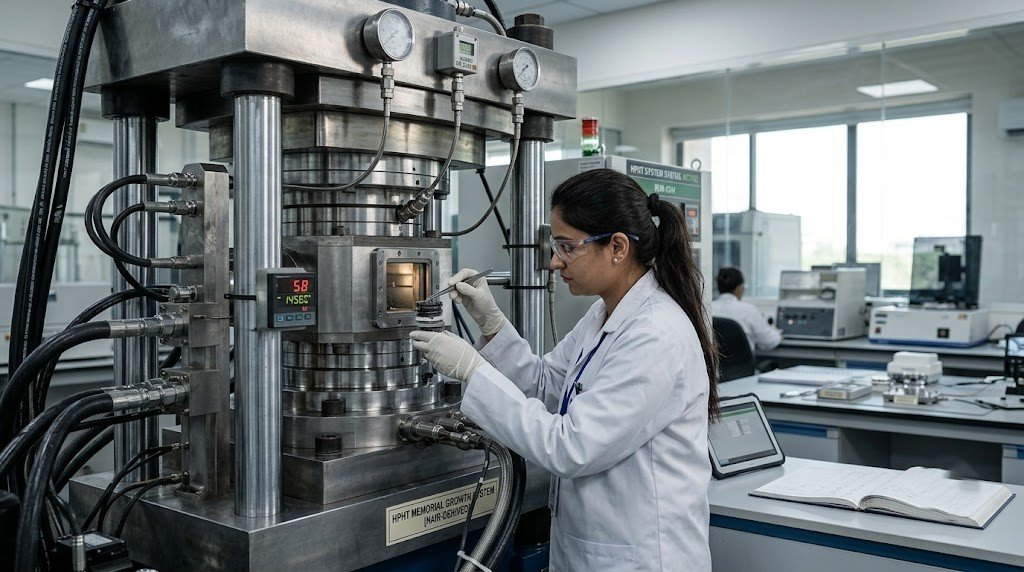
Five stages stand between a sealed envelope and a finished partner hair diamond. The third column is the part to have documented, because the middle of this chain erases everything that would let anyone check it afterward.
| Stage | What happens | What to have documented |
|---|---|---|
| Intake | The sample is received, weighed, and logged against a reference number | The weight received, the date, and the source description you supplied |
| Purification | Non carbon components of the keratin are stripped in an oxygen free furnace to roughly 99.9% carbon | That your sample was processed on its own, and what happens to any unused portion |
| Graphitization | The purified carbon is heated to roughly 2,500 to 2,700°C and converted to graphite | Confirmation that the batch reference follows the material through |
| Growth | Graphite plus supplemental lab carbon is grown around a seed in an HPHT press at roughly 6 to 8 GPa and 1,400 to 2,500°C | Which method is used, whether growth is in house or subcontracted, and what happens if a run fails |
| Cutting and grading | The rough stone is cut, polished, and graded on cut, color, clarity, and carat | Whether grading is independent or in house, and what the origin certificate actually certifies |
After purification no test distinguishes one person’s carbon from another’s, the features that made it hair are gone by design. This is why documentation at intake matters more to a partner hair diamond than anything promised later, and why chain of custody tracking is worth understanding before you choose anyone.
What Color and Carat Should You Expect From a Partner Hair Diamond?
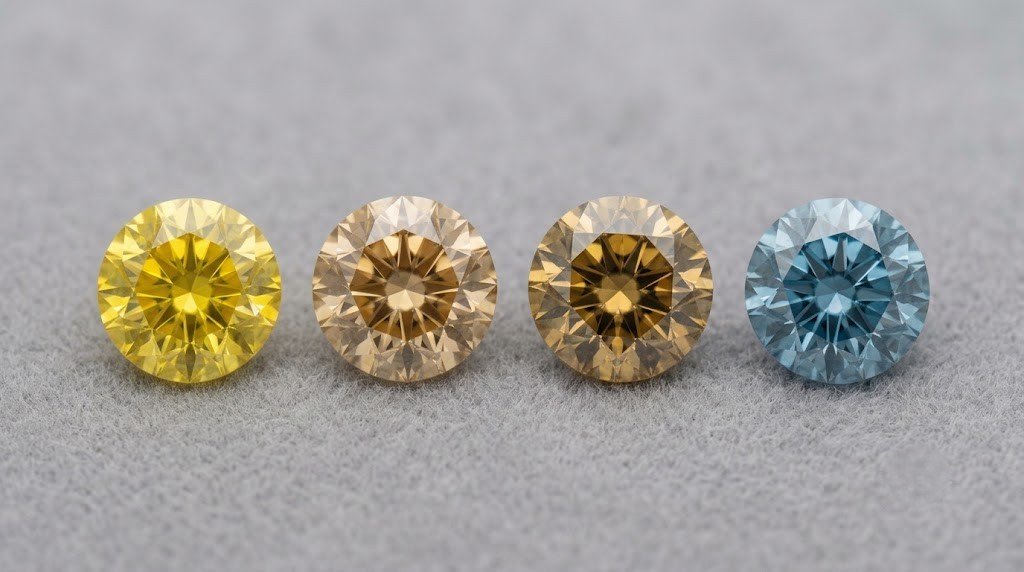
Drop one intuition immediately: your partner’s hair color has no bearing on the color of a partner hair diamond. Nothing carrying it survives purification.
Color arrives instead from the trace elements sharing the growth cell with the carbon. Yellow tones are what nitrogen leaves behind; blue is boron’s signature. Colorless is not a third ingredient but the near total absence of those two, and taking something out is harder laboratory work than letting it in, which is why colorless costs meaningfully more per carat. Organic feedstock rarely arrives that clean, so yellow, blue, and champagne tones are this category’s ordinary results rather than its disappointments. What color a diamond grown from a partner’s hair will be covers the range honestly.
Carat is a decision, and it sets the schedule for a partner hair diamond. Industry wide, production runs 6 to 10 months from receipt of material, stretching toward twelve for a stone around 2 ct or a specialty color. Add collection, shipping, and setting around that and the real end to end wait is longer than the production figure suggests, an editorial estimate of ours rather than an industry number.
That is also the cleanest way to read the price bands. You are not buying a bigger pile of feedstock; the step up between tiers buys time under pressure.
| Carat band | What is physically different at this size | Typical 2026 industry range |
|---|---|---|
| 0.10 to 0.25 ct | The least growth time in the press, and the shortest schedule | ~$1,500 to $3,500 |
| 0.5 to 1 ct | More hours under pressure, which is most of what the extra cost buys | ~$5,000 to $15,000 |
| 2 to 5+ ct | The longest runs, and the sizes that stretch a schedule toward twelve months | ~$20,000 to $75,000+ |
Read those as the industry’s own range rather than a Memorial Diamond price list, which is not published. Setting, engraving, and an independent grading report are usually quoted separately, so ask what a number includes. What drives the cost of a partner memorial diamond breaks a quote down properly.
One durability note, since a partner hair diamond is usually worn. Diamond is 10 on the Mohs scale, the hardest known natural mineral, but the prongs, the bail, and the metal holding it are not, and daily wear is a question about everything except the stone.
What to Ask Before You Send Anything
Every item below is a question to ask before committing to a partner hair diamond, not a claim about what any company does. Ask them in writing and keep the answers.
- What weight do you actually need, and what is the minimum you will work with? Ask what happens if the sample arrives lighter than expected.
- Will my partner’s sample be processed on its own? Ask how separation is maintained, and what the batch reference is.
- What happens to hair that isn’t consumed? Ask whether it is returned, retained, or destroyed, and get that in writing before submission.
- What fraction of the finished stone will be from my sample? Ask for the working figure rather than a reassurance.
- Is the growth done in house? If not, ask how custody is recorded at each handover.
- If a growth run fails, what then? Ask whether a second attempt consumes more of the sample, and who absorbs the delay.
- What does the grading report cover, and who issues it? How gemologists grade cut, color, clarity, and carat is the standard those reports are written against, and an in house origin certificate is a different document doing a different job.
A provider who answers all seven plainly has told you a great deal; one who answers in adjectives has told you something too. What to ask before choosing a company goes further.
Frequently Asked Questions
Does a partner hair diamond require a cremation to have taken place?
No. Hair is roughly 50% carbon on its own, so no cremation is involved at any stage. That is why this route stays open for a partner who was buried, whose ashes are held elsewhere, or who is still living.
The only hair I have is fifteen years old. Is it too late?
No. Keratin kept dry is the same starting material for a partner hair diamond after fifteen years as after fifteen minutes. Check it has not sat anywhere damp, weigh it rather than measuring it, and describe its origin accurately at submission.
Can hair for a partner hair diamond be taken from a brush rather than cut?
Yes. Lift strands out individually with tweezers under good light rather than emptying the brush, keep only what you are confident belongs to your partner, and note on the envelope exactly where it came from.
Does the color of my partner’s hair affect the color of a partner hair diamond?
No. Purification reduces the sample to almost pure carbon, so nothing carrying hair color survives. Stone color comes from trace elements in the growth cell, nitrogen reads yellow, boron reads blue, and colorless requires the near absence of both.
I had no legal say over my partner’s remains. Does that affect this?
Not for hair already in your keeping. No national rule governs remains: authority varies by state, and written instructions can displace the default, so a partner is not guaranteed to hold standing. A partner hair diamond grown from a lock you hold sidesteps that. Check your state if ashes are involved.
Can two people each get a stone from one collection of hair?
Often, since a single submission usually exceeds what one partner hair diamond consumes. It is far easier to agree that before anyone sends anything, because splitting a sample is a decision that cannot be reversed afterward.
Is a partner hair diamond faster to make than an ashes diamond?
No. Extraction is a short front end step in a schedule dominated by crystal growth, which runs 6 to 10 months industry wide from receipt of material whichever source the carbon came from.
Final Thoughts on a Partner Hair Diamond
What makes a partner hair diamond unusual is not the chemistry. It is that it does not depend on permission, on a cremation having happened, or on a family agreeing with you about anything.
If there is hair in the house, the decision is genuinely yours, and it can wait as long as you need it to. Label what you have, keep it dry, and take the rest of it slowly.
Learn More About Partner Memorial Diamonds
- Partner Ashes Diamond: The Complete Guide
- How to Turn Your Partner’s Hair Into a Diamond
- What Color Will a Diamond Made From Your Partner’s Hair Be?
- Memorial Diamonds for Non Cremated Loved Ones: Hair Based Options
- What Is a Memorial Diamond? The Complete Guide
Talk With Memorial Diamond
Bring a weight, a photograph of what you have, and an honest description of where it came from. That is enough to have a real conversation about whether a partner hair diamond makes sense for you, and about what it would involve if it does.
Reach out to memorialdiamond.us to talk it through, including talking yourself out of it, which is a legitimate outcome.