
Having both materials is more common than people expect, and it complicates the ordering rather than the grieving.
To turn partner ashes and hair into a diamond, you place one order with two submissions: a measured portion of remains and a small lock of hair, each weighed, labeled, and documented on its own. Decide the carat, color, and shape first, then send both. The materials are purified separately and combined only during growth. Typically six to ten months, industry wide.
This is a practical guide to the sequencing of an order to turn partner ashes and hair into one stone, what to settle before anything is packed, and how to keep two paper trails from collapsing into one vague receipt.
Table of Contents
What You Need Before You Turn Partner Ashes and Hair Into a Diamond
Almost every delay comes from starting an order to turn partner ashes and hair into a diamond before these are settled. The list is short, and none of it requires a decision about the stone itself.
- Standing to authorize the ashes. Who may decide the fate of a person’s remains is a question each state answers for itself, with nothing settling it nationally, and a document your partner signed can override the default that state would otherwise apply. Nobody inherits that standing simply by having been the partner, a point that bites hardest where the relationship had no legal footing, or where parts of the family never knew of it. Establish this before you open a container.
- Access to a lock of hair. This is frequently the easier half. Hair kept in an envelope, taken at a haircut, or gathered from a brush sits outside the question of who controls the remains.
- A rough sense of both quantities. Not exact weights, just whether you have a generous amount of each, or barely any of one.
- Agreement among anyone who needs to be asked. A decision to turn partner ashes and hair into a diamond is easier to make once than to reopen after material has been committed.
- A decision about carat, color, and shape. These drive cost and timeline more than anything else, and they should be chosen before either submission ships. Everything else about how you turn partner ashes and hair into a diamond follows from these three.
- Somewhere to keep the paperwork. One folder, physical or digital, that will hold two sets of records rather than one.
One thing worth knowing before you divide anything: when you turn partner ashes and hair into a diamond, neither portion, nor both together, makes up the whole stone. The purified carbon from each source is combined with lab grown carbon until the growth cell holds the volume a crystal of your chosen size requires. The personal carbon is real and traceable; it is not the totality of what you will be wearing.
The 6 Steps to Turn Partner Ashes and Hair Into a Diamond
Taken in this order, the work to turn partner ashes and hair into a diamond is a sequence of small, ordinary tasks rather than one large one.
Step 1: Confirm who is authorizing what. The ashes and the hair can sit under different permissions. Ashes are governed by whoever holds authority over the remains; a lock of hair you already possess generally is not. If you are not the person with that authority, resolve it now. This is the step most likely to stall an order in week three.
Step 2: Inventory both materials before choosing anything. Look at what you actually have. Weigh the hair on a kitchen scale if you can. Note roughly how much of the remains is available and whether any of it is already committed to a burial, a scattering, or another family member. Nobody can sensibly turn partner ashes and hair into a diamond without knowing the inventory first.
Step 3: Decide what each material contributes, and why. This is the decision unique to turning partner ashes and hair into a diamond. You are not choosing a look, nothing about the finished stone will reveal the split. You are choosing what the record will say. Settle on approximate weights for each submission and write them down before you contact anyone.
Step 4: Choose carat, color, and shape once. These apply to one stone, not to two materials, and changing them later is expensive or impossible. Carat is bought as growth time rather than as quantity of material, so sending more of either material does not make the stone bigger.
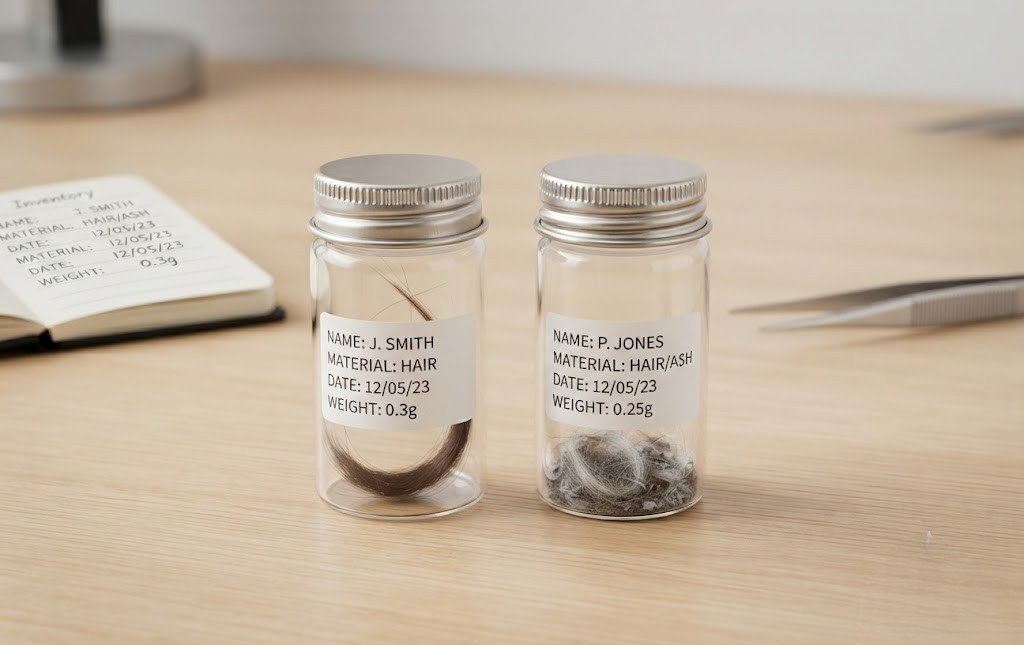
Step 5: Pack and send two separate, separately labeled submissions. Do not combine the ashes and the hair in one bag or one container. Two sealed containers, each labeled with your partner’s name, the material, the date collected, and the weight. Photograph each one before sealing, then use tracked shipping for both, with a note inside naming both submissions and the single order they belong to. If you choose to turn partner ashes and hair into a diamond as one order, say so explicitly in writing. Two packages arriving separately can otherwise be logged as two unrelated jobs, and this single packing habit is what makes everything in step 6 possible.
Step 6: Open one order file and keep it fed. Every confirmation, identifier, weight, and date goes in it. Ask for a written acknowledgment of each submission separately rather than one combined receipt. It is the only record of how you chose to turn partner ashes and hair into a diamond that will still exist in ten years.
How Much of Each Material Should You Send?
There is no industry standard split for how to turn partner ashes and hair into a diamond, and anyone who tells you there is a correct ratio is inventing one. What exists are two independent requirements.
For ashes, industry guidance generally describes somewhere between a few tablespoons and roughly 4 oz of cremated remains, usually only a small fraction of a full cremation, which means the rest can still be buried, scattered, or kept as planned. For hair, the typical figure is far smaller: a small lock, a few grams, sometimes described as palm sized. Hair is roughly 50% carbon by weight, while cremated remains yield usable carbon at only around 0.5% to 4% of ash by weight, which is why the two requirements are so different.
Confirm both figures with whoever will turn partner ashes and hair into a diamond for you, before cutting or measuring anything. Requirements vary, and it is much better to be told you need less than to have taken more than was necessary.
When people decide to turn partner ashes and hair into a diamond, the proportion question usually resolves in one of three ways:
| Approach | What it looks like | Who it suits | What to confirm |
|---|---|---|---|
| Meet both minimums | Send the stated requirement for each material, nothing more | Most people, most of the time | That both minimums are stated separately, in writing |
| Lead with one material | Send the full requirement of the more plentiful material, plus whatever exists of the other | Anyone with a very small amount of one | Whether the scarcer material is still enough to be processed at all |
| Deliberate weighting | Send a chosen ratio for a personal reason | Anyone for whom the record itself matters | That both weights appear on the paperwork, since nothing in the stone will show them |
None of the three approaches changes how the stone looks. All three change what the record says about how you chose to turn partner ashes and hair into a diamond.
What If One of the Two Materials Is Scarce?
This is the most common complication when people turn partner ashes and hair into a diamond, and it usually runs one way: plenty of ashes, almost no hair. A single lock kept from years ago, or a few strands from a brush.
Ask three questions before assuming you cannot turn partner ashes and hair into a diamond after all.
First, ask what the actual minimum is for the scarcer material, stated as a weight rather than a description. “A small lock” is not a specification you can measure against a plastic bag on a scale.
Second, ask what happens if the scarce material turns out to be unusable at intake, whether the run proceeds on the remaining material, whether you are told before that decision is made, and what gets recorded. Settle this in advance rather than discovering it partway through.
Third, ask whether a smaller stone changes the requirement. It generally does not, because material quantity and carat size are separate variables, but it is worth confirming rather than assuming.
If the scarce material genuinely is not enough, you have two honest options and neither is a failure. You can proceed with the plentiful material alone and note in your own records what you had hoped to include. Or you can hold the scarce material unprocessed, hair in particular keeps almost indefinitely when stored dry and sealed, and revisit the question if you ever commission a second stone. Neither route is a failed attempt to turn partner ashes and hair into a diamond; both are ordinary outcomes.
How Do You Keep the Paperwork for Two Sources Straight?
The whole practical difficulty of what it takes to turn partner ashes and hair into a diamond is here. One stone, one invoice, one grading report, and two materials that need to remain separately documented right up to the point they are combined.
The table below is the spine. Print it, or keep it at the top of the order file.
| Document | Which submission | When it should exist | What it should say |
|---|---|---|---|
| Your own collection note | Each, separately | Before packing | Who collected it, when, from where, approximate weight |
| Photograph of material as packed | Each, separately | Before sealing | Dated, showing the labeled container |
| Shipping tracking record | Each, separately | At dispatch | Which material is in which package |
| Intake acknowledgment | Each, separately | Within days of arrival | Received weight, date, and a unique identifier per submission |
| Processing confirmation | Each, separately | After purification | That each identifier was processed as its own batch |
| Combination record | One, covering both | At loading | Both identifiers named together in one document |
| Origin or authenticity document | One, covering both | With the finished stone | Both submissions named explicitly, not “submitted material” |
| Independent grading report | One, covering the stone | With the finished stone | Cut, color, clarity, carat. This document says nothing about origin |
Two notes on reading that table. The last two rows are different documents answering different questions, and a grading report is not evidence of origin no matter how impressive it looks. And the combination record is the last document in the sequence that mentions two sources at all. After that point, everything refers to one stone. Every piece of evidence that you set out to turn partner ashes and hair into a diamond, rather than to grow a single source stone, is created upstream of it.
Should the Two Submissions Travel Together or Separately?
Either works when you turn partner ashes and hair into a diamond, and the choice is mostly about risk tolerance.
Together, in one outer package, as two sealed inner containers. Simplest to track, one tracking number, and the two materials arrive at the same time so intake can log both against one order. The downside is obvious: one lost package loses both materials.
Separately, staged a few days apart. Splits the risk, and gives you a chance to confirm that the first submission was received and logged correctly before the second one leaves. The downside is the coordination burden, and the real possibility that two packages get treated as two unrelated jobs.
If you send them separately, the one thing that must travel with each is a written statement naming both submissions and the single order they belong to. Without it, the decision to turn partner ashes and hair into a diamond can quietly become two half orders sitting in different queues.
Whichever route you choose to turn partner ashes and hair into a diamond, ask for an acknowledgment of each submission on arrival rather than one message at the end saying everything is here.
What to Expect After You Turn Partner Ashes and Hair Into a Diamond
Once you turn partner ashes and hair into a diamond, the waiting is longer than most people plan for, and the character of it changes partway through.
Timeline. Industry wide, the whole process typically runs six to ten months, sometimes twelve for larger or specialty color stones. Choosing to turn partner ashes and hair into a diamond does not double it. Growth time in the press dominates everything else, and the press runs for as long as the chosen carat requires regardless of how many sources fed it.
Color. Nobody can forecast the shade. Nitrogen produces yellow tones and boron produces blue, and organic carbon sources bring trace elements with them, which is why memorial stones trend toward yellow, blue, and champagne rather than colorless. Colorless is achievable but requires additional process control and typically costs more. Choose a range you would be happy with.
Cost. Industry wide, an entry tier stone in the 0.10 to 0.25 ct band sits somewhere around $1,500 to $3,500, a mid tier one of 0.5 to 1 ct around $5,000 to $15,000, and anything larger considerably higher. Grading reports, engraving, and settings are typically priced separately from the loose stone, so ask what a quoted figure includes.
What arrives. A stone, an origin document, and, if you asked for it, an independent grading report covering cut, color, clarity, and carat. Check that the origin document names both submissions. That is the single thing worth verifying on the day it arrives, because it is the only document that records what you actually did.
Frequently Asked Questions About Turning Partner Ashes and Hair Into a Diamond
Can I turn partner ashes and hair into a diamond in one order?
Yes. This is a standard combined request. The two materials are received, weighed, and purified separately, then combined during growth. Ask for separate intake acknowledgments so both submissions are documented independently before they are joined.
Do I need equal amounts of ashes and hair?
No. To turn partner ashes and hair into a diamond you meet each material’s stated minimum separately. Hair is roughly 50% carbon by weight and cremated remains only about 0.5% to 4%, so the two requirements are nothing alike.
Will anyone be able to tell both materials were used?
Not from the stone. Purified carbon carries no marker of its origin, so the evidence is entirely in the records created before the materials were combined. That is why separate intake documentation matters so much.
What if my partner was buried rather than cremated?
Then hair alone is the route, and it works perfectly well. No cremation is involved in a hair based diamond at any point, which is often the reason hair is the material a partner actually has access to.
Can I do this years after the death?
Yes. Cremated remains do not degrade, and hair kept dry and sealed stays usable for a very long time. Mention the storage history at intake so anything unusual is recorded rather than discovered later.
Does it cost more to turn partner ashes and hair into a diamond?
Handling two submissions can add process steps, and some providers price that separately. Carat, color, and whether an independent grading report is included affect the total far more than the number of source materials does.
Final Thoughts on How to Turn Partner Ashes and Hair Into a Diamond
None of this is complicated in itself. It is two submissions, one order, and a folder. What makes it feel hard is that the decisions arrive in the wrong emotional order, you are asked to settle weights and carat sizes at a point when almost nothing feels settled.
So take the sequence seriously and the deadlines lightly. Establish who authorizes what, look honestly at how much of each material you have, decide the stone once, label two containers, and keep every piece of paper that comes back. Done in that order, the decision to turn partner ashes and hair into a diamond is a set of small, manageable tasks rather than one enormous one.
Learn More About Partner Memorial Diamonds
- Partner Ashes and Hair Diamond: The Complete Guide
- How a Memorial Diamond Is Made From Your Partner’s Ashes and Hair
- How to Turn Your Partner’s Ashes Into a Diamond
- How to Turn Your Partner’s Hair Into a Diamond
- What Is a Memorial Diamond? The Complete Guide
Talk With Memorial Diamond
If you have both materials and want to know how a combined order would actually be handled, reach out to Memorial Diamond at memorialdiamond.us and ask what gets recorded for each submission before you pack anything. Those questions are easiest to ask at the start, and they are the ones that matter later.