
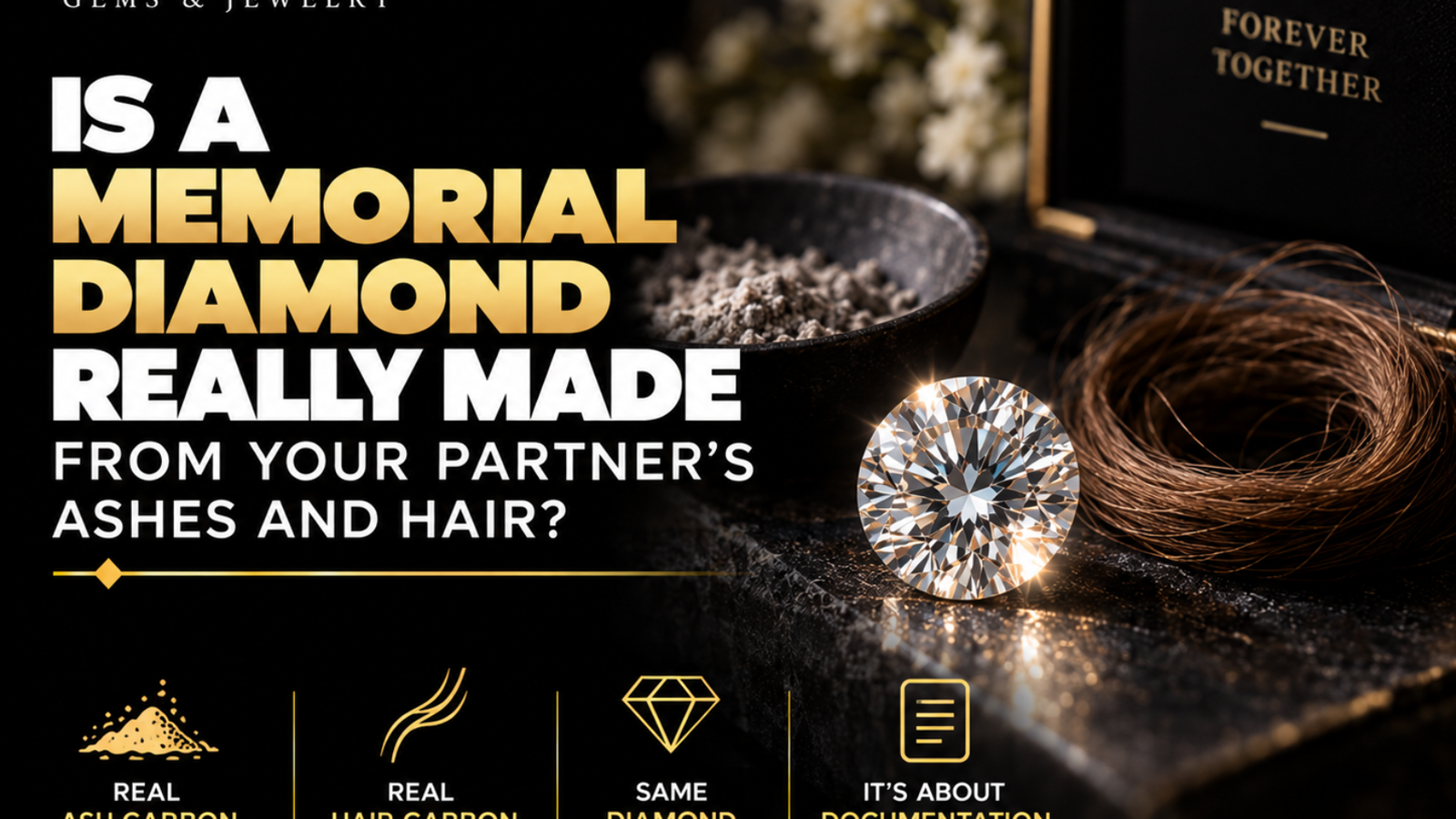
Yes. A memorial diamond really made from partner ashes and hair contains carbon recovered from both materials, purified on separate tracks and blended with lab-grown carbon before growth. The complication is that a combined stone carries two unrelated doubts: the ash is questioned on how little carbon it holds, while the hair is questioned on whose it was. Answering one does nothing for the other.
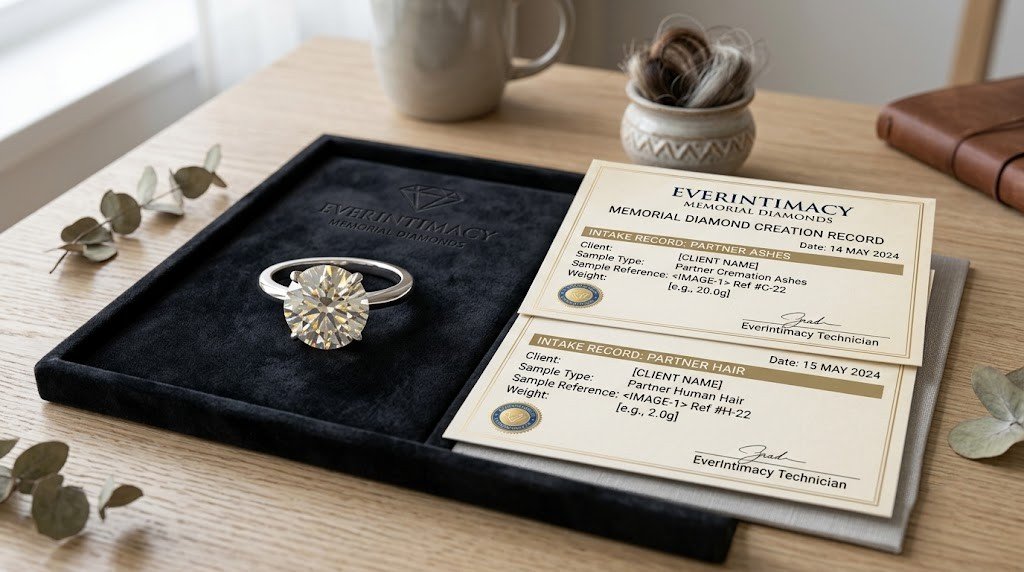
Table of Contents
What “Really Made From Partner Ashes and Hair” Actually Claims
A claim that a stone is really made from partner ashes and hair contains three assertions, and only the first two are usually said out loud.
It claims that carbon recovered from a portion of cremated remains is physically in the crystal. It claims that carbon recovered from a lock of hair is physically in the same crystal. And it claims, silently, that both of those happened in one order which is the part no examination of the finished stone can support.
That third claim is the whole difficulty. A stone really made from partner ashes and hair looks exactly like a stone grown from either material alone, and exactly like a stone grown from neither. Once both materials have been reduced to elemental carbon, there is no seam, no layer, no ratio and no marker.
Whether something is really made from partner ashes and hair is therefore a documentary question with a deadline attached to it, and that deadline is earlier than most people realize.
Memorial Diamond grows these stones commercially, so this page has an interest in the subject. The useful test is whether the deadline described below appears anywhere in what a provider tells you about something really made from partner ashes and hair before you order.
Two Truths That Sit Underneath the Question
Two things are true about a diamond really made from partner ashes and hair, and they are true for opposite reasons. Holding both is what makes the answer defensible.
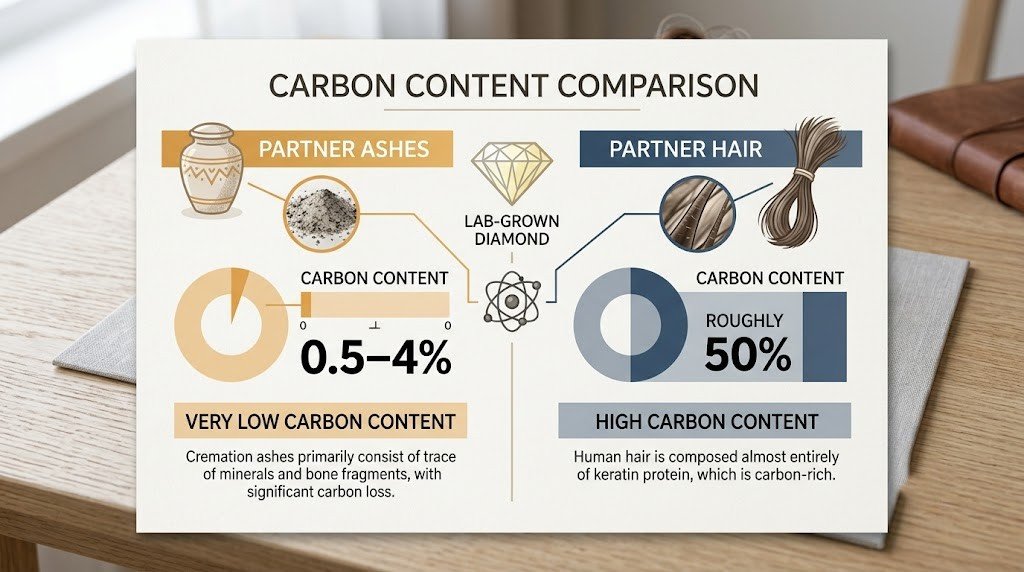
Truth one the ash carbon is genuine and small. Cremated remains are mineral-dominated, mostly calcium phosphate, with usable carbon running at roughly 0.5% to 4% of ash by weight. What is recovered is real and is purified to roughly 99.9%+ carbon, but it is also a modest quantity.
Neither parcel, and not both together, holds enough carbon to fill a growth cell. Both purified streams are therefore made up to working volume with lab-grown carbon before the run starts. Once the run is over, the share traceable to the partner sits at roughly 10% to 15% of the stone’s mass by the figures the industry publishes.
That is the first half of any honest account of a stone really made from partner ashes and hair.
Truth two the hair carbon is abundant and unproven. Hair is roughly 50% carbon by weight, so yield is not usually the central concern. What cannot be demonstrated from the finished stone is whose hair it was, because a lock arrives with no institutional history behind it and purification destroys every characteristic that could have identified it.
That is the second half of the same account, and it is the half people often underestimate when they picture something really made from partner ashes and hair.
So a stone really made from partner ashes and hair is strong exactly where it is weak, twice over, in mirror image. The ash is well-documented and thin; the hair is plentiful and undocumented. Neither shortcoming is fixed by the other.
Why Does Closing One Doubt Do Nothing for the Other?
Because the two doubts about something really made from partner ashes and hair ask for different categories of proof, and evidence does not transfer between them.
Suppose a relative challenges the ash side: most of that is lab carbon. You can answer with the published figures 0.5% to 4% carbon in ash and roughly 10% to 15% personal carbon in the finished stone and the objection is addressed on its own terms.
But nothing in that exchange says anything about the lock of hair. A person who then asks how you know the hair was theirs is asking a completely different question.
Now run it the other way. You produce a dated note describing exactly who cut the lock and when. That helps document the hair. It says nothing about how much of the finished stone is personal carbon.
This is why people defending a diamond really made from partner ashes and hair can end up sounding evasive even when they are being entirely truthful. They answer the doubt they prepared for rather than the one they were asked.
The fix is not necessarily more evidence. It is noticing which of the two questions is actually on the table before answering it.
The ash half, argued on its own terms, and the hair half, argued on its own terms, go further into their respective questions.
The Window: While the Two Materials Are Still Separate
Here is the part worth acting on.
Whether a stone is really made from partner ashes and hair can only be separately evidenced during a limited period — from the moment you decide until the moment the two purified streams meet. After that, the two materials are one substance and there is nothing left to evidence separately.
| Stage | What Can Still Be Separately Evidenced About the Ash | What Can Still Be Separately Evidenced About the Hair | What Stops Being Possible Once This Stage Ends |
|---|---|---|---|
| Before anything is sent | Which portion was taken, from what container, and on what date | Who cut it, when, from where, and whether anything else could be mixed in | Your own first-hand record. Nobody else can create it afterward. |
| At intake, on arrival | A dated log with a received weight and its own order reference | A separate dated log with its own weight and reference | Two independent intake records. A single merged line cannot be un-merged later. |
| Through separate purification and graphitization | Whatever yield is measured for this material, if measured at all | Whatever yield is measured for this material, if measured at all | Per-material yield figures, which nothing downstream reconstructs. |
| In the growth cell and afterward | Nothing | Nothing | Everything. The two carbons are identical from here on. |
Read the bottom row first. Every column says the same thing, and that is the honest shape of this question: a stone really made from partner ashes and hair is evidenced entirely before it exists.
What Closes at the Growth Cell?
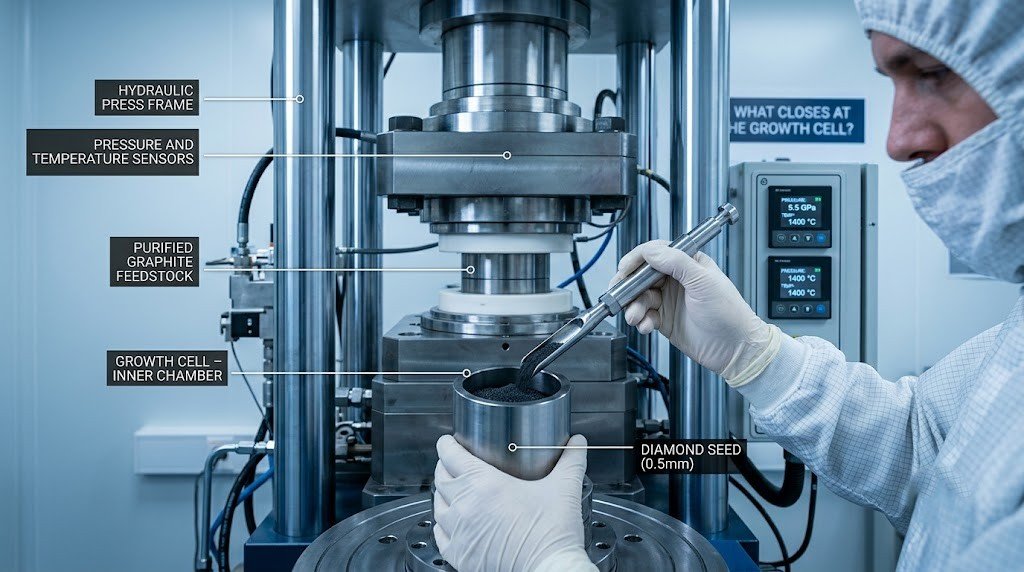
The distinction between the two materials closes permanently through ordinary chemistry rather than by anyone’s choice.
Carbon recovered from bone and carbon recovered from keratin are the same element. Once each has been purified to roughly 99.9%+ and converted to graphite, they are the same feedstock, and the growth run neither knows nor records which grain came from where.
The resulting stone is a genuine lab-grown diamond by its physical characteristics, but it is silent about its own history.
So a relative who says the diamond itself proves nothing about whether it is really made from partner ashes and hair is, strictly speaking, right. What that observation misses is that nobody in this category necessarily claims the finished object is the evidence.
A grading report describes cut, color, clarity and carat and says nothing about origin by design. Quality and origin are separate questions and require separate documentation.
That means the useful response to is it really made from partner ashes and hair? is to point at the window, not at the stone.
What to Have Recorded Inside the Window
Six things requested in writing before either parcel is posted can help turn a claim that a stone is really made from partner ashes and hair into a documented process. Each exists because there are two materials rather than one.
- A separate intake record for each material its own date, received weight and reference. Two materials should be logged as two, never as a single combined line.
- Confirmation that both were received against the same order, including what happens to the schedule if they arrive weeks apart.
- Whatever per-material yield is measured, if a provider measures and reports it, and which document contains that information.
- A stated position on under-yield if one material recovers almost nothing, ask whether you are told before the two streams are combined and whether the order can be paused at that point.
- What happens to material not consumed by extraction, answered separately for each material.
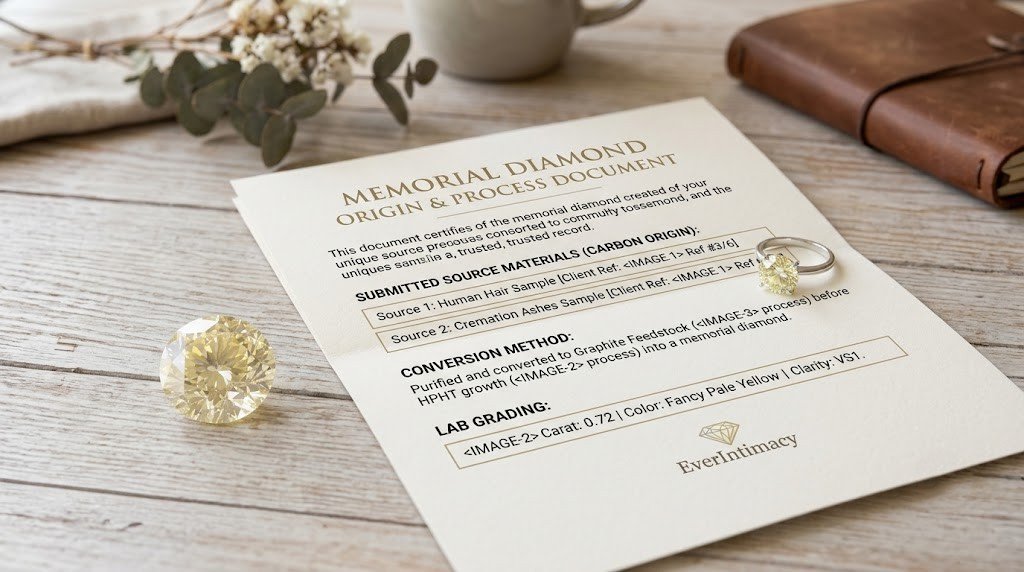
- What the origin document actually says whether it names both source materials individually or merges them into one line.
Item four is one families can discover too late. A diamond really made from partner ashes and hair can, in practice, end up carrying far more of one material than the other, and the moment to learn that is before blending rather than after delivery.
The wider list worth asking before anything is sent covers the rest of the conversation, while how much of each material is needed covers what actually goes into the process.
What Happens If Only One Material Can Be Used?
It can happen, and it is better to think about it before the materials are processed rather than during a phone call after the process has already begun.
An ash portion can under-recover 0.5% to 4% is a wide span, and a small portion sitting at the bottom of that range may yield very little usable carbon.
A hair sample can also be smaller than it appeared, arrive with substantial product, or provide less usable material than expected after cleaning. In either case, a provider has to decide what happens next, and that is a matter of policy rather than chemistry.
Three outcomes are possible in principle:
- The run proceeds with whatever was recovered, producing a stone heavily weighted toward one material.
- The run proceeds with one material only, which changes the description of the order.
- The order pauses while you decide what should happen next.
Nothing about a finished stone really made from partner ashes and hair will tell you afterward which of these occurred.
That is why the under-yield question belongs in writing before either parcel leaves the house.
Ask what the threshold is, who is notified, and how quickly. Ask whether a shortfall on one side is made up with additional lab-grown carbon and whether the origin documentation is amended to reflect what was actually used.
Why Do Partners So Often End Up With Both Materials?
Because the two materials behind a stone really made from partner ashes and hair frequently arrive from two different directions.
A lock of hair is often something you already had in a drawer, box or envelope that nobody could throw away. A portion of ashes, for a partner, may be something that had to be given to you.
If your relationship was not legally recognized, or was not recognized by their family, or was not fully known to everyone involved, you may not have been the person with authority over the remains. Questions involving authority over remains can vary by jurisdiction and by what the person left in writing.
So a combined submission can be the result of two unequal situations: a small share of ashes handed over by someone else, alongside a lock of hair that was always yours.
That shapes what really made from partner ashes and hair means in practice. A stone really made from partner ashes and hair may carry a very small portion of ashes, which makes the under-yield question more important rather than less important.
None of that changes the chemistry. It does mean the documentation conversation is worth having with both sources in mind.
How to talk to family about a partner memorial diamond addresses the family conversation directly, while the complete guide to a combined partner diamond sets the broader decision out in order.
Frequently Asked Questions
Is there any test proving a stone is really made from partner ashes and hair?
No. Once both materials have been purified and converted to graphite, they are chemically identical, and nothing performed on the finished diamond recovers the ratio or source. Verification is therefore documentary and happens before the stone exists.
Does a stone really made from partner ashes and hair hold more of them?
No. The personal share is determined by how much feedstock a growth cell needs, not simply by how many materials you send. Combining the materials changes whose carbon fills that share rather than automatically increasing the total personal share.
Which half of a stone really made from partner ashes and hair is harder to verify?
The hair can be harder to document because no institutional record necessarily establishes when it was cut or whose it was, while cremation may have associated documentation. Neither source can be confirmed from the finished stone itself.
What if one material yields almost nothing?
That is the scenario worth settling in advance. Ask whether you are notified before the two streams are combined, what options are available at that point, and whether the order can be paused while you decide.
Should a stone really made from partner ashes and hair have separate paperwork for each?
Two materials handled on separate tracks should ideally be traceable as two, with their own dates, weights and references. A single merged intake line is worth questioning before anything is posted.
Can the two materials for a stone really made from partner ashes and hair be sent separately?
Confirm this with the provider before assuming it is possible. Ask how an order is held while a second parcel is awaited, what happens to the first material in the meantime, and whether waiting affects the schedule or growth process.
Final Thoughts on Whether It Is Really Made From Partner Ashes and Hair
The mistake is treating this as one question with one answer.
It is two questions wearing one coat. They attach to two different materials for opposite reasons, and they close in two different ways — the ash question with an honest statement about proportion, and the hair question with documentation about the lock.
Neither closes with the finished diamond, and no amount of looking at it will reveal the complete history.
That is actually useful because it tells you precisely where your attention is worth spending: on two intake records, on the under-yield question, and on your own dated note about the lock.
If you have not ordered yet, the window described above is still the important part. Whether a stone is really made from partner ashes and hair is documented during that window, not by examining the finished stone afterward.
Learn More About Partner Memorial Diamonds
- Partner Ashes and Hair Diamond: The Complete Guide
- Is a Memorial Diamond Really Made From Your Partner’s Ashes?
- Is a Memorial Diamond Really Made From Your Partner’s Hair?
- How Much Ash and Hair Do You Need for a Partner Memorial Diamond?
- How Memorial Diamonds Are Graded and Certified
Talk With Memorial Diamond
If you want to understand how an order for something really made from partner ashes and hair is logged, what documentation is provided for each material, and what happens if one material under-yields, ask those questions before either parcel is posted.
Nothing has to be sent for that conversation to happen.