
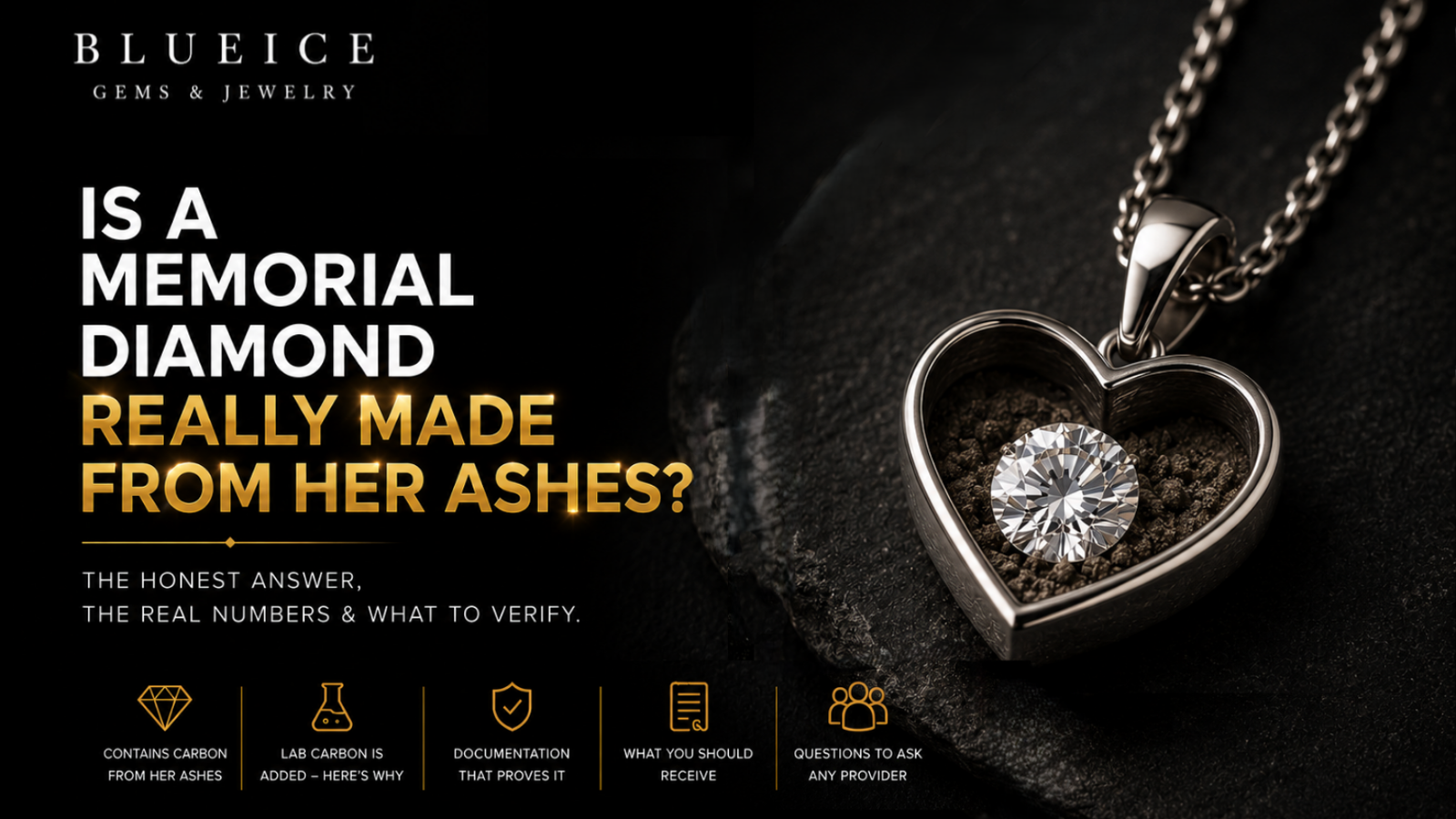
Someone has probably already said it to you a brother, an aunt, or perhaps your own voice at two in the morning:
“You know that’s not really her, right?”
The honest answer is yes, with one important qualification.
Carbon extracted from your mother’s cremated remains can genuinely become part of the finished diamond crystal. However, it is not the only carbon in that crystal. Personal carbon is blended with additional lab-sourced carbon required during the diamond-growing process.
Anyone claiming that a memorial diamond is made 100% from one person’s ashes is overstating the reality.
That does not mean the memorial diamond is merely symbolic. Carbon from your mother’s remains can become physically incorporated into the crystal lattice of the finished diamond.
On This Page
- How much of the diamond comes from your mother?
- Why lab carbon is added
- What you are actually buying
- What a family can verify
- Questions to ask a provider
- Frequently asked questions
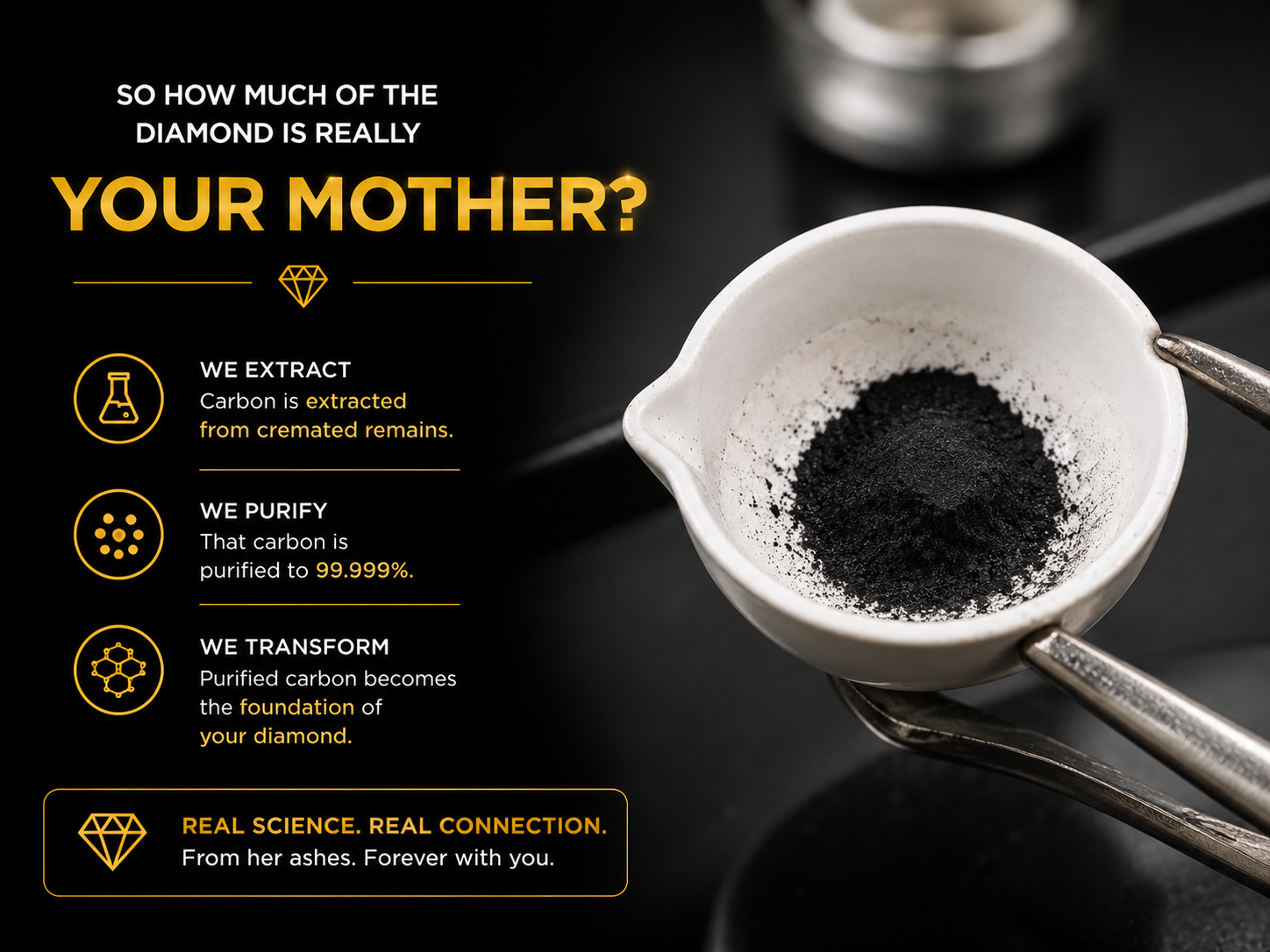
So How Much of the Diamond Is Really Your Mother?
Cremated remains are not the same as the ash left behind by a campfire.
Instead, they consist primarily of mineral material, especially calcium phosphate from bone. Carbon makes up only a relatively small portion of cremated remains, and the amount can vary depending on the individual and the cremation process.
First, the recoverable carbon undergoes extraction and purification before the laboratory prepares it for diamond growth.
However, because a diamond-growth cell requires enough carbon feedstock, the provider generally combines the personal carbon with additional laboratory-sourced carbon.
Industry figures commonly describe personal carbon as making up only a portion of the finished stone rather than the entire diamond.
So the skeptical relative is only partly right.
They may be wrong to say that none of her is in the diamond, but they are also right to question claims suggesting that the entire stone consists exclusively of her remains.
That distinction matters.
Why Can’t the Stone Be Grown From Her Ashes Alone?
The reason is primarily about the composition of cremated remains and the physical requirements of diamond growth.
An HPHT diamond-growth process requires a sufficient quantity of purified carbon material. Cremated remains simply do not contain enough recoverable carbon to provide all of the feedstock necessary to grow a meaningful diamond crystal.
Adding more ashes does not necessarily mean that a larger diamond can be created.
Diamond size depends on factors such as the growth process and growth time, rather than simply on the quantity of ashes you submit.
As a result, most of your mother’s cremated remains can remain available to your family for other purposes, including keeping them in an urn, burial, or scattering.
However, you should not automatically view supplemental carbon as a replacement for your mother’s material.
Instead, the laboratory uses supplemental carbon as part of the physical process required to grow the diamond.
So What Are You Actually Buying?
Here is the most accurate way to describe a memorial diamond:
A laboratory can extract and purify carbon that was once part of your mother’s body and incorporate that carbon into the crystal structure of a diamond grown through a controlled laboratory process.
This process differs from simply creating a piece of jewelry in her memory.
At the same time, you should not describe the entire diamond as physically made only from her remains.
Instead, the finished diamond can serve as a genuine physical object that contains material derived from the person you remember.
For many families, that distinction is meaningful.
A memorial diamond is still a personal choice. It does not replace an urn, burial, scattering, or any other way of remembering someone.
It is simply another option.
What Can a Family Actually Verify?
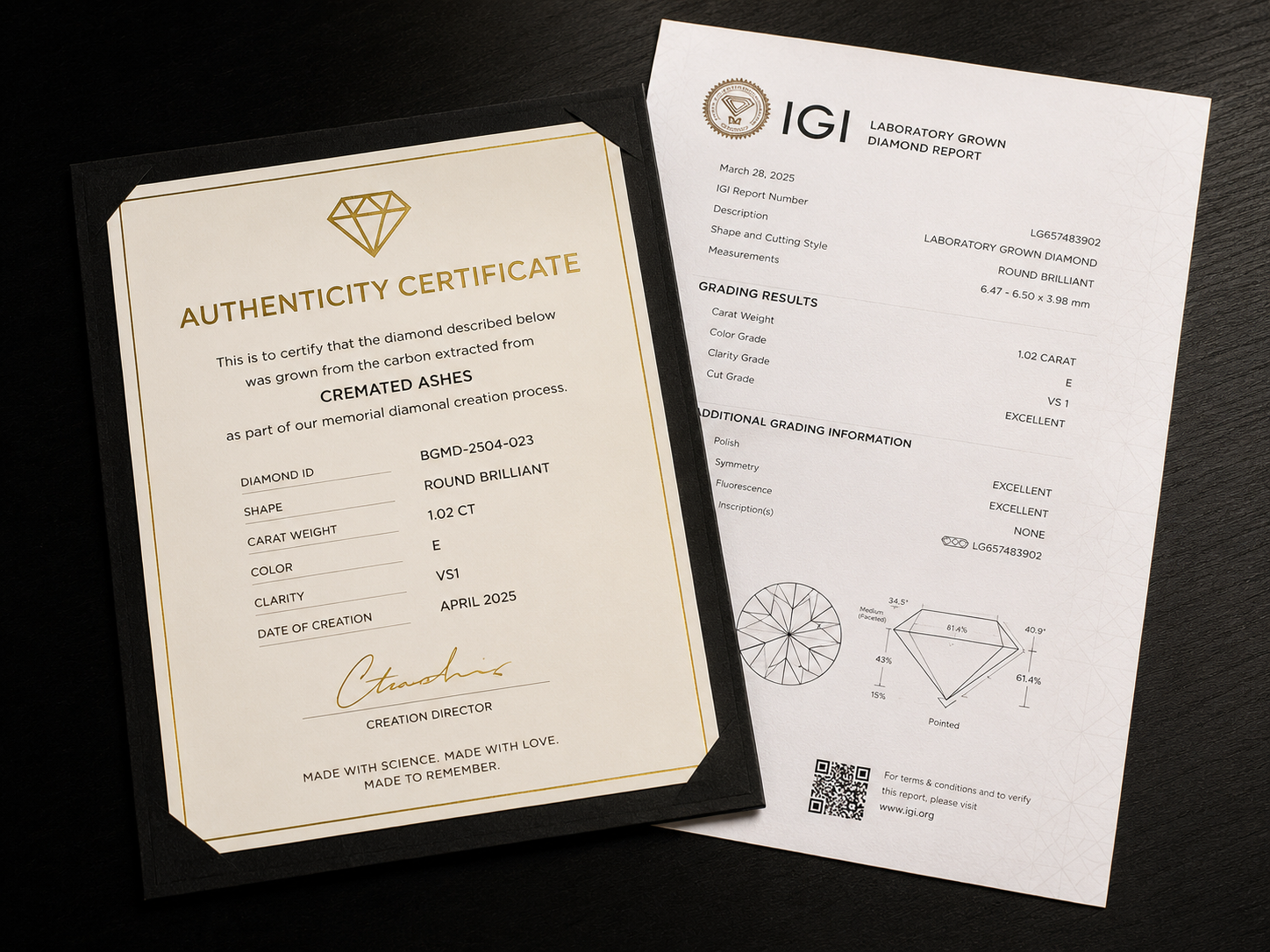
This is one of the most important questions to ask before choosing a memorial diamond provider.
The strongest evidence generally comes from documentation and chain-of-custody procedures, rather than from a test performed on the finished diamond.
Two types of documentation may be relevant.
| Document | What It Establishes | What It Does Not Establish | Who Issues It |
|---|---|---|---|
| Authenticity or origin certificate | Documents the submitted material and production history associated with the memorial diamond | The independent quality of the diamond | The provider |
| Independent grading report | Documents characteristics such as cut, color, clarity, and carat weight | The origin of the carbon used | A gemological laboratory |
Why Chain of Custody Matters
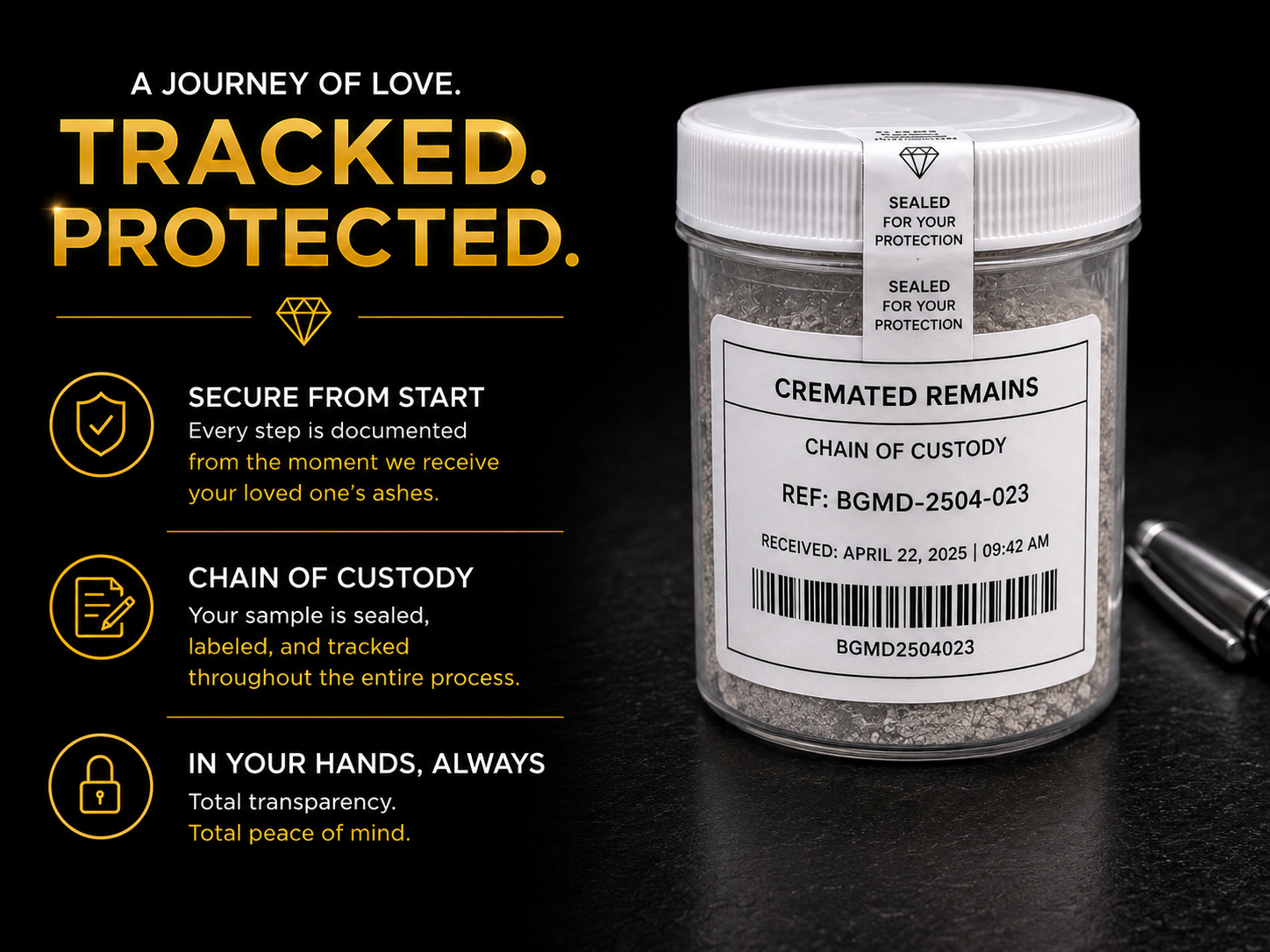
A provider may assign a tracking or chain-of-custody reference when the family submits its material.
This reference can help the provider track the material through stages such as processing, carbon preparation, diamond growth, and the handling of any remaining material.
The provider should maintain clear documentation because you cannot determine the source of a finished diamond through visual inspection alone.
Therefore, before placing an order, ask the provider which records it provides and which stages it documents.
Which Questions Expose a Provider Who Can’t Back This Up?
A transparent provider should answer clear questions about its process and explain how it handles your material.
1. What Tracking Reference Will I Receive?
Ask the provider whether it assigns a unique tracking reference to your submitted material and when it records that reference during the process.
Also, ask what documentation the provider will give you when it completes the process.
2. Is Carbon Extraction Done In-House?
Ask the provider whether its team handles carbon extraction and preparation directly or uses another facility.
If the provider uses another facility, ask how it tracks your material during the transfer.
3. What Happens to the Material That Is Not Used?
Ask the provider whether it returns unused material to your family and what procedure it follows.
In addition, make sure the provider clearly explains this process before you send any material.
4. What Documentation Comes With the Diamond?
Ask whether you will receive:
- An authenticity or origin certificate
- An independent diamond grading report
- Both
Also ask which organization performs any independent grading.
5. What Happens if a Growth Run Fails?
Diamond growth is a technical process, and families should understand what happens if a particular growth attempt does not produce the intended result.
Ask about the timeline, available material, and the provider’s process for handling a re-growth.
Frequently Asked Questions
Can Anyone Prove the Diamond Came From My Mother’s Specific Ashes?
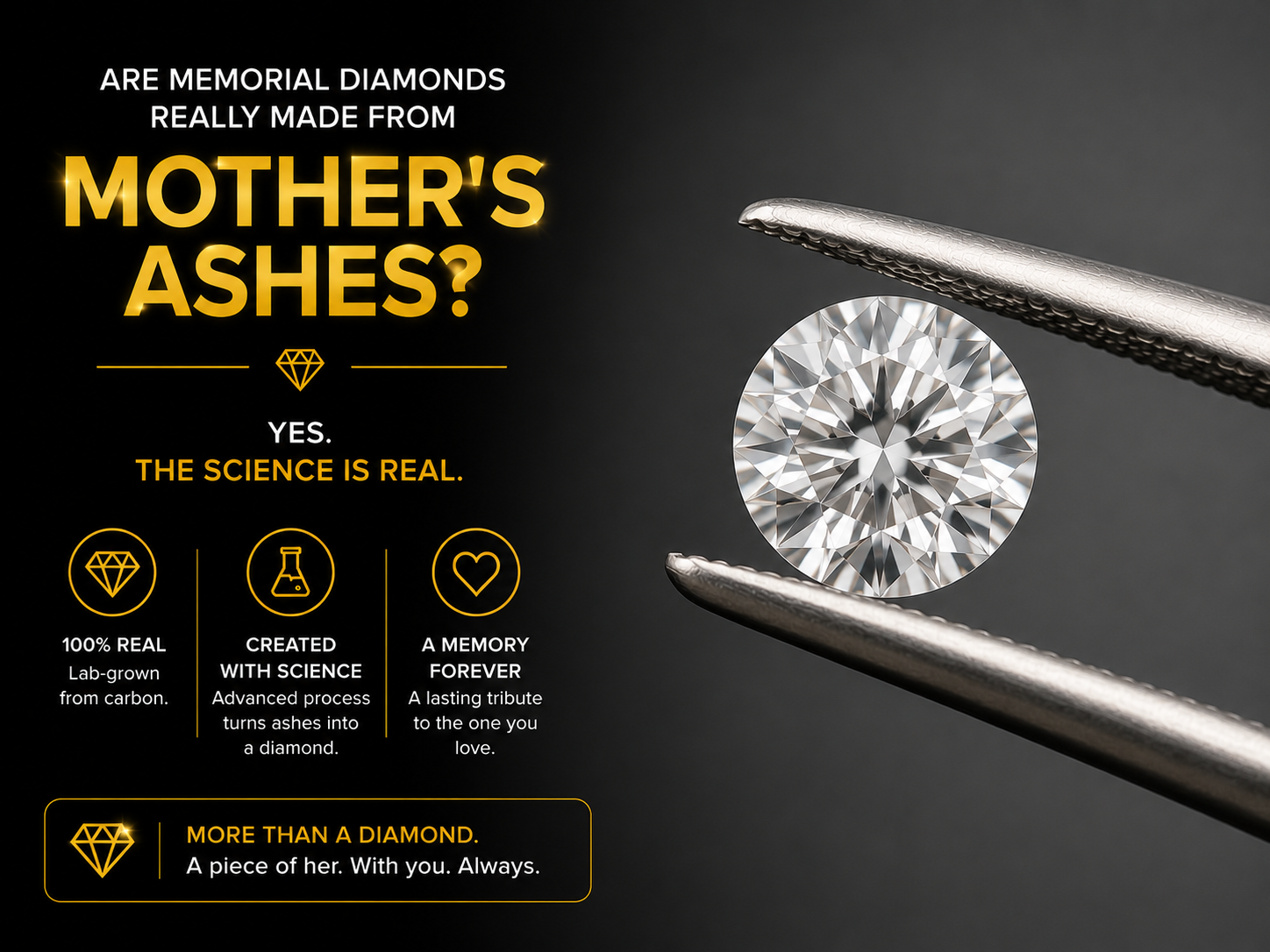
The strongest evidence generally comes from documented handling and chain-of-custody records.
Purified carbon becomes chemically similar regardless of its original source, which is why documentation about the handling and production process is so important.
Before ordering, ask exactly what evidence and records the provider can provide.
Do Providers Ever Just Use Lab Carbon Instead?
This is exactly why transparency matters.
Families should ask about the provider’s tracking procedures, extraction process, documentation, and chain of custody before submitting any personal material.
A detailed and clearly documented process provides more confidence than marketing claims alone.
Is It a Real Diamond or a Substitute?
A memorial diamond can be a real diamond.
Lab-grown diamonds have the same fundamental crystal structure and chemical composition as diamonds formed naturally in the Earth.
They are not the same thing as simulants such as cubic zirconia or resin.
Like other diamonds, a laboratory-grown diamond can be evaluated using characteristics such as cut, color, clarity, and carat weight.
Will I Be Able to See the Ashes Inside the Diamond?
No.
The carbon derived from cremated remains is processed at the material level before the diamond is grown.
You should not expect to see visible ash particles or flecks inside a finished memorial diamond.
The finished stone is a diamond crystal rather than a container holding visible ashes.
What Should I Do if a Provider Doesn’t Deliver What Was Promised?
Before sending cremated remains or making a payment, make sure important promises are documented.
This can include:
- The expected process
- Documentation provided
- Treatment of unused material
- Estimated timeline
- Diamond specifications
- Terms and conditions
Keep copies of the written information provided during the purchase process.
Clear written documentation is generally more useful than relying only on verbal assurances.
If You’re Still Unsure
Being skeptical is reasonable.
Choosing what to do with a mother’s cremated remains is deeply personal, and there is no requirement to make a decision immediately.
Take the time to understand the process.
Ask how the material is handled.
Ask what documentation you will receive.
Ask what happens to unused ashes.
Ask how the provider tracks the material throughout the process.
A trustworthy decision should be based on clear answers rather than emotional pressure.
A memorial diamond may contain carbon derived from your mother’s remains, but understanding exactly what that means is important before choosing one.
When you are ready, ask the provider directly about the documentation and process used for a diamond created from your mother’s ashes.