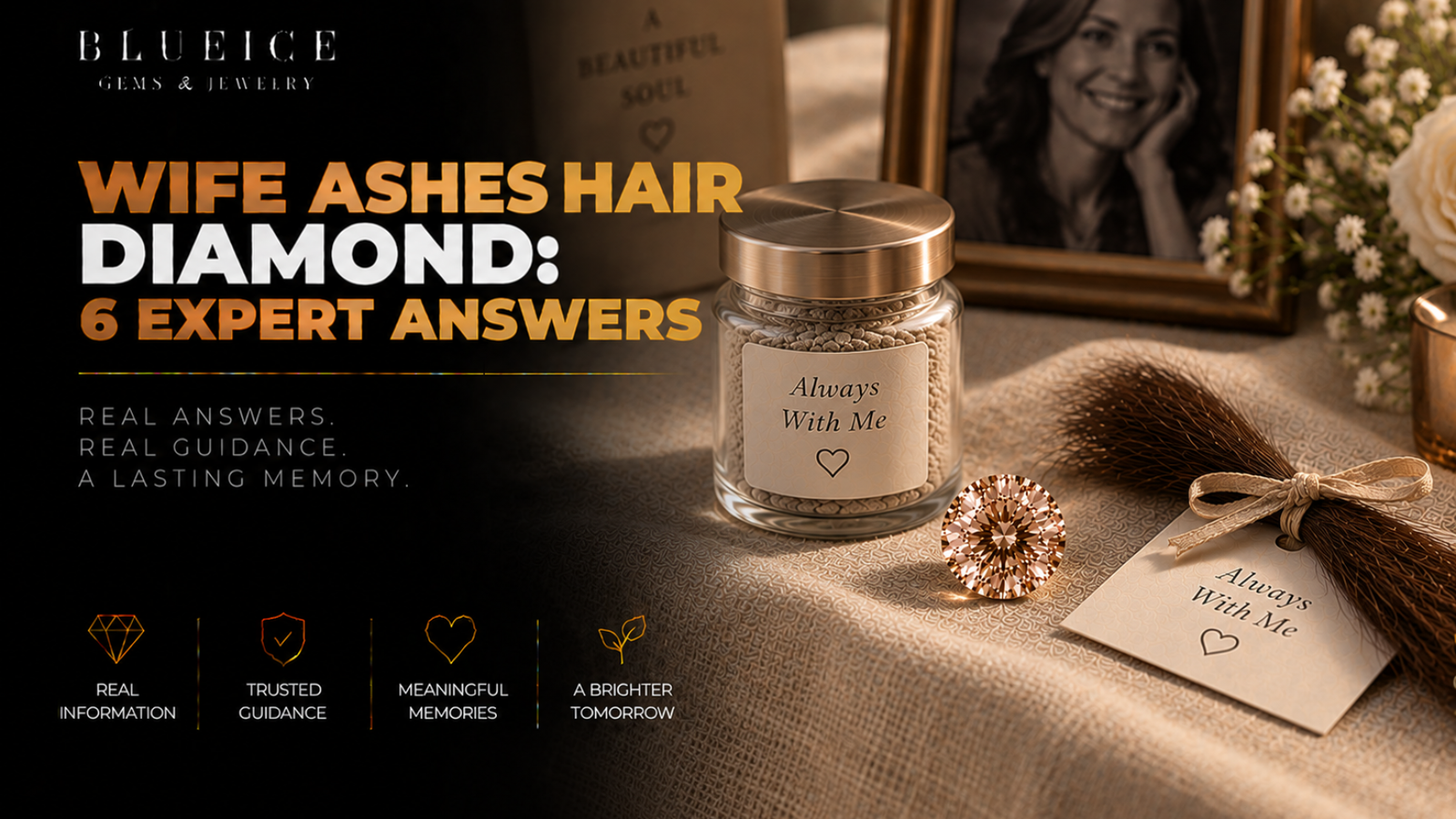
Wife ashes hair diamond: a small champagne lab-grown diamond between a sealed ash container and a tied lock of hair on linen

Wife Ashes and Hair Diamond: The Complete Guide

You have both. The urn came home from the crematorium, and somewhere there is also a lock, from a haircut, a brush, a hospital bed. The question is not whether either can become a diamond; each can on its own. A wife ashes hair diamond is a single lab grown diamond grown from carbon extracted from both her cremated remains and a lock of her hair, purified together and grown into one stone, and the honest reason to combine them is meaning, not chemistry, because hair alone supplies far more carbon than ashes do.

This guide covers the six questions that only arise when you are choosing between one material, the other, or both: what combining actually changes, when it genuinely helps, how the two carbons are blended, what to send from each, what it costs, and the practical risks that come with sending two irreplaceable things at once.

What Combining Ashes and Hair Actually Changes

Start with what it does not change, because the marketing around combined stones sometimes implies otherwise.

A wife ashes hair diamond is not bigger than a single source stone. Carat is set by how long the crystal grows in the press, not by how much material goes in. A wife ashes hair diamond is not faster, either; the timeline is the same 6 10 months industry wide. Combining does not make it “more her” in any measurable way, because the personal carbon in any memorial diamond is blended with lab carbon to reach a workable size, and the proportion is governed by carat, not by the number of sources.

What combining a wife ashes hair diamond does change is one thing, and it is a real thing: the stone’s carbon comes from two different moments of her. Hair is carbon she grew while alive; it records months or years of her body’s ordinary chemistry. Ashes are what remained after. For some families, having both in one crystal lattice matters in a way a single source stone does not. That is the reason to do it. It is a good reason. It is not a chemical one.

QuestionAshes onlyHair onlyAshes and hair combined
Carbon yield per gram of materialLow, roughly 0.5 4% of ash by weightHigh, hair is roughly 50% carbonHair supplies most of the personal carbon; ash adds a smaller share
Cremation required?YesNoYes, ashes are part of the submission
Effect on caratNone, set by growth timeNoneNone
Effect on timelineNone, 6 10 months typicalNoneNone
Effect on colorTrace elements from the sourceTrace elements from the sourceTrace elements from both; no reliable predictable difference
What it meansA stone from what remainedA stone from carbon she grew while livingBoth moments in one stone
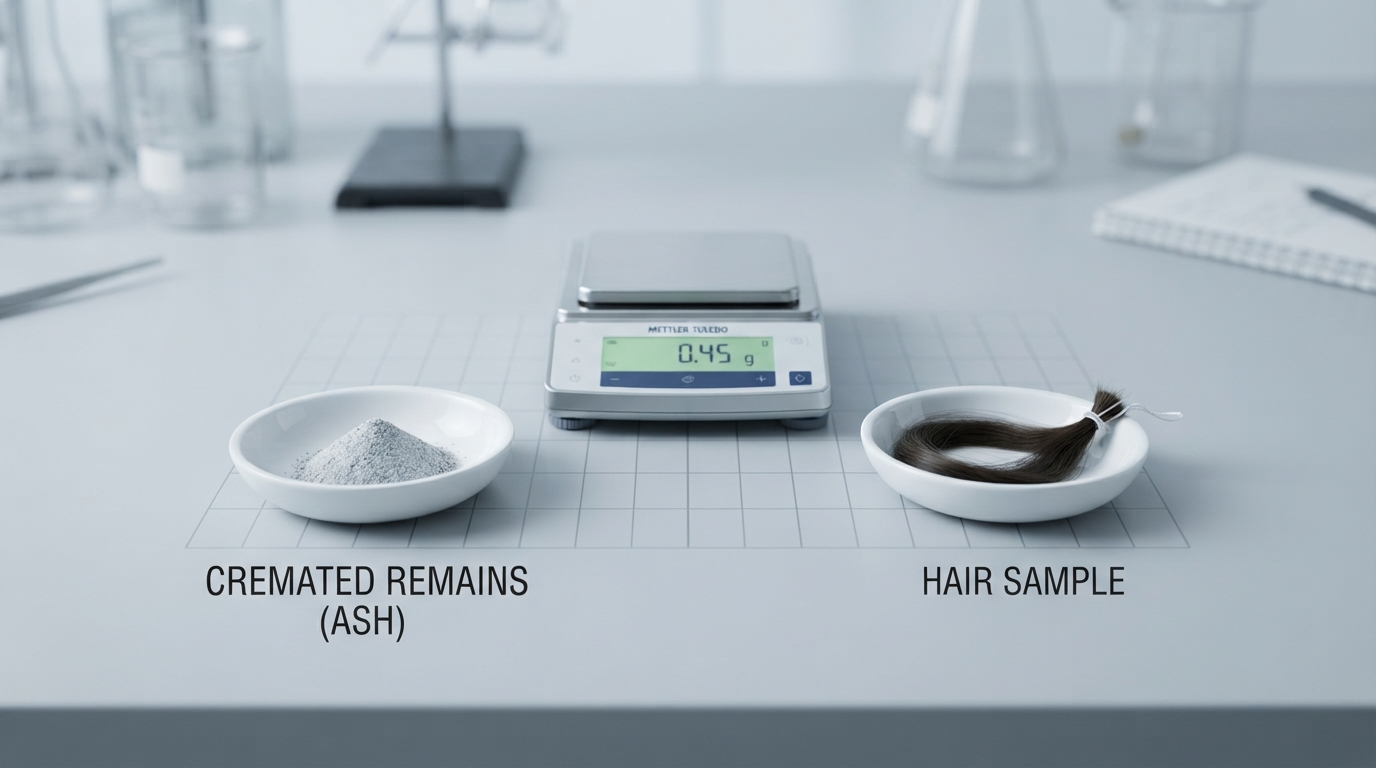
Two labeled dishes on a lab bench a small mound of ash and a lock of hair with a scale between them

If the last row is the reason you are reading this, a wife ashes hair diamond is worth doing. If you were hoping the combination would yield a larger or purer stone, it will not, and one material is the simpler route. The ashes only guide and the hair only guide cover each on its own.

When a Wife Ashes Hair Diamond Makes Sense

Four situations where a wife ashes hair diamond is the right call, and two where it is not.

It makes sense when:

  1. The meaning is the point. You want a wife ashes hair diamond because you want carbon from her living years and from what remained, in one stone, and you know that is why. That is sufficient.
  2. You hold only a very small amount of ashes. If most of her ashes were scattered or interred and only a pinch was kept, less than a provider’s typical minimum, adding hair can make the submission viable where ashes alone would not. Hair does the chemical work; the ashes still contribute.
  3. You hold only a few strands of hair. The reverse case. A handful of strands from a brush may fall below a provider’s minimum on its own; combined with ashes, the submission clears the bar.
  4. Two people are contributing. Occasionally a spouse holds the ashes and a daughter or sister holds the lock. Combining lets both be part of one stone without either having to give the other their portion.

It does not make sense when:

  • You are hoping for a bigger, faster, or “purer” diamond. A wife ashes hair diamond changes none of those.
  • The hair is the only lock you have and you want to keep some. Sending both materials means two irreplaceable things leave the house at once. If keeping part of the lock intact matters, an ashes only stone with the hair kept whole may be the better arrangement.

How the Two Carbons Are Extracted and Blended

The process for a wife ashes hair diamond is the standard seven stage memorial diamond process, with the difference concentrated in stage two.
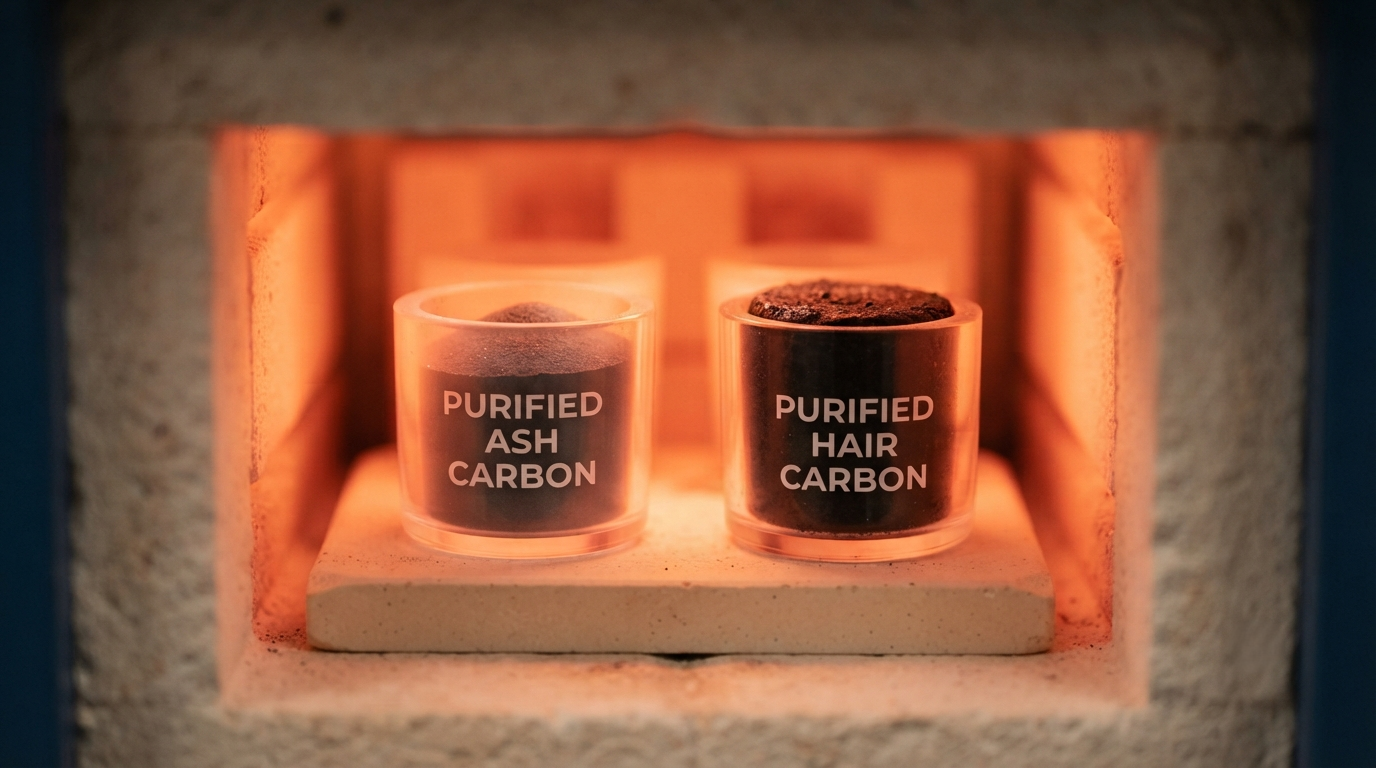
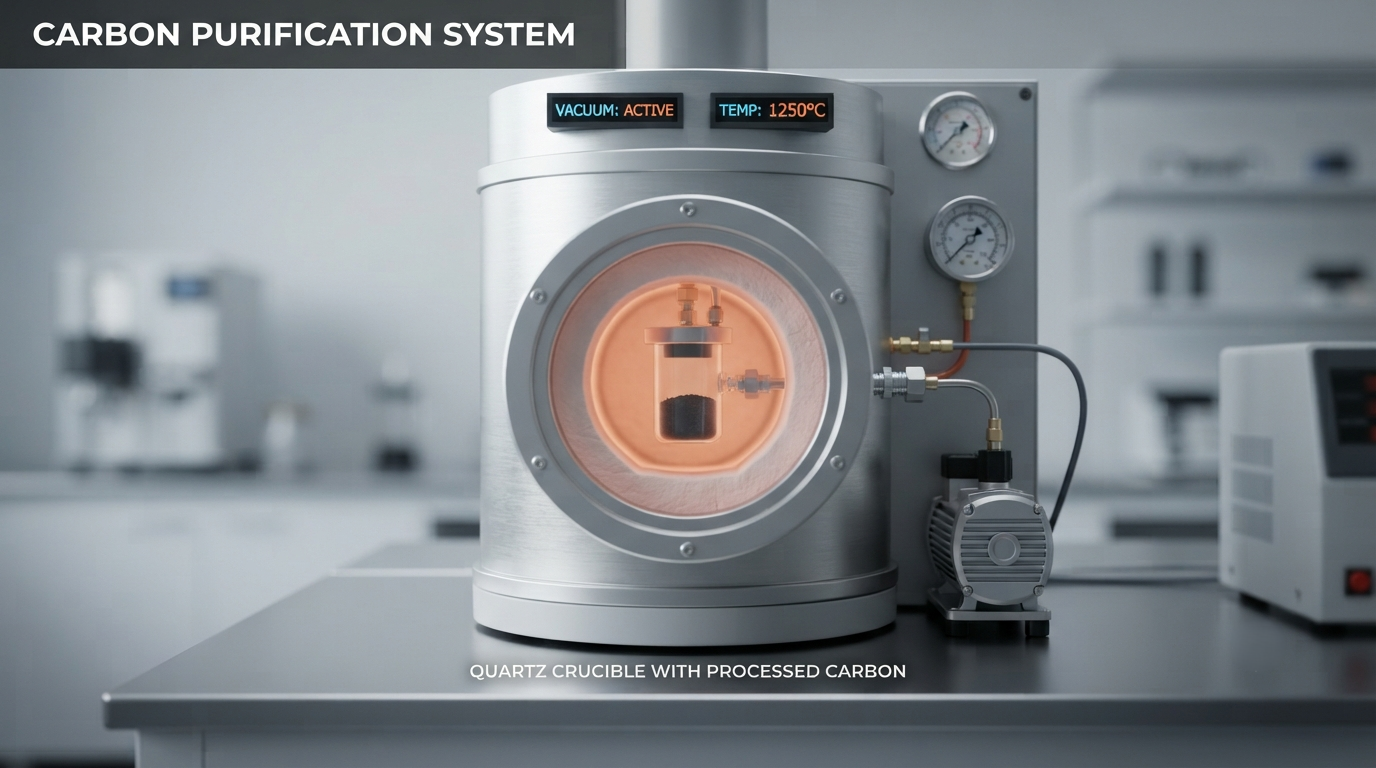
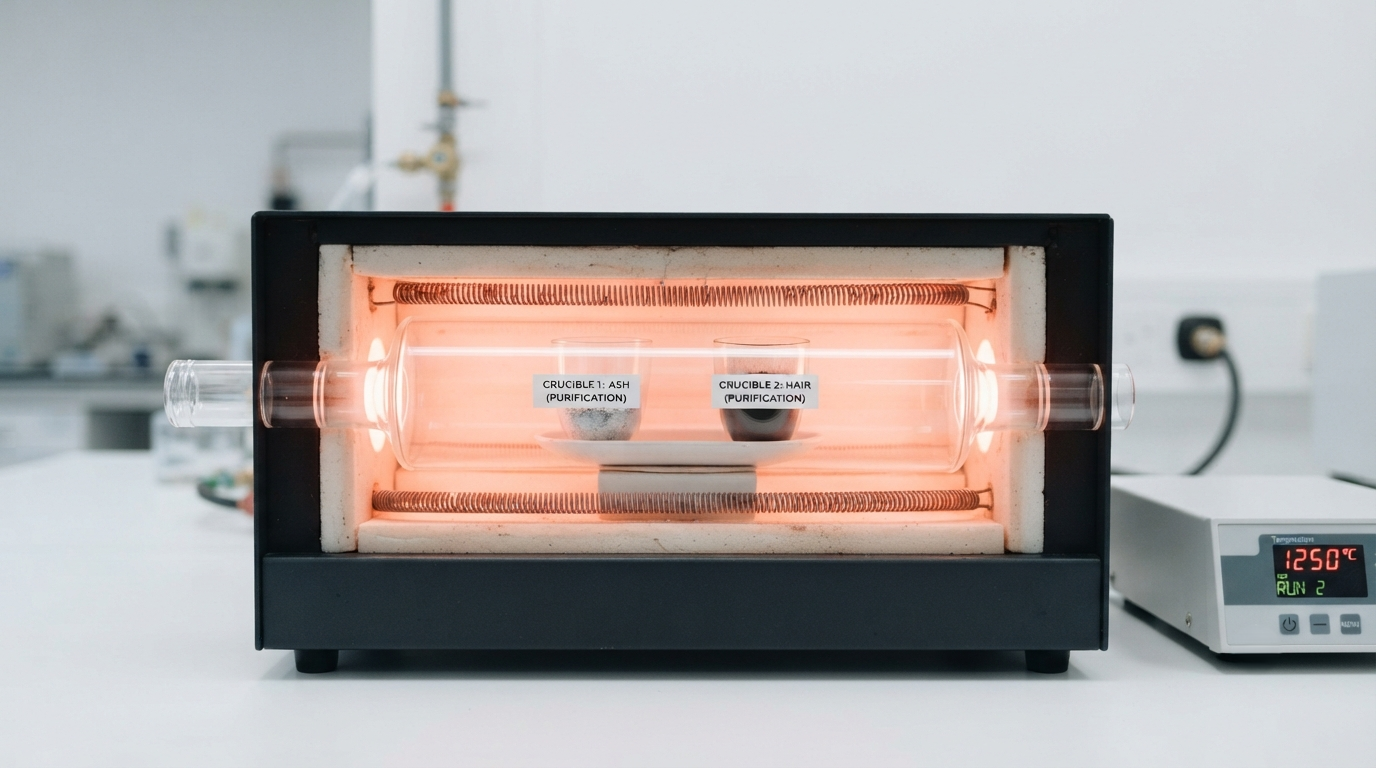
Two labeled crucibles side by side in a laboratory furnace during purification
  1. Collection. For a wife ashes hair diamond, both materials are received together, logged as a single submission under one chain of custody record. Ask how the provider labels a two material submission; you want one traceable record, not two that could be separated.
  2. Carbon extraction and purification, run for each material. Ashes are almost entirely calcium phosphate, so their extraction strips away bone mineral to recover the small carbon fraction. Hair is keratin, roughly 50% carbon, so its extraction removes the non carbon components of the protein. Both are heated in controlled, oxygen free, multi stage processes to reach 99.9%+ carbon purity. Some providers process the two materials together from the start; others purify separately and combine after. Ask which; the result is the same, but knowing the method tells you the provider understands the difference.
  3. Graphitization. The combined purified carbon is heated to roughly 2,500 2,700°C and converted to graphite.
  4. Diamond growth. The graphite, blended with supplemental lab carbon to reach adequate volume, goes into an HPHT press with a diamond seed at roughly 6 8 GPa and 1,400 2,500°C, or into a CVD chamber with some providers, for weeks to months. This stage sets the carat. Both methods are described on the synthetic diamond page.
  5. Cutting and polishing.
  6. Optional irradiation for red, pink, green, or black.
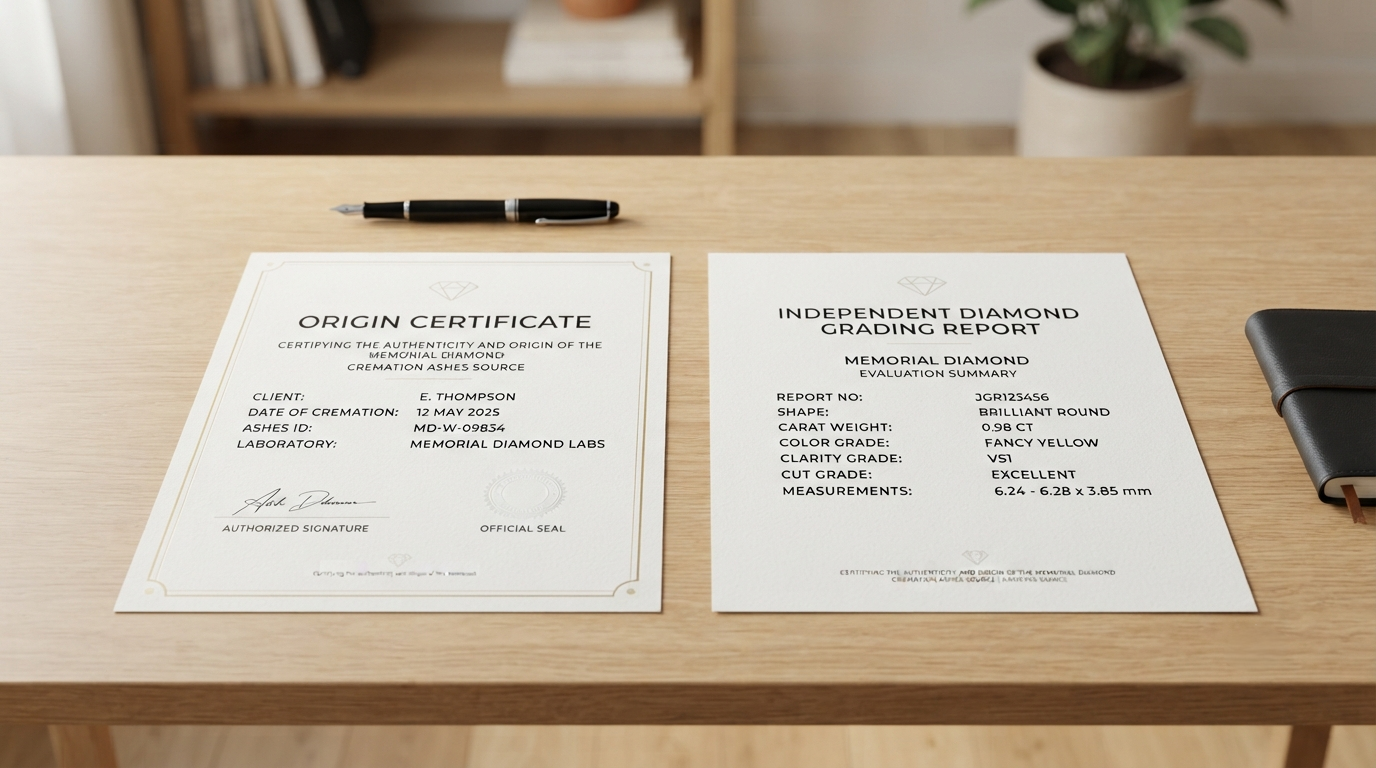
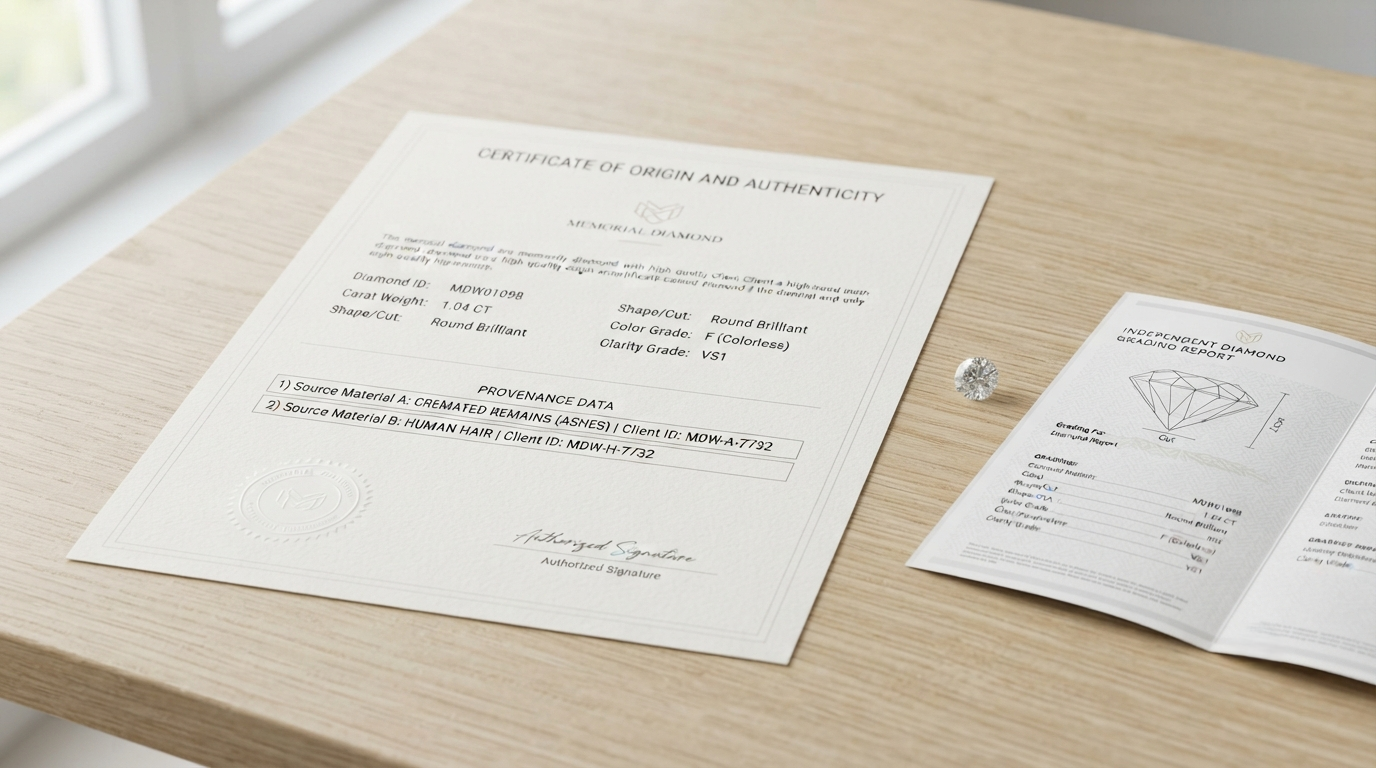
  7. Grading and certification. An origin certificate documents that this stone was grown from her submitted ashes and hair; a grading report, ideally independent, using the same cut, color, clarity, and carat standards as any diamond, documents quality.

One honesty point specific to combined stones: because hair yields so much more carbon per gram than ash, in most wife ashes hair diamond submissions the hair supplies the majority of the personal carbon and the ashes a smaller share. The finished stone contains both, verifiably. But if a provider implies the ashes and hair contribute equally, they are describing a symmetry the chemistry does not support. Ask what proportion of the personal carbon came from each; a good provider can tell you.

What to Send From Each Material

Because a wife ashes hair diamond does not require more of either material, send the minimum of each and keep the rest.

MaterialTypical industry amountWhat to keep
AshesA few tablespoons to roughly 4 oz, about 100 g, often less when hair is also submitted; askEverything else, the scattering, interment, or urn proceeds as planned
HairA small lock or a few grams, often less when ashes are also submitted; askPart of the lock, intact, if it is the only one you have
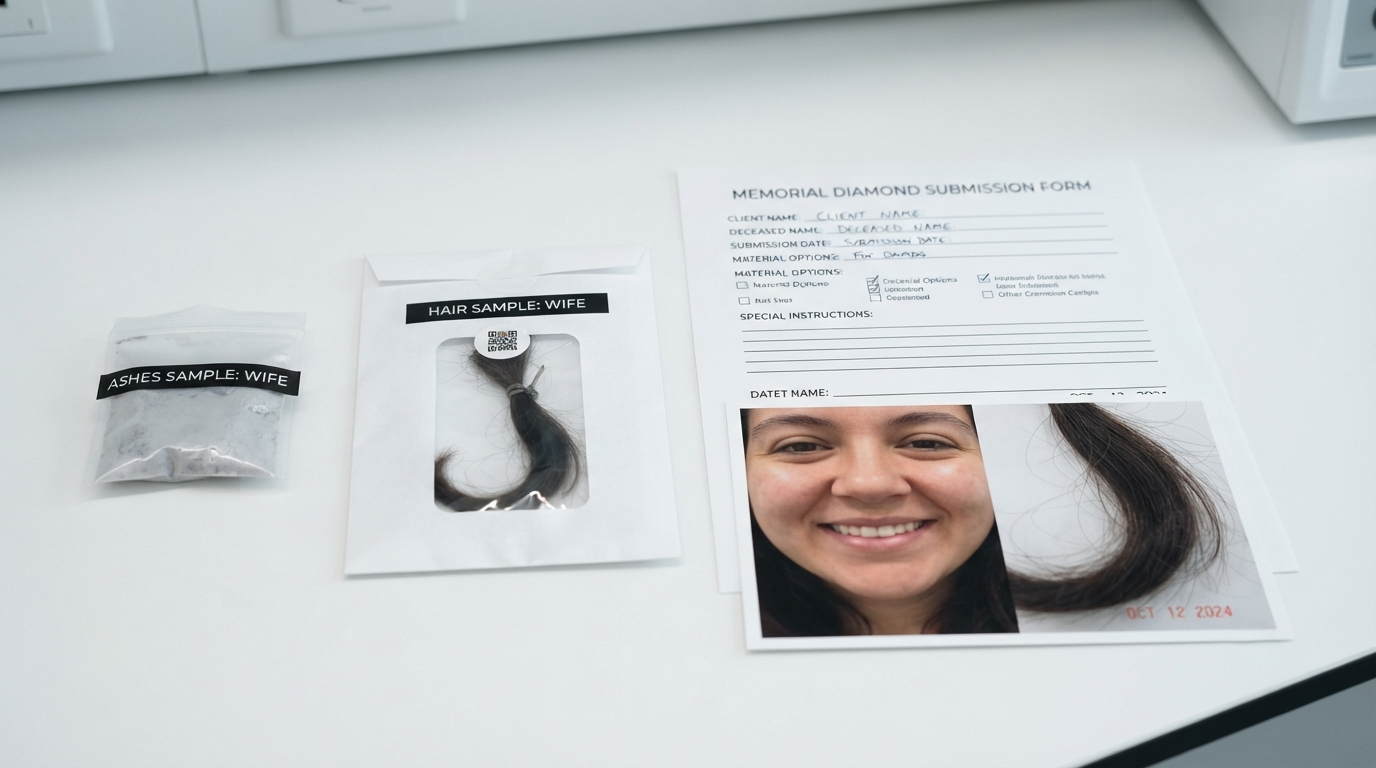
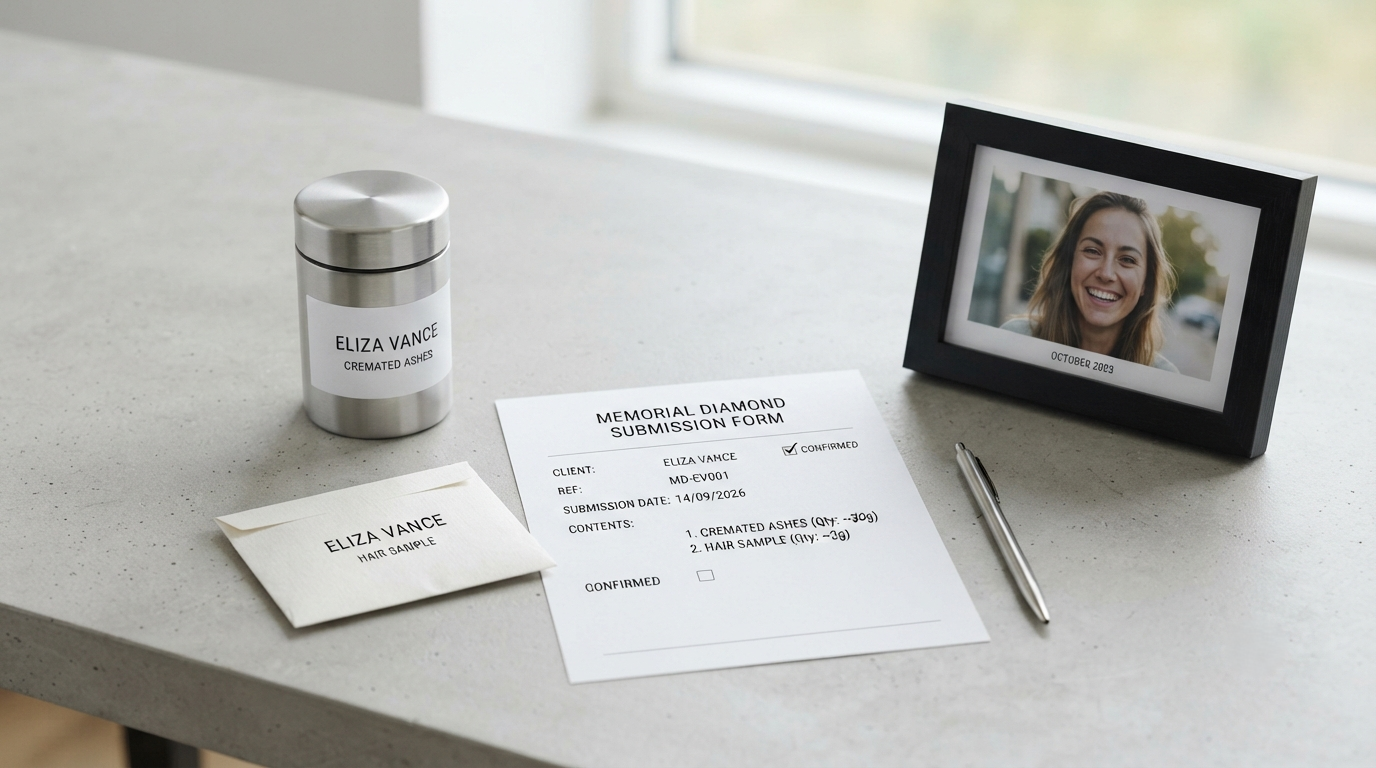
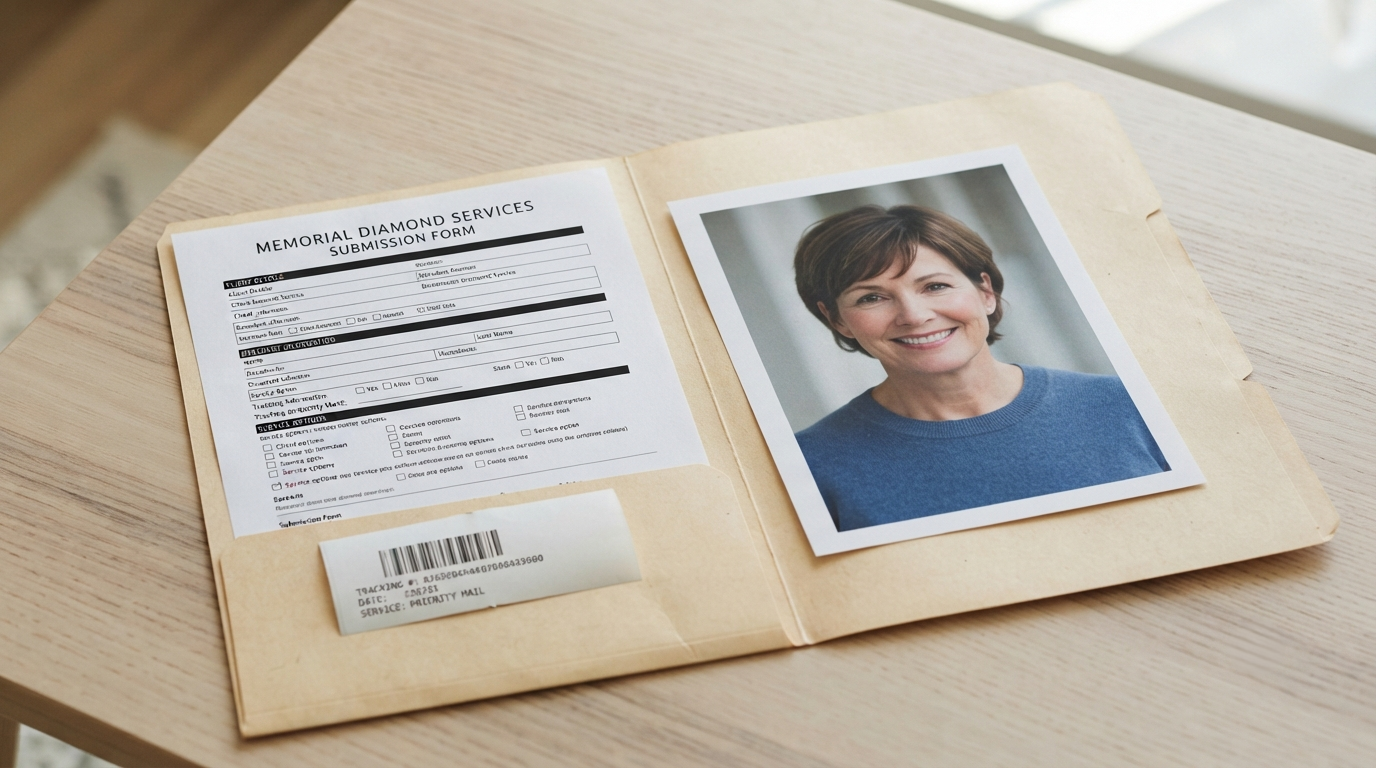
Sealed ash container and labeled hair envelope beside a completed submission form and a dated photograph

Three practical notes:

  • Ask the provider for the combined minimum specifically. Some quote the ashes minimum and the hair minimum as if both apply in full; for a combined stone, many will accept less of each. Do not send the full amount of both by default.
  • Package them separately, labeled, in one shipment. Ashes in a sealed container, hair in a labeled envelope, both inside one outer package with one submission form. This keeps the chain of custody record clean.
  • Photograph both before sending. For a wife ashes hair diamond submission, a dated photograph of the hair lock and of the ash container, alongside the submission form, is the record you will want if any question ever arises. How much ash and hair you need for a wife memorial diamond covers the quantities in detail.

Sending more of either does not produce a bigger wife ashes hair diamond. If a provider suggests otherwise, that is a reason to ask more questions, not to send more.

Does Combining Change the Color, Carat, or Cost?

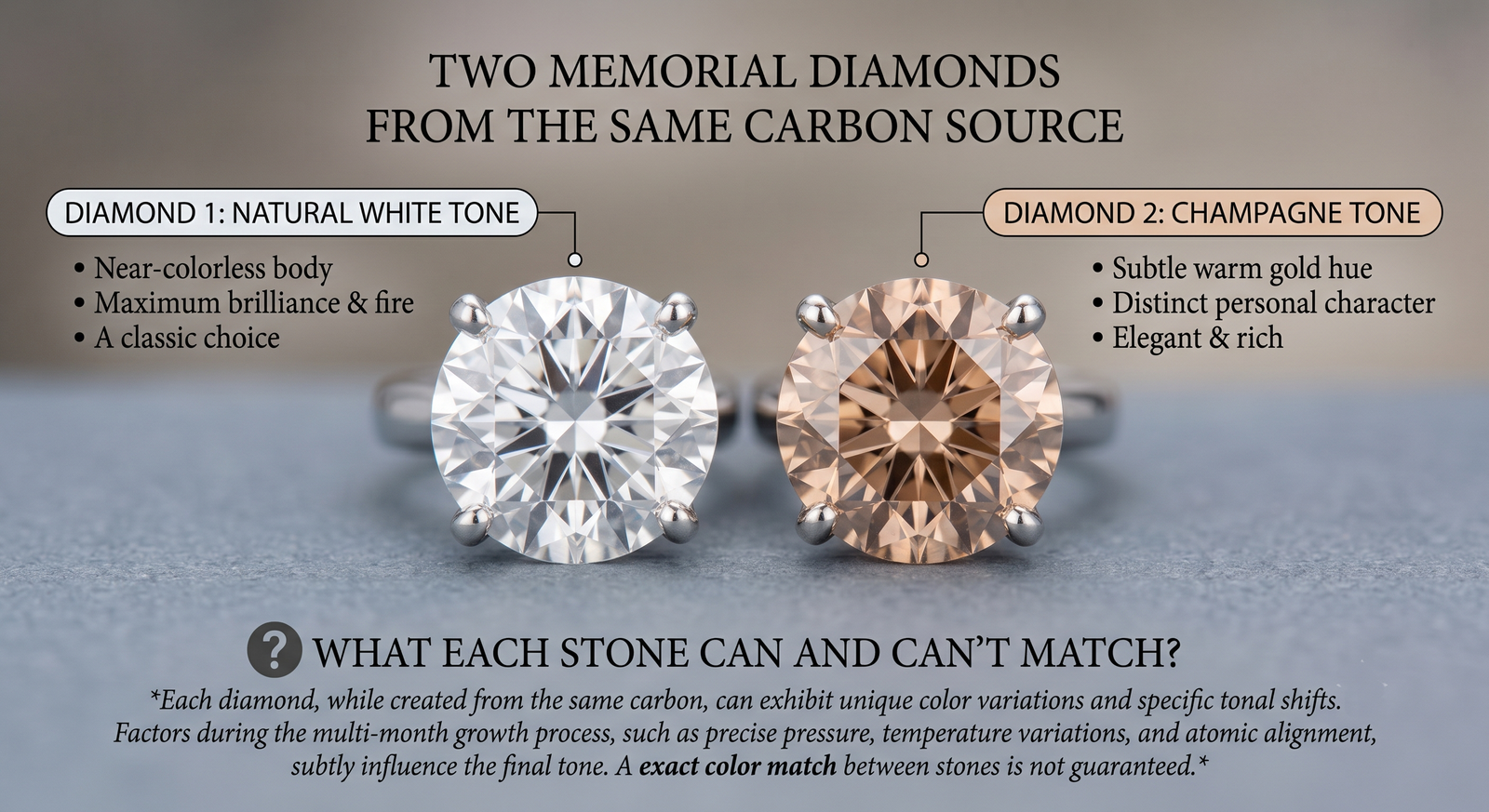
Color: Not predictably. Diamond color is set by trace elements during growth, nitrogen for yellow, boron for blue, and carbon from an organic source carries trace elements with it whether it came from ashes or hair. A wife ashes hair diamond trends toward yellow, champagne, or blue like any memorial diamond, and colorless requires additional processing at extra cost. There is no reliable rule that combined stones lean one direction. Two stones from the same combined submission can differ slightly. What color a diamond made from your wife’s ashes and hair will be covers the choice.

Carat: Unchanged. Growth time in the press sets the carat of a wife ashes hair diamond. Memorial diamonds are typically offered from about 0.10 ct to 5+ ct regardless of source material.

Cost: For a wife ashes hair diamond, usually unchanged, sometimes slightly more. Most providers price by carat, color, cut, and grading rather than by material. A few charge a modest additional processing fee for a two material submission because extraction runs twice. The ranges below are general 2026 industry figures, not Memorial Diamond’s published pricing.

TierApproximate caratTypical industry range
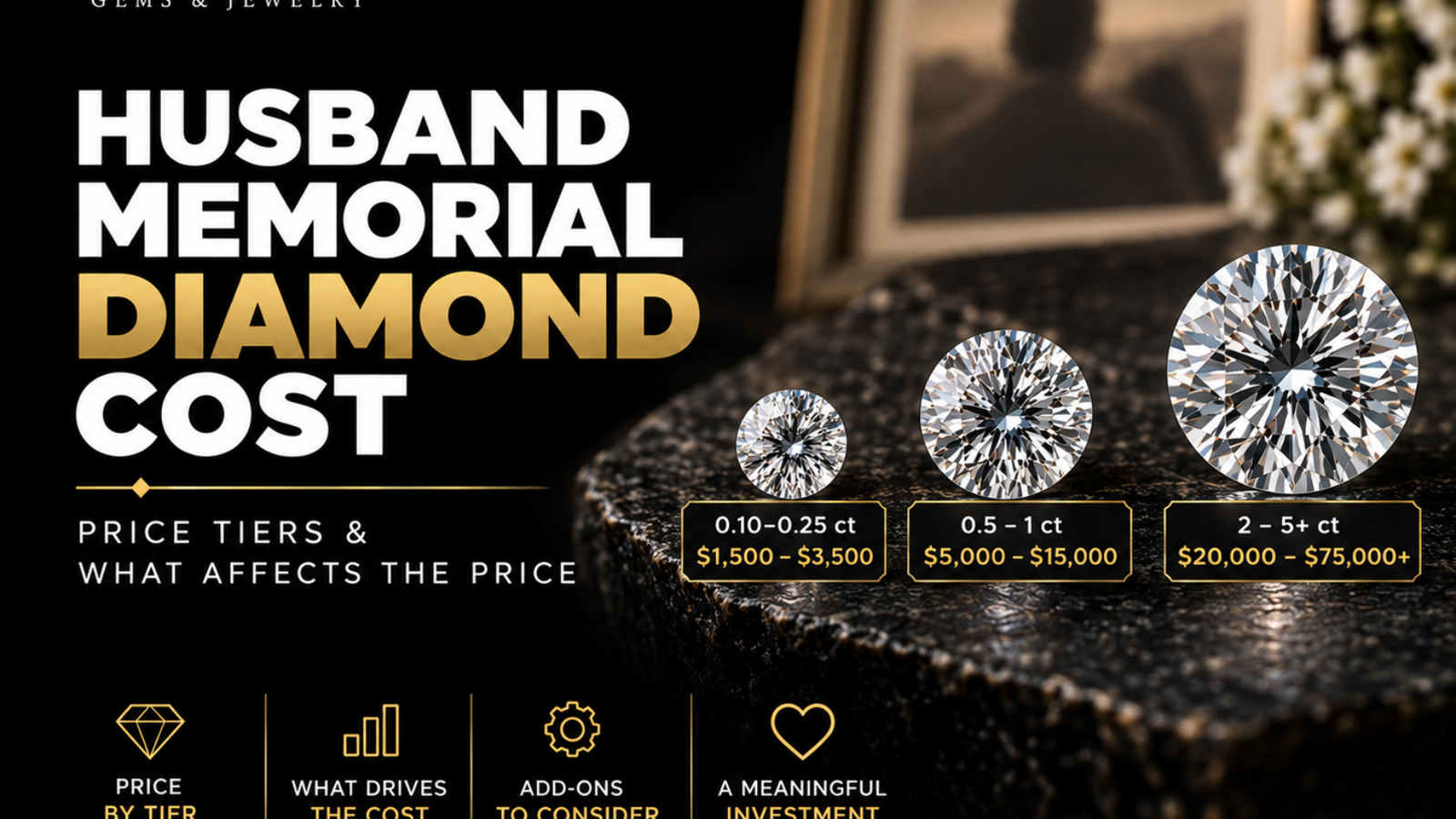
Entry0.10 0.25 ctRoughly $1,500 $3,500
Mid0.5 1 ctRoughly $5,000 $15,000, colorless meaningfully more
Large / rare2 5+ ctRoughly $20,000 $75,000+

Settings, engraving, and independent grading are priced separately from the loose stone. Ask specifically whether a two material submission carries any surcharge, and get the loose stone price and the set price as separate lines. How much a wife memorial diamond costs works through a full quote.
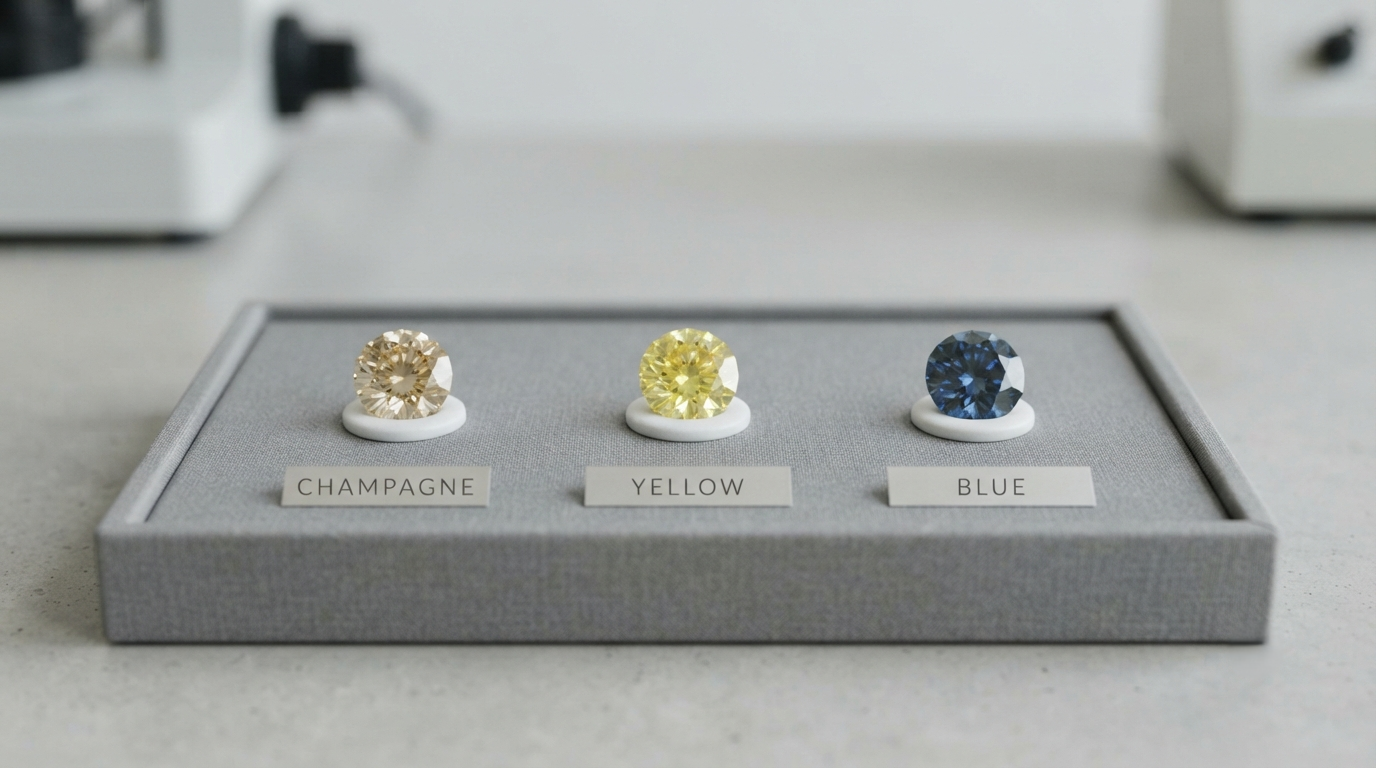
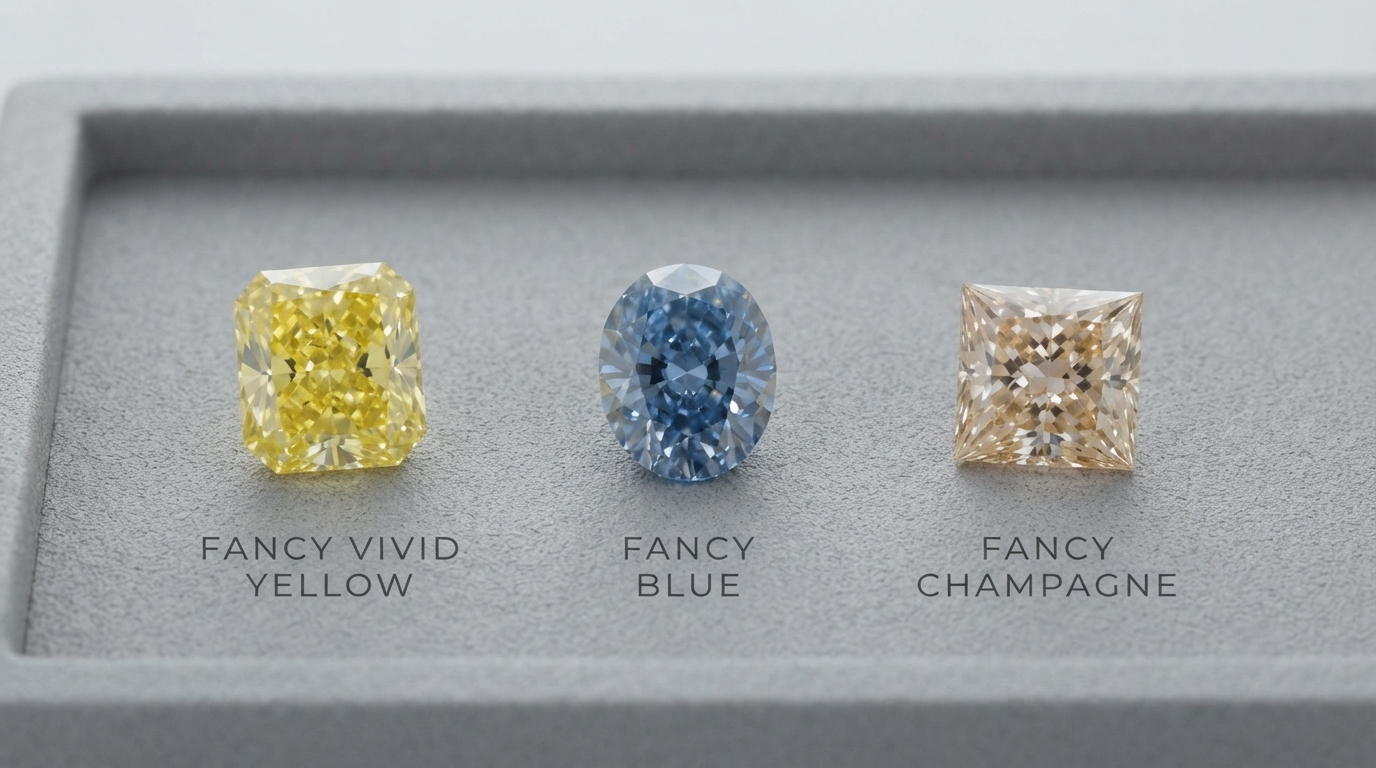
Three loose memorial diamonds in champagne, yellow, and blue on a gray tray

Timeline: Unchanged for a wife ashes hair diamond. 6 10 months typical, up to 12 for large or black stones. How long a wife memorial diamond takes covers planning against a date.

The Risks of Sending Two Irreplaceable Things

An ashes only submission risks a portion of the ashes. A hair only submission risks a lock. A wife ashes hair diamond risks both at once, and that deserves a plainer look than most guides give it.

What can go wrong: a shipment lost in transit; a provider that fails before the stone is finished; a two material submission logged as two records and separated; a dispute about whether the finished stone came from your submission.

What reduces each risk:

  • Keep part of both. Do not send the last of the ashes or the whole lock. A provider needs a small amount of each; the rest stays home.
  • Use tracked, insured shipping and keep the tracking record with your copy of the submission form.
  • Ask for the chain of custody record in writing before sending, and ask how a two material submission is logged, one record or two.
  • Ask what happens if the provider cannot complete the stone. A written answer about returned material is worth having before, not after.
  • Photograph everything, dated, before it is packaged.
  • Get the origin certificate’s wording in advance. It should name both materials.

None of this is a reason not to proceed with a wife ashes hair diamond. It is the reason to proceed carefully. Questions to ask before turning your wife’s ashes and hair into a diamond isolates the questions that exist only for a combined submission.

Frequently Asked Questions

Does combining ashes and hair make a bigger diamond?

No. Carat is set by how long the crystal grows in the press, not by how much material is submitted. A wife ashes hair diamond is the same size range, typically 0.10 to 5+ carats, as a stone from either material alone. The reason to combine is meaning, not size.

Which material contributes more of the carbon?

Usually the hair. Hair is roughly 50% carbon, while ashes are almost entirely calcium phosphate with only about 0.5 4% usable carbon. In most combined submissions the hair supplies the majority of the personal carbon and the ashes a smaller share. A good provider can tell you the proportion.

How much of each should I send?

Less than the standard minimum for each, in many cases. Ask the provider for the combined minimum specifically. Typical industry amounts are a few tablespoons to roughly 4 oz of ashes and a small lock or a few grams of hair, often reduced when both are submitted. Keep part of each.

Is a wife ashes hair diamond more expensive?

Usually not, or only slightly. Most providers price by carat, color, cut, and grading rather than by material. Some charge a modest processing fee for a two material submission because extraction runs twice. Ask for the surcharge, if any, as a separate line on the quote.

Will the diamond be a different color because both were used?

Not predictably. Color is set by trace elements during growth, and carbon from either source carries them. Combined stones trend toward yellow, champagne, or blue like any memorial diamond; colorless requires extra processing. There is no reliable rule that combined submissions lean one way.

Can I send ashes now and hair later, or add hair to an ashes stone already made?

Not to the same stone. Once a diamond has grown, no carbon can be added to it. If you want both materials in one stone, both must be submitted together before growth begins. If one stone already exists, a second stone from the other material is the alternative.

Final Thoughts on a Wife Ashes Hair Diamond

A wife ashes hair diamond is not a shortcut to a better diamond. It is a choice about what the diamond is made from, carbon she grew while she was here, and carbon from what remained, held together in one crystal. If that distinction matters to you, it is reason enough, and the chemistry will accommodate it without complaint. If it does not, a single material is simpler and the stone will be no less real. Either way, keep some of both. A wife ashes hair diamond takes only a little of each, and the rest of her should stay where you can reach it.

Learn More About Wife Memorial Diamonds

Talk With Memorial Diamond

If you hold both her ashes and a lock of her hair and want to know what a combined submission would need, whether your amounts are enough, or how the two materials are logged and blended, reach out to Memorial Diamond. Nothing has to be sent until every question on this page has an answer you are satisfied with.

Word count: 2,620. Reading time: about 13 minutes.
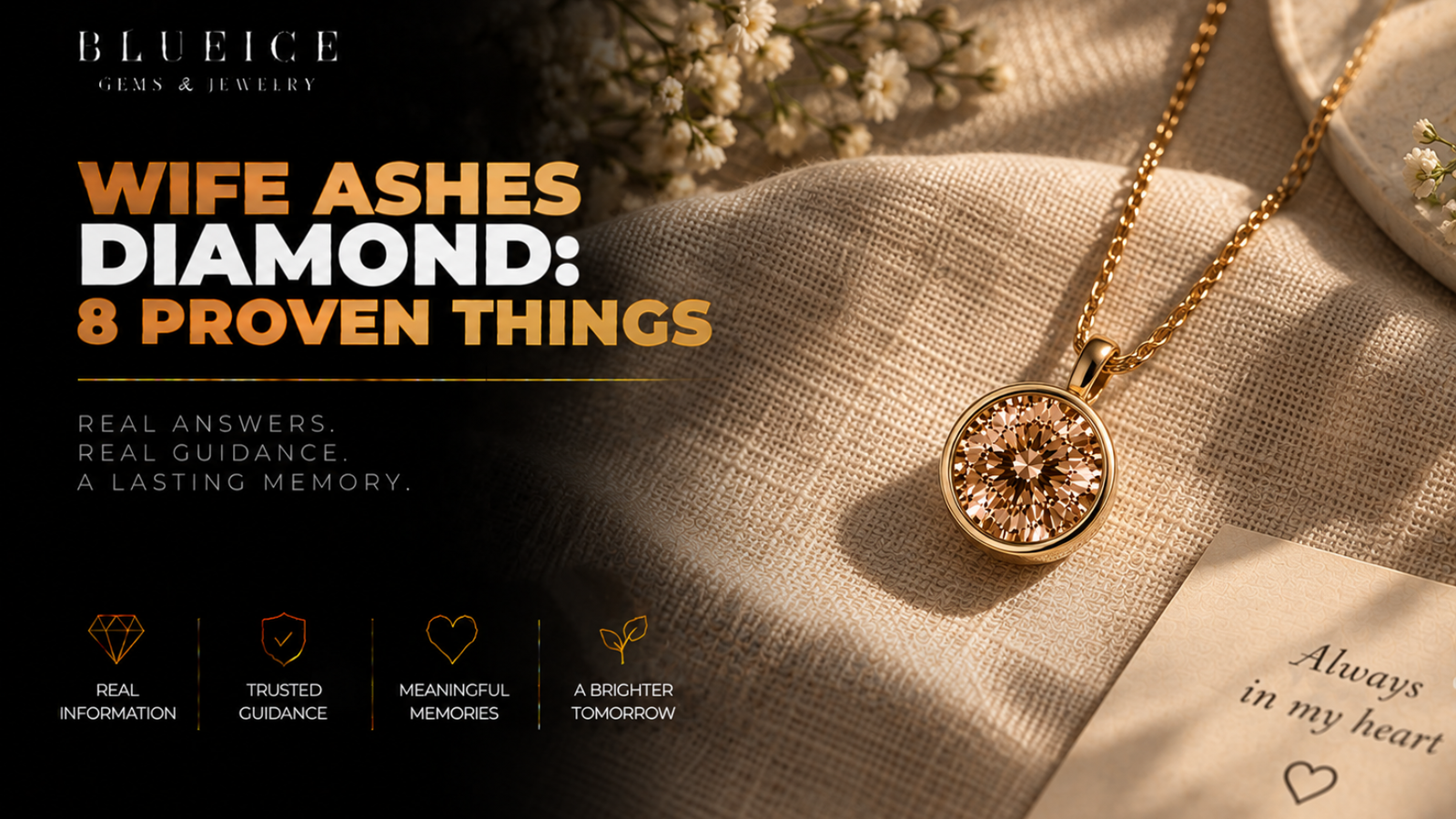
Wife ashes diamond: a champagne-toned lab-grown memorial diamond in a bezel pendant on a plain linen background

Wife Ashes Diamond: The Complete Guide

There is a version of your house that still expects her. Her side of the closet, the mug that was hers, the way you still buy two of something. A wife ashes diamond is a real, lab grown diamond containing a purified portion of your wife’s own carbon, extracted from a small amount of her cremated remains and grown over roughly 6 to 10 months into a stone that can be set in a ring, a pendant, or kept loose.

It is not all of her ashes, and it is not a symbol standing in for her. It is a diamond that physically exists because of her. This guide covers the eight things that decide whether it is right for you: what the stone contains, how much ash is used, the process, the colors, carat and cost, the timeline, what to ask before sending anything, and who else in the family the decision touches.
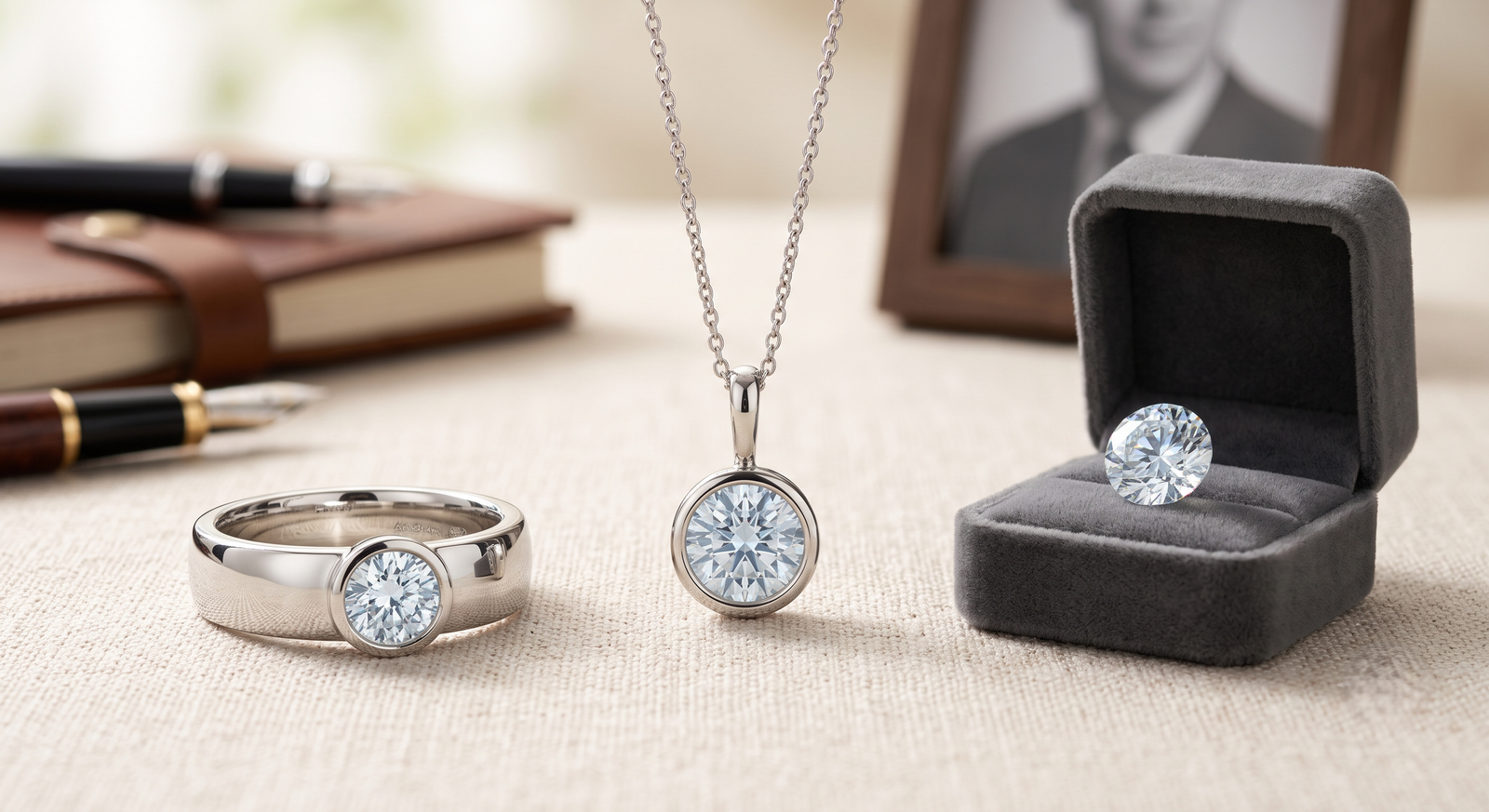
What a Wife Ashes Diamond Actually Contains

Start with the fact about a wife ashes diamond most people quietly doubt, because everything else rests on it.

Cremated remains are almost entirely calcium phosphate, the mineral structure of bone. Carbon, the element a diamond is made of, is a small fraction of ash by weight: industry figures put usable carbon at roughly 0.5% to 4%, depending on the person and on how the cremation was carried out. A laboratory extracts that carbon, purifies it to 99.9%+ purity, and then blends it with additional lab sourced carbon to reach the volume a diamond of meaningful size needs.
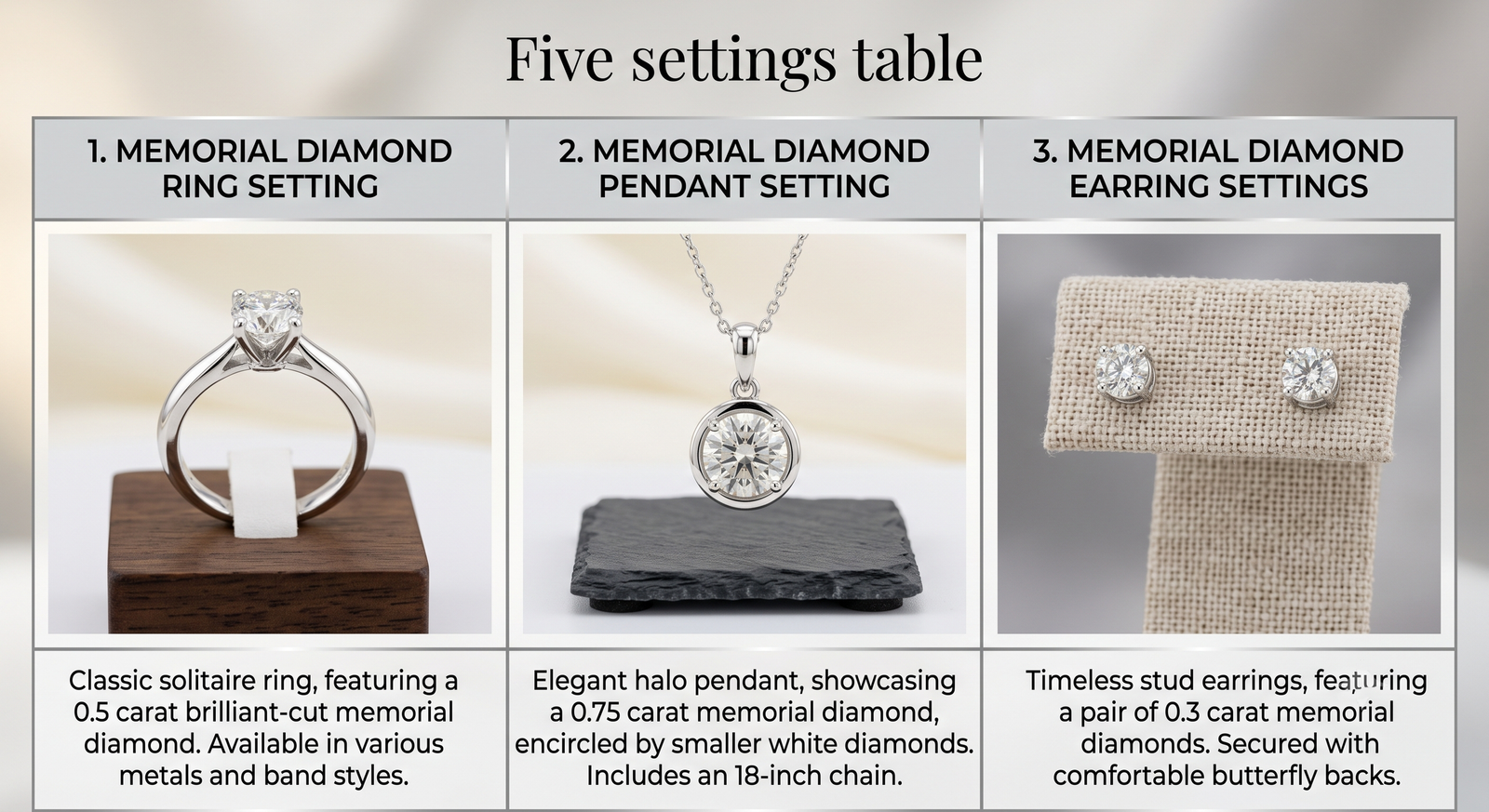
The result is that in a wife ashes diamond, the personal carbon recovered from her ashes typically makes up somewhere around 10% to 15% of the finished stone’s mass. Some providers cite figures as low as 3%, others higher, depending on the carat and how much ash was submitted. The rest is lab carbon that was never part of her.
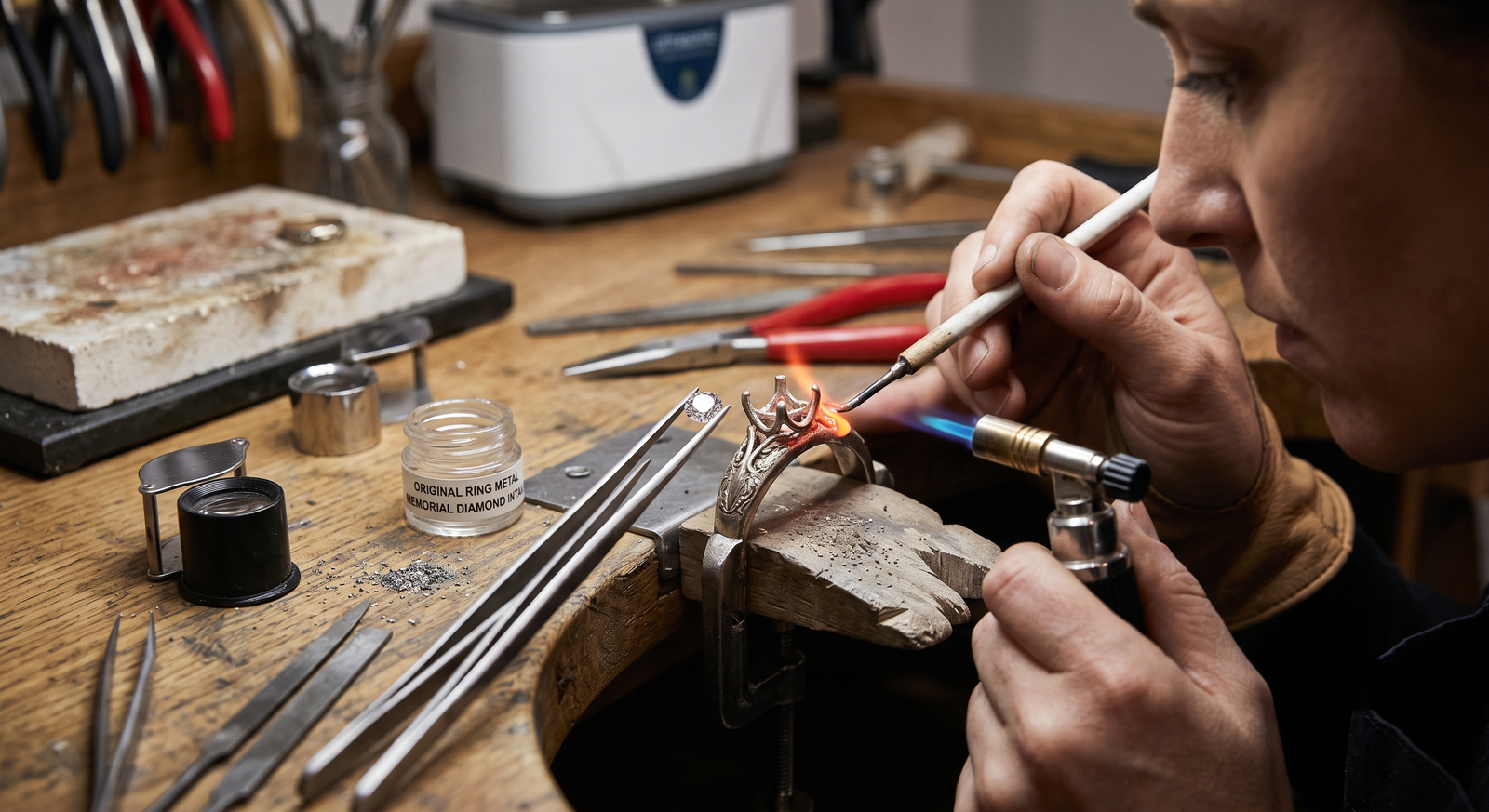
That sentence is the one to hold onto. A wife ashes diamond is not “100% her,” and any provider who tells you otherwise is describing physics that does not exist. What it is: a genuine diamond in which a real, verifiable portion of the carbon that was in her body now sits inside a crystal lattice. Chemically, optically, and by hardness, 10 on the Mohs scale, it is indistinguishable from any other diamond.

How Much of Her Ashes Is Used?

Far less than most people fear. Requirements vary by provider, but across the industry a wife ashes diamond typically needs somewhere between a few tablespoons and roughly 4 oz, about 100 g, of cremated remains, a small fraction of the ashes a full cremation produces.

That has two consequences worth stating plainly:

  • Everything else you planned for her still happens. The scattering at the beach she loved, the interment beside her parents, the urn that stays on the shelf, none of it is cancelled. The diamond takes a portion; the plan takes the rest.
  • More than one stone is often possible. Because so little is used per wife ashes diamond, a second stone for a daughter, a son, or her sister can usually be grown from the same submission. How much ash is needed for a wife memorial diamond covers the quantities in detail, including what happens if the ashes were already divided at the crematorium.

Sending more ash does not produce a bigger wife ashes diamond. Size is a function of growth time in the press, not of how much material went in, so a family that sends a full urn does not get a larger stone, only an unnecessary loss of ashes they could have kept.

How Is a Wife Ashes Diamond Made?

The process is the same one the broader lab grown diamond industry uses, with a personal carbon source at the front of it. Seven stages, in order:

StageWhat happensTypical duration
1. CollectionHer ashes are received with chain of custody tracking, a labeled, logged, traceable record from arrival to finished stoneDays
2. Carbon extractionThe ash is heated in a controlled, oxygen free, multi stage process that strips away the calcium phosphate and other minerals, leaving carbon at 99.9%+ purityWeeks
3. GraphitizationThe purified carbon is heated to roughly 2,500 to 2,700°C and converted to graphite, the crystalline form presses use as feedstockDays to weeks
4. Diamond growthThe graphite, blended with supplemental lab carbon, goes into an HPHT press with a tiny diamond seed at roughly 6 to 8 GPa and 1,400 to 2,500°C, or, with some providers, is converted to gas for CVD growthWeeks to months, this stage sets the carat
5. Cutting and polishingA gemologist cuts the rough crystal into round, princess, cushion, or another shapeWeeks
6. Optional irradiationSome providers shift or intensify color post growth for red, pink, green, or blackDays
7. Grading and certificationThe stone is graded, ideally by an independent lab, and issued an origin certificateWeeks
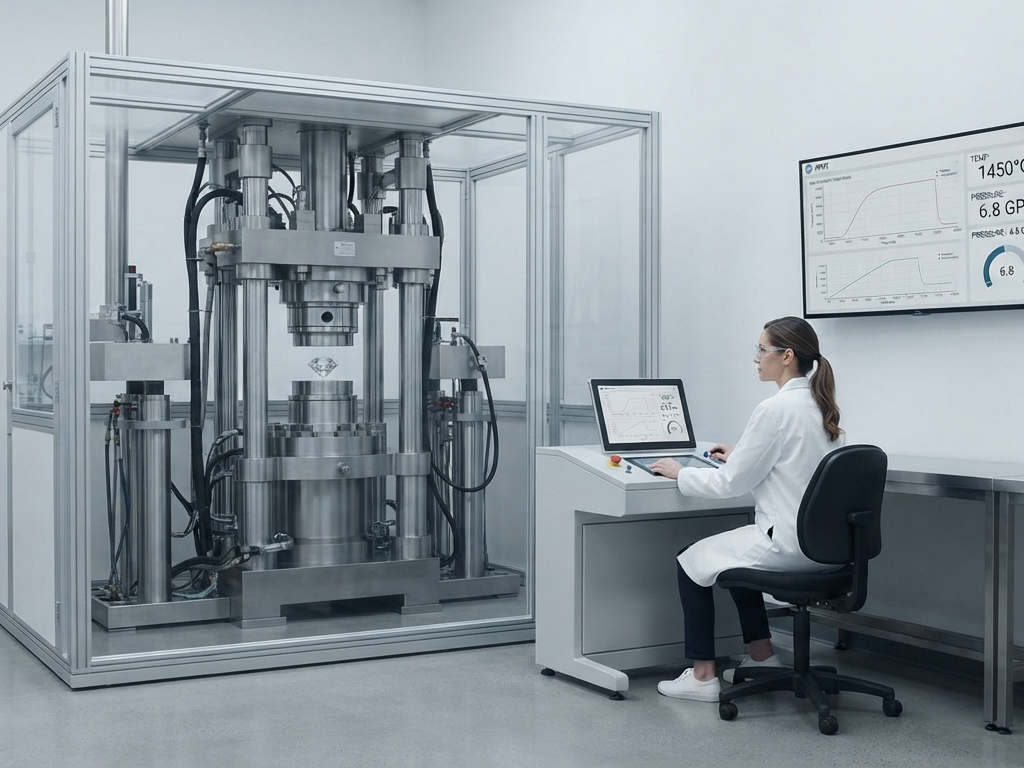
Industrial HPHT press in a laboratory with a technician checking readouts

HPHT is the standard method for memorial stones; a minority of providers use CVD. Both produce a genuine diamond. The technical detail of both methods is on the synthetic diamond page, if you want to read past what a provider tells you.

The step in making a wife ashes diamond most families ask about is the second one, how anyone can be sure the carbon that comes out was hers. The honest answer is the chain of custody record: a reputable provider logs the sample at every stage, and the origin certificate at the end documents that this specific stone was grown from this specific submission. How a memorial diamond is made from your wife’s ashes goes through each stage in more detail, and whether it is really made from her ashes takes the skeptic’s question seriously.

What Color Will It Be?

Probably not colorless, and that is worth knowing before you picture it.

Diamond color comes from trace elements present during growth. Nitrogen produces yellow tones; boron produces blue. Because the carbon in a wife ashes diamond comes from an organic, personal source rather than a controlled synthetic feedstock, trace elements are common, which is why memorial diamonds naturally trend toward yellow, blue, and champagne or amber brown tones.

Three loose memorial diamonds yellow, blue, and champagne on a gray grading tray
ColorWhat produces itWhat it typically means for cost
Yellow to champagneTrace nitrogen, the most common natural outcomeThe baseline; usually the most accessible tier
BlueTrace boronSimilar to yellow; some providers price it higher
Colorless / whiteAdditional processing to exclude trace elementsMeaningfully more at the same carat
Red, pink, green, blackPost growth irradiationProvider specific; black often takes longer

The color of a wife ashes diamond is a feature of the individuality of the source, not a flaw. Two stones grown from the same ashes can differ slightly. If she had a favorite color, or if you already know the ring you want will be yellow gold or platinum, that is a reasonable thing to steer by, but the stone’s own tendency is the starting point, and colorless is a choice that costs more, not the default. What color a diamond made from your wife’s ashes will be covers the choice in full.

Carat, Cost, and What Drives the Price

A wife ashes diamond is generally offered from about 0.10 carats up to 5 carats or more, and cost scales steeply with size because larger stones need much longer in the press.

The ranges below are general industry figures for 2026, not Memorial Diamond’s published prices, and every provider prices differently. Final cost depends on carat, color, cut, and whether an independent grading report is included.

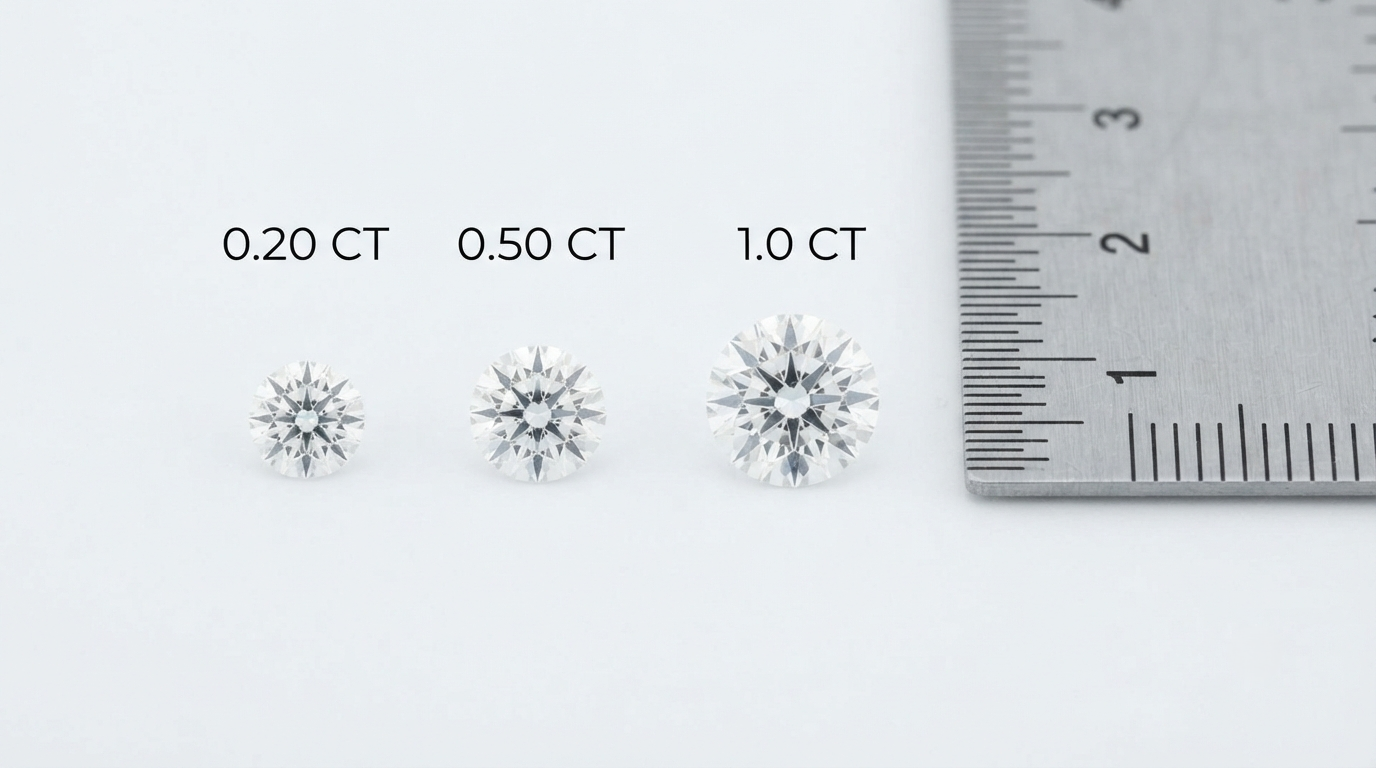
Loose diamonds at 0.20, 0.50, and 1.0 carat beside a ruler for scale
TierApproximate caratTypical industry rangeNotes
Entry0.10 to 0.25 ctRoughly $1,500 to $3,500Reads well in a bezel ring or a small pendant
Mid0.5 to 1 ctRoughly $5,000 to $15,000Colorless costs meaningfully more than yellow, blue, or champagne at the same size
Large / rare2 to 5+ ctRoughly $20,000 to $75,000+Growth time drives both price and timeline

Settings, a ring, pendant, or pair of earrings, are almost always priced separately from the loose stone, as are engraving, fancy cuts, and an independent grading report. A wife ashes diamond at the entry tier, set simply in gold, is the realistic floor for most families; the ceiling is wherever carat and platinum take it. How much a wife memorial diamond costs works through a full quote line by line.

One non financial note on carat: a small wife ashes diamond is not a small gesture. A 0.20 ct diamond in a bezel is worn every day by people who would never have worn a solitaire. Choose the size for the piece you will actually wear.

How Long Does It Take?

Across the industry, a wife ashes diamond typically takes 6 to 10 months from receipt of her ashes to a finished stone. Larger stones and some specialty colors, black in particular, or anything over roughly 2 carats, can take up to 12 months.

An origin certificate and an independent grading report side by side on a desk

The timeline for a wife ashes diamond is driven by growth time, which is driven by carat. It is not driven by how much ash you sent, and it is not something a provider can meaningfully rush. If there is a date you are hoping to have the stone by, an anniversary, a child’s wedding, count back from it and add a margin, and be honest with yourself about whether missing that date would be bearable. Ordering against a date you cannot bear to miss is the one piece of timing advice that matters. How long it takes to make a wife memorial diamond covers reverse planning against a calendar.

Questions to Settle Before Anything Is Sent

A wife ashes diamond is a decision you make once, with material you cannot get back. These are the questions worth answering before her ashes leave the house, most of them are for you, a few are for the provider.

  1. Do you control the ashes? If you are her spouse and she left no written instructions, prepaid plan, or will naming someone else, in most US states the answer is yes. If any of those documents exist, read them first.
  2. Have the ashes already been divided? If a portion went to her mother or her sister at the crematorium, that portion is theirs. You send from what you hold.
  3. How much does this provider need, and what happens to any excess? Ask whether unused material is returned.
  4. What chain of custody documentation do they provide? You want a logged, traceable record, not just a certificate at the end.
  5. Is grading independent or in house? An in house authenticity certificate documents origin; an independent grading report documents quality. They are different documents, and reputable providers offer both. How gemologists grade cut, color, clarity, and carat is the same standard for a memorial stone as for any other.
  6. What is the realistic timeline for a wife ashes diamond at the carat you want? Get it in writing.
  7. What is the full price, including the setting? Ask for the loose stone price and the set price separately.
  8. Who else expects a stone, and have you told them? The next section.

Questions to ask before turning your wife’s ashes into a diamond expands each of these into what a good provider answer sounds like.

Who Else This Decision Touches

A wife ashes diamond touches her parents, if they are living. Her siblings. Your children, whatever their age. In most cases none of them has a legal say, but all of them have a stake, and telling them before the material is sent goes far better than telling them after.

Three things families find useful to say early: only a small portion is used, everything else planned for her still happens, and there is often enough for more than one stone if someone wants their own. Whether more than one family member can get a diamond from the same wife’s ashes covers the cost and the mechanics before you offer.

If her family holds a religious view on cremation or on dividing ashes, note that no tradition has an official position on memorial diamonds specifically, only on cremation and ash handling in general, and that views vary by denomination and by individual clergy. The cremation has already happened; the live question is usually about dividing what remains, which is a narrower concern with a narrower answer.

Frequently Asked Questions

Is a wife ashes diamond a real diamond?

Yes. It is a lab grown diamond with the same chemical composition, optical properties, and hardness, 10 on the Mohs scale, as any other diamond, graded by the same cut, color, clarity, and carat standards. It differs only in where part of its carbon came from.

How much of the finished diamond is actually her?

Typically around 10% to 15% of the stone’s mass is carbon recovered from her ashes, with the rest supplemental lab carbon added to reach a workable size. Some providers cite lower or higher figures depending on carat. No memorial diamond is 100% personal carbon; any provider claiming that is overstating.

Can I still scatter or bury the rest of her ashes?

Yes. A wife ashes diamond needs only a small portion, typically a few tablespoons to around 4 oz, so the scattering, interment, or urn you already planned still happens with the rest. The diamond is an addition to that plan, not a replacement for it.

Will the diamond be colorless?

Usually not by default. Trace nitrogen from an organic carbon source tends to produce yellow or champagne tones, and boron produces blue. Colorless is achievable with additional processing and typically costs more at the same carat. Many families choose the natural color as a feature of the stone’s individuality.

How long does a wife ashes diamond take?

Typically 6 to 10 months from receipt of ashes to finished stone across the industry, with larger stones or specialty colors such as black sometimes taking up to 12 months. Growth time depends on carat, not on how much ash was sent, and cannot meaningfully be rushed.

Can our children each have a diamond from her ashes too?

Often, yes. Because only a small portion is used per stone, several diamonds can typically be grown from one submission. Each stone is priced and grown separately, and stones from the same ashes can differ slightly in color. Tell the family before the material is sent.

What documents should come with the finished stone?

Two: an origin or authenticity certificate documenting that this diamond was grown from her submitted carbon, and a grading report, ideally from an independent lab, documenting cut, color, clarity, and carat. Keep both with the receipt for any setting.

Final Thoughts on a Wife Ashes Diamond

Nothing on this page has to be decided this month. Her ashes do not change, the process does not change, and a provider will be there when you are ready. What a wife ashes diamond offers is narrow and real: a stone that exists because a portion of her carbon is inside it, that you can wear or keep or hand to a child, and that is a genuine diamond by every test a jeweler can run. Whether that is the right thing for you is not something a guide can settle. What it can do is make sure that if you choose it, you choose it knowing exactly what it is.

Learn More About Wife Memorial Diamonds

Talk With Memorial Diamond

If you are weighing a wife ashes diamond and want to know what is possible with the amount of ashes you hold, what carat is realistic for your budget, or how a second stone for a child would work, reach out to Memorial Diamond to talk it through. There is no deadline on any of it.

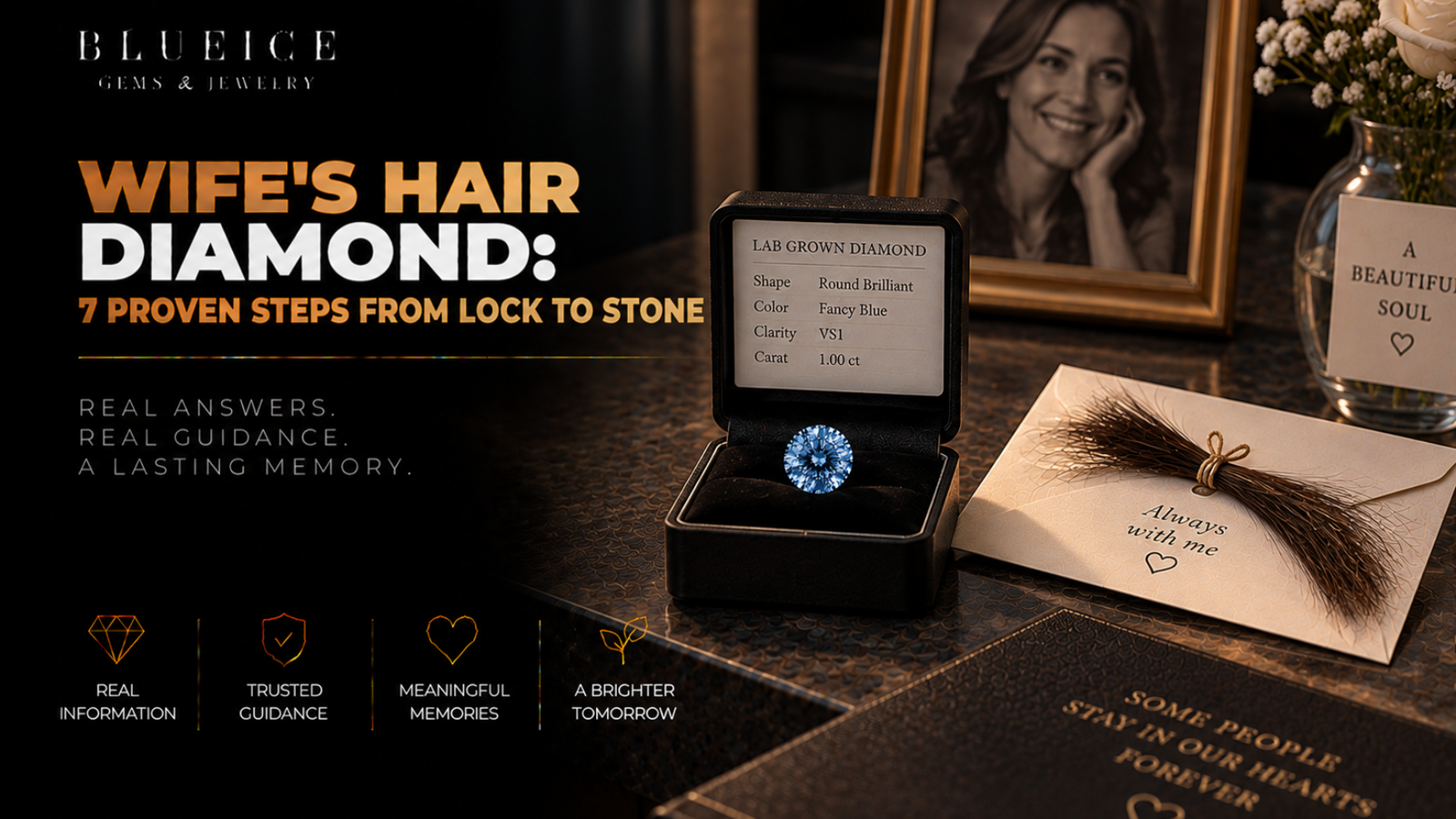
Wife's hair diamond: a small blue lab-grown diamond in its grading box beside a tied lock of hair on a paper envelope

How to Turn Your Wife’s Hair Into a Diamond

The hair is probably somewhere already: a brush that was never emptied, an envelope from a haircut before treatment, a braid saved from years ago, a few strands caught in a hat. A wife’s hair diamond is made in seven steps: find and check the hair, divide the lock so part of it stays with you, choose a provider and a carat, send the portion with a documented chain of custody, wait roughly 6 to 10 months while the carbon is extracted and grown into a real lab grown diamond, receive the graded stone, and decide what it becomes.

No cremation is involved at any stage, a few grams is typically enough, and the hair’s age and color do not matter. This is the practical, in order version: what you do and what to keep, with the science left to the guides linked along the way.

Before Step One: Why Hair Works, and What the Stone Contains

Hair is built from keratin, a carbon rich protein, and is roughly 50% carbon by weight. Cremated ashes, by contrast, are almost entirely calcium phosphate with only about 0.5% to 4% usable carbon. That is why a wife’s hair diamond needs so little material, why it needs no cremation, and why it is available to families who chose burial or who scattered every ash but kept a lock.

The finished wife’s hair diamond is a real lab grown diamond: same crystal structure, same optics, hardness 10 on the Mohs scale. It is not “100% her”: the carbon extracted from her hair is purified and blended with supplemental lab carbon to reach the volume a diamond needs. What is true is that a real, verifiable portion of the carbon that was in her body sits inside the crystal lattice. Because hair yields so much more carbon than ash, some providers reach a higher personal carbon share from hair at small carats: ask yours what they achieve rather than assuming.

That is enough science for a wife’s hair diamond to begin. Wife Hair Diamond: The Complete Guide has the rest.

Step 1: Find the Hair and Check Its Condition

Gather what exists before deciding anything about a wife’s hair diamond, because how much you have shapes every later step.

SourceUsable for a wife’s hair diamond?What to do
A cut lock, tied or in an envelopeYes, almost alwaysThe ideal case: keep it as it is
A braid or ponytail from a haircut or a donation that never wentYes, with plenty to spareEnough for several stones
Hair from a brush or combUsuallyDo not empty it; a provider may want more volume than a cut lock to allow for cleaning
Strands from a pillowcase, hat, or coat collarSometimesPool them in one envelope and ask
Hair kept from decades agoYesKeratin is stable; age is not a barrier if it has stayed dry
Dyed, bleached, permed, or gray hairYesTreatments change the surface, not the carbon; the diamond’s color is unrelated to the hair’s
Synthetic extensionsNoNo keratin, no carbon
Hair that has visibly rottedNoProlonged damp is the one thing that ruins it, and it is obvious when it has
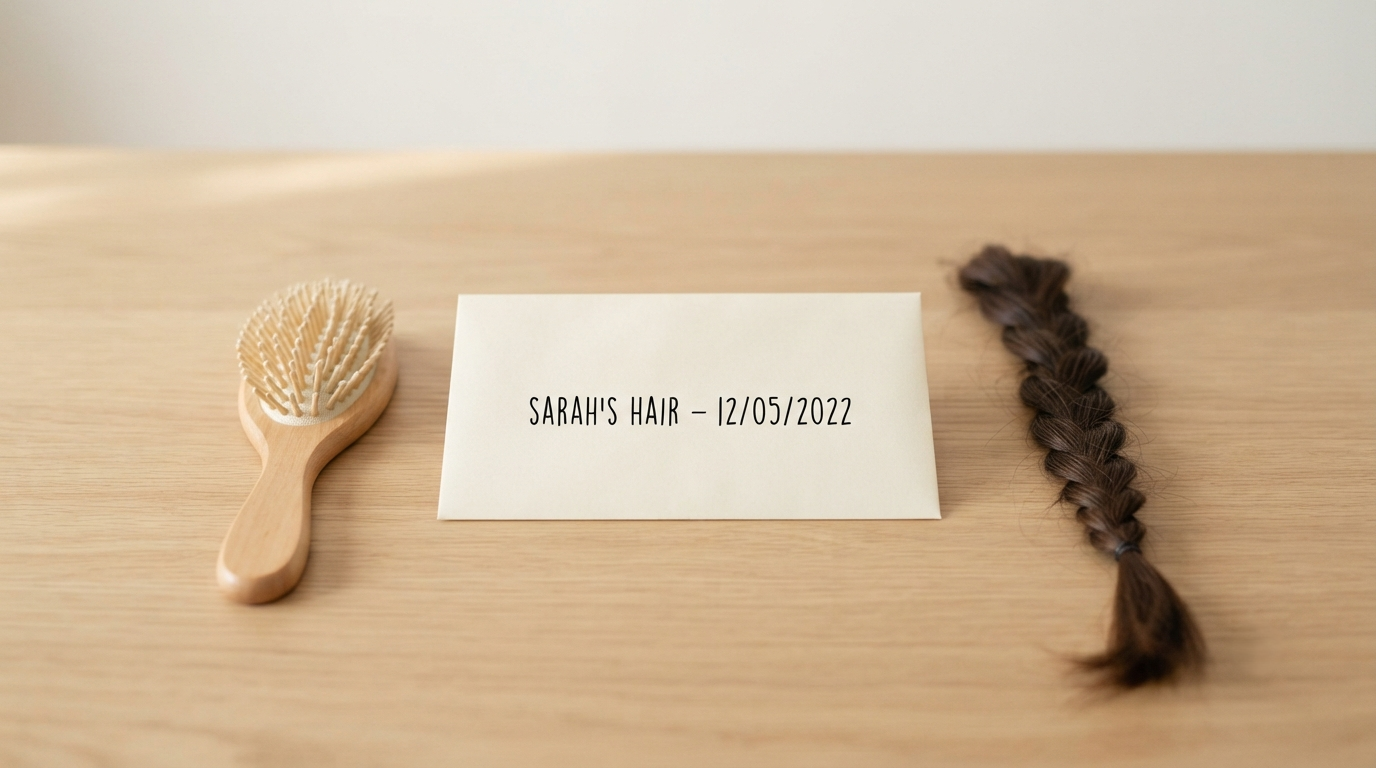
A hairbrush, a labeled paper envelope, and a saved braid laid side by side on a table

Check the hair for a wife’s hair diamond is dry, keep it in a paper envelope rather than plastic (paper breathes), label the envelope with her name and the date you gathered it, and photograph it. If you are unsure whether what you have is enough, that is a question for step 3: do not throw anything away while deciding.

Step 2: Divide the Lock and Keep Some

This step exists only for a wife’s hair diamond, and it matters more than any other on this page.

A portion of ashes can sometimes be topped up from the urn. A lock of hair, once sent, is gone. Across the industry a wife’s hair diamond typically needs a small lock or a few grams: often described as “palm sized,” “a few wisps,” or “pencil thick”: so if you hold a full braid, you will send a fraction of it. If you hold a single small lock, decide now whether to divide it.

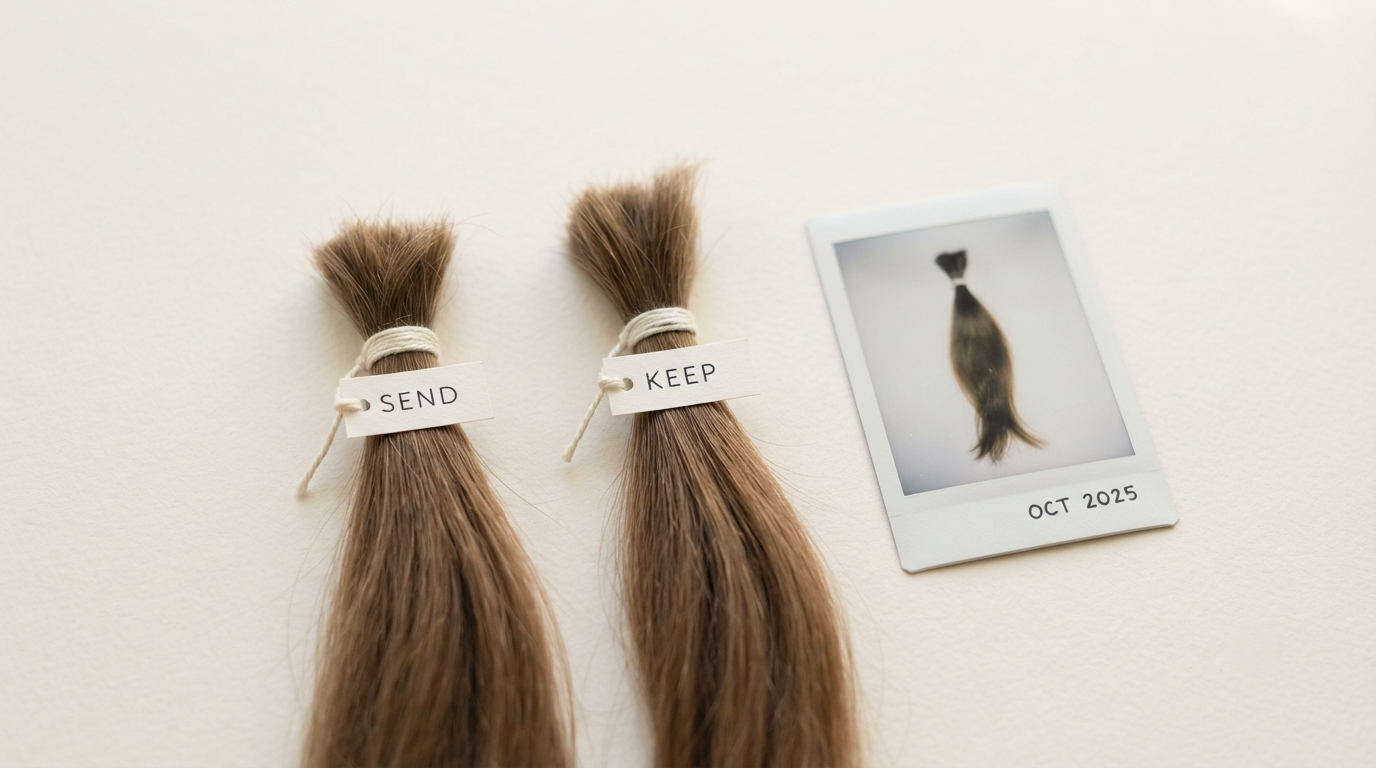
Two tied portions of one lock of hair one labeled "send," one labeled "keep" beside a dated photograph
  • If the lock is the only one you have, divide it. Send what the provider needs and keep the remainder intact, in its own labeled envelope, with the photograph you took in step 1.
  • Sending more does not help. The carat of a wife’s hair diamond is set by growth time in the press, not by material volume. A provider who suggests sending the whole braid “to be safe” is a provider to question.
  • If several people want a stone, the same lock can usually support more than one wife’s hair diamond, and each is grown and priced separately. Decide whether to send enough for all of them now, or keep the remainder for later. How much hair you need for a wife memorial diamond covers the quantities and the edge cases.

Tie the portion to be sent with thread, label it, photograph it beside the portion you are keeping, and only then move to the next step.

Step 3: Choose a Provider and a Carat

For a wife’s hair diamond the two decisions arrive together because carat sets both price and timeline, and the provider tells you what your amount of hair can support.

The provider. Put the same questions to each candidate:

  1. Is what I have enough: and can I send a photograph before I ship anything?
  2. Do you return unused hair?
  3. What chain of custody documentation do you provide, and can I see where her hair is at each stage?
  4. What share of the finished stone’s carbon typically comes from the submitted hair, at the carat I want?
  5. Is grading independent or in house? An origin certificate documents that the stone was grown from her hair; a grading report, ideally from an independent lab using GIA’s cut, color, clarity, and carat standards, documents quality. You want both.
  6. What is the realistic timeline for this carat, in writing, and what is the loose stone price separate from the setting?

The carat. A wife’s hair diamond is typically offered from about 0.10 ct to 5+ ct. General 2026 industry ranges, not Memorial Diamond’s published pricing:

TierCaratTypical rangeTypical timeline
Entry0.10 to 0.25 ctRoughly $1,500 to $3,5006 to 8 months
Mid0.5 to 1 ctRoughly $5,000 to $15,0008 to 10 months
Large / rare2 to 5+ ctRoughly $20,000 to $75,000+Up to 12 months

Colorless costs meaningfully more than yellow, blue, or champagne at the same carat. Hair does not shorten the timeline: growth time is growth time. How much a wife memorial diamond costs works through a full quote.

The color. A wife’s hair diamond will not be the color of her hair. Nitrogen carried in with organic carbon tints a diamond yellow or champagne; boron tints it blue; and a stone from red, brown, or gray hair is no more likely to be any of those than one from ashes. Colorless takes extra processing and extra cost. If you want the natural result, say so; if you want a specified color, the provider will give you a date by which to decide, because nothing can be changed once growth begins.

Step 4: Send It With a Paper Trail

Because the hair you are sending for a wife’s hair diamond cannot be replaced, this is the step to slow down on.

Fill in the provider’s submission form and copy it: a scan on your phone is enough: before it goes in the package. Put the tied, labeled portion in whatever envelope or container the provider asked for, with the form. Ship it by a tracked, insured service that can tell you where the package is at any hour, and write the tracking number on your copy of the form.

Then wait for the acknowledgement. A reputable provider confirms the hair arrived and gives you a reference number; if the window they promised passes in silence, ask rather than assume. Before any of this, ask what the chain of custody record will let you see, and when: some providers show each stage, others only the finished stone.

One folder, kept together: the form, the tracking record, the photograph from step 2 of the sent portion beside the kept portion, and the acknowledgement. If anyone ever asks how you know the wife’s hair diamond came from her, that folder is the answer.

Step 5: What Happens During the 6 to 10 Months

Nothing is asked of you for most of a year. Knowing what the laboratory is doing to a wife’s hair diamond in that time makes the silence easier.

The hair goes first into purification: a controlled, oxygen free heating process, run in stages, that burns off everything in keratin that is not carbon and leaves carbon at 99.9%+ purity. Because hair starts at roughly half carbon, this stage recovers far more from a few grams of hair than the equivalent stage recovers from ashes. The purified carbon is then heated toward 2,500 to 2,700°C until it becomes graphite, the form of carbon a diamond press can work with.

Laboratory furnace with a sealed crucible during carbon purification

Growth is the long part. The graphite, blended with supplemental lab carbon to make up the volume, sits with a tiny diamond seed inside an HPHT press at roughly 6 to 8 GPa and 1,400 to 2,500°C: or, with a minority of providers, is turned into gas and deposited layer by layer in a CVD chamber. Weeks to months pass here, and the length of this stage is what decides the carat. The synthetic diamond article describes both methods in more depth than any provider brochure will.

After growth: cutting and polishing by a gemologist, irradiation only if you asked for red, pink, green, or black, and finally grading and the origin certificate. Ask before sending whether the provider sends progress updates: a photograph of the rough crystal, a note at cutting: so that months of nothing are expected rather than worrying. How a memorial diamond is made from your wife’s hair and how long a wife memorial diamond takes go further on both.

Step 6: Receive and Check the Wife’s Hair Diamond

Open the box with the folder from step 4 beside you, and check four things before anyone else sees it:

CheckWhat you are looking for
The origin certificateHer name or your reference, “hair” as the material, and the provider’s attestation that this stone grew from it
The grading reportCarat, color and clarity grades, cut: and the name of the lab, so you know whether it is independent or in house
The stone against the reportCarat within normal cutting variance; color inside the range you were told to expect
Returned hair, if the provider returns itThat it came back, and roughly matches what you expected

Expect a color you did not picture. Yellow, champagne, and blue are the natural outcomes for any memorial diamond, and two stones from one lock can differ. If you specified a color and the stone falls outside the promised range, this is the moment to say so, with the report in hand: not after it has been set.

Then the origin certificate, the grading report, the submission folder, and the kept portion of her hair go together in one place. The person who holds this wife’s hair diamond after you should be able to prove what it is.

Step 7: Decide What It Becomes

There is no clock on this step, and a loose wife’s hair diamond in its grading box loses nothing by sitting there for a year.

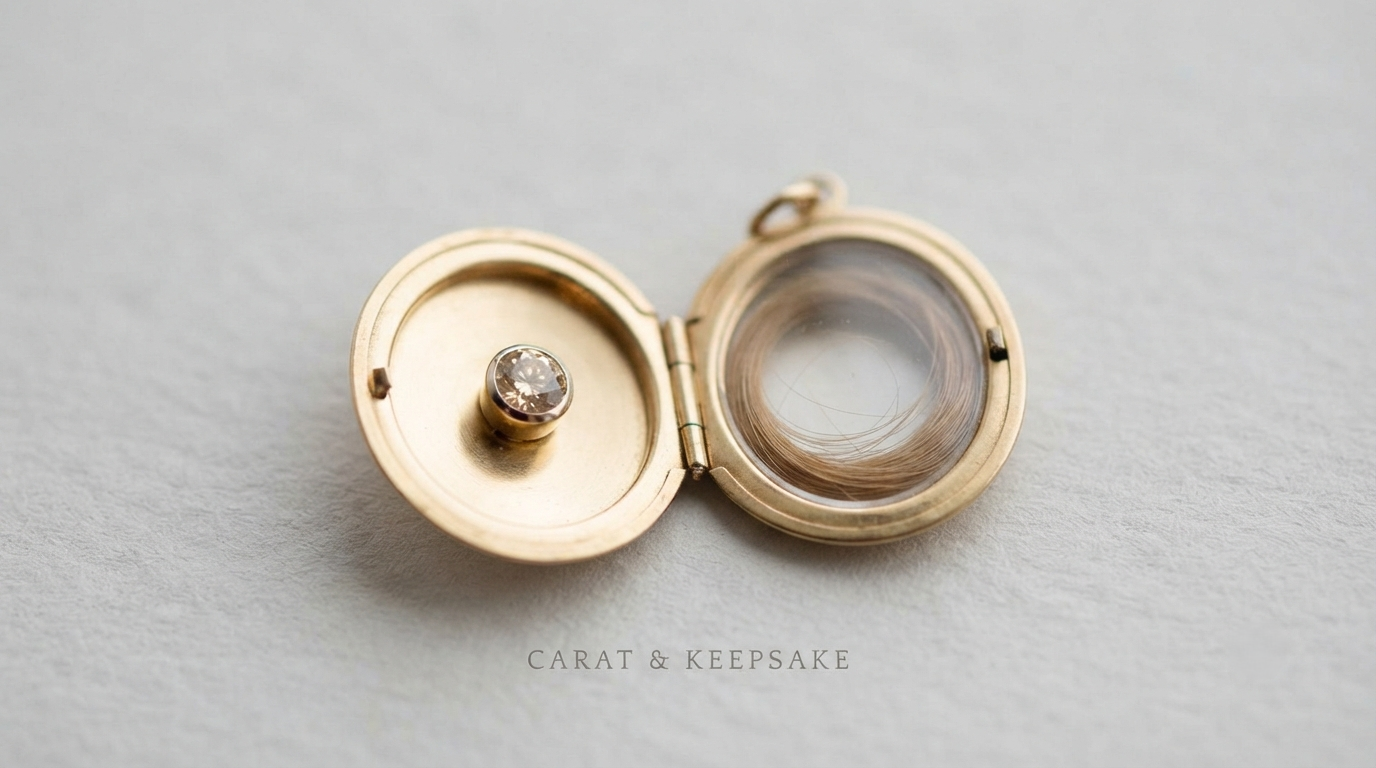
 An open gold locket holding a small champagne diamond on one side and a coiled lock of hair on the other

Two ideas are specific to hair. The first is a locket: one side holds the diamond, the other holds the coiled remainder of the lock you kept in step 2, so the stone and its source travel together. The second is a small bezel pendant on the chain she wore: hair based stones are often ordered at the entry carat, and a 0.15 to 0.25 ct diamond that would vanish in a prong ring looks deliberate in a bezel.

Beyond those: a ring for daily wear, her own band reset if the metal can be worked, a piece for a son or daughter. Match metal to the color the stone came back: warm metals for yellow and champagne, white metals for blue: and expect the setting to be priced separately. Wife memorial diamond ideas: rings, pendants, and keepsakes has the fuller list.

Frequently Asked Questions

How much of my wife’s hair do I need?

Typically a small lock or a few grams: often described as palm sized or pencil thick: though minimums vary by provider. Send a photograph and ask before shipping. Sending more does not produce a larger diamond, because carat is set by growth time. Keep part of the lock.

Does hair from her brush work?

Usually. Loose strands from a brush or comb are typically usable, though a provider may ask for more volume than a cut lock because loose hair is cleaned before extraction and some is lost. Do not empty the brush while deciding, and ask the provider before you send.

Does it matter that her hair was dyed, gray, or very old?

No. Dye and chemical treatments change the hair’s surface, not its carbon; extraction strips everything that is not carbon. Keratin is stable, so hair kept dry for decades still works. The diamond’s color is set by trace elements during growth and has nothing to do with the hair’s color.

Can I make a wife’s hair diamond if she was buried?

Yes. Hair contains its own carbon: roughly 50% by weight: so no cremation is involved at any stage. A wife’s hair diamond is the route to a memorial diamond for families who chose burial, or who scattered or interred all the ashes but kept a lock.

How long does it take?

A wife’s hair diamond typically takes 6 to 10 months from the day the provider receives the hair, with large stones and black stones sometimes running to 12. Hair does not shorten this: the press sets the timeline by carat, not by what went in: so plan against a date with margin.

What should I keep?

Part of the lock, intact, in its own labeled envelope. Your submission form, the tracking record, a dated photograph of the sent portion beside the kept portion, and the provider’s acknowledgement. When the stone arrives, add the origin certificate and the grading report. Together, that is the proof.

Final Thoughts on Making a Wife’s Hair Diamond

Of the seven steps, the one that matters most is the second: the one where you divide the lock and keep some. Everything else is a provider’s job or a matter of patience. A wife’s hair diamond asks very little of you and very little of her: a few grams, a tied thread, a photograph, and most of a year. If you are not ready for a wife’s hair diamond, the envelope keeps. If you are, the process is simpler than the weight of the decision suggests.

Learn More About Wife Memorial Diamonds

Talk With Memorial Diamond

If you have found the hair and want to know whether it is enough, whether its condition matters, or how to divide it so you keep some, reach out to Memorial Diamond with a photograph before sending anything. The first question is usually answerable without shipping a single strand.

Wife's ashes hair diamond: a small champagne lab-grown diamond between a sealed ash container and a tied lock of hair, all labeled with the same reference

How to Turn Your Wife’s Ashes and Hair Into a Diamond

If you hold both her ashes and a lock of her hair, you have already read or could read how each becomes a diamond on its own. This page does not repeat those steps.

A wife’s ashes hair diamond is a single lab grown diamond grown from carbon extracted from both her cremated remains and her hair, and turning both into one stone adds exactly five things to the standard process: asking for a combined minimum rather than two separate ones, insisting on one chain of custody record instead of two, packaging both materials for one shipment, understanding how the two carbons are blended, and getting an origin certificate that names both.

Everything else, confirming you can decide, choosing a provider and carat, the 6 to 10 months of growth, receiving and checking the stone, is identical to a single material stone and is covered in the ashes how to and the hair how to. This page covers only what combining adds.

What a Wife’s Ashes Hair Diamond Is, and Why Families Combine

A wife’s ashes hair diamond is a real lab grown diamond, same crystal structure, same optics, hardness 10 on the Mohs scale, grown around carbon that came from two sources: her cremated remains and a lock of her hair.

The chemistry is lopsided, and it is better to know that now. Hair is roughly 50% carbon by weight; ashes are almost entirely calcium phosphate with only about 0.5 to 4% usable carbon. In a combined submission, the hair supplies most of the personal carbon and the ashes a smaller share. Neither material makes the stone bigger, faster, or purer. Carat is set by growth time in the press, and the personal carbon is blended with supplemental lab carbon regardless of how many sources it came from.

So the reason to combine is not chemical. It is that the hair is carbon she grew while alive and the ashes are what remained, and some families want both in one crystal lattice. That is a good reason. Wife Ashes and Hair Diamond: The Complete Guide covers when it makes sense and when a single material is simpler.

What Stays the Same as a Single Material Stone

Most of the process of a wife’s ashes hair diamond. The table below is the whole seven step how to with the unchanged rows pointed to the page that already covers them, so this page can spend its length on the five rows that differ.

StepChanges for a wife’s ashes hair diamond?Where it is covered
Confirm you have the right to decide about her remainsNoAshes how to, step 1
Find the hair and check its conditionNoHair how to, step 1
Measure out the ashes portionPartly: see added step 1Ashes how to, step 2
Divide the lock and keep somePartly: see added step 1Hair how to, step 2
Choose a providerPartly: see added steps 2 and 4Either how to, step 3
Choose a carat and, if wanted, a colorNoEither how to, step 3
Send it with a paper trailPartly: see added steps 2 and 3Either how to, step 4
The 6 to 10 months of extraction, graphitization, growth, cutting, gradingPartly: see added step 4Either how to, step 5
Receive and check the stonePartly: see added step 5Either how to, step 6
Decide what it becomesNoEither how to, step 7

Cost of a wife’s ashes hair diamond is also unchanged or nearly so: most providers price by carat, color, cut, and grading, not by material, though a few add a modest processing fee because extraction runs twice. General 2026 industry ranges, not Memorial Diamond’s published pricing, run roughly $1,500 to $3,500 for 0.10 to 0.25 ct, $5,000 to $15,000 for 0.5 to 1 ct, and $20,000 to $75,000+ above 2 ct, with colorless costing more at every size. Timeline is unchanged at 6 to 10 months, up to 12 for large or black stones.

Added Step 1: Ask for the Combined Minimum

The single material how tos tell you to ask the provider’s minimum in writing. For a wife’s ashes hair diamond, ask specifically for the combined minimum, because it is often less of each than the two standalone figures.

The standalone figures across the industry are a few tablespoons to roughly 4 oz of ashes, and a small lock or a few grams of hair. A provider quoting both in full for a combined stone may simply be reading two lines off a price list. Many will accept less of each when both are submitted, since the hair alone usually clears the carbon requirement. Ask:

  1. “For a combined ashes and hair submission at [carat], how much of each do you need?”
  2. “If I hold less ashes than your standard minimum, does the hair make up the difference?”
  3. “Do you return unused material of either kind?”

Then measure out only that amount for the wife’s ashes hair diamond. Everything else you planned for her ashes still happens, and the remainder of the lock stays home. If the lock is the only one you have, divide it before sending: a wife’s ashes hair diamond takes two irreplaceable things from the house at once, and keeping part of each is the one precaution that costs nothing. How much ash and hair you need for a wife memorial diamond covers the quantities.

Added Step 2: Insist on One Custody Record

A chain of custody record is the logged, traceable trail from the moment your submission arrives to the finished stone. Every reputable provider keeps one. The risk specific to a wife’s ashes hair diamond is that two materials get logged as two submissions, and somewhere between extraction and growth the link between them is lost, or the provider cannot later show that both went into the same stone.

Before sending anything for a wife’s ashes hair diamond, ask:

  • “How is a two material submission logged: as one record or two?”
  • “At what stage are the two purified carbons combined, and is that step recorded?”
  • “Can I see the record for both materials at each stage?”

The answer you want is one submission reference covering both materials, with the combination step logged. If the provider logs them separately, ask how the two records are tied together in writing. A provider who cannot answer this clearly is telling you something.

Added Step 3: Package Both for One Shipment

For a wife’s ashes hair diamond, the ashes go in a sealed, dry container the provider specifies. The hair goes in a labeled paper envelope, tied with thread. Both go inside one outer package with one submission form that lists both materials.

ItemWhat to write on itWhy
Ash containerHer name, “ashes,” your submission referenceSo it cannot be mistaken for another family’s
Hair envelopeHer name, “hair,” the same submission referenceSame reference ties both to one record
Submission formBoth materials listed, amounts statedThe provider’s record starts from this form
Your photographBoth items, labeled, beside the form, date visibleYour own record, independent of theirs
Labeled ash container, labeled hair envelope, and a submission form listing both, arranged beside a dated photograph

Ship the wife’s ashes hair diamond submission tracked and insured, keep the tracking number with your copy of the form, and confirm receipt of both materials, not just “your package arrived.” A wife’s ashes hair diamond submission has two things to acknowledge, and a good provider will name both.

Added Step 4: Understand the Blend

The seven stage process for a wife’s ashes hair diamond is the standard one, with the difference concentrated in stage two.

  1. Collection: both materials for the wife’s ashes hair diamond logged under one reference.
  2. Carbon extraction and purification: run for each. Ashes are heated in a controlled, oxygen free, multi stage process that strips away bone mineral to recover the small carbon fraction. Hair is heated the same way to remove the non carbon components of keratin. Both reach 99.9%+ carbon purity. Some providers process the two together from the start; others purify separately and combine after. The result is the same; asking which tells you the provider understands the difference.
  3. Graphitization: the combined carbon is heated to roughly 2,500 to 2,700°C and converted to graphite.
  4. Diamond growth: the graphite, blended with supplemental lab carbon, grows around a seed in an HPHT press at roughly 6 to 8 GPa and 1,400 to 2,500°C, or in a CVD chamber with some providers, for weeks to months. This sets carat. Both methods are on the synthetic diamond page.
  5. Cutting and polishing.
  6. Optional irradiation for red, pink, green, or black.
  7. Grading and certification.
Two labeled crucibles in a laboratory furnace during separate purification runs

The question worth asking about a wife’s ashes hair diamond at this step: “What proportion of the personal carbon in the finished stone came from the ashes, and what from the hair?” A confident provider gives a range. A provider who implies the two contributed equally is describing a symmetry the chemistry does not support. Color is not predictably affected by combining: trace nitrogen or boron from either source produces yellow, champagne, or blue as with any memorial diamond, and colorless needs extra processing. What color a diamond made from your wife’s ashes and hair will be covers the choice.

Added Step 5: Get a Certificate That Names Both

When the stone arrives, the single material how tos tell you to check the origin certificate, the grading report, the stone against the report, and the carat. For a wife’s ashes hair diamond, add one check: the origin certificate must name both materials.

An origin or authenticity certificate is the provider’s attestation that this specific stone was grown from this specific submission. If it says “ashes” and does not mention the hair, the document does not record what you sent. Ask for the certificate’s wording in advance, before the material leaves the house, so there is no argument at the end. The grading report, ideally from an independent lab using GIA’s cut, color, clarity, and carat standards, documents quality and is unaffected by the number of sources.

An origin certificate on a desk with two material lines visible, beside a loose diamond on its grading report

Then put the wife’s ashes hair diamond certificate, the grading report, your submission folder, and the kept portions of both materials together. Whoever holds the stone after you should be able to prove what it is and what it came from.

What Good Answers to the Five Questions Sound Like

Because every added step is a question, here is how to tell a provider who has made a wife’s ashes hair diamond before from one who is reading a price list.

QuestionAn answer that shows they understand combined stonesAn answer that should prompt more questions
Combined minimum“For that carat, about half our standard ash amount plus a small lock: the hair carries most of the carbon.”“Send the full minimum of each to be safe.”
One custody record“One reference number; both materials logged under it, and the combination step is recorded.”“We’ll log them as two jobs and match them up later.”
Packaging“Sealed container for ashes, paper envelope for hair, same reference on both, one form.”“Just put them in the box.”
The blend“We purify separately, combine before graphitization, and can tell you the approximate share from each.”“It all just goes in together.”
The certificate“It lists both materials and the submission reference.”“It says ashes; the hair is implied.”

None of the answers in the right hand column is disqualifying on its own. Two or three together mean the provider has not thought about what a wife’s ashes hair diamond needs that a single material stone does not, and that is worth knowing before two irreplaceable things leave the house.

Frequently Asked Questions

Does combining her ashes and hair make a bigger or better diamond?

No. Carat is set by growth time in the press, not by material, and the personal carbon is blended with lab carbon regardless of how many sources it came from. A wife’s ashes hair diamond is the same size range, color range, and timeline as a single material stone. The reason to combine is meaning.

How much of each do I send?

Ask the provider for the combined minimum specifically: it is often less of each than the two standalone figures, a few tablespoons to roughly 4 oz of ashes; a small lock or a few grams of hair. Keep part of both. Sending more of either does not change the stone.

Which material ends up as most of the carbon?

Usually the hair. Hair is roughly 50% carbon by weight; ashes are almost entirely calcium phosphate with only about 0.5 to 4% usable carbon. In most combined submissions the hair supplies the majority of the personal carbon and the ashes a smaller share. A good provider can tell you the proportion.

Can I add hair to a diamond already made from her ashes?

No. Once a diamond has grown, no carbon can be added to it. Both materials must be submitted together before growth begins. If a stone from one material already exists, a second stone from the other material is the alternative.

Is a wife’s ashes hair diamond more expensive?

Usually not, or only slightly. Most providers price by carat, color, cut, and grading rather than by material. Some add a modest processing fee because extraction runs twice. Ask for any surcharge as a separate line on the quote, alongside the loose stone price and the setting price.

What if the certificate only mentions ashes?

Raise it before accepting the stone. The origin certificate should name both materials, since it is the provider’s record of what the diamond was grown from. Asking for the certificate’s wording in advance, before you send anything, prevents this.

Final Thoughts on Making a Wife’s Ashes Hair Diamond

Five added steps, and every one of them is a question to ask before anything leaves the house: the combined minimum, one custody record, how the two are packaged, how the two are blended, and what the certificate will say. None of them is hard, and none of them is unique to a wife’s ashes hair diamond in kind, only in count.

A wife’s ashes hair diamond is not a more complicated stone to make than a single material one: it is a stone that needs a little more care on the way in, because two irreplaceable things are going at once. Keep some of each, ask the five questions, and the rest of the process is the same patient wait it always is.

Learn More About Wife Memorial Diamonds

Talk With Memorial Diamond

If you hold both materials and want the five answers above before sending either, reach out to Memorial Diamond: the combined minimum, how a two material submission is logged, and what the certificate will say are all answerable before anything is shipped.

Wife's ashes diamond: a small yellow lab-grown diamond in its grading box beside a closed ceramic urn on a wooden shelf

How to Turn Your Wife’s Ashes Into a Diamond

The urn has been on the shelf long enough that you have stopped noticing it, and then one day you notice it again. A wife’s ashes diamond is made in seven steps: confirm you have the right to decide, measure out a small portion of her ashes, choose a provider and a carat, send the portion with a documented chain of custody, wait roughly 6 to 10 months while the carbon is extracted and grown into a real lab grown diamond, receive the graded stone, and decide what it becomes.

Only a few tablespoons are needed, so everything else you planned for her ashes still happens. This is the practical version of the process, what you do, in what order, and what to keep a copy of, rather than the science, which lives in the guides linked along the way.

Before Step One: What a Wife’s Ashes Diamond Is and Is Not

A wife’s ashes diamond is a real, lab grown diamond, same crystal structure, same optics, same hardness at 10 on the Mohs scale as any diamond, grown around carbon that was extracted from her cremated remains.

It is not “100% her.” Cremated remains are almost entirely calcium phosphate; usable carbon is only about 0.5% to 4% of ash by weight. That carbon is extracted, purified to 99.9%+, and blended with supplemental lab carbon to reach the volume a diamond needs. The personal carbon typically ends up around 10% to 15% of the finished stone’s mass, though providers cite figures from roughly 3% upward depending on carat. Any provider who tells you the stone is entirely her ashes is describing physics that does not exist. What is true is stronger: a verifiable portion of the carbon that was in her body is now inside a diamond’s crystal lattice.

That is the whole of the science a wife’s ashes diamond needs before you start. Wife Ashes Diamond: The Complete Guide has the rest.

Step 1: Confirm You Can Decide

Most surviving spouses can arrange a wife’s ashes diamond, but check rather than assume.

In most US states, the right to control a person’s remains passes to the surviving spouse first, unless she left written instructions, a prepaid funeral plan, or a will naming someone else. If none of those exist, the decision about a wife’s ashes diamond is yours. If any of them exist, read the document before doing anything else; it may name a different person, or it may say what she wanted done with her ashes.

Two further checks:

  • Were the ashes already divided? If a portion went to her mother, her sister, or a child at the crematorium, that portion is theirs. You send from what you hold.
  • Who expects to be told? Her parents, her siblings, your children. None of them usually has a legal say; all of them have a stake. Telling them before the ashes leave the house goes far better than telling them after. How to talk to family about a wife memorial diamond covers the conversations person by person.

If her family holds a religious view on dividing ashes, note that no tradition has an official position on memorial diamonds specifically, only on cremation and ash handling generally, and views vary by denomination and by individual clergy.

Step 2: Measure Out the Portion

A wife’s ashes diamond needs far less than you think, and sending more does not help.

Across the industry, a wife’s ashes diamond typically requires somewhere between a few tablespoons and roughly 4 oz, about 100 g, of cremated remains, a small fraction of what a full cremation produces. The exact minimum varies by provider; ask for it before opening the urn.

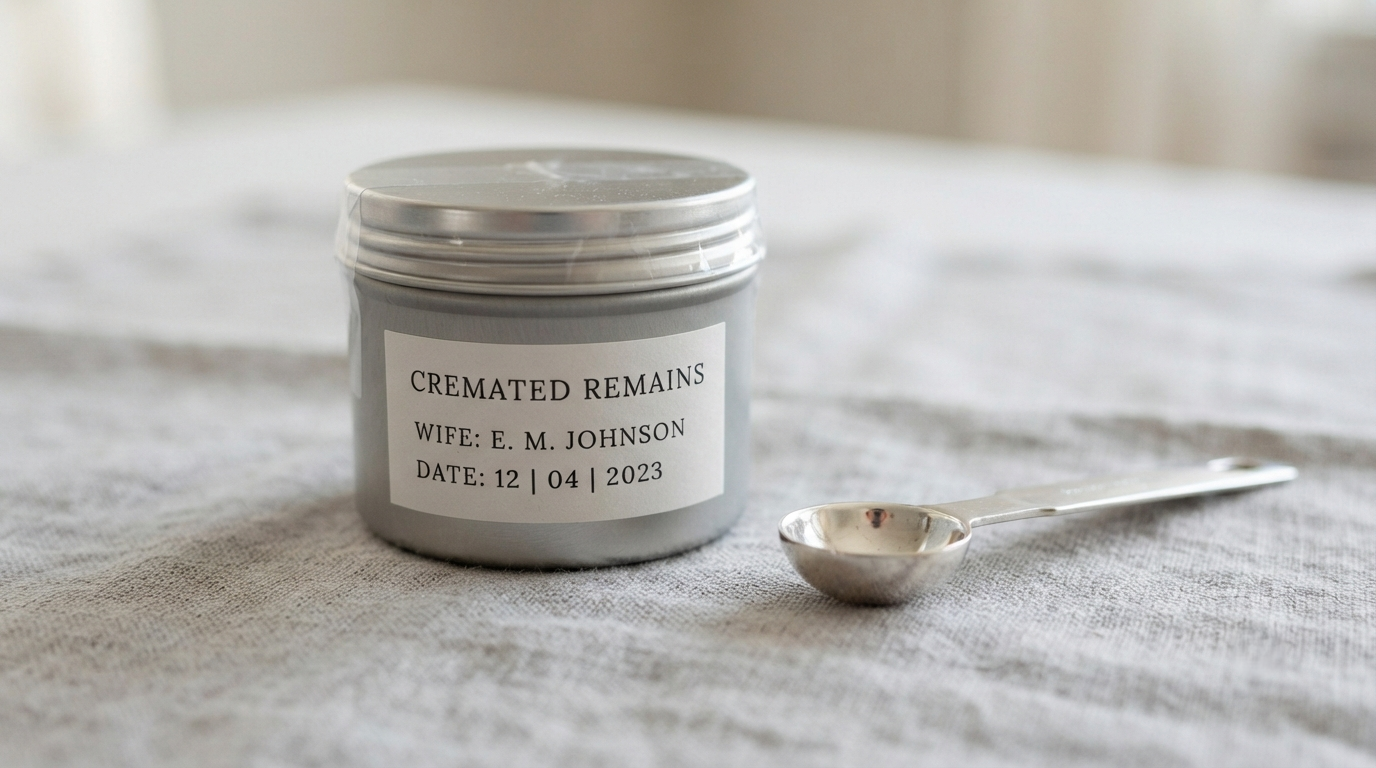
A small sealed container of cremated remains, labeled and dated, next to a measuring spoon on a clean cloth
What to doWhy
Ask the provider for their minimum in grams or ounces, in writingMinimums vary; do not guess
Measure out only that amount, plus a small margin if the provider suggests oneSending more does not produce a larger diamond, carat is set by growth time, not by material volume
Use a clean, dry, sealable container the provider specifies or suppliesAshes must arrive dry and uncontaminated
Label it with her name and your submission referenceChain of custody begins at your kitchen table
Photograph the container, sealed and labeled, with the date visibleYour own record, independent of the provider’s
Return the rest of the ashes to the urnThe scattering, interment, or shelf you planned still happens

If you hold very little, a keepsake vial rather than an urn, a wife’s ashes diamond may still be possible; tell the provider the amount. Some accept less than their standard minimum; some can combine a small amount of ashes with a lock of her hair. How much ash you need for a wife memorial diamond covers the edge cases.

Step 3: Choose a Provider and a Carat

For a wife’s ashes diamond these two decisions come together, because carat sets both the price and the timeline, and the provider sets what is realistic.

Choosing the provider. Ask every candidate the same questions and compare the answers:

  1. What chain of custody documentation do you provide, and can I see where her ashes are at each stage?
  2. What proportion of the finished stone’s carbon is typically from the submitted ashes, at the carat I want?
  3. Is grading independent or in house? An origin certificate, usually in house, documents that the stone came from her ashes; a grading report, ideally from an independent lab using GIA’s cut, color, clarity, and carat standards, documents quality. You want both.
  4. What is the realistic timeline for this carat, in writing?
  5. What is the loose stone price, and what is the setting price, as separate lines?
  6. What happens to unused ashes, and what happens if you cannot complete the stone?

Choosing the carat. A wife’s ashes diamond is generally offered from about 0.10 ct to 5+ ct. Growth time, and therefore cost and timeline, scales steeply with size. General 2026 industry ranges, not Memorial Diamond’s published pricing:

TierCaratTypical rangeTypical timeline
Entry0.10 to 0.25 ctRoughly $1,500 to $3,5006 to 8 months
Mid0.5 to 1 ctRoughly $5,000 to $15,0008 to 10 months
Large / rare2 to 5+ ctRoughly $20,000 to $75,000+Up to 12 months

Colorless costs meaningfully more than yellow, blue, or champagne at the same size. A small stone in a bezel is worn every day by people who would never wear a solitaire, choose the size for the piece you will actually wear. How much a wife memorial diamond costs works through a full quote.

Choosing the color can wait, and often should. A wife’s ashes diamond naturally trends toward yellow, champagne, or blue because the organic carbon source carries trace nitrogen or boron; colorless requires extra processing. Decide whether you want the natural outcome or a specified color before the growth stage begins, the provider will tell you the deadline.

Step 4: Send It With a Paper Trail

This is the step in making a wife’s ashes diamond where a small amount of care prevents the only problems that cannot be undone.

Submission form, tracking receipt, and a printed photograph laid together in a folder
  • Complete the provider’s submission form and keep a copy, paper or scanned, before it leaves your hands.
  • Package the sealed container as the provider instructs, with the form inside.
  • Use tracked, insured shipping and keep the tracking number with your copy of the form. Do not use a service that cannot tell you where the package is.
  • Confirm receipt. A reputable provider will acknowledge arrival and log your submission under a reference number. If you have not heard within the window they gave you, ask.
  • Ask for the chain of custody record’s format in advance, what you will be able to see, and when.

Keep in one place: your copy of the form, the tracking record, your dated photograph of the sealed container, and the provider’s acknowledgement. That folder is the proof, if any question ever arises, that the wife’s ashes diamond came from her.

Step 5: What Happens During the 6 to 10 Months

You do nothing for most of a year while a wife’s ashes diamond grows, and it helps to know what is happening while you wait.

  1. Carbon extraction and purification, weeks. Her ashes are heated in a controlled, oxygen free, multi stage process that strips away the calcium phosphate and other minerals, leaving carbon at 99.9%+ purity.
  2. Graphitization, days to weeks. The purified carbon is heated to roughly 2,500 to 2,700°C and converted to graphite, the feedstock diamond presses use.
  3. Diamond growth, weeks to months. The graphite, blended with supplemental lab carbon, goes into an HPHT press with a tiny diamond seed at roughly 6 to 8 GPa and 1,400 to 2,500°C, or, with some providers, is converted to gas for CVD growth. This is the stage that sets carat and takes most of the time. Both methods are described on the synthetic diamond page.
  4. Cutting and polishing, weeks. A gemologist cuts the rough crystal into the chosen shape.
  5. Optional irradiation, days, only if a red, pink, green, or black stone was specified.
  6. Grading and certification, weeks.
HPHT press in a laboratory with a technician monitoring readouts

Ask the provider at the start whether they send progress updates on a wife’s ashes diamond and at what stages. Some send a photograph of the rough crystal; some send nothing until the stone is finished. Neither is wrong, but knowing which to expect prevents months of wondering. How a memorial diamond is made from your wife’s ashes covers each stage in more depth, and how long a wife memorial diamond takes covers planning against a date.

Step 6: Receive and Check the Stone

When the wife’s ashes diamond arrives, check four things before you do anything else.

CheckWhat you are looking for
The origin certificateHer name or your submission reference, the material submitted, and the provider’s attestation that this stone was grown from it
The grading reportCarat, color grade, clarity grade, cut, and whether it is from an independent lab or in house
The stone against the reportCarat matches; color is within the range you were told to expect
The carat you orderedIf you ordered 0.50 ct and the report says 0.48, that is within normal cutting variance; if it says 0.30, ask

The color will probably not be what you pictured, and that is normal. Yellow, champagne, and blue are the natural outcomes; two stones from the same ashes can differ. If you specified a color and the stone is outside the range you were promised, this is the moment to raise it, with the report in hand.

Then put the wife’s ashes diamond certificate, the grading report, your submission folder, and the receipt together. Whoever holds this stone after you should be able to prove what it is.

Step 7: Decide What It Becomes

This step has no deadline. A loose wife’s ashes diamond in its grading box loses nothing by waiting a year.

When you are ready: a bezel ring for daily wear, a pendant if your hands are already full, her own wedding ring re set around the stone if the metal allows, a piece for a child, or a loose stone kept and displayed. Metal follows color, yellow gold flatters yellow and champagne, white metals flatter blue. Settings are priced separately from the stone. Wife memorial diamond ideas, rings, pendants, and keepsakes walks through the options.

Frequently Asked Questions

How much of my wife’s ashes do I need to send?

Typically a few tablespoons to roughly 4 oz, about 100 g, though minimums vary by provider, ask for theirs in writing before opening the urn. Sending more does not produce a larger diamond, because carat is set by growth time. Everything else you planned for her ashes still happens.

Can I make a wife’s ashes diamond if her ashes were already scattered?

A wife’s ashes diamond is possible only if a portion was kept, a keepsake vial, a small container, a share held by a family member willing to contribute. If nothing was retained, ashes are not an option; a lock of her hair, if one exists, is the alternative route to a memorial diamond.

How long does it take?

Typically 6 to 10 months from the provider receiving the ashes to a finished stone, with larger sizes or specialty colors such as black sometimes taking up to 12 months. The timeline is set by growth time in the press, which is set by carat, and cannot meaningfully be rushed.

What should I keep a copy of?

Your submission form, the shipping tracking record, a dated photograph of the sealed and labeled container, and the provider’s acknowledgement of receipt. When the stone arrives, add the origin certificate and the grading report. Together, that folder proves the diamond came from her.

Will the diamond be colorless?

Usually not by default. Carbon from an organic source carries trace nitrogen or boron, which produce yellow and blue tones respectively; champagne is also common. Colorless is achievable with additional processing and typically costs more at the same carat. Decide before growth begins whether you want the natural outcome.

Do I have to choose the ring before I send the ashes?

No. Choose carat and, if you want to specify it, color before growth begins. The setting can wait until the stone arrives, many families wait to see the actual color before choosing metal. A loose diamond in its box loses nothing by waiting.

Final Thoughts on Making a Wife’s Ashes Diamond

Seven steps to a wife’s ashes diamond, and only two of them, measuring out the portion and sending it, involve doing anything to her ashes. The rest is paperwork, patience, and a decision at the end that can wait as long as you need. A wife’s ashes diamond is not a complicated thing to arrange. It is a small, careful thing, done once, with a little of her, that produces a real diamond you can hold. If you are not ready for step one, nothing is lost by waiting; the urn will still be on the shelf, and the process will still be there.

Learn More About Wife Memorial Diamonds

Talk With Memorial Diamond

If you are at step one and want to know what a wife’s ashes diamond would need from the amount you hold, what carat is realistic, or how the chain of custody is documented, reach out to Memorial Diamond. Nothing has to leave the house until you are sure a wife’s ashes diamond is what you want.

About a husband memorial diamond: two people at a kitchen table with a small ring box between them and coffee going cold

How to Talk to Family About a Husband Memorial Diamond

You have probably rehearsed this conversation more times than you will ever have it. Telling his mother. Telling the children. Telling the sister who already has opinions about the funeral. The honest starting point about a husband memorial diamond is that you usually do not need anyone’s permission, but you will probably want some people’s understanding, and those are different conversations with different people. This guide separates the family members who have a legal say from the ones who have an emotional stake, gives you plain language for each, and covers what to do when someone says no.

Who Actually Gets a Say About a Husband Memorial Diamond?

Two groups of people have a view about a husband memorial diamond, and it helps to know which is which before you open your mouth.

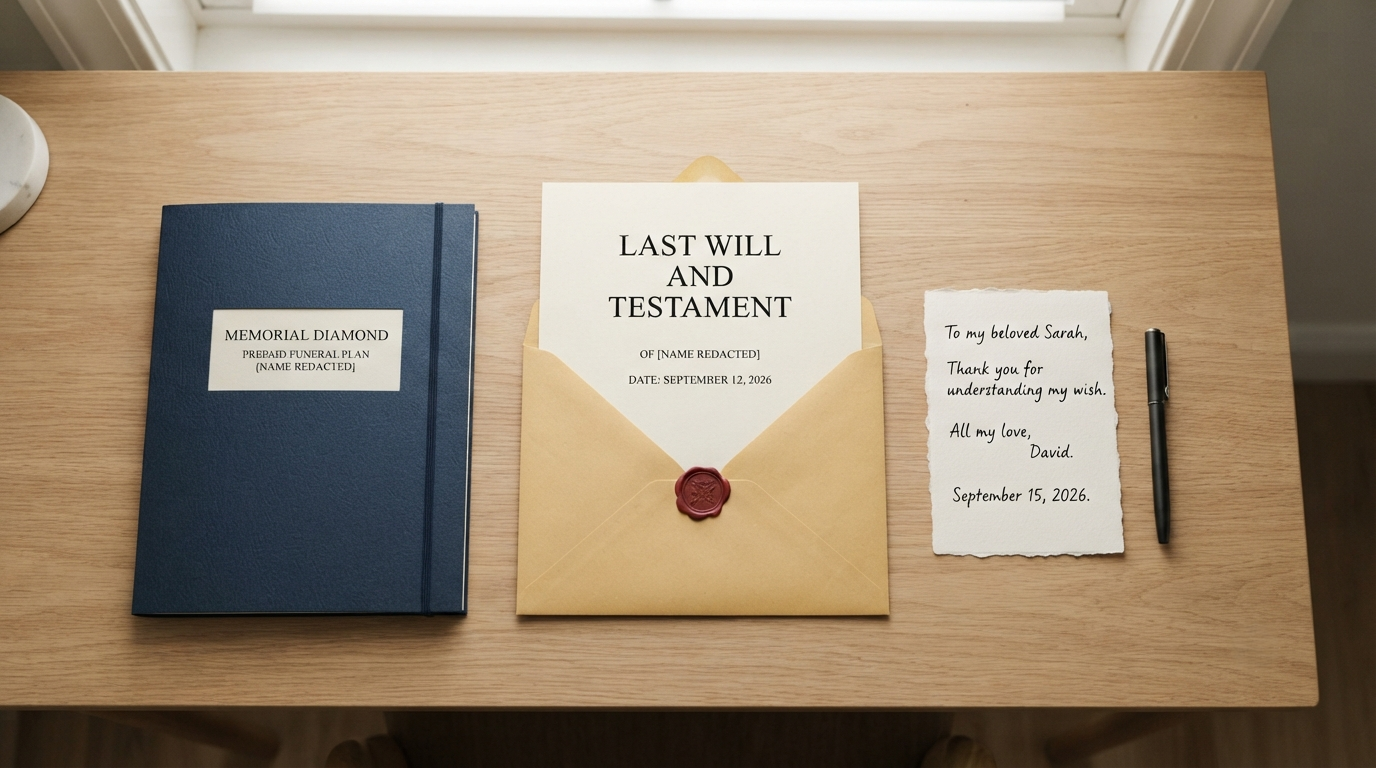
The people with legal authority. In most US states, the right to control a person’s remains passes to the surviving spouse first, unless he left written instructions, a prepaid funeral plan, or a will naming someone else. If you are his widow or widower and none of those exist, the decision about a husband memorial diamond is yours. His parents, siblings, and adult children generally do not have a legal veto. This varies by state and by what he set down in writing, so read what exists before assuming, but for most spouses the legal question is settled.

The people with an emotional stake. This is everyone else who loved him and who will have feelings about a husband memorial diamond, and this is where the actual conversations live. His mother has no legal say and every emotional one. Your children may not be consulted by law and will absolutely have feelings about where their father’s ashes went.

The table below sorts the family by which conversation about a husband memorial diamond you are actually having with them.

Family memberLegal say? (typical US, no written instructions)Emotional stakeWhat they most often need from you
You, the spouseYes, usually first in lineHighestClarity about your own reasons before talking to anyone
Adult childrenRarely, unless named in his willVery highTo hear it from you directly, not secondhand
Minor childrenNoVery highAge appropriate honesty, not protection through silence
His parentsNoVery highReassurance that the rest of him is not going anywhere they object to
His siblingsNoHighTo be told, not asked, unless you want their view
Your own familyNoModerateUsually support; occasionally practical questions
His friendsNoVariesNothing until they ask
A will, a prepaid funeral plan folder, and a handwritten note laid on a desk

One honest caveat: if his ashes were divided at the crematorium and someone else already holds a portion, that portion is theirs. The material you send for a diamond has to be material you control.

What People Are Really Asking When They Object

Most objections about a husband memorial diamond are not about the diamond. Almost every hard question about a husband memorial diamond turns out to be a question about something else. They are about one of four things underneath it, and answering the surface question without hearing the real one is how these conversations go wrong.

  • “Is that even real?” They are asking whether the stone genuinely contains about a husband memorial diamond. The answer is that a memorial diamond is a real lab grown diamond containing a purified portion of his own carbon, blended with lab carbon to reach a workable size, not all of him, not a symbol of him, but physically grown in part from him. Whether it is really made from his ashes walks through the evidence if someone wants it.
  • “Doesn’t that use all of him?” They are asking whether the scattering, the interment, or the urn on the mantel is being cancelled. It is not. Only a small portion of ashes, typically a few tablespoons to around 4 oz, or a small lock of hair is needed. The rest goes where the family already planned.
  • “Isn’t that a bit much?” They are asking about money, or about whether you are all right. Both deserve a direct answer rather than a defensive one.
  • “Would he have wanted that?” They are asking whether you are honoring him or serving yourself. Sometimes the person asking knew him well enough to have a view worth hearing. Sometimes they are asking the question they wish they could ask about their own grief.

Hearing which of the four is underneath a given objection about a husband memorial diamond tells you which page of this guide to reach for.

Five Ways to Open the Conversation

There is no script about a husband memorial diamond that works for every family, but there are five openings that families describe going better than the alternatives. Pick the one that matches the person.

  1. Lead with the decision, not the request. “I’ve decided to have a small diamond made from some of his ashes. I wanted you to hear it from me.” This works with siblings, in laws, and anyone whose approval you are not seeking. It closes the door on a debate you did not open.
  2. Lead with the fact that reassures. “Only a few tablespoons are used. Everything we planned for the rest of him still happens.” This works with his parents and with anyone whose first fear is that the funeral plan is changing.
  3. Lead with the question they would ask. “You’re probably wondering if it’s actually him. It is, the lab extracts the carbon from the ashes and grows the diamond around it.” This works with the skeptic, and it works better than waiting for the skepticism.
  4. Lead with an invitation. “I’m having a diamond made from Dad’s ashes. There’s enough that you could have one too, if you ever wanted.” This is for adult children and for his siblings when you genuinely mean it. How more than one family member can receive a diamond from the same husband’s ashes covers the cost and the mechanics before you offer.
  5. Lead with time. “I’m thinking about this. I haven’t done anything yet. I wanted to tell you before it’s decided.” This is the opening for a family member you know will struggle, when there is genuinely still room for their view to matter.

Whichever opening you use, say the practical facts once, plainly, and stop. The conversation about a husband memorial diamond does not improve with more justification.

Talking to His Parents and Siblings

His parents are the hardest conversation about a husband memorial diamond for most spouses, because they lost a son and have no legal say in what happens to him. That combination produces grief that comes out as objection.

What tends to help:

Tell them before the material leaves the house. Being informed after the fact, even about something they could not have stopped, reads as being cut out. Being told before reads as being included, even when the decision is already made.

Separate what changes from what does not. “The interment is still on the 14th. The urn is still going to the plot. I’m keeping a small portion for this.” Parents who are afraid the plan is changing relax when they hear the plan stated.

Do not defend the decision about a husband memorial diamond. Describe it. A memorial diamond is grown over roughly 6 to 10 months in a laboratory press that recreates the pressure and heat of the Earth’s mantle. That sentence, delivered without apology, does more than any argument for why it is a reasonable thing to want.

Offer, if you mean it. Some parents want their own stone. Some are horrified by the idea. You will not know which until you ask, and the offer costs nothing.

Siblings are usually a shorter conversation about a husband memorial diamond. They are less likely to feel ownership over his remains and more likely to want to know whether their own family will be included. Tell them the same facts, and if you have decided that only your household is receiving stones, say so without over explaining.

If his family holds a religious view on cremation or on dividing ashes, note that no tradition has an official position on memorial diamonds specifically, only on cremation and ash handling more generally, and that views vary by denomination and by individual clergy. If the objection is religious, it is worth asking whether the concern is with cremation itself, already done, or with dividing what remains. Those are different concerns with different answers.

Talking to Your Children

Children generally handle honesty about a husband memorial diamond better than adults expect, and handle silence worse.

For young children, the true version is short: a tiny bit of what is left of Dad is being turned into a diamond by scientists, it takes most of a year, and when it comes back it will be kept somewhere they can see it. They will ask if it hurts him. It does not. They will ask if they can hold it. They can.

Adult hand holding a small champagne lab-grown diamond in its grading box while a child's hand reaches toward it

For teenagers, the conversation about a husband memorial diamond is closer to the one with an adult, with one difference: teenagers are more likely to ask whether they get a say, and more likely to be hurt if the answer is no. If there is genuinely room for their preference, on the color, on the setting, on whether they receive their own stone later, give it to them. If there is not, tell them what was decided and why, and do not pretend the question was open.

For adult children, particularly ones from a previous marriage, the talk about a husband memorial diamond needs care on ownership. They may feel their father’s ashes belong to the family he had before you. Legally, absent his written instructions, they usually do not, but the feeling is real, and leading with the law is a way to win the argument and lose the relationship. Lead with the invitation instead: there is enough material for more than one stone.

Whatever the child’s age, the timeline matters. The stone will not exist for most of a year. Tell them that, so the wait is not a surprise, and tell them when it arrives so the ending is shared.

When Someone Says No

Someone might say no about a husband memorial diamond. A parent might say it is grotesque. A sibling might say he would have hated it. A child might refuse to look at it.

Four things are true at once when this happens:

What is trueWhat it means for you
Their no is usually not a vetoIf you hold legal authority, the decision remains yours
Their no is usually about him, not youGrief that has nowhere to go often lands on the nearest decision
A no today is not always a no foreverFamilies report that objectors sometimes ask to see the stone once it exists
You do not have to winThe goal was for them to know, not to agree

What you can offer about a husband memorial diamond that is neither surrender nor a fight: “I hear that you don’t want this. I’m still going to do it, because it matters to me. I won’t bring it up with you again unless you ask.” Then keep that promise.

What you should not offer: a promise to consult them on every future decision about his remains, a promise not to wear the stone in front of them, or a promise to give the diamond back. Promises made to end a hard conversation tend to be regretted.

One caveat that bears repeating: if the objecting person holds a legal right to his remains that outranks yours, because of his will, a prepaid plan, or a state specific rule, then their no may in fact be a veto, and the honest next step is reading the document, not having the conversation again.

What to Say When People Ask Later

The conversation about a husband memorial diamond does not end when the decision is made. It resurfaces in the months while the stone grows, and it resurfaces for years afterward every time someone notices the ring.

While you wait: “It’s being made. It takes most of a year.” That is a complete answer about a husband memorial diamond. You do not owe anyone the carat, the color, or the cost.

A phone screen showing a photo of a finished yellow memorial diamond ring being sent in a message

When it arrives: Decide in advance who gets told about a husband memorial diamond first. Families who had a hard conversation at the start often find that the arrival is a chance to close it, a photograph sent to his mother, without commentary, sometimes says more than the original conversation did.

When a stranger asks about the ring: You will be asked. The short true answer is “It’s a memorial diamond; it was made from my husband’s ashes.” Most people respond with quiet interest. Some go silent. You can say more or not. The diamond itself is a real, graded stone with the same cut, color, clarity, and carat documentation as any other diamond, which is sometimes the fact that makes a skeptic go quiet in a different way.

When one of the objectors asks to see it: Show them. Say nothing about the earlier conversation about a husband memorial diamond.

Frequently Asked Questions

Do I need my husband’s family’s permission for a memorial diamond?

Usually not. In most US states the surviving spouse holds first authority over a person’s remains unless he left written instructions, a prepaid plan, or a will naming someone else. His parents and siblings generally have no legal veto. Check any documents he left, and check your state’s rule, before assuming.

Should I tell his family before or after the ashes are sent?

Before. Being told after the fact, even about a decision they could not have changed, reads as exclusion. Telling them before the material leaves the house, with the plain facts and the reassurance that the rest of the funeral plan is unchanged, tends to go far better.

How do I explain a memorial diamond to a young child?

Keep it short and true: a tiny bit of what is left of Dad is being turned into a diamond by scientists, it takes most of a year, and it will be kept where they can see it. It does not hurt him. They can hold it when it arrives. Answer their questions as they come.

What if his mother says a memorial diamond is disrespectful?

Hear the fear underneath, usually that the funeral plan is changing, or that all of him is being used. Explain that only a small portion is needed and everything else planned for him still happens. Then state your decision without defending it. Her no is not a legal veto, and it is often not permanent.

Can I offer his family their own diamond from the same ashes?

Often, yes. Only a small portion of ashes is used per stone, so several diamonds can typically be grown from one submission. Each is priced and grown separately, and stones from the same material can differ in color. Make sure you understand the cost before offering.

What do I say when strangers ask about the ring?

The short, true answer works: “It’s a memorial diamond; it was made from my husband’s ashes.” You are not obliged to say more. Most people respond with quiet interest. If you would rather not discuss it, “It’s a family piece” is also true.

Final Thoughts About a Husband Memorial Diamond Conversation

You will not get every one of these conversations about a husband memorial diamond right, and you do not have to. The people who love him will mostly remember that you told them, not the words you used. The ones who objected will mostly remember whether you kept the promise you made when they did. Be clear about a husband memorial diamond once, be kind about it as many times as it takes, and let the stone, which will exist long after the conversation is forgotten, do the rest.

Learn More About Husband Memorial Diamonds

Talk With Memorial Diamond

If a family member’s question about a husband memorial diamond is one you cannot answer yet, how much material is really needed, what the process involves, whether a second stone is possible, reach out to Memorial Diamond. Having the facts before the conversation is often the difference between a hard talk and a short one.

Husband memorial diamond cost, featuring a brilliant memorial diamond and jewelry box representing different price tiers and cost considerations.

How Much Does a Husband Memorial Diamond Cost?

Loose lab-grown memorial diamond beside a price tier chart showing how much a husband memorial diamond costs by carat

The Short Answer

Understanding husband memorial diamond cost starts with recognizing that there is no single price for every memorial diamond. The final amount depends mainly on the carat size and color of the diamond you choose. Across the industry, an entry tier stone of roughly 0.10 to 0.25 carats typically runs from $1,500 to $3,500. A mid tier stone from 0.5 to 1 carat typically runs from $5,000 to $15,000. A large or rare stone measuring 2 to 5 or more carats can reach $20,000 to $75,000 or more.

These figures are general industry ranges and are not Memorial Diamond’s published pricing. A specific price should always be confirmed directly with the provider because the final amount depends on the particular stone and options selected.

If you are only beginning to consider a memorial diamond, you do not need to decide the size immediately. Understanding husband memorial diamond cost can help you see the available range without requiring you to make a final decision today.

Why Husband Memorial Diamond Cost Varies So Much

Husband memorial diamond cost can vary considerably because a memorial diamond is available in different sizes, colors, cuts, and certification options. The price follows the characteristics of the stone rather than simply the amount of ashes or hair submitted.

Two families could submit similar amounts of material and still receive different quotes because the stone they choose may have a different carat size, color, cut, or grading requirement.

The amount of ashes or hair submitted does not automatically determine the size of the finished diamond. Sending more material does not mean that the resulting stone will automatically be larger or less expensive. The carat size is a choice that affects the growth process and therefore affects the cost.

This is an important part of understanding husband memorial diamond cost because families may initially assume that submitting more material will change the final price. According to the information in this guide, the material volume itself is not the main pricing factor.

Price by Tier

TierCarat RangeTypical CostWhat It Usually Looks Like
Entry0.10 to 0.25 ct$1,500 to $3,500A small accent stone, often set into an existing piece rather than used as a standalone centerpiece
Mid0.5 to 1 ct$5,000 to $15,000A solitaire scale stone that can serve as the centerpiece of a ring or pendant
Large or rare2 to 5 or more ct$20,000 to $75,000 or moreA significant centerpiece stone, with colorless stones at this size costing meaningfully more than colored tones of the same carat
Side-by-side visual comparison of memorial diamond carat sizes from entry to large tier

These ranges provide a starting point for understanding husband memorial diamond cost. They are industry wide figures rather than a confirmed Memorial Diamond price list. The actual amount can change according to the carat, color, cut, and certification selected.

What Actually Drives the Number

When considering husband memorial diamond cost, four main factors can move the price: carat, color, cut, and certification.

Carat

Carat is the single biggest pricing factor described in this guide. Larger stones require longer growth runs and more careful process control. Because of this, the cost does not simply increase in a straight line as the diamond becomes larger.

A family deciding between a smaller stone and a larger centerpiece should therefore consider the carat size carefully. The selected size can have a substantial effect on husband memorial diamond cost.

Color

Color is another important part of husband memorial diamond cost. Colorless stones generally cost more than blue, yellow, or champagne tones at the same carat size. Achieving a colorless result requires additional processing to exclude trace elements such as boron and nitrogen that can naturally occur in organic and personal carbon sources.

This means that two diamonds with the same carat size can still have different prices when their colors differ.

Cut

Cut can also affect the final amount. A round brilliant cut is the industry default, while fancy cuts such as cushion, princess, and emerald can carry a premium depending on the provider.

When comparing husband memorial diamond cost between providers, it is therefore important to make sure you are comparing stones with similar specifications rather than looking only at the headline price.

Certification

An independent third party grading report can also affect the total. Such a report is commonly associated with GIA standards and is typically priced separately from the loose stone.

If certification matters to you, ask whether it is included in the quoted amount or listed as an additional charge.

What Does Not Drive the Price

One of the most useful points when considering husband memorial diamond cost is that the amount of ashes or hair submitted does not determine the final carat size or automatically reduce the price.

A full urn does not produce a larger or cheaper diamond simply because more material is available. The guide explains that carat size is a choice made during the process rather than a direct result of how much material arrives.

This can make the planning process easier because families do not need to think of the amount of material as a way to control the price.

Add Ons That Price Separately

Side-by-side visual comparison of memorial diamond carat sizes from entry to large tier

The loose diamond is not necessarily the only expense. Several options can be priced separately, so an itemized quote is useful when comparing husband memorial diamond cost.

  • Independent grading report
  • Engraving
  • Fancy cut premiums
  • Jewelry settings such as rings, pendants, and earrings

Jewelry settings are particularly important because the mounting and metal are typically quoted separately from the loose stone. A ring or pendant can therefore have its own cost in addition to the diamond.

For general information about how diamonds are evaluated, you can also review how gemologists grade a diamond’s cut, color, and clarity.

When requesting a quote, ask the provider to separate the loose stone from each additional service or product. This gives you a clearer picture of husband memorial diamond cost and makes it easier to compare different options.

The Cheapest Decision Available Today

If the estimated price feels higher than you are ready to commit to, there is another option: you do not have to make the decision immediately.

Preserving the option for later can cost very little. A small portion of ashes can be kept aside, or a lock of hair can be sealed and preserved while you decide what you want. This allows you to consider the size, color, and overall husband memorial diamond cost when you are ready.

The important point is that choosing not to proceed this year is still a valid decision. You can take time to understand the available options, consider your budget, and decide later without immediately committing to a particular stone.

For additional information about memorial diamond options, you can explore BlueIceGems and learn more about jewelry and diamond related choices.

Small labeled portion of ashes kept aside, preserving the option for a future memorial diamond

Frequently Asked Questions

Is there a cheaper option than the entry tier?

The entry tier of approximately 0.10 to 0.25 carats, with a general industry range of $1,500 to $3,500, is generally the lowest starting point described in this guide. Smaller stones are not typically offered because of the process minimums involved in growing a stone.

Does color affect cost more than carat?

Carat typically has the larger effect at a given color. However, at the same carat size, colorless stones can cost noticeably more than colored stones. Both factors matter, and their effects can compound when making a selection.

Can I pay for the stone in stages as it is grown?

Payment arrangements are provider specific. If staged payments are important to your planning, ask the provider directly about available payment structures instead of assuming that a particular arrangement is available.

Is grading and certification included in the price?

Grading and certification are typically treated as a separate add on across the industry. Always confirm this with the provider before comparing husband memorial diamond cost because an apparently lower quote may not include the same certification options.

Does sending more ashes or hair reduce the cost?

No. The cost tracks the diamond you choose to grow, including carat, color, cut, and certification. The volume of ashes or hair submitted does not automatically make the diamond larger or cheaper.

Is financing available for a memorial diamond?

Financing terms, if offered, vary by provider and lender. Ask directly about current financing arrangements and eligibility rather than assuming that every provider offers the same terms.

Final Thoughts on Husband Memorial Diamond Cost

The main thing to remember about husband memorial diamond cost is that the price is influenced by the diamond you choose. Carat, color, cut, and certification can all affect the final amount, while the quantity of ashes or hair submitted does not automatically determine the cost.

The available ranges can look very different depending on the size of the stone. An entry tier may be approximately $1,500 to $3,500, a mid tier may be approximately $5,000 to $15,000, and a large or rare stone may reach $20,000 to $75,000 or more.

These figures should be treated as general industry ranges rather than a specific quote. If you are planning your budget, request an itemized quotation that separates the loose diamond from grading, engraving, cut premiums, and jewelry settings.

Most importantly, you do not have to decide everything today. You can keep the option open while you consider the size, color, design, and husband memorial diamond cost that fits your own circumstances.

Learn More About Husband Memorial Diamonds

Talk With Memorial Diamond

If you want a clearer understanding of where your budget fits within the available tiers, you can talk with Memorial Diamond about what may be possible for your husband’s ashes or hair.

Because the pricing ranges in this article are general industry figures, confirm the current price directly with the provider before making a decision.

family member get diamond same husbands ashes

Family Member Get Diamond Same Husbands Ashes: Proven Guide

Urn with several small labeled portions set aside, one for each family member's memorial diamond family member get diamond same husbands ashes
Multiple memorial diamond options from a single source of cremation ashes.

The Short Answer: Family Member Get Diamond Same Husbands Ashes

Yes, any family member get diamond same husbands ashes inquiry confirms that several relatives can receive individual stones from one shared portion of cremation remains. Because only a small fraction of a full cremation’s ashes is typically used per stone (with usable material ranging from a few tablespoons up to roughly 4 oz), the majority of remains usually stay available. This is precisely what makes multiple distinct gems possible from a single individual.

What is not guaranteed is that every finished stone will match in color, carat weight, or appearance. Each gem develops into its own unique diamond on its own specific growth timeline.

Why This Is Usually Possible

The scientific reason why each family member get diamond same husbands ashes comes down to basic material arithmetic: cremated remains carry a usable carbon yield of roughly 0.5% to 4% by weight, yet the total mass of cremation remains far exceeds what any single gem synthesis requires. A surviving spouse who preserves the majority of the ashes for scattering or traditional interment can easily allocate small portions for herself and adult children without exhausting what is available.

This process is standard across specialized laboratories like Blue Ice Gems, where only a modest sample is needed to synthesize authentic stones.

Who Decides How the Ashes Are Divided

This aspect is not a matter of laboratory chemistry: it is an emotional and practical family question. You are the one who decides how the ashes are allocated, which can feel like a heavy responsibility. Whether you are the named executor, the surviving spouse, or the designated custodian of the remains, you are under no automatic obligation to say yes to every inquiry or divide the portions equally.

What is actually being askedWhat it requires of you
“Can I have a small portion for my own stone?”A decision about whether to divide, and the specific quantity to grant
“Can we all get matching stones?”A decision regarding whether aesthetic matching is realistic
“I would rather the ashes stay together”A valid stance, as no relative is legally forced to divide remains
“What if I do not want to decide right now?”A sensible choice, since material can be reserved for future creation
Family members discussing how to divide a loved one's ashes among several memorial diamonds

Clearly categorizing each request as it arises makes conversations substantially more constructive than treating division as an all or nothing scenario.

What Each Stone Can and Can’t Be Guaranteed to Match

When multiple relatives plan how every family member get diamond same husbands ashes, it is natural to wonder about consistency across the order:

  • Color is not guaranteed to match: Trace elements such as boron and nitrogen disperse unevenly throughout organic remains, meaning two gems grown from the same source may yield different shades.
  • Carat weight is an independent choice: Each family member selects their own carat size based on personal preference and budget rather than the volume of the original source.
  • Production timelines vary: Growth cycles begin at the moment of intake, meaning separate orders placed months apart follow independent schedules.
Two memorial diamonds grown from the same source showing different color tones
Stones grown from the same ash source often display distinct individual colors.

Requests This Raises, and What They’re Actually Asking For

  • “I want mine bigger than hers”: This relates strictly to personal setting choices and budget, as carat weight operates independently of the shared material pool.
  • “I do not want to be the one who divides it”: A completely valid perspective; the remains can remain undisturbed while decisions are deferred.
  • “What if we cannot agree?”: Reserving a small secondary container of ashes protects future options for relatives without forcing immediate consensus.

Frequently Asked Questions

Does dividing the ashes use up what would otherwise be scattered or interred?
Only the small fraction designated for synthesis; the standard volume needed per diamond leaves the vast majority of remains available for other memorial plans.

Can stones from the same ashes be grown at different times, years apart?
Yes. There is no mandate to submit orders simultaneously, provided the reserved portion is stored securely.

Is there a limit to how many stones can come from one cremation?
There is no theoretical limit beyond having sufficient qualifying carbon mass for each individual growth cycle.

Who has the legal authority to decide how ashes are divided?
Legal control depends on regional statutes, probate documents, and executor designations; formal disputes should be reviewed with legal counsel.

Can one family member combine ashes with hair while another uses ashes only?
Yes. Every order is handled independently, allowing different combinations of hair and ash according to individual preference.

What if the ashes were already interred or scattered before this was considered?
Recovering remains from a columbarium or cemetery depends entirely on the operating rules of that specific resting place.

Final Thoughts on Family Member Get Diamond Same Husbands Ashes

Understanding how a family member get diamond same husbands ashes makes it clear that technical limitations rarely prevent shared memorials. The primary considerations are open communication, respecting differing grief journeys, and deciding how best to honor a loved one together.

Learn More About Husband Memorial Diamonds

Talk With Memorial Diamond

If you are exploring shared memorial stones, reach out directly to the team at Memorial Diamond for dedicated assistance tailored to your family’s needs.

memorial diamond colors husband expect

Memorial Diamond Colors for a Husband: What to Expect

diamond colors for a husband shown as a range of yellow, blue, and champagne toned stones


A showcase of the diverse tones in husband memorial diamonds.

The Short Answer: Memorial Diamond Colors Husband Expect

When reviewing what memorial diamond colors husband expect, families find that stones typically trend toward yellow, blue, and champagne or brown tones rather than colorless. This natural palette is a direct result of trace elements naturally present in ash or hair derived carbon, not a flaw or an inconsistency in the process. A fully colorless stone is achievable, but it requires additional processing to exclude those trace elements and typically costs more.

If you are picturing a classic white diamond and wondering whether that is realistic, the honest answer is: it is possible, but it is not the default outcome, and there is a real, interesting reason why.

Why Color Happens at All

Diamond color comes from trace elements present during crystal growth. Specifically, boron produces blue tones, nitrogen produces yellow tones, and the complete absence of both is required for a colorless stone.

A controlled synthetic feedstock, with nothing in it but carbon, tends to grow colorless by default because there is nothing else present to introduce color. Ash and hair derived carbon is different: it comes from an organic, personal source, so trace elements are common. That is precisely why the spectrum of memorial diamond colors husband expect skews toward yellow, blue, and champagne rather than white. It is a direct consequence of the carbon’s real, human origin, not something that went wrong in growing it.

The Common Color Range

Side-by-side comparison of memorial diamonds in white, yellow, and champagne tones
Side by side comparison of white, yellow, and champagne tones.
ToneWhat causes itHow common it is
YellowTrace nitrogen present in the carbonCommon
BlueTrace boron present in the carbonLess common than yellow, but not rare
Champagne / brownA mix of trace elements and growth conditionsCommon
Colorless / whiteRequires processing to exclude both boron and nitrogenAchievable, but not the default; typically costs more
Red, pink, green, blackPost growth irradiation, offered by providers such as Blue Ice GemsAvailable where a provider specifically offers it

None of these outcomes reflects anything about your husband specifically. The baseline of memorial diamond colors husband expect varies the same way it would for any family member’s stone, based strictly on the carbon’s trace element profile, not on any personal trait.

Can You Request a Specific Color?

To a degree, yes, but it is worth understanding what is actually being requested in each case.

  • Colorless/white: Can be requested, but achieving it requires additional processing beyond standard growth, since natural trace elements must be excluded or minimized. This typically costs more than accepting the natural color range.
  • Yellow, blue, or champagne: These are the natural outcomes of standard growth from organic carbon and do not require special processing, though the exact shade within that range is not fully controllable in advance.
  • Red, pink, green, or black: These are available through post growth irradiation at some providers. Always ask specifically whether your provider offers this service, since it is not universal across the industry.

Ask your specific provider what is realistically achievable for your submitted material before committing to an expectation, since trace element profiles vary by individual submission and cannot be predicted with total precision before synthesis.

Post-growth irradiation process used to shift or intensify a memorial diamond's color memorial diamond colors husband expect

What the Color Doesn’t Tell You

It is worth saying plainly: color has no bearing on how “much” of your husband is in the stone, on the stone’s durability, or on its structural quality as a genuine diamond. A yellow toned memorial diamond is not a lesser diamond than a colorless one. Cut, color, clarity, and carat are independent qualities, and color here is simply a natural fact of origin, not a marker of emotional value or purity.

Frequently Asked Questions

Does gray hair produce a different color diamond than dark hair?
No. Diamond color comes from trace elements present during crystal growth, not from the visible pigmentation of the hair itself. Gray, dark, or light hair does not predict the finished stone’s tone.

Is a colorless memorial diamond better than a colored one?
No. Colorless simply reflects a different, more refined chemical process, and typically costs more. Color and quality are independent; a colored stone is fully authentic.

Can I know the exact color before the stone is grown?
Not precisely. Trace element profiles vary by individual submission, so while a general range can be planned, the exact resulting shade cannot be completely predicted in advance.

Is irradiated color less real than natural color?
No. Irradiation is an established, accepted diamond treatment across the global jewelry industry, not an inferior process.

Does a bigger stone come out a different color than a smaller one from the same material?
Not inherently. Color and carat are governed by separate variables (trace elements versus growth cycle duration), so stone size alone does not dictate hue.

Will the color match if more than one family member gets a stone from the same ashes?
Not guaranteed. Trace elements distribute unevenly and each stone grows in its own cycle, so two gems from the same source can display distinct tones. See can more than one family member share the same ashes for additional details.

Final Thoughts on Memorial Diamond Colors Husband Expect

The natural array of memorial diamond colors husband expect is not a limitation to work around. It is a genuine scientific reflection of how these stones are formed. Whatever tone your stone grows into, it embodies the authentic chemistry of the carbon it originated from, which is deeply meaningful and truly unique.

Learn More About Husband Memorial Diamonds

Talk With Memorial Diamond

If you would like to discuss which shades are realistic for your husband’s ashes or hair, consult with the specialists at Memorial Diamond to get clear guidance before making your decision.

Husband memorial diamond ideas featuring a memorial diamond pendant, earrings, keepsakes, and existing wedding rings in a luxury setting

Husband Memorial Diamond Ideas: Rings, Pendants, and Keepsakes

Collection of husband memorial diamond ideas shown as a ring, a pendant, and a loose stone side by side |

The Short Answer

The most common husband memorial diamond ideas fall into five settings: a ring worn daily, a pendant worn close but not constantly, stud or drop earrings, a loose stone kept in a small display case, or a stone incorporated directly into an existing wedding ring. Because diamond is the hardest known natural mineral, any of these settings offers long term durability. None is more “correct” than another : the right setting depends on how often you want to see it, touch it, or explain it, not on any rule about memorial jewelry.

There’s no obligation to decide this before the stone is finished, either. Many families choose the setting only once the diamond itself : its color, its cut : is in hand.

Five Settings, and Who Each One Tends to Fit

SettingFits families whoWorth knowing
Ring, worn dailyWant daily physical contact with the stoneSits closest to the hand that may already wear a wedding band
PendantWant it visible but not constantEasiest to remove for sleep, work, or specific occasions
EarringsWant a pair : for two stones, or one stone split into a matched setLess commonly asked about, but genuinely available where two family members each want a piece
Loose stone, displayedAren’t ready to wear it, or want it kept rather than wornNo mounting decision needed yet; keeps every option open
Set into an existing wedding ringAlready have his or her wedding ring and want the two combinedRaises specific questions about the original ring : see below
Memorial diamond shown mounted in three different setting styles: ring, pendant, and earrings

Husband memorial diamond ideas rarely stop at one of these : many families choose a primary setting now and revisit a second later, once the first piece has been worn for a while.

What to Do With the Wedding Rings Already in the House

If your husband’s wedding ring, or your own, is already sitting in a drawer, it’s worth naming as its own decision rather than assuming the memorial stone automatically belongs there.

There are a few genuinely distinct relationships between the new stone and the two rings already in the house:

  • The memorial stone is set into your husband’s original ring, worn by you or kept as a keepsake.
  • The memorial stone is set into your own ring, alongside or in place of your original stone.
  • Both original rings stay as they are, and the memorial diamond becomes its own separate piece entirely.
  • The metal from one or both original rings is reworked into a new setting that holds the memorial stone.

Whether a jeweler can rework an existing ring’s metal, and what that costs relative to a new setting, is a bench question specific to the ring and the jeweler : not something this page can answer in general terms. One thing worth sitting with honestly: there’s no requirement that you still wear your own wedding ring, or that you make any specific decision about it, as part of choosing a setting for his memorial diamond. The two decisions can stay entirely separate.

An original wedding ring's metal being reworked into a new setting for a memorial diamond

Choosing a Setting Before Choosing a Jeweler

A useful order of operations, among the many husband memorial diamond ideas worth considering: settle roughly which setting you’re leaning toward before you start shopping for who mounts it, since that choice narrows who you actually need to talk to.

  • A ring or earrings setting usually means working with a jeweler experienced in fine jewelry mounting.
  • A pendant setting has the widest range of jewelers who can execute it well.
  • Reworking an existing ring’s metal specifically requires a jeweler comfortable with bench repair and remaking work, not just new mounting.

What a Jeweler Will and Won’t Do

Ask any jeweler directly what they will and won’t mount a memorial stone into : this varies by jeweler, not by any industry wide rule. Some jewelers work happily with lab grown memorial stones in any setting; others may have preferences about metal type, prong style, or whether they’ll work with an existing (rather than new) piece of metal. This is a bench level judgment made by whoever does the mounting, not something Memorial Diamond itself performs : the stone and the setting are typically two separate steps with two separate providers.

Frequently Asked Questions

Does the setting need to be chosen before the diamond is grown?
No. Carat, cut, and color are specified when the order is placed, but the setting : ring, pendant, or otherwise : is typically a separate decision made once the stone is finished.

Can a memorial diamond be set into a ring style that isn’t a solitaire?
Yes : cluster settings, halo settings, and accent stone placements alongside other diamonds are all common husband memorial diamond ideas, not just a single centerpiece stone.

Is it appropriate to combine the memorial stone with my engagement ring?
This is a personal decision with no right answer; some families do combine the two, others keep them entirely separate. Either is a valid, meaningful choice.

What if I want two smaller stones instead of one larger one?
Ask your provider whether a single submission can be grown into two separate stones : this depends on the amount of material available and is worth asking about directly.

Does earring styling limit which materials or colors are available?
Not inherently : earring settings work with the same range of colors and cuts as ring or pendant settings.

Can the setting be changed later if I choose wrong the first time?
Generally yes, since resetting a loose stone into a new mounting is a standard jewelry bench service, separate from the diamond growing process itself.

Final Thoughts on Husband Memorial Diamond Ideas

None of these five settings is the “right” one : the right one is whichever lets you carry, wear, or keep the stone in a way that actually fits how you want to remember him. Take the time this decision deserves; unlike the growth timeline, this one has no clock running against it.

Learn More About Husband Memorial Diamonds

Talk With Memorial Diamond

If you’d like to talk through which setting might fit best, reach out to Memorial Diamond : there’s no need to decide before the stone itself is finished.