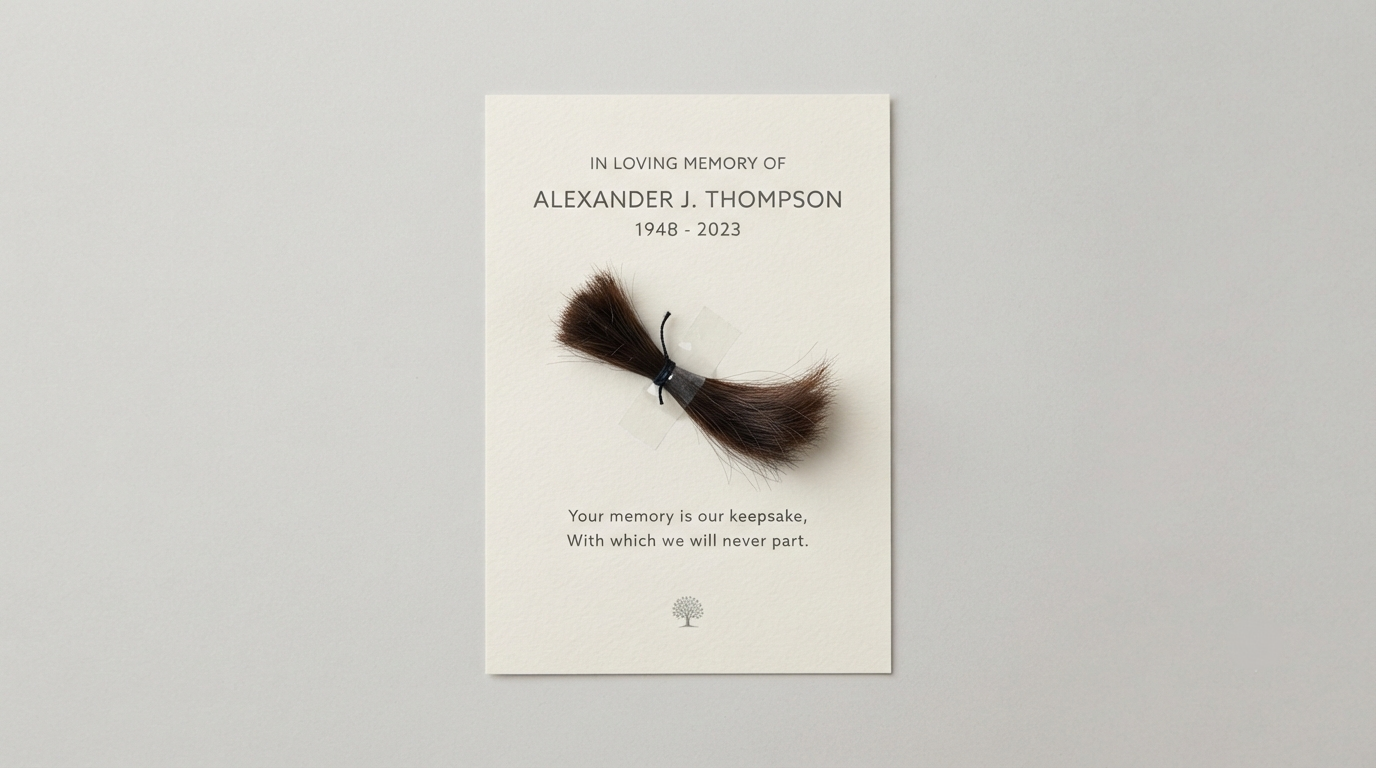
A small lock of hair beside an open paper envelope on a table, the irreplaceable sample behind most partner hair diamond questions

Questions to Ask Before Turning Your Partner’s Hair Into a Diamond

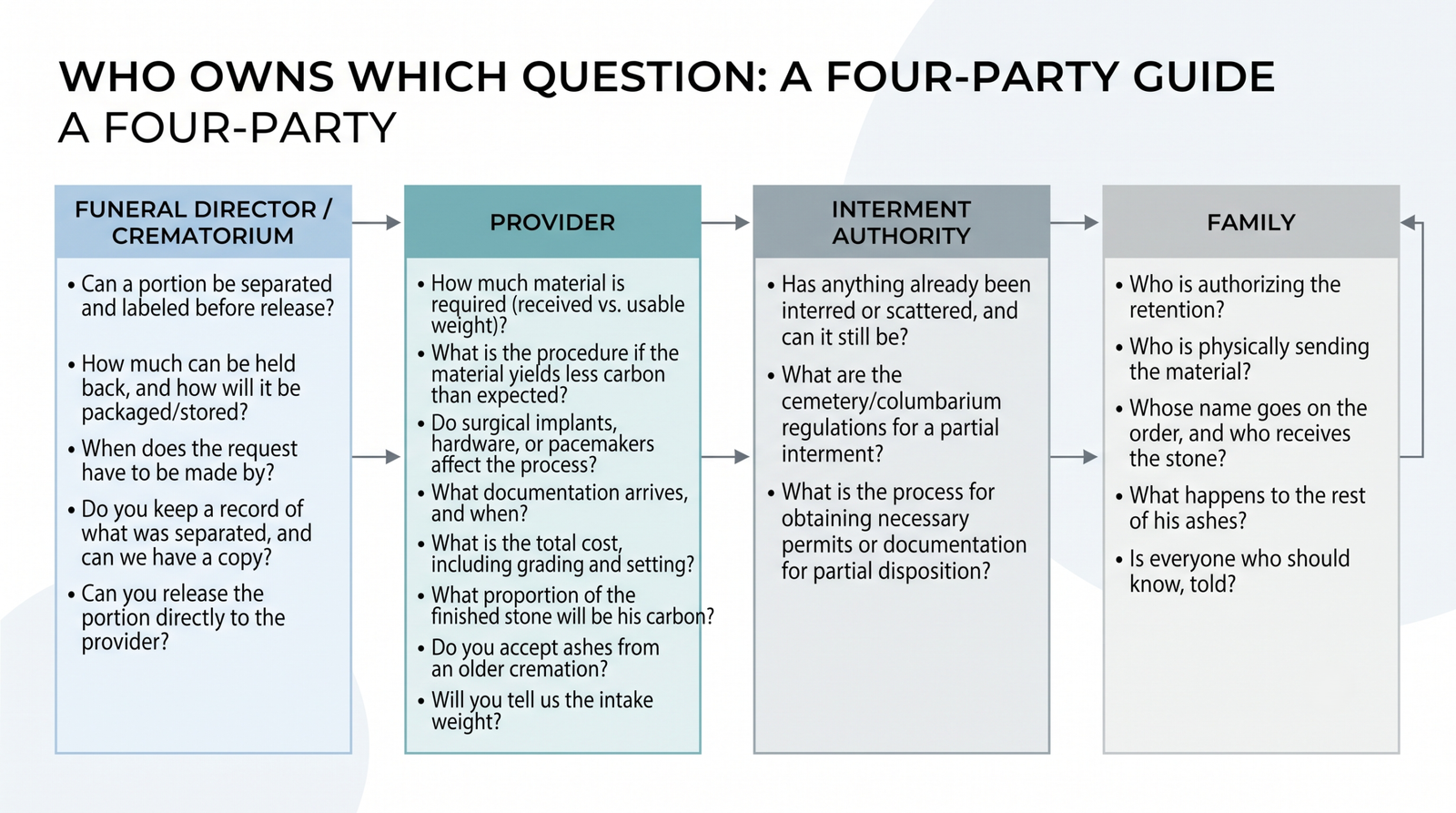
There is one envelope. Whatever is inside it, a lock cut at a hospital, a curl saved years ago, the strands still caught in a brush nobody could bring themselves to clean, there will never be a second one. The partner hair diamond questions that matter most are about provenance and irreplaceability: how a laboratory handles a sample nobody can independently identify, whether the condition of yours still works, and what “enough” means when running short is not survivable.

Memorial Diamond grows diamonds from hair, so treat this page as interested rather than neutral. Every figure here is an industry wide range, not a published requirement of ours. And the most important of the partner hair diamond questions has an answer you may not expect.

The Sample That Cannot Be Replaced

Hair is a far better carbon source than ash. Roughly half of a strand’s weight is carbon, built into keratin, against the 0.5% to 4% that cremated remains yield. That is why this route needs a small lock rather than a scoop, and why it works for someone who was buried.

But chemistry is not the constraint behind the partner hair diamond questions here. Scarcity is. Ashes exist in quantity and can usually be re portioned if a first attempt goes badly. A lock of hair is a fixed object with a fixed weight, sitting in a drawer, and once it is gone it is gone. That single asymmetry is what should reshape every conversation you have with a provider.
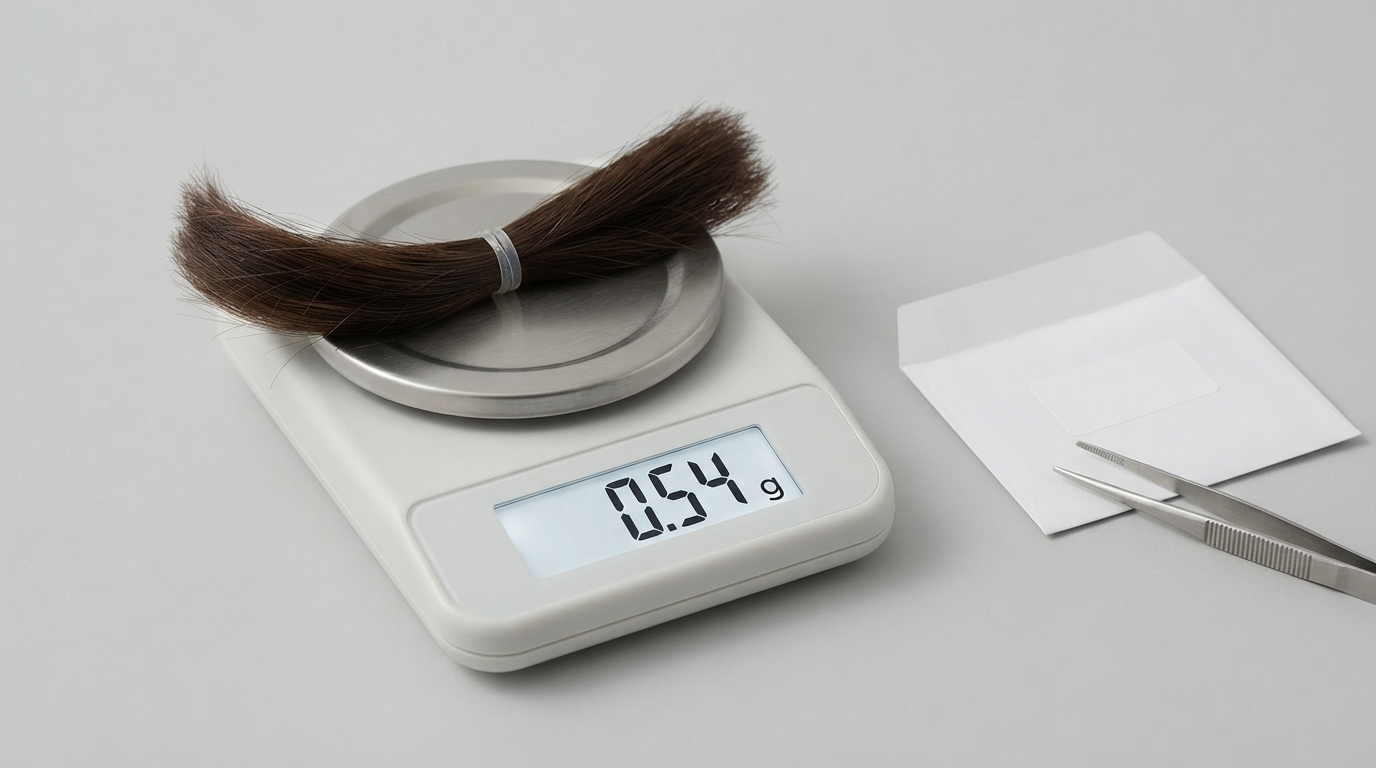
A lock of hair on a small digital scale reading in grams, showing how a sample is weighed before it is sent

It changes which partner hair diamond questions matter, and when you ask them. With hair, the assessment conversation has to happen before anything is posted, because a sample declared marginal after arrival is a sample already out of your hands. That is the practical spine of the partner hair diamond questions below: front load everything that could disqualify your sample, and accept no answer that begins with “send it and we’ll see.”

  • Weigh it first. A kitchen scale that reads to 0.1 g costs very little and tells you where you stand before anyone else knows.
  • Photograph it in the container it has lived in, including any tape, card, ribbon or plastic attached to it.
  • Write down what you know, roughly when it was cut, by whom, and how it has been stored since.
  • Ask for the provider’s minimum in grams, not in adjectives like “a small lock.”

How Would a Laboratory Know Whose Hair This Is?

This is the first of the partner hair diamond questions, and the honest answer surprises most people.

1. Can a provider verify that this sample is my partner’s?

Ask, and expect the answer to be no. Hair carries DNA in its root bulbs, but genetic testing is not something providers generally offer on this route, there would be nothing to test it against unless a reference sample exists, and the growth process itself, graphitization at roughly 2,500 to 2,700°C, then a press at 6 to 8 GPa, destroys every trace of biological material long before a crystal forms. A finished diamond cannot be tested afterwards to name anyone. Put it to the company in those words and see what comes back.

What a serious provider documents instead is a chain of custody beginning at receipt: this sample, logged under this reference, entered purification, and this carbon came out. That is a real and verifiable record. It simply starts at their door, not at your drawer.

So the truthful framing of one of the central partner hair diamond questions is this: the identity of the sample rests on your word, and the provider’s job is to make sure that whatever you sent is what they grew. A company that claims more than that is claiming something the physics does not allow.

2. What happens if the lock turns out to be mixed, or not theirs?

Expect nothing to flag it. Keratin from two people is chemically indistinguishable once purified to the 99.9% plus carbon the process requires, and separating or identifying sources is not what a purification and growth sequence is built to do, worth confirming with your provider rather than taking on trust. A brush sample that also holds a few of your own strands, or a child’s, will simply be carbon.

Whether that matters is one of the partner hair diamond questions only you can answer, and plenty of families conclude it does not, a brush two people shared is arguably a truer object than a clinical cut. But decide it now rather than discovering the ambiguity afterwards. If it does matter, a single clean lock with a known history beats a larger, vaguer sample.

This is also the point at which the partner hair diamond questions stop being technical. If nobody else can confirm what this is, your own record becomes the provenance. A dated note and a photograph taken today, kept with the paperwork, is worth more in twenty years than a memory.

Which Partner Hair Diamond Questions Are About the Sample’s Condition?

Two of the nine, and they are the partner hair diamond questions most often answered wrongly by well meaning guesswork.

3. The hair is old. Is it still usable?

Almost certainly, and this sits among the partner hair diamond questions where instinct misleads. Keratin is remarkably stable, hair survives for centuries in archaeological contexts, and a lock kept in a drawer for fifteen years has not lost its carbon. Age alone is not a disqualifier.

Storage is the real variable. Damp gives mold a foothold; adhesive tape, laminated cards and glued memorial books bond the hair to something that now has to be removed; loose strands may have picked up fibers. None of these is automatically fatal, and purification strips non carbon material anyway, but all are worth disclosing rather than hoping nobody notices.

4. Does dye, bleach or a treatment change anything?

Less than people fear, which makes this one of the partner hair diamond questions worth asking rather than assuming. Bleaching and permanent color alter the keratin cuticle, but they do not remove the carbon, and extraction strips out everything that is not carbon regardless. Heavily processed hair is generally still workable.

Hair thinned by illness or chemotherapy raises a volume issue rather than a viability one, fine, sparse strands weigh very little, so a visually generous lock may come in well under the gram figure a provider needs. Weigh it. The same goes for very short hair, where what looks like plenty on a card can be under a gram.

What you haveEffect on carbonEffect on viabilityDisclose when you ask
Lock kept loose in an envelope for yearsNone, keratin is stableGenerally fineHow long, and where it was stored
Hair taped to a card or laminatedNone to the hair itselfAdhesive must be removed firstThat tape or lamination is involved
Dyed, bleached or permedNone, purification removes the restGenerally fineThe treatment, so nothing is a surprise
Fine or chemotherapy thinnedNone per gramVolume is the risk, not chemistryThe actual weight in grams
Strands from a shared hairbrushNoneWorks, but sources cannot be separatedThat the sample may be mixed
Hair showing mold or damp damageReduced usable massAssessment needed before commitmentImmediately, with a photograph
A lock of hair taped to a keepsake memorial card, the kind of mounting that has to be removed before processing

The pattern across that table answers several of the partner hair diamond questions at once: chemistry is rarely the obstacle, and mass almost always is. If your sample fails, it will fail on a scale, not in a beaker. To see how the numbers work out, how much hair a partner memorial diamond actually needs sets out the typical bands.

What Does “Enough” Mean With No Second Sample?

A provider quoting “a small lock” is describing a comfortable case, not a threshold. Weight sits at the dead center of the partner hair diamond questions. For an irreplaceable sample, comfortable is not the number you need.

5. What is your minimum, in grams, and what is your preferred amount?

Ask for both, because they are not the same and the gap between them is where your risk lives. Industry wide, hair submissions typically run to a few grams, which sounds trivial until you weigh a thin lock of fine hair and find it at 0.6 g.

If you sit between the minimum and the preferred amount, you are not disqualified, you are in the band where the provider’s honesty matters most. Among the partner hair diamond questions this is the one to ask in writing, so the answer exists as text rather than as an encouraging phone call.
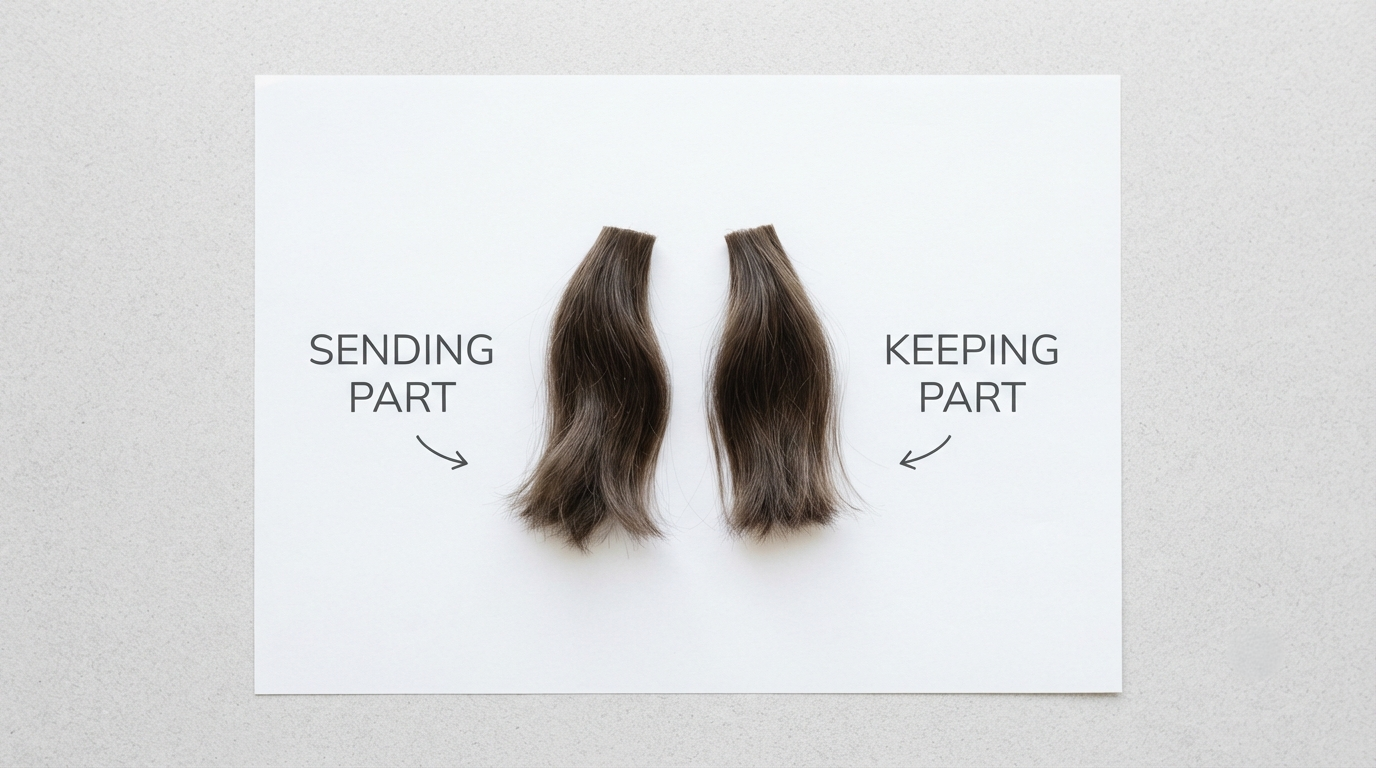
One lock of hair divided into two portions on a sheet of paper, illustrating sending part and keeping part

6. Will you assess the sample before I commit, and will you tell me plainly if it is marginal?

The answer you want is yes to both, with specifics. Some providers will look at a photograph and a stated weight and give a view. Some accept a few strands as a test portion. Some assess only on arrival, which for an irreplaceable sample is a materially worse offer.

Then ask the follow up that separates careful companies from confident ones: if it is marginal, will you say so and pause, or proceed and hope? Of all the partner hair diamond questions, this one most reliably reveals how a company behaves when things are not going well. The rest of the sequence from posting a lock to receiving a finished stone is comparatively predictable.

What Survives If the Run Fails?

Growth runs fail occasionally, and the partner hair diamond questions here are the least pleasant to ask. Crystals fracture, cells misbehave, and a stone can be lost in cutting. With ashes there is usually more material. With hair there is usually not.

7. If the sample is consumed and the run fails, what exists afterwards?

Ask this in the bluntest form you can manage, because the answer defines your actual exposure. Is the purified carbon recovered and re grown, or is it lost with the crystal? Is a second attempt made without further material? Is money returned when material cannot be?

There is no industry standard answer to these partner hair diamond questions, and different policies are all legitimate. What is not acceptable is vagueness. Of the nine partner hair diamond questions on this page, this is the one most often left unanswered: if a provider cannot describe what happens in the bad case, you are being asked to carry a risk nobody has quantified for you.

8. Can the sample be split, so that part of it stays with me?

Often, and it is the single most effective protection available to you. Sending half a lock and keeping half means a failure costs you a stone rather than the object itself. It also leaves a second family member able to commission their own stone later from the same source.

Ask whether the provider will work from a reduced portion and whether doing so changes the likely outcome. If your sample is large enough to split, splitting it converts the worst case from irreversible to merely disappointing, which is why it belongs among the partner hair diamond questions asked before the envelope is sealed, not after. Where more than one person wants a stone, the practicalities of sharing a single source are worth reading first.

The Partner Hair Diamond Questions About What a Certificate Asserts

Documents outlast the people who commissioned them, which is why the partner hair diamond questions end here. Read yours before it exists.

9. What, exactly, does the certificate claim about origin?

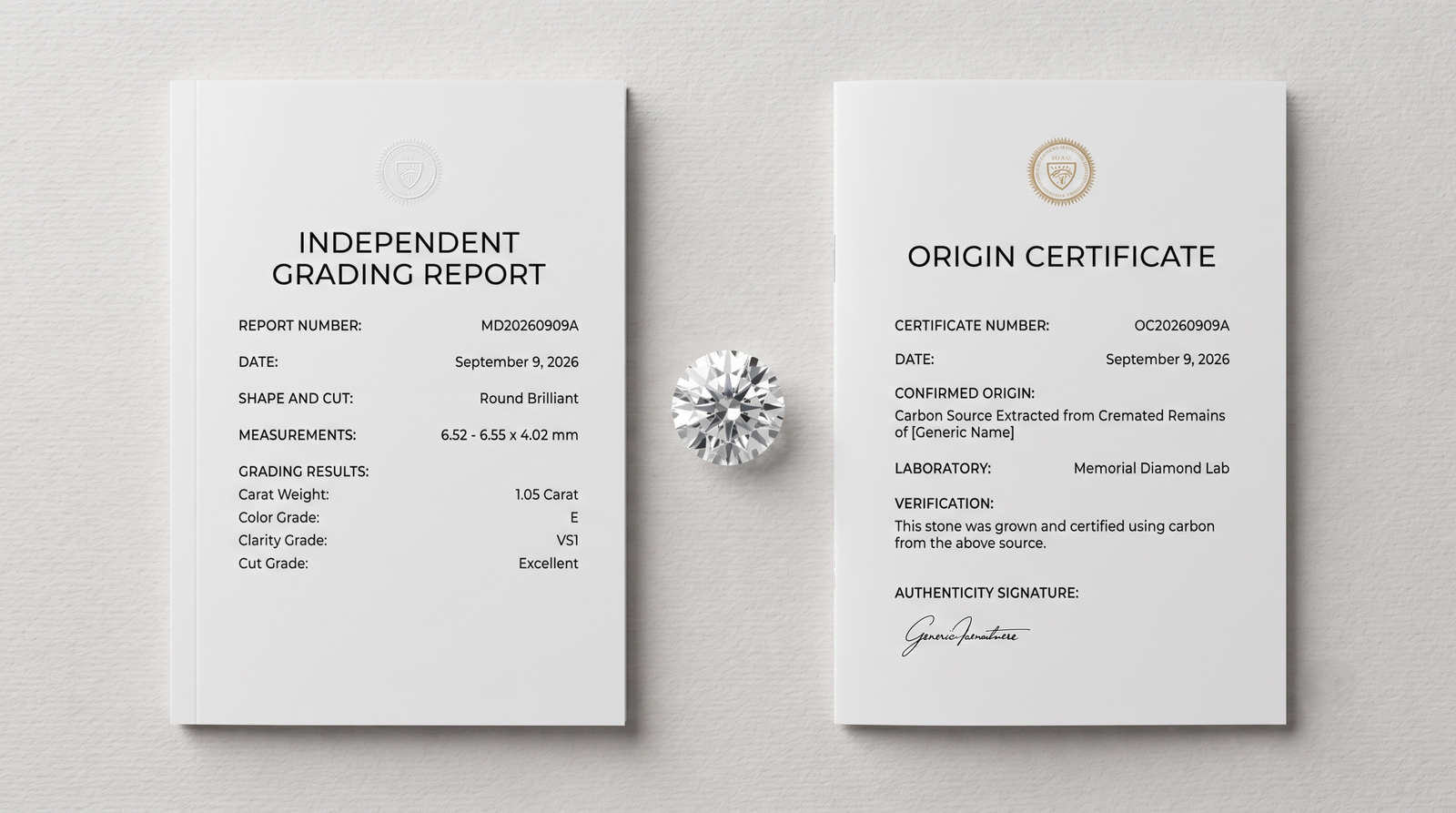
There are two documents and they do different work. A grading report, ideally from an independent laboratory, describes the finished stone, cut, color, clarity, carat, the same category of assessment any diamond receives. An origin or authenticity certificate describes the submission: that this diamond was grown from carbon extracted from material received under this reference on this date.

Notice what the second document can and cannot say, because this is one of the partner hair diamond questions a certificate answers on your behalf for the rest of its life. It can say material was received and tracked. It cannot say whose hair it was, because nobody at the laboratory was in your house when the lock was cut. Good wording reflects that honestly. Wording that implies genetic verification is overreaching, and it is fair to ask for a sample certificate before you commit.

Ask too about the proportion, and be careful with the number you have probably already read. The often quoted 10 to 15% band describes carbon recovered from cremated ashes; no equivalent share is published for hair, so no honest document can put a hair figure on it. What is true on either route is that laboratory carbon makes up the bulk of the charge so the crystal reaches a viable size, and that the personal carbon is a real, verifiable, permanent minority of the lattice rather than the whole of it.

So make it one of your partner hair diamond questions: what share is my sample expected to contribute, and how is that recorded? Any document or salesperson claiming the stone is wholly your partner is overstating what a grown diamond actually is, and a company comfortable overstating that will be comfortable overstating other things. That honesty test sits underneath all nine partner hair diamond questions on this page.

Frequently Asked Questions

Can a finished diamond be tested to prove whose hair it came from?

No. The growth process runs far above the temperature at which biological material survives, so nothing identifiable remains in the crystal. Treat any claim that a finished stone can be genetically matched to a person as a reason to ask a great many more questions.

Is hair from a hairbrush usable?

Physically, yes, brush strands are the same keratin as a cut lock. The caveat is that a shared brush may hold more than one person’s hair, and nothing in the process distinguishes them. Decide in advance whether that ambiguity sits comfortably with you.

Does the hair need roots attached?

No. The carbon is in the shaft, and roots add almost nothing to the mass. Root bulbs would matter for DNA testing, which providers do not generally offer on this route, so cut ends are perfectly workable.

My partner’s hair was gray. Does that change the stone?

No. Pigment is present in trace quantities and is removed during purification like everything else that is not carbon. A diamond’s color comes from trace elements at growth, nitrogen tending yellow, boron tending blue, neither present giving colorless.

Can I send more hair later if the first sample falls short?

Ask, because it depends entirely on where the run has reached. Once material is purified and committed to a growth cell, adding to it is usually not possible. Before that stage, some providers will accept a top up. Get the deadline in writing.

My partner was buried rather than cremated. Does hair still work?

Yes, and that is the point of this route. Hair needs no cremation at all, which is why it also suits families whose faith or wishes ruled cremation out, and why a lock saved during life is enough on its own.

Final Thoughts on Partner Hair Diamond Questions

Everything on this page comes back to one sentence: there is no second envelope. The chemistry is forgiving, the timeline is ordinary at six to ten months, and the finished stone is a real diamond by every measure. The only unrecoverable thing is the sample you start with, and that is what shapes the partner hair diamond questions.

Which is why the partner hair diamond questions worth asking are the ones that happen before postage, weight, condition, assessment, splitting, and what a provider does on a bad day. Asked in that order, they cost you an afternoon. Asked afterwards, some of them have no useful answer at all.

If a company answers all nine partner hair diamond questions plainly, you have learned something. If one of them produces a shrug, you have learned something more useful still, and you have learned it while the envelope is still in your drawer.

Learn More About Partner Hair Diamonds

Talk With Memorial Diamond

If you want the partner hair diamond questions above answered against your actual sample rather than in general, reach out to Memorial Diamond at memorialdiamond.us. Bring a weight in grams, a photograph of the lock as it currently sits, and an honest description of how it has been stored, including the parts you would rather not mention.

Nothing about the partner hair diamond questions needs deciding in a first conversation, and nothing should be posted before one. Ask what your sample would need to weigh, whether it can be split, and what happens on the day a run goes wrong.
partner ashes hair diamond questions

Questions to Ask Before Turning Your Partner’s Ashes and Hair Into a Diamond

You have two things, and they are not the same kind of thing. One sits in a container that still holds far more than any laboratory will ask for. The other is a single lock in an envelope, and there is no more of it anywhere in the world. The partner ashes hair diamond questions that actually decide how this goes are questions of reconciliation: whether each source is assessed on its own, which one is committed first, what happens when one fails and the other does not, and what the certificate ends up naming.

Memorial Diamond grows these stones, so read this page as an interested source rather than a neutral one. Figures below are industry wide bands, not our published requirements. And one of the partner ashes hair diamond questions has a reassuring answer: combining two sources does not change the diamond itself at all.

Two Sources, Two Different Risks

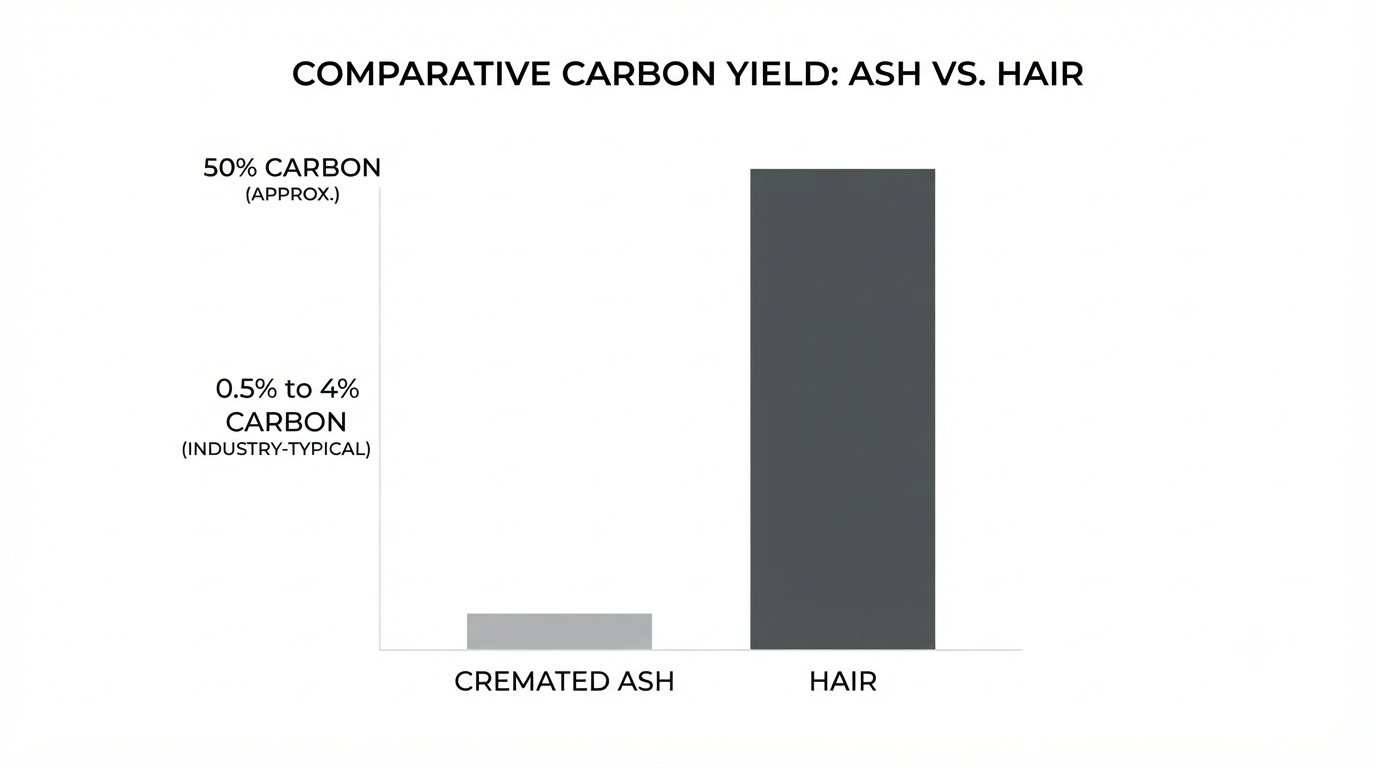
Start with why the partner ashes hair diamond questions are not two sets of single source questions stapled together. Cremated remains are mostly calcium phosphate, which is why the carbon a laboratory can recover from them sits somewhere between 0.5% and 4% of their weight. Hair runs at roughly 50% carbon, because keratin is a carbon rich protein. A few grams of hair can therefore carry more usable carbon than a generous scoop of ash.

That difference produces two entirely separate failure modes, which is the practical root of most partner ashes hair diamond questions. Ash fails quietly, at the yield stage, when a portion that looked ample gives up less carbon than expected. Hair fails at the scale, before anything else happens, when a lock that looked generous weighs under a gram.

A simple bar comparison showing roughly 0.5 to 4 percent carbon in cremated ash against roughly 50 percent in hair

They also differ in replaceability, and this is the asymmetry that should drive your planning:

  • Ash is usually re portionable. If a first portion underperforms, another can often be taken from the same container, assuming the person who authorized the first will authorize a second.
  • Hair is not. A lock is a fixed object with a fixed weight, and there will be no second one.
  • Ash may not be yours to divide. Authority over cremated remains is set state by state and by anything your partner left in writing, and for an unregistered relationship it can rest with a parent, an adult child or a former spouse.
  • Hair is usually the simpler question. What the law regulates here is cremated remains, not mementos, which is why hair you already keep is ordinarily the less obstructed route. It is not a free pass. An estate can take in a person’s belongings, states do not agree, and hair in another household is something to raise rather than assume. Verify it if the answer would change your plan.

Hold those four facts in mind and most of the partner ashes hair diamond questions below answer themselves in a particular direction.

Are Both Sources Assessed Before You Commit to Either?

This is where a combined submission either becomes safer than a single source one or considerably riskier, depending entirely on how the provider works. Among the partner ashes hair diamond questions, this one is the fork.

1. Will each source be weighed and evaluated separately?

Ask for two assessments, not one verdict: the first of the partner ashes hair diamond questions to put in writing. The chemistry, the risks and the thresholds are different for each material, so a single yes covering both tells you almost nothing about which of the two is actually carrying the submission.

What you want to hear is a stated weight for the ash, a stated weight for the hair, and a view on each against the provider’s own figures. Of all the partner ashes hair diamond questions, this is the one that most often gets a vague reply, and vagueness here means you will not learn which source was marginal until after both have gone. For the underlying numbers, how much ash and hair a partner memorial diamond actually needs sets out the typical bands for each.

2. Do you need both, or is one of them already sufficient?

This is one of the partner ashes hair diamond questions that saves people material they did not have to send. If the hair alone meets the threshold, sending ash as well is a choice about meaning rather than a technical necessity, and plenty of families make that choice deliberately, wanting both represented.

But it should be a decision, not a default. Ask plainly whether either source would suffice on its own. If the answer is that the hair carries the submission and the ash is supplementary, you may decide to keep the ash portion where it is.

Which Partner Ashes Hair Diamond Questions Are About Sequence?

Order matters more than most people expect, and these partner ashes hair diamond questions exist because the two materials are not equally recoverable.

3. Which source is committed first, and can one be held back?

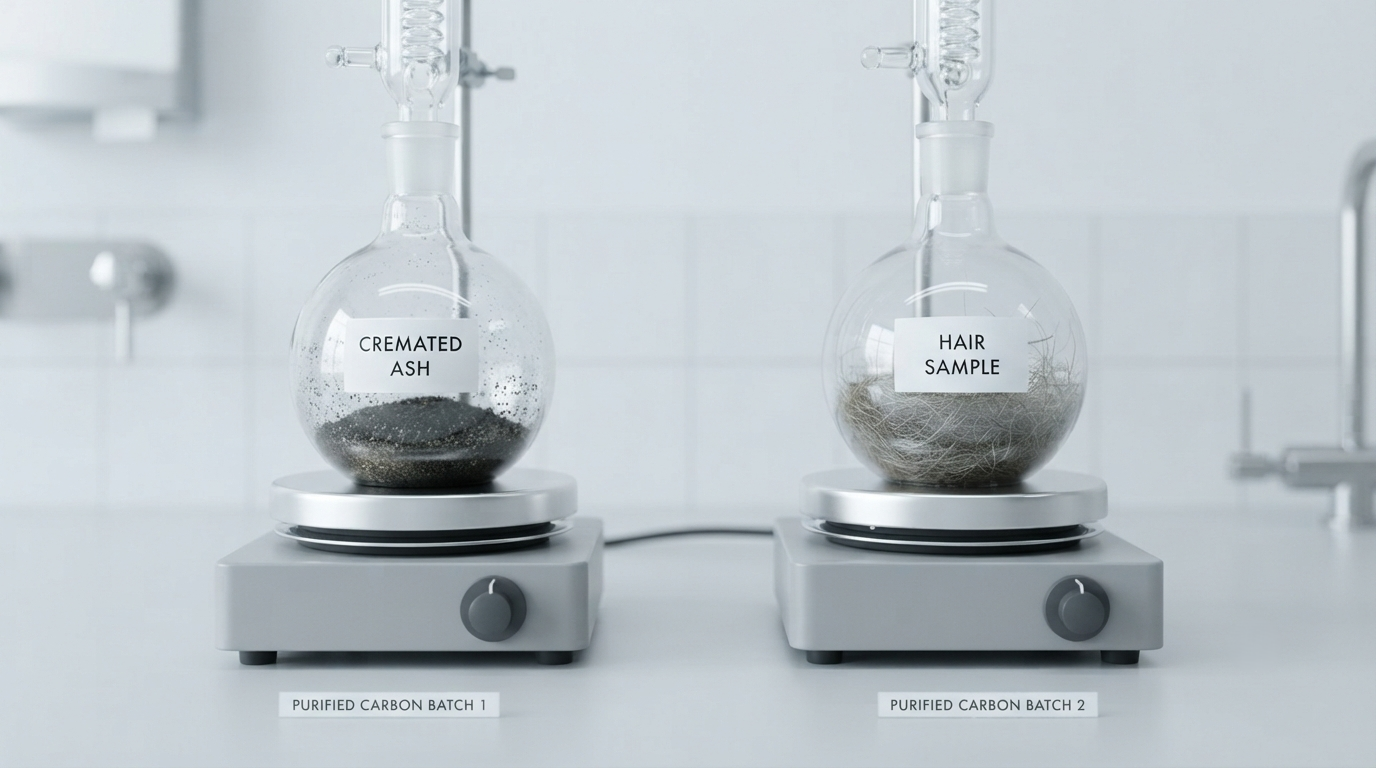
In most processes each material is purified to roughly 99.9% carbon, converted to graphite at around 2,500 to 2,700°C, and only then loaded into a growth cell. That means there is a window during which the two carbon streams exist separately, and what a provider does in that window is worth knowing.

The protective arrangement, where a provider will allow it, is to commit the replaceable source first and hold the irreplaceable one until the first stage has gone well. Ash, which can usually be re portioned, is the natural candidate to go first. Hair, which cannot be replaced at all, is the natural candidate to hold. Whether a provider can work that way is among the partner ashes hair diamond questions most worth asking early, because it costs nothing to arrange in advance and cannot be arranged at all afterwards.

4. What happens if one source fails and the other is fine?

Get this answered before either leaves your house. Few partner ashes hair diamond questions age as badly. The table below sets out the four outcome combinations, plus two rows that turn on when the sources are blended, and the decision each one forces, so you can decide now rather than under pressure later.

Ash outcomeHair outcomeWhat you are left withSettle in advance
SufficientSufficientA normal combined submissionNothing further
SufficientUnder weightAsh carries the stone; hair may be returned or added anywayDo you still want the hair included, or kept intact?
Short yieldSufficientHair carries the stone; more ash may be requestedCan a second ash portion be authorized, and by whom?
Short yieldUnder weightNeither source is sufficient aloneIs combining them enough, and who decides?
EitherEither, after blendingBoth consumed in one failed runIs a re grow attempted from recovered carbon?
EitherEither, before blendingOnly the committed source is lostCan the uncommitted source be returned?
partner ashes hair diamond questions

The bottom two rows are the ones people skip, and they are the reason the sequencing question matters. Once two carbon streams are blended and loaded, a failed run takes both. Kept separate until the last moment, a failure takes only what was committed. What actually happens to each material inside the laboratory makes the timing of that decision much easier to picture.

The follow up: are the two carbon streams blended, or kept as separate batches?

Related but distinct, and it sits beneath several of the partner ashes hair diamond questions above. Some providers purify both materials and combine the carbon before growth. Some may be able to grow from one and hold the other. The answer determines everything in that table, and it is a straightforward operational fact any provider should be able to state.

Ask it as a process question rather than a preference, and ask when the point of no return falls. These are the partner ashes hair diamond questions with the shortest useful shelf life: after blending, none of them can be acted on.

Does Combining Two Sources Change the Finished Stone?

Here is the reassuring part of the partner ashes hair diamond questions, and it deserves stating flatly.

5. Is a two source diamond different from a single source one?

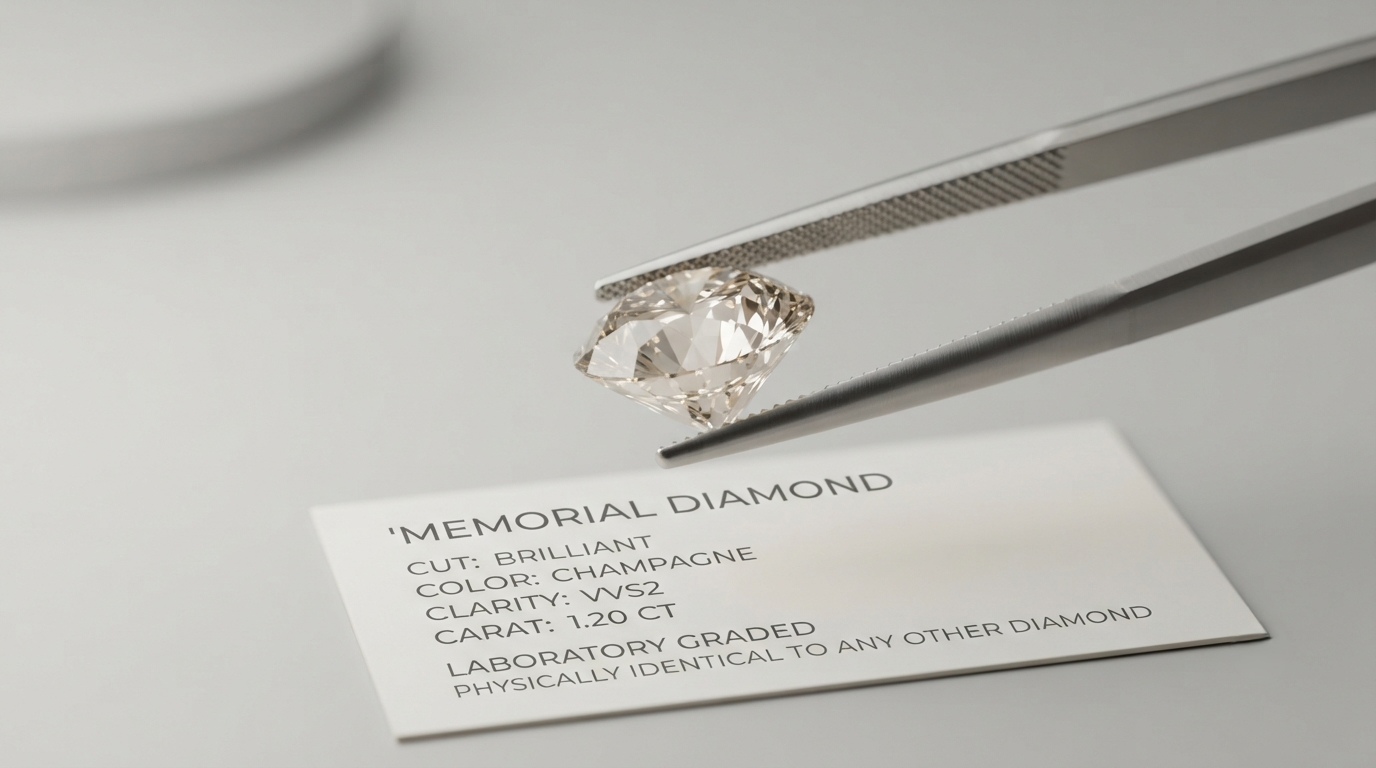
No. Once carbon is purified to 99.9% plus, its origin is no longer chemically legible. Carbon from keratin and carbon from cremated remains are the same element, entering the same lattice. The finished stone is a real diamond by every measure: 10 on the Mohs scale like any other, graded on the same four Cs GIA applies to every diamond, with clarity for memorial stones typically landing between SI2 and VVS.

A polished memorial diamond held in gemmological tweezers, a stone graded on the same four Cs as any other diamond

Color is worth a word, because it drives more partner ashes hair diamond questions than anything else and people assume blending must muddy it. It does not work that way. A diamond’s color comes from trace elements present during growth: nitrogen producing yellow tones, boron producing blue, the absence of both being what makes a stone colorless. Those traces come from whatever survives purification, so a combined submission can shift the odds slightly, but there is no blending effect that makes a two source stone look different in kind. What color to expect from a combined submission goes further into the mechanism.

One honest caveat belongs here, and it is the same one that applies to every memorial diamond. Sending two sources does not raise the proportion of your partner that ends up in the stone. The figure usually cited, something around 10 to 15% of a finished stone’s mass, with some providers citing as low as 3%, describes the ash route, and no published figure covers a blended ash and hair charge.

Laboratory carbon makes up the balance either way, so the crystal can reach a viable size. Ask what share your provider expects your own samples to contribute. A real and permanent part of your partner is in that lattice either way. Two sources means both are represented, not that the fraction doubles, and among the partner ashes hair diamond questions this is the one most often answered dishonestly by people selling something.

6. Will the certificate name both sources?

Ask to see the wording before you commit. Of the partner ashes hair diamond questions this is the quietest, and the certificate is the only place the combination is ever recorded. A stone made from two sources looks identical to one made from either, so the document is the entire distinction.

Good wording names both materials and the date each was received. Weaker wording refers only to “personal carbon” and leaves the specifics out, which is not dishonest but does erase exactly the thing you went to the trouble of doing. For a relationship that may not be documented elsewhere, that certificate may become the formal record that names you both, which is a reason to care about a sentence nobody else will ever read closely.

One Stone From Both, or Two Stones From One Each?

A fork in the road that is easy to miss, which is why it belongs among the partner ashes hair diamond questions: a quote will usually answer only the option you asked about.

7. Should this be one diamond or two?

One stone from both sources is a single object in which the two materials are permanently indistinguishable. That is the point, for many people. It is also, practically, one thing, which matters if more than one person may eventually want to inherit it, since a diamond cannot be divided.

Two stones, each from a single source, keeps the materials separate and gives you two objects. They will be smaller at the same total cost, because price scales steeply with carat, and each carries its own growth time. Neither answer is better. But deciding deliberately is far better than discovering at the certificate stage that you chose without noticing. If inheritance is part of your thinking, whether several people can have stones from the same source is the next thing to read.

8. If the ashes are contested, can the hair go ahead alone?

Yes, and of all the partner ashes hair diamond questions this one has the most useful answer. The hair route needs no cremation and no crematorium’s authorization file, so in practice a lock already in your own home does not usually raise the same custody question as a container of ashes. Check rather than assume, since personal effects can fall to an estate and that varies by state.

If authority over the remains rests with someone who has not agreed, or has not yet been asked, a hair only submission proceeds while that conversation continues, and ash can often be added to a later stone. Treat it as a live fallback, not a consolation. The ashes specific custody questions and the hair specific provenance questions cover each route in its own right.

The Partner Ashes Hair Diamond Questions About Cost and Time

The last of the partner ashes hair diamond questions, and the one with the most counterintuitive answer.

9. Does a two source submission cost more or take longer?

Growth time is set by the carat you choose, not by how many materials you sent. A stone takes what it takes: six to ten months across the industry, occasionally up to twelve for larger or specialty color stones, whether the carbon came from one source or two. Two intake and purification runs may add handling at the front end, so ask whether that is priced separately.

Ask the question in that shape: what does the second source add to the invoice, and what does it add to the calendar? A clear answer to both is easy for an organized provider to give. Money and months are the partner ashes hair diamond questions people ask first and should ask last. If you want the sequence laid out end to end before you ask, the step by step for a combined submission covers it.

Frequently Asked Questions

Do the two materials have to be sent at the same time?

Not necessarily, and sending them separately can be an advantage. Ask whether the provider will receive, log and assess one while the other stays with you. That is the arrangement that protects the irreplaceable source until the first stage has gone well.

Can we tell afterwards which carbon came from where?

No. After purification and growth the carbon is chemically the same element regardless of which sample it started in, and providers do not generally offer any test that separates it by origin, worth asking about directly rather than assuming either way. What records the combination is the paperwork, which is why the certificate wording is worth checking in advance.

Does adding hair make the stone more likely to be colorless?

Not reliably. Color depends on trace elements surviving purification, and while hair and ash carry different trace profiles, neither guarantees an outcome. Ask instead whether the provider offers a color choice and what that involves.

If we send both, can we still keep some of each?

Usually, and it is worth stating up front. Only a portion of the ashes is needed, and a lock can often be divided so part remains with you. Ask for both to be confirmed in writing before anything is posted.

Is a combined stone harder to insure or value?

It is valued like any other diamond, on cut, color, clarity and carat. An independent grading report, if you order one, is what an insurer will want, and the origin certificate is a separate document that speaks to provenance rather than market value.

Could a second diamond be made later from what is left?

Often, if material remains. Ash portions are frequently large enough to support more than one stone, and a divided lock leaves the option open. Ask before the first submission, because the answer may change what you send.

Final Thoughts on Partner Ashes Hair Diamond Questions

None of the partner ashes hair diamond questions here is about whether a combined diamond is worth having. It is about the fact that you are handing over two objects with different risks, different legal footing and, crucially, different chances of ever being replaced.

Asked in advance, the partner ashes hair diamond questions here mostly resolve into one instruction: protect the hair. Assess both separately, commit the ash first if a provider will allow it, keep the sources apart for as long as the process permits, and get the certificate wording before rather than after.

The stone itself will be a diamond like any other, identical in hardness, graded on the same scale, indistinguishable from a single source stone by any instrument. What the partner ashes hair diamond questions protect is not the stone. It is the envelope in the drawer that has to survive the process intact if anything goes wrong.

Learn More About Combined Partner Memorial Diamonds

Talk With Memorial Diamond

If you want the partner ashes hair diamond questions above answered for your two specific sources rather than in general, reach out to Memorial Diamond at memorialdiamond.us. Bring the weight of the ash portion you hold, the weight of the lock in grams, and any uncertainty about who controls the remains.

Ask for two assessments rather than one, ask whether the hair can be held back, and ask what the certificate would say. The partner ashes hair diamond questions cost nothing to put in an email. Nothing has to be decided in a first conversation, and nothing should be posted before one.

A cremation authorization form on a kitchen table beside a closed urn, the paperwork behind the partner ashes diamond questions that decide custody

Questions to Ask Before Turning Your Partner’s Ashes Into a Diamond

The container has been on the same shelf for months and you have already decided what you want. What stops people at this point is rarely the price. It is the quieter realization that you may not be the person legally permitted to open it. The partner ashes diamond questions that actually decide whether this happens are about custody and quantity: who may authorize a portion leaving the house, how much leaves, what is written down as it goes, and what comes back if the growth run yields nothing.

Memorial Diamond grows stones from cremated remains, so this page is written by a company with an interest in your answer. Read it that way. Every figure below is an industry wide band, not a published requirement of ours, and the hardest of the partner ashes diamond questions is one no provider can answer for you.

Why Standing Comes Before Everything Else

Between the shelf and the laboratory there is a decision, and in the United States it belongs to whoever the law of your state says it belongs to, modified by anything your partner set down in writing. There is no national rule: there is a stack of state statutes that do not agree with each other.

For a married couple this is usually uncomplicated. For a partner it may not be. If the relationship was never registered, if the families never quite acknowledged it, or if a divorce was never finalized, the ashes may be legally controlled by a parent, an adult child, or a former spouse. That is not a comment on the relationship. It is a comment on what a crematorium’s file says.

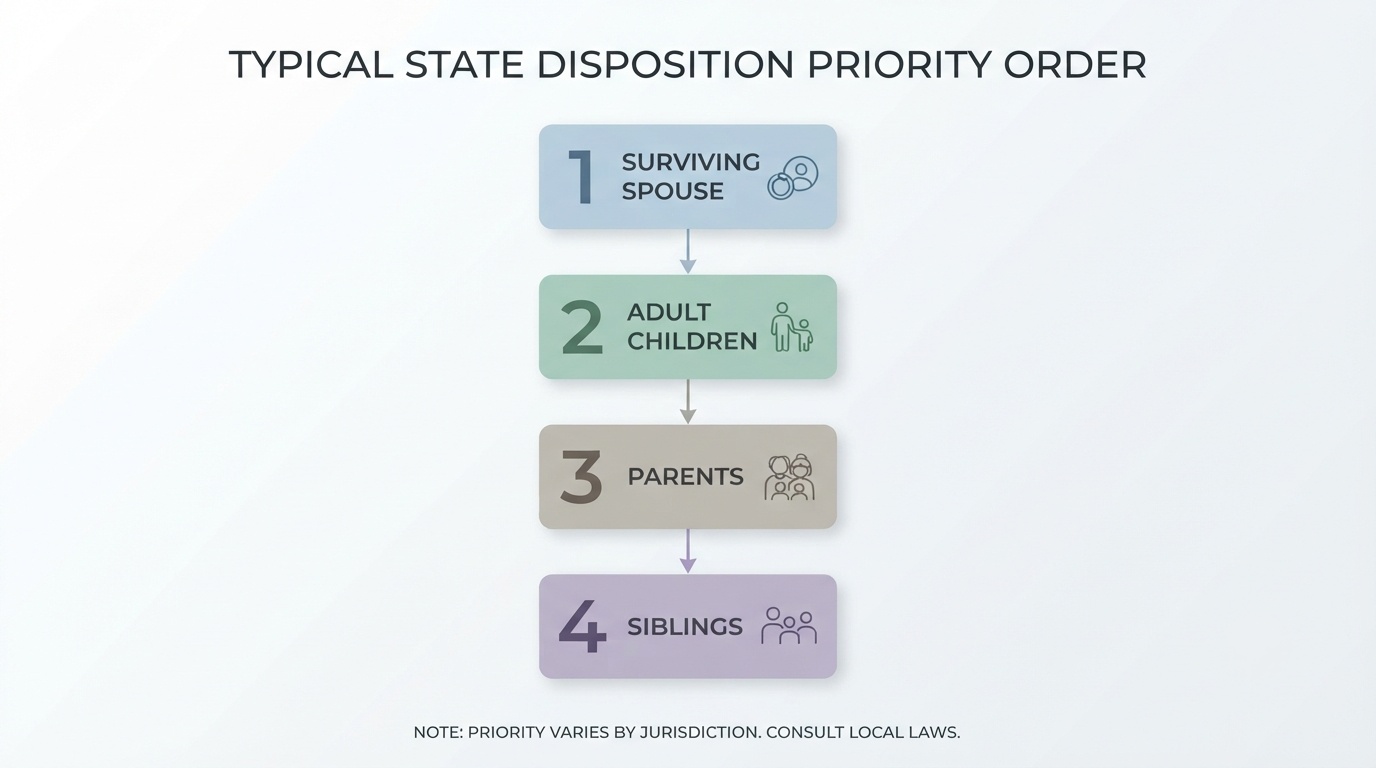
A simple diagram of a typical state disposition priority order listing spouse, adult children, parents and siblings

So the order matters. Settle standing first, then material, then money. A deposit paid before you know who controls the remains is a deposit paid on a maybe. Every useful list of partner ashes diamond questions starts here rather than with carat or setting.

Four places usually hold the answer, and working through them settles the first of the partner ashes diamond questions before a cent is spent:

  • The cremation authorization form. Whoever signed it is the person the crematorium recognized as having the right to direct disposition. Ask the funeral home for a copy; they generally keep one.
  • Anything your partner wrote down. A will, a designated agent form, a pre need contract, or in some states a simple signed disposition directive naming you specifically.
  • Your state’s disposition statute. Most set an explicit priority order: spouse, then adult children, then parents, then siblings: and most were written before the range of relationships they now govern.
  • The funeral home’s own file. Staff there have had this conversation many times and can usually tell you in five minutes where you stand.

Which Partner Ashes Diamond Questions Are About Who Decides?

Three of the nine belong here. They are the partner ashes diamond questions to settle before you contact any provider, because no laboratory can resolve one of them for you.

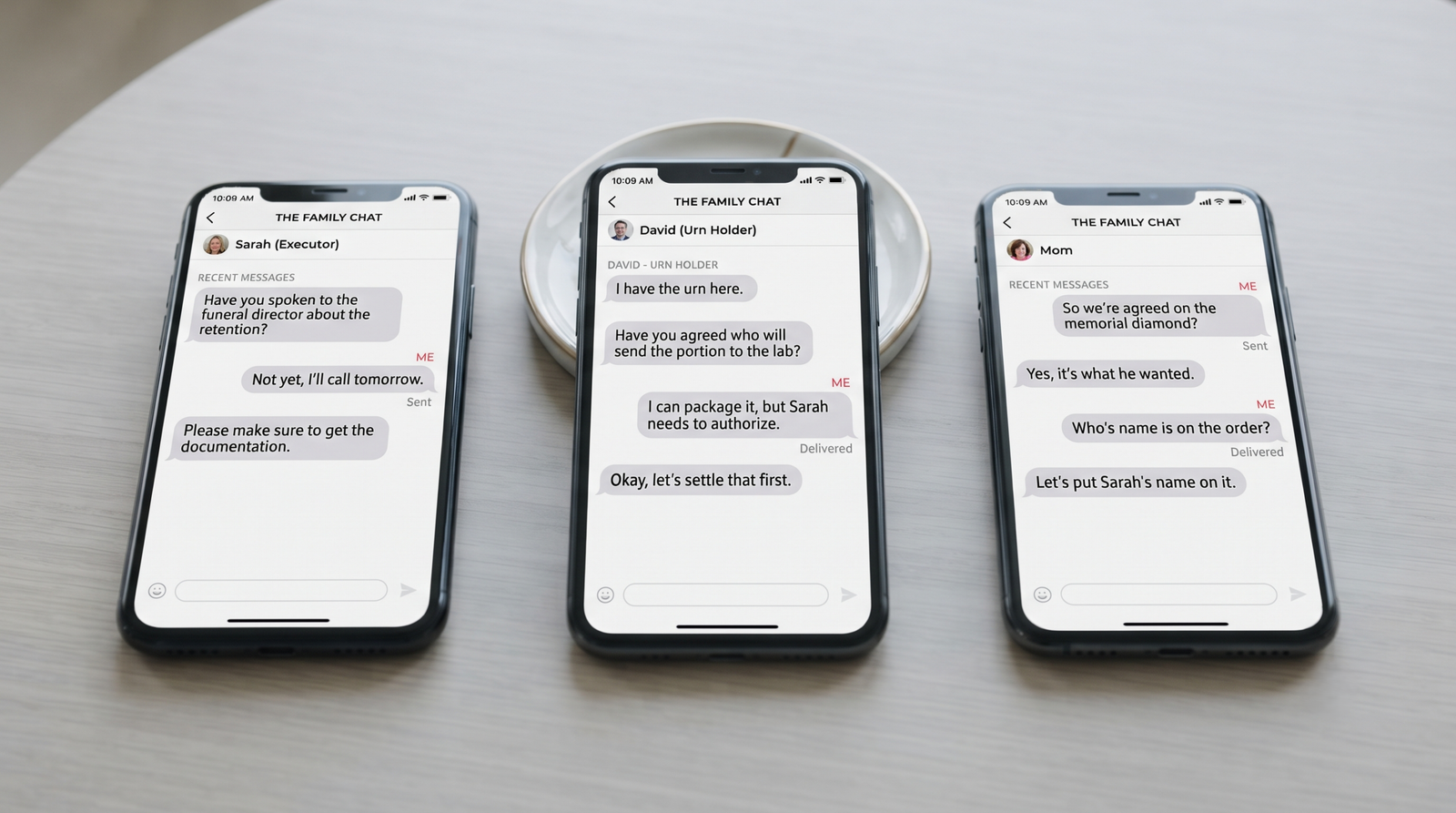
1. Who signed the cremation authorization, and does that person agree?

This is the single fact that most often changes the shape of everything after it. The signature on that form is the crematorium’s record of who held authority at the time, and a provider that takes chain of custody seriously will eventually want to know that the person sending material had the right to send it.

If the name on the form is yours, the rest of this page is logistics. If it is someone else’s, your next conversation is with that person and not with a laboratory. Among the partner ashes diamond questions families put off longest, this is the one that costs the most to delay, because every other arrangement is built on top of it. Treat it as the root of the partner ashes diamond questions and the rest become ordinary planning.

2. If the ashes are not yours to divide, what exactly are you asking for?

There is a large practical difference between asking a family to hand over the remains and asking them to permit one small portion. The first sounds like a claim. The second sounds like what it is: a request that leaves their plans entirely intact.

Say the number out loud when you ask. Industry wide the requirement runs from a few tablespoons up to roughly 4 oz, around 100 g, which is a small fraction of a full cremation. The interment still happens. The scattering still happens. The urn a sibling wants on a mantel still sits on that mantel. Framed that way, a refusal becomes much less likely, and if it comes anyway you have learned something before spending anything. Stating the quantity turns one of the harder partner ashes diamond questions into a small, specific request.

3. Does anyone else expect a portion of the same ashes?

Ashes get divided more often than people assume, and rarely with a written record of who took what. If a sibling already has a keepsake urn and a parent is planning a scattering, what remains on the shelf may be less than the container suggests.

Ask before you weigh anything: quantity is one of the partner ashes diamond questions that cannot be answered in the abstract. If more than one person wants a stone, say so early: the same submitted material can often support several diamonds, and whether a second family member could have a stone from the same source is a question far better settled at the start than after a run has begun. Shared plans are among the partner ashes diamond questions that get expensive when they surface late.

How Much Leaves the House, and What Stays?

Quantity is where the abstract becomes physical. You will, at some point, be holding a scoop. The partner ashes diamond questions in this group are all versions of one worry: how little can go, and how much stays.

4. Is the published minimum a received weight or a usable weight?

This distinction is rarely spelled out and it matters more than any other number on a provider’s page. Cremated remains are mostly calcium phosphate, the mineral structure of bone. Of the weight sitting in that container, only something between 0.5% and 4% is carbon a laboratory can actually use. A figure quoted as “what we need” might mean the weight arriving at the door, or it might mean the carbon that survives purification.

Ask which. The answer tells you whether a marginal portion is likely to be assessed as sufficient, and it is one of the partner ashes diamond questions that a straightforward provider will answer in a sentence.

5. What happens to the ash the process does not consume?

Extraction leaves most of what arrives behind. That residue is not nothing to you, and what becomes of it is policy rather than chemistry, which means it varies from company to company and is worth having in writing.

Three sub questions cover it: does the unconsumed material return by default or only on request, in what container, and within what period after the stone is finished? Providers that have thought about this will have a stated practice. Providers that have not will tell you they will look into it, which is its own answer. Remainder policy is one of the partner ashes diamond questions worth holding as text rather than reassurance.

6. Can you send less than the published figure if less is all you hold?

Sometimes the portion you control is smaller than the band. A keepsake urn holds what it holds, and no amount of asking will make it larger if the rest was scattered two years ago.

A provider should be willing to assess a partial share on its actual weight rather than turning you away at a published minimum. Ask whether they will look at a photograph, a weight, and a description of how the ashes have been stored before you commit to anything. If the answer is yes, how much ash a partner memorial diamond actually uses becomes an arithmetic problem rather than a wall. A provider who refuses to look has answered one of the partner ashes diamond questions by declining to.

What Should Be Written Down Before the Portion Goes?

Chain of custody is not bureaucracy for its own sake. It is the only thing that later distinguishes a stone made from your partner’s carbon from a stone somebody assures you was. Documentation is quietly the most durable of the partner ashes diamond questions, because paperwork outlasts memory.

7. What record exists at the moment the portion leaves your hands?

The honest answer is that identity here rests on custody rather than on testing. Providers do not generally offer DNA verification of cremated remains, so ask outright what a company does and does not verify, and what it relies on instead. What a serious provider documents is an unbroken record of handling: that this container, sealed on this date, sent by this person, was the container that entered the process and the one whose carbon came out. Of the partner ashes diamond questions here, this is the one whose answer you build yourself rather than receive.

That record only works if it starts in your house. The table below is the ledger to keep. Fill in the right hand column with the answers you get, and ask for any blank one in writing before shipping. Six moments, six documents, and six of the partner ashes diamond questions answered on paper rather than by promise.

MomentWho is holding the ashesDocument that should existWhat to ask for
Before anything movesYou, or the authorizing family memberCopy of the cremation authorization formWritten agreement from the authorizing person, even a dated email
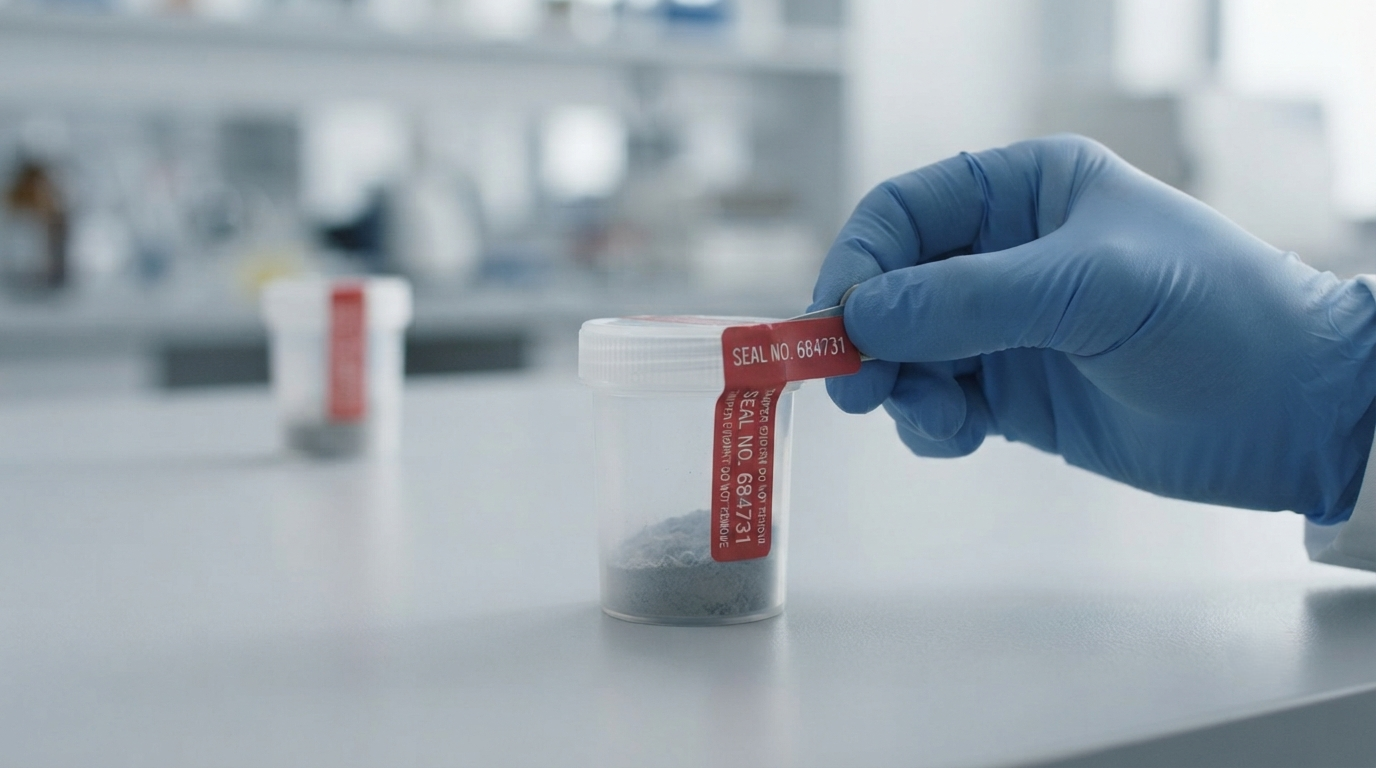
Portion separatedYouYour own note: date, weight, who was presentA provider issued intake kit with a pre numbered seal
In transitThe carrierTracking record and signature on deliveryConfirmation the shipment must be signed for, not left
Arrival and weighingThe laboratoryDated receipt naming weight receivedA stated weight, not a confirmation that “it arrived”
Purification onwardThe laboratoryInternal batch or reference numberThe number itself, given to you, usable in later emails
Finished stoneYouOrigin certificate tied to that batch numberThe certificate wording, shown before you commit
A pre-numbered tamper-evident seal being applied to a small intake container on a table

8. What comes back if the growth run produces nothing?

Growth runs can fail. Carbon yield from ash is low and variable, presses are unforgiving at 6 to 8 GPa and temperatures between 1,400 and 2,500°C, and a crystal can fracture during growth or cutting. No published figure puts a rate on it, and a provider who tells you it never happens is telling you something they cannot know. Failure is the least comfortable of the partner ashes diamond questions and the most revealing.

So ask the awkward version: if the run fails, does the process restart from material you have already sent, is more material requested, or is money returned? The answers differ across the industry and none of them is wrong: but you want to know which one you have bought. Of all the partner ashes diamond questions, this is the one most likely to be met with a pause, and the pause itself is informative. The mechanics of what actually happens to the ashes inside the laboratory will make the answer easier to follow.

The Partner Ashes Diamond Questions About Names and Certificates

Paperwork outlives grief admin, and certificate wording is where the partner ashes diamond questions finally land on one page. What a certificate says in 2026 is what it will still say in 2050, when whoever inherits the stone has to explain it to somebody.

9. Whose name goes on the certificate, and who may request a copy later?

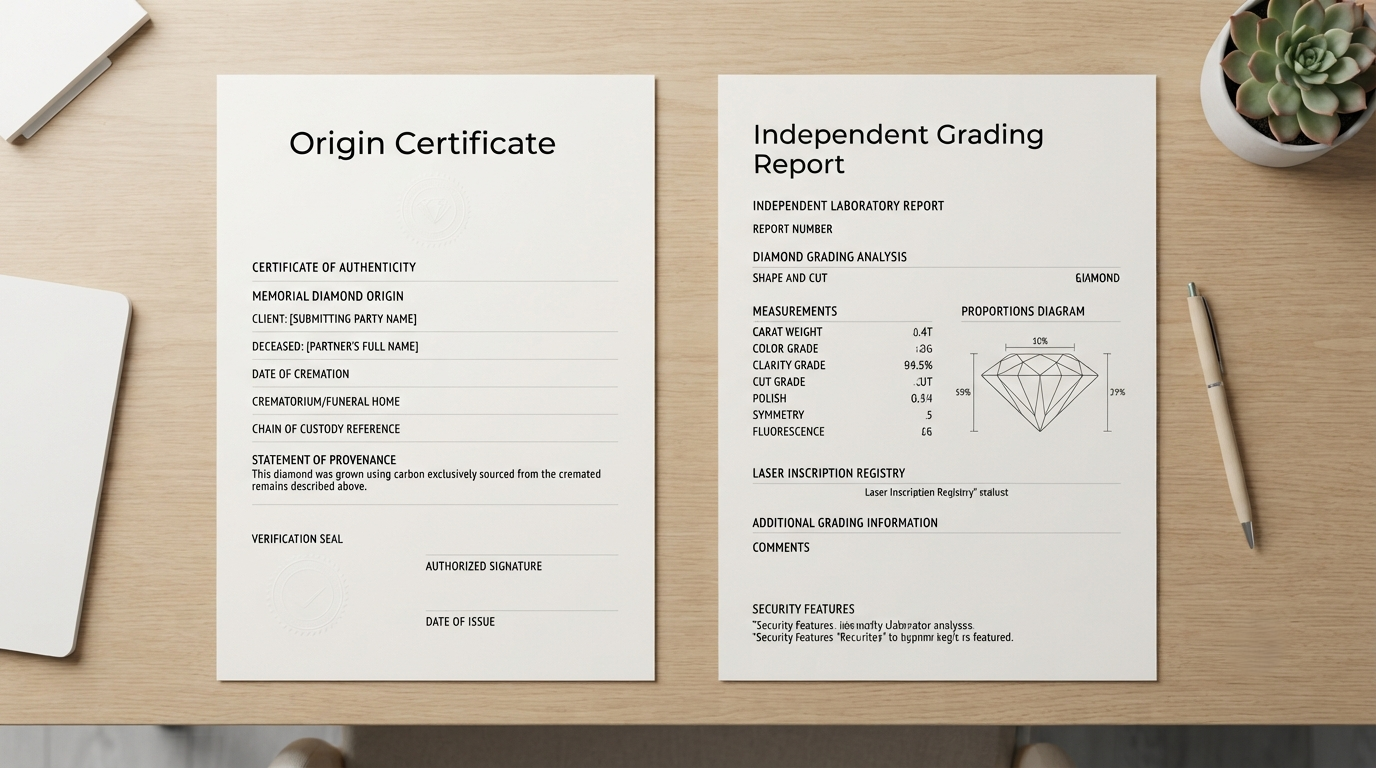
Two documents can exist, doing different jobs. An origin certificate, usually issued in house, records that this diamond was grown from this family’s submitted carbon. An optional grading report, ideally independent, documents the stone’s own cut, color, clarity and carat against the same standards GIA applies to any diamond.

The origin certificate is where names appear, so see the wording before you commit. Does it name your partner? Does it name you as the submitting party, and would that be a problem if a family member disputes the arrangement later? Can a second copy be issued years afterwards, and who may ask? For a relationship documented nowhere else, that certificate may be the only formal record naming you both. Before you finalize anything, it is worth reading the full sequence of steps from collection to finished stone so the certificate arrives as the last item on a list you recognize.

Two documents side by side on a desk, an origin certificate and an independent grading report, showing the different jobs each one does

One thing no certificate should claim is total purity. For carbon drawn from ash, the share of the finished stone’s mass usually quoted is 10 to 15%, with published figures running down to 3% at some companies; laboratory sourced carbon makes up the balance so the crystal reaches a viable size.

Ask your own provider what share they expect your portion to contribute; it is one of the partner ashes diamond questions with a company specific answer. A real portion of your partner is in the lattice, permanently and verifiably. It is not the whole lattice, and any document saying otherwise is overstating the physics. Proportional honesty belongs on any list of partner ashes diamond questions, since a provider willing to overstate that will overstate other things.

Frequently Asked Questions

Can I ask these questions without committing to anything?

Yes, and a provider’s willingness to answer before payment is itself a useful signal. Standing, quantity, remainder policy and failure policy are all answerable in an email thread. Nothing on this page requires a deposit, a phone call, or a decision about carat.

What if the person with authority refuses?

Then the ashes route is closed for now, and that is worth knowing early. Hair is the alternative, since it needs no cremation and no release from a crematorium’s file. What is regulated here is cremated remains rather than mementos, so hair you already keep ordinarily meets fewer obstacles: though belongings can be drawn into an estate, so confirm rather than presume.

Does asking about failure make me sound distrustful?

It makes you sound like someone who has read a contract before. Every laboratory process has a failure rate, and companies accustomed to serious buyers expect the question. A provider who treats it as an insult has told you how the harder conversations will go.

How long do I have to decide?

Cremated remains are chemically stable and do not degrade on a shelf, so there is no deadline pressing on you. Storage matters more than time: a container kept somewhere damp or opened repeatedly is worth mentioning when you ask for an assessment.

Should the whole conversation happen in writing?

Where it concerns permission, yes. A dated email from the authorizing family member costs nothing and settles arguments that would otherwise surface much later. Provider policies on remainder and failure are also better held as text than as a remembered phone call.

Is any of this different if the ashes were already interred?

It becomes a permissions question rather than a custody one. Each cemetery and columbarium sets its own policy on taking remains back out, with state or local rules sitting on top. Put the request in writing and wait for their answer rather than predicting it.

Final Thoughts on Partner Ashes Diamond Questions

None of the nine questions on this page is about diamonds. They are about a container, a signature, a weight, a receipt, and a piece of paper that will outlive everyone currently arguing about it. The stone is the easy part: it takes six to ten months, occasionally up to twelve, and the laboratory handles all of it. Nobody expects the partner ashes diamond questions to be about filing.

What the partner ashes diamond questions really do is move the difficult conversations to the front, where they cost less. A family that says no in March is easier to absorb than a family that says no in September with a run already underway.

If the answers come back well, you will know it. If they come back vague, you will know that too, and you will have learned it for the price of an email. That is the whole purpose of putting the partner ashes diamond questions before the paperwork rather than after it.

Learn More About Partner Memorial Diamonds

Talk With Memorial Diamond

If you have worked through the partner ashes diamond questions above and want the answers for a real submission rather than a general one, reach out to Memorial Diamond at memorialdiamond.us and ask them in order. Bring the weight you hold, the storage conditions, and any uncertainty about who controls the remains: that last one especially, because it is better raised now than discovered later.

No decision is required in a first conversation. Ask what a portion would need to weigh, what returns to you, and what the certificate would say. Then take as long as you need. The partner ashes diamond questions are yours to ask in any order; this is simply the order that wastes the least.

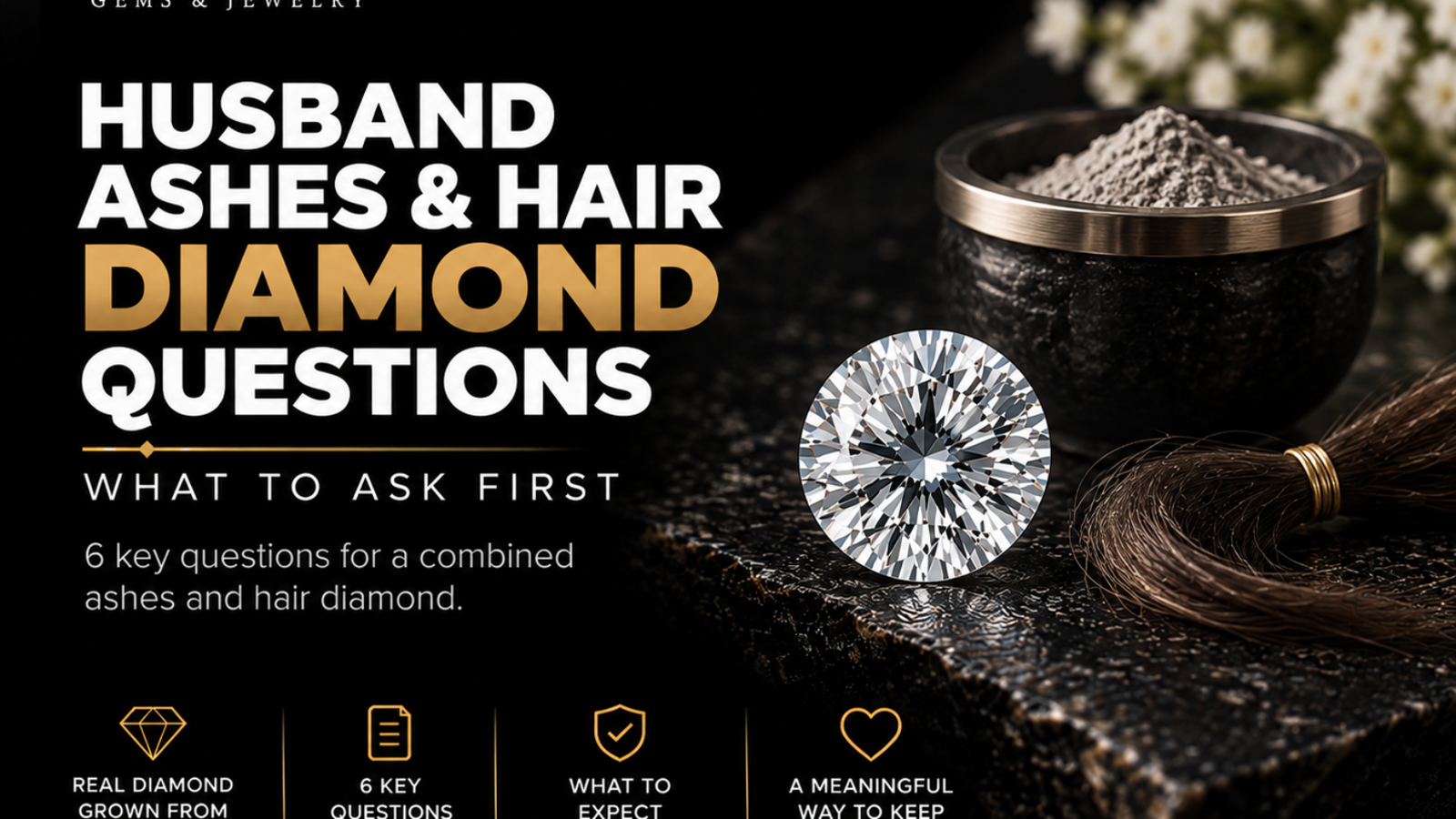
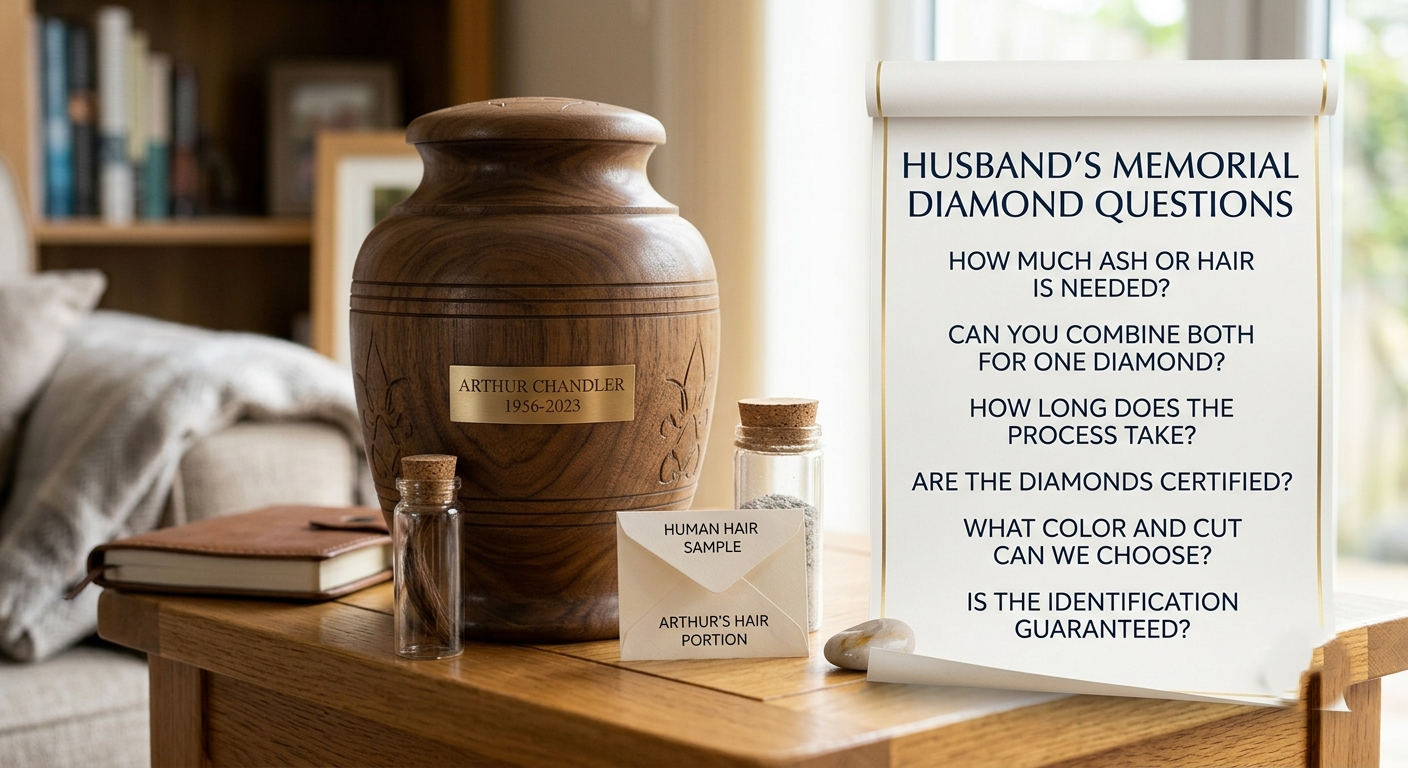
Husband hair diamond questions, showing a memorial diamond and a preserved lock of hair with key questions to ask before sending a hair sample.

Questions to Ask Before Turning Your Husband’s Ashes and Hair Into a Diamond

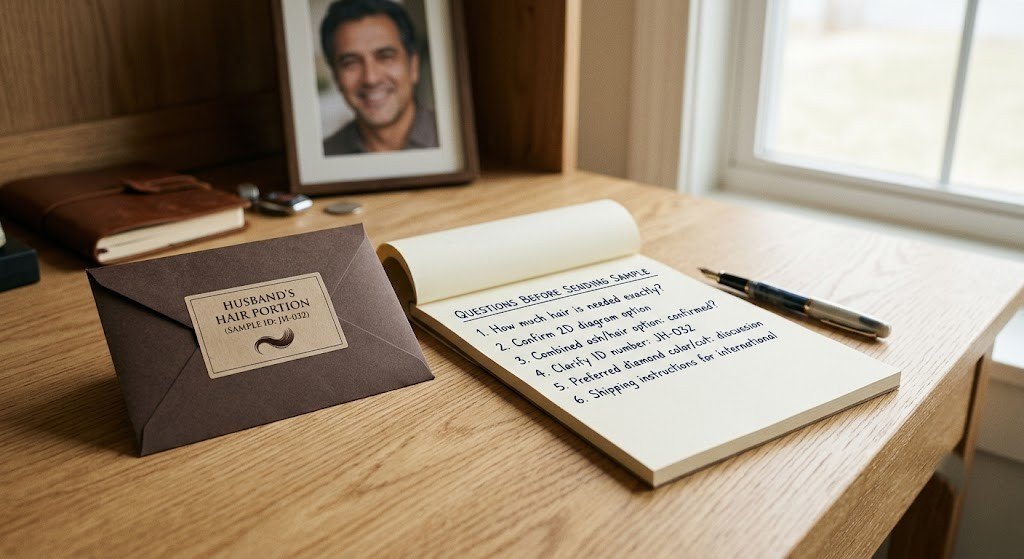
 Small labeled envelope of hair beside a notepad of husband hair diamond questions to ask before sending a sample

The Short Answer

When you are considering a memorial diamond made using both your husband’s ashes and hair, it is important to understand how a combined order works before sending either material. The most important husband ashes hair diamond questions are about the parts of the process that change when two different materials are included in one order.

These husband ashes hair diamond questions cover six important areas. You should ask whether combining ashes and hair changes the quantity required, whether the materials are processed together or separately, whether the origin documentation identifies both materials, whether you can add the second material later, whether using both materials changes the cost or production time, and what happens if one material is accepted while the other is not.

If you have already researched ashes based memorial diamonds or hair based memorial diamonds, some of that information will still be useful. However, a combined order has its own considerations. These husband ashes hair diamond questions are designed to help you focus on those combined order details.

Question 1: Does Combining Ashes and Hair Change the Quantity Requirement?

One of the first husband ashes hair diamond questions you should ask is whether combining two source materials changes the amount required from either one.

Ashes and hair have very different carbon profiles. Ash typically yields around 0.5 percent to 4 percent usable carbon by weight, while hair contains roughly 50 percent carbon. Because the materials have different carbon characteristics, a provider accepting both does not automatically mean that the quantity requirements become smaller.

Ask whether the ashes still need to meet their own minimum requirement and whether the hair needs to meet its own minimum requirement. You should also ask whether submitting both materials changes the amount required from either source.

This distinction is important because accepting both materials and changing the quantity requirement are two different things. A clear answer to this husband ashes hair diamond questions can help you prepare the correct amount before sending anything.

If you want to understand the quantity involved in a combined order in more detail, you can also read how much ash and hair a combined order needs.

Question 2: Are the Two Materials Processed Together or Separately?

Another important husband ashes hair diamond questions concerns how the two materials are prepared before diamond growth begins.

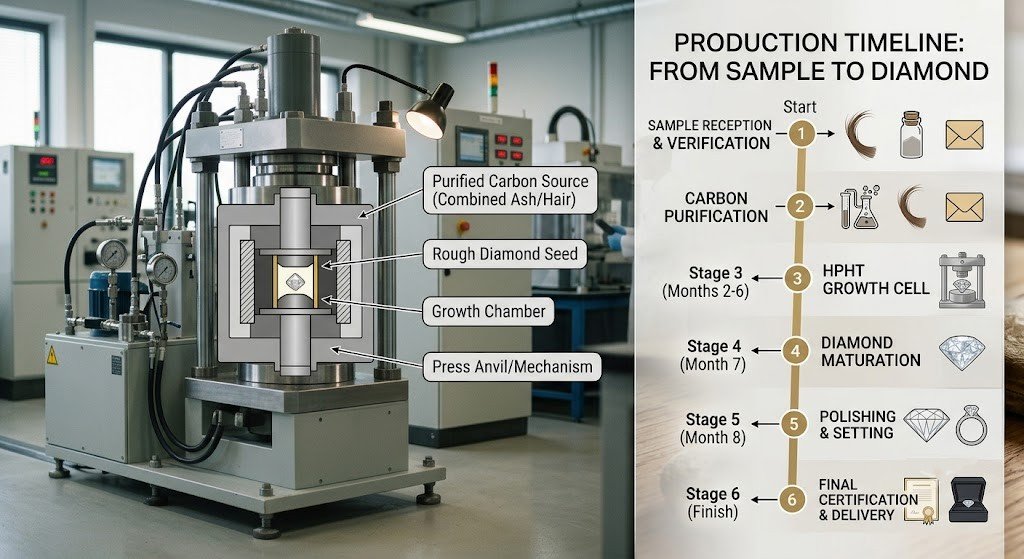
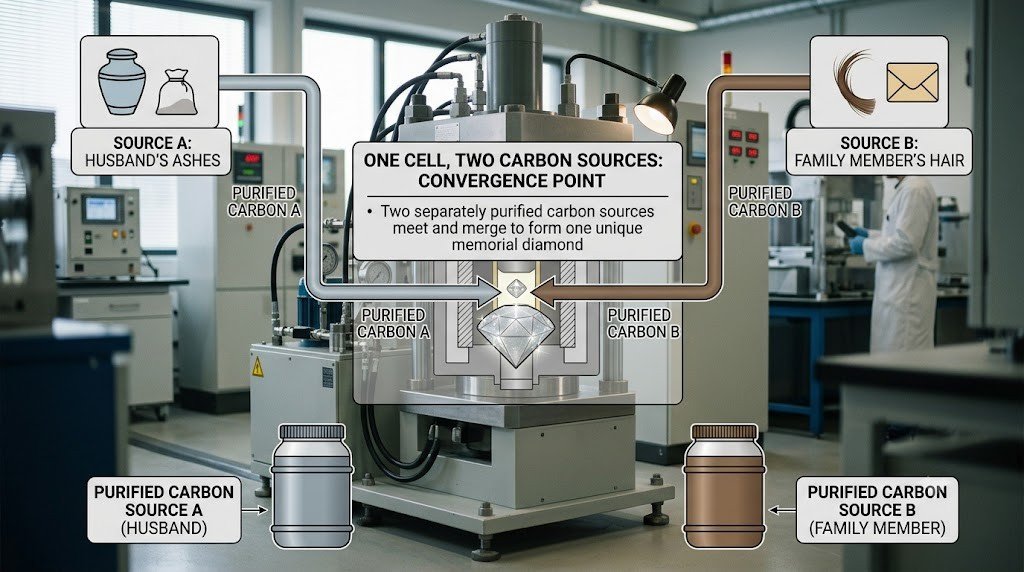
Ashes and hair require different preparation because they have different physical and chemical characteristics. In general industry practice, carbon is extracted and purified from each material separately. The purified carbon sources can then meet within the growth cell together with supplemental laboratory sourced carbon needed to reach the selected diamond size.

Ask your provider to explain exactly how your husband’s ashes and hair will be handled. You can ask when each material is processed, how each source is identified, and at what stage the two purified carbon sources come together.

Understanding this part of the process makes these husband ashes hair diamond questions easier to answer because you are asking about the actual combined process rather than assuming that the two materials are simply placed together at the beginning.

For more information about diamond related jewelry options, you can also explore BlueIceGems.

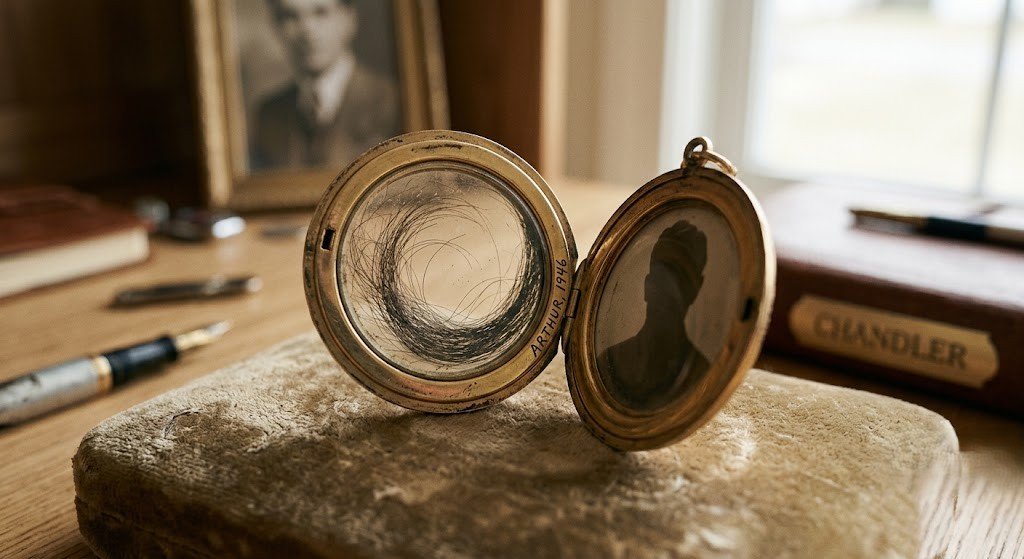
A decades-old keepsake locket holding a preserved lock of hair

Question 3: Does the Origin Document Identify Both Materials?

Documentation is another area where husband ashes hair diamond questions can help you make an informed decision.

If both your husband’s ashes and hair are being submitted, ask whether the origin documentation identifies both materials. The document may describe the submission as one combined order, or the provider may identify each source separately.

If documentation is important to you, ask to see an example before you send the materials. Find out whether your husband’s ashes will be listed separately from his hair and whether both materials will appear in the final documentation.

You can also ask when the documentation is provided and whether it is included with the finished diamond. The format and terminology can differ between providers, so this is one of the husband ashes hair diamond questions that should be answered directly by the company handling your order.

Question 4: Can You Add the Second Material Later?

Sometimes you may have one material available while the other is not ready. For example, you may have access to your husband’s ashes but still be deciding whether to use his hair. You may also have a lock of hair available while the ashes are being preserved elsewhere.

One of the most practical husband ashes hair diamond questions is whether you can start an order using one material and add the second material later.

Ask whether the provider allows an existing order to be changed before production begins. If the answer is yes, ask exactly when the second material must be submitted.

You should find out whether the additional material can be added before carbon extraction, before purification, or before another specific stage of the process.

This is a provider policy rather than something that should be assumed from general diamond production information. That is why this particular husband ashes hair diamond questions deserves a direct answer before you send either material.

Question 5: Does a Combined Order Cost More or Take Longer?

Cost and timing are naturally important husband ashes hair diamond questions when you are planning a combined order.

Rather than asking only whether using both materials costs more, ask for a complete explanation of the pricing structure. Find out whether processing two materials creates an additional charge and whether the final price depends on the selected carat size or other options.

The production time for a memorial diamond is primarily connected with the selected carat size and the growth time required in the press. Using two source materials does not automatically mean that the finished stone will require twice as much growth time.

However, each material can require its own preparation before the shared growth stage. Ask whether preparing both materials affects the estimated overall timeline for your specific order.

These husband ashes hair diamond questions can help you separate preparation time from actual diamond growth time. They can also help you understand whether the price you receive includes every stage of the combined process.

If you want to discuss your particular requirements, you can talk with Memorial Diamond about what may apply to your combined ashes and hair order.

Question 6: What Happens If One Material Is Accepted and the Other Is Not?

This is one of the most important husband ashes hair diamond questions to ask before sending your materials.

A combined order can involve different acceptance outcomes. Your provider should explain what happens if one material meets the requirements while the other does not.

SituationQuestion to Ask
Hair is accepted but ashes are not acceptedCan the order continue using the hair only?
Ashes are accepted but the hair sample is insufficientCan additional hair be submitted?
Both materials are accepted at different timesWhen does the production timeline officially begin?
One material cannot be usedWhat happens to the material that was accepted?

Ask the provider to explain this policy before submitting anything. You should know whether the order pauses, continues using one material, or requires another step if one source does not meet the requirements.

Getting a clear answer to these husband ashes hair diamond questions can prevent confusion if an unexpected situation occurs during the acceptance stage.

Why Combined Orders Need Their Own Questions

Diamond growth cell used in the HPHT process, shown alongside a production timeline

Some people assume that they can simply combine the questions for an ashes based diamond with the questions for a hair based diamond. However, that does not cover every situation.

The husband ashes hair diamond questions in this guide focus on what happens at the point where two source materials become part of one order.

The quantity requirements may be different. The preparation process may involve separate handling. Documentation may need to identify both sources. A second material may or may not be added later. Pricing and timing may have their own provider specific rules. Acceptance can also produce different outcomes for each material.

That is why asking these husband ashes hair diamond questions before sending anything can give you a clearer understanding of your particular order.

Frequently Asked Questions

Is this list different from asking about ashes and hair separately?

Yes. These husband ashes hair diamond questions focus on the issues created when two materials are included in one order. The individual questions about ashes and hair still apply, but they do not cover every combined order situation.

Do both materials need to be sent in one shipment?

This is a provider policy question. Shipping requirements can change, so ask the company directly whether both materials need to arrive together or whether they can be submitted separately.

Will the finished stone be half ashes and half hair?

No fixed ratio should be assumed. Both materials can contribute extracted carbon, which can be blended with supplemental laboratory carbon to reach the diamond size selected for the order.

Is a combined stone bigger than a single material stone for the same price?

No. The carat size is a choice made when specifying the order. Using two source materials does not automatically make the finished diamond larger.

Can more than one family member receive a diamond from the same materials?

Often, yes, because only a portion of the source material is typically required for an individual stone. If you are considering multiple memorial diamonds, ask the provider how much material is required for each stone.

Should I ask about grading and certification separately?

The finished stone is graded according to standard diamond characteristics such as cut, color, clarity, and carat. The fact that more than one source material was used does not create a separate grading system.

What Should You Ask Before Sending the Materials?

Before sending your husband’s ashes and hair, it can help to prepare a short list of questions. The following list covers the most important husband ashes hair diamond questions and a few practical follow up points.

  • How much ash is required?
  • How much hair is required?
  • Does using both materials change either quantity requirement?
  • Are the materials processed separately?
  • When are the two carbon sources combined?
  • How are the materials identified and tracked?
  • Will both materials appear in the origin documentation?
  • Can the second material be added later?
  • Does using two materials affect the total price?
  • Does preparing both materials affect the expected timeline?
  • What happens if one material is not accepted?
  • What happens to material that is not used?

Keeping these husband ashes hair diamond questions available when speaking with a provider can make it easier to compare the information you receive and identify any details that need clarification.

What If You Only Have One Material Ready?

You do not necessarily need to make every decision at once. If you currently have your husband’s ashes but are not ready to provide hair, or you have hair available but need more time before submitting ashes, ask the provider about its options.

The key husband ashes hair diamond questions in this situation concern whether an order can remain open while you prepare the second source material and whether there is a specific stage after which an additional material cannot be added.

Knowing the answer before sending the first material can help you decide whether you should wait or begin the process with what you currently have.

Final Thoughts on Husband Ashes Hair Diamond Questions

A combined memorial diamond order is not simply an ashes order and a hair order placed side by side. There are specific questions that arise when both materials are considered for one memorial diamond.

The most important husband ashes hair diamond questions cover quantity requirements, material preparation, origin documentation, adding the second material later, cost, timing, and acceptance.

Asking these husband ashes hair diamond questions before sending your husband’s ashes or hair can help you understand what the provider expects and what you can expect from the process.

You can take your time, ask for clear answers, request written information where appropriate, and make sure you understand the provider’s policies before submitting any material.

Learn More About Husband Memorial Diamonds

Talk With Memorial Diamond

If you are considering using both your husband’s ashes and hair for a memorial diamond, speak with the provider before sending any material.

Ask about quantity requirements, preparation, documentation, timing, pricing, and acceptance. The answers to these husband ashes hair diamond questions can help you understand what applies to your specific order.

You can talk with Memorial Diamond about the combined process and ask your questions before submitting your husband’s ashes or hair.

Husband ashes and hair diamond questions, featuring a memorial diamond, cremation ashes, and a lock of hair.

Questions to Ask Before Turning Your Husband’s Ashes and Hair Into a Diamond

Urn and a small envelope of hair together on a table beside a list of husband ashes hair diamond questions

When you are considering turning your husband’s ashes and hair into one memorial diamond, having clear information before beginning the process can make the experience easier to understand. The most important husband ashes hair diamond questions are not simply the same questions you would ask when using ashes or hair separately.

A combined order brings two different source materials into one memorial diamond process. That creates specific questions about quantity, preparation, documentation, timing, pricing, and acceptance. Understanding these husband ashes hair diamond questions before sending anything can help you know what to expect from your provider.

If you have already reviewed information about ashes only or hair only memorial diamonds, those subjects can still be useful. However, this guide focuses specifically on the husband ashes hair diamond questions that apply when both materials are being considered for one order.

The Short Answer

The most useful husband ashes hair diamond questions focus on six areas that are unique to combining two source materials. You should ask whether combining ashes and hair changes the quantity requirement, whether both materials are processed together or separately, whether both materials appear on the origin documentation, whether the second material can be added later, whether using both affects cost or timing, and what happens if one material is accepted while the other is not.

These husband ashes hair diamond questions are worth answering before you separate an ash portion or prepare a lock of hair. A provider may have specific procedures for combined orders, so information that applies to one type of memorial diamond should not automatically be assumed to apply to another.

Question 1: Does Combining Materials Change Either Quantity Requirement?

One of the first husband ashes hair diamond questions to ask is whether using both ashes and hair changes the amount required from either source.

Ashes and hair have different carbon profiles. Ash typically yields around 0.5 percent to 4 percent usable carbon by weight, while hair contains roughly 50 percent carbon. Because these materials have different characteristics, accepting both does not automatically mean that the quantity requirement for either material changes.

Ask your provider whether the ashes must meet their own minimum and whether the hair must independently meet its own minimum. You can also ask whether providing both materials allows less of either source to be submitted.

This is an important distinction. Saying that a provider accepts ashes and hair does not necessarily answer how much of each material is required. A direct answer to this husband ashes hair diamond questions can help you prepare the correct materials before shipping.

Question 2: Are the Two Materials Processed Together or Separately?

Another important husband ashes hair diamond questions concerns how the two materials are handled before diamond growth begins.

Industry practice generally involves extracting and purifying carbon from each material separately because ashes and hair require different preparation. The purified carbon sources can then meet inside the growth cell together with supplemental laboratory sourced carbon needed to reach a viable diamond size.

Ask your provider to describe the process in simple terms. You can ask when the ashes are processed, when the hair is processed, when the purified carbon sources are brought together, and how the materials are tracked during the process.

Knowing the answer to this husband ashes hair diamond questions can give you a clearer picture of what happens to each material before the diamond growth stage.

For additional information about jewelry and diamond related options, you can also explore BlueIceGems.

Two separately purified carbon sources shown meeting in one diamond growth cell

Question 3: Does an Origin Document Itemize Both Materials?

Documentation is another area where husband ashes hair diamond questions can be especially useful.

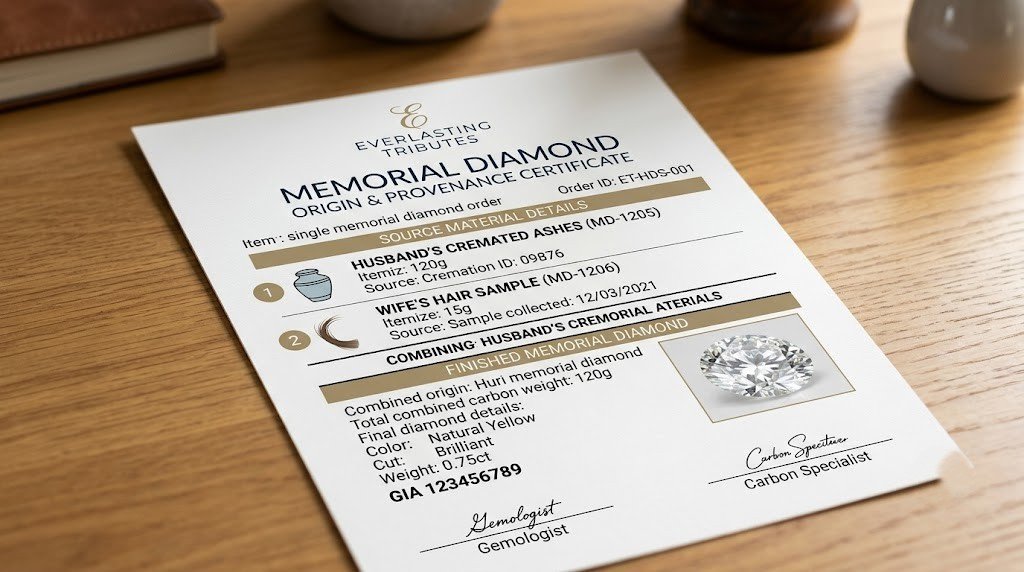
If you want a record showing that both your husband’s ashes and hair were submitted, ask whether the origin document identifies each source individually. Some documentation may describe the submission as one combined order, while another provider may document the source materials separately.

Ask to see an example of the documentation before committing to the process. You can ask whether your husband’s ashes will be identified separately from his hair and whether the final documentation records both materials.

This can be meaningful for families who want a clear record of the materials associated with the memorial diamond. Since documentation practices can differ between providers, this is one of the husband ashes hair diamond questions that should be answered directly.

Question 4: Can I Add the Second Material Later?

You may have one material available before the other. Perhaps your husband’s ashes are already preserved while you are still deciding whether to use his hair. You may also have the hair ready while the ashes are being handled separately.

One of the most practical husband ashes hair diamond questions is whether you can begin with one material and add the second material later.

Ask whether the provider allows an existing order to be amended. If it is possible, ask about the exact cutoff point. You should know whether the second material must be added before extraction, before purification, or before another specific stage.

Some providers may require both materials at the beginning, while others may have procedures that allow an additional material to be submitted later. Because this is provider specific, do not assume that one company’s procedure applies everywhere.

Getting a clear answer to this husband ashes hair diamond questions can be particularly helpful if you are not emotionally ready to decide about both materials at the same time.

Question 5: Does a Combined Order Cost More or Take Longer?

Cost and production time are also important husband ashes hair diamond questions to ask before sending your materials.

Instead of asking only whether a combined order costs more, ask for a clear explanation of the pricing structure. Find out whether processing two source materials creates an additional charge and whether the final amount depends on the selected carat size or other options.

Production time is primarily connected with the selected carat size and the growth time in the press. The number of source materials does not automatically mean that the finished diamond will require a longer growth period.

However, ashes and hair can require separate preparation before the shared growth stage. Ask your provider whether this preparation affects the estimated timeline for your particular order.

These husband ashes hair diamond questions can help you understand the difference between preparation time, diamond growth time, and the overall expected timeline.

If you want to discuss the process directly, you can talk with Memorial Diamond about what may apply to your particular ashes and hair order.

Question 6: What Happens If One Material Fails Acceptance?

Among the most important husband ashes hair diamond questions is what happens when the two materials do not receive the same acceptance result.

SituationQuestion to Ask
Hair is accepted but ashes are declinedDoes the order continue as a hair only diamond or pause completely?
Ashes are accepted but the hair sample is too smallCan additional hair be provided or does the order proceed using ashes only?
Both materials are accepted at different timesDoes production timing begin when the first material arrives or when both materials arrive?

Ask for the provider’s policy before submitting anything. This is especially important because ashes and hair are personal materials that may not be replaceable.

A written answer to these husband ashes hair diamond questions can give you a reference if an unexpected situation occurs during the acceptance stage.

Sample origin document itemizing two separate source materials for one memorial diamond order

Why These Questions Matter Before You Send Anything

The reason these husband ashes hair diamond questions matter is simple. When two materials are being used, assumptions about a single material order may not always apply.

For example, a provider may have one quantity requirement for ashes and another for hair. The preparation process may also differ because each material has different characteristics. Documentation may have its own format, and the rules for adding a second material later can vary.

Asking the questions in advance allows you to understand the complete process before making a decision. It also gives you an opportunity to request written information about pricing, preparation, acceptance, documentation, and timing.

You can keep the answers together in one place and use them when comparing your options. This makes the husband ashes hair diamond questions more useful because you are not relying on memory when reviewing the details later.

Frequently Asked Questions

Are these questions different from asking about ashes and hair separately?

Yes. The individual questions about ashes and hair still apply, but the husband ashes hair diamond questions in this guide focus specifically on issues created by combining both materials in one order.

Do both materials need to be sent together?

Ask your provider directly. Shipping requirements are provider specific and can change. One provider may require both materials at the same time while another may have a different procedure.

Will the finished diamond be half ashes and half hair?

No fixed ratio should be assumed. Both materials can contribute extracted carbon, which is combined with supplemental laboratory carbon to reach the selected size. Ask your provider how the contribution of each material is handled and documented.

Will using two materials make the finished diamond larger?

No. The carat size is selected as part of the order. Using both ashes and hair does not automatically create a larger diamond for the same price.

Can more than one family member receive a diamond from the same materials?

Often, yes, because only a portion of each material is typically used for an individual stone. If several diamonds are being considered, ask how much material is required for each stone. You can also review information about how much ash and hair a combined order needs.

Should grading and certification be discussed for a combined diamond?

Yes. The finished diamond is graded according to characteristics such as cut, color, clarity, and carat. Ask whether grading or certification is included in the quoted price or offered separately.

Additional Questions to Ask Your Provider

Beyond the six main husband ashes hair diamond questions, you may want to prepare a few additional questions before contacting a provider.

  • How much of each material should be submitted?
  • How should each material be packaged?
  • Can the two materials be shipped separately?
  • How will each source be identified after arrival?
  • What happens if additional material is required?
  • When will you receive confirmation that the materials were accepted?
  • What documentation is provided after the diamond is completed?
  • Which services are included in the quoted price?

Writing these questions down can make your conversation more organized. It also helps ensure that you receive clear answers instead of making assumptions about how the combined order works.

Final Thoughts on Husband Ashes Hair Diamond Questions

A combined memorial diamond order does not necessarily mean twice the complexity, but it does create several questions that do not apply to a single material order.

The most important husband ashes hair diamond questions involve quantity requirements, separate processing, origin documentation, adding the second material later, cost, timeline, and what happens if one material is not accepted.

Taking the time to answer these husband ashes hair diamond questions before sending your husband’s ashes or hair can help you understand the process with greater clarity.

You do not need to make every decision immediately. You can ask questions, review the answers, understand the provider’s policies, and then decide whether combining both materials is right for your memorial diamond order.

Learn More About Husband Memorial Diamonds

Talk With Memorial Diamond

If you are considering using both your husband’s ashes and hair for one memorial diamond, speaking directly with the provider can help answer the husband ashes hair diamond questions that are specific to your situation.

Ask about the required quantity, material preparation, documentation, acceptance process, timeline, and total pricing before sending anything.

You can talk with Memorial Diamond about the combined process and ask your questions before submitting any material.

Before turning a father's ashes into a diamond: a handwritten list of questions beside a sealed urn and a loose memorial diamond

Questions to Ask Before Turning Your Father’s Ashes Into a Diamond

Families tend to arrive at this with a list and point all of it at one company. The questions worth asking before turning your father’s ashes into a diamond actually divide across four parties: the provider, the funeral director or crematorium, whoever controls his interment or scattering, and your own family. Sending each question to the party that owns the answer is what turns a month of waiting into a week.

Two weeks can otherwise go by waiting on an answer a diamond laboratory was never in a position to give. What follows is the full list of what to settle before turning anything over, sorted by who to ask rather than by topic.

Memorial Diamond is itself one of the providers these questions are aimed at. Ask them of us as readily as of anyone else.

Which Questions Belong to Which Party?

Ask thisWho owns the answerWhy it goes there
Can a portion be separated and labeled before release?Funeral director or crematoriumIt is their handling procedure, and it has to happen on their premises
Is there still a retained portion on file?Funeral directorOnly their records show it
Has anything already been interred or scattered, and can it still be?Whoever controls the interment, cemetery, executor, or the familyA provider has no visibility of this and no standing to advise on it
How much material is required, and how is it assessed?ProviderIt is their process minimum
What happens if the material yields less carbon than expected?ProviderTheir procedure, not an industry constant
What documentation arrives, and when?ProviderTheir chain of custody practice
What is the total cost, including grading and setting?ProviderTheir pricing
Who is the order in, and who receives the stone?Your familyNobody outside the family can settle it
What happens to the rest of his ashes?Your familyA decision, not a question
Simple four-box diagram labeled funeral director, provider, interment authority and family, each with the questions it owns

Read the right hand column before the left. A question that stalls before turning into an answer is rarely a hard question. More often it has arrived somewhere that could not answer it.

What Can Only a Funeral Director Answer Before Turning Anything Over?

These are also the ones with a deadline, which makes them the first calls to make, before turning to a provider at all.

  • What is your procedure for separating and labeling a portion? Ask what the procedure is rather than whether it can be done. Practice varies between firms, and the answer tells you whether you are dealing with something routine for them or something they will have to arrange.
  • How much can be held back, and how will it be packaged and stored? Bring a figure to this conversation. How much ash is needed covers the industry typical quantity to ask for.
  • When does the request have to be made by? This is the only genuinely closing door in the process. Once remains are interred or scattered, the ash route is usually over.
  • Do you keep a record of what was separated, and can we have a copy? For a portion retained months or years ago, this record may be the only documentation of that stage.
  • Can you release the portion directly, or does it come through us?

The complete guide to father ashes diamonds covers working backwards from an interment date if one is already booked.

What Should You Ask a Provider About His Ashes?

These are the questions to put in writing before turning his ashes over to anyone.

  • How much do you require, and is that a received weight or a usable one?
  • What is your procedure if the material yields less carbon than expected? Usable carbon in cremated remains runs at roughly 0.5% to 4% by weight, and no provider can know in advance where a particular person’s remains sit in that range.
  • Do surgical implants, hardware or a pacemaker affect what you can use?
  • What happens to material that extraction does not consume? Does it come back as a matter of course, or on request? Ask which, in writing. The two answers are very different in practice.
  • Do you accept ashes from a cremation that happened years ago, and does anything need checking before turning them over?
  • Will you tell us the intake weight when the parcel arrives?
  • What proportion of the finished stone will be his carbon, and what is supplemental lab grown carbon? No honest answer to this is 100%. The purified carbon is blended with lab grown carbon before growth in an HPHT press, and personal carbon in ash derived stones is commonly cited at around 10% to 15% of the finished stone’s mass. Ask for the figure in writing. Whether a memorial diamond is really made from your father’s ashes covers what can and cannot be proven on this point.

What to Ask When the Executor and the Urn Holder Are Different People

This is the situation the four party split exists for, and the one to resolve before turning to any company. It is common enough after a second parent’s death to plan for: one sibling was named executor, another was given the urn, and a third is the one making inquiries.

Three phones on a table, each showing a different thread of the same family conversation about a father's ashes

Three questions have to be settled between those people before turning to a provider, who is no use until they are.

  • Who is authorizing the retention? The funeral director will act on one person’s instruction, and it should be a person the rest of the family knows about.
  • Who is physically sending the material, and do they agree to? Whoever holds the urn has to open it. That is not a small thing to ask of someone by email.
  • Whose name goes on the order? It does not have to be the executor, and it does not have to be whoever holds the urn, but it should be settled before a company is contacted rather than after.

Legal authority over a parent’s remains varies by state and by circumstance and is not something a jewelry company can advise on. What can be said plainly is that this is a conversation to have before, not during. How to talk to family about a father memorial diamond covers how families open it.

What Should Arrive With the Stone, and What Comes Back?

Two documents side by side, an independent grading report and an origin certificate, with a loose diamond between them
  • What chain of custody reference do we get, and at what point? Before turning the material over, or after?
  • Is the stone graded by an independent third party laboratory, or in house? These are different documents doing different jobs. A grading report grades the diamond’s cut, color, clarity and carat; an origin certificate ties it to your father. How providers track a loved one’s ashes covers what a chain of custody record should actually contain.
  • What does the certificate say, and does it name him?
  • What is returned to us at the end, and in what condition?
  • What is the full price, including grading, setting, engraving and shipping? What a father memorial diamond costs covers which of those line items sit outside a quoted price.

Ask all five before turning any material over. Every one of them is easier to get in writing before a parcel exists than after.

Which Questions Must Your Own Family Answer First?

No provider can answer these, and leaving them open before turning the ashes over is what makes a straightforward order difficult in month nine.

  • Whose name is the order in, and who is the single point of contact?
  • Who receives the finished stone, and what happens to it afterwards?
  • Is everyone who should know, told, before turning the ashes over, not after?
  • What happens to the rest of his ashes? A memorial diamond submission is typically a small fraction of a full cremation, so this is usually a decision rather than a constraint.

Where Does a Service or Veterans Interment Add a Fifth Party?

Where a national or service cemetery is involved, one question is added and it goes to the funeral director rather than to the cemetery: when do you release, and can a portion be separated before that happens? Honoring military service with a memorial diamond covers how that timetable works and why the date is not the family’s to move. Ask it early, before turning to anything else on this page, if a service interment is planned.

Frequently Asked Questions

Should the funeral director be told a memorial diamond is planned?

Yes. Say so plainly rather than asking in the abstract. A director who knows why a portion is being retained can package and document it appropriately, and can tell you what their firm’s procedure actually is before turning anything over.

Can the executor decide this without the rest of the family?

Legally that varies and is not something a jewelry company can advise on. Practically, a decision about a father’s remains taken without telling his other children can be hard to unpick afterwards, whatever the paperwork says.

How long should a provider take to answer these?

Days rather than weeks is a reasonable expectation before turning to a decision on the factual ones: quantity, documentation, pricing, timeline. How quickly those arrive is worth noting, given the process runs for most of a year.

Should these questions be asked before or after his ashes are released?

Before, wherever possible. The funeral director questions have a genuine deadline attached, while the provider questions have none, so the order to work in is funeral home first, provider second, before turning anything over to either.

Does the crematorium hold any record we can still ask for?

Frequently yes, particularly where a portion was separated at the time. Ask before turning to the provider, since the record is theirs. Ask what they hold and request a copy. For a retention made years ago, that record may be the only documentation of what was set aside and when.

If a provider’s answers and the funeral home’s answers conflict, which one governs?

Neither automatically. Write both down and put the conflict to each of them. A contradiction of this kind is often two parties describing different stages, but check rather than assume, and do it before anything is shipped.

Final Thoughts on What to Ask Before Turning His Ashes Into a Diamond

The whole list above fits into three messages and one family conversation: one to the funeral director, one to whoever controls the interment if a date already exists, and one to the provider. None of them commits you to anything, and the first is the only one with a clock on it. Asked in that order, before turning anything over, the answers arrive in a week instead of a month.

Learn More About Father Memorial Diamonds

Talk With Memorial Diamond

Put the provider half of that list to Memorial Diamond: what is needed, what comes back, what documentation arrives, and what the total is. Ask it before turning anything over, and get the answers in writing. Start at memorialdiamond.us.