
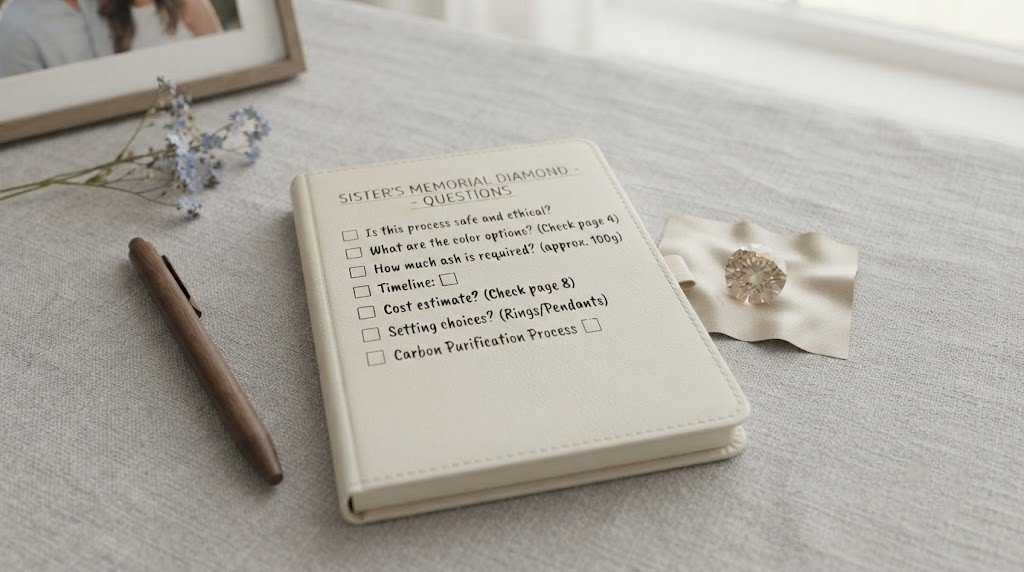
Turning your sister’s ashes into a memorial diamond is a deeply personal decision. Before choosing a provider, asking the right sister ashes diamond questions can help you understand the process, family permissions, costs, and the company’s policies. These questions can also help you recognize unclear answers before you send something irreplaceable to a laboratory.
This guide organizes fifteen important questions into three groups: questions to ask yourself, questions to discuss with your family, and questions to ask the memorial diamond provider. You will also learn which answers to request in writing, which warning signs to notice, and how to compare providers without feeling rushed.
Table of Contents
Why Organize Sister Ashes Diamond Questions by Who You Ask?
Different people can answer different parts of the process. You decide what kind of memorial feels right for you. The person legally authorized to make decisions about your sister’s remains can help establish permission. The provider should explain the laboratory process, handling procedures, costs, and timeline.
Organizing your sister ashes diamond questions makes these conversations easier to manage. It also helps prevent confusion between family permission and the technical details of making a diamond.
If you are still deciding whether this is the right memorial, read our guide on choosing a memorial diamond for your sister.
If you are considering her hair rather than her ashes, our guide to questions about a sister hair memorial diamond covers that different process.
Which Sister Ashes Diamond Questions Should You Ask Yourself First?
Before contacting a provider, take time to understand what you want from the memorial. These first three questions can help you make choices that suit your needs and budget.
1. What do I want this diamond to represent?
Think about how you hope to remember your sister. You might want a small stone to wear every day, a pendant to keep close to your heart, or a diamond that will become a family keepsake.
Your intended use can influence the size, setting, and budget. A stone worn daily may need a practical setting, while a diamond kept in a display box may have different requirements.
A clear answer sounds like: I want a small diamond that I can wear on a necklace to remember my sister.
An answer that needs more thought sounds like: I am not sure yet, but I want something meaningful.
There is no need to decide everything immediately. Understanding your purpose simply makes the next steps easier.
2. What is my complete budget?
Ask how much you can comfortably spend without putting pressure on other financial responsibilities. Remember that the finished diamond may not be the only expense.
Depending on the provider, additional costs may include an independent grading report, a jewelry setting, engraving, shipping, or a special cut. Ask for a complete written quote instead of relying on an advertised starting price.
A clear answer sounds like: I have a budget limit and want to understand every additional charge before placing an order.
A warning sign: A provider pressures you to spend more without explaining what the extra cost covers.
Your sister ashes diamond questions should include affordability from the beginning, so you can compare options calmly.
3. Am I ready to send a portion of her ashes and wait for the result?
The process involves sending a portion of the remains to a provider. The laboratory may need several months to create and finish the diamond. Waiting can feel comforting to some families and difficult for others.
Consider whether you feel ready to part with a portion of the ashes, even temporarily. Ask yourself whether the expected wait fits your emotional needs and any important family dates.
A clear answer sounds like: I feel comfortable sending the agreed portion and understand that the process may take several months.
If you feel uncertain, pausing is a reasonable decision. You do not have to move forward before you feel ready.
Who Has Authority Over Her Ashes, and What Should You Ask?
Family permission deserves careful attention. A sibling may not automatically have legal authority to release or divide cremated remains. The rules can vary by location, and written instructions or a designated representative may affect who can make the decision.
If you are uncertain, ask the funeral home or crematory what information it can provide, and seek local legal advice when necessary.
4. Who has authority over her remains, and will they agree to release a portion?
This is one of the most important sister ashes diamond questions to resolve before sending anything.
Identify the person who has authority to make the decision. Explain your intention respectfully and ask whether they agree to provide the amount required by the chosen provider.
A clear answer: The authorized person has agreed to the specific amount and the arrangement is documented.
An unclear answer: Family members assume someone else has already given permission.
Do not assume that possession of the urn automatically establishes legal authority.
5. How much ash is needed, and what happens to the remainder?
The required amount varies between providers and may depend on the requested diamond. Ask for the exact amount before packaging or shipping anything.
For more detail, see our guide to how much ash is needed for a sister memorial diamond.
A clear answer: The provider gives a specific quantity, explains its collection instructions, and confirms what happens to any unused material.
An unclear answer: The provider simply says to send as much as possible.
Sending more material does not automatically guarantee a larger diamond. Only send what the provider requests and what the authorized family member has agreed to release.
6. Who else in the family should be consulted?
Other relatives may want a say in how the remains are handled. Some may wish to share a memorial diamond, while others may prefer that the ashes remain together.
Discuss these preferences before making an irreversible decision. If relatives have concerns related to faith or family tradition, consider speaking with a trusted religious adviser.
A clear answer: Relevant family members have been consulted, and everyone understands who will own or receive the finished jewelry.
An unclear answer: Someone assumes that the rest of the family will agree later.
If you need help starting the conversation, read our advice on talking to family about a sister memorial diamond.
Which Sister Ashes Diamond Questions Belong With the Provider?
Once you understand your wishes and have addressed permission, ask the provider for clear answers. Whenever possible, get important details in writing before sending the ashes or paying a deposit.
7. How will you identify and track her ashes?
Ask how the company labels, records, receives, and tracks the material throughout the process. You should understand how it confirms receipt and records transfers between stages.
A clear answer: The provider explains its identification system, record keeping, and arrival confirmation.
A warning sign: The provider offers reassurance but cannot explain its procedures.
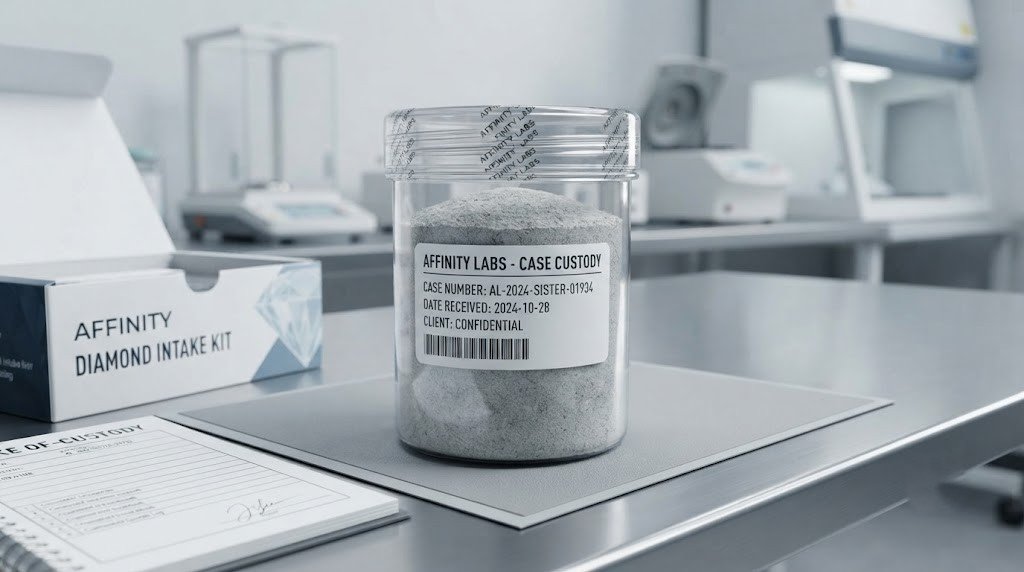
8. Will her material be processed separately from other families’ material?
Tracking and processing are different questions. A label may identify a container, but you should also ask how the provider handles extraction and purification.
A clear answer: The provider explains whether processing is performed separately and describes the safeguards it uses.
A warning sign: The company avoids answering whether material from different families may be processed together.
Do not rely on assumptions. Ask the provider to explain its actual process in writing.
9. What percentage of the finished diamond will come from her carbon?
Cremated remains contain mineral material as well as a small amount of usable carbon. The amount of carbon that can be recovered and its contribution to the finished diamond can vary.
Ask the provider how it estimates the contribution from your sister’s remains, whether supplemental laboratory carbon is used, and what it can document for your selected diamond.
A clear answer: The provider explains its method and supplies a written estimate or range when it can substantiate one.
A warning sign: The company claims that the finished diamond consists entirely of your sister’s ashes without explaining the material and growth process.
You can learn more about how a memorial diamond is made from a sister’s ashes.
10. Will the diamond’s color come from the growth process or later treatment?
Memorial diamonds may be available in different colors, depending on the provider and its process. Ask which colors are available, whether a particular color is guaranteed, and whether any post growth treatment is used.
A clear answer: The provider explains the available colors, the limitations of predicting a final shade, and any treatments in writing.
A warning sign: The company promises a precise color without explaining how it will be achieved.
Color alone does not establish the origin of a diamond or describe the person being remembered.
11. Will I receive an origin certificate, an independent grading report, or both?
These documents may serve different purposes. A provider’s origin document may describe the company’s claimed connection between the submitted material and the finished stone. An independent grading report evaluates diamond characteristics according to the issuing laboratory’s procedures.
Ask who issues each document, what it verifies, whether independent grading is available, and whether it costs extra. You can read about the four Cs of diamond quality for more information about cut, color, clarity, and carat weight.
A clear answer: The provider names the issuing organization and explains exactly what each document covers.
A warning sign: The company uses the word certified without identifying who performs the certification or what is being verified.
12. What happens if a growth attempt fails or the stone breaks during cutting?
Diamond growth and cutting involve technical processes, and a usable stone is not guaranteed at every stage. Before proceeding, ask what happens if a growth attempt fails or a rough stone fractures during cutting.
A clear answer: The provider explains its policy for additional attempts, possible costs, retained material, communication, and changes to the timeline.
A warning sign: The company says failure is impossible or refuses to provide a written policy.
Do not assume a replacement or another growth attempt will be free unless the agreement explicitly says so.
13. What happens to unused ashes?
Only a portion of the material you send may be needed for the process. You should know what happens to anything that remains.
A clear answer: The provider explains whether unused material can be returned, how it would be shipped, or whether storage is available under stated conditions.
A warning sign: The company gives no specific explanation of how unused remains are handled.
Discuss this before shipping and keep a copy of the written agreement.
14. Can I receive a complete, itemized quote?
Ask for a quote that lists the selected diamond, size, color, cut, jewelry setting, grading, engraving, shipping, deposit, and any other applicable charges.
Prices can vary substantially by provider, diamond size, color, and included services. General industry estimates are not a substitute for a current quote from the company you intend to use.
A clear answer: You receive a written quote showing the individual costs and the total payable amount.
A warning sign: You receive only a starting price or discover additional charges late in the process.
Compare providers using the same specifications so that you can understand what each quote includes.
15. When does the production timeline start?
Ask whether the estimated timeline begins when the provider receives the ashes, when payment clears, or when a particular laboratory stage begins. Also ask what could delay the expected completion date.
A clear answer: The provider identifies the starting event, supplies an estimated completion window, and explains how it communicates delays.
A warning sign: The company gives a vague timeline without defining when the clock starts.
If you hope to receive the diamond by an anniversary or birthday, explain that date before placing your order. Do not treat an estimate as a guaranteed delivery date unless the written agreement expressly provides one.
What Red Flags Can Sister Ashes Diamond Questions Uncover?
An unclear answer does not automatically prove that a provider is dishonest. However, it is a reason to slow down and request more information.
Watch for these warning signs:
- Claims that the finished diamond consists entirely of the original ashes without a clear explanation.
- No explanation of how the material is identified and tracked.
- Refusal to explain whether material is processed separately.
- Promises of an exact color without explaining the process or its limitations.
- Confusion between an origin document and an independent grading report.
- No written policy for failed growth or damage during cutting.
- Unclear arrangements for unused ashes.
- Pressure to pay quickly or emotional pressure to purchase a more expensive option.
- A quote that lists only the starting price.
- Refusal to put important answers in writing.
A responsible provider should be willing to answer reasonable questions and explain the limits of what it can guarantee.
What Should Good Answers Include?
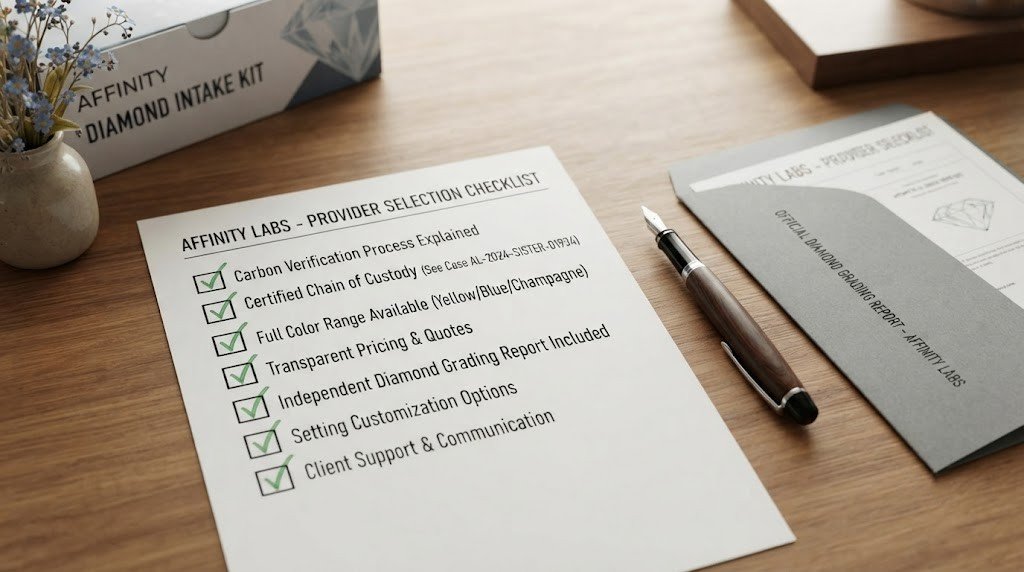
Use this checklist when comparing providers. It summarizes the main points covered by these sister ashes diamond questions.
| Question | What a useful answer includes |
|---|---|
| How are ashes tracked? | Identification procedures and receipt confirmation |
| Is processing separate? | A clear explanation of handling and processing |
| What is the carbon contribution? | A documented estimate or explanation of the method |
| How is color achieved? | Available colors and disclosure of treatment |
| What documents are supplied? | Named issuing organizations and document purposes |
| What if growth fails? | Written policy for further attempts and possible costs |
| What happens to unused ashes? | Return or storage arrangements |
| What does the full service cost? | Itemized quote and total |
| When does production start? | Defined starting event and estimated completion window |
Do not feel that you need to make the decision during the first call. Take time to review the answers and compare the written information.
How Do You Keep Track of the Answers?
Grief can make it difficult to remember details from several conversations. Keeping everything in one place can help.
Create a document or notebook with the questions, the provider’s answers, the date of each conversation, and any documents received. After a phone call, send a brief email summarizing your understanding and ask the provider to confirm it.
If possible, invite a trusted person to take notes while you speak with the company. Ask each provider the same questions in the same order so you can compare their answers fairly.
Your sister ashes diamond questions are there to help you make an informed decision, not to force you into one. If an answer leaves you uncomfortable, take time to investigate it or contact another provider.
Frequently Asked Questions
Is it disrespectful to ask a provider so many questions?
No. You are entrusting a company with something deeply meaningful and potentially irreplaceable. Asking about handling, costs, documents, and policies is a reasonable part of making an informed decision.
Can I contact providers before my family agrees?
Yes. You can gather information and request quotes without sending ashes or committing to a purchase. Before any material is released or shipped, make sure the person with the relevant authority has agreed.
What if two providers give different answers?
Ask each provider to explain its answer in writing. Differences in processes, services, pricing, and timelines can occur. Compare what each company actually offers rather than relying on a single claim.
Do I need to ask all fifteen questions at once?
No. You can divide the questions across several conversations. Start with your own intentions and family permission, then discuss technical procedures, documentation, costs, and timing with the provider.
Can I ask these questions if my sister was cremated years ago?
Yes. Ask the provider whether the age and storage conditions of the ashes affect its process. Do not assume that all providers have identical requirements.
What if a provider refuses to put an answer in writing?
Treat that refusal as a reason to pause. Important claims about handling, processing, costs, and unused material should be clear enough for you to review before making a decision. You can seek another provider if your concerns remain unresolved.
Final Thoughts
There is nothing cold about asking careful questions before turning your sister’s ashes into a diamond. Taking time to understand the process can help you protect her remains, respect family wishes, and make a decision that feels right for you.
Work through your sister ashes diamond questions one group at a time. Start with your own intentions, discuss permission and family preferences, and then ask the provider for clear written answers. If something feels uncertain, give yourself permission to pause.
A memorial diamond is a personal choice, not an obligation. Whether you decide to proceed now, wait, or choose another way to remember your sister, the decision should be made with care.
Learn More About Sister Memorial Diamonds
Explore these related guides for additional information:
- Sister Ashes Diamond: The Complete Guide
- Is a Memorial Diamond Really Made From Your Sister’s Ashes?
- How Much Does a Sister Memorial Diamond Cost?
- How Long Does It Take to Make a Sister Memorial Diamond?
Talk With Memorial Diamond
If you would like to discuss your options, visit Memorial Diamond. Prepare your questions, ask for written details, and take the time you need before deciding what feels right for your family.