
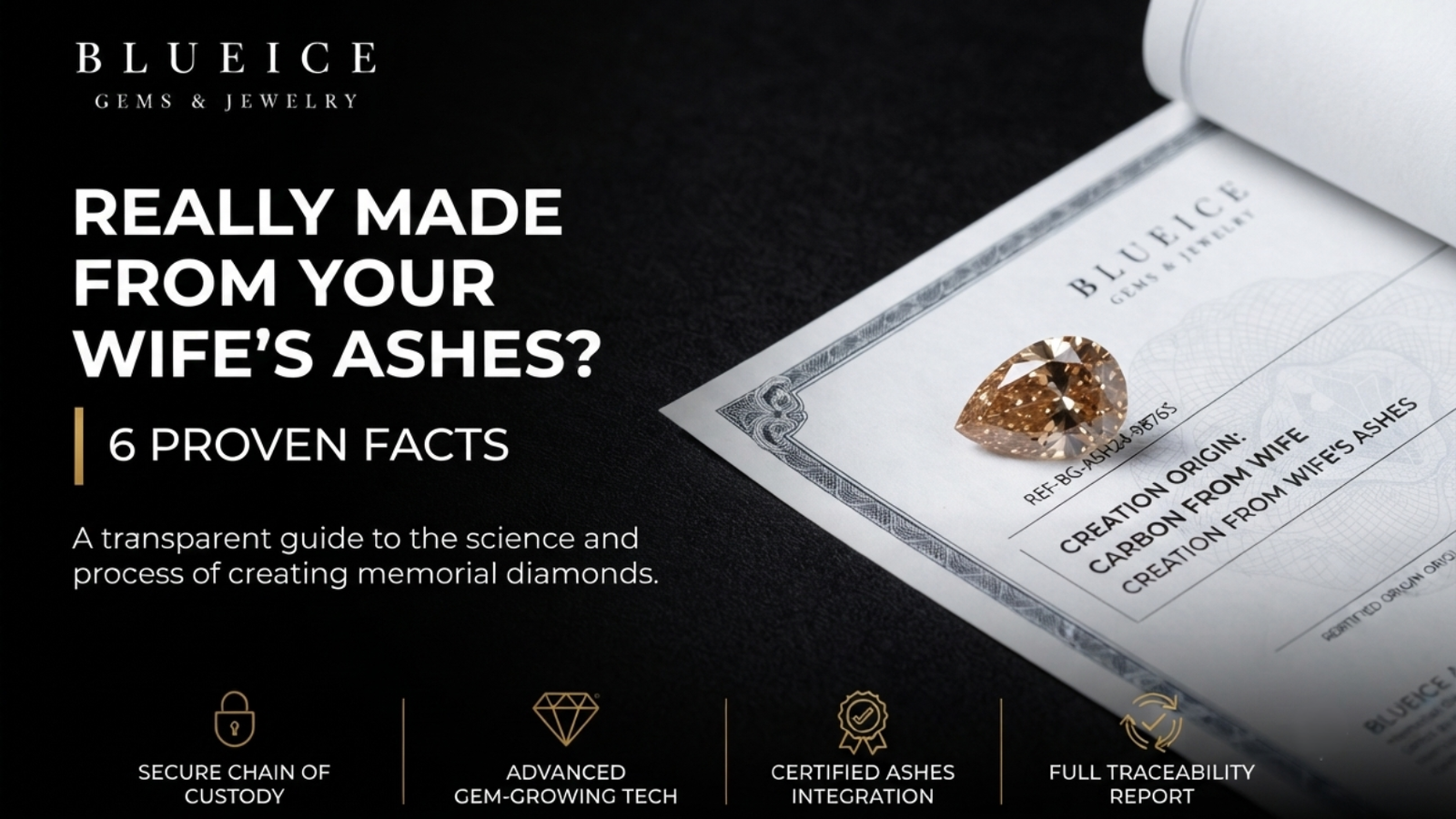
You are allowed to be skeptical. Somebody is asking you to hand over a portion of your wife’s ashes, wait most of a year, and accept a stone on their word that she is in it. A memorial diamond is really made from your wife’s ashes in part: carbon is extracted from a small amount of her cremated remains, purified, blended with lab sourced carbon to reach a workable volume, and grown into a genuine diamond in which her carbon typically makes up around 10 to 15% of the stone.
Table of Contents
The Short Answer, and Why “In Part” Is the Honest Version
Ask whether a memorial diamond is really made from your wife’s ashes and you are asking two questions at once. The first is chemical: can a diamond be grown from cremated remains at all? The second is procedural: how do I know this stone came from her and not from a jar of industrial graphite?
The chemistry is settled and public. The procedure is where the trust lives. The table below is the whole argument, one claim per row.
| Claim you will hear | Verdict | What the evidence is |
|---|---|---|
| “A diamond can be grown from cremated ashes.” | True | Ashes hold roughly 0.5 to 4% usable carbon. The process is public for the whole memorial diamond category. |
| “The diamond is 100% her.” | False | Her carbon is blended with lab carbon; her share is typically around 10 to 15%. Anyone claiming total purity is wrong. |
| “It is really made from your wife’s ashes.” | Partly true and that is the right claim | A real, purified portion of her carbon is in the crystal lattice. “In part” is accurate; “entirely” is not. |
| “A lab test can prove it is her.” | False | No test can identify whose carbon a diamond contains. The proof is procedural, not chemical. |
| “The custody record proves it.” | True, if the record is real and specific | A logged, traceable record from arrival to finished stone is the actual evidence. |
| “The grading report proves it came from her.” | False | A grading report proves quality: cut, color, clarity, carat. It says nothing about origin. |
Six claims; the rest of this page takes them one at a time.
Fact 1 Is There Really Carbon in Her Ashes to Work With?
Yes, though less than most people assume, and that is the first thing a doubter gets right about a stone really made from your wife’s ashes.
Cremated remains are almost entirely calcium phosphate, the mineral structure of bone. Carbon, the only element a diamond is made of, survives as a small fraction: industry figures put usable carbon at roughly 0.5% to 4% of ash by weight, varying by person and by cremation.
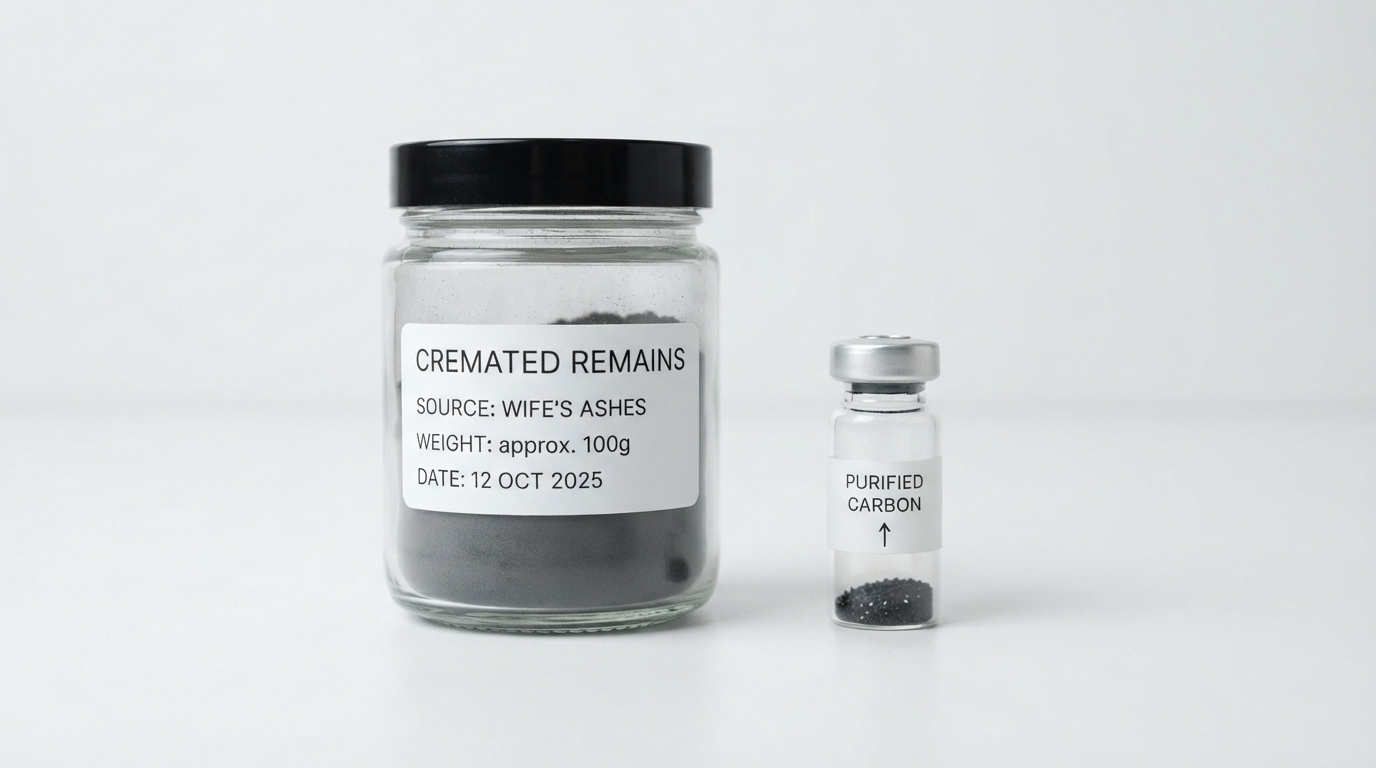
That fraction is enough. A provider heats a portion of her ashes, typically a few tablespoons to around 4 oz, about 100 g, in a controlled, oxygen free, multi stage process that strips away the minerals and leaves carbon at 99.9%+ purity. That carbon is heated to roughly 2,500 to 2,700°C and converted into graphite, the feedstock a diamond press uses.
So the chemical premise behind a diamond really made from your wife’s ashes is not exotic: a small quantity of a common element, recovered from a material that is mostly something else. How a memorial diamond is made from your wife’s ashes walks through every stage in order; this page stays on the question of proof.
Fact 2 How Much of the Diamond Is Really Her?
This is the fact that makes the skeptic right to ask, and the one a good provider volunteers before you do.
The carbon recovered from a few tablespoons of ash is not enough, on its own, to grow a diamond of meaningful size, so the purified graphite is blended with lab sourced carbon. In the finished stone, the personal carbon from her ashes typically makes up around 10 to 15% of the mass. Some providers cite figures as low as 3%, others higher, depending on carat and how much ash was submitted. Three consequences follow for whether the stone is really made from your wife’s ashes in the sense you mean:
- “100% her” is false wherever you read it. It describes physics that does not exist.
- “In part” is not a loophole; it is the accurate description. A real, measurable portion of the carbon that was in her body is now locked in a crystal lattice. The diamond is really made from your wife’s ashes; it is not made only from them.
- Sending more ash does not raise her share meaningfully. Carat is set by growth time in the press, not by material quantity. A provider who suggests a full urn will make the stone “more her” is wrong on two counts.
Ask the percentage question. A specific range with a reason means the provider understands what they are selling. “It’s all her” tells you something more useful than the percentage.
Fact 3 What Does a Chain of Custody Record Actually Prove?
Because no test can identify the carbon, the evidence that a stone is really made from your wife’s ashes is a paper trail.
A chain of custody record is a logged, traceable account of your submission from arrival to shipped diamond. In a reputable operation it looks like this:
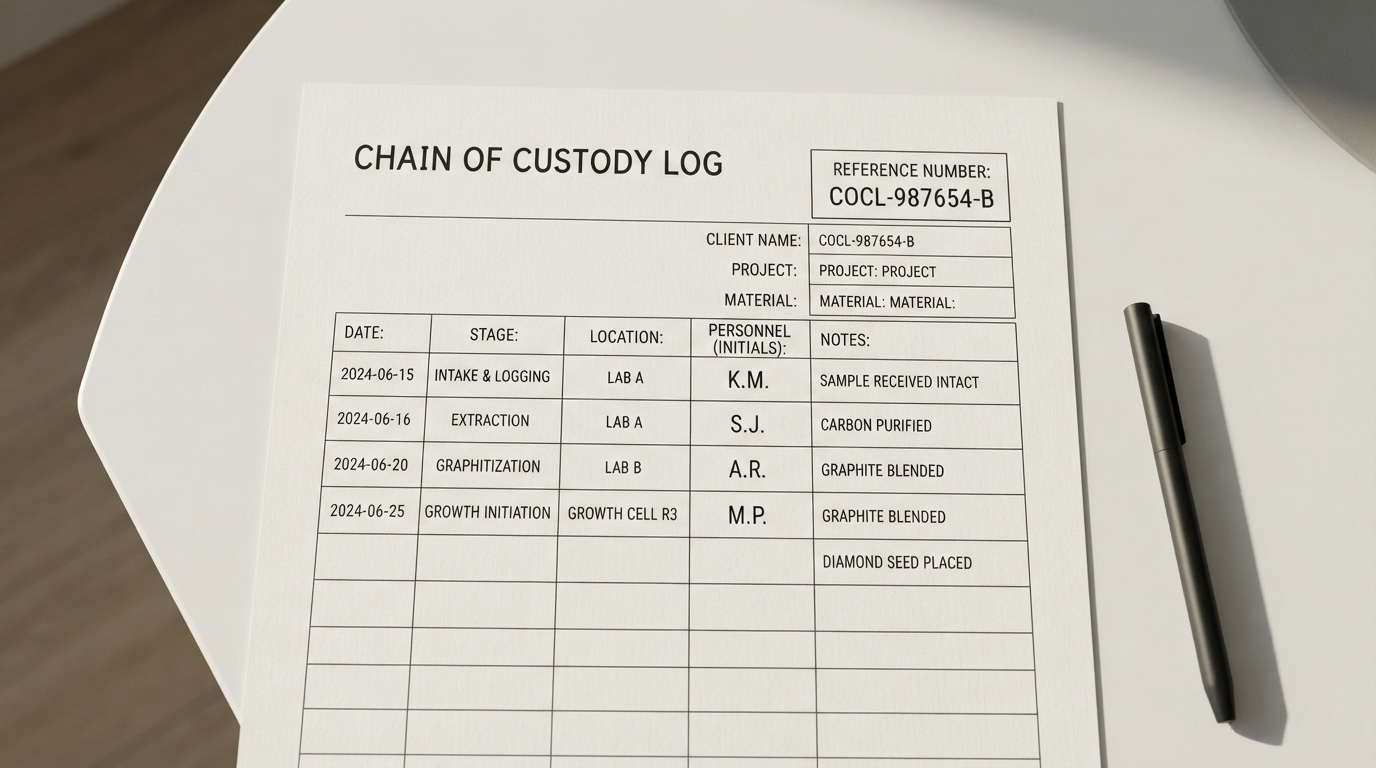
- Intake. Your submission is weighed, photographed, and assigned a unique reference the moment it is opened.
- Sealed transfer. The ash portion moves to extraction in a labeled, sealed container under that reference. Nothing is pooled with another family’s material.
- Extraction and purification. The carbon recovered is weighed and logged against the same reference.
- Graphitization and growth. The purified carbon and the growth cell it enters are logged under the reference, with dates.
- Cutting, grading, and return. Rough crystal and finished stone are tracked against the reference through to shipping.
What this proves: that an identified sample entered the process and an identified stone left it, with a documented link at every stage. What it does not prove: anything about the atoms themselves. A record is only as good as the provider keeping it, which is why you ask to see one. If a diamond is really made from your wife’s ashes, this record is the only place that fact is written down. Questions to ask before turning your wife’s ashes into a diamond turns it into a list you can read down the phone.
Fact 4 What Does an Origin Certificate Prove That a Grading Report Does Not?
Two documents arrive with a finished stone, and people routinely treat them as one. They prove different things, and only one speaks to whether the diamond is really made from your wife’s ashes.
| Document | Who issues it | What it proves | What it does not prove |
|---|---|---|---|
| Origin or authenticity certificate | The provider, in house | That this specific stone was grown from this specific submission, the summary of the custody record | The stone’s quality |
| Grading report | Ideally an independent gemological lab | That the stone is a genuine diamond of a stated cut, color, clarity, and carat | Where the carbon came from, a grading lab has no way to know |
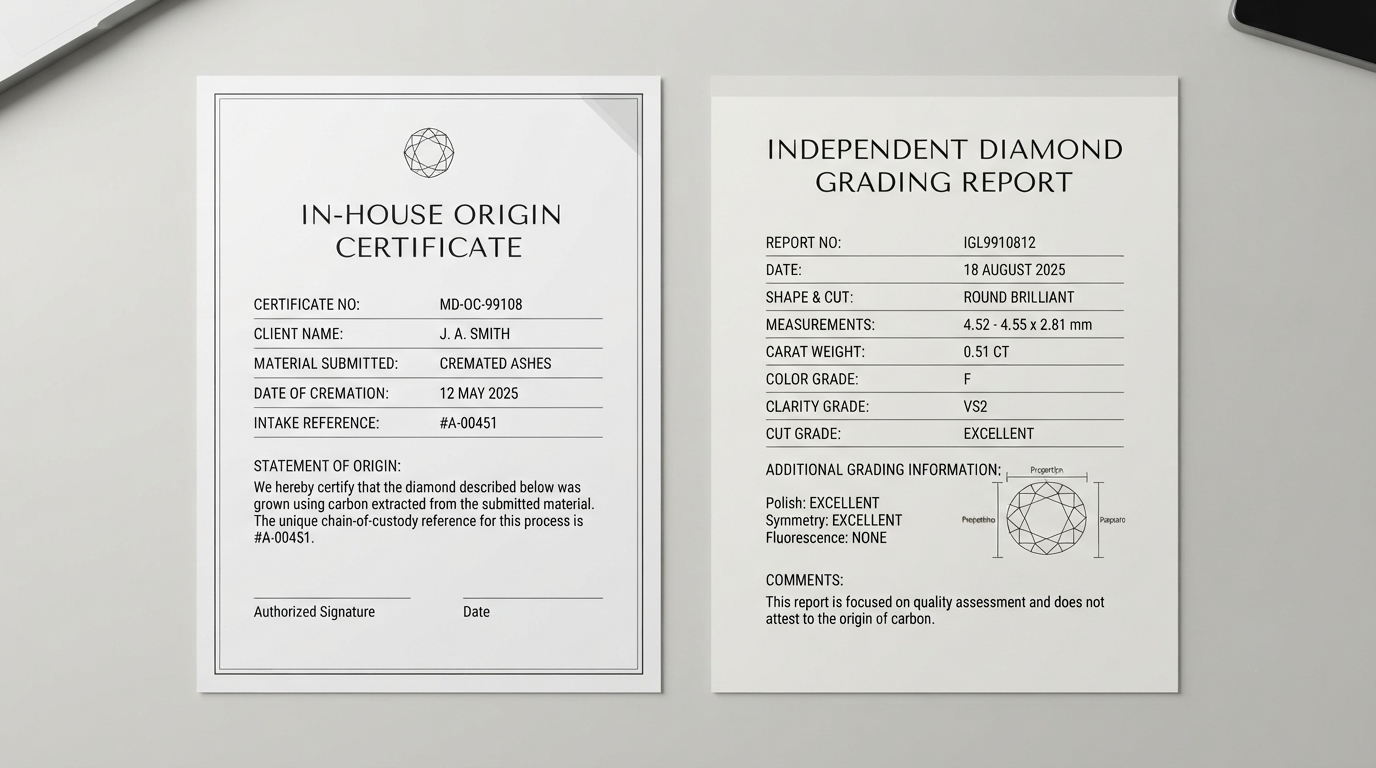
The origin certificate is the provider’s attestation: this stone, this submission, this reference. It should carry your intake reference number, the material submitted, and the date. A certificate that only says “genuine memorial diamond” is a souvenir, not evidence that anything is really made from your wife’s ashes.
The grading report is about the diamond as a diamond. An independent lab applies the same cut, color, clarity, and carat standards to a memorial stone as to any other; typical memorial clarity lands between SI2 and VVS. It is silent on origin by design, and a provider who points to the grading report when you ask whether the diamond is really made from your wife’s ashes is answering a question you did not ask.
Fact 5 What Can You Verify Yourself, and What Can Nobody Verify?
Here is the line most articles blur, stated plainly.
What you can verify about a diamond really made from your wife’s ashes: that it is a real diamond. Any jeweler with a thermal or electrical tester can confirm it is diamond rather than a simulant. An independent lab can grade it and identify it as lab grown by the HPHT or CVD method described on the synthetic diamond page. You can also check that the documents match each other and your intake paperwork.
What nobody can verify: whose carbon is in it. A carbon atom from your wife’s ashes is identical to a carbon atom from a lab feedstock. There is no isotope test, DNA test, or spectroscopic signature that says “this carbon came from this person.” A diamond grown entirely from lab carbon and a diamond really made from your wife’s ashes would be indistinguishable to every instrument in existence.
That is no reason to distrust the category. It is a reason to be precise about where the proof lives: in procedure, the custody record, the reference numbered certificate, the provider’s willingness to show you both, not in chemistry. Anyone who says a test can settle whether a stone is really made from your wife’s ashes is mistaken or selling the test.
So the question to carry into every conversation is “show me the record.” A provider who has one will be relieved you asked. How to turn your wife’s ashes into a diamond puts the paperwork check at the receiving end of the process, where it belongs.
Fact 6 Which Red Flags Suggest a Provider Is Overstating?
A provider does not have to be dishonest to overstate; some repeat marketing they inherited. Either way, these signals mean the answer to “is it really made from your wife’s ashes” is being stretched:
- “100% made from your loved one.” The most reliable red flag. It is chemically false, and a provider who leads with it will not be careful about the percentage that is true.
- No specific percentage, or one that changes when you ask twice. A good answer is a range with a reason.
- “Send as much as you can.” More ash does not make the stone bigger or more her.
- Custody described but never shown. A brochure sentence instead of a sample record means the record may not be what the sentence implies.
- An origin certificate with no reference number. A generic certificate proves nothing about your specific stone.
- The grading report offered as proof of origin. It is proof of quality. Conflating the two is a misunderstanding or a redirection.
- A guarantee that a test will confirm it is really made from your wife’s ashes. No such test exists.
None of the first six is disqualifying alone; two or three together are a pattern. The seventh is a plain falsehood, do not send anything irreplaceable to a provider who states it, whatever else they say about a stone really made from your wife’s ashes.
Why Does This Question Matter More for Ashes Than for Hair?
If you also hold a lock of her hair, the “is it really her” doubt is weaker on that side, and it is worth knowing why.
Hair is roughly 50% carbon by weight, built from keratin. Ashes are under 4% carbon. A hair submission supplies far more personal carbon per gram, so the question of whether there was enough of her barely arises. With ashes, the small carbon fraction is what makes the honesty point necessary: lab carbon has to do most of the volume, so the percentage has to be answered squarely before you can say a stone is really made from your wife’s ashes.
That does not make an ashes stone less real. It makes the proof more dependent on procedure. A diamond really made from your wife’s ashes is one whose provider will tell you, unprompted, how small her share is, because the alternative is a provider who will not.
The hair version of the same doubt, different chemistry, worries about dye and gray, the same procedural proof, is in whether a memorial diamond is really made from your wife’s hair. Both routes end at a stone that is genuinely, partly, provably her, with the proof on paper rather than in the atoms. Wife Ashes Diamond: The Complete Guide covers everything downstream, quantity, color, carat, cost, and timeline, once you are satisfied that the stone is really made from your wife’s ashes.
Frequently Asked Questions
Is a memorial diamond really made from your wife’s ashes, or is that marketing?
It is really made from your wife’s ashes in part. Carbon is extracted from a small portion of her cremated remains, purified, and grown into a genuine diamond. Her carbon typically makes up around 10 to 15% of the stone; the rest is lab sourced carbon added to reach a workable volume.
Can a lab test prove the diamond is really made from your wife’s ashes?
No. Carbon atoms carry no personal signature, so no chemical, isotopic, or gemological test can identify whose carbon a diamond contains. A jeweler can confirm it is a real diamond and a lab can grade it; proof of origin is procedural, the custody record and origin certificate.
What does “chain of custody” actually mean for her ashes?
A logged, traceable record following your submission under one reference number from intake through extraction, growth, cutting, and return, with no pooling with other families’ material. Ask to see a sample record; it is the only written evidence the stone is really made from your wife’s ashes.
Is the origin certificate the same as the grading report?
No. The origin certificate is issued by the provider and attests that this stone was grown from your specific submission. The grading report, ideally from an independent lab, documents cut, color, clarity, and carat and says nothing about origin. You want both.
Why is the personal carbon only 10 to 15% of the stone?
Because ashes are almost entirely calcium phosphate, with only about 0.5 to 4% usable carbon. The carbon recovered from a few tablespoons of ash is not enough to grow a meaningful stone alone, so it is blended with lab carbon. Some providers cite figures as low as 3% depending on carat.
Would sending more of her ashes make the diamond more her?
Not meaningfully. Carat is determined by growth time in the press, not by material quantity, and the blend ratio is set by the growth cell’s volume. Sending a full urn loses ashes you could have kept without making the stone any more really made from your wife’s ashes than it already is.
Is the doubt any different if I use her hair instead?
Yes, in one respect. Hair is roughly 50% carbon compared with under 4% for ashes, so far more personal carbon is available per gram and the “was there enough of her” question barely arises. The procedural proof, custody record and origin certificate, is the same for both.
Final Thoughts on Whether It Is Really Made From Your Wife’s Ashes
The skeptic in you is doing its job. A memorial diamond is really made from your wife’s ashes in the only sense physics allows, a small, purified, real portion of her carbon inside a genuine diamond, and no honest provider will tell you otherwise. You cannot prove it with an instrument. You can insist on a provider who states the percentage plainly, shows you the custody record, and issues a certificate tied to your reference number. Choose on those three things, and the stone you receive will be what it claims: really made from your wife’s ashes, entirely real, and honestly described.
Learn More About Wife Memorial Diamonds
- Wife Ashes Diamond: The Complete Guide
- How a Memorial Diamond Is Made From Your Wife’s Ashes
- Is a Memorial Diamond Really Made From Your Wife’s Hair?
- Questions to Ask Before Turning Your Wife’s Ashes Into a Diamond
- How Much Ash Do You Need for a Wife Memorial Diamond?
Talk With Memorial Diamond
If you want to ask the three questions on this page, the percentage, the custody record, and the certificate wording, before any of her ashes leave the house, reach out to Memorial Diamond. Asking whether a stone is really made from your wife’s ashes before you send them is what a careful person does. There is no deadline.