
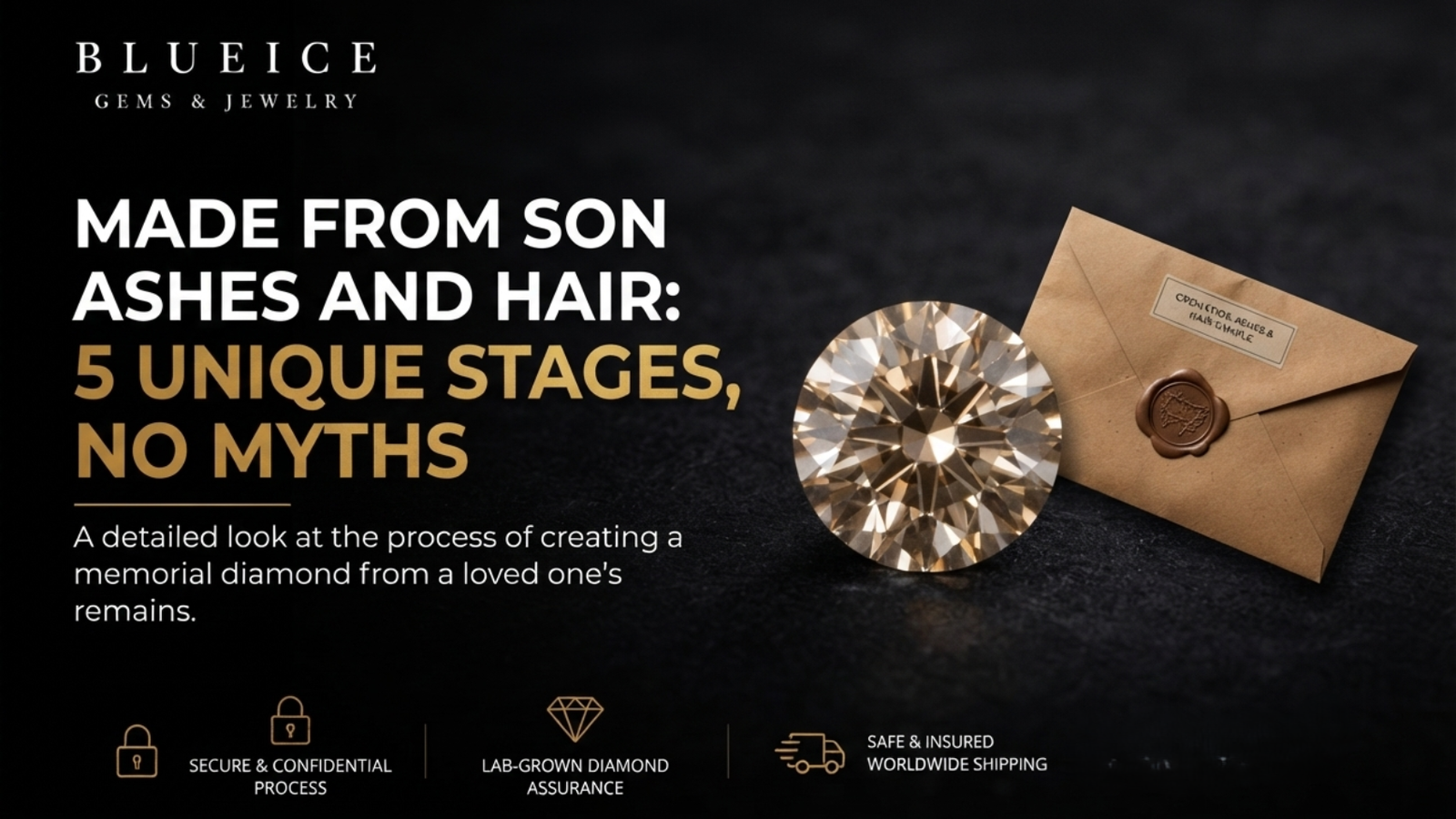
When a parent holds both a jar and an envelope, the question underneath everything else is usually chemical: are these really the same substance in the end? A memorial diamond made from son ashes and hair works because both samples contain carbon, bone ash holds a little, hair holds a great deal, and that carbon can be separated, purified, restructured and grown into a genuine diamond. This page explains what happens at the level of the atoms rather than at the level of the paperwork, because that is where the honest answers live. Everything below applies specifically to a stone made from son ashes and hair rather than to either material on its own.
Table of Contents
What Are You Actually Holding, Chemically?
Two very different substances, which is the first thing to understand about anything made from son ashes and hair.
Cremated remains are overwhelmingly calcium phosphate, the mineral scaffolding of bone, left behind once everything organic has burned away at cremation temperatures. Carbon survives in that residue only as a minority component. Industry figures put the usable carbon in ash at roughly 0.5% to 4% by weight.
Hair is the opposite case. It is built from keratin, a fibrous protein, and comes in at roughly 50% carbon by weight. A few grams of hair therefore carry far more recoverable carbon than the same weight of ash.
| Cremated remains | Hair | |
|---|---|---|
| Dominant compound | Calcium phosphate, bone mineral | Keratin, fibrous protein |
| Carbon by weight | Roughly 0.5% to 4% usable | Roughly 50% |
| Cremation required | Yes | No |
| Typical amount requested | A few tablespoons to about 4 oz | A small lock, a few grams |
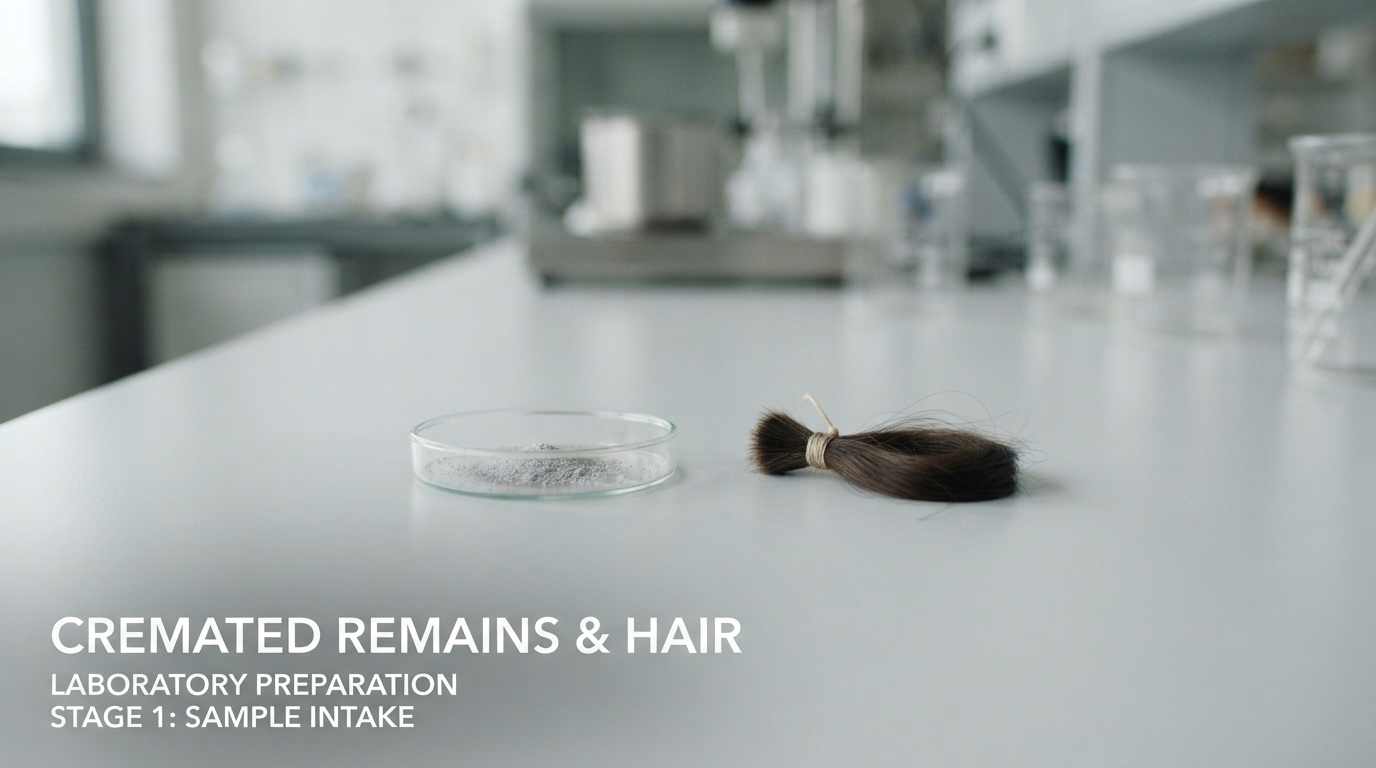
Both go into one commission when a diamond is made from son ashes and hair, and a laboratory must treat each differently. That contrast is the entire reason a stone made from son ashes and hair is worth discussing as its own thing rather than as a variant of either route. You are handing a laboratory one carbon poor mineral sample and one carbon rich organic one, and asking for a single crystal.
Who Is Entitled to Authorize a Combined Submission?
A combined submission raises two separate permission questions at once, and they do not have the same answer.
A submission made from son ashes and hair therefore needs two answers rather than one. The ash half is governed by the rules that apply to remains. Most states set a statutory order for who may direct the disposition of a decedent’s remains, and a surviving spouse commonly sits at the top of it, with the deceased’s own adult children often ranking above his parents. Whatever your son put in writing, a will, a funeral directive, a designated agent, can reorder that list, and the details genuinely differ state to state. Settle that with the funeral director who handled the cremation, or with a local attorney, before any ash is shipped.
The hair half sits elsewhere. Those disposition rules are written about the remains themselves, so a lock you already keep at home is usually the simpler question in practice, though a decedent’s belongings can still form part of his estate, treatment varies by state, and a sample in somebody else’s keeping is a conversation rather than a decision.
In practice parents commission diamonds made from son ashes and hair without difficulty all the time, and one parent arranging it alone is normal. Ask early rather than discover a disagreement in month seven. Questions worth settling first lists the rest of them.
What Happens Chemically During Purification?
Both samples are heated in a controlled, oxygen free environment, and the absence of oxygen is the whole trick.
With oxygen present, heating organic material simply burns the carbon off as carbon dioxide, exactly what happened to most of your son’s carbon during the cremation itself. Remove the oxygen, and heat instead drives off volatile non carbon fractions while the carbon stays behind. For the hair, that means breaking keratin down and releasing its nitrogen, sulfur, oxygen and hydrogen. For the ash, it means separating carbon from a large excess of calcium phosphate and other minerals.
Multiple stages later, the recovered material reaches roughly 99.9%+ carbon purity. Everything made from son ashes and hair passes through this, and it is where the yield difference between the two samples shows up most starkly: the hair gives up a lot, the ash gives up very little.
Ask a provider whether the two samples are purified together or separately, and whether purity is measured or assumed. A laboratory that grows stones made from son ashes and hair regularly will answer both without hesitating. Ask too which material is processed first, it changes nothing chemically, but it tells you how a diamond made from son ashes and hair is actually scheduled inside the lab.
Why Must the Carbon Become Graphite First?
Because carbon has more than one crystalline form, and a growth press needs a specific one.
Pure carbon can be arranged as graphite, loosely stacked flat sheets, each atom bonded to three neighbors, or as diamond, where every atom bonds to four in a rigid framework. Same element, wholly different properties. The purified carbon from a submission made from son ashes and hair is heated to somewhere around 2,500 to 2,700°C and converted into graphite, which is the feedstock a press can actually work with.
Nothing is added and nothing personal is lost in that conversion. A carbon atom that came out of keratin and a carbon atom that came out of bone residue are chemically indistinguishable once purified, carbon is carbon, with no memory of its source. That is a genuinely important point for a stone made from son ashes and hair, because it means the two samples are not competing or layered; they become one feedstock.
It also means nobody can later point at a facet and say which part came from which sample, which is worth knowing before you commission a diamond made from son ashes and hair expecting some visible division inside it. That is not a limitation of the process. It is what “same element” means.
What Happens in the Lattice During Growth?
The graphite, blended with supplemental lab sourced carbon to reach workable volume, goes into a growth cell around a tiny diamond seed. Then the structure is forced to change. Nothing about a charge made from son ashes and hair alters how the press itself is operated.
In the HPHT process used for most memorial stones, the cell is taken to roughly 6 to 8 gigapascals with temperatures held between 1,400°C and 2,500°C. Under those conditions graphite’s flat, three bond arrangement becomes thermodynamically unstable, carbon dissolves into a molten metal flux, and atoms reprecipitate onto the seed in diamond’s four bond geometry. A minority of providers use CVD instead, cracking a carbon bearing gas in a vacuum chamber so atoms deposit layer by layer.
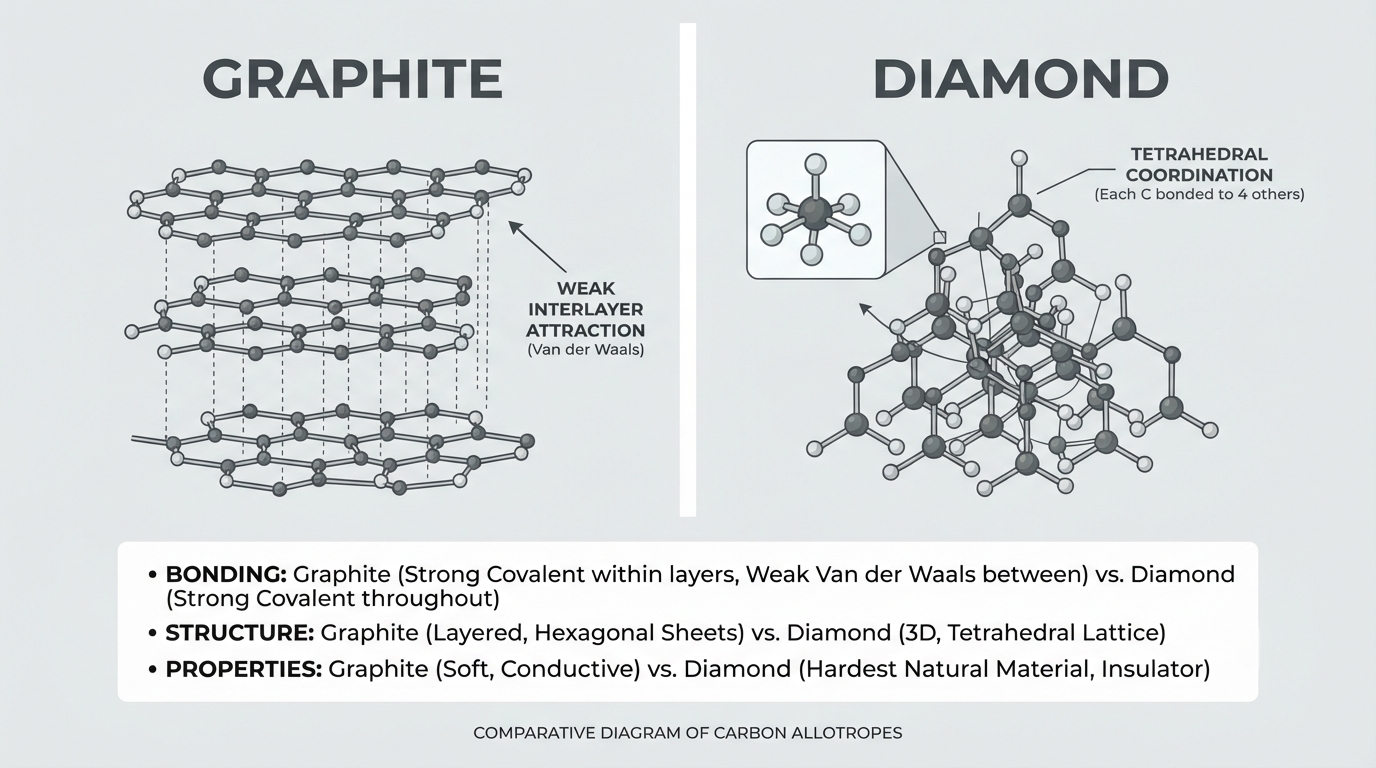
Either way, a diamond made from son ashes and hair is built atom by atom over weeks to months. Growth time governs the final carat weight, not how much ash or hair you supplied, which is the single most persistent misunderstanding in this category.
Everything made from son ashes and hair moves through the same five chemical states, whichever provider and whichever growth method is used:
| Stage | Chemical state | What it is |
|---|---|---|
| 1 | Calcium phosphate and keratin | The samples as you send them |
| 2 | Carbon at 99.9%+ purity | After oxygen free multi stage purification |
| 3 | Graphite | Purified carbon restructured at about 2,500 to 2,700°C |
| 4 | Diamond lattice | Carbon rebonded under pressure and heat around a seed |
| 5 | Cut gemstone | The crystal shaped and polished by a cutter |
How Much of a Diamond Made From Son Ashes and Hair Comes From Him?
This is where most pages get vague, so here is the position stated exactly.
For the ash route on its own, the industry publishes a figure: personal carbon recovered from cremated remains typically makes up around 10% to 15% of the finished stone’s mass. Figures as low as 3% are cited by some providers, varying with the size of stone requested and the quantity of remains supplied. That number belongs to ash and should be quoted as such.
For hair on its own, no equivalent finished stone percentage is published at all. And for a blended charge, a diamond made from son ashes and hair grown together, there is no published figure either. No industry wide number exists for what proportion of such a stone is personal carbon, because the answer depends on how much of each sample was supplied, what each yielded, and what the target size required.
So do not accept a confident percentage for a stone made from son ashes and hair from anyone who cannot show their working. Ask your provider, in writing, for their own estimate for your specific commission and the basis they calculated it on.
What is true without qualification: supplemental lab sourced carbon is always part of the charge, no memorial diamond from any material is 100% personal carbon, and a real, verifiable quantity of carbon that was structurally part of him ends up inside the lattice. Treat a precise sounding number for a diamond made from son ashes and hair as a prompt for a follow up question rather than as a settled fact. Whether the stone is genuinely his takes that apart at greater length.
Why Is a Diamond Made From Son Ashes and Hair Rarely Colorless?
Because trace elements ride along with the carbon, and a diamond’s color is a direct readout of what was in the growth cell.
Nitrogen atoms that substitute into the carbon lattice absorb light at the blue end of the spectrum, leaving the stone looking yellow. Boron does the reverse and produces blue. A colorless diamond requires that effectively neither element is present, straightforward with an industrial feedstock, difficult when the carbon came out of a body.
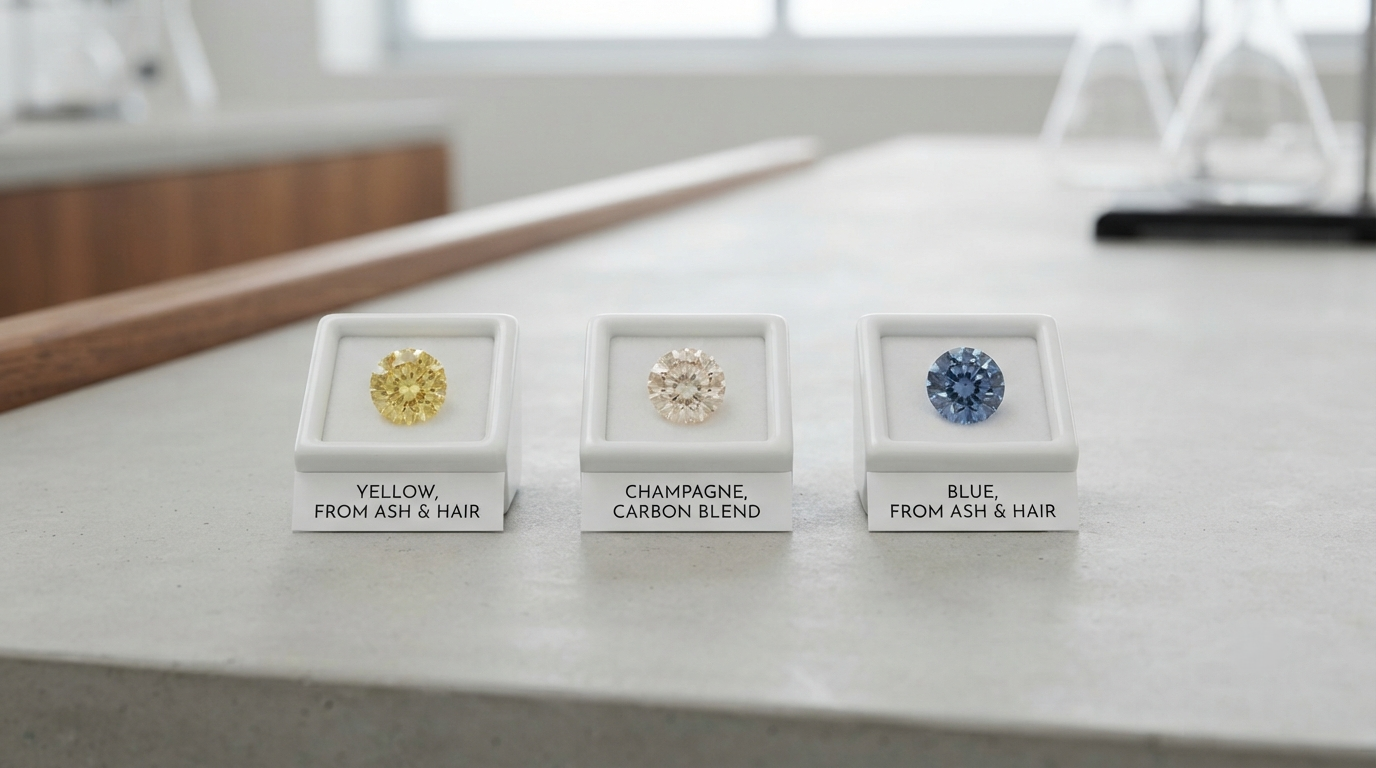
A combined submission gives the cell two organic sources rather than one. Keratin is markedly nitrogen rich, which is one plausible reason stones made from son ashes and hair often finish in the yellow to champagne range, though no provider can predict a specific shade before growth. Colorless is achievable with additional processing and generally costs more, and post growth irradiation can produce red, pink, green or black.
Think of the color of a diamond made from son ashes and hair as data rather than decoration. It records what the material contained. What color to expect sets out the likely range in detail.
Are the Two Samples Blended or Grown Separately?
This is the question that genuinely distinguishes a combined commission, and providers handle it differently, so ask rather than assume.
There are three arrangements in circulation across the industry:
- One blended charge. Carbon from both samples is purified, combined, and grown as a single feedstock into one stone. This is what most people picture when they imagine something made from son ashes and hair.
- Separate growth, matched pair. Each sample is processed and grown independently, producing two stones, often set together in one piece. Chemically this is two single source diamonds, not a blend.
- One sample as primary, the other held. The laboratory grows from one material and retains the second for a future stone, which can suit families who want a second piece later.
Each of the three is legitimate, and each produces something materially different from a commission made from son ashes and hair. They are not equivalent, and only the first produces a single diamond made from son ashes and hair in the literal sense. If a single blended stone is what you want, say so explicitly at intake and get it confirmed in writing, because assumptions here are expensive to discover late. The complete guide to combining both covers the trade offs between the three.
What Does the Chemistry Not Let Anyone Promise?
Several claims in this category are not exaggerations so much as physical impossibilities, and telling those apart makes a provider much easier to read.
- A guaranteed color. Trace element content is not known precisely in advance, so nobody can commit to a shade before a diamond made from son ashes and hair has actually been grown.
- A traceable split between the samples. Purified carbon carries no marker of origin, so nothing made from son ashes and hair can be shown afterwards to be sixty per cent one material and forty per cent the other.
- A published blend percentage. An industry figure exists for the ash route alone. None exists for a combined charge.
- A larger stone from more material. Carat weight follows growth time, so supplying a fuller jar does not enlarge a stone made from son ashes and hair.
- A guaranteed first run. Crystals can grow heavily included or fracture during growth. Ask what a second attempt involves before you commit, not after.
- DNA in the finished gem. Purification is designed to strip out everything that is not carbon, so genetic material does not survive it. Any provider describing a diamond made from son ashes and hair as carrying his DNA is describing something this process does not do.
None of that undercuts the thing itself, a real, measurable quantity of his carbon genuinely ends up in the lattice. It simply marks the line between what the chemistry supports and what marketing occasionally adds on top. The step by step version keeps to the same boundary.
What Does the Chemistry Mean for Time and Cost?
Mostly it means that time, not material, is the variable you are paying for. The chemistry of a diamond made from son ashes and hair does not make it inherently dearer than a single source stone; the finished size you choose does that.
Because carat weight is set by how long the crystal spends growing, count on six to ten months from receipt of material across the industry, extending toward twelve for stones beyond roughly two carats or for specialty colors such as black. Sending a fuller jar or a longer lock changes none of that for a stone made from son ashes and hair, and how to turn his ashes and hair into a diamond covers the practical side of that decision.
General 2026 industry ranges, not any single company’s published prices:
| Finished weight | Typical industry range |
|---|---|
| 0.10 to 0.25 ct | About $1,500 to $3,500 |
| 0.5 to 1.0 ct | About $5,000 to $15,000 |
| 2 to 5+ ct | About $20,000 to $75,000+ |
Colorless costs meaningfully more than yellow, blue or champagne at the same weight, and settings, engraving, fancy cuts and independent third party grading are usually quoted separately. Independent grading remains optional across the industry rather than standard, and it documents the stone against the usual cut, color, clarity and carat criteria, a different document from the origin certificate that records whose material was used. Ask which you are being offered. How much of each sample is needed covers quantities.
Frequently Asked Questions
Is a diamond made from son ashes and hair possible when the samples were gathered years apart?
Yes. Neither material degrades in a way that matters chemically, ash is mineral and stable, and dry hair keeps its keratin indefinitely. A lock cut in childhood and remains from a cremation decades later purify into the same element with no difference in the result.
Does adding hair increase how much of him is in the stone?
Very likely, since hair is far richer in carbon than ash by weight, but no provider can put a published industry figure on the increase because none exists for blended charges. Ask for their own estimate, in writing, for your specific commission.
Can the lab tell the two sources apart in the finished diamond?
No, and no laboratory should claim otherwise. Once purified, carbon atoms from keratin and from bone residue are chemically identical, so they cannot be distinguished within the lattice. The origin documentation records what was submitted, not which atom came from where.
Is a blended stone harder to grow than a single source one?
Not inherently. Once both samples have been purified to carbon, the growth process is the same as for any other memorial diamond. The extra work sits earlier, in processing two different starting materials, which is worth confirming is included in your quote.
What if there is not enough usable carbon in the ash?
Hair usually compensates, because its carbon content is so much higher by weight. If yield still falls short, a laboratory will normally ask for more of one material or the other before growth begins rather than after, ask what their process is for that conversation.
Can we still bury or scatter the remaining ashes?
Yes. Only a small portion of a cremation is used, so interment, scattering, keeping an urn, or dividing the rest among relatives all remain fully available. A diamond sits alongside those choices rather than replacing any of them.
Final Thoughts on a Diamond Made From Your Son’s Ashes and Hair
The chemistry is oddly consoling once it is laid out. Carbon does not remember where it came from, which sounds cold until you follow it through: it means the carbon from a lock cut when he was small and the carbon from what was left after the cremation become genuinely the same material, in the same crystal, with no seam between them.
What a diamond made from son ashes and hair is, exactly, is that: one substance, drawn from two things you kept, restructured into a form you can wear. It is not a metaphor and it is not a stand in.
Take the percentage question seriously, get the blending arrangement confirmed in writing, and settle who has standing before anything is posted. Everything else about a stone made from son ashes and hair is chemistry, and chemistry is the part that behaves predictably.
Learn More About Son Memorial Diamonds
- The complete guide to combining both, the whole subject in one place
- How to turn his ashes and hair into a diamond, the practical, decision side walkthrough
- The step by step version, set out in order
- How much of each sample is needed, quantities for both materials
- Where to start if you are undecided, comparing the options first
Talk With Memorial Diamond
If you want to talk through what your particular samples could realistically produce, including whether a single blended stone is possible with what you hold, reach out to Memorial Diamond at memorialdiamond.us. No form to fill in first, and nothing decided by asking.
Word count: 3,065 words · Reading time: about 15 minutes