son-ashes-hair-diamond-color

What Color Will a Diamond Made From Your Son’s Ashes and Hair Be?

Families who send both usually hope the combination gives them some say in how the stone turns out. It does not, and the honest answer is this: son ashes hair diamond color most often settles into the yellow, blue or champagne to brown families, because impurities trapped in the lattice during growth decide the shade and both of your materials came from a person rather than a supplier. White is possible with extra work and extra money, and no laboratory can name your son ashes hair diamond color in advance.
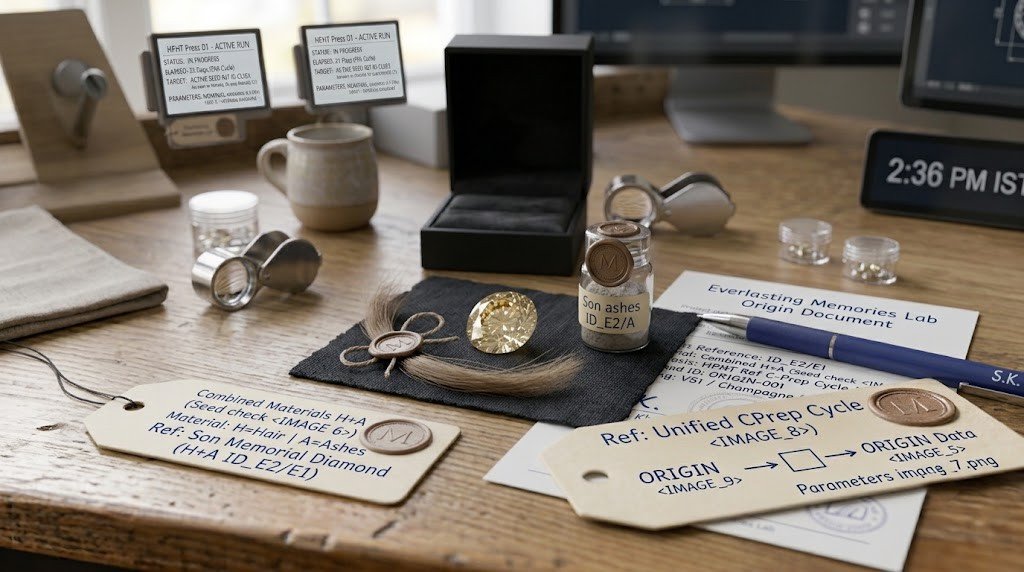
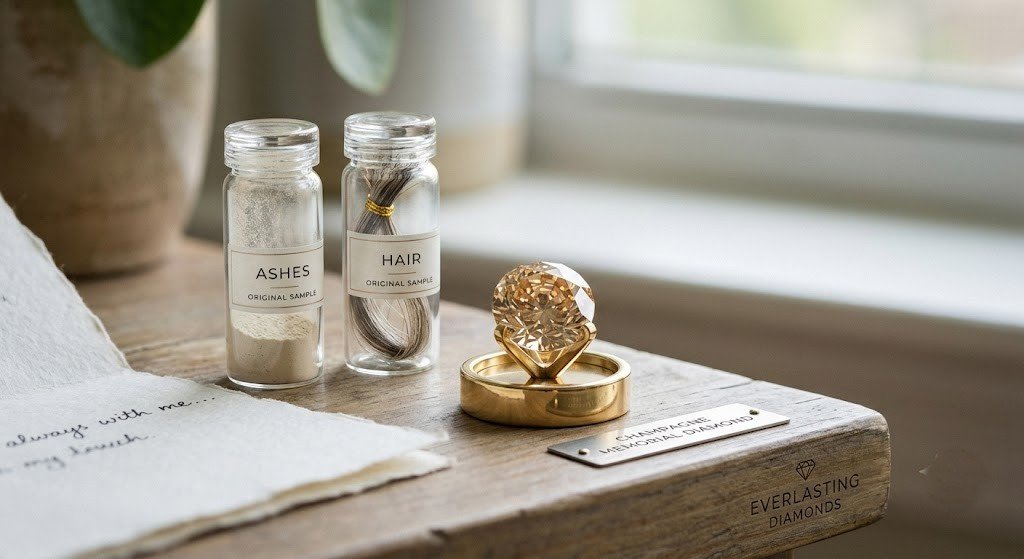
Son ashes hair diamond color shown as a single champagne-toned memorial diamond resting beside a small lock of hair and a sealed ash vial

How Does a Diamond End Up Tinted at All?

Son ashes hair diamond color, like the color of any diamond, is an impurity story. The crystal is carbon arranged in a rigid repeating pattern, and any atom that is not carbon which finds a place in that pattern as it grows alters how light leaves the finished stone.

Where nitrogen occupies some of those positions, the eye reads the result as yellow. Where boron occupies them instead, the eye reads blue. Only a lattice that took up neither comes out water white, which is why colorlessness is best described as what was kept out rather than what was put in.

That is the entire basis of son ashes hair diamond color, and it is worth internalizing before any sales conversation. The shade is structural. It is not a polish, a plating or a finish, and it cannot be undone later by recutting.

It also means son ashes hair diamond color is settled inside a sealed press over a period of months, with nobody watching. How a memorial diamond is made from his ashes and hair walks through that stage in order.

Does Blending Ashes and Hair Shift the Result?

Not in any direction you could plan around. This is the specific hope that brings most parents to the combined route, so it deserves a blunt answer rather than a hedge.

The thinking usually runs that ash is the messy material and hair the clean one, so mixing in hair ought to pull son ashes hair diamond color toward something lighter or at least more predictable. Neither half of that holds. Both materials are reduced to purified carbon, roughly 99.9% or better, before anything is grown, and the trace elements that set son ashes hair diamond color live in whatever survives that purification on both sides, plus in the growth conditions themselves.

So a blend does not average two outcomes together, and it does not dilute anything. It produces one crystal, whose son ashes hair diamond color falls wherever the chemistry of that particular run puts it.

That is the same position this library takes about the ashes only question and about the hair only question. No route is the controllable one.
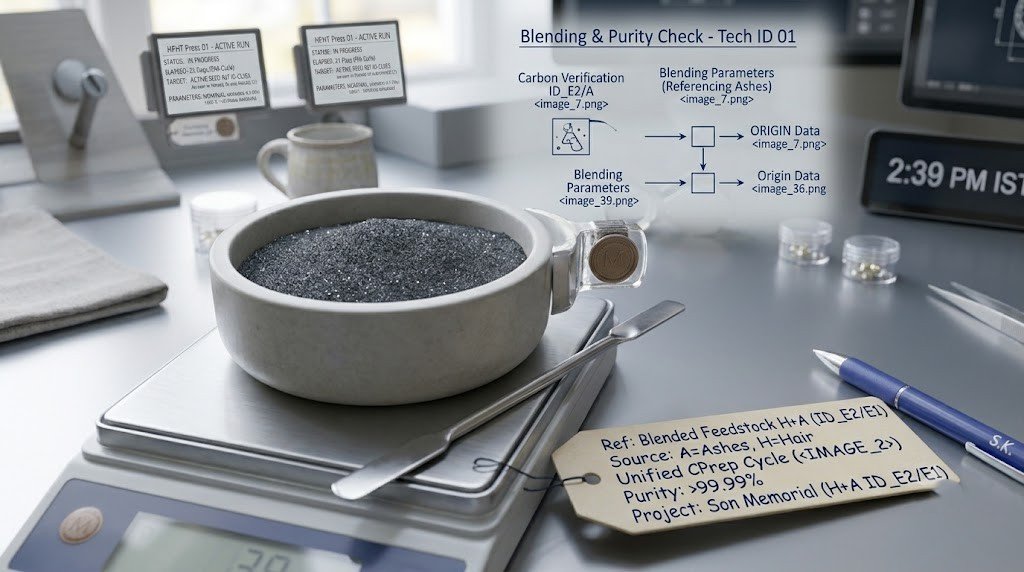
Purified carbon feedstock in a laboratory crucible before being loaded into a diamond growth cell

Which Son Ashes Hair Diamond Color Outcomes Are Most Common?

Five families of son ashes hair diamond color cover almost everything that actually reaches a parent’s hands, in a category with a longer history than most families realize. Treat this as a description of the landscape rather than an order form:

Shade familyOriginFrequency across the categoryPrice impact
Yellow to golden amberNitrogen in the latticeThe most frequent outcomeNo premium
BlueBoron in the latticeFrequentNone to modest
Champagne through brownMixed trace elements and run conditionsFrequentNo premium
Near colorless and colorlessNitrogen and boron both held outUncommonSubstantial premium
Irradiated red, pink, green, blackTreatment applied after growth, where offeredDepends entirely on the providerPremium; black runs longest

The frequency column reflects tendency across the industry, not a probability anyone can calculate for your submission. No test looks at a portion of ash and a lock of hair and forecasts which row your son ashes hair diamond color will land in.

The practical value of a table like this is calibration. A parent who already understands that warm tones dominate is far less likely to be blindsided by the son ashes hair diamond color that eventually arrives.

Does One Material Overrule the Other?

There is no published basis for saying that whichever material you send more of will dominate son ashes hair diamond color, and it is worth being suspicious of anyone who implies otherwise.

Part of the reason is that the two materials are not weighed against each other in any meaningful sense by the time growth begins. Each is stripped to carbon, and that carbon is combined with supplemental lab sourced carbon to reach a workable volume. What reaches the growth cell is one feedstock, not two competing ones.

So sending a heavier portion of ash will not push son ashes hair diamond color toward amber, and adding an extra lock will not pull it toward white. If a provider tells you the ratio is a lever you can pull, ask them to explain the mechanism and to put the claim in writing.

The genuinely useful question to ask instead is procedural: does this laboratory process both materials in a single run, or handle them separately and combine later? That affects chain of custody and paperwork rather than son ashes hair diamond color, but it is worth knowing. Whether the finished stone is genuinely his covers the verification side of that.

Can a Blended Submission Come Out Colorless?

Yes, and it is worth knowing what that actually asks of a laboratory before you request it, because a colorless son ashes hair diamond color is not a preference you simply state.

Achieving white means keeping nitrogen and boron almost entirely out of the growth environment. That takes tighter control and additional processing steps than a run where trace elements are simply allowed to do what they do, and across the category a colorless stone typically costs considerably more than a warm or blue stone of the same carat weight.

The part that gets undersold is that additional processing buys better odds on son ashes hair diamond color, not certainty. A laboratory working toward white is still working toward it, and a blended submission does not improve those odds.

Raise it at the first conversation if white matters to you, not after a deposit. Ask how often that target is met in their hands, what happens when a stone arrives tinted anyway, and whether the extra charge stands regardless. The complete guide to a son ashes and hair diamond sets out the rest of the questions in sequence.

Where Do Red, Pink, Green and Black Stones Come From?

From a separate step that happens after the crystal already exists. Some providers offer post growth irradiation, which can move a finished stone into red, pink, green or black territory.

Two caveats matter. Availability differs sharply between companies, so a treated son ashes hair diamond color you have in mind may not be on the menu at the provider whose process you otherwise prefer. That is a question for the first call, not the last.

The other caveat is about meaning rather than logistics. Treatment changes how the stone reads; it does not change where the carbon came from. A treated son ashes hair diamond color is still a stone grown from his ashes and his hair.

Timing is the practical trade off with any treated son ashes hair diamond color. Black stones and larger carat weights are the two things most likely to stretch a commission toward the long end of the normal schedule. How long a son memorial diamond takes covers the waiting properly.

How Much of a Blended Stone Is Actually His?

This is where families are most often given a number that does not apply to them, so it is worth separating carefully.

The percentages quoted around this industry describing how much of a finished stone came from the personal source are ash figures. On the ash route, personal carbon recovered from cremated remains is usually said to account for something in the region of 10 to 15% of a finished stone’s mass. Lower numbers circulate too, 3% appears in some published material, and the figure moves with stone size and with the quantity a family sent. There is no equivalent published figure for hair, and none at all for a blended charge of ash and hair together.

So nobody can tell you what share of a combined stone is his without their own data. Ask your provider for their figure for a blended submission specifically, and ask for it in writing rather than over the phone.

What is safe to say is the shape of the thing. His carbon is purified and then combined with supplemental lab sourced carbon to reach growth volume, so the stone is part him and part supplementary feedstock, never wholly one or the other. That has no bearing on son ashes hair diamond color, but it is the claim most worth pinning down before money moves.

What Can Anyone Promise You About Son Ashes Hair Diamond Color?

A target and a described process. Nothing beyond that, and how a company responds when you press on this is one of the better tests of its honesty.

A provider can reasonably say which shade family they will aim for and explain which variables they control. What no provider can honestly write onto a contract is a guaranteed son ashes hair diamond color, in the way they can guarantee a carat weight or a cut shape.

Get these five answered before you sign anything:

  1. Which shade family are you aiming for with a blended submission, and why that one?
  2. How often does that aim land, in your own recent experience?
  3. What happens if the finished stone comes out well away from it?
  4. Is any fee refunded, reduced, or a second run offered in that case?
  5. Will the finished son ashes hair diamond color be documented independently?

That last question carries more weight than it looks like it does. An independent grading report assesses the stone on the same four quality factors used for any diamond, which makes it the only third party record of what you actually received. It is usually an optional extra rather than standard, so ask whether it is included.

Is There a Reason to Send Both Rather Than One?

Yes, but the reasons are practical and emotional rather than chromatic. Sending both will not steer son ashes hair diamond color anywhere.

Some parents have only a modest portion of ash left because the rest was scattered or interred, and a lock of hair makes up the shortfall. Others want the hair included simply because it was cut while he was alive. Both are good reasons.

There is also a redundancy argument. If one material proves unusable, having submitted both means the commission does not stall while a family decides what else to send. Ask the provider how they would proceed in that situation.

What should not sway you is a suggestion that combining materials improves the stone. It does not improve clarity, it does not improve son ashes hair diamond color, and it does not shorten the wait. How much of each material a laboratory needs sets out the quantities involved.

Who Has to Agree Before Both Materials Are Used?

The two materials sit in slightly different positions, and it helps to separate them before you fill in a form.

His cremated remains are governed by a statutory order of priority that most states set out. A surviving spouse or partner commonly sits at or near the top of it, and adult children of his own can rank above parents. Written instructions he left behind can reorder that, and the detail varies state by state. In practice the person holding that authority is the one a provider will want signing for the ash, and that same signature usually sets the son ashes hair diamond color being aimed for.

A lock of hair you have kept is generally the more straightforward half in practice, because those statutory rules are written about remains rather than about a keepsake in a drawer. It is not a question with no dimensions at all, though: a person’s belongings can form part of an estate, treatment differs between states, and hair that somebody else has been keeping is a conversation to have rather than a decision to take on your own.

It is also entirely normal for two parents to want different things here, or for one parent to be arranging all of it alone. Where authority is genuinely unclear, the funeral director who handled the cremation or a local attorney will settle it quickly.

How Do Shade, Price and Waiting Time Connect?

Son ashes hair diamond color nudges the price; carat weight sets it. Working from category wide 2026 figures rather than any one company’s list, a stone between 0.10 and 0.25 carats typically falls between $1,500 and $3,500, half a carat to a full carat runs roughly $5,000 to $15,000, and two carats and up starts near $20,000 and can pass $75,000.

Within a tier, a colorless result carries a real premium over a warm or blue stone of the same weight, for the process control reasons above. Irradiated shades usually carry their own premium, and grading reports, engraving, fancy cuts and settings are quoted separately from the stone.

On timing, the industry norm runs roughly six to ten months from the day material is received. A specialty son ashes hair diamond color, black in particular, or a larger stone can push that toward a full twelve. What a son memorial diamond costs breaks the tiers down in detail.

What Should You Expect on the Day It Arrives?
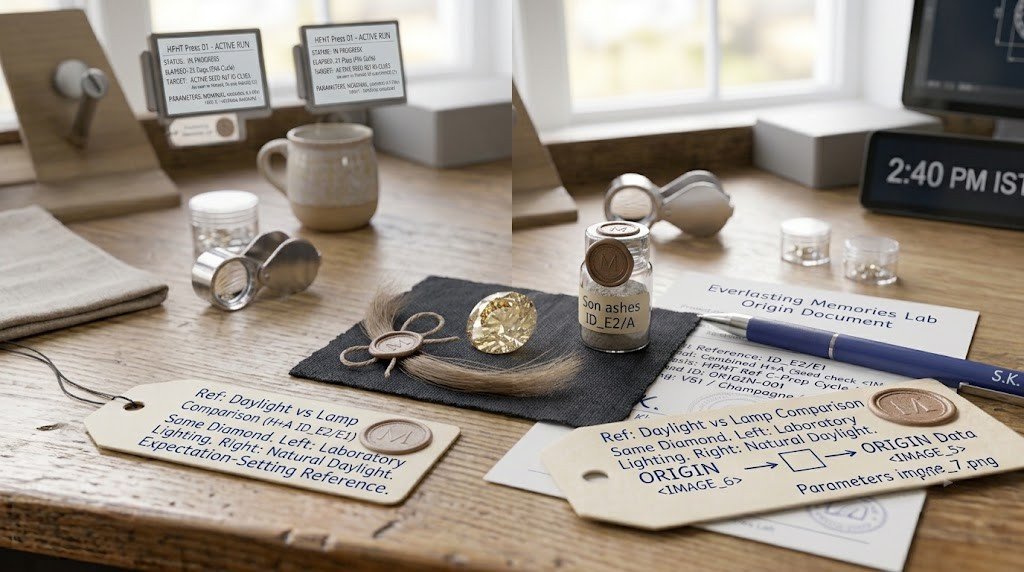
The same memorial diamond photographed under laboratory lighting and again in natural daylight for comparison

Something that looks different from the photographs, almost always. Laboratory lighting is unforgiving and flattening in equal measure, and a son ashes hair diamond color that looked one way on a screen frequently reads warmer or cooler in daylight at a kitchen window.

Setting changes it again. Yellow gold absorbs a faint warm tint into its surroundings, while platinum throws the same tint into relief. A blue stone usually looks strongest against white metal, and champagne tones settle beautifully into rose gold.

Give yourself permission not to have an instant reaction. Some parents love the stone the moment the box opens; others need weeks, and some find it only makes sense once it is worn rather than examined.

Neither response says anything about you. It is an unusual object to receive, and there is no correct way to feel about a son ashes hair diamond color the first time you see it.

Frequently Asked Questions

Does sending more hair than ash make the stone lighter?

No, and there is no published basis for the idea that the ratio steers the shade. Both materials become purified carbon before growth begins, and trace elements plus press conditions decide the son ashes hair diamond color. Ask any provider claiming otherwise to explain the mechanism.

Can I ask for the ash and the hair to be grown separately?

Some providers can grow more than one stone from a submission, which is a different question from blending. Ask directly whether separate runs are possible, what each would cost, and whether the paperwork documents which material went into which stone.

Will a blended stone look different from an ashes only one?

Not in any way a family could predict or a grader could attribute to the blend. Both routes produce shades clustered in the same yellow, blue and champagne families, and neither can be forecast before the growth run has finished.

Does the shade fade over the years?

No. The tint comes from elements built into the crystal structure while it formed, not from any coating or treatment applied to the surface. Normal wear, cleaning, sunlight and decades of handling leave it unchanged.

Is a warm toned stone lower quality than a white one?

No. A colorless result costs more because holding trace elements out demands more process control, not because a tinted diamond is inferior. Cut, clarity and carat are assessed separately from shade on any grading report.

What if I dislike the color when it arrives?

Tell the provider and ask what their policy permits, but allow yourself some time first. Many parents describe an initial reaction that changed once the stone had been set, worn and seen in ordinary daylight rather than under a lamp.

Final Thoughts on the Shade of a Blended Memorial Stone

Sending both his ashes and a lock of his hair is often about wanting to include everything that remains of him, and that instinct deserves better than a sales answer about shade.

The truthful version is that the combination will not give you more control over son ashes hair diamond color than either material alone would. What it gives you is a stone grown from two different traces of one person, one taken while he was alive, one after, and a shade that arrived out of that specific chemistry rather than out of a catalogue.

Ask for the intended son ashes hair diamond color in writing, ask what recourse exists if the run misses it, and then let the months pass. Whatever son ashes hair diamond color comes back, it came back from him.

Learn More About Son Memorial Diamonds

Talk With Memorial Diamond

If you are holding both his ashes and a lock of his hair and trying to work out what is realistic, that is a reasonable place to start from. Memorial Diamond can be reached at memorialdiamond.us for a straight account of what a blended submission can and cannot do. Nothing is committed by asking.

Word count: 3,009 words · Reading time: about 15 minutes
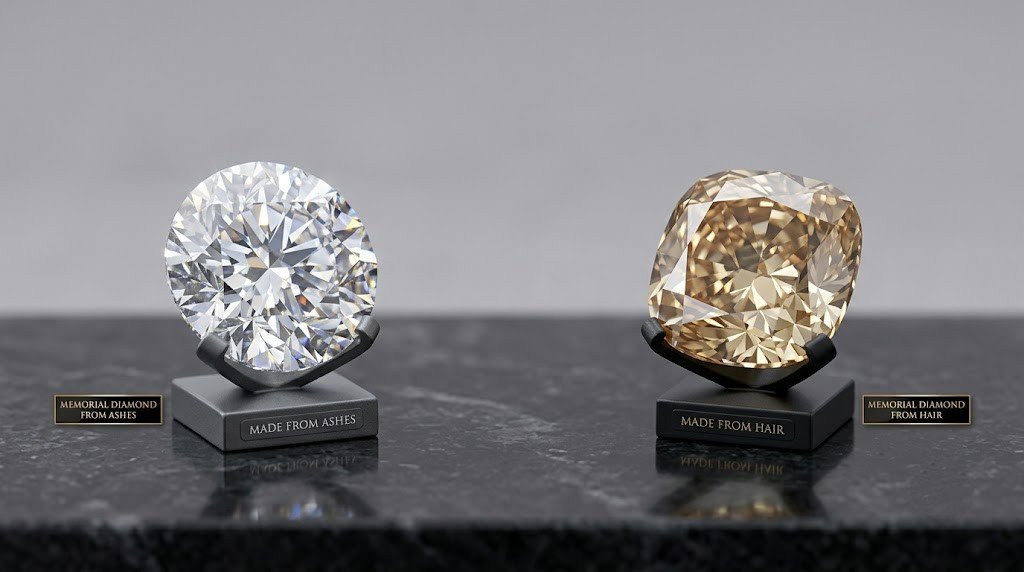
: Memorial diamond made from partner ashes and hair, featuring a diamond, cremated ashes, and a lock of hair.

How a Memorial Diamond Is Made From Your Partner’s Ashes and Hair

Some people end up with both because of how the year went, a lock kept early, a portion of remains later.

A memorial diamond made from partner ashes and hair is not one process. Each material is purified on its own track, ash to recover the 0.5% to 4% carbon it holds, hair to recover roughly half its weight in carbon, and each is graphitized separately at about 2,500 to 2,700°C. The two tracks meet only when both charges enter a single HPHT growth cell at roughly 6 to 8 GPa. Five stages in total.

That meeting point is the whole story of a memorial diamond made from partner ashes and hair. Everything that can be separately evidenced about the two materials happens before it, and nothing can be after.

Single champagne-toned memorial diamond made from partner ashes and hair, photographed beside two small sealed sample containers

Why Two Materials Means Two Separate Tracks

Ash and hair are not the same chemical problem, and nothing in the making of a diamond made from partner ashes and hair pretends they are.

Cremated remains are mostly calcium phosphate, which is bone mineral. The usable carbon inside that comes to roughly 0.5% to 4% of ash by weight, which means extraction is a long subtraction. Most of what you send is removed as mineral residue. Hair is keratin, roughly 50% carbon by weight, so extraction there is comparatively quick and far less lossy.

Two materials with yields that differ by more than an order of magnitude cannot be purified in the same vessel on the same settings. So a memorial diamond made from partner ashes and hair begins as two parallel operations that happen to be running for the same person, and for the same stone, at the same time.

That is not a complication to be apologized for. It is the reason a diamond made from partner ashes and hair can have its two materials separately weighed, separately logged, and separately accounted for right up to the moment they are combined. This provides more evidence, not less, than a single material stone can offer.

The Five Stages of a Memorial Diamond Made From Partner Ashes and Hair

1. Two intakes. The portion of ashes and the lock of hair arrive and are logged independently. This means separate weights, separate identifiers, and ideally separate dated photographs. Ask for two records rather than one combined receipt. This is where a diamond made from partner ashes and hair gains the documentation that makes it different from a single source stone.

2. Two purifications. Each material is heated in a controlled, oxygen free process that strips away everything that is not carbon, reaching roughly 99.9% or higher purity. The ash track loses the overwhelming majority of its submitted mass. The hair track loses roughly half. Two batches of purified carbon come out, still separate. At this stage a diamond made from partner ashes and hair still has two independently verifiable histories.

3. Two graphitizations. Each purified batch is heated to about 2,500 to 2,700°C and converted into graphite, the feedstock form a diamond press can use. There are now two graphite charges, still distinguishable because they are still in different containers, not because anything about them is chemically different.

4. One growth cell. Both charges, combined with supplemental lab grown carbon, are loaded into a single HPHT growth cell around a tiny diamond seed and held at roughly 6 to 8 GPa and 1,400 to 2,500°C for weeks to months. This is the convergence point, and it is the only one.

5. One stone, cut and graded. The rough crystal is cut and polished, then assessed against the same cut, color, clarity, and carat standards used for any diamond, ideally by an independent third party laboratory. One stone comes out. A diamond made from partner ashes and hair has no ash half and no hair half.

Where Do the Two Tracks Actually Converge?

For a diamond made from partner ashes and hair, convergence happens at stage four. Both graphite charges are weighed into the growth cell alongside the supplemental lab carbon, and the cell is sealed.

Up to that moment, everything is separable. Two weights at intake. Two purification runs with two batch records. Two graphite charges sitting in two containers with two identifiers. A memorial diamond made from partner ashes and hair has, at that point, a paper trail with two distinct branches, each traceable back to a different material and a different day.

The instant the cell is sealed and pressurized, those branches end. Carbon purified from ash and carbon purified from hair are the same element in the same form. Graphite is graphite, whatever it used to be part of. They do not layer, settle, or occupy separate regions of the crystal. They dissolve into the same molten metal flux and deposit onto the same seed, atom by atom, in no particular order.

StageAsh TrackHair TrackWhat Can Be Separately Evidenced
1. IntakePortion weighed, logged, identifiedLock weighed, logged, identifiedTwo weights, two dates, two identifiers
2. PurificationLong subtraction. Most mass removed as mineralShorter run. Roughly half the mass retainedTwo batch records, two yields
3. GraphitizationAsh derived carbon to graphite at 2,500 to 2,700°CHair derived carbon to graphite at 2,500 to 2,700°CTwo charges, two container records
4. Growth CellCharge loaded with lab carbonCharge loaded with lab carbonNothing after this point. The cell is sealed.
5. Cutting and GradingOne stoneOne stoneThe stone’s own 4Cs, and nothing about origin
two separate purification vessels processing ash-derived and hair-derived carbon on parallel runs


After Convergence, Can Anyone Tell the Two Apart?

No. This is the part of a diamond made from partner ashes and hair worth stating plainly, because a reader who suspects it and is never told clearly may assume the worst.

Once both charges are in the growth cell, no test performed on the finished diamond can identify which carbon came from the ashes, which came from the hair, and which came from the supplemental lab feedstock. A grading report will not show it. A gemologist with a loupe will not see it. There is no analysis of a diamond made from partner ashes and hair that separates the sources, because after purification there is nothing left to separate. There are only carbon atoms, chemically identical regardless of what they used to be part of.

That also means nobody can verify a stated proportion after the fact. If a stone is described as using both, the honest meaning of that statement is that both entered the process and both are recorded as having done so. It does not mean both are measurable in the finished crystal.

Two consequences follow for anyone considering a diamond made from partner ashes and hair, and they are the practical reason to read this before starting rather than after.

The first is that the value of the two track structure in a diamond made from partner ashes and hair is entirely upstream. Insist on the separate records while the tracks are still separate, because the window closes at stage four and does not reopen.

The second is that any provider claiming to demonstrate the split in a finished stone is claiming something that is not physically available. That is a useful test of how the rest of their answers should be read.

So What Can Be Documented About a Diamond Made From Partner Ashes and Hair?

Quite a lot, as long as you ask for it in the right window. What can be documented is every fact created before the cell was sealed.

  • Two intake records, each with its own date, weight, identifier, and ideally a photograph of the material as received.
  • Two purification batch records, tying each identifier to a specific run rather than to a general statement that material was processed.
  • Two graphitization records, confirming both charges existed as separate feedstock before loading.
  • A cell loading record naming both identifiers and the supplemental lab carbon added. This is the single most important document for a memorial diamond made from partner ashes and hair, because it is the last one that mentions two sources.
  • An origin or authenticity document that names both submissions explicitly, rather than referring vaguely to submitted material.
  • A grading report, which describes the stone’s quality and says nothing at all about origin. The two documents answer different questions and neither substitutes for the other.

Neither track yields the volume a growth run consumes, not separately and not added together. Both purified batches are made up with lab grown carbon before the cell is sealed, which means the personal carbon in a diamond made from partner ashes and hair is real, traceable to two named submissions, and still a minority of the crystal’s mass. Any description that implies otherwise is describing a stone that does not exist.

Does Using Both Materials Change the Stone Itself?

Not in a way anyone can see, and it is better to know that now.

Color. Trace elements drive color. Nitrogen can contribute toward yellow, boron can contribute toward blue, and colorless material requires the absence of both. Both ash and hair are organic sources that bring trace elements with them, so a memorial diamond made from partner ashes and hair sits in the same realistic range as a single material stone. Yellow, blue, or champagne are possible, while colorless material can require more process control and typically costs more. Nobody can forecast a precise shade from either material or from the combination.

Size. For a diamond made from partner ashes and hair, carat is bought as growth time, not as quantity of material. Submitting two materials instead of one does not produce a larger stone, and does not shorten the run.

Timeline. Industry wide, the whole sequence typically runs six to ten months, sometimes twelve for larger or specialty color stones. Two purification tracks can add a little at the front end if they are run sequentially rather than in parallel. The press is where almost all of the months live, and the press does not care how many sources fed it.

Quality. A diamond made from partner ashes and hair is graded on exactly the same 4Cs as any other stone. There is no separate scale, no allowance, and no penalty.

Can the Two Tracks Become Two Separate Stones Instead?

Two finished memorial diamonds of similar size displayed separately rather than set together

Yes, and this is the option most people do not realize they have until someone says it out loud.

If the two materials never enter the same growth cell, they never converge. This means they stay separately evidenced permanently. An ash grown stone and a hair grown stone, each with its own intake record, its own batch history, and its own origin document, preserve a distinction that a diamond made from partner ashes and hair gives up at stage four by design.

There are real trade offs, and they run in both directions.

  • Two stones cost more than one. Each needs its own growth run, and growth time is the dominant cost in every memorial diamond. Two half carat stones will not cost what one half carat stone costs.
  • Two stones take the same time, not twice as long, if the runs happen in parallel. Sequential runs would change that answer considerably.
  • Two stones can go to two people. This is often the deciding factor. One stone has to live somewhere. Two can be shared without anyone having to give anything up.
  • One stone concentrates everything. For many people that is precisely the point, and the loss of separability is a price they are glad to pay.
  • You can also do one of each and keep the rest. A memorial diamond typically uses only a portion of the available material, so choosing one route now rarely forecloses the other later.

The question to sit with is not which option is more meaningful. Both follow the same physics. The question is whether the distinction between the two materials is something you want to be able to point at in ten years. If it is, a diamond made from partner ashes and hair is the wrong shape for it, and two stones are the right one. If it is not, one stone is simpler and cheaper.

Why Families Choose Both Anyway

Knowing that the combination is invisible in the finished stone does not make a diamond made from partner ashes and hair pointless, and it is worth being clear about why.

The reason for a diamond made from partner ashes and hair is usually circumstantial rather than symbolic. A lock of hair was kept at some point, from a haircut before an illness, from a hospital stay, or from a drawer nobody had cleared. A portion of ashes became available later. Using both is less a decision than an acknowledgment that both exist and neither felt right to leave out.

Sometimes it is about standing. Who controls a person’s remains is settled state by state rather than by any nationwide statute, and a written direction left by your partner can shift it again on top of that. The standing does not attach to a partner as a matter of course, and it attaches least reliably where the relationship had no recognition in law or was not known to everyone. Hair may be the material you can act on without permission. Ashes may become available only later, or only partly. A diamond made from partner ashes and hair sometimes reflects that sequence rather than a plan.

And sometimes it is simply that the two materials represent different periods, one from when your partner was alive, one from after. That is a real reason. It does not need to be measurable in the crystal to be true.

What matters is that the reason is yours, and that the record describes what actually happened.

Frequently Asked Questions About a Memorial Diamond Made From Partner Ashes and Hair

Are the ashes and hair processed together?

No. In a diamond made from partner ashes and hair, each material is purified and graphitized on its own track, because their carbon yields differ by more than an order of magnitude. The two only meet when both graphite charges are loaded into a single growth cell.

Can a lab prove both materials were used?

Not from the finished stone. Proof exists only as records created before the growth cell was sealed. These include two intake logs, two batch records, and a cell loading document naming both identifiers. Ask for those specifically.

Can I choose the proportion of each material?

You can specify how much of each is submitted and have those weights recorded. What you cannot do is verify a proportion in the finished crystal, because purified carbon carries no marker of its origin.

Does using both materials make the diamond more genuinely my partner’s?

Not measurably. A diamond made from partner ashes and hair draws real personal carbon from both sources, and both are blended with lab grown carbon to reach a viable volume. What changes is the documentation, which traces two submissions instead of one.

Will it cost more than a single material stone?

A diamond made from partner ashes and hair can add process steps, and some providers price that separately. Size, color, and whether an independent grading report is included drive cost far more than the number of source materials.

What if one material turns out to be unusable?

Ask what happens before you send anything, whether the run proceeds on the remaining material, whether you are told first, and what is recorded. This is a question to settle in advance, not one to discover partway through.

Final Thoughts on a Memorial Diamond Made From Partner Ashes and Hair

The honest shape of a memorial diamond made from partner ashes and hair is two lines that run parallel for four fifths of their length and then become one line permanently. Almost everything you might want proven about the two materials is provable while those lines are apart, and none of it is provable afterward.

So the useful work happens early. Two records at intake, two batch records, and one loading record that names them both. Ask for those while asking still changes something. After the cell is sealed, the only honest answer anyone can give you about which carbon came from where is that the paperwork says so, which is a good answer, provided the paperwork exists.

Learn More About Partner Memorial Diamonds

Talk With Memorial Diamond

If you have both materials and want to understand how each would be handled, reach out to Memorial Diamond and ask what gets recorded at each intake and what the cell loading document will say. Those are the questions worth asking while the two tracks are still separate.

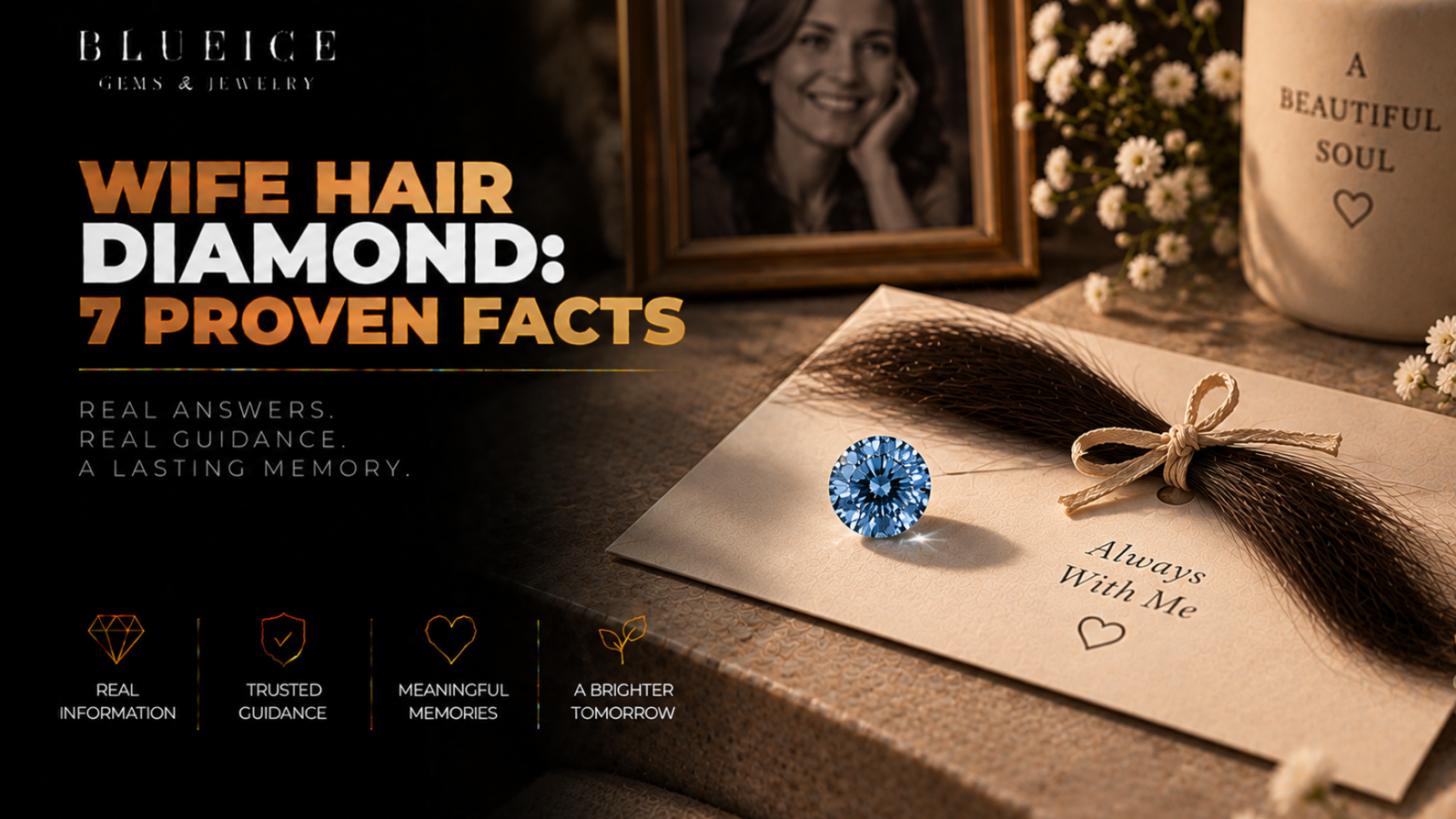
Wife hair diamond: a small blue lab-grown memorial diamond beside a tied lock of dark hair on cream paper

Wife Hair Diamond: The Complete Guide

You may have found it without looking for it, a hairbrush in the bathroom drawer, a lock kept from a chemo cut, the braid from a wedding photo, strands on a pillowcase you never washed. A wife hair diamond is a real, lab grown diamond grown from carbon extracted from a small lock of your wife’s hair, no cremation required, no ashes involved, and because hair is roughly 50% carbon by weight, a few grams is typically enough.

It works whether she was buried or cremated, whether the hair is decades old, and whether it was cut deliberately or gathered from a brush. This guide covers the seven facts that matter: why hair works so well, how much you need, what condition the hair has to be in, the process, the colors, cost and timeline, and what to ask before you send anything that cannot be replaced.

Why Hair Is a Better Carbon Source Than Most People Expect

Most people assume a memorial diamond means ashes. For a wife hair diamond, hair is often the better material, for a reason that comes down to chemistry.

Hair is built from keratin, a carbon rich protein, and is roughly 50% carbon by weight. Cremated remains, by contrast, are almost entirely calcium phosphate, the mineral structure of bone, with usable carbon making up only about 0.5% to 4% of ash by weight. A gram of hair carries something on the order of ten to a hundred times the carbon of a gram of ash.

That difference is why a wife hair diamond needs so little starting material, and why it opens up situations an ashes based stone cannot reach:

  • She was buried, not cremated. Hair is the only route to a memorial diamond for a family that chose burial.
  • Her ashes were scattered or interred in full. If nothing was kept, but a lock of hair was, the diamond is still possible.
  • Her family objected to cremation on religious grounds. Because a wife hair diamond involves no cremation, it sits entirely outside a cremation specific objection, a point worth making plainly to Muslim, Orthodox Jewish, and other families whose concern is with cremation itself.
  • The hair was kept for another reason. Locks saved from a first haircut, from a wedding, from a hospital stay, or simply in a brush that was never emptied.

The wife hair diamond that results is a genuine diamond by every test: the same crystal structure, the same optics, the same hardness, 10 on the Mohs scale, and the same cut, color, clarity, and carat grading as any other.

How Much of Her Hair Does a Wife Hair Diamond Need?

Less than you have. Requirements for a wife hair diamond vary by provider, but across the industry a wife hair diamond typically needs a small lock or a few grams, often described as “palm sized,” “a few wisps,” or “about the thickness of a pencil.” That is the amount most families already hold without knowing it.

What you haveTypically enough?Notes
A cut lock, tied or in an envelopeYes, almost alwaysThe ideal case, clean, intact, easy to log
Hair from a brush or combUsuallyLoose strands work; the provider may ask for more volume to allow for cleaning
A braid or ponytail from a donation or a haircutYes, with plenty to spareEnough for several stones
Strands from a pillowcase or hatSometimesAsk; small amounts may be usable if pooled
A single strandNoBelow the practical minimum for every provider
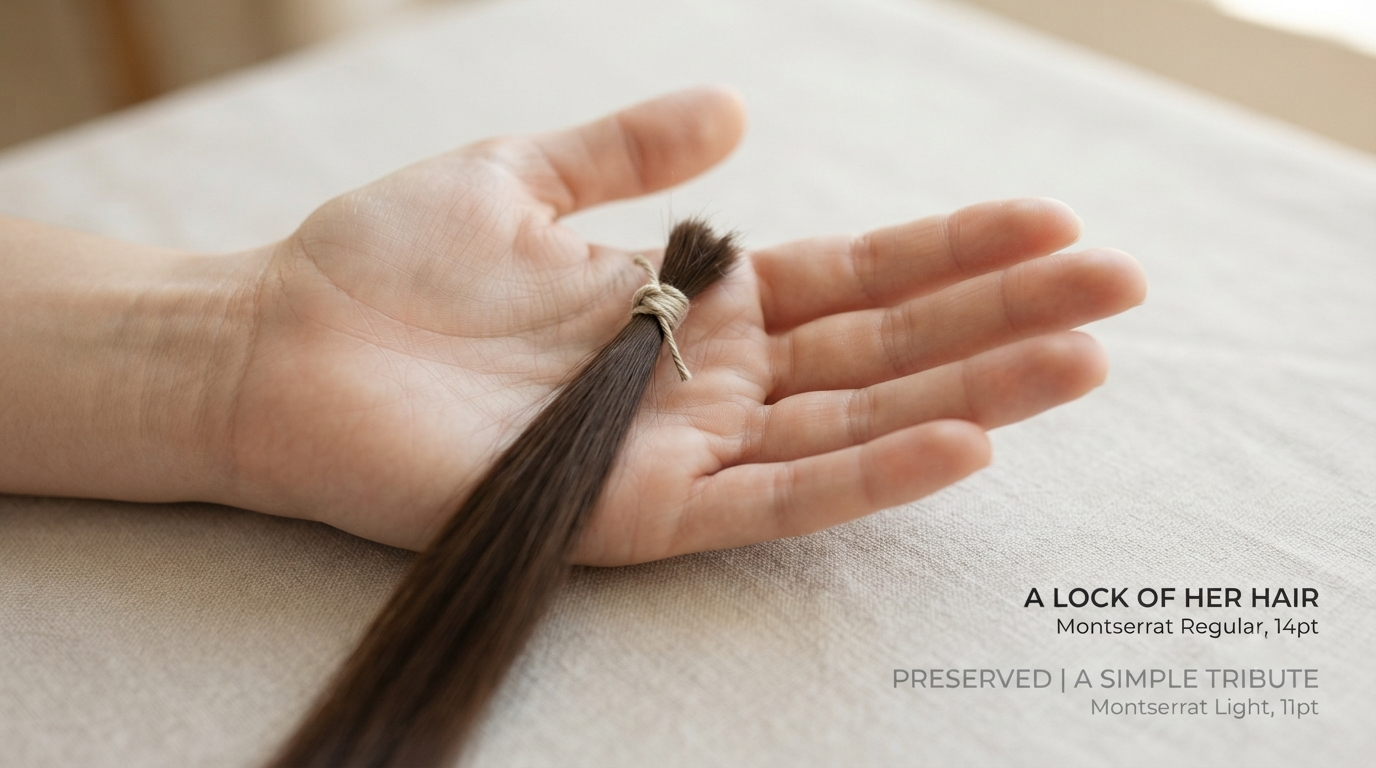
A pencil-thick lock of hair tied with thread resting in an open palm

Two facts follow from how little a wife hair diamond needs. First, sending more hair does not produce a bigger diamond, carat is set by growth time in the press, not by material volume, so there is no reason to send all of it. Keep some. Second, more than one stone is often possible from one lock, so if a daughter or her sister would want their own, a single submission can usually cover it. How much hair is needed for a wife memorial diamond covers the quantities and the edge cases in detail.

Does Old, Dyed, or Brush Gathered Hair Work?

These are the three questions about a wife hair diamond that stop people from asking at all, so here are the direct answers.

Old hair works for a wife hair diamond. Keratin is chemically stable. Hair kept dry in an envelope or a locket for twenty, forty, or sixty years still contains its carbon. Provided it has not rotted, which requires prolonged damp, and is visible and obvious if it has, age is not a barrier. A lock from her childhood is as usable as one cut last year.

Dyed or chemically treated hair works. Dye, bleach, perms, and keratin treatments change the surface and the color of hair; they do not remove the carbon in its structure. The extraction process strips everything that is not carbon, including dye. The finished diamond’s color has nothing to do with the hair’s color, a wife hair diamond from red hair is not red, and one from gray hair is not gray.

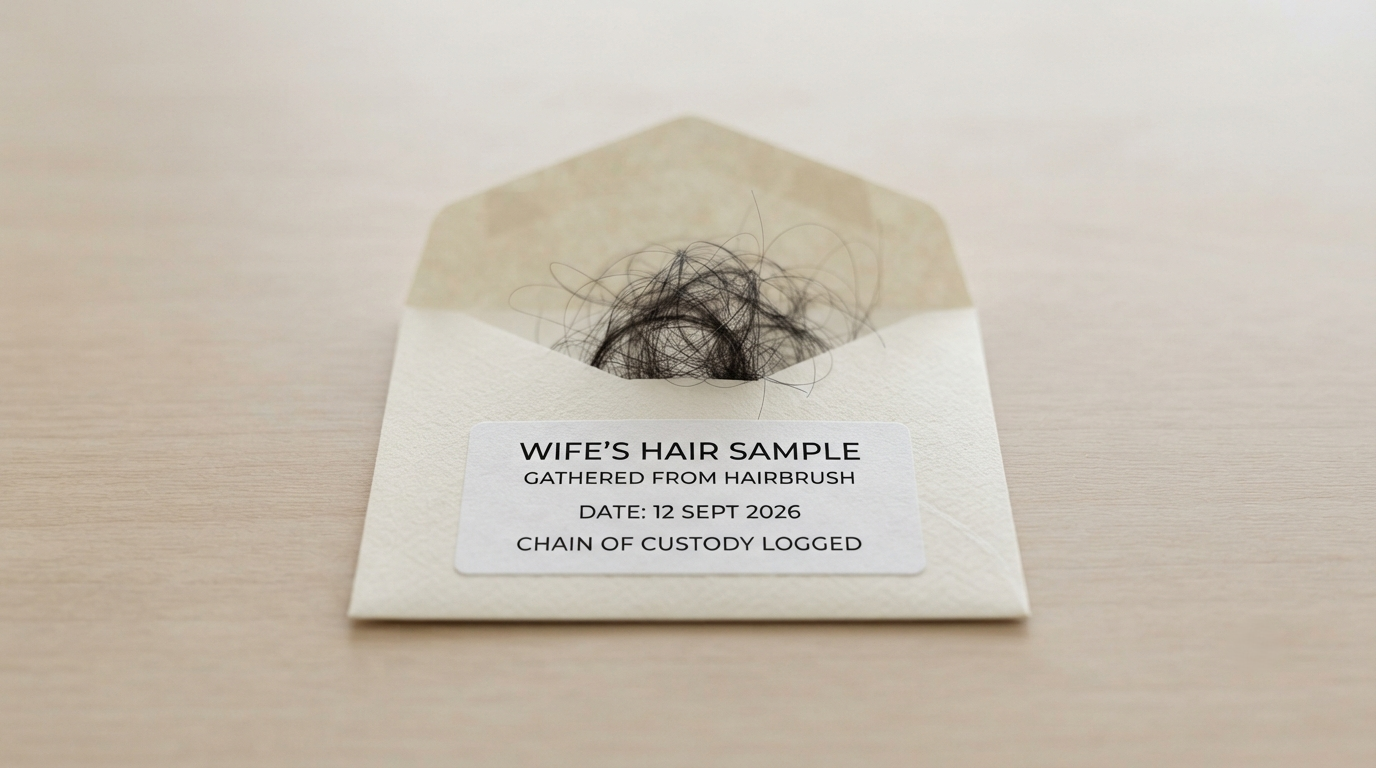
Loose strands gathered from a hairbrush placed in a labeled paper envelope

Brush gathered hair works, with a caveat. Strands from a brush are usually usable, but a provider may ask for more volume than a cut lock, because loose hair is cleaned before extraction and some is lost. If a brush is all you have, do not empty it into the trash while deciding.

What does not work for a wife hair diamond: hair that has visibly decomposed, a single strand, or synthetic extensions, which contain no keratin. If you are unsure what you hold, ask the provider before sending, most will tell you from a photograph whether it is enough.

How a Wife Hair Diamond Is Made

The wife hair diamond process mirrors the one used for ashes based stones, but the first two stages are simpler because there is no mineral matrix to remove.

  1. Collection. The hair is received and logged with a chain of custody record, a traceable trail from arrival to finished stone. A reputable provider can tell you where her hair is at any stage.
  2. Carbon extraction and purification. The hair is heated in a controlled, oxygen free, multi stage process that strips away the non carbon components of keratin, leaving carbon at 99.9%+ purity. Because hair starts at roughly 50% carbon, this stage yields far more usable material per gram than ash does.
  3. Graphitization. The purified carbon is heated further, to roughly 2,500 to 2,700°C, and converted to graphite, the crystalline form of carbon that diamond presses use as feedstock.
  4. Diamond growth. The graphite, blended with supplemental lab carbon to reach adequate volume, is placed in an HPHT press with a tiny diamond seed at roughly 6 to 8 GPa and 1,400 to 2,500°C, or converted to gas for CVD growth with some providers. This stage takes weeks to months and is what determines carat. The mechanics of both methods are on the synthetic diamond page.
  5. Cutting and polishing. A gemologist cuts the rough crystal into the chosen shape.
  6. Optional irradiation. Some providers shift or intensify color post growth.
  7. Grading and certification. The stone is graded, ideally by an independent lab, and issued an origin certificate documenting that it was grown from her submitted hair.
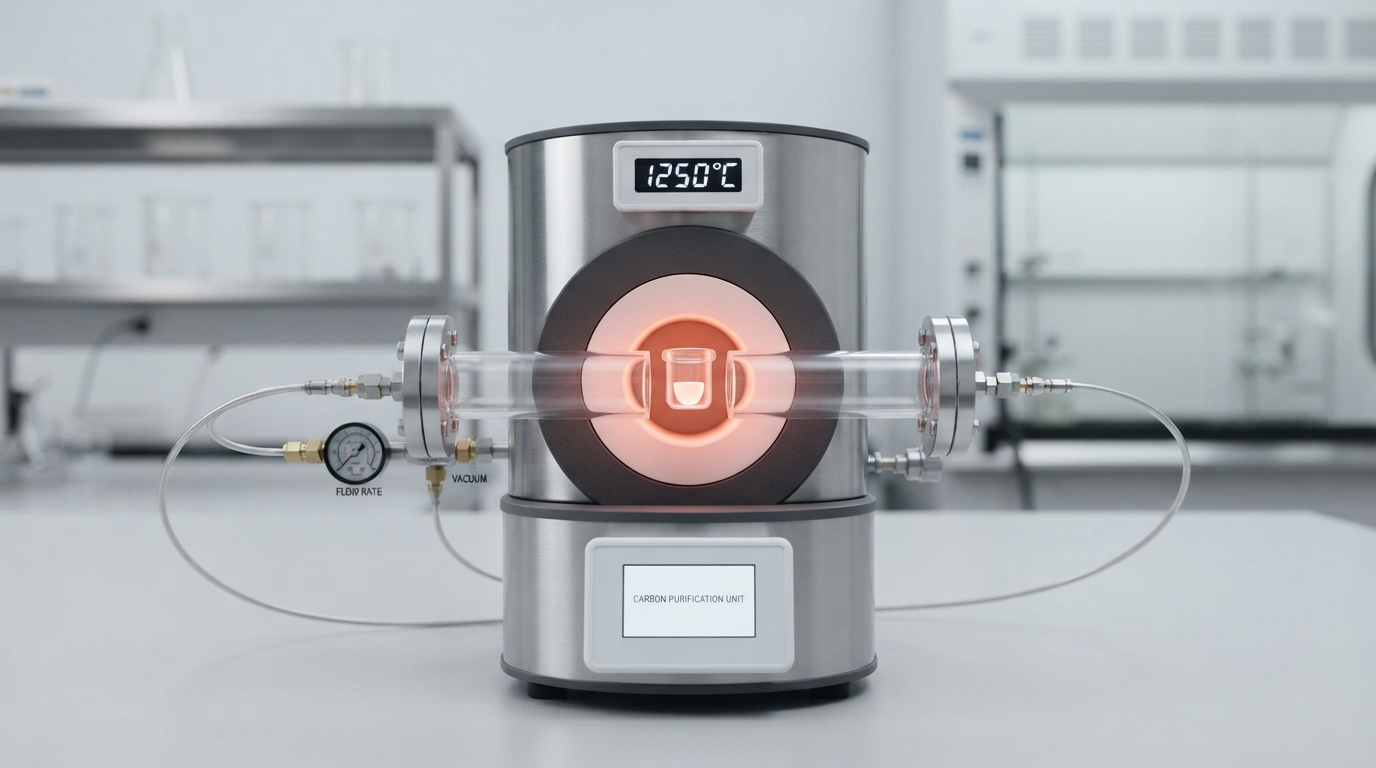
Laboratory furnace with a sealed crucible during carbon purification

The honesty point that applies to every memorial diamond applies here too: the personal carbon from her hair is blended with lab carbon to reach a workable size, so the finished stone is not “100% her.” It is a real diamond in which a genuine, verifiable portion of the carbon that was in her body now sits in the crystal lattice. Because hair yields so much more carbon than ash, some providers can reach a higher personal carbon proportion from hair at small carats, ask what your provider achieves rather than assuming. How a memorial diamond is made from your wife’s hair goes stage by stage, and whether it is really made from her hair takes the doubt seriously.

What Color Will It Be?

Not the color of her hair, and probably not colorless.

Diamond color is set by trace elements present during growth, nitrogen produces yellow, boron produces blue, and colorless requires the absence of both. Carbon from an organic, personal source carries trace elements with it, which is why a wife hair diamond naturally trends toward yellow, champagne, or blue rather than white. Colorless is achievable with additional processing and typically costs more at the same carat. Red, pink, green, and black are available from some providers through post growth irradiation.

Two wife hair diamond stones grown from the same lock can differ slightly. That variation is a feature of the source, not a defect. If you have a metal in mind for the setting, yellow gold flatters yellow and champagne, white metals flatter blue, the stone’s natural tendency is worth knowing before you choose. What color a diamond made from your wife’s hair will be covers the options and the vocabulary a grading report will use.

Carat, Cost, and Timeline

A wife hair diamond is priced and timed like any memorial diamond: by carat, color, cut, and whether an independent grading report is included. The ranges below are general industry figures for 2026, not Memorial Diamond’s published prices.

TierApproximate caratTypical industry rangeTypical timeline
Entry0.10 to 0.25 ctRoughly $1,500 to $3,5006 to 8 months
Mid0.5 to 1 ctRoughly $5,000 to $15,0008 to 10 months
Large / rare2 to 5+ ctRoughly $20,000 to $75,000+Up to 12 months
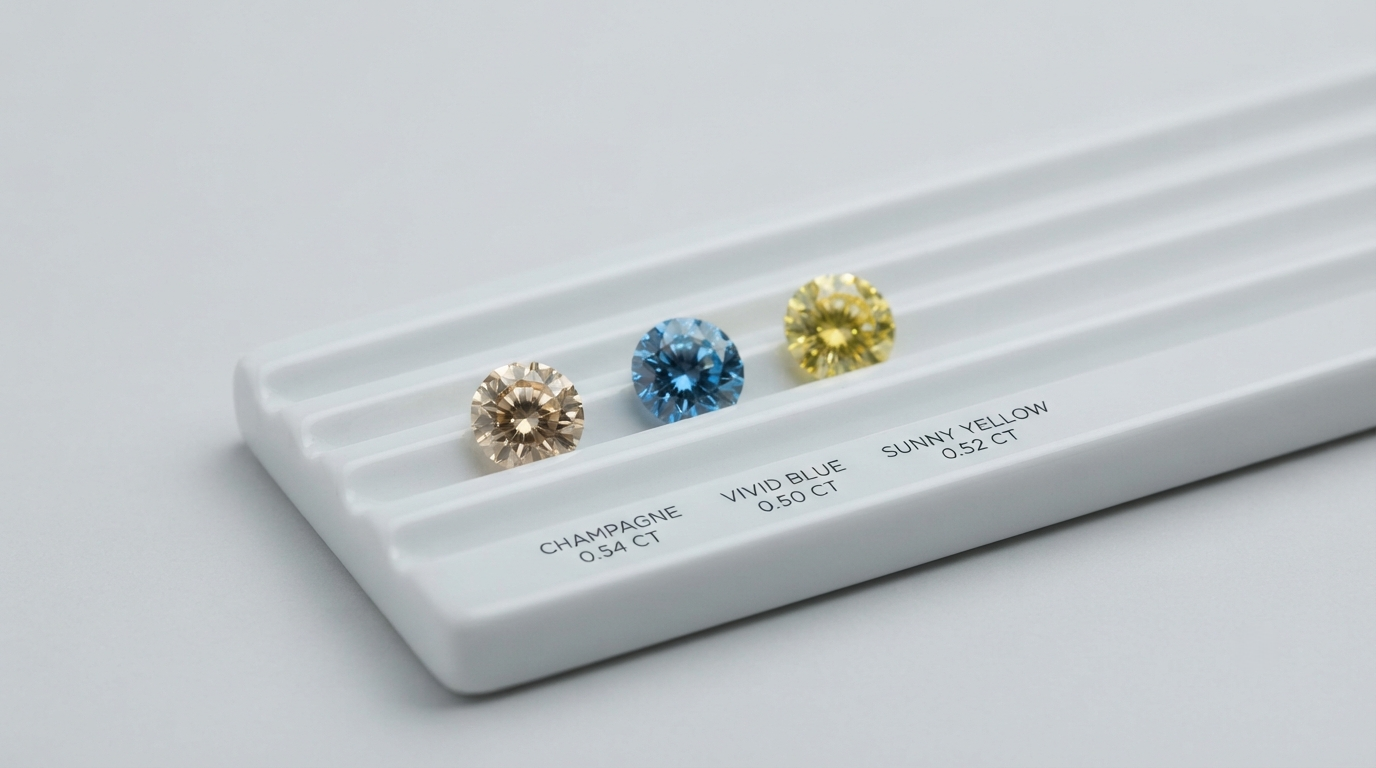
memorial-diamond-champagne-blue-yellow-loose

A colorless wife hair diamond costs meaningfully more than yellow, blue, or champagne at the same size. Settings, engraving, fancy cuts, and independent grading are usually priced separately from the loose stone.

Hair does not make the process faster. The timeline is set by growth time in the press, which is set by carat, so a wife hair diamond takes the same 6 to 10 months as an ashes based stone, with larger sizes or black stones sometimes running to 12. If there is a date in mind, count back and add margin. How much a wife memorial diamond costs and how long it takes go deeper on both.

What to Ask Before Sending Hair You Cannot Replace

Ashes can sometimes be topped up from the urn. A single lock of hair, once sent, is gone. That makes the pre send questions more important for a wife hair diamond than for almost any other memorial stone.

  1. Is what I have enough? Send a photograph and ask before shipping. Do not guess.
  2. Do you return unused hair? Some providers do; ask, and ask how much they expect to use.
  3. What is your chain of custody record, and can I see where her hair is during the process?
  4. What personal carbon proportion do you typically reach from hair at this carat? A confident provider will give a range rather than a promise.
  5. Is the grading independent or in house? An origin certificate documents that the stone came from her hair; a grading report, ideally from an independent lab using GIA’s cut, color, clarity, and carat standards, documents quality. You want both.
  6. What is the realistic timeline for the carat I want, in writing?
  7. What is the full price, loose stone and setting separately?

And one question for yourself before any of the above: have you kept some? If the lock is the only one, divide it before sending. A provider needs a few grams; you do not need to send the whole braid. Questions to ask before turning your wife’s hair into a diamond expands each of these into what a good answer sounds like.

Frequently Asked Questions

Can a wife hair diamond be made if she was buried rather than cremated?

Yes. Hair contains its own carbon, roughly 50% by weight, so no cremation is involved at any stage. A wife hair diamond is the route to a memorial diamond for families who chose burial, or whose ashes were scattered or interred in full but who kept a lock of hair.

How much hair is needed?

Typically a small lock or a few grams, often described as palm sized or pencil thick, though requirements vary by provider. Sending more does not produce a larger diamond, because carat is set by growth time, not material volume. Keep part of the lock; do not send all of it.

Does hair from a brush work?

Usually. Loose strands from a brush or comb are typically usable, though a provider may ask for more volume than a cut lock because loose hair is cleaned before extraction and some is lost. Send a photograph and ask before shipping, and do not empty the brush while you decide.

Does it matter if her hair was dyed or gray?

No. Dye, bleach, and chemical treatments change hair’s surface, not the carbon in its structure, and extraction strips everything that is not carbon. The diamond’s color is set by trace elements during growth, not by the hair’s color, gray hair does not make a gray diamond.

Is a wife hair diamond really made from her hair?

Yes, in part. Carbon is extracted from her hair, purified to 99.9%+, and grown into the diamond’s crystal lattice alongside supplemental lab carbon added to reach a workable size. No memorial diamond is 100% personal carbon. A reputable provider documents the origin with a chain of custody record and a certificate.

How long does a wife hair diamond take?

Typically 6 to 10 months from receipt to finished stone, the same as an ashes based diamond, because the timeline is set by growth time in the press rather than by the material. Larger stones and some specialty colors, black in particular, can take up to 12 months.

Can more than one diamond be made from one lock?

Often, yes. Because so little hair is needed per stone, a single lock or braid can usually yield several diamonds. Each is grown and priced separately, and stones from the same hair can differ slightly in color. Ask the provider how many stones your amount could support before dividing it.

Final Thoughts on a Wife Hair Diamond

The lock in the drawer is not a small thing. It is, gram for gram, a richer carbon source than ashes, it needs no cremation, it does not care how old it is or what color she dyed it, and it is very likely enough for more than one stone. A wife hair diamond is not the right choice for every family, but it is available to more families than realize it, including the ones who thought the moment had passed with the burial. If you have the hair, you have the option. What you do with it can wait until you are ready.

Learn More About Wife Memorial Diamonds

Talk With Memorial Diamond

If you are holding a lock of her hair and want to know whether it is enough, whether its age or condition matters, or how many stones it could support, reach out to Memorial Diamond before sending anything. A photograph is usually enough to answer the first question, and nothing has to be shipped until you are sure.