
His body spent years building each strand, and the laboratory spends weeks taking that work apart. A memorial diamond made from your husband’s hair starts with a small lock, a few grams, which is purified to carbon, converted to graphite, blended with laboratory carbon, and grown into a real diamond over roughly six to ten months. Almost every stage of that process reverses something his biology did to make the fiber, in the opposite order it was made. Exactly one stage is not a reversal. That is where the diamond comes from.
Table of Contents
What His Body Built, and What the Lab Undoes
Your husband’s hair is keratin, a protein his follicles assembled from amino acids, cross linked with sulfur bonds, wrapped in a protective cuticle, and coated with oils. Roughly half of its weight is carbon. To reach that carbon, the laboratory strips away each of those layers, last added first.
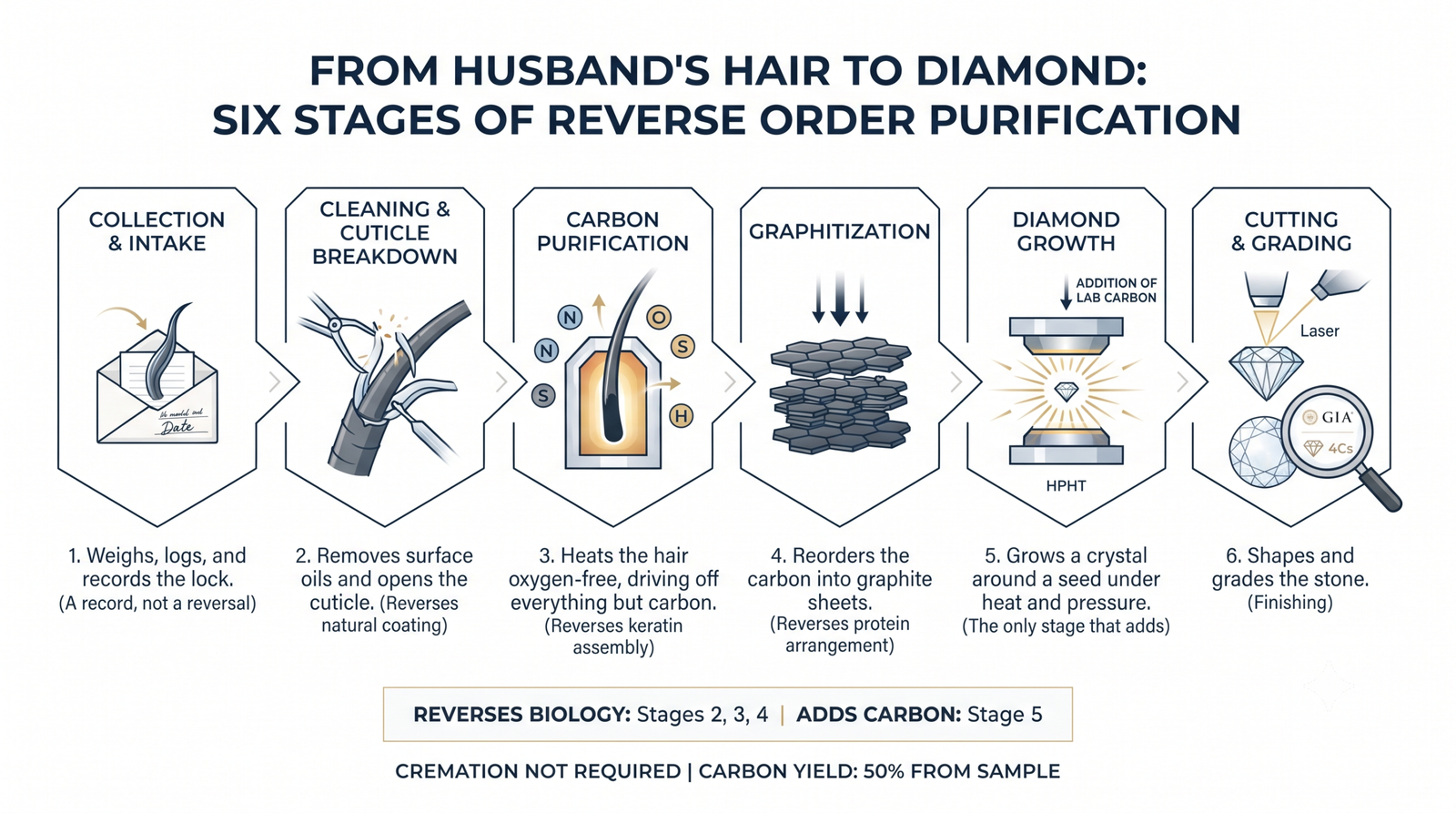
| # | Stage | What his body did | What the lab does | Reversal? |
|---|---|---|---|---|
| 1 | Collection and intake | Grew your husband’s hair over months | Weighs, logs, and records the lock | No; a record, not a reversal |
| 2 | Cleaning and cuticle breakdown | Coated the fiber in oils and a scale like cuticle | Removes surface oils and opens the cuticle | Yes |
| 3 | Carbon purification | Assembled keratin from carbon, nitrogen, oxygen, sulfur, hydrogen | Heats the hair oxygen free, driving off everything but carbon | Yes |
| 4 | Graphitization | Arranged carbon inside a protein | Reorders the carbon into graphite sheets | Yes |
| 5 | Diamond growth | Nothing; his body never made diamond | Grows a crystal around a seed under heat and pressure | No; this is the one addition |
| 6 | Cutting and grading | Nothing | Shapes and grades the stone | No; finishing |
Stage 1: The Lock Leaves Your Hands
Your husband’s hair is not a regulated shipment the way cremated remains are, so the safeguards are the ones you build. Label the envelope with his name, the date collected, and the source. Photograph it. Ask the provider what they record at intake, whether a photograph, a weight, or both, and ask them to confirm receipt with the weight they logged. The collection method itself is in how to turn your husband’s hair into a diamond. If the lock is small, ask before sending whether they will assess a photograph and a weight first, so you are not committing the only hair you have to an order that cannot proceed.
Stage 2: Removing What Keratin Added Last
The outermost layer of your husband’s hair is the last thing his body finished: the cuticle, a scale like sheath, and the oils that coated it. The laboratory removes those first, cleaning surface contamination and opening the cuticle so the process can reach the fiber’s core. This is a small stage, but it is the first of the reversals, and it is why hair from a hat or a coat collar, with lint and dust attached, is still usable: contamination sits on the outside, and the outside is what goes first.
Stage 3: Purification to Carbon
The keratin in your husband’s hair is made of carbon, nitrogen, oxygen, sulfur, and hydrogen, bonded together. In a controlled, oxygen free, multi stage heating process, the laboratory drives off every element except carbon, leaving it at roughly 99.9% purity. Everything his follicles assembled around the carbon, the sulfur cross links that gave his hair its texture, the nitrogen in the amino acids, is removed.
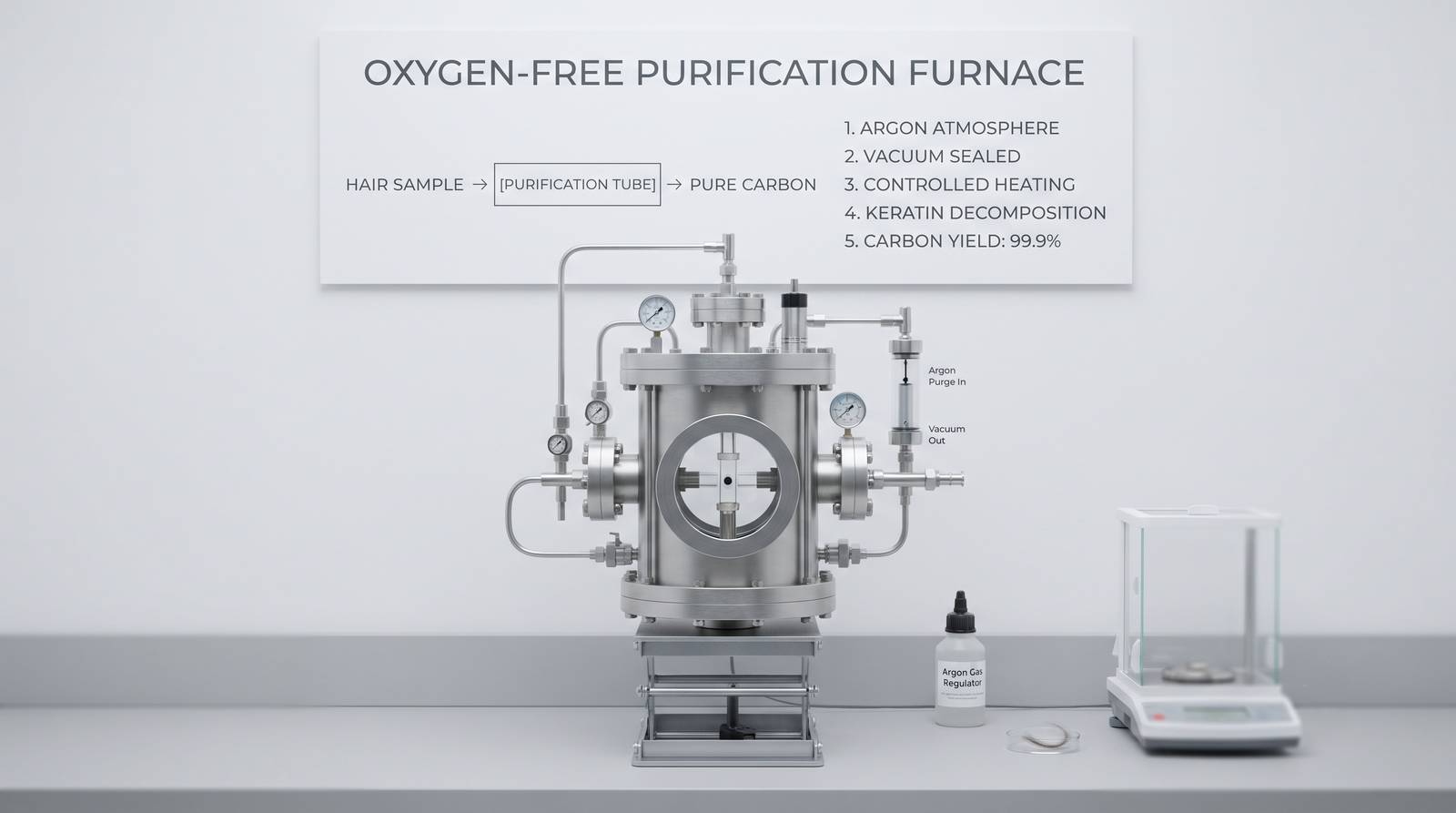
Because your husband’s hair is roughly 50% carbon, this stage yields a great deal from a very small lock. Cremated remains, by comparison, are roughly 0.5% to 4% carbon. That difference is why a hair based stone needs grams rather than ounces, and why it is available to families who chose burial. Ask what happens to any hair not consumed by extraction; some providers return it, and if you sent the only lock you had, that matters.
Stage 4: Graphitization
The carbon purified from your husband’s hair is heated further, to roughly 2,500 to 2,700°C, and its atoms reorganize into graphite, the layered crystalline form that diamond presses use as feedstock. His body arranged those same carbon atoms inside a protein; the lab now arranges them into sheets. After this stage the material is graphite, physically indistinguishable from any other graphite except by the record that says whose it is.
That record, from your envelope label to the intake weight to this stage, is what the origin document will eventually certify, and it is the answer to the question in is a memorial diamond really made from your husband’s hair. The ashes equivalent of this map is in how a memorial diamond is made from your husband’s ashes.
Stage 5: Growth, the One Step That Adds
This is the only stage that does something his body never did. The graphite is blended with additional laboratory carbon, placed with a tiny diamond seed in a growth cell, and grown by HPHT or CVD diamond growth. Most memorial providers use HPHT, a press recreating roughly 6 to 8 GPa and 1,400 to 2,500°C; a minority convert the carbon to gas for CVD. Growth takes weeks to months, and growth time, not the size of the lock, sets the carat.
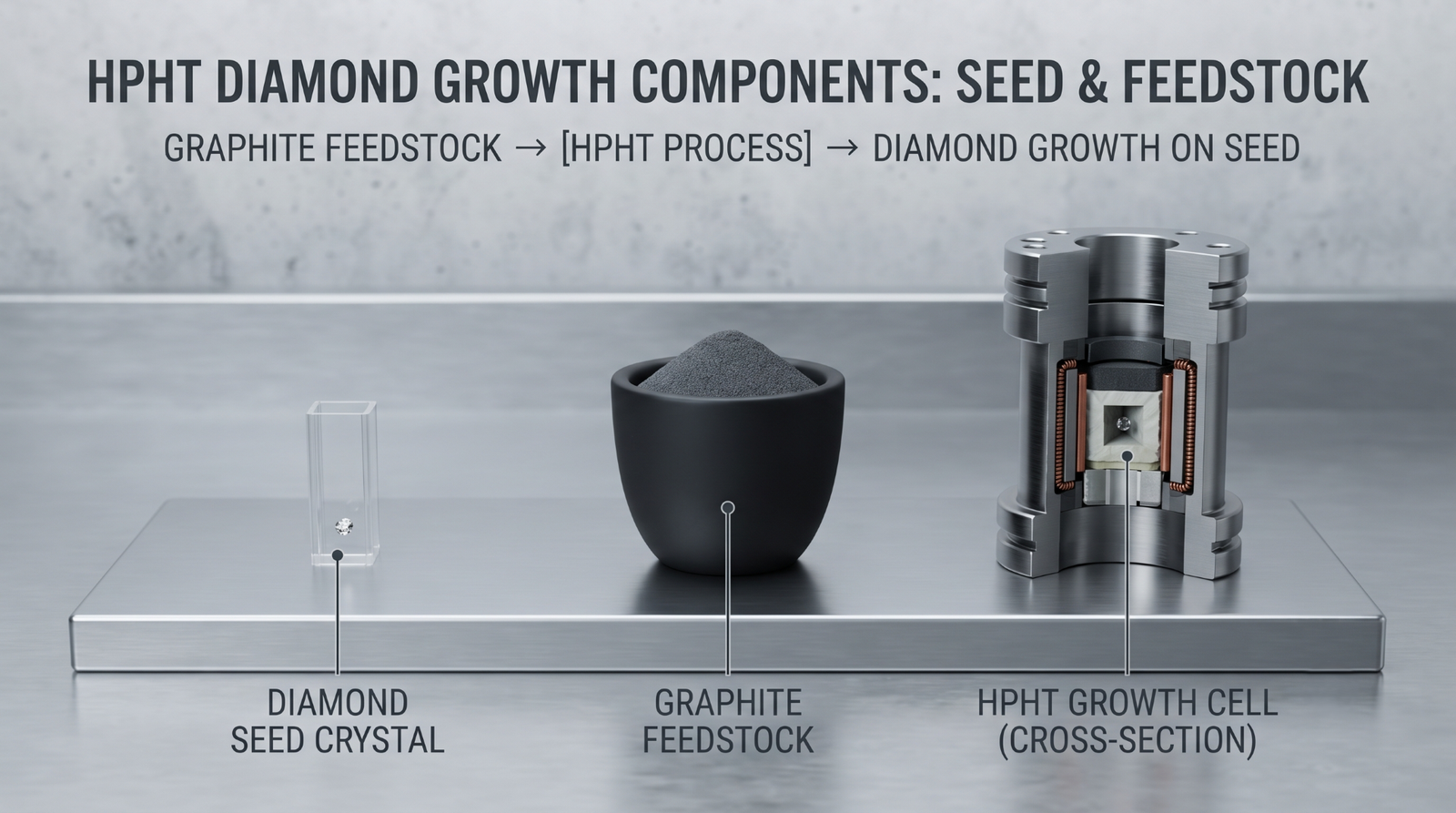
The honest proportion belongs here too. Personal carbon typically makes up around 10 to 15% of a finished memorial diamond; the rest is laboratory carbon needed to grow a crystal of usable size. With hair, the limit on the personal share is the stone’s size, not your sample. The finished crystal is diamond in every physical sense, scoring 10 on the Mohs scale as the hardest known natural mineral.
Stage 6: Cutting, Grading, and the Record
A gemologist cuts and polishes the rough crystal grown from your husband’s hair into the shape you chose. Reputable providers then send it to an independent laboratory for grading on cut, color, clarity, and carat. Two documents should return with the stone: a grading report describing the diamond’s quality, and an origin document tracing it back through every stage to the lock you sent. Color will not match his hair; it is set by trace elements during growth, with most memorial stones landing in yellow, champagne, or blue. The options are in what color diamond can be made from your husband’s hair.
Why Your Husband’s Hair Needs So Little Material
- A palm sized lock, a few grams, is the industry typical minimum, against a few tablespoons to four ounces of ashes.
- Your husband’s hair keeps indefinitely once dry, so a lock from decades ago works as well as one cut last month.
- One generous lock can sometimes support more than one stone; a few strands usually support one. Ask before assuming either.
- Because hair yields carbon so efficiently, it can be combined with a small ash portion when a family holds both; that route is described in how a memorial diamond is made from your husband’s ashes and hair.
Quantity on its own is covered in how much hair you need for a husband memorial diamond.
Frequently Asked Questions
How much of my husband’s hair is needed?
Industry typical minimums are a small lock, a few grams, often described as palm sized. Because hair is roughly 50% carbon, far less is needed than for ashes. If you have only strands, ask the provider to assess a photograph and a weight before you commit the sample.
Does his hair need to be cremated first?
No. A memorial diamond from your husband’s hair involves no cremation at any stage. Carbon is extracted directly from the keratin in the strand, which is why this option is available to families who chose burial or who scattered his ashes.
Does the diamond contain his DNA?
No. Purification removes every element except carbon, and DNA is a large molecule made of several elements. What remains is his carbon, physically grown into the crystal, traced by the origin document rather than by any biological marker.
How much of the diamond is actually him?
Typically around 10 to 15% of the finished stone’s mass is carbon from his hair; the remainder is laboratory carbon needed to reach a growable volume. With hair, that share is limited by the stone’s size, not by how small your lock was.
Will the diamond be the color of his hair?
No. Color is set by trace elements such as nitrogen or boron during growth, not by the pigment of your husband’s hair, and gray hair yields the same carbon as dark hair. Most memorial diamonds land in yellow, champagne, or blue; colorless is possible with extra processing at higher cost.
Can a failed growth run be attempted again?
Sometimes, if purified carbon from your husband’s hair remains after the first attempt. Whether a provider re runs from remaining carbon, what it costs, and who bears that cost varies. Ask before ordering, especially if you sent the only lock you had.
Final Thoughts on How a Memorial Diamond Is Made From Your Husband’s Hair
Five of these six stages take apart your husband’s hair, what he grew without noticing, one layer at a time and in reverse. The sixth builds something he never had. If that ordering means something to you, it is worth choosing a provider who can show you the record of each stage, from the envelope you labelled to the document that comes back with the stone.
Learn More About Husband Memorial Diamonds
- How a Memorial Diamond Is Made From Your Husband’s Ashes
- How a Memorial Diamond Is Made From Your Husband’s Ashes and Hair
- Is a Memorial Diamond Really Made From Your Husband’s Hair?
- How to Turn Your Husband’s Hair Into a Diamond
- How Much Hair Do You Need for a Husband Memorial Diamond?
Talk With Memorial Diamond
If you are holding a lock of your husband’s hair and want to understand what each stage would record before you send it, reach out to Memorial Diamond to talk through what’s possible.