
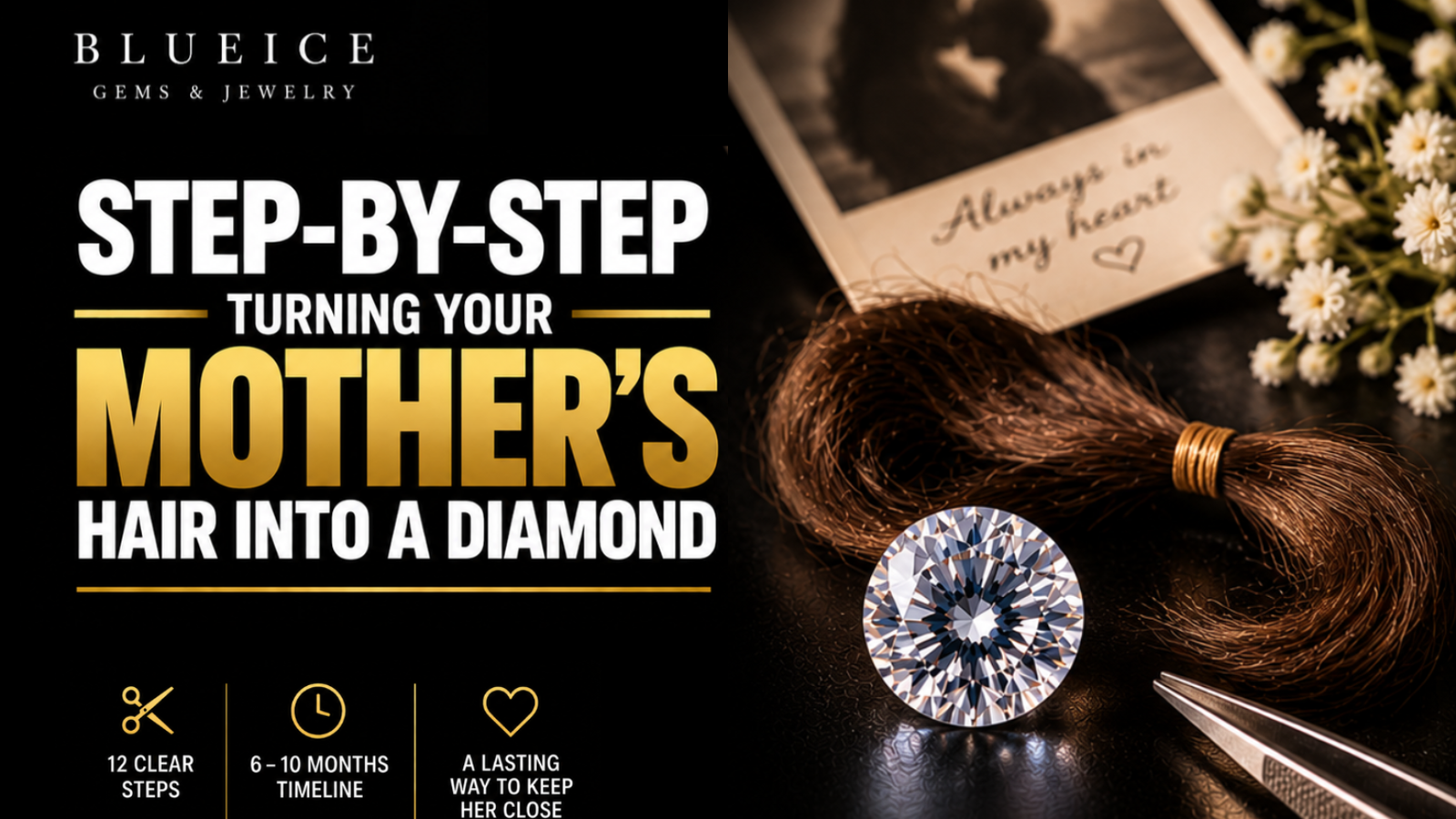
Here is the whole process as one numbered sequence: twelve steps from finding the lock to setting the finished stone, five of them yours and seven the lab’s, with the handover at step five. Industry-wide the lab half runs 6 to 10 months from the day your mother’s hair is received. No cremation is involved at any point, which is why this route stays open to families who buried their mother and to daughters whose mother is still alive.
Print it, work down it. For the reasoning rather than the order of operations, how to turn your mother’s hair into a diamond covers the same ground as prose.
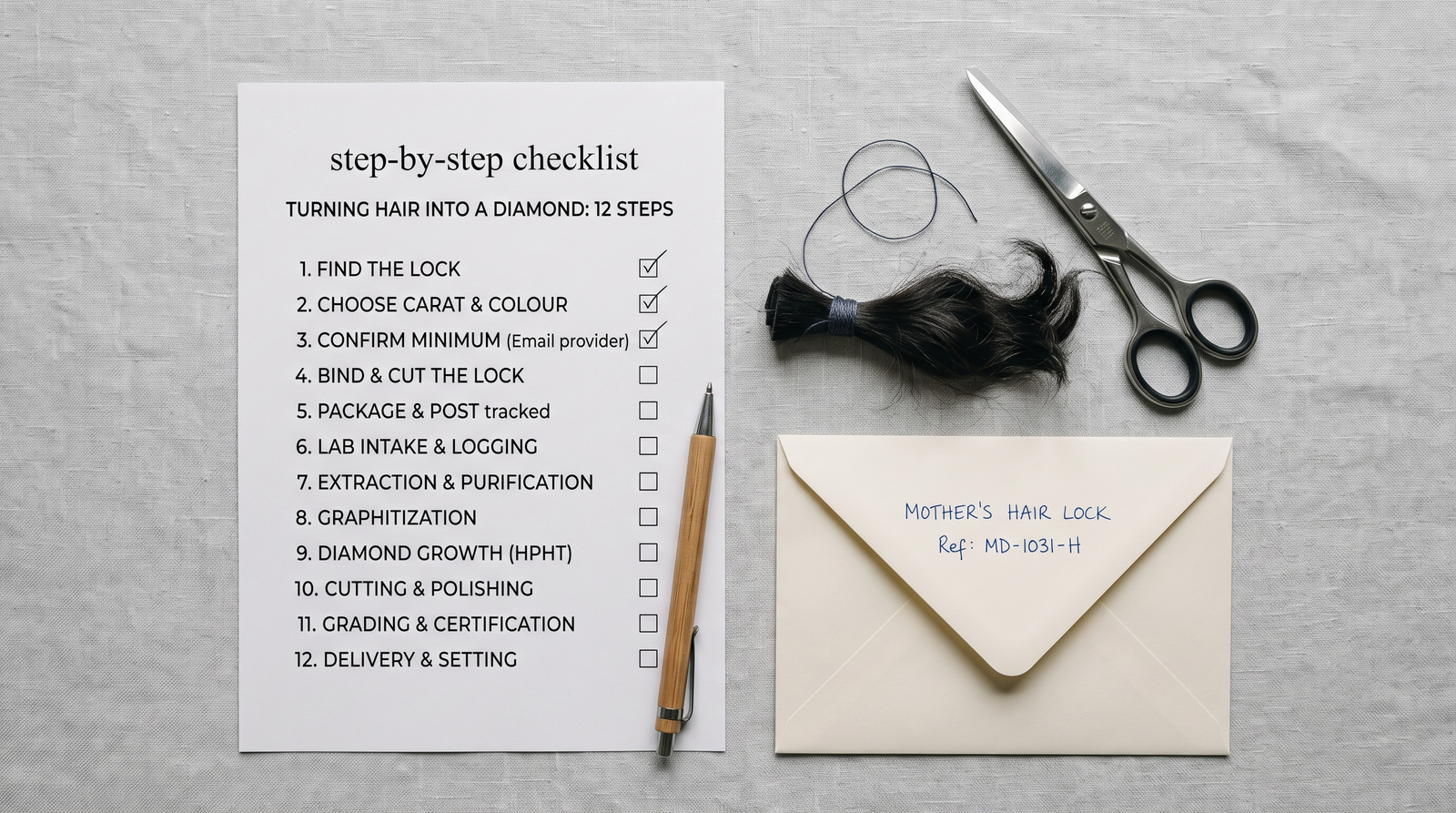
On this page:
- What Do You Need Before You Start?
- Steps 1–5: What Does Your Family Do?
- Which Step Is the Point of No Return?
- Steps 6–12: What Does the Lab Do?
- How Long Does Each Step Take?
- Where Does This Differ From the Ashes Sequence?
- Frequently Asked Questions
- Nothing You Do This Week Involves Scissors
What Do You Need Before You Start?
Short list, and most of it is already in the house.
- The lock, or a plan for collecting one
- Sharp scissors and a length of sewing thread to bind one end
- A small paper envelope, not a plastic bag, inside a rigid mailer stiff enough not to fold in a sorting machine
- Your provider’s written minimum for the carat you chose
- A pen for her name and reference, and tracked postage ordinary mail class is fine
What you don’t need matters too: no special carrier, no official postal box, no cremation certificate, no service-class restriction. No carrier publishes a rule for human hair the way USPS publishes one for cremated remains an absence rather than a stated permission, so confirm with your provider and your carrier rather than assuming.
Steps 1–5: What Does Your Family Do?
Step 1 Find out whether a lock already exists
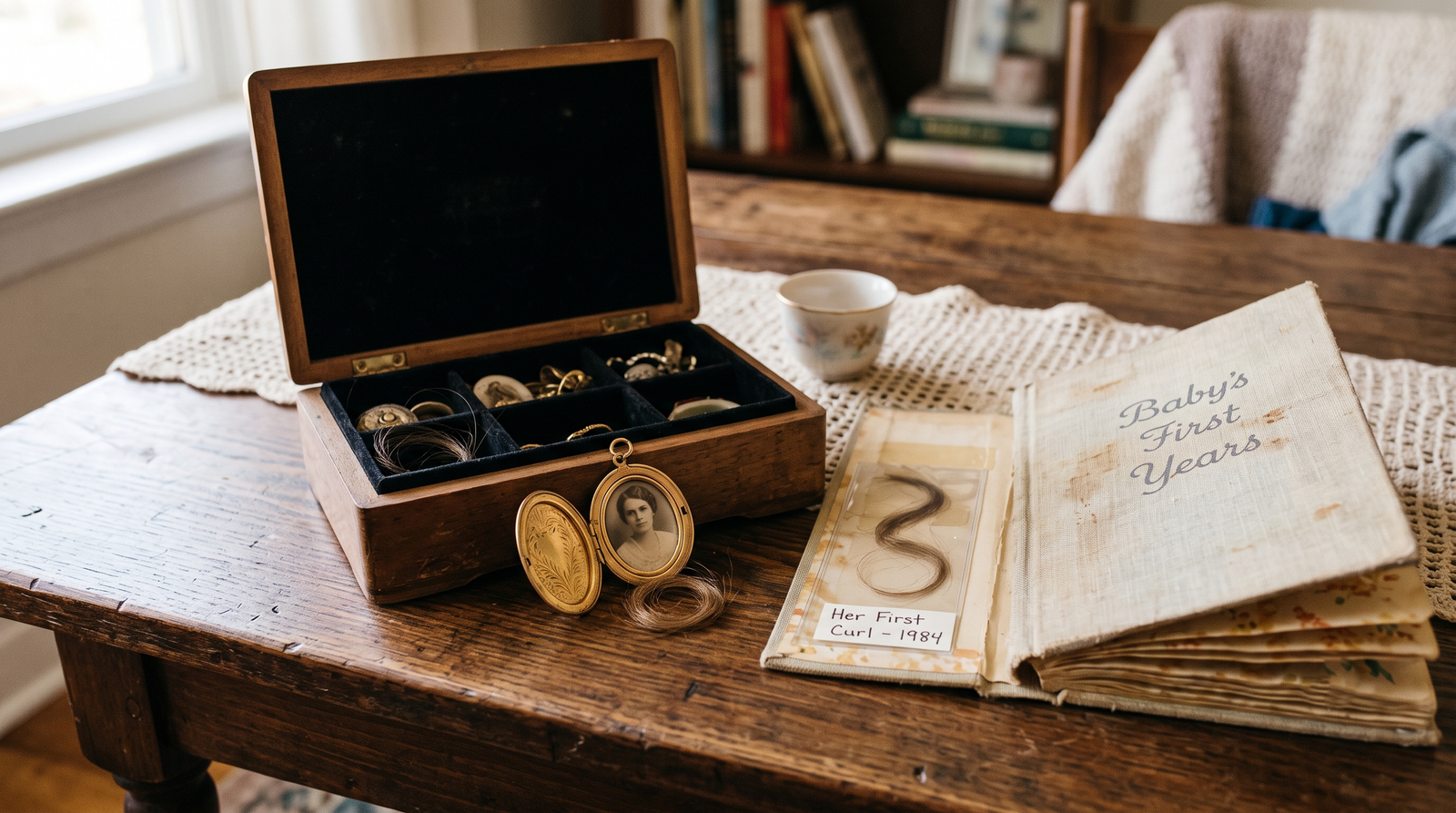
Start here: a lock you already have costs nothing, and one you have to take is irreversible. Saved hair turns up in a folded envelope in a jewelry box, taped into a baby book, inside a locket, or as a childhood braid. Hospice nurses and funeral directors often cut one unasked if either was involved, phone before assuming there is nothing.
Step 2 Choose carat and colour
Carat comes from growth time in the press, not from how much hair you send, so a bigger lock buys neither a bigger stone nor a faster one. Sizes run from about 0.10 carats to 5 and beyond, cost climbing steeply. Her own hair colour has no bearing on the stone’s see what colour to expect.
Step 3 Get the minimum in writing, for that carat
Ask your intended provider for the exact amount needed at the size you chose, by email. Industry-typical requirements are modest a small lock, a few grams, often called palm-sized because hair is roughly 50% carbon by weight. That is a range, not one company’s policy, and minimums shift with carat.
Step 4 Cut or gather the lock
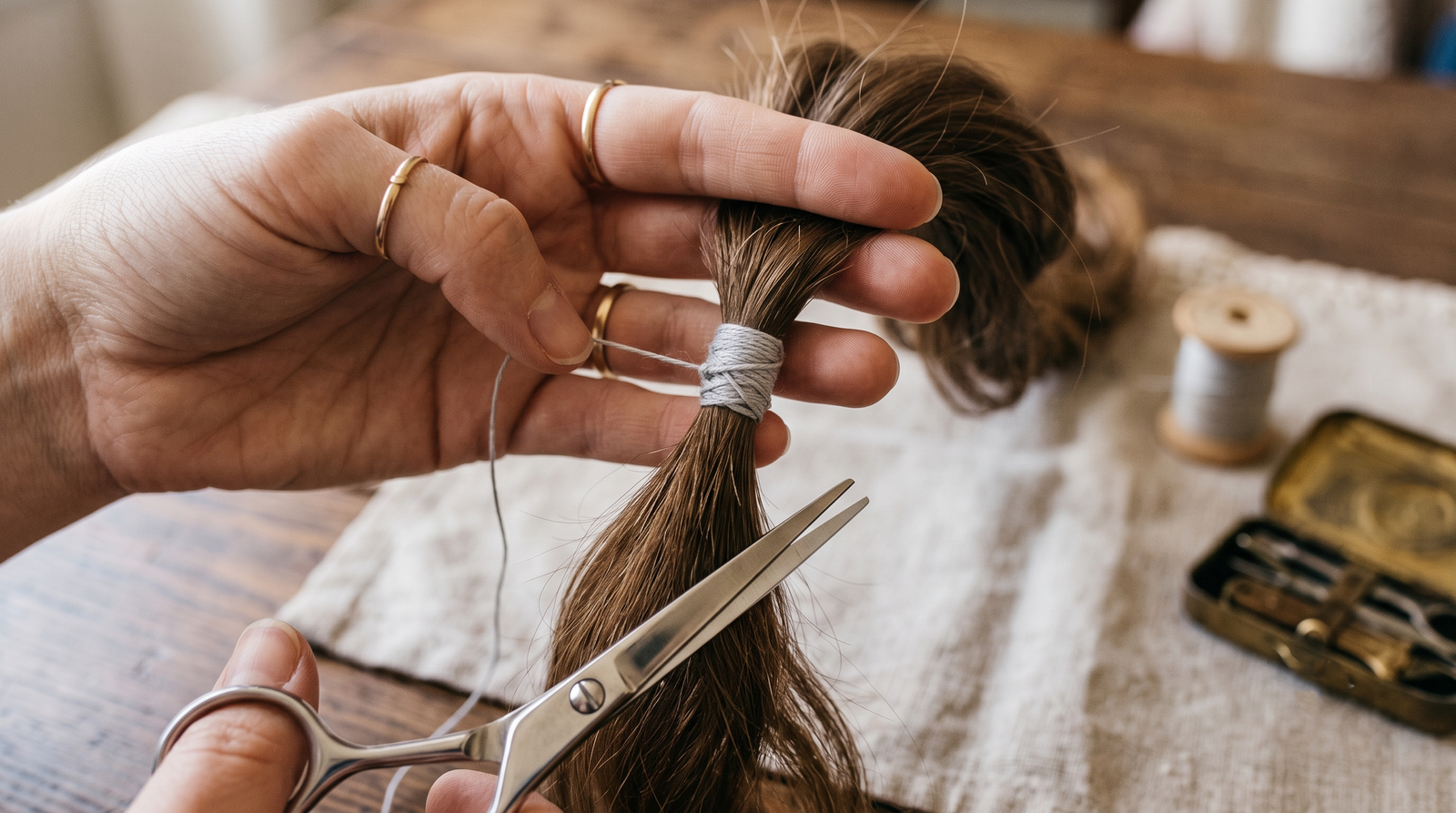
Bind one end with thread first, so it stays a lock rather than loose strands. Cut, don’t pull; take it from underneath at the nape, where the gap won’t show. Keep it whole. The root isn’t needed; the carbon is in the shaft.
Step 5 Package it and post it
Hair into the sealed paper envelope, name and reference on that inner envelope rather than only the outer one, then into the rigid mailer with any provider forms. Post it tracked, and tell the provider it’s coming so receipt is logged the same day.

Which Step Is the Point of No Return?
Step 4 the structural difference that matters most between the hair route and the ashes route.
With ashes, the irreversible moment comes late at the seal and the handover and if you send too little there is nearly always more ash. With hair it arrives a step earlier, at your own kitchen table: a saved lock is frequently the only one that will ever exist, and a cut that falls short cannot be topped up. So the ordering of steps 3 and 4 isn’t stylistic confirm the amount, then cut, and if the answer is borderline take a smaller carat rather than a bigger cut. Questions worth asking first and how much hair you need cover the rest.
Steps 6–12: What Does the Lab Do?
Step 6 Intake and chain-of-custody logging
Your lock is checked in, weighed against the requirement, and assigned a tracking reference that follows it through every later stage. Ask for it that trail is what supports the certificate of origin.
Step 7 Carbon extraction and purification
The hair is heated in a controlled, oxygen-free, multi-stage process that strips away the non-carbon components of keratin, reaching roughly 99.9%+ carbon purity. Dyed, permed, and grey hair are generally workable, since purification removes everything that isn’t carbon.
Step 8 Graphitization
The purified carbon is heated to roughly 2,500–2,700°C and converted into graphite the crystalline form a growth press uses as feedstock. How a memorial diamond is made from your mother’s hair covers steps 7 to 11 in far more depth.
Step 9 Diamond growth
The graphite, blended with supplemental lab carbon to reach the volume a growth cell needs, goes into an HPHT press with a tiny diamond seed at roughly 6–8 GPa and 1,400–2,500°C. Longest step by a wide margin: weeks to months, set by the carat chosen at step 2. Her carbon becomes a real, verifiable part of the crystal not all of it, and no honest provider claims 100%.
Step 10 Cutting and polishing
A gemologist cuts and polishes the rough crystal into the shape selected. Memorial diamonds trend toward yellow, blue, and champagne because organic carbon carries trace elements into the growth cell; a colour the run doesn’t produce naturally needs post-growth irradiation here, adding time.
Step 11 Grading, certification, and the return of unused hair
The stone is graded on cut, colour, clarity, and carat, ideally by an independent third-party lab, while an in-house origin certificate ties it to your family’s material. Hair the process didn’t consume should come back as standard practice, not on request. The two documents answer different questions: one grades the diamond, the other ties it to your mother.
Step 12 Delivery, then the setting
It arrives loose, in a box, usually smaller than you pictured. A loose stone isn’t wearable, so one decision remains: keep it loose, or set it a pendant, a ring, her own ring reset around it. Settings and jewelry ideas covers the trade-offs.
How Long Does Each Step Take?
Durations are industry-typical, not confirmed turnaround guarantees. Both halves of this column are estimates: providers publish the 6–10 month total, not the breakdown, and the family-side figures reflect ordinary domestic logistics.
| Step | Who | Typical duration |
|---|---|---|
| 1. Find the lock | Family | An afternoon to a few phone calls |
| 2. Choose carat and colour | Family | Hours to a week |
| 3. Get the minimum in writing | Family | A few days |
| 4. Cut or gather the lock | Family | About 10 minutes — and irreversible |
| 5. Package and post — handover | Family → lab | 1–3 days transit |
| 6. Intake and custody logging | Lab | Days |
| 7. Extraction and purification | Lab | Weeks |
| 8. Graphitization | Lab | Days to weeks |
| 9. Diamond growth | Lab | Weeks to months the long one |
| 10. Cutting and polishing | Lab | Weeks |
| 11. Grading, certification, returns | Lab | Weeks |
| 12. Delivery and setting | Lab → family | Weeks, if you set it |
| Steps 6–12 total | – | 6–10 months; up to 12 for stones over ~2 ct or specialty colours |
The 6–10 months runs from receipt, not from step 1. For a particular anniversary, count backward from receipt at step 6, then add your own steps 1 to 5 on top of it.
Where Does This Differ From the Ashes Sequence?
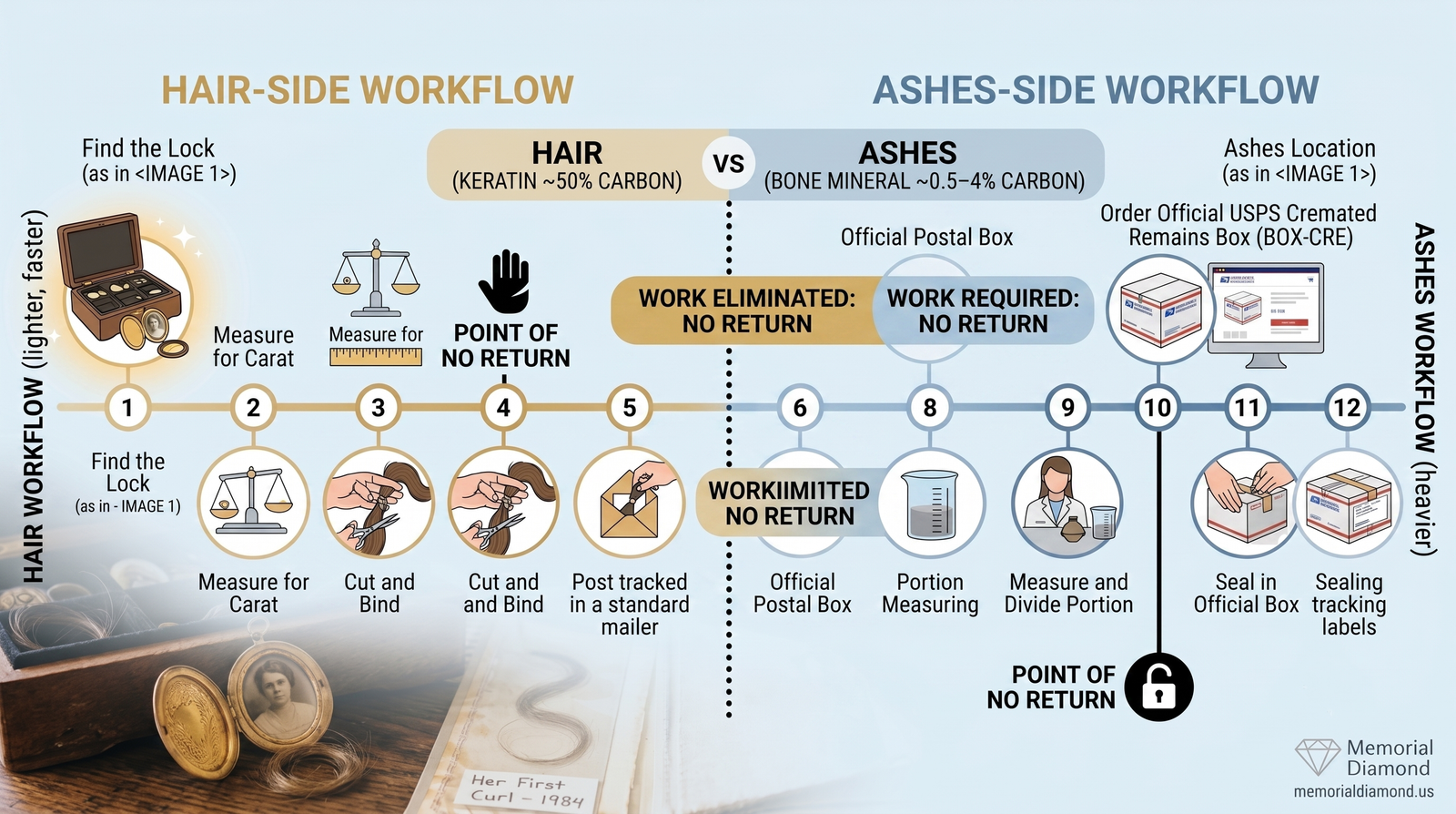
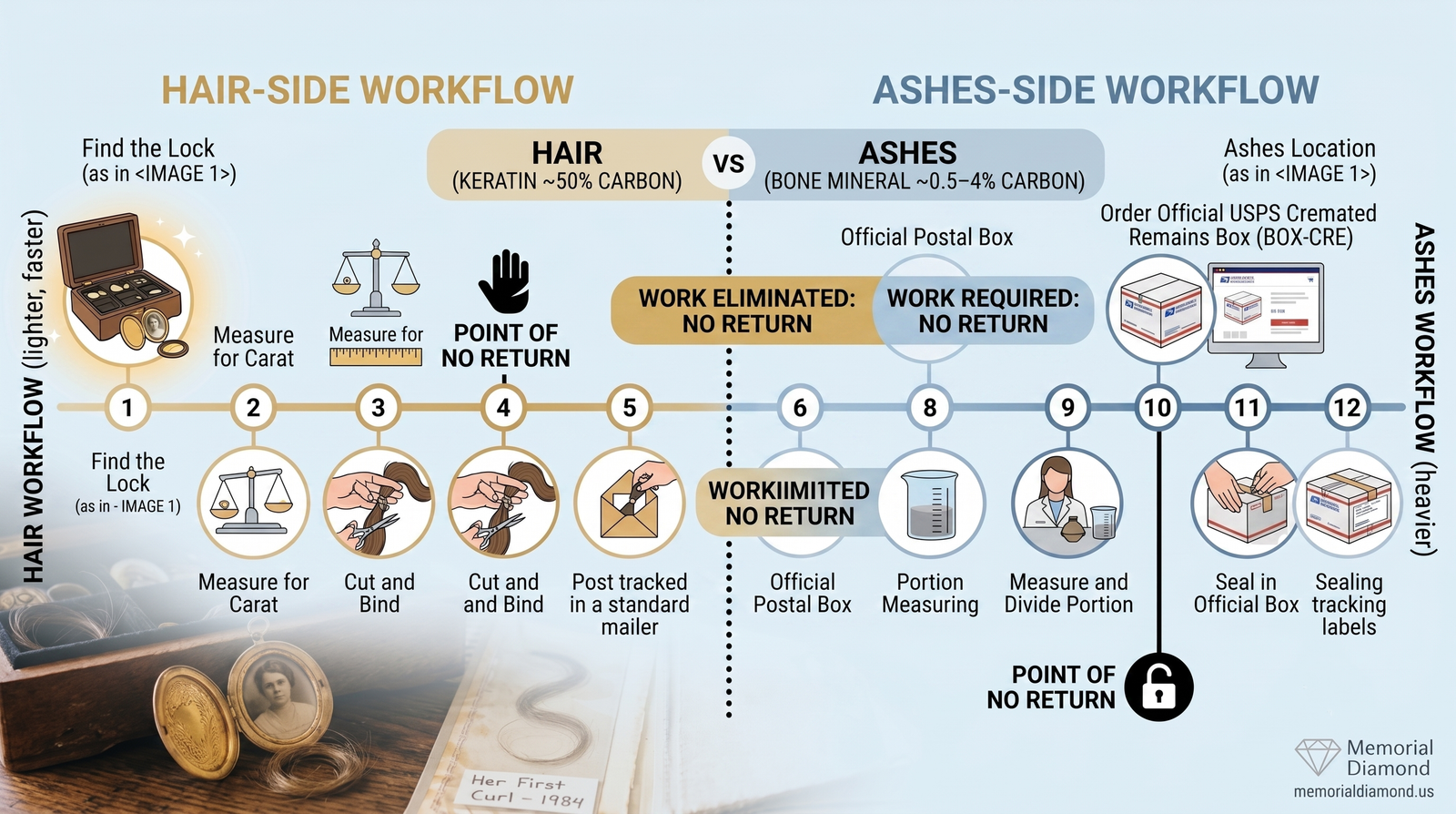
The lab half is identical from step 6 onward. The family half is genuinely lighter not in how many numbers it runs to, since the two posts group their steps differently, but in the work itself: hair removes three pieces of it and adds one.
- Removed: ordering an official postal box. Cremated remains require the USPS Cremated Remains box, orderable online only, forcing days of delay before shipping is possible at all. Hair posts as ordinary mail.
- Removed: measuring out a portion, and the family agreement gate. Nothing is divided a lock goes whole and where dividing a parent’s cremated remains usually needs everyone’s consent, a saved lock rarely carries the same weight.
- Added: finding the lock at all. Ashes sit in a known place; hair has to be located, and sometimes doesn’t exist.
- Moved: the point of no return. From the handover to the cut.
The same sequence for ashes runs the nine-step version, and the complete guide to a mother hair diamond covers treated hair and colour.
Frequently Asked Questions
Which step am I on if the lock has been in a drawer for twenty years?
Step 1 is done, so start at step 2. Age doesn’t degrade hair for this purpose keratin is stable, and a lock cut decades ago extracts the same as one cut last week.
Can I do step 4 before step 3?
Strongly advise against it. Confirming the minimum takes only a couple of days, while an insufficient cut may be unrecoverable if no second lock exists anywhere. If you have already cut, ask before posting rather than after.
Does the sequence change if my mother was buried rather than cremated?
No every step is identical, because no step involves cremation. That is the practical advantage of the hair route: it stays open to families who chose burial, and to those whose faith rules cremation out.
What if the lock turns out to be too small at step 6?
The lab should flag it at intake rather than growing a failed stone. Options are usually a smaller carat, or a second lock if one exists. Exactly why step 3 comes before step 4.
What if my mother is still living?
Then step 1 is a conversation instead of a search, and she can choose the carat at step 2 herself. Every step after that is unchanged, and she gets to see the finished stone.
Nothing You Do This Week Involves Scissors
Step 1 is a search of a jewelry box and step 3 is an email; between them they cost a few days and nothing else. The only step on this list that cannot be walked back is step 4, and it sits deliberately behind both of them which is the whole reason the sequence is ordered the way it is. If the search turns up nothing, or if the answer ends up being the lock left exactly where she put it, that is a whole answer too.
When you’re ready for step 3, reach out to Memorial Diamond at memorialdiamond.us and ask what amount is needed for the size you have in mind. Get it in writing first. Everything after that is reversible; the cut isn’t.