
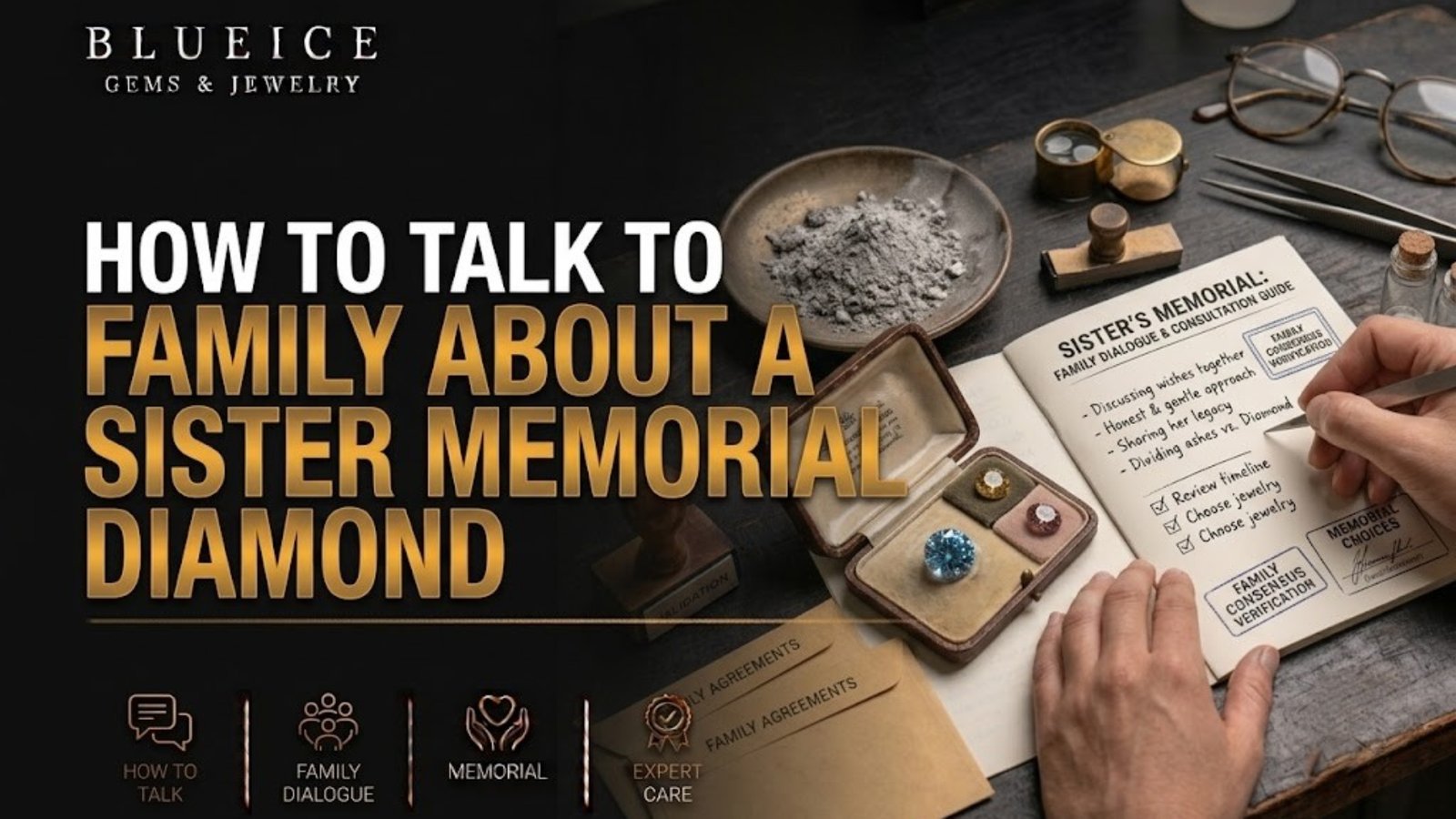
Raising the idea with her family can feel harder than deciding you want it. The first conversation about a sister memorial diamond is usually with whoever has authority over her remains, and that is often not a sibling. Start there, explain why it matters to you, ask for something small and specific, such as a few tablespoons of ashes or a lock of hair, share the provider’s custody paperwork, and write down what everyone agrees.
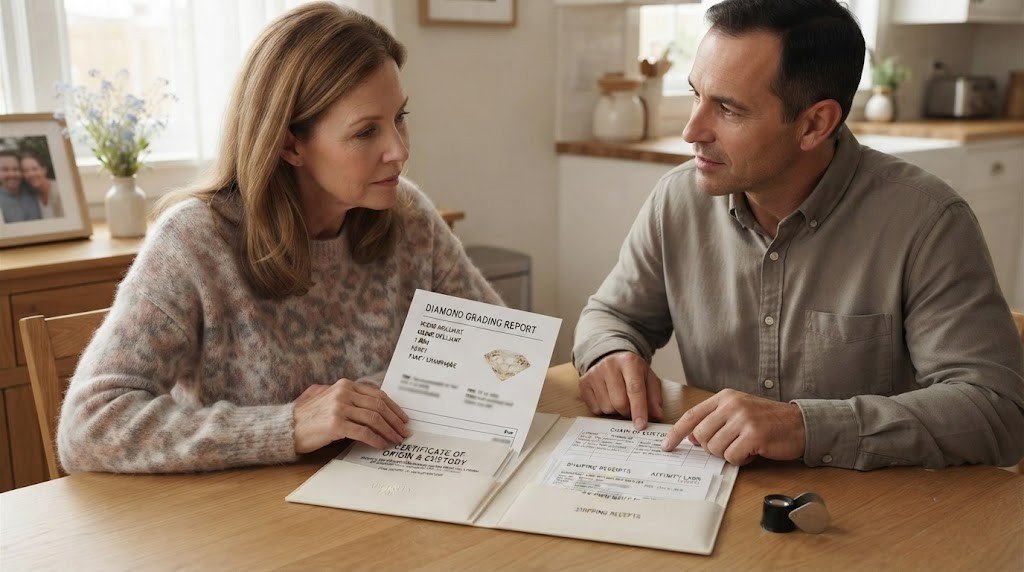
Table of Contents
Why Does Talking About a Sister Memorial Diamond Involve So Many People?
When a sister dies, the people who loved her often fill several roles. She may have had a spouse or partner, children, living parents, and brothers and sisters of her own, including half siblings, step siblings or adopted siblings. Each of them may feel a claim on how she is remembered, and none of those claims cancels another.
A memorial diamond also involves her physical remains. A provider needs a portion of her ashes or some of her hair, and that material has to be released by someone with the right to release it. That is why a decision about a sister memorial diamond rarely belongs to one person alone.
None of this means your wish counts for less. It means the path to it runs through other people. If you are still at the beginning, our guide on where to begin with the whole decision explains the wider choices.
Who Has the Final Say Over Her Remains?
Authority over remains comes from state rules and from any wishes she put in writing, so there is no single national answer. Before any discussion about a sister memorial diamond, it helps to understand how your state approaches it. A typical default in many states starts with a spouse or registered partner, moves to adult children, then to parents, and reaches siblings after that.
States do not all use that default, and an agent she designated or a declaration she signed can change the situation. A sibling often is not the person who decides, but that does not leave you without a voice. Siblings can ask, offer and take part, and in some situations a sibling does hold authority.
A call to the funeral home or crematory is often enough to learn whose signature is on her cremation paperwork. If the picture is still unclear, a local attorney can explain how your state handles it.
If she left hair at home, in a brush or in a keepsake, those belongings can form part of her estate, and the rules differ from state to state. Speak with the executor or whoever holds authority before collecting it, so nobody feels something was taken without asking.
Who Might You Need to Talk With, and What Are They Weighing?
The people involved differ in every family. This table can help you think through each conversation about a sister memorial diamond before it happens. It is not a list of people you must approach.
| Person | Role they may have | What they may be weighing | A respectful way to begin |
|---|---|---|---|
| Her spouse or partner | Commonly first in many states, although rules vary | Their plans for her ashes and how public a memorial feels | Ask privately and early, and make clear that their decision matters |
| Her adult children | Can hold authority in some states, especially if there is no spouse | Their own wish for a keepsake and protecting their parent’s memory | Offer to include them and ask what they would want |
| Her parents | May hold authority or simply carry deep feelings | Grief, faith and possibly different views from each other | Speak with each parent in the way that suits them |
| Other siblings | Share your relationship with her | Whether they want a stone and what feels fair | Ask what they want rather than assuming |
| Relatives with faith concerns | May or may not hold authority, but can be influential | Teachings on cremation and dividing remains | Listen first and suggest speaking with their own faith leader |
| The executor | Manages her estate, including belongings | Hair or jewelry that may belong to the estate | Check before collecting anything she owned |
Thinking through these relationships can show you who to speak with first and who should hear the plan from you directly. Any conversation about a sister memorial diamond is easier when the people closest to the decision are not caught by surprise.
What Are Six Steps for Talking About a Sister Memorial Diamond?
No script fits every family, but a simple order helps. These six steps keep a talk about a sister memorial diamond focused and respectful.
- Find out who has authority. Ask the funeral home or crematory who signed the paperwork, or ask the family directly, before planning anything else.
- Choose a calm time. Avoid the funeral, the reading of a will, or a crowded holiday table.
- Lead with her, not the product. Explain what the idea means to you before describing how it works.
- Make a small, specific request. Ask whether a few tablespoons of ashes or a small lock of hair could be used rather than making a vague request for some of her remains.
- Share the provider’s paperwork. Show how the material would be tracked, used and, where possible, returned.
- Write down what everyone agrees. Record who gave permission, what material was shared, who owns each stone and who pays.
Each step gives your family space to understand the idea and ask questions before making a decision.
When Should You Start Talking About a Sister Memorial Diamond?
There is rarely a perfect moment, but some moments are harder than others. The days around the funeral are full of logistics, and a new idea can feel like one more demand. Raising it during a dispute over belongings or a will can make it sound like another claim.
A memorial diamond typically takes six to ten months to complete once the provider receives the material, although the actual timeline depends on the provider and the order. The stone itself does not set a deadline for starting. If her ashes are going to be scattered, buried or placed in a niche, however, the conversation needs to happen before that. You can explain the timing clearly without pressuring anyone.
A private conversation, in person or by phone, often works better than a group message because it gives the other person room to react and think. A question about a sister memorial diamond dropped into a family group chat can force everyone to answer publicly before they have had time to consider it.
What Should You Say First About a Sister Memorial Diamond?
Start with her. A relative who hears that you want to make a diamond from her ashes may picture something they are not ready for. A relative who first hears that you are looking for a way to keep her close in everyday life can understand your feelings before considering the product.
Then explain the request clearly. You might say that you would like to ask whether a small portion of her ashes or a little of her hair could be set aside for a memorial stone. Explain that you will share information about how the material would be handled and documented.
Plain words in your own voice work better than a polished speech. Give your relative time to respond and do not expect an immediate answer.
Expect questions you cannot answer on the spot. Saying you will find out is better than guessing. Relatives with practical questions about a sister memorial diamond deserve accurate answers, and a wrong answer given to smooth the moment can damage trust later.
How Do You Answer the Question, Is It Really Her?
A skeptical relative may ask this first, and an honest answer is the most reassuring one. A memorial diamond is a real diamond grown in a laboratory, usually using a method also used for other lab grown diamonds. Carbon is extracted from ashes or hair, purified and used during the crystal growth process. Supplemental laboratory carbon may also be used to provide enough material for growth.
For ashes, usable carbon is only roughly 0.5 to 4 percent of the ash by weight. The share of the finished stone’s mass attributed to the person’s carbon varies by provider and process. Some providers cite figures around 10 to 15 percent, while others cite lower figures. Ask the provider to explain its process and what it can document for your order.
Hair contains a substantial amount of carbon by weight, but the finished stone’s precise carbon contribution depends on the process. Ask the provider directly rather than relying on a general estimate. Our article on whether a memorial diamond is really made from her ashes explains this subject in more detail.
Relatives may also worry that a diamond would use most of her ashes. Providers often request an amount ranging from a few tablespoons to around four ounces, approximately 100 grams, although requirements vary. Hair based orders usually require a small lock or another specified amount.
That can leave most of her ashes available for whatever the family has already planned. Our guide to how much ash a sister’s stone usually needs explains the range to discuss before making a decision.
How Do You Talk With Parents Who Are Grieving Differently?
If both her parents are living, they may respond very differently. One may want a stone while the other finds the idea painful. They may be divorced or remarried, and she may have had a step parent who raised her. Treat each relationship on its own terms.
Speak to each parent separately if they are not on the same page, and avoid asking one to persuade the other. If a parent holds legal authority, their role generally depends on the rules that apply to the situation and any written wishes your sister left. If a parent does not hold that authority, they may still deserve to hear your thoughts before anything happens.
Resist comparing who is grieving more. A parent’s loss and a sibling’s loss are different experiences, and both deserve room. Conversations about a sister memorial diamond go better when everyone’s feelings are allowed to be real at the same time.
What If Other Siblings Want a Stone, or Do Not?
Siblings may each want a stone, want to share one, or want nothing to do with the idea. Every one of those choices is valid. One sibling who would rather keep a photograph and another who wants a ring are both remembering her.
Because only a portion of ashes or hair may be needed, more than one stone can sometimes be made from the same source. What is possible depends on the provider, the available material and the requirements for each order. Our guide to more than one relative receiving a diamond from her ashes explains how families can approach this question.
Be careful not to assume who counts as a sibling when discussing a sister memorial diamond. Half siblings, step siblings and adopted siblings may feel the same connection, and leaving someone out by accident can hurt more than an open disagreement.
Cost belongs in the family conversation, too. As an illustrative industry range for 2026, smaller stones of roughly 0.10 to 0.25 carats may cost around $1,500 to $3,500. Settings, engraving and grading may cost extra. Prices vary by provider, size, color and other options, so request a written quote before agreeing to an order.
Decide early whether each person will pay for their own stone or whether costs will be shared. Clear expectations can prevent misunderstandings later.
How Do You Handle Faith Questions About a Sister Memorial Diamond?
Some relatives will have religious concerns about cremation, dividing remains or keeping remains at home. Practices differ by faith, denomination and individual faith leader. Religious teachings often address cremation and the care of ashes, while a family’s questions about memorial diamonds may require a conversation about those broader teachings.
Listen before responding, and do not try to argue anyone out of a belief. Suggest that the relative speak with their own faith leader, or offer to go with them. If cremation itself is the concern, a diamond grown from hair does not require cremation. That distinction may matter to some families. Our complete guide to a diamond grown from her hair explains how that option works.
Respecting a faith concern about a sister memorial diamond does not always mean dropping the idea. It may mean waiting, considering hair instead of ashes, or keeping the stone private. The right decision is one the family can approach with care and understanding.
What Can the Provider’s Paperwork Show Your Family?
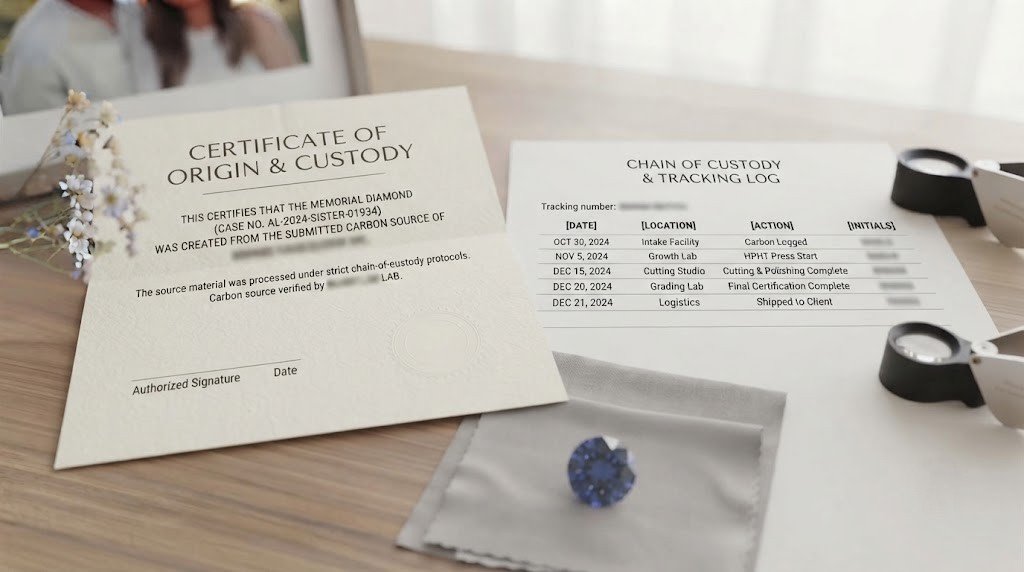
Handing over a portion of someone’s remains takes trust. Ask the provider how it tracks the material from arrival through the finished stone and what documentation it supplies. A certificate of origin or authenticity may record details about the diamond and its stated source. The exact documentation depends on the provider, so review it before committing.
Before the conversation, ask the provider to explain or send written answers to these questions.
- How is the material labeled and tracked at each stage?
- What happens to ashes or hair that are not used, and can unused material be returned?
- What happens if the diamond does not grow as planned or is damaged during cutting?
- What information appears on the origin certificate?
- Is an independent grading report available, and what does it cover?
Our list of questions to ask a provider before sending her ashes covers more ground. Sharing written answers lets relatives read at their own pace. Clear documents can address concerns about a sister memorial diamond more effectively than reassurance offered in the moment.
What If the Answer About a Sister Memorial Diamond Is No or Not Yet?
A not yet is a real answer, and it may be temporary. Someone who cannot face the idea early on may feel differently later. Thank them for being honest and ask whether you may raise the subject again at a time they choose.
A firm no from the person with authority over her remains is harder to hear. It is fair to ask gently whether a particular part of the idea is the obstacle, such as using ashes, wearing jewelry, the cost or the timing. Sometimes a different approach, such as using hair or having another relative keep the stone, may address the concern. If it does not, respecting the answer can help protect your relationship.
If you believe a decision is unfair, a local attorney can explain the rules that apply in your state. Formal disputes over remains can place lasting strain on family relationships. Other ways of keeping her close remain possible whatever the answer. Our comparison of a memorial diamond and a traditional urn may help if the family prefers an urn.
How Do You Put Agreements About a Sister Memorial Diamond in Writing?
Writing things down is not a sign of mistrust. It protects everyone from remembering the same conversation differently years later. A short email that each person replies to can provide a useful record. Whether a more formal agreement is appropriate, especially when money or estate property is involved, is a question for a local attorney.
A written note should answer these questions.
- Who gave permission for the material to be used?
- What amount of ashes or hair was shared, and with whom?
- How many stones will be made?
- Who owns each stone?
- Who will pay for the process, settings and any additional services?
- What happens to unused material?
- Who will keep the origin certificate and related paperwork?
- If two people share a stone, where will it be kept and what happens to it later?
Keep copies with the provider’s paperwork, and consult a local attorney if estate questions are involved. An agreement about a sister memorial diamond written while everyone is calm is easier to understand and follow than one pieced together after a misunderstanding.
Frequently Asked Questions
Do I need permission to use my sister’s ashes for a diamond?
You will generally need agreement from whoever has authority over her remains. Who holds that authority depends on state rules and anything she put in writing. It may be a spouse, adult children or parents. The funeral home or crematory can help identify the person who signed the paperwork, and a local attorney can explain the applicable rules.
Can I ask for a lock of her hair instead of ashes?
Yes. Some families find this a gentler request. Hair does not require cremation, and providers typically request only a small amount. Hair she left at home may belong to her estate, so check with the executor or whoever has authority before collecting it.
What if her spouse and her parents disagree?
Where relatives disagree, the person with authority under the applicable rules and her written wishes generally has the deciding role. Speak with each side separately, avoid taking sides and explore an option everyone can accept, such as using a small portion of material or considering a hair based stone.
Should I contact a provider before telling the family?
Gathering information about a sister memorial diamond first is reasonable because it helps you answer questions accurately. Avoid committing to an order or sending material until the person with authority has agreed. This helps the family understand that the decision is not being made without them.
Can a relative who said no change their mind later?
Yes. Feelings about a sister memorial diamond can change over months or years. If ashes or hair are kept safely and the material remains suitable, it may be possible to use them later. Leave the conversation open, ask whether you may raise the idea again and let the relative choose when.
Who should keep the origin certificate if a stone is shared?
Agree on this in writing before the stone is made. The person who keeps the stone may hold the original certificate, while other family members keep copies. Keeping the documentation with the stone can be helpful if it is reset or passed down in the future.
Final Thoughts on Raising It With Her Family
The wish to carry something of your sister with you is ordinary and human, and so is the worry about how her family will feel about a sister memorial diamond. Neither makes you wrong for asking.
Go gently, ask clearly and accept that the answer may take time. Give your family accurate information, respect the person who has authority over her remains, and write down any agreement. A conversation handled with patience can help protect family relationships, whatever is decided in the end.
Learn More About Sister Memorial Diamonds
- Sister Ashes Diamond: The Complete Guide explains the process from ashes to finished stone.
- How Much Does a Sister Memorial Diamond Cost? explores estimated price ranges by size and color.
- How Long Does It Take to Make a Sister Memorial Diamond? explains the stages involved.
- Memorial Diamond Settings and Jewelry Ideas for a Sister helps you explore ways to wear and preserve her stone.
Talk With Memorial Diamond
If you are preparing to talk with family about a sister memorial diamond and want accurate answers to bring to that conversation, visit Memorial Diamond. Learn more about how memorial diamonds are made and what questions to ask before deciding, at a pace that suits you and your family.