Ashes and Hair Into a Diamond

Step-by-Step: Turning Your Grandmother’s Ashes and Hair Into a Diamond

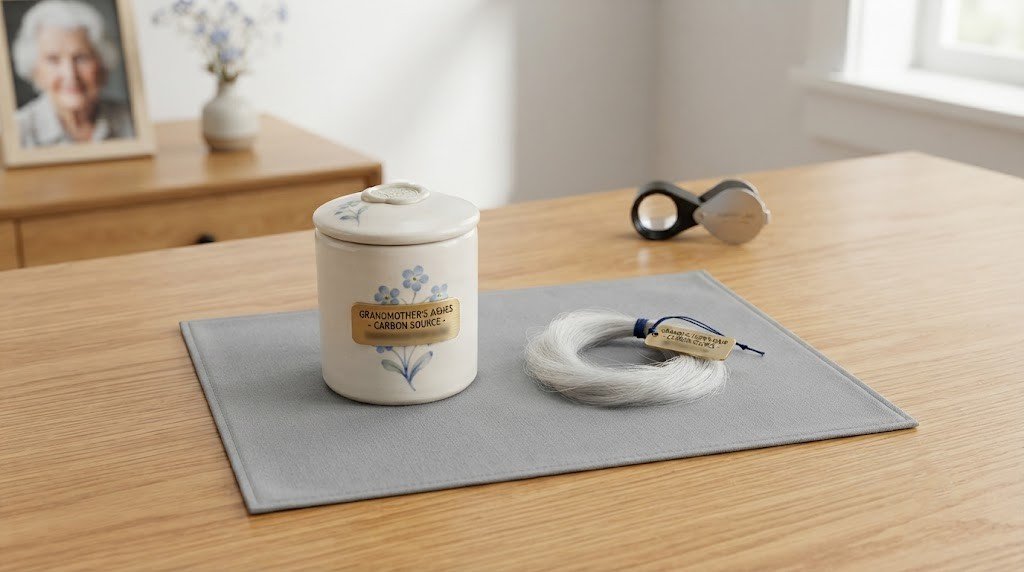
Sometimes the urn rests with one relative while a lock of her hair has been tucked away by another. The grandmother ashes hair diamond steps start with a question rather than a parcel: will a provider grow both materials into one stone, or suggest two? From there come two separate permissions, careful portioning and labeling, the stone choices, shipping, the lab’s work and delivery, typically 6–10 months in all.
grandmother ashes hair diamond steps

Can her ashes and hair go into one diamond at all?

Step 1: Ask the provider before anything else. Whether ashes and hair can share one stone depends entirely on the provider. Some may combine them, some may prefer to grow two separate diamonds, and some may accept only one material, so this question opens the grandmother ashes hair diamond steps because every later step depends on the answer.

Send it in writing, with a few follow-ups that shape the rest of the grandmother ashes hair diamond steps:

  1. Do you grow a single diamond from both ashes and hair, or do you recommend two stones?
  2. If you combine them, how do you describe that process, and what does the origin certificate say?
  3. If you prefer two stones, can they be matched in cut and color as a pair?
  4. Does using both materials change the price, the timeline or the amount you need of each?

Neither answer is better. One stone holds both in a single piece; two stones can go to different relatives or be set together as a pair. If a provider cannot work with one of the materials, the grandmother ashes hair diamond steps simply narrow to the other, and that is still a complete memorial. Your family’s plans for the stone should guide which route fits, and our complete guide to a grandmother ashes and hair diamond sets the two routes side by side.

Who needs to agree to using her ashes?

Step 2: Find out who holds authority over her ashes. Of the grandmother ashes hair diamond steps, this is the one most shaped by where you live: authority over cremated remains follows state rules, so there is no single national answer. A surviving spouse or partner, and then her adult children, commonly come ahead of grandchildren, and her written wishes can change that order.

For a grandchild, the respectful route is a direct, unhurried conversation, ideally before anyone contacts a provider.

You might ask whoever holds authority whether a small portion of the ashes could be set aside for a diamond, explaining that typically only a few tablespoons to roughly 4 oz (about 100 g) is needed, leaving the rest to be kept, scattered or interred as the family already planned. If the answer is not yet, the hair may still offer a way forward on its own, and the grandmother ashes hair diamond steps can wait or adapt.

Approaching it gently matters at this point in the grandmother ashes hair diamond steps more than at any other. Our guide to talking with family about a grandmother memorial diamond has ideas for opening the subject, and an estate attorney can explain how the rules apply in your state.

Who should you talk with about her hair?

Step 3: Treat the hair as its own conversation. Hair moves through the grandmother ashes hair diamond steps differently from ashes. Because the rules on remains are written with remains in mind, a lock you already hold tends to raise fewer practical questions. That said, her possessions may count as part of her estate, each state sets its own rules, and if an aunt, uncle or cousin kept the hair, using it is something to agree with them rather than settle on your own.

The people involved in the hair may not be the same people involved in the ashes. The urn might rest with one relative while the lock sits with a cousin, so the grandmother ashes hair diamond steps can mean two separate, equally respectful conversations.

How do you gather and portion both materials?

Step 4: Collect each material and portion the ashes as instructed. Once both permissions are in place, the grandmother ashes hair diamond steps turn practical: gather the materials, following the provider’s instructions for each one exactly.

For the ashes, the provider will say how much is needed and how to transfer it; industry figures put it anywhere from a few tablespoons to roughly 4 oz. Portioning can feel heavy. You can ask whether the funeral home or crematory would help with it, and there is no need to do it alone or in a hurry.

For the hair, a small lock or a few grams is typically enough. It may be gray, white, dyed, permed or thinning, and nothing published says any of these makes it more or less suitable for the grandmother ashes hair diamond steps, so describe it to the provider and ask. Our article on how much ash and hair a grandmother memorial diamond needs explains the quantities in more detail.

How do you keep a record of two materials?

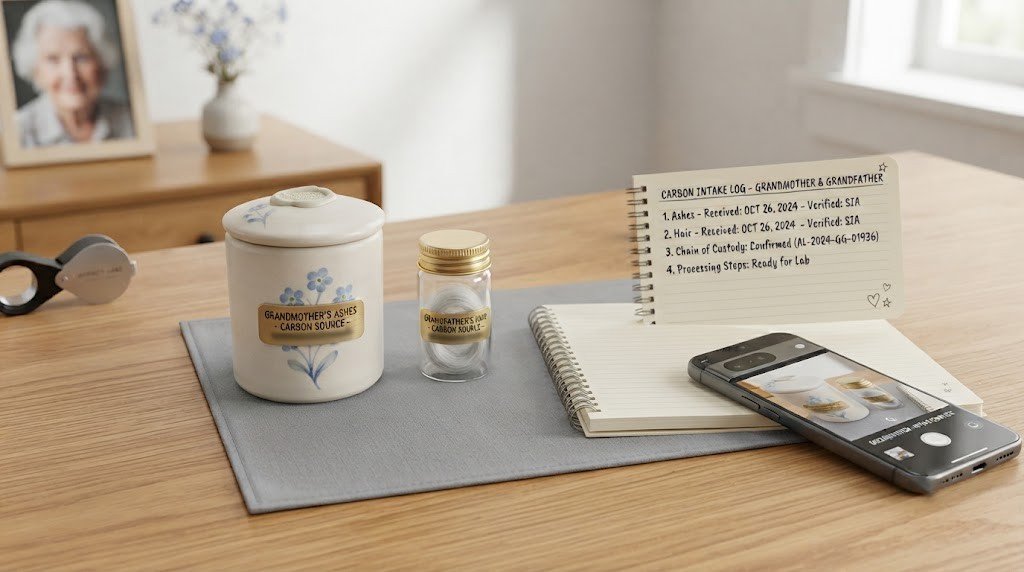
Step 5: Document both materials before they leave your family. With two materials, the chain of custody has two starting points, and each one should be clear from the first day of the grandmother ashes hair diamond steps.

A simple family record for the grandmother ashes hair diamond steps might include:

  • A photo of the portioned ashes in the provider’s container, with a note naming her.
  • A photo of the lock of hair, with the same note.
  • Who provided each material and the date it was set aside.
  • Separate labels for each container, if the provider asks for them.

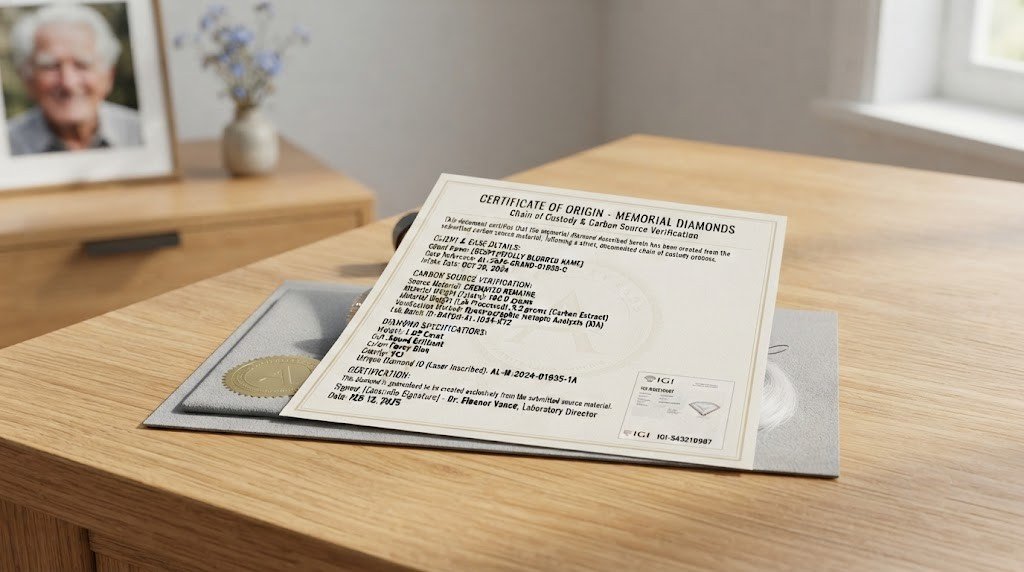
These notes take a little time, but they let anyone in the family see exactly what entered the grandmother ashes hair diamond steps and who agreed to it. Then ask the provider how each material is logged when it arrives, whether they stay separately identified until processing, and how the origin certificate will describe a stone made from both. Those answers belong in writing, kept alongside your own photos.

How much of a blended stone is actually her?

Step 6: Know what is published, and ask about the rest. Only ash has a published figure: carbon recovered from her ash is typically somewhere near 10–15% of a finished stone’s mass, though individual providers quote figures from about 3% upward. For hair alone, no finished-stone figure is published at all, and nothing is published for a stone grown from both.

Supplemental lab carbon is typically blended in during the grandmother ashes hair diamond steps, so a stone from both materials is not made entirely of her ashes and hair. Ash usually contains only about 0.5–4% usable carbon by weight, since it is mostly calcium phosphate, while hair is roughly 50% carbon. Those are facts about the starting materials, not about the finished diamond.

That gap makes this one of the grandmother ashes hair diamond steps worth slowing down for. Ask the provider in writing what share of the finished stone comes from her ashes, what share from her hair, and how they arrived at those figures. Our honest look at whether a memorial diamond is really made from your grandmother’s ashes and hair goes further.

What do you choose about the stone before shipping?
Step 7: Settle carat, color and cut, for one stone or two. Within the grandmother ashes hair diamond steps, these choices shape how the lab grows the diamond, so ask the provider whether it needs them before the materials are shipped. Growth time, not the amount of ash or hair, sets the carat size.

ChoiceTypical rangeWhat to ask
CaratAbout 0.10 to 5+ caratsDoes using two materials affect available sizes?
ColorYellow, blue, champagne or brown are common; colorless usually costs moreIs irradiation offered for red, pink, green or black?
CutRound, princess, cushion and othersAre fancy cuts priced separately?
Price (2026 industry ranges)Smallest stones (0.10–0.25 ct) around 1,500–3,500; half to one carat around 5,000–15,000; 2–5+ ct around 20,000–75,000+What is included, and what is extra?

Trace nitrogen tends to give yellow and boron blue, but no source makes the color of a stone grown from ashes, hair or both predictable. For more, see what color a diamond from your grandmother’s ashes and hair might be. If you choose two stones, these decisions apply to each, and the pair can match or deliberately differ.

How do the materials travel, and what happens in the lab?

Step 8: Ship both materials with tracking. Shipping is where the grandmother ashes hair diamond steps leave your family’s hands, so ship the ashes and hair exactly as the provider directs, whether together or separately, with tracking and a written confirmation of arrival. Packaging, kits and carriers vary between providers, so follow their instructions rather than any general rule, and ask in writing if anything is unclear about shipping cremated remains.

Step 9: Extraction, graphitization and growth. In the lab, this part of the grandmother ashes hair diamond steps treats the two materials differently. Ash is mostly mineral, so its small carbon content is separated from the calcium phosphate; hair is keratin, so far more of its weight is carbon to start with. In both cases, controlled oxygen-free heating isolates the carbon and purifies it to roughly 99.9% or more.

The purified carbon is then graphitized at roughly 2,500–2,700°C and, typically blended with supplemental lab carbon, grown around a small diamond seed. Most providers use HPHT, recreating roughly 6–8 GPa and 1,400–2,500°C; a minority use CVD. This summary of how synthetic diamonds are grown covers both methods. Whether the carbon from her ashes and her hair is combined before growth is exactly the Step 1 question, and the provider’s written answer is the only reliable source.

What happens during finishing and delivery?

Step 10: Finishing. Finishing is the last of the grandmother ashes hair diamond steps where your family still makes choices: the rough diamond is cut and polished, optionally irradiated for color, and optionally graded. An in-house origin certificate documents the chain of custody back to the materials you sent; an independent grading report, often to GIA standards and sometimes from IGI, describes the 4Cs. Clarity typically falls in the SI2 to VVS range. Grading usually costs extra, so ask whether it is included.

Step 11: Delivery, and the rest of each material. The finished stone or stones arrive with their documents. Because only a portion of each material is typically used, the last of the grandmother ashes hair diamond steps is asking what happens to any unused ashes and any unused hair. Can each be returned, held for another stone, or handled another way, and is there a time limit? Get both answers in writing before you ship.

A diamond is 10 on the Mohs hardness scale, the hardest natural mineral, yet it can still chip if struck hard; ask a jeweler which settings shield the edges for daily wear.

If other relatives might want their own stone, our guide to more than one family member getting a diamond from her ashes explains how that typically works.

How do ashes and hair compare across the grandmother ashes hair diamond steps?

Ashes and hair follow the same broad path, but they differ at almost every practical point, from who must agree to how much carbon each one holds. This table shows how each one moves through the grandmother ashes hair diamond steps.

StepHer ashesHer hair
1. One stone or twoProvider questionProvider question
2–3. PermissionWhoever holds authority over the remains, which varies by stateUsually simpler if hair is in your keeping; estate rules and whoever holds it still matter
4. AmountTypically a few tablespoons to about 4 ozTypically a small lock or a few grams
5. RecordPhoto, label and note of who set it asidePhoto, label and note of who kept it
6. Published carbon figure~10–15% of the finished stone for ash alone (some cite ~3%)None published; none for a blend
8. ShippingPer provider instructions for cremated remainsPer provider instructions for hair
9. Carbon contentAbout 0.5–4% usable carbon by weightRoughly 50% carbon by weight
11. What remainsAsk whether unused ash is returnedAsk whether unused hair is returned

Reading across each row shows why the grandmother ashes hair diamond steps involve twice the questions of a single-material stone, even though the lab work looks much the same.

How long do the grandmother ashes hair diamond steps take?
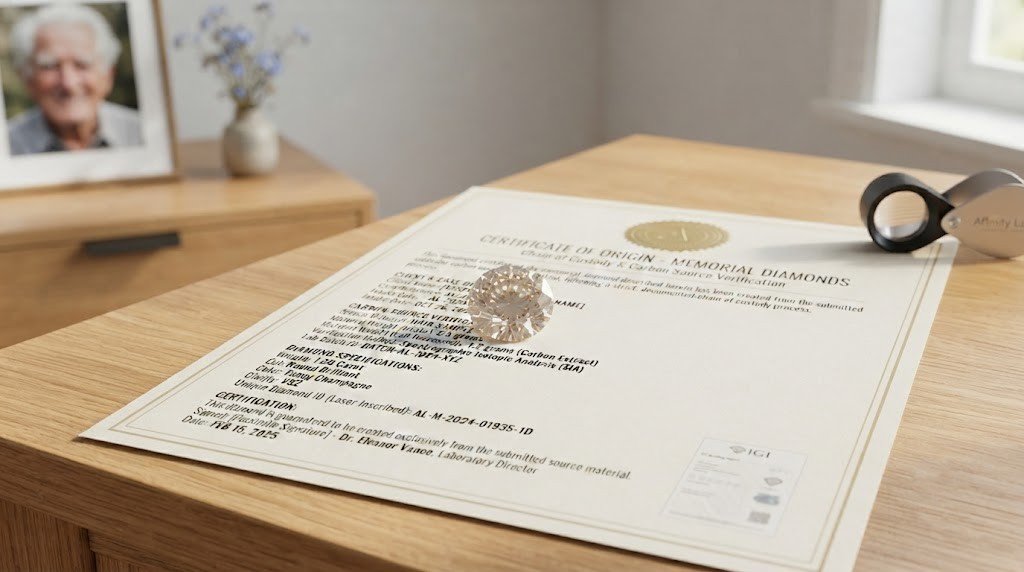
The grandmother ashes hair diamond steps typically take 6–10 months overall, measured from when the provider receives the materials, and can reach about 12 months for stones near 2 carats or larger or for specialty colors. Providers do not publish reliable timing for individual stages, and growth itself takes weeks to months depending on size.

Using two materials, or choosing two stones, may lengthen the grandmother ashes hair diamond steps, so ask the provider in writing. The family conversations in Steps 2 and 3 have no timetable at all, and they should not be hurried. Our article on how long a grandmother memorial diamond takes covers the variables.

Where does faith fit into the decision?

Religious teaching addresses cremation and what happens to ashes, but no tradition has set out an official view on memorial diamonds as such. Because the grandmother ashes hair diamond steps involve both, faith can shape each material differently, and a family may feel at ease with one and not the other.

  • Catholic: the Church’s current guidance favors keeping ashes whole in a sacred, church-approved place, allowing only a minimal part in narrow conditions, which bears directly on setting ashes aside.
  • Islam, and Orthodox and Conservative Judaism: these generally object to cremation itself. A hair-based stone sits outside that cremation-specific objection.
  • Hindu, Buddhist, Protestant and secular families: views on dividing ashes vary by community, congregation and family.

In every case, your own priest, imam, rabbi, pastor or teacher is the right person to ask before the grandmother ashes hair diamond steps begin. If ashes feel uncertain, the step-by-step guide to turning your grandmother’s hair into a diamond follows the hair-only route.

Frequently Asked Questions

What if the person holding her urn would rather not divide the ashes?

Then the hair may still offer a path. The grandmother ashes hair diamond steps can narrow to a hair-only route, using a lock you hold or one a relative agrees to share, while the urn stays exactly as her family wishes.

Is a stone made from both materials more her than a stone made from one?

No published figure supports saying so. The ash-only figure is around 10–15% of the finished stone, nothing is published for hair or a blend, and supplemental carbon is typically added. Ask the provider what share comes from each.

Can my cousin and I each get a stone from her ashes and hair?

Often several stones can come from one source, because only a portion of each material is typically used. Whether the grandmother ashes hair diamond steps can yield two stones from both materials, and how much of each is needed, is a question for the provider.

Should her ashes and her hair be shipped in the same parcel?

Follow the provider’s own instructions. Some may want both together and others separately, with their own packaging and labeling. Ask how each material is logged on arrival and keep your own photos and notes of what you sent.

Will the origin certificate mention both her ashes and her hair?

That depends on the provider. Ask in writing how the certificate describes a stone grown from both materials, and how it differs from an independent grading report, which documents the stone’s quality rather than where its carbon came from.

Does it matter if the ashes were kept for years before this?

Nothing published suggests that ashes kept for some years are unsuitable, but every provider sets its own requirements. Tell them roughly how long the ashes have been kept and how they were stored, then ask whether that changes any of the grandmother ashes hair diamond steps.

Final Thoughts on Turning Your Grandmother’s Ashes and Hair Into a Diamond

Bringing two pieces of her together asks more of a family than choosing just one. There are more people to talk with, more questions to put in writing and more care in the packing. Taken slowly, the grandmother ashes hair diamond steps leave room for every relative who wants a say, and for the answer to be one stone, two, or not yet.

Learn More About Grandmother Memorial Diamonds

Talk With Memorial Diamond

If your family is weighing her ashes, her hair or both, Memorial Diamond can talk through the grandmother ashes hair diamond steps with you and answer questions as they come up. Reach out whenever it feels right, with no pressure to decide.
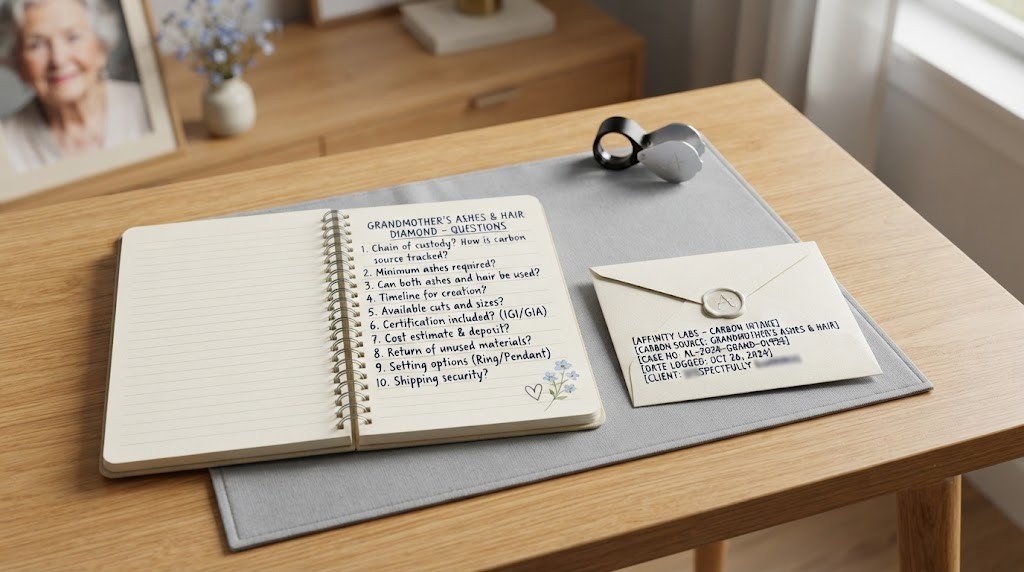
Questions to Ask Before Turning Your Grandmothers Ashes and Hair Into a Diamond

Questions to Ask Before Turning Your Grandmother’s Ashes and Hair Into a Diamond

grandmother ashes hair diamond questions

Holding both a portion of her ashes and a saved lock of her hair can make the choice feel twice as weighty. The grandmother ashes hair diamond questions below give you a calm way to check a provider before anything is sent. In short, ask whether they combine both materials or suggest two stones, what the paperwork records for each, what carbon share they can honestly state, who must agree, how much is needed, and what happens to the rest.

Why Do Grandmother Ashes Hair Diamond Questions Matter Before You Begin?

Because using two materials doubles the details that can go unexplained. Ashes and hair arrive differently, carry different amounts of carbon, and may be handled by different people in your family. A provider who is clear about one material is not automatically clear about both, which is why grandmother ashes hair diamond questions deserve more care than a single-material checklist.

Asking first also protects something irreplaceable. Once a portion of her ashes or a lock of her hair has been processed, that portion cannot be returned to its original form. Working through a set of grandmother ashes hair diamond questions before you commit means you understand the plan while every option is still open.

Clear answers also help at home. A grandchild, her son or daughter, or a step-, adopted or chosen grandchild may each relate differently to what was kept, and written replies to grandmother ashes hair diamond questions give everyone the same information.

If you want the wider background first, the complete guide to a grandmother ashes and hair diamond explains the whole route. The 24 grandmother ashes hair diamond questions here are the due-diligence layer that sits on top of it.

Will a Provider Combine Both Materials in One Stone or Suggest Two?

Put this near the top of your grandmother ashes hair diamond questions, because providers may answer differently and the choice shapes everything else. Some may combine carbon from both materials in a single stone, and some may recommend a separate stone for each. You are not looking for a particular answer, only a clear one with reasons.

  1. Do you combine ashes and hair in one stone, or do you recommend a separate stone for each material? Ask them to explain why they suggest what they suggest.
  2. If you combine them, can you describe at a general level how both materials are handled before growth? You do not need trade secrets, just enough to understand that each one is tracked.
  3. If you recommend two stones, can they be matched in cut, size or setting so they sit together as a pair? This matters if you picture them worn side by side or shared between relatives.

Treat these first grandmother ashes hair diamond questions as a way of hearing how a provider thinks. A thoughtful reply that admits what varies tells you more than a confident one-word answer.

What Will the Documentation Say About Each Material?

You want to know, in advance, exactly what the paperwork will record about her ashes and about her hair. A memorial stone typically comes with an in-house certificate of authenticity or origin, which is a chain-of-custody document rather than a quality report.

  1. Will the origin certificate name both materials, and will it say whether they were combined or kept separate? A vague certificate can leave relatives unsure later on.
  2. How is each material labeled and tracked from the moment it arrives? Ask whether ashes and hair receive separate reference numbers, and whether you can see an example document.
  3. Is independent grading offered, and is it separate from the origin certificate? Optional third-party grading, commonly using GIA’s diamond quality factors, describes the stone itself: cut, color, clarity and carat.

Ask to see a sample of each document before you send anything. Reading real wording is often the fastest way to answer several grandmother ashes hair diamond questions at once.

What Is the Honest Carbon Picture When Ashes and Hair Are Used Together?

The honest answer is that nobody publishes a finished-stone figure for blends. The only widely cited percentage applies to ash alone, so anything a provider says about a combined stone should come to you in writing. That gap is why carbon sits at the heart of many grandmother ashes hair diamond questions.

Here is what is known. Cremated ashes are mostly calcium phosphate, and usable carbon is roughly 0.5 to 4 percent of ash by weight. For stones grown from ash, her own carbon usually accounts for around 10 to 15 percent of the stone by mass; a few providers quote nearer 3 percent and others quote more. Hair is a different starting material, roughly 50 percent carbon because it is built from keratin. That is a fact about the hair going in, not about the stone coming out.

In both cases the extracted carbon is purified to roughly 99.9 percent or more, converted to graphite, and typically blended with supplemental lab carbon before growth. The stone is a real lab-grown diamond, usually grown by HPHT, as the overview of synthetic diamond methods explains. It is never all of her, and that is fine to say plainly.

  1. For our combined stone, roughly how much of the mass would be her carbon? If no figure exists for a blend, ask them to state that in writing.
  2. Is supplemental lab carbon added, and roughly how much? An honest reply says it is typically added; a flat “no” deserves a follow-up.
  3. Does combining materials change the personal-carbon share compared with a single-material stone? No published figure answers this, so it belongs on your list of grandmother ashes hair diamond questions to send by email.

For a deeper look at this exact point, see whether a memorial diamond is really made from your grandmother’s ashes and hair.

Who Has Authority Over Her Ashes, and Who Holds Her Hair?

Who decides about her ashes depends on the state you are in; nothing at the national level settles it for everyone. Commonly, the order puts a surviving spouse or partner first and her grown children next, ahead of grandchildren, and any written wishes she left can change that. Check your own state and situation before relying on any general summary. Before you send grandmother ashes hair diamond questions to any company, it helps to know where authority sits at home.

If you are a grandchild, there is a respectful route. You can ask whoever holds authority whether they would be comfortable setting aside a small portion of her ashes. Framing it as a request rather than a plan leaves room for an honest answer.

Hair is a little different. Rules on remains are aimed at the remains themselves, so a lock of hair already in your keeping is usually simpler in practice. Even so, her belongings may count as part of her estate, and those rules differ from state to state. If a relative is the one keeping the hair, treat using it as something to talk over with them rather than settle on your own. For some grandchildren, hair alone becomes the route that fits, which the questions for a grandmother hair diamond cover separately.

The provider-facing grandmother ashes hair diamond questions for this stage are below.

  1. What written consent do you ask for when ashes are sent, and from whom? Ask how they handle a sender who is not the person with authority.
  2. Do you ask for anything in writing about the hair, such as who it came from and who holds it?
  3. Do you accept hair that is gray, white, dyed, permed or thinning? Whether a given lock is suitable is a provider question; do not assume either way.
  4. If relatives disagree, will you pause the order until everyone is settled?

Faith can be part of this too. Faith communities have spoken about cremation and how ashes are kept, but none has issued an official teaching on memorial diamonds as such. Islam regards cremation as impermissible in ordinary circumstances, and Orthodox and Conservative Judaism generally prohibit it; because that concern is about cremation itself, a hair-based stone sits outside it. Catholic guidance asks that ashes be kept intact, with only narrow allowance for a minimal part. Whatever your tradition, your own clergy or faith leader is the right person to ask.

How Much of Each Material Is Needed, and What Happens to the Rest?

Typically, a provider asks for a few tablespoons up to roughly 4 ounces (about 100 grams) of ashes, and a small lock or a few grams of hair. Those are industry-typical figures, not any one provider’s requirement, so confirm the exact amounts in writing. Quantity is one of the simpler grandmother ashes hair diamond questions to get answered precisely, so ask for numbers rather than ranges.

Only a portion is typically used. That means the rest of her ashes can stay in an urn, be scattered, or be interred as planned, and the remaining hair can stay with whoever kept it. Carat size is set by growth time, not by how much material you send, so sending more does not make a larger stone.

  1. Exactly how much ash and how much hair do you need for the size we are considering?
  2. If you combine them, do you need the same amount of each, or does one carry more weight in the process?
  3. What happens to any material you do not use: is it returned, held, or disposed of, and can we choose? Ask for this policy in writing, since it differs between providers.
  4. Could the same materials support more than one stone later, for example for cousins or siblings?

The guide to how much ash and hair a grandmother memorial diamond needs walks through these amounts in more depth.

Do Cost and Timeline Change When Both Materials Are Used?

There is no published rule that using two materials costs more or takes longer, so treat both as questions for the provider. Industry-wide, memorial stones typically take about 6 to 10 months overall, stretching toward a year when a stone is about 2 carats or larger or a specialty color is chosen.

Prices across the industry in 2026 run roughly from $1,500 to $3,500 for small stones of about 0.10 to 0.25 carats, up to $5,000 to $15,000 at 0.5 to 1 carat, with colorless costing more. Settings, engraving, fancy cuts and grading are usually extra. A full breakdown sits in the guide to what a grandmother memorial diamond costs.

These three grandmother ashes hair diamond questions cover the practical side.

  1. Is there any difference in price if we send both ashes and hair rather than one material?
  2. Does using both materials change your expected timeline, and how will you keep us informed along the way?
  3. What is included in the quote, and what would be charged separately?

Ask these grandmother ashes hair diamond questions early, before anyone pays a deposit, so the quote reflects your actual plan.

Which Family Questions Should You Settle Before Ordering?

A provider can answer only part of what matters. The rest concerns who receives what, which is easier to talk through before the stone exists.

These four are family-facing grandmother ashes hair diamond questions rather than ones for the company:

  1. Who will wear or keep the stone, and is there a wish for more than one?
  2. Is everyone comfortable with her ashes and her hair being used, or would some prefer one material only?
  3. Who is speaking to the provider, and who receives copies of the written answers?
  4. What happens to any returned material, and who will keep it?

Not every family has the same shape. There may be cousins, siblings, her children, step-relatives or nobody else at all. The guide to talking with family about a grandmother memorial diamond suggests a few gentle openings. Sharing your list of grandmother ashes hair diamond questions with relatives can also show that nothing is being decided behind anyone’s back.

Grandmother Ashes Hair Diamond Questions: A Checklist to Print

This table gathers the grandmother ashes hair diamond questions by theme, with the kind of answer worth getting. Print it, fill in the right-hand column as replies arrive, and keep it with the emails.

ThemeQuestionsWhat a clear answer includesGet it in writing?
One stone or two1–3Whether they combine materials or suggest two, and whyYes
Documentation4–6Sample origin certificate naming both materials; grading kept separateYes
Carbon7–9Ash-only figures labeled as such; a stated position on blendsYes
Permissions10–13Who signs for ashes; how hair is recorded; hair suitabilityYes
Quantities and unused material14–17Exact amounts of each; what happens to the restYes
Cost and timeline18–20Any difference for two materials; what the quote includesYes
Family21–24Agreement on who receives what and who holds returned materialAgreed at home

Every provider-facing row ends in “Yes” for a reason: written answers to grandmother ashes hair diamond questions are easier to share, compare and revisit.

Which Replies to Grandmother Ashes Hair Diamond Questions Should Make You Pause?

Some replies deserve a second look before you go further, even when the rest of your grandmother ashes hair diamond questions were answered well. None of them prove anything on their own, but each is a reason to ask again or compare another provider.

  • “The diamond is entirely her.” Supplemental lab carbon is typically added. A claim of total purity is not how the process works.
  • A precise personal-carbon percentage for a blend with no written source. No published figure exists for combined stones, so ask where the number comes from.
  • No sample documents. If they cannot show what the origin certificate says, you cannot know how both materials will be described.
  • Pressure to send material before your questions are answered. A careful provider will wait.
  • Vague replies about unused material. You deserve to know what happens to the rest of her ashes and hair.
  • “No one needs to sign anything.” Whether consent is needed depends on your state and situation, and a provider should ask how authority is held.
  • Promises about color. No source makes memorial diamond color predictable from ash or hair.

The questions for a grandmother ashes diamond cover similar warning signs when ashes are the only material.

How Should You Send Your Grandmother Ashes Hair Diamond Questions?

Email works well, because it leaves a dated record that relatives can read. Number your grandmother ashes hair diamond questions to match this list so replies are easy to line up.

Keep one shared folder for the replies to your grandmother ashes hair diamond questions, the sample documents and the quote. If a phone call adds detail, ask the provider to confirm the key points by email afterward. If anything changes later, the original answers are there for anyone in the family to check.

Frequently Asked Questions

Can I send my grandmother ashes hair diamond questions before deciding on a provider?

Yes. Sending the same written list to more than one provider is a fair way to compare. Replies to your grandmother ashes hair diamond questions show how each company explains combining materials, documentation and unused material before you commit to anything.

Is a combined ashes-and-hair stone more “her” than one made from ashes alone?

No published figure answers that. The 10 to 15 percent personal-carbon range describes ash-based stones only, and nothing equivalent is published for blends. Ask the provider in writing what share they expect, and treat any number without a source carefully.

What if only some of my relatives agree to using her ashes?

Pause before ordering. Authority over ashes varies by state; a surviving spouse or partner, then her adult children, commonly hold it ahead of grandchildren, and her written wishes can change that. A hair-based stone, or a portion agreed later, may still be possible.

Does gray or dyed hair work for a memorial diamond?

That is something only the provider can answer for her specific hair, so add it to your grandmother ashes hair diamond questions. Ask whether gray, white, dyed, permed or thinning hair is accepted, how much they need, and whether they would like to see a photo before you send anything.

Will the paperwork prove the stone came from her?

An in-house origin certificate documents chain of custody, not chemistry. Among your grandmother ashes hair diamond questions, ask what it records about both materials, how each is tracked, and whether you can see a sample. Independent grading, if chosen, describes quality rather than origin.

Should my grandmother ashes hair diamond questions include anything about religion?

Only if faith matters to your family. No tradition has an official position on memorial diamonds specifically. Ask your own clergy, and note that for families whose concern is cremation itself, a hair-based stone sits outside that particular question.

Final Thoughts on Asking Before You Begin

Writing questions down can feel strangely formal when the subject is someone you loved. It may help to think of your grandmother ashes hair diamond questions as care rather than suspicion: a way of making sure her ashes and her hair are handled the way you would want, and that everyone close to her hears the same answers.

You do not need every answer at once. Start with the grandmother ashes hair diamond questions that matter most to you, send them, and let the replies guide the next step.

Learn More About Grandmother Memorial Diamonds

Talk With Memorial Diamond

If you would like to talk any of these questions through, the team at Memorial Diamond is happy to listen and answer in writing. There is no rush and no obligation, just a conversation about what you have kept and what you hope for.