
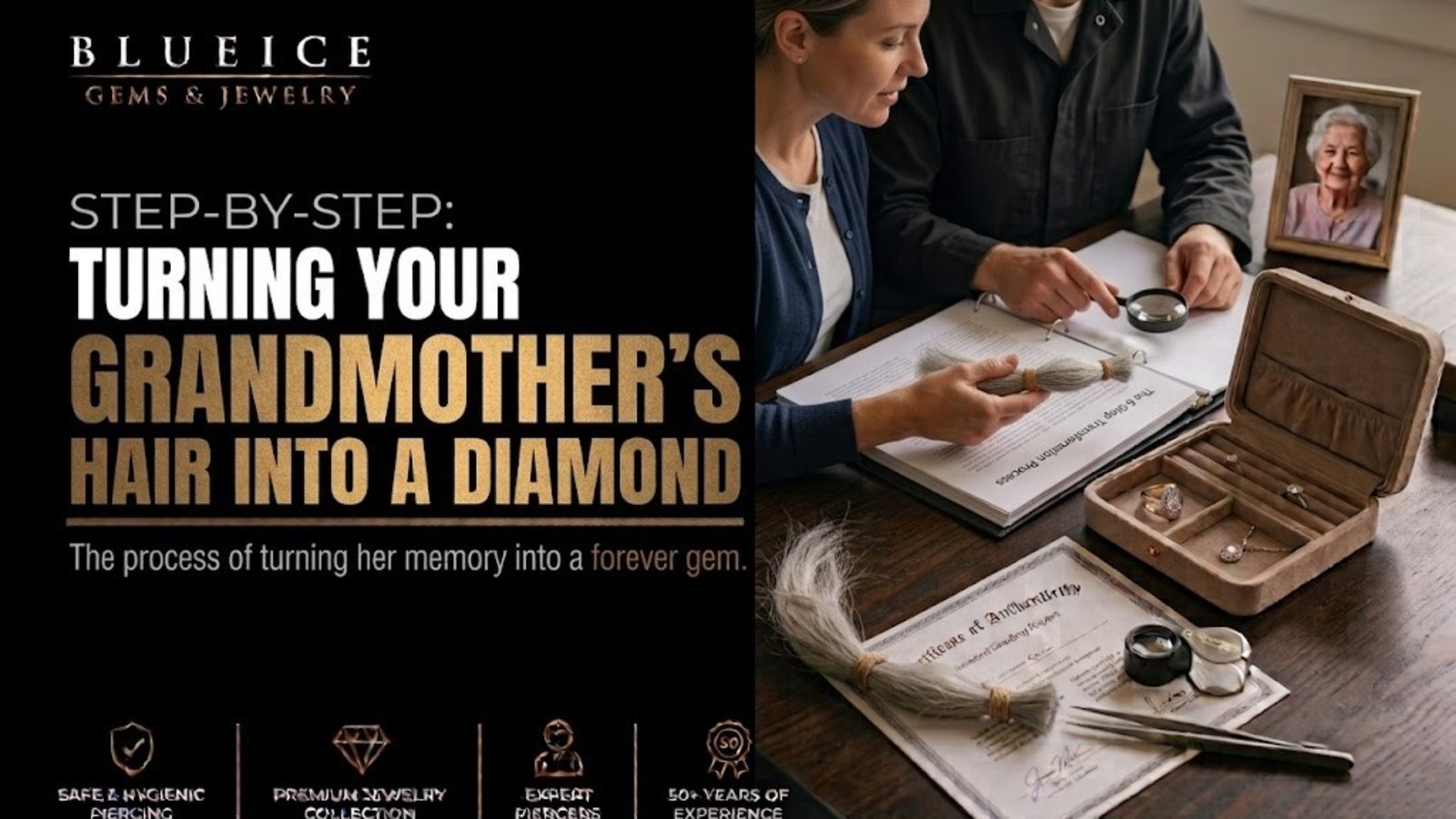
Maybe a lock of her hair sits in an envelope in a drawer, or a cousin mentions a keepsake they have quietly held onto for years. The grandmother hair diamond steps come down to ten stages: confirm the hair is hers, check whose agreement matters, choose a provider, confirm the amount and condition, choose the stone, and ship it; the lab then extracts the carbon, grows the diamond and finishes it before delivery, typically within 6–10 months overall.
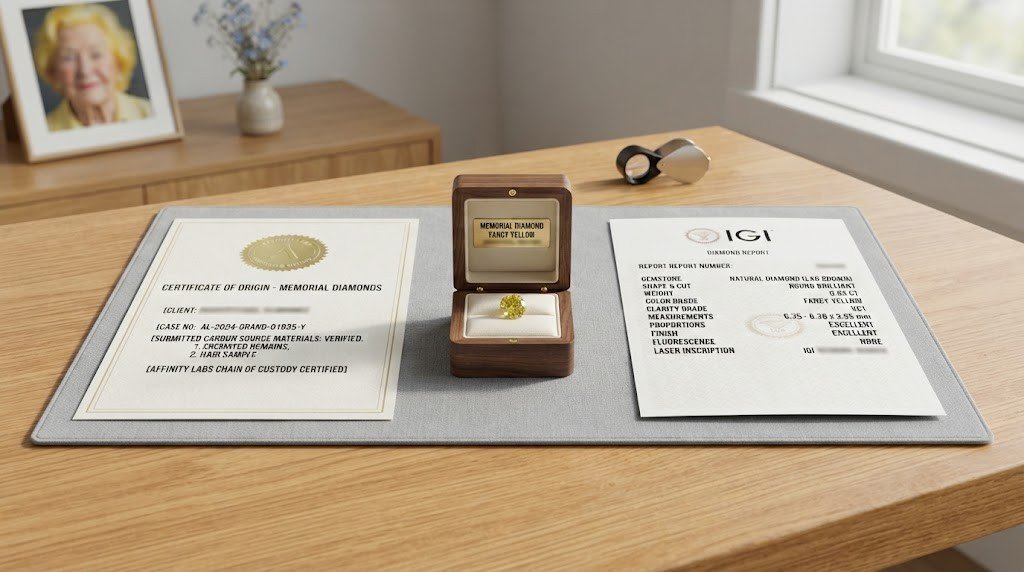
Table of Contents
What are the grandmother hair diamond steps, from start to finish?
The grandmother hair diamond steps are ten ordered stages. Your family handles the first six and the provider’s lab the last four, so reading the whole sequence first shows which choices are yours and which belong in a written question.
- Find hair that is certainly hers — a saved lock, a keepsake, or hair a relative kept.
- Check whose agreement matters — the relatives who share her memory and anyone who holds the hair.
- Choose a provider and put your questions to them in writing.
- Confirm the amount and condition of the hair with that provider.
- Choose carat, color and cut, at whatever point the provider asks for them.
- Pack and ship the hair with tracking, following the provider’s own instructions.
- Extraction and purification of the carbon in the lab.
- Graphitization and growth of the diamond.
- Finishing — cutting, optional irradiation and optional independent grading.
- Delivery, along with a clear answer about any hair that was not used.
Providers word their stages differently, so hold these grandmother hair diamond steps up against any company’s own explanation; a missing stage is worth a question.
How do you find hair that is certainly your grandmother’s?
Step 1: Locate hair you can trace to her
Start with hair you know came from her and no one else. Of all the grandmother hair diamond steps, this is the most personal, and it is practical too: an origin certificate can only document what your family actually sent.
Places worth searching, or relatives worth asking, include:
- A lock saved in an envelope, card, book or small box, ideally with her name or a date written nearby.
- A locket, brooch or framed keepsake that holds hair.
- Hair a relative kept, perhaps an aunt, uncle or cousin.
- Her own hairbrush, which may hold her hair but could also hold someone else’s, so ask whether brush hair is accepted.
If she died recently and the funeral is still ahead, the funeral home may be able to cut a small lock before burial or cremation, if asked in time and with the agreement of whoever holds authority over her arrangements. Whether a provider accepts each of these sources is a question for that provider, never something to assume.
Whose agreement should you check before you begin?
Step 2: Talk with the people who share her memory
Before any hair leaves your hands, and before the other grandmother hair diamond steps begin, find out who else would want a say. Rules about remains are aimed at the remains themselves, so a lock already in your keeping is usually simpler in practice than ashes would be. Still, what she owned may belong to her estate, details differ by state, and if a cousin or aunt holds the lock, the choice is theirs to talk through with you, not yours alone.
People worth including might be:
- Her surviving spouse or partner, if there is one.
- Her children, who may include your own parent, aunts and uncles.
- Cousins or siblings who were close to her or who also hold some of her hair.
- The executor or personal representative, if her estate is still being settled.
None of these relationships can be assumed, and families include step-, adoptive and chosen ones. The purpose of this second of the grandmother hair diamond steps is simple: nobody should discover the diamond after it exists and feel shut out of a choice they cared about. An estate attorney can explain the rules where you live, and our guide to talking with family about a grandmother memorial diamond suggests gentle ways to begin.
How do you choose a provider, and what should you ask in writing?
Step 3: Choose a provider and keep their answers
Choose a provider whose answers you can keep in writing, because almost every practical detail of the grandmother hair diamond steps differs from one company to the next.
Send these questions in writing before the grandmother hair diamond steps go any further:
- Which kinds of hair do you accept: a cut lock, a keepsake, brush hair, or hair cut by a funeral home?
- How much hair do you need for the size of stone we want?
- Do you add supplemental lab carbon, and how much of the finished stone comes from her hair?
- How do you track the hair from arrival to the finished diamond?
- What happens to hair you do not use, and can it come back to us?
- What is your current price, what does it include, and what costs extra?
- What are your refund and cancellation terms?
- Is the stone graded independently, and by which lab?
Hair is roughly 50% carbon by weight, which is why a small amount is typically enough, but no industry-wide figure is published for how much of a finished hair diamond comes from the hair itself. Supplemental lab carbon is typically added, so ask each provider to state its own figure in writing. Our full list of questions to ask before turning your grandmother’s hair into a diamond goes further into each one.
Is there enough hair, and does its condition matter?
Step 4: Confirm amount and condition with the provider
Industry-wide, a hair diamond typically needs a small lock or a few grams of hair, but each provider sets its own requirement, so this stage of the grandmother hair diamond steps is about confirming rather than guessing.
Her hair may be gray, white, dyed, permed or thinning, or it may be a short trim rather than a long lock. Nothing published shows that any of these makes hair more or less suitable, or changes the color of the finished stone. Describe the hair as it is, and ask whether the provider would like a photo before you ship anything.
If the hair is shared among relatives, this is also the moment to ask whether one lock could serve more than one stone, since only a portion is typically used. For a closer look at quantities, see how much hair a grandmother memorial diamond needs.
Which stone choices come before the hair is shipped?
Step 5: Decide on carat, color and cut
Carat, color and cut guide how the lab grows the stone, so within the grandmother hair diamond steps they are worth settling early; ask the provider whether it needs them before the hair is sent. Growth time, not the quantity of hair, sets the carat size, so sending more hair does not produce a bigger diamond.
- Carat: memorial diamonds typically range from about 0.10 carats to 5 carats or more.
- Color: yellow comes from trace nitrogen and blue from boron; a colorless stone excludes both and is usually priced higher. Yellow, blue and champagne or brown tones are common in memorial stones, and irradiation after growth, where offered, can give red, pink, green or black.
- Cut: round, princess, cushion and oval are common, with fancy cuts often extra.
No source makes the color of a hair diamond predictable, and nothing published shows that gray, white or dyed hair leads to a lighter or darker stone. Our article on the color a diamond from your grandmother’s hair might be explains why.
As a general 2026 industry guide, roughly 0.10–0.25 carats runs 1,500–3,500, 0.5–1 carat 5,000–15,000 (more for colorless) and 2–5+ carats 20,000–75,000 or more, with settings, engraving, fancy cuts and grading usually extra. These are not any one provider’s prices, so ask for a written quote before you commit to the grandmother hair diamond steps that follow.
How should the hair be packed and shipped?
Step 6: Pack it, record it and track it
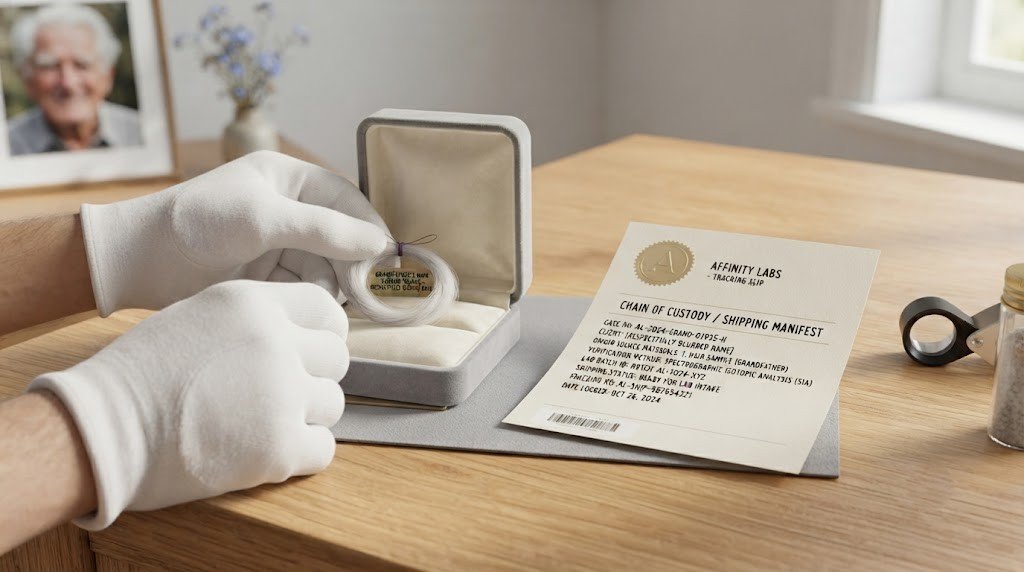
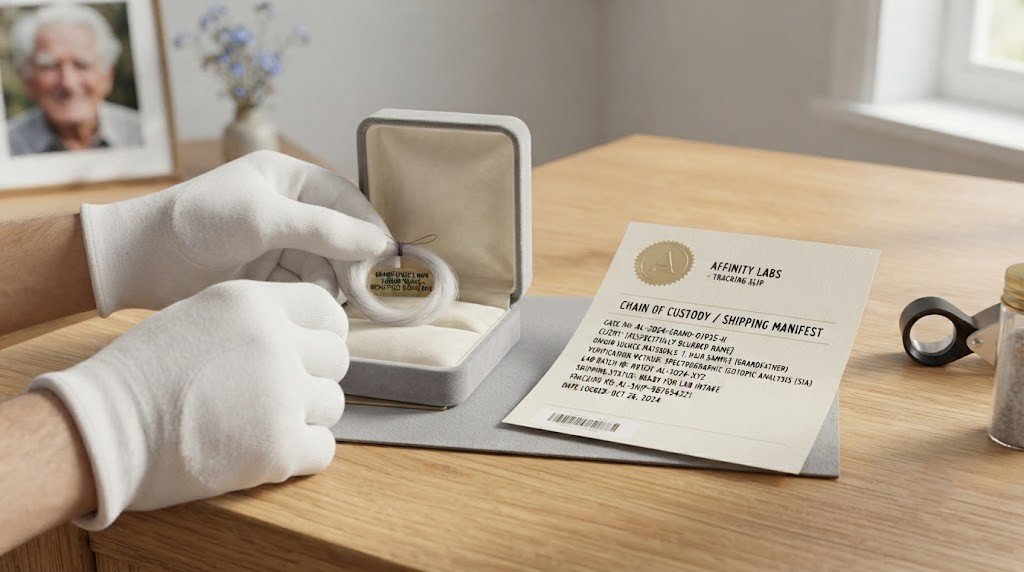
Shipping is where the grandmother hair diamond steps pass from your hands to the lab’s, so pack and ship the hair exactly as the provider instructs, using a tracked service, and keep your own record of what went into the parcel. Whether a collection kit is provided, and what it would contain, is a question for them.
A few habits make this part of the grandmother hair diamond steps calmer:
- Photograph the hair next to a note with her name before you pack it.
- Keep it dry, in whatever container the provider asks for.
- Write down the tracking number and the date you sent it.
- Ask the provider to confirm in writing when the hair has arrived.
If several relatives hold some of her hair, agree beforehand whose lock is sent. Once the lab confirms receipt, the hair enters the provider’s chain of custody, and the remaining grandmother hair diamond steps take place in the lab.
What happens to her hair inside the lab?
Step 7: Extraction and purification
Extraction is the first of the grandmother hair diamond steps carried out entirely by the lab, which separates the carbon from everything else in the hair. Hair is mainly keratin, a protein roughly half carbon by weight, and controlled oxygen-free heating removes the rest. The carbon left behind is purified to roughly 99.9% or higher.
Step 8: Graphitization and growth
Heated further, to roughly 2,500–2,700°C, the purified carbon becomes graphite, the feedstock a diamond press uses. It is typically blended with supplemental lab carbon to reach a workable volume, then grown around a tiny diamond seed. HPHT, the industry-standard method, recreates around 6–8 GPa and roughly 1,400–2,500°C; a minority of providers use CVD, which builds carbon onto a seed plate layer by layer. This overview of synthetic diamond growth describes both.
What emerges is a real diamond, not a simulant or resin, grown partly from carbon that came from her hair. Our explanation of how a memorial diamond is made from your grandmother’s hair looks at the science of these two grandmother hair diamond steps in more depth.
How is the rough diamond finished and documented?
Step 9: Cutting, optional color treatment and grading
Finishing is the last of the grandmother hair diamond steps in which your family still has choices to make. Once it is grown, the rough diamond is cut and polished into the shape your family chose. Some providers then offer optional post-growth irradiation to shift or deepen the color, which is how red, pink, green and black memorial stones are typically produced.
You may receive two separate documents with the stone:
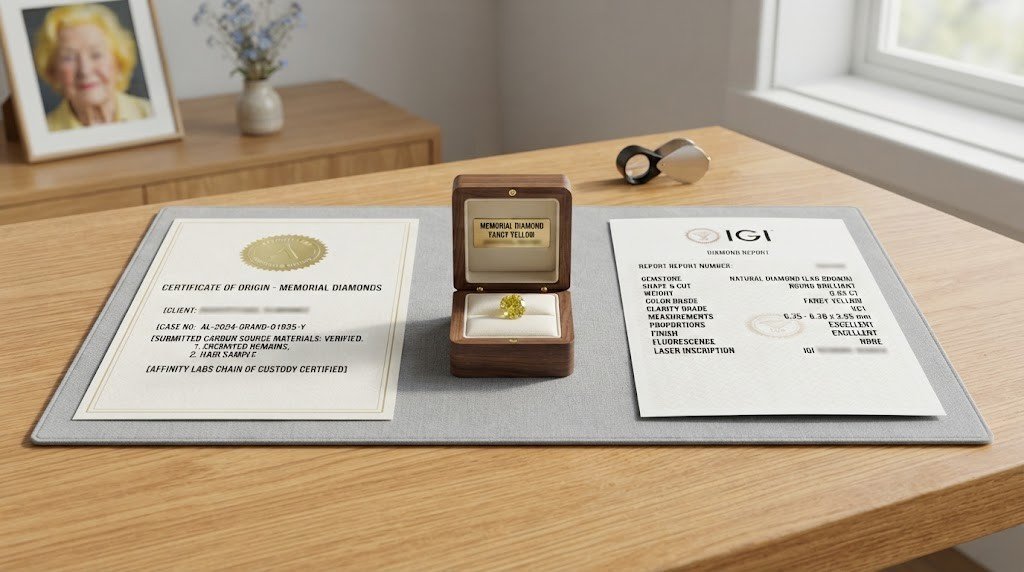
- An origin or authenticity certificate, usually issued in-house, records that the diamond was grown from the hair your family sent. It is essentially a chain-of-custody record.
- A grading report, ideally from an independent lab, describes the stone’s quality using the 4Cs set out in GIA’s diamond quality factors. GIA standards are the most common reference, and IGI is sometimes used.
Independent grading is optional and usually extra; memorial diamond clarity typically falls between SI2 and VVS. Before the grandmother hair diamond steps begin, ask whether grading is included, which lab is used, and whether the report will note the stone’s lab-grown origin.
What arrives at the end, and what happens to the unused hair?
Step 10: Receive the diamond and confirm what remains
The last of the grandmother hair diamond steps is delivery: the finished stone, loose or set, with whatever certificate or report you arranged. Check the paperwork against what you were promised.
Because only a portion of the hair is typically used, ask what becomes of the rest. You might want it returned, kept for a second stone, or left with the provider; get the answer, and any time limit, in writing before you ship.
A diamond is 10 on the Mohs scale, yet a hard knock can still chip it, so ask a jeweler about a protective setting for everyday wear.
Who does what at each of the grandmother hair diamond steps?
The family makes the decisions in the first six grandmother hair diamond steps and remains the decision-maker on finishing, while the provider’s lab carries out the technical work. This summary shows where each responsibility sits.
| Step | What happens | Who does it | What the family decides |
|---|---|---|---|
| 1. Find her hair | A lock or keepsake that is certainly hers is located | You and relatives | Which hair to use |
| 2. Check agreement | Relatives and anyone holding hair are consulted | You | Who is part of the decision |
| 3. Choose a provider | Questions are sent and answered in writing | You and the provider | Which provider to trust |
| 4. Confirm the hair | Amount and condition are checked against requirements | The provider, with your description | Whether to proceed |
| 5. Choose the stone | Carat, color and cut are agreed | You | Size, color, shape, budget |
| 6. Ship | Hair is packed, tracked and logged on arrival | You, then the provider | How the parcel travels |
| 7. Extraction | Carbon is separated and purified | The lab | Nothing at this stage |
| 8. Growth | Carbon is graphitized and grown with a seed | The lab | Nothing at this stage |
| 9. Finishing | The stone is cut, optionally treated and graded | The lab and grader | Irradiation and grading options |
| 10. Delivery | The stone and documents arrive | The provider | What happens to unused hair |
Kept beside the paperwork, it shows which of the grandmother hair diamond steps still needs an answer.
How long do the grandmother hair diamond steps take overall?
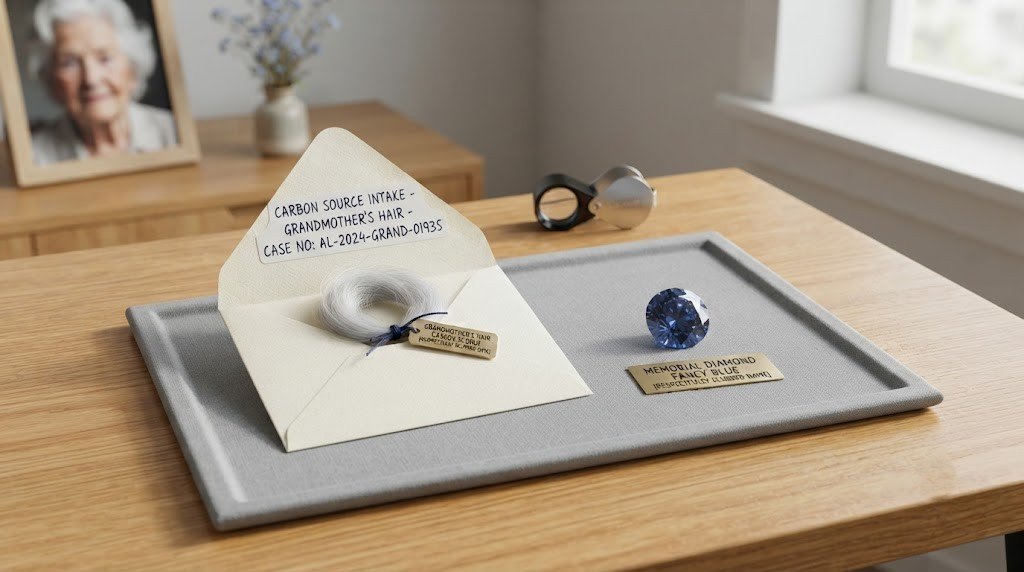
The grandmother hair diamond steps typically take 6–10 months in total, counted from the day the lab receives the hair; a stone of around 2 carats or larger, or a specialty color, can stretch that toward 12 months. No reliable timing is published for individual stages, and the family’s early conversations should never be rushed.
Carat size has a large effect on how long the grandmother hair diamond steps take, because a larger stone spends longer in the press, and a specialty color can add time. If a date matters, ask the provider in writing whether it is realistic. Our article on how long a grandmother memorial diamond takes covers what can affect the schedule.
What if she was buried, or faith shapes the family’s choices?
Hair needs no cremation, so the grandmother hair diamond steps stay open to you if your grandmother was buried, provided hair that is certainly hers was kept.
Faith deserves its own conversation. No religious tradition has an official position on memorial diamonds specifically; traditions address cremation and the handling of ashes. Islam and Orthodox and Conservative Judaism generally object to cremation itself, so a hair-based stone sits outside that cremation-specific objection. In those traditions and every other, your own clergy are the right people to ask before the grandmother hair diamond steps begin.
If ashes are part of your family’s plans as well, the step-by-step guide to turning your grandmother’s ashes into a diamond walks through that route, and the complete guide to a grandmother hair diamond puts the grandmother hair diamond steps in wider context.
Frequently Asked Questions
Can I begin if I only have a few strands of her hair?
Yes, you can begin by asking. A hair diamond typically needs a small lock or a few grams, but requirements differ, so describe exactly what you have, send a photo if invited, and ask the provider in writing whether it is enough before going further.
Will the finished diamond be made entirely from her hair?
No. Supplemental lab carbon is typically blended with the carbon taken from her hair, and no industry-wide figure is published for how much of a finished hair diamond comes from the hair. Ask the provider for its own figure in writing before you order.
Does it matter how long ago her hair was cut?
Nothing published says older hair is unsuitable, but every provider sets its own standards. Tell them roughly when the lock was cut and how it has been stored, and ask in writing whether its age or condition affects anything in the grandmother hair diamond steps.
Can one lock of her hair become more than one diamond?
Often it can, since the grandmother hair diamond steps typically use only a portion of the hair. Whether your lock is enough for two or more stones depends on the provider’s requirements and the sizes you want, so ask before you ship and keep the answer.
Can a grandchild arrange this without telling the rest of the family?
Possibly, if the lock is already yours, though telling them is usually kinder. Hair in your keeping is usually simpler in practice than ashes, yet her belongings can form part of her estate, rules vary by state, and hair a relative holds is theirs to discuss.
Final Thoughts on Turning Your Grandmother’s Hair Into a Diamond
There is no rush built into the grandmother hair diamond steps. A lock that has waited in a drawer can wait a little longer while you find the right people and the right questions. When the time feels right, the grandmother hair diamond steps are simply a way of keeping the decisions in your family’s hands, one at a time.
Learn More About Grandmother Memorial Diamonds
- Grandmother hair diamond: the complete guide the wider picture, from science to settings.
- How to turn your grandmother’s hair into a diamond a shorter overview of the same journey.
- Is a memorial diamond really made from your grandmother’s hair? an honest look at what the stone contains.
- Choosing a memorial diamond for your grandmother where to start if you are still deciding.
Talk With Memorial Diamond
If you have found a lock of her hair and would like someone to walk through the grandmother hair diamond steps with you, the team at Memorial Diamond is happy to answer your questions, at whatever pace suits your family. There is no obligation, just a conversation whenever you are ready.
Leave A Comment