
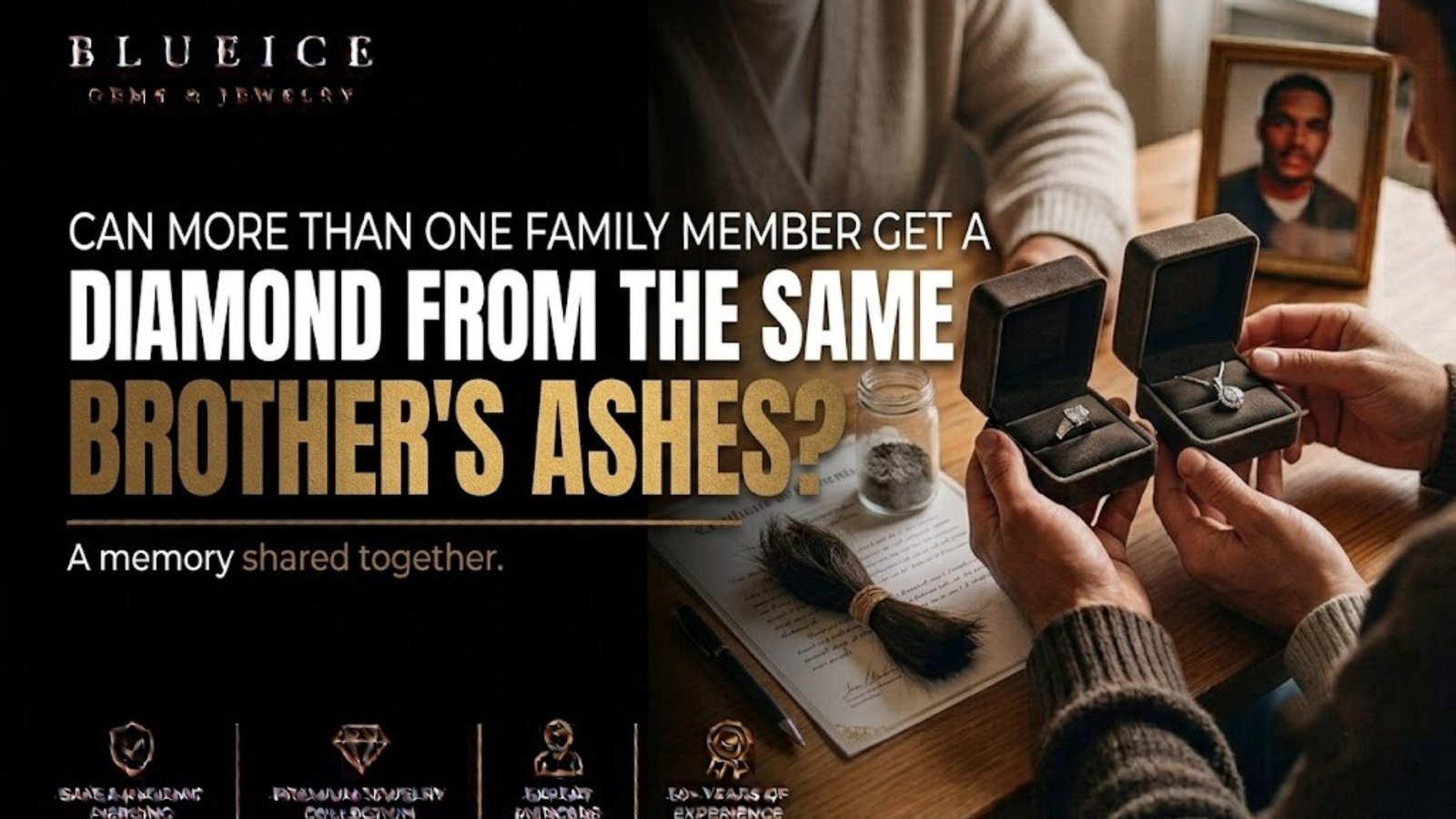
The people who loved a brother rarely live under one roof, and the question of who keeps what can feel heavy long before it feels practical. Yes, more than one family member can often get a diamond from the same brother’s ashes. Each stone typically draws on only a small portion, so sharing a brother memorial diamond source among the relatives who want one is often possible, as long as whoever holds authority over his remains agrees.
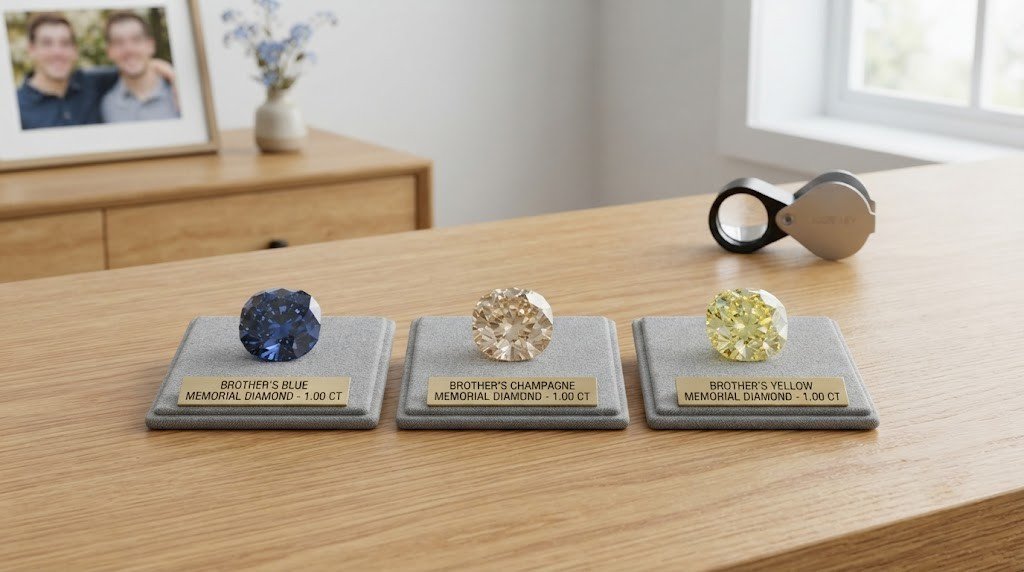
Table of Contents
Can Several Family Members Each Get a Diamond From His Ashes?
Often, yes. Every memorial diamond is a genuine diamond grown in a lab, and part of its carbon is drawn out of the ashes or hair you send; crucially, each stone needs only a measured share of that material, never all of it. That leaves room for a second stone, a third, or more, depending on how much material is available and what the provider requires.
Who might want a stone looks different in every family. Around him there may be other siblings, parents, and perhaps a spouse or partner, children, or friends who were family by choice. Not every brother has all of these people, and no family should feel it has to fit a template. Sharing a brother memorial diamond source simply means that more than one of the people who loved him can carry a stone grown from the same remains.
The practical answer depends on three things: how much of his ashes the family can set aside, the provider’s minimum per stone, and agreement from the person who holds authority over his remains. When all three line up, sharing a brother memorial diamond among several relatives is a workable request. For background on memorial diamonds as a category, including how the practice developed, the overview is a useful starting point.
Why Can One Brother’s Ashes Become More Than One Stone?
Cremated remains are mostly calcium phosphate, the mineral structure of bone, and carbon makes up only a small share of them, roughly 0.5 to 4 percent by weight across industry figures. Providers extract and purify that carbon to around 99.9 percent purity, then typically blend it with supplemental lab carbon so there’s enough feedstock to grow a stone. From ashes, the personal carbon typically lands at around 10–15% of what the finished diamond weighs, though a few providers put it as low as roughly 3%.
Because of that blending, each diamond needs only a modest amount of ash. Industry requirements generally fall between a few tablespoons and about 4 ounces, or roughly 100 grams, per stone. A full cremation produces far more than that, which is why sharing a brother memorial diamond source among relatives is often feasible while still leaving most of his ashes for an urn, burial, or scattering. The page on how much ash a brother memorial diamond typically needs goes into the ranges in more depth.
One point can come as a surprise: a bigger portion of ashes doesn’t make a bigger diamond. Carat size is set by how long the stone grows in the press, not by how much material arrives. So dividing his ashes among several relatives doesn’t shrink anyone’s stone. For a full walk-through of the process, the brother ashes diamond complete guide covers extraction, growth, cutting, and grading.
Who Decides on Sharing a Brother Memorial Diamond Source?
The right to direct what happens to his remains usually rests with one person or a defined group, and it isn’t always a sibling. Each state sets its own priority order. That order commonly puts a surviving spouse or registered partner first, then adult children, then parents, with siblings after them, but it varies. If he chose a person to make these calls, or set out his wishes on paper ahead of time, that can shift who decides.
For a sibling hoping to receive a stone, this can feel like an awkward gap between love and paperwork. The respectful path is to ask the authority holder directly whether a small portion of his ashes could be set aside for you. Framing it as a request rather than an expectation tends to keep the conversation gentle, and it acknowledges that the person deciding is grieving too.
When siblings themselves hold authority, perhaps because no spouse, partner, child, or parent is in that role, the decision may be shared among several of you. If you’re unsure where you stand, the funeral home or crematory involved may be able to explain who signs which forms. Sharing a brother memorial diamond source works best when that question is answered first, before anyone places an order.
How Do You Open the Conversation About Sharing a Brother Memorial Diamond?
There’s rarely a perfect moment to raise sharing a brother memorial diamond. Some families raise the idea while arrangements are being made; others wait weeks or months. Either is fine. Ashes can be kept safely while people decide, so there’s no need to rush anyone.
A few approaches can make the first conversation easier:
- Lead with the memory, not the product. Talk about wanting something of his to keep close before talking about diamonds, carats, or prices.
- Ask, don’t announce. “Would you be open to setting aside a small portion for a few of us?” invites a real answer.
- Name who might want one. Mentioning everyone who could be interested, siblings and anyone else close to him, helps no one feel overlooked later.
- Share the facts. Knowing that each stone uses only a small portion can ease worries that a diamond will take the ashes away from the urn or the burial.
- Leave room for no. Some people will want a stone; others won’t. Both answers are valid.
Sharing a brother memorial diamond plan in writing afterward, even in a short group message, helps everyone remember what was agreed.
What Are the Steps for Sharing a Brother Memorial Diamond Among Relatives?
The order below keeps the decisions in a sensible sequence so nobody commits money before the basics are settled. Each step can take as long as your family needs.
| Step | What happens | Typically involved |
|---|---|---|
| 1. Check whose decision it is | Learn who has the final say over his remains under state rules and any wishes he left | The authority holder, with guidance from the funeral home |
| 2. Gather interest | Learn who would like a stone of their own | Siblings, plus his spouse, partner, children, or parents if they’re part of the family |
| 3. Agree on portions | Decide how much ash is set aside and for whom | The authority holder, using the provider’s per-stone minimum |
| 4. Choose stones | Each recipient picks carat, color target, cut, and setting | Each person, alone or together |
| 5. Settle costs | Agree who pays for which stone and any shared fees | Everyone contributing |
| 6. Place orders | Order together, or reserve portions for later orders | Whoever coordinates with the provider |
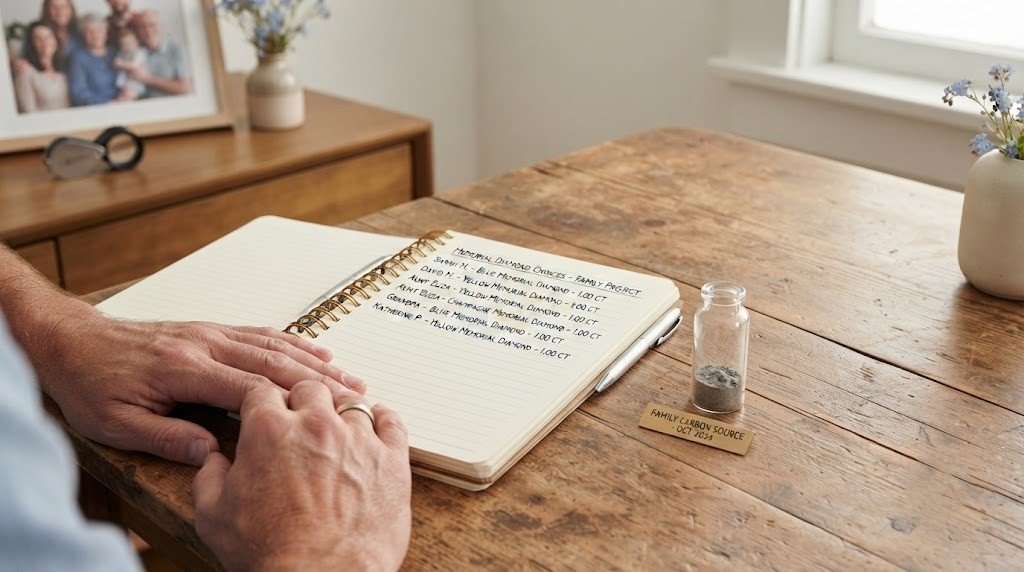
Writing these decisions down protects relationships as much as logistics. When sharing a brother memorial diamond source among several households, a simple list of names, portions, and choices prevents confusion months later when stones arrive. It’s worth keeping a copy with whoever holds the remaining ashes.
Should Everyone Choose Matching Stones or Individual Ones?
Both work when sharing a brother memorial diamond source. Matching stones, ordered at the same carat, cut, and target color, can feel like a family emblem: each person carries a piece that echoes the others. Individual stones let each recipient choose what suits their life, whether that’s a small pendant, a larger ring, or a loose stone kept in a box.
Color deserves an honest note. Memorial diamonds tend toward yellow, blue, and champagne tones, since nitrogen during growth produces yellow and boron produces blue; a colorless stone requires excluding both and typically costs more. Even stones grown from the same ashes and ordered in the same target color can differ slightly in shade, because the exact color can’t be predicted from the source. If perfect matching matters to your family, ask the provider how closely they can align several stones.
A middle path suits some families: the same color target for everyone, with each person choosing a different setting. For inspiration, the guide to rings, pendants, and keepsake ideas covers settings for every kind of wearer. Sharing a brother memorial diamond source doesn’t mean everyone must wear the same thing.
How Can Relatives Split the Cost of Sharing a Brother Memorial Diamond?
Each diamond is generally priced as its own stone, so the cost of sharing a brother memorial diamond source scales with the number of stones and the choices made for each. Industry-wide 2026 ranges give a sense of scale: a stone of roughly 0.10 to 0.25 carats commonly runs $1,500 to $3,500; half a carat to one carat about $5,000 to $15,000, with colorless near the top; and two to five carats or more about $20,000 to $75,000 and up. Grading reports, engraving, fancy cuts, and settings usually add to that. The full brother memorial diamond cost guide breaks this down further.
Families approach the split in different ways:
- Each person pays for their own stone. Simple, and it lets everyone choose freely within their own budget.
- Everyone pays an equal share. Works well when stones are matched, so each piece costs the same.
- One person covers the others. Sometimes a relative wants to give the stones as a gift; that’s a generous option, never an obligation.
- A shared fund. Contributions go into one pot by agreement, with any difference handled openly.
Ask the provider whether any processing is charged once per source or once per stone, and whether multi-stone orders are priced differently. Sharing a brother memorial diamond order goes more smoothly when everyone sees the same quote before agreeing.
When Sharing a Brother Memorial Diamond, Should You Order Together or Later?
Ordering together has clear advantages. All the material goes through a single intake, the stones can be planned with the same color target, and everyone’s pieces may arrive on a similar schedule. Industry turnaround typically runs 6 to 10 months, and larger or specialty-color stones can take up to about 12; the brother memorial diamond timeline explains what drives that.
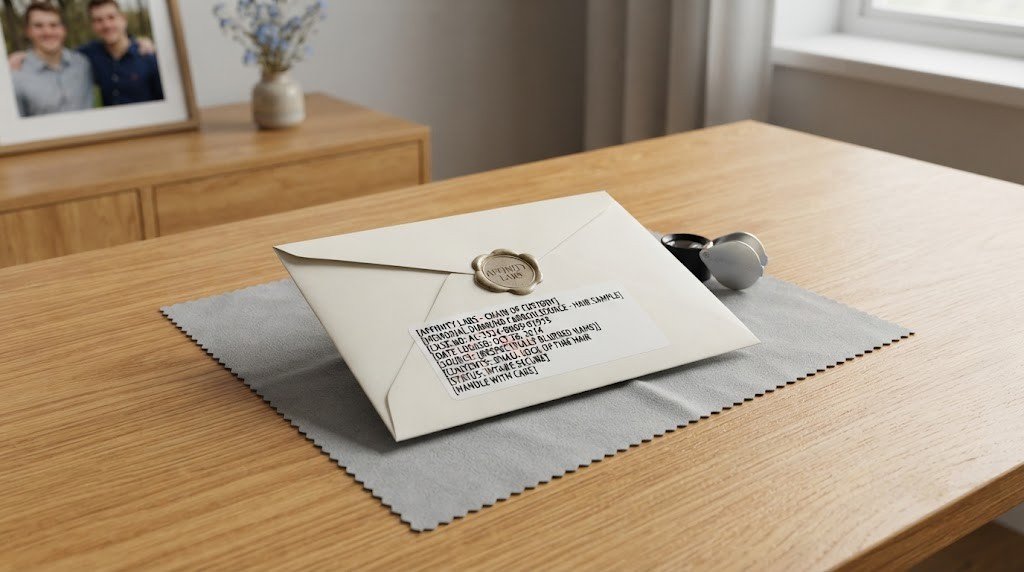
Ordering later may also be possible, but how it works depends on the provider. One might hold a reserved portion, another might return unused material, or the family might keep the remaining ashes and send a new portion when someone is ready. Ask how each option is handled, labeled, and tracked, because chain of custody matters just as much for the third stone ordered two years later as for the first.
Later orders suit relatives who aren’t ready yet, younger family members who may want a stone as adults, or anyone whose budget needs time. Sharing a brother memorial diamond source doesn’t require every decision to happen at once.
Can His Hair Help With Sharing a Brother Memorial Diamond?
Sometimes. Hair is roughly half carbon by weight, built from the protein keratin, so a small lock of a few grams is typically enough for a stone. No published figure exists for what share of a finished diamond comes from hair, but its high carbon content means far less material is needed than with ash. The guide to how much hair a brother memorial diamond needs covers the details.
Hair can help when the ashes available are limited, when he was buried rather than cremated, or when relatives would like a stone without dividing the ashes further. A lock saved at home or found among his belongings may be treated as part of his estate, and the rules differ from state to state, so it’s wise to check before using it. Hair a funeral home trimmed is generally released through the person who holds authority over his remains.
Families sometimes combine routes: one or two stones from his ashes, another from his hair. When sharing a brother memorial diamond across the family, you can draw on whichever material is available and agreed upon.
What If Not Everyone Wants a Diamond?
That’s entirely normal when sharing a brother memorial diamond source among relatives. One relative may want a ring, another may prefer the urn on a shelf, and another may want to scatter a portion somewhere he loved. Burial, keeping an urn, and scattering are all meaningful choices, and a memorial diamond sits alongside them rather than above them.
Because a diamond uses only a small fraction of the ashes, choosing a stone rarely conflicts with other plans. Cremation is now the more common choice in the United States, with NFDA’s 2025 cremation and burial report projecting a cremation rate of 63.4 percent for 2025.
If faith is part of the picture, it’s worth knowing that no religious tradition has an official position on memorial diamonds specifically. Views on cremation and dividing ashes differ, so a conversation with your own faith leader can help. Sharing a brother memorial diamond source should never pressure anyone into a choice that doesn’t sit right with them.
What Should You Ask a Provider Before Sharing a Brother Memorial Diamond Order?
A clear list of questions protects everyone, especially when several households are involved. Consider asking:
- What is your minimum amount of ash or hair per stone, and how many stones can our portion support?
- How do you label and track each stone back to the right recipient?
- Can we order several stones at once, and is pricing different for multiple stones?
- Can we reserve a portion for a later order, or will unused material be returned?
- How closely can you match color across stones from the same source?
- What happens if a growth attempt doesn’t succeed?
- Does each stone come with an origin certificate, and is independent grading available?
A longer list of questions to ask before turning his ashes into a diamond covers process, grading, and custody in more detail. Sharing a brother memorial diamond order is easier when every relative hears the same answers.
Frequently Asked Questions
Can siblings each get a diamond from one brother’s ashes?
Often, yes. Each memorial diamond typically uses only a small portion of the ashes, so several stones can often be grown from the same remains. The person who holds authority over his remains needs to agree, and the provider’s per-stone minimum applies.
Who has to agree before sharing a brother memorial diamond source?
Whoever holds authority over his remains. Depending on the state, that’s commonly a spouse or registered partner, then adult children, then parents, with siblings after them. His written wishes, such as a designated agent or will, can change that order.
Will every diamond from his ashes look the same?
Not necessarily. Stones from one source can be ordered in the same carat, cut, and target color, but the exact shade can still vary slightly, because color can’t be predicted from the ashes. Ask the provider how closely stones can match.
Can someone order a stone years later from the same ashes?
Often, though it depends on the provider. A provider might hold a reserved portion or return unused material, and families can also keep the remaining ashes and send a new portion later. Ask how storage, labeling, and chain of custody work.
How can relatives divide the cost of several stones?
Each stone is generally priced separately, so relatives might each pay for their own, split matched stones equally, pool funds, or let one person give the stones as a gift. Ask whether any processing fees apply once per source or per stone.
Is sharing a brother memorial diamond possible if he was buried?
It can be, through hair rather than ashes. Hair saved before burial, or kept among his belongings, can typically supply a stone from just a few grams. Hair kept at home may be part of his estate, and rules vary by state.
Final Thoughts on Sharing a Brother Memorial Diamond
A brother can mean something different to each person who loved him, and a shared source with separate stones honors that. Some relatives will want matching pieces, some their own, and some none at all. What matters is that the decision is made together, with patience, and with room for everyone’s grief.
Learn More About Diamonds for Several Relatives
- Brother ashes diamond: the complete guide the full process from ashes to finished stone
- How much ash a brother memorial diamond needs typical ranges per stone when sharing a brother memorial diamond source
- How much a brother memorial diamond costs price tiers and add-ons
- Ideas for rings, pendants, and keepsakes settings for every wearer
Talk With Memorial Diamond
If your family is considering sharing a brother memorial diamond source, Memorial Diamond is glad to talk through portions, timing, and options for each person. Reach out at memorialdiamond.us whenever you’re ready, with no pressure to decide anything right away.
Word count: 2,941 words · Reading time: about 15 minutes