son-memorial-diamond-timeline

How Long Does It Take to Make a Son Memorial Diamond?

Parents almost always ask this before they ask anything about price, and the reason is not impatience: it is that the waiting has to be planned for. A son memorial diamond timeline generally runs about six to ten months from the day a laboratory receives your material to the day a finished stone is ready. Stones above roughly two carats, and specialty colors such as black, can stretch that toward twelve.
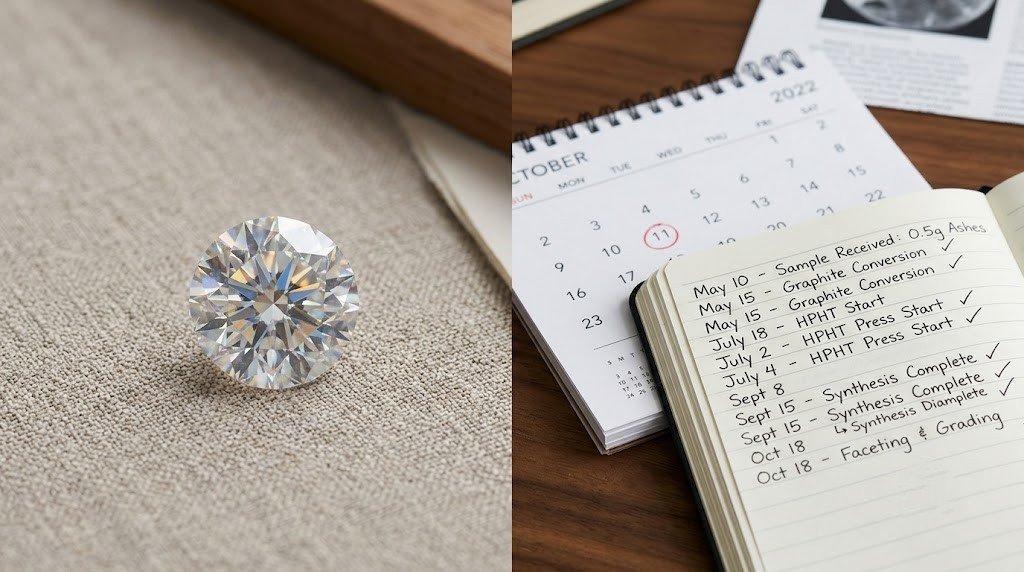
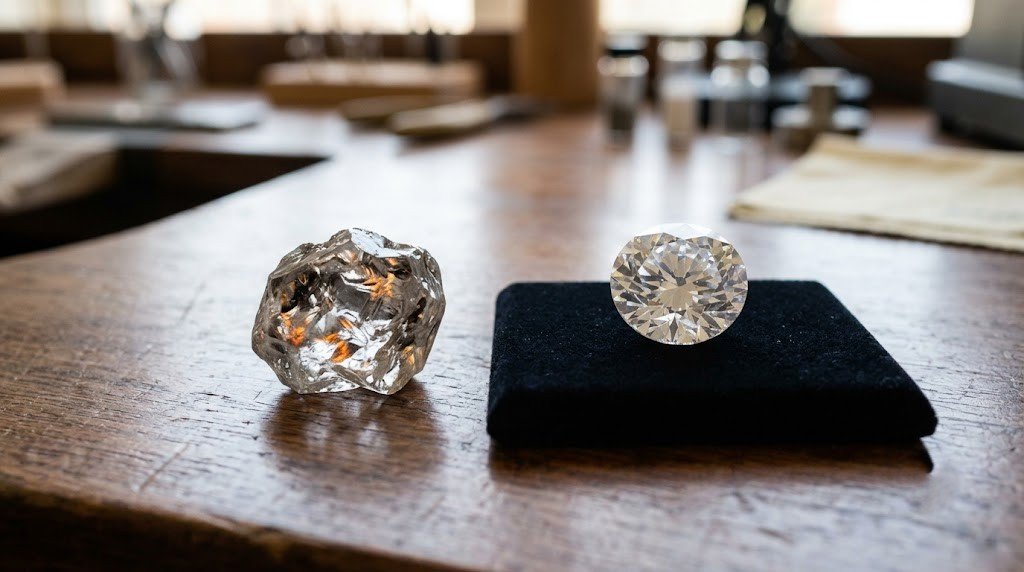
Son memorial diamond timeline shown as a finished memorial diamond resting beside a calendar and a dated laboratory log

How Long Is the Son Memorial Diamond Timeline?

Six to ten months is the honest industry answer for a son memorial diamond timeline, measured from receipt of material to finished stone. That is the band most providers work inside, and it is wide because it has to cover very different commissions.

A small stone in a standard shade sits near the short end of the son memorial diamond timeline. A large stone, an unusual color, or an order with several optional steps attached sits nearer the long end, and can pass twelve months without anything having gone wrong.

None of that band is memorialdiamond.us’s published turnaround, because no turnaround has been published. Treat it as the shape of the category, then ask whoever you commission for their own figure and get it in writing.

The range is not a queue you are stuck in, either. Most of it is a physical process at a fixed pace, and chasing does not shorten the part that takes the time.

Why Does It Take Six to Ten Months?

Because a diamond is not assembled, it is grown. Carbon has to be recovered, purified, converted, crystallized, cut and, in most cases, checked by somebody independent.

Growth itself is the part people underestimate. Inside a high pressure press the cell is held at roughly 6 to 8 GPa and somewhere between 1,400°C and 2,500°C, conditions that imitate the deep mantle, and the crystal builds up slowly under them. A minority of providers grow by chemical vapor deposition instead, layering carbon onto a seed plate in a vacuum chamber.

Either method takes weeks to months of continuous, monitored running, which is the bulk of any son memorial diamond timeline. You can read more about how the two growth methods work if the physics interests you.

Everything either side of growth, the extraction before it, the cutting and grading after, adds meaningfully to the total, but none of it is where the months of a son memorial diamond timeline mostly go.

What Are the Eight Steps in a Son Memorial Diamond Timeline?

Laid out in order, the sequence is easier to hold in your head than a single span of months. Two of the eight are optional, and whether you choose them changes the son memorial diamond timeline total.

#StepWhat happensOptional?
1Intake and documentationMaterial is received, logged and tracked under chain of custody proceduresNo
2Carbon extraction and purificationEverything that is not carbon is stripped away, reaching roughly 99.9%+ purityNo
3GraphitizationThe purified carbon is heated to roughly 2,500 to 2,700°C and converted to graphiteNo
4GrowthHPHT at roughly 6 to 8 GPa and 1,400 to 2,500°C, or CVD for a minority of providersNo
5Cutting and polishingA gemologist shapes the rough crystal into the finished stoneNo
6IrradiationPost growth treatment to shift or intensify color, where offeredYes
7Independent gradingA third party laboratory reports cut, color, clarity and caratYes
8SettingThe stone is mounted as a ring, pendant or earrings, or returned looseYes

What a finished stone can be set into covers that last step, which begins only once a stone exists.

What the library does not publish is how many weeks each individual step takes, and it would be dishonest to invent the breakdown. The documented figure is the overall span; how it divides internally varies by provider and by commission.

So use this list to ask better questions rather than to build a calendar. A provider who can say where your son memorial diamond timeline currently sits, step by step, is telling you something useful about how they work.

When Does the Clock Actually Start?

Not when you decide, and not when you pay. It starts when a laboratory has your material in hand and logged, so every son memorial diamond timeline has a private prologue that belongs entirely to you, and it is worth organizing early.

There is a practical obstacle parents are rarely warned about. Where his remains are concerned, a surviving spouse or registered partner, or, if he had them, his own adult children, can sit above a parent in the order the law recognizes. It turns on your state’s statute and on whatever he put in writing beforehand, so the answer is genuinely local rather than universal.

Sorting that out is often the slowest part of the whole project, and it happens before the son memorial diamond timeline begins. A funeral director can usually tell you quickly who holds that authority; an attorney licensed in your state can resolve anything disputed.

Hair you already keep at home tends to be simpler in practice, though a person’s belongings can still form part of an estate, and a lock somebody else is holding is a conversation to have rather than a decision to make alone.
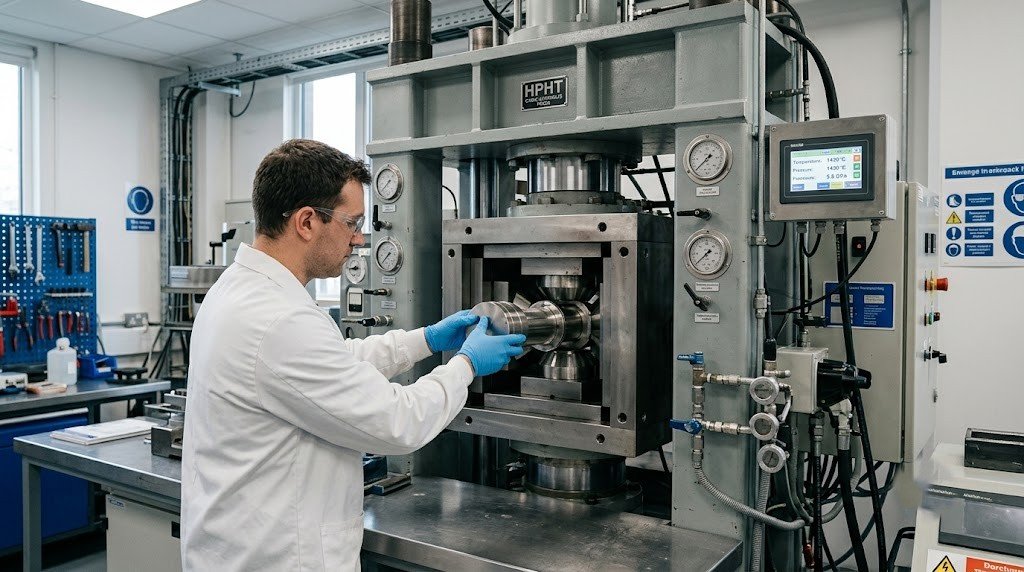
 A high-pressure high-temperature growth press with a sealed cell being loaded by a technician

Which Step Takes the Longest in a Son Memorial Diamond Timeline?

Growth, by a wide margin. Every other step is measured against it, and it is the one step whose length is chosen rather than fixed.

The reason is simple: carat comes from time under pressure. A crystal is built atom by atom, so a stone twice the weight needs considerably more than twice the patience, and the press is occupied throughout, which is why growth dominates any son memorial diamond timeline.

Extraction and graphitization are real work, stripping cremated remains or hair down to almost pure carbon, then converting it to a feedstock, but they are preparation for the long run rather than the long run itself. Cutting and polishing is skilled, careful and comparatively quick.

Because the reference library publishes the overall span and not the stage by stage split, ask each provider how they divide it. Any honest answer will put most of your son memorial diamond timeline inside the growth cell. How the whole sequence runs from intake to finished stone walks through the same order in more detail.

Does Carat Size Change the Son Memorial Diamond Timeline?

Yes, more than any other single choice you make. Size is bought with time in the press rather than with material, so the larger stone is always the longer one.

That has a consequence worth sitting with before you order. A half carat commission and a two carat commission are the same process, the same person’s carbon and the same laboratory, the difference between them is months. Choosing size is therefore choosing a date as much as a price.

It also means sending more of him does not speed anything up or scale anything up. Providers work from a modest portion either way, and a fuller submission neither shortens the son memorial diamond timeline nor produces a bigger crystal. How much ash a memorial stone actually needs covers the usual quantities.

If the wait is the thing you are struggling with most, a smaller stone is a legitimate answer rather than a compromise. What a stone at each size typically costs sets the size question alongside the money one.

Does Color Change the Son Memorial Diamond Timeline?

It can, and specialty shades are the clearest example. Black stones and other treated colors sometimes push a commission toward the twelve month end of the range.

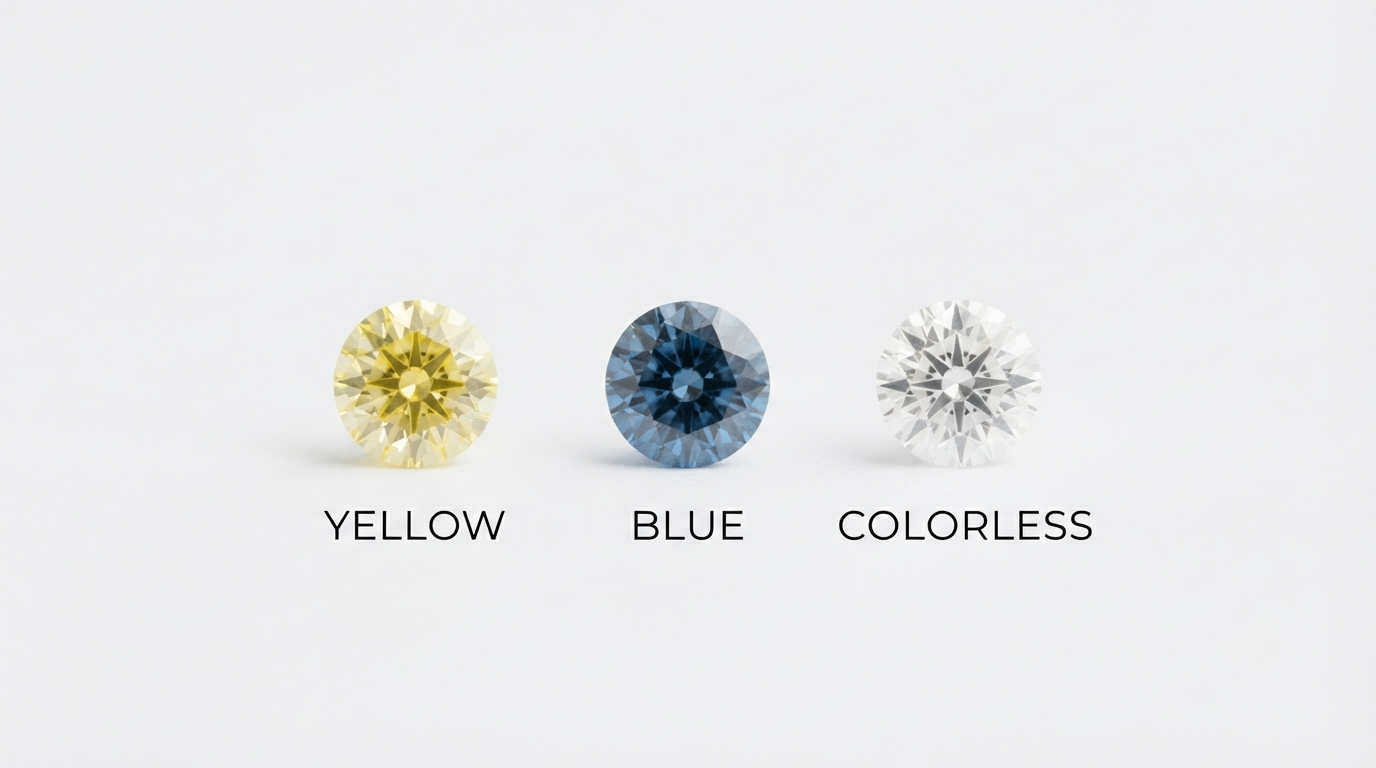
The mechanism differs depending on what you want. A colorless result requires excluding trace elements during growth, which means tighter process control rather than an extra step bolted on. Nitrogen caught in the crystal produces yellow; boron produces blue; only the absence of both reads as colorless.

Treated colors work the other way. Red, pink, green and black are typically produced by irradiating the finished stone after growth, where a provider offers it, and that is an additional stage added to the son memorial diamond timeline rather than a change inside the press.

If a particular shade matters to you, raise it at the quoting stage rather than later, and ask what it adds to the son memorial diamond timeline in weeks. What color to expect from his ashes explains why warm tones are the usual outcome.

Is the Son Memorial Diamond Timeline Different for Ashes and Hair?

The published son memorial diamond timeline covers both routes, and the growth stage, the long one, is essentially the same either way. Where they differ is in what has to happen before growth can begin.

Cremated remains are mostly calcium phosphate, and the carbon worth recovering is between about 0.5% and 4% of their weight. Once purified and topped up with lab carbon so there is enough volume to grow with, that personal carbon usually represents on the order of 10% to 15% of the finished crystal’s mass, with some providers publishing figures as low as 3%.

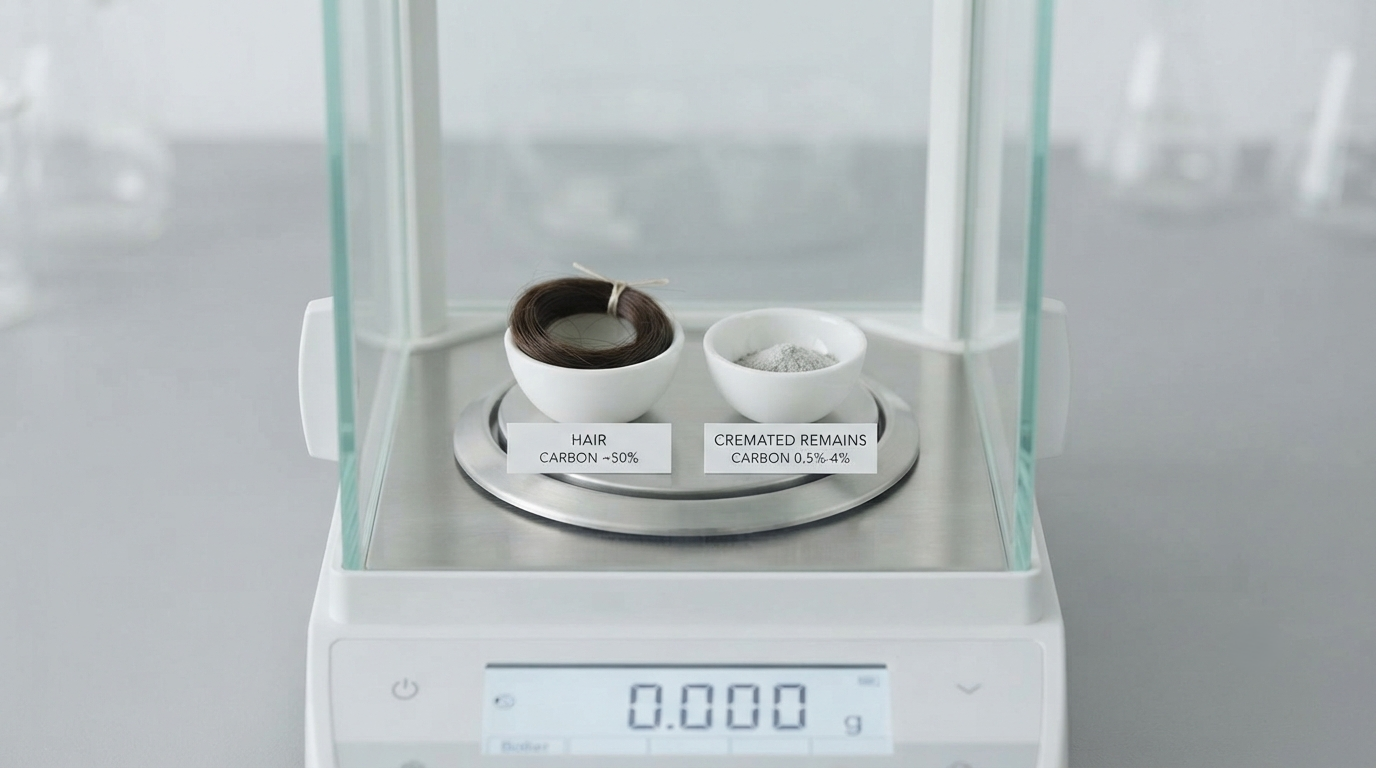
Hair works from the opposite position: keratin is around 50% carbon by weight, so a modest lock carries enough to work with, and no cremation is involved. That is a fact about what you send, not about what you receive: no comparable published finished stone figure exists for hair, and none for a submission combining both. Ask whoever you commission to put their own number in writing.

None of that reliably lengthens or shortens a son memorial diamond timeline, so choose the material for what it means to you. How much of his hair a stone needs sets out the usual amounts, and whether more than one family member can each have a stone covers splitting a single submission.

Why Is So Much of the Son Memorial Diamond Timeline Silent?

Because for long stretches there is genuinely nothing new to report. A crystal growing under pressure does not produce weekly news, and a laboratory that contacted you every seven days would mostly be telling you that the press is still running.

That silence is normal, and it is also hard. Parents describe the middle months as the strangest part, the decision made, the material gone, the house quiet, and no obvious sign that anything is happening on his behalf.

The practical response is to establish expectations at the start rather than to chase later. Ask, before you commit, what you will be told and when: confirmation of arrival, confirmation that growth has begun, and notice when the stone comes out of the press.

A provider who sets that out plainly is easier to wait alongside. The son memorial diamond timeline is long enough that how a company communicates matters nearly as much as how it grows.

What Updates Should You Ask For, and When?

Ask before you commission, not afterwards, and ask for specifics rather than reassurance. These are the points worth pinning down:

  1. Confirmation of receipt written notice that the material arrived and has been logged.
  2. Confirmation of extraction that carbon was successfully recovered and purified.
  3. Start of growth the date the cell actually went into the press.
  4. End of growth when the rough crystal came out.
  5. Cutting complete the finished shape and final carat weight.
  6. Grading, if ordered when the report is issued and how you receive it.
  7. Dispatch how the stone travels back, insured and tracked.

Seven notifications across the better part of a son memorial diamond timeline is not intrusive, and most providers can accommodate it. What you are really buying with that list is the ability to stop wondering between messages.

Put the agreed points in writing alongside the quote. A son memorial diamond timeline with named checkpoints is far easier to live with than one long unexplained silence.

What Can Extend a Son Memorial Diamond Timeline?

Several things, most of them ordinary rather than alarming. Knowing them in advance takes the fear out of a delay if one arrives.

  • A growth run that does not produce a usable crystal and has to be repeated.
  • A larger carat or a specialty color added after the original quote.
  • Optional independent grading, which adds a third party laboratory’s own schedule to yours.
  • A setting commissioned separately, which begins only once the stone exists.
  • Paperwork over authority that was not settled before material was sent.

Ask what each of these would mean for your own son memorial diamond timeline specifically, in weeks and in money. A provider who has clearly thought about failure is generally a safer one than a provider who implies it never happens.

And if a delay does come, ask what stage it is at. A son memorial diamond timeline that slips during growth is a very different situation from one that slips because nobody chased a grading report.

How Do You Plan Around a Date That Matters?

Work backwards, generously. If you want the stone in hand for a birthday, an anniversary of his death, or a family gathering, count back from that day using the long end of the range rather than the short one.

Ten months back from the date is a sensible planning anchor, and twelve if you are considering a large stone or a treated color. A son memorial diamond timeline built on the long end leaves room you may not need but will be glad of. Commissioning with only six months of margin means hoping for the fastest version of a process that does not reliably deliver it.

Tell the provider the date explicitly. Some can sequence work around a deadline; none can compress the growth stage, and a company that promises to is telling you something you should not want to hear.

If the date cannot be met, there is no harm in letting it pass. A stone that arrives in the spring instead of the winter is the same stone, and nothing about the son memorial diamond timeline makes one month more fitting than another.
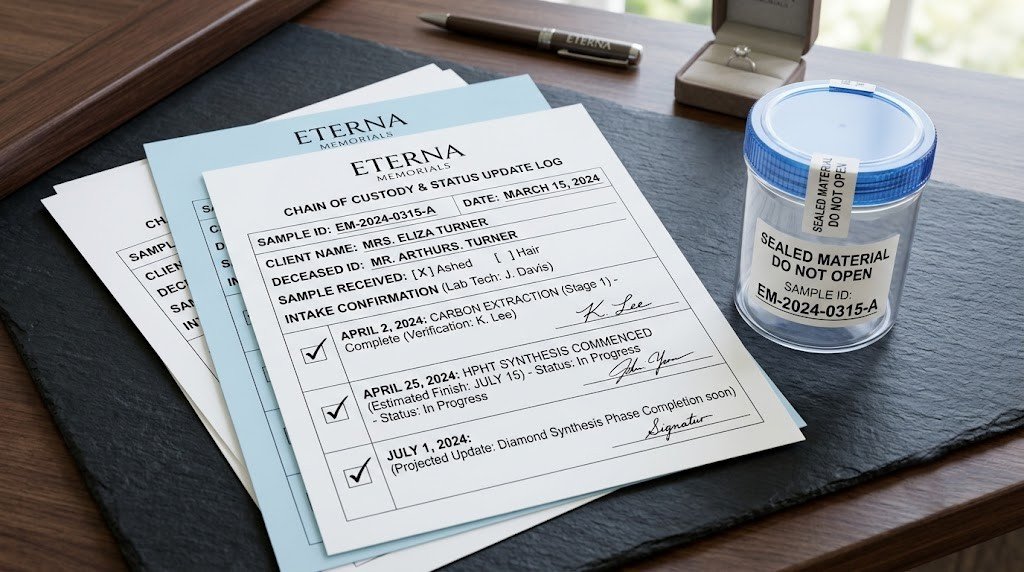
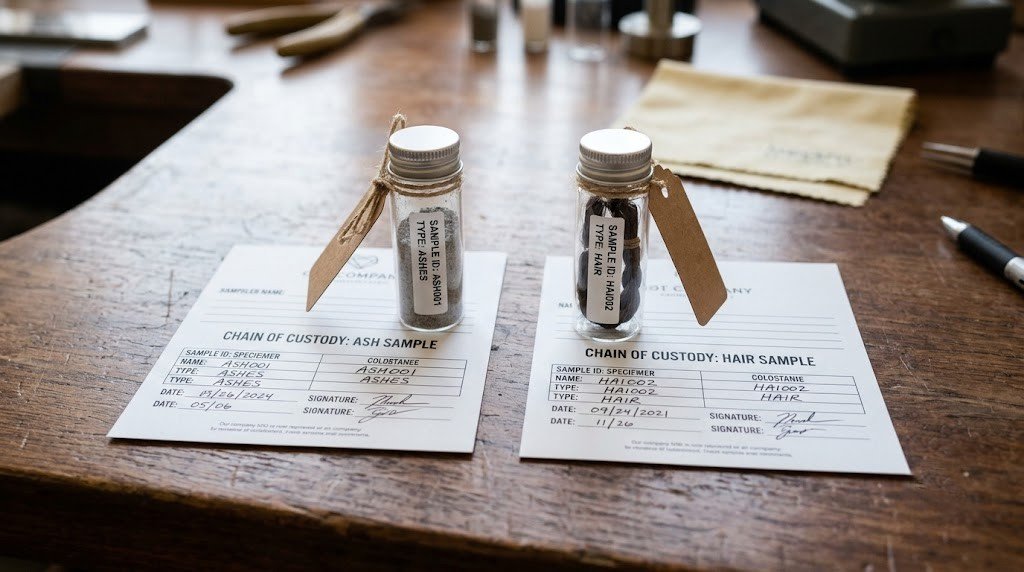
Chain-of-custody paperwork and dated status updates laid out beside a sealed material container

What Does the Son Memorial Diamond Timeline Feel Like for a Parent?

Different in each third, from what parents describe. The first stretch is busy, paperwork, decisions, packaging, questions. There is something to do, and doing it helps.

The middle is the long one. His material is somewhere else, the decisions are behind you, and the son memorial diamond timeline becomes an abstraction rather than a task. Some parents find they think about it constantly; others are surprised by how completely it recedes, and then feel guilty about that.

The last stretch changes again. Once a stone leaves the press and takes a shape, it stops being a process and becomes an object with a delivery date, which can land harder than people expect.

Whatever version you get, none of it is wrong, and whether your son was six or sixty does not make the months pass differently. Deciding whether this is the right choice at all is a fair thing to revisit while you wait.

Frequently Asked Questions

Can I pay more to have it finished faster?

Generally no, because the limiting factor is physical rather than administrative. Growth under pressure takes the time it takes, and no fee shortens it. A provider may be able to sequence the steps either side more tightly, but the press cannot be hurried.

Does the material expire if I wait before ordering?

No. Cremated remains and hair keep indefinitely when stored dry and undisturbed, so there is no deadline pressing on you. Families commission stones years after a death, and waiting until the decision feels settled costs nothing in terms of what is possible.

How long after he died can I still do this?

There is no cutoff. What matters is that suitable material exists and that whoever holds authority over it agrees, not how recently the death occurred. Ashes kept in an urn for a decade and a lock of hair kept longer are both workable starting points.

What if I change the size partway through?

Ask immediately, because the answer depends entirely on which step has been reached. Before growth begins a change is usually straightforward; once a crystal is forming in the press, changing the target size generally means starting that stage again.

Will I be told if something goes wrong?

You should be, and it is worth confirming in writing that you will. Ask specifically what happens if a growth run fails: whether the laboratory repeats it, how long a repeat adds, and whether any additional charge falls to you.

Can two stones be grown at the same time?

Often yes, since only a portion of the material is used and several stones can come from one submission. Whether they grow simultaneously or in sequence varies by provider, and the difference matters for when each family member receives theirs.

Final Thoughts on the Son Memorial Diamond Timeline

Most of the months in a son memorial diamond timeline are physics, and physics does not negotiate. What is genuinely in your control is the front end, settling authority early, choosing a size with the calendar in mind, and agreeing what you will be told and when.

The rest is waiting, and waiting for something on behalf of your son is its own particular experience. It helps to know in advance that the quiet stretch is normal, expected, and not a sign that anybody has forgotten him.

When the stone arrives, the son memorial diamond timeline stops mattering almost immediately. Nobody looks at a finished diamond and thinks about the week it was in the press.

Learn More About Son Memorial Diamonds

Talk With Memorial Diamond

If you want to understand what the months would actually look like for your family, you are welcome to ask before deciding anything. Reach out to Memorial Diamond at memorialdiamond.us and talk it through, including the question of when, which is often the hardest one to settle.
son-memorial-diamond-ideas-rings-pendants-keepsakes

Son Memorial Diamond Ideas: Rings, Pendants, and Keepsakes

At some point the question stops being scientific and becomes personal: once the stone exists, what do you actually do with it? The honest answer is that the good son memorial diamond ideas are the ones that match how you want him near you, a ring, a pendant, earrings, a piece a father would wear, or the stone kept loose in a box and never set at all. None of those is the correct choice, and any of them can be changed later.

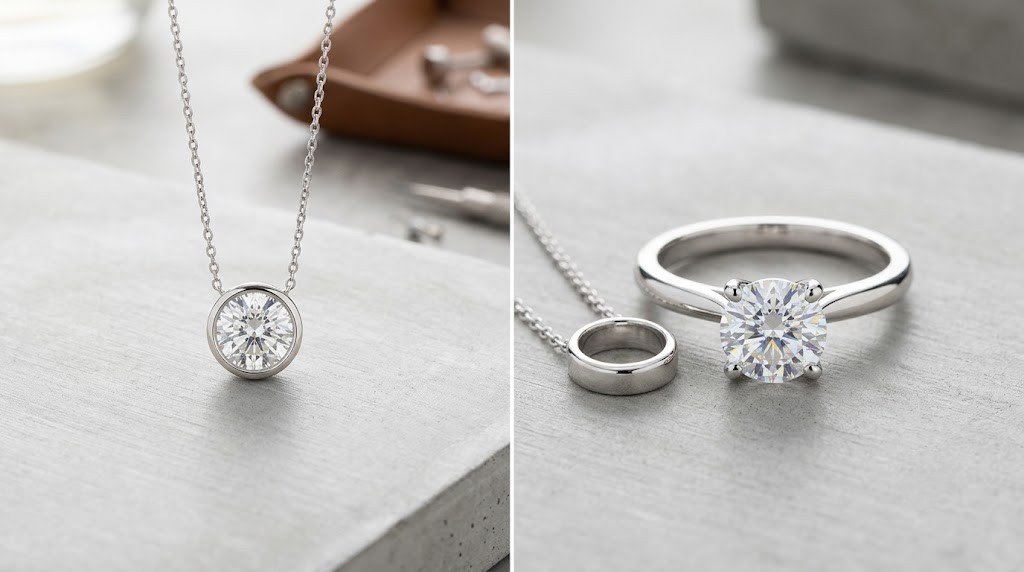
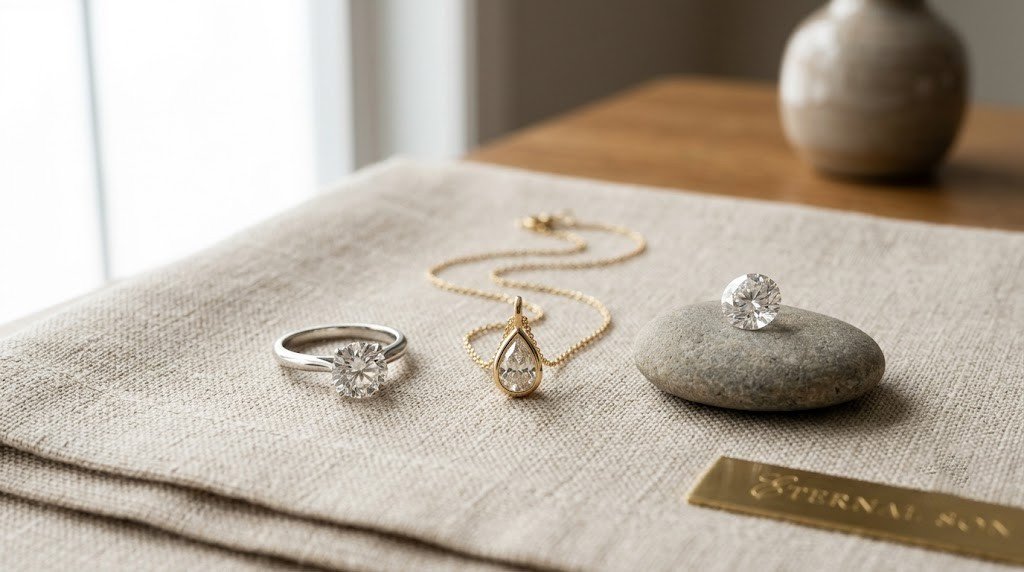
Son memorial diamond ideas shown as a pendant, a ring and a loose memorial stone arranged together on linen

What Are the Main Son Memorial Diamond Ideas?

Seven formats cover almost everything families actually choose. They differ less in cost than in how present the stone is in an ordinary day.

#FormatWhy parents choose itWorth knowing
1Pendant or necklaceClose, private, easy to wear under anythingSuits every stone size; the most forgiving choice if you are undecided
2RingConstantly visible and constantly feltTakes the most knocks of any setting; sizing and resizing matter
3EarringsTwo stones from one submission, worn as a pairNeeds matched or deliberately mismatched stones
4BraceletVisible to you rather than to othersMore exposure to bumps than a pendant, less than a ring
5Men’s pieceA signet, tie bar, cufflink or lapel pinOften the format a father will actually wear
6Loose stoneKept in a box, held rather than wornNo setting cost; can be set at any point in the future
7Shared setSeveral smaller stones from one submissionLets siblings, both parents and grandparents each hold one

Read across the table and the pattern behind most son memorial diamond ideas becomes clear: you are really choosing between visibility and protection, and between something for yourself and something for the family.

No ranking is implied among these son memorial diamond ideas. A loose stone in a drawer is not a lesser tribute than a ring worn every day, and parents often move between the two over years.

Should It Be Worn Daily or Kept Safe?

Answer this first, because the rest of the son memorial diamond ideas follow from it. A stone meant for daily wear points toward a pendant or a ring; a stone meant to be kept points toward a case or a box.

Daily wear has an obvious appeal: he is with you at work, in the supermarket, at three in the morning. It also makes the piece ordinary, which some parents find comforting and others find unbearable.

Keeping the stone safe has its own logic. A piece taken out on his birthday, or when you simply want it, carries a different weight than one you stop noticing. Neither approach is more devoted.

If you genuinely do not know, the practical move is to choose a format that leaves the door open. That is why so many son memorial diamond ideas start with a simple pendant and change later, rather than starting with something elaborate.

Which Son Memorial Diamond Ideas Work as a Ring?

Of all the son memorial diamond ideas a ring is the most present, and for some parents that is exactly right. It is in your eyeline all day, and you feel it against everything you touch.

It is also the hardest working piece of jewelry a person owns. Rings take knocks a pendant never sees, so setting style matters: a bezel or low profile setting protects a stone far better than high prongs.

Size matters too. A small stone reads beautifully in a slender band and can look lost in a wide one, so see a similar carat weight set before committing. Among son memorial diamond ideas, the ring is where setting design does the most work.

One detail parents often like: a ring can be worn on any finger, and many choose one not tied to marriage, the right hand, or whichever finger feels like his. What a stone at each size typically costs helps set the size question against a budget.

Why Do Pendants Lead Most Son Memorial Diamond Ideas?

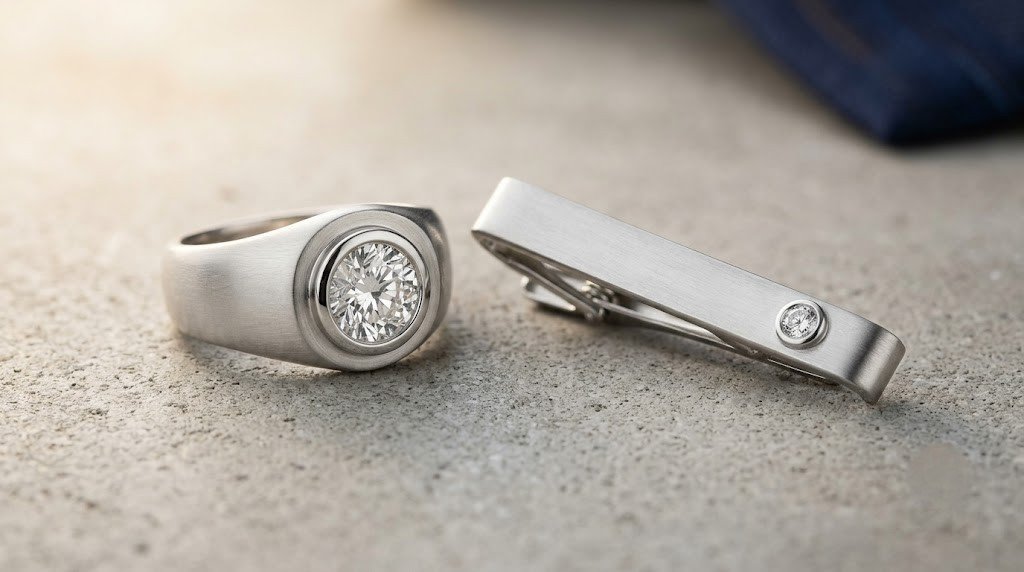
 A bezel-set memorial diamond in a men's signet ring beside a tie bar carrying a smaller stone

Because a pendant is the least demanding choice in every sense. It works at any carat weight, sits against you without being on display, and can be tucked away when you do not want to explain it.

That privacy matters more than people expect. A memorial piece invites questions, and some days answering them is impossible. Among the son memorial diamond ideas here, a pendant is the one that lets you decide each morning whether today is a day for that conversation.

It is also the gentlest setting for the stone. A pendant hangs clear of most impacts, so the worries that attach to a ring fall away.

For parents who want him near without wanting a statement, a simple pendant remains the most quietly useful of the son memorial diamond ideas, and the easiest to reset into something else years from now if your feelings change.

What About Earrings, Bracelets and Smaller Pieces?

Earrings are among the son memorial diamond ideas that need two stones, which is workable because only a portion of the material is used and several diamonds can often come from one submission.

Matching matters here in a way it does not elsewhere. Two stones grown in separate runs can differ noticeably in shade even from the same source, so if a matched pair is the goal, say so before anything is commissioned. Some parents deliberately choose two different tones and find that more honest.

Bracelets sit between a ring and a pendant. You see the stone constantly because it is in your own field of view, and it takes fewer knocks than a ring.

Smaller pieces belong on the list too. A charm added to an existing bracelet, a stone set into a watch, a pin on a coat lapel: son memorial diamond ideas do not have to be built from scratch when something you already wear can carry him. Whether more than one family member can each have a stone covers splitting one submission, and what shade to expect and how metal changes it matters once you choose a metal.

Which Son Memorial Diamond Ideas Suit a Father?

This deserves a straight answer, because many fathers quietly want something and assume nothing is made for them.

A signet ring carries a stone well, particularly bezel set and flush with the metal. A tie bar, cufflinks or a lapel pin suit someone who dresses formally. A plain band with a small flush set stone is the most discreet of the son memorial diamond ideas here, and reads as an ordinary ring to anyone who does not know.

There is also the pocket option, which is not jewelry at all: a loose stone in a small case, carried and handled rather than worn. Some fathers find that far more natural than anything worn around the neck.

The point is simply that son memorial diamond ideas are not automatically feminine, and nobody should end up with nothing because the obvious suggestions did not suit them. Where to begin if you are still deciding is a useful starting point for a parent who has not made up their mind.

Is Keeping the Stone Loose One of the Son Memorial Diamond Ideas?

Yes, and it is more common than the jewelry led framing of this topic suggests. A finished diamond kept in a case, a drawer or on a shelf is a complete answer in itself.

There are good reasons for it. Some parents cannot face wearing him. Some want the decision to be someone else’s one day. Some find holding a stone in a palm better than seeing it on a hand.

Practically it is also the cheapest and most flexible of the son memorial diamond ideas, since no setting is commissioned and nothing is committed to. The stone can be set in five years, or twenty, or never.

If you go this way, ask about a proper case and keep any grading paperwork with it. Among all son memorial diamond ideas the loose stone is the one most likely to be handed on, so make it easy for whoever receives it to know what it is.

Will Daily Wear Damage the Stone?

Not in any way you need to worry about. Diamond sits at 10 on the Mohs scale: it is the hardest known natural mineral, and a memorial diamond is chemically genuine, with the same properties as any other.

That hardness is what makes daily wear practical. The stone will not scratch against ordinary surfaces, will not dull, and will not need replacing. Dishes, gardening, a handbag full of keys: none of it touches the stone.

The setting is the part that wears, not the diamond. Prongs loosen, gold thins and chains weaken, and any jeweler will check and tighten those. Booking that once a year is the whole of the maintenance.

So durability should not narrow your son memorial diamond ideas at all. Choose the format you want for emotional reasons and let a good jeweler solve the practical ones.

Do Settings Add to the Cost of Son Memorial Diamond Ideas?

Yes: across the industry a quoted price generally covers a finished loose stone, and jewelry settings are typically priced separately. That is normal rather than a hidden charge, but confirm it before assuming a quote includes the mounting.

Metal choice moves the number as much as design does, so two son memorial diamond ideas built around identical stones can differ substantially. Platinum costs more than gold, and a heavier, more sculptural piece uses more of it.

The sequence matters too. A setting can only be commissioned once the stone exists and its final carat weight is known, so setting work sits after the growing. How long the whole process takes, stage by stage explains where that falls.

Nothing here is memorialdiamond.us’s published pricing, because none has been set. Treat these as category norms, ask whoever you commission to itemize the stone and the setting separately, and ask separately about how a finished stone is graded, which is optional and priced on its own.

Can a Son Memorial Diamond Be Engraved?

Usually, and it is one of the quietly meaningful options available: though engraving is almost always an add on rather than something included, so ask about it specifically.

Two different things get engraved. The setting can carry a name, a date or initials inside a band or on the back of a pendant, which is straightforward jewelry work. The stone itself can sometimes take a microscopic laser inscription on the girdle, readable only under magnification.

The second is more specialized, and availability varies. It is also permanent in a way worth thinking about: a phrase that feels right in the first year may feel different in the tenth.

If engraving matters to you, raise it early rather than after a piece is finished. It is often simpler to build into the original commission, and it is one of the few son memorial diamond ideas that costs very little and adds a great deal.

Can the Setting Be Changed Later?

The same memorial diamond shown first as a pendant and then remounted in a ring to illustrate resetting

Yes, and this is the single most freeing fact on this page. A diamond can be removed from one setting and mounted in another, the same way any family stone gets reworked across generations.

That means the choice you make now is not permanent. A pendant can become a ring. A ring can be reset into something a grandchild wears. A loose stone can stay loose for a decade and then be set.

It matters because grief changes what you want. Parents describe wanting something private in the first year and something visible later, or the reverse, and resetting means neither instinct has to be right forever.

So treat the first setting as a decision for now rather than for good. Most son memorial diamond ideas are reversible, and knowing that takes much of the pressure out of choosing.

What If Two Parents Want Different Son Memorial Diamond Ideas?

It is common, and not a sign that either of you is grieving wrongly. One parent wants to wear him constantly; the other cannot bear the idea and wants the stone kept safe.

The most practical answer is often two stones rather than one. Because only a portion of the material is used, more than one diamond can frequently be grown from a single submission, and two smaller stones can total less than one larger one.

That lets each parent pick from the son memorial diamond ideas independently: a pendant for one, a loose stone in a case for the other, without either arguing the other out of what they need. It also works where parents are divorced, estranged, or no longer in the same house.

And if you are arranging this alone, none of the negotiating applies. Choose the son memorial diamond ideas that suit you, and leave the question of anyone else’s piece for a day when it comes up. Whether the stone is genuinely made from him is a separate question worth reading if anyone in the family is unsure.

Who Actually Has the Say Over His Remains?

Before any of the son memorial diamond ideas becomes a design decision, there is a legal one, and parents are often surprised by it. A mother or father is not automatically the person whose signature releases a son’s remains.

Depending on the state he lived in, and on anything he set down while he was alive, a widow, a widower, a civil partner or a grown child of his own may be asked ahead of you. Written instructions, a funeral prearrangement or a named agent for disposition can all shift that order, and the rules are not the same everywhere.

The quickest way to find out is to ask the funeral director who handled the cremation; an attorney licensed in his state can resolve anything disputed. Have that conversation early, before anyone is attached to a particular piece.

Hair already in your keeping is usually a simpler matter in practice, though belongings can still form part of an estate, and a lock held by someone else is something to discuss rather than decide. How the whole thing works from material to finished stone covers what the process asks of you either way.

How Do You Choose Among Son Memorial Diamond Ideas Without Rushing?

Slowly, and later than you think you have to. The stone takes months to grow, so there is no need to settle the setting at the same time you settle everything else.

A useful sequence is to weigh the son memorial diamond ideas last. Commission the stone, live with the idea of it while it grows, and only then choose what it goes into, by which point you will know far better whether you want him visible or kept.

It helps to try things on. Any jeweler will let you handle similar stones in different settings, and imagining a piece is nothing like holding one.

And keep it in proportion. A memorial diamond is one option among several valid ones, and burial, scattering or an urn at home are not lesser choices. How a diamond and a traditional urn compare is worth reading if you are unsure.

Frequently Asked Questions

Can my own local jeweler set the stone?

Usually yes, and many families prefer it. Confirm with both the provider and the jeweler first, ask about insurance while the stone is out of your hands, and check the jeweler is comfortable working with a stone that cannot be replaced.

What metal suits a warm toned stone best?

Yellow gold tends to deepen a champagne or yellow stone, while white gold and platinum make the same shade read cooler and brighter. Neither is correct: ask to see your stone against both before deciding, since photographs rarely show the difference honestly.

Can a small stone still be set as a ring?

Absolutely. A quarter carat stone set flush or bezel set in a slender band looks deliberate rather than sparse, and it is more practical for everyday wear than a larger raised stone. Ask your jeweler to show you a comparable weight already mounted.

Is it safe to wear every day?

Yes. Diamond is the hardest known natural mineral, so the stone itself is effectively immune to ordinary wear. What needs occasional attention is the setting: prongs, chains and clasps loosen over years, so have any worn piece checked annually.

Can two stones be set as a matching pair?

Often, but raise it before anything is commissioned. Separate growth runs can produce visibly different shades even from one submission, so a truly matched pair has to be planned rather than assumed. Some families choose deliberately differing stones instead.

What if I do not want to wear it at all?

That is a complete answer, and a common one. A finished stone kept loose in a case costs less, commits to nothing, and can be set at any point in the future, or passed on unset to someone who will decide for themselves.

Final Thoughts on Son Memorial Diamond Ideas

No arrangement of metal and stone measures how much he was loved, and no format is the one a grieving parent is supposed to choose. Whether he was six or sixty, the right piece is the one you will actually live with.

If it helps to have a default: of all the son memorial diamond ideas, a simple pendant suits more people than anything else, costs less than most alternatives, and can be reset into something entirely different whenever you want.

And if none of the son memorial diamond ideas here feel right yet, that is fine too. The stone will keep, unset, for as long as you need to think about it.

Learn More About Son Memorial Diamonds

Talk With Memorial Diamond

If you would like to talk through what a finished stone could become, without deciding anything today, you are welcome to. Reach out to Memorial Diamond at memorialdiamond.us and ask about formats, metals, or what tends to work.

son-hair-diamond-steps

Step by Step: Turning Your Son’s Hair Into a Diamond

It usually starts with an envelope you already own, a curl from a first haircut, a lock cut in a hospital room, something kept without a plan for it. The son hair diamond steps come to seven: look at the sample, settle whose decision it is, pick a provider, choose the stone, post the lock, wait out the growth, then receive and set it. Six to ten months is the usual industry span.

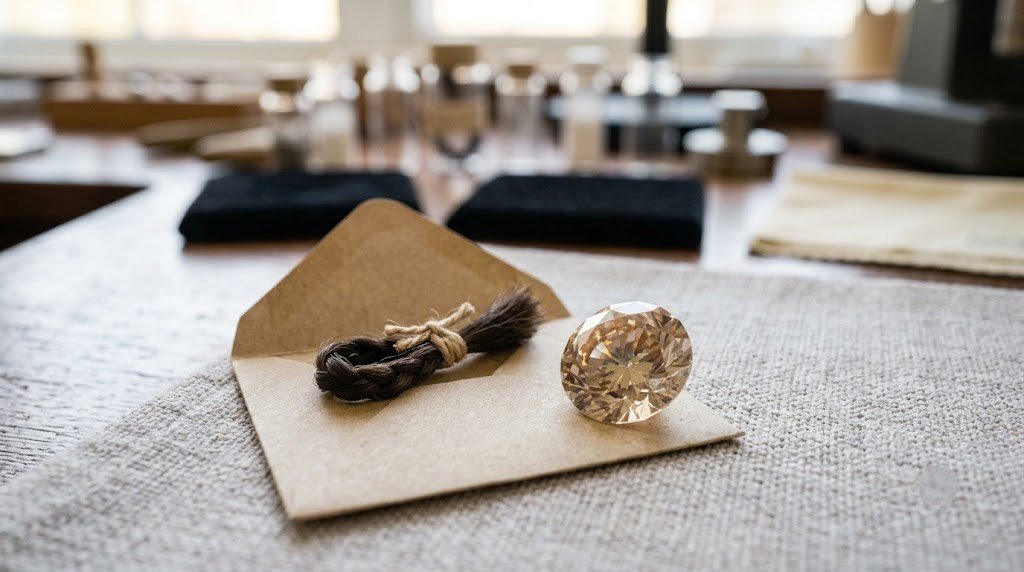
 The son hair diamond steps beginning with a tied lock of hair in a paper envelope beside a finished memorial stone

How Do the Son Hair Diamond Steps Differ From the Ashes Route?

In three ways that matter, and they change the shape of the whole thing rather than just the wording.

The first is that no cremation is involved at any point. A son who was buried, or who died decades ago, or whose remains were never yours to direct, can still be represented in a stone if a lock of his hair exists somewhere. That single fact is why the son hair diamond steps exist as a separate route at all.

The second is quantity. Hair is roughly 50% carbon by weight as a starting material, against the small carbon fraction recoverable from cremated remains, which is why the request is measured in grams rather than ounces.

The third is that the material is usually already in your possession, which means the son hair diamond steps can begin on the afternoon you decide to begin them. Nobody has to open an urn.

Hair routeAshes route
Cremation requiredNoYes
Typical amount requestedA small lock, a few gramsA few tablespoons to roughly 4 oz
Where the sample usually sitsA keepsake box, a locket, a baby bookAn urn or a funeral home’s keeping
Published finished stone carbon shareNone publishedRoughly 10 to 15%, some providers as low as 3%
Typical wait6 to 10 months6 to 10 months

The complete guide to a son hair diamond covers the background that sits behind these seven stages.

Step 1: What Do You Actually Have in That Envelope?

Open it, in your own time, and look properly. The son hair diamond steps begin with an honest assessment of the sample, because everything afterwards is sized against it.

Note three things. Roughly how much is there, a pinch, a lock, a full braid? Is it loose strands or a tied bundle, since a tied lock is easier to weigh and handle? And is there anything on it: dye, bleach, styling product, or the residue of a mounting adhesive if it came out of a locket or a memory frame?

Age is rarely the problem parents fear it is, and it delays none of the son hair diamond steps. Hair is chemically stable and keeps for decades in a drawer, which is exactly why baby curls kept in the 1970s are still workable material today.

Loose strands from a brush are a genuine question mark rather than an automatic no. They tend to be fewer and lighter than a cut lock, and whether they meet a given laboratory’s threshold is a question for that laboratory. How much hair is actually needed sets out the quantities in detail.

Step 2: Whose Decision Is It?

Worth thinking through before you commit to any of the son hair diamond steps, even where the answer turns out to be straightforward.

The rules most states write on this subject are aimed at a person’s remains, a statutory order of priority naming who may direct them, with a surviving spouse or registered partner usually high on that list, adult children of his own able to outrank his parents, and everything subject to whatever he set down in writing and to which state you are in. Because that machinery is pointed at the remains themselves, a lock already sitting in your own keeping is usually the more straightforward question in practice.

Usually is doing real work in that sentence. A decedent’s belongings can form part of an estate, how that plays out differs by state, and if the sample is in someone else’s house, a former partner, a grandparent, whoever packed up his apartment, then the first of the son hair diamond steps is a conversation rather than a decision.

Parents also do not always agree about the son hair diamond steps, and one parent arranging this alone is common rather than unusual. Where anything feels unclear, a short call to a local attorney costs less than a family rift.

Step 3: How Do You Pick a Provider and Confirm What It Needs?

By making a company write things down. The son hair diamond steps are only as dependable as the specification behind them, and warmth on a phone call is not a specification.

Four things to get in an email before you begin the later son hair diamond steps: the minimum weight or length of hair required, whether treated or dyed hair is accepted, what documentation will link the finished stone to your sample, and whether any unused hair is returned.

That second one catches people out. Dye, bleach and heavy styling product are worth disclosing rather than hoping nobody notices, and a laboratory’s answer will tell you whether it needs a larger sample to compensate.

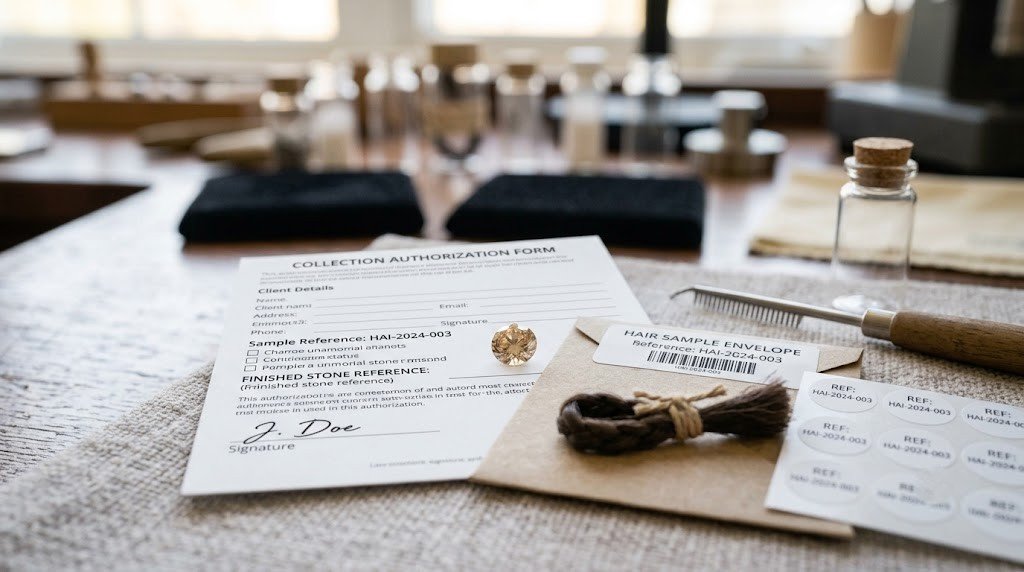
Paperwork is lighter here than on the ashes route, since no cremation certificate exists to supply. Expect a signed authorization form, identification for whoever signs it, and the provider’s own intake sheet. Ask what it wants before you assemble anything, because requirements differ and a wasted trip to a notary helps nobody.

It is also fair to ask where growth physically happens, since some companies run their own presses while others work through a partner facility. Neither is automatically better, but you are entitled to know. Questions worth asking before you commit works through a fuller list.

Step 4: How Do You Choose the Stone Itself?

Before anything is posted, because these decisions set both the price and the length of the wait. In the son hair diamond steps this stage comes early for a practical reason: a provider cannot quote you properly until it knows what you want.

Carat first. Sizes on offer typically run from about a tenth of a carat to five carats or more, and size is a function of how long the crystal is grown rather than how much hair you sent. A bigger stone means more months, not a bigger envelope.

Color next, and it is partly chosen and partly inherited from the material. Nitrogen present during growth pushes a crystal toward yellow, boron toward blue, and a colorless result depends on the near absence of both. Because the carbon here comes from something organic and personal rather than a sterile feedstock, warm tones turn up often. What color a diamond grown from his hair will be covers that honestly, including what nobody can promise.

Cut last. Round, cushion, princess, emerald, the same shapes offered for any diamond, and the one decision in the son hair diamond steps that can sensibly wait until the rough crystal exists.

Step 5: How Do You Send a Lock of Hair Safely?

More simply than families imagine, which is one of the quiet advantages the son hair diamond steps hold over the alternative. There is no urn to open and nothing heavy to package.

Most providers send a small kit: a paper envelope or sachet, a label and a form. Paper is preferred over plastic for anything that might hold moisture. If the lock is loose, tie it at one end with thread before it goes in, so it arrives as a bundle rather than a scatter.

  1. Tie the lock at one end if it is not already bound.
  2. Seal it in the paper envelope provided and label it clearly.
  3. Include the signed authorization form in the same parcel.
  4. Photograph the sealed envelope before you close the package.
  5. Send it tracked, and keep the tracking number somewhere findable.

Do not send your only sample into the son hair diamond steps if you can avoid it. Where there is enough hair to divide, keeping a portion back is sensible insurance, and it costs nothing. An acknowledgement of receipt is the formal handover point in the son hair diamond steps, everything before it is yours to manage, everything after belongs to the laboratory.

A provider's collection kit with a paper sachet, label and authorization form laid out on a table

Step 6: What Is Happening While You Wait?

A sequence of four processes, none of which needs anything from you. This is the longest of the son hair diamond steps by a wide margin and the one families find hardest, because there is genuinely nothing to do.

Purification comes first. The hair is heated in a controlled, oxygen free environment that drives off everything in the keratin that is not carbon, leaving purified carbon at roughly 99.9% or better.

Graphitization follows, and it is the hottest part of the son hair diamond steps: that carbon is taken to somewhere around 2,500 to 2,700°C and converted into graphite, the form a growth press can actually use.

Then growth. That purified graphite, topped up with lab sourced carbon until the charge is large enough, sits in a press with a tiny diamond seed under conditions equivalent to the deep mantle, roughly 6 to 8 GPa at somewhere between 1,400 and 2,500°C. Weeks to months later, a rough crystal exists, and it is as hard as any diamond on earth. How his hair becomes a diamond follows that chemistry in more depth.

Step 7: What Arrives, and What Do You Do With It?

The stone, loose, unless you ordered a setting alongside it, plus an origin document, and a grading report if you asked for one. Independent grading against the four quality factors used for any diamond is offered as an extra across this category rather than included by default.

Two finishing decisions come back to you near the end of the son hair diamond steps, usually shortly before delivery. One is the cut, confirmed against what the rough crystal can actually yield. The other is irradiation, an optional post growth treatment some providers offer to shift or deepen color; plenty of families decline it precisely because the stone’s own color came from him.

Expect the arrival to be a strange hour. Parents respond to it very differently, some want the house empty, some want everyone there, some leave the box closed for a week. There is no correct version of this.

Setting can wait indefinitely. A loose stone does not deteriorate, and the last of the son hair diamond steps has no deadline attached to it. Ideas for rings, pendants and keepsakes is worth reading without any obligation to decide.

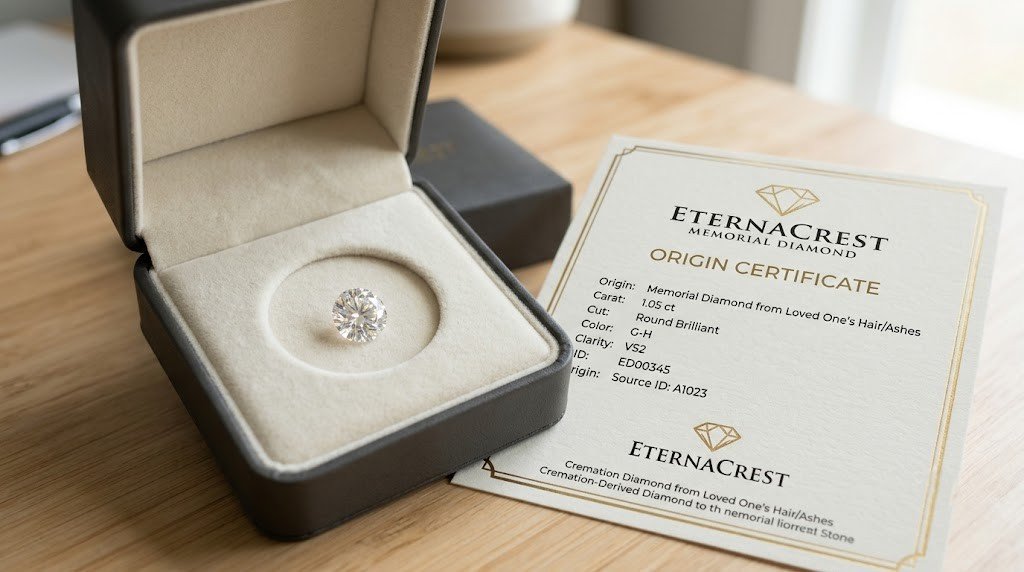
 A loose memorial diamond in an open presentation box next to its origin document

What Should You Not Assume About Hair?

One thing above all: that the widely quoted personal carbon percentage applies here. It does not, and this is where the son hair diamond steps are most often misdescribed online.

That figure, personal carbon making up roughly 10 to 15% of a finished stone’s mass, is published for carbon recovered from cremated ashes, and it has no documented bearing on the son hair diamond steps. It is an ash figure. No equivalent published percentage exists for a diamond grown from hair, and nobody should be quoting you one as though it were settled.

Hair being roughly 50% carbon by weight is a separate fact entirely. It describes what enters the son hair diamond steps rather than what leaves them, the raw material before processing, not the composition of the finished crystal, and treating it as a share of the stone is simply wrong.

So if that proportion matters to you, and for many parents it does, ask your provider directly for its own figure for hair grown stones, and ask for the answer in writing. A company that works with this material routinely should be able to tell you. Whether the diamond is genuinely made from his hair examines how that link is documented and verified.

What Do the Son Hair Diamond Steps Cost and How Long Do They Take?

Between six and ten months, typically, is how long the son hair diamond steps run once the laboratory logs your envelope in, stretching toward twelve for larger stones or unusual colors. Nearly all of that is growth time, since the stages you personally handle are measured in hours.

On price, given as general 2026 industry ranges rather than any single company’s published rate:

SizeTypical industry range
Around a tenth to a quarter of a carat$1,500 to $3,500
Half a carat up to one carat$5,000 to $15,000
From two carats upward$20,000 to $75,000 plus

Colorless costs more than a warm or blue tone at matching weight. Settings, engraving, unusual shapes and optional grading are each quoted apart from the stone.

Nothing in that list changes because you sent a longer lock. Across the son hair diamond steps, the carat you chose at stage four drives both figures. What a son memorial diamond costs breaks the tiers apart in more detail.

Where Do the Son Hair Diamond Steps Go Wrong?

Rarely in the laboratory, and fairly often in the two weeks before anything is sent.

The commonest issue is an undersized sample. A parent sends what they have, it falls below the threshold, and there is no second lock to fall back on. Weighing the sample against a written requirement first removes that risk almost entirely.

The second is undisclosed treatment, which can stall the son hair diamond steps at intake. Dye and bleach are not automatically disqualifying, but a laboratory that learns about them after the fact is in a worse position than one told up front.

The third is a mismatch of expectation rather than process, assuming a colorless stone, or assuming more hair produces more carats. Neither is how the son hair diamond steps behave, and the time to hear it is now rather than in month eight.

Frequently Asked Questions

What share of the finished stone is genuinely his hair?

No published figure exists for hair grown stones, the commonly quoted 10 to 15% applies to carbon recovered from cremated ashes. Ask your provider for its own figure for hair specifically, in writing, rather than accepting a number borrowed from the ash route.

Does it matter that he was buried rather than cremated?

Not at all. The son hair diamond steps require no cremation at any point, which is exactly why this route exists for families who buried their son, or who made that decision long before a diamond was ever considered.

Can hair from a hairbrush be used?

Possibly, though it depends on how much there is and on the individual laboratory’s threshold. Brush strands are usually fewer and lighter than a cut lock. Weigh what you have and ask before sending, rather than posting it hopefully.

Is dyed or bleached hair a problem?

It is not automatically disqualifying, but disclose it at the outset. A laboratory may want a larger sample to compensate, and finding out afterwards is worse for everyone. Mention styling product and adhesive residue from lockets in the same conversation.

Can more than one stone come from one lock?

Sometimes, depending on the weight available and each provider’s threshold. Each stone needs a growth run of its own within the son hair diamond steps, so expect two waits and two invoices. Ask before committing to the first.

Who needs to agree before I send his hair?

Rules on directing remains are aimed at the remains themselves, so a lock you already keep is usually the simpler question in practice. Belongings can fall to an estate and that varies by state, so confirm locally.

Final Thoughts on the Steps of Turning His Hair Into a Diamond

Seven stages, and five of the son hair diamond steps are things you could finish in an afternoon. What makes this feel large is not the process; it is opening the envelope.

The route has one real advantage worth naming plainly. Because no cremation sits anywhere in it, the decision is open to families it would otherwise be closed to, a son who was buried, a son who died long before this was possible, a son whose remains someone else directs.

Get the sample weighed, get the requirement in writing, and the remaining son hair diamond steps are mostly patience. What comes back at the end is a real object with a documented line running straight back to something of his that you kept without quite knowing why.

Learn More About Son Memorial Diamonds

Talk With Memorial Diamond

If you are holding an envelope and would rather ask a person than read another page, that is a fair instinct. Memorial Diamond can be reached at memorialdiamond.us to talk through the son hair diamond steps, what a sample needs to weigh, and what happens at each stage. Asking commits you to nothing.

son-hair-diamond-questions

Questions to Ask Before Turning Your Son’s Hair Into a Diamond

Whatever you have of his hair is probably small, and there is probably no more of it. The son hair diamond questions that genuinely protect a family are about that fragility: how a sample that size is tracked, what a laboratory does if it is too little or too degraded to work with, what the provider will actually put a number on, and what the paperwork proves at the end. Ask them in writing, before anything is posted.

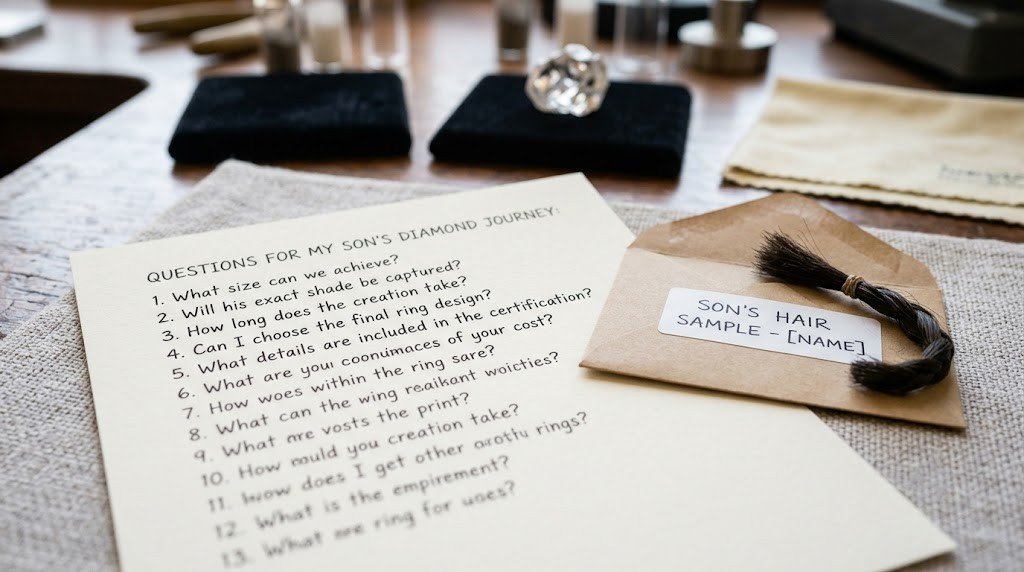
Son hair diamond questions listed on paper beside a small labeled envelope holding a lock of hair

Why Are the Son Hair Diamond Questions Different?

No cremation stands behind this one. That removes a whole category of worry and introduces a different one, which is why the son hair diamond questions do not simply copy the ashes version with a word swapped.

The son hair diamond questions start from one physical fact: the sample is usually tiny, frequently old, and almost always the only one in existence. It may have come from a first haircut, a lock taken in a hospital room, or a brush nobody could bring themselves to clean out. None of those arrive with documentation.

That changes what the son hair diamond questions need to establish. Quantity becomes a live issue rather than a formality. Condition matters, hair that has been dyed, bleached, or stored loose in a drawer for twenty years is not the same starting material as a lock cut yesterday.

Provenance becomes a question you may quietly be asking yourself. The son hair diamond questions here are built around those three pressure points, and each is easier to raise before a padded envelope leaves your hands.

Which Son Hair Diamond Questions Belong on Your List?

Eleven, covering the sample, its handling, what comes back, and the commercial terms. Send the son hair diamond questions below as a numbered email and ask for numbered replies.

#AreaThe question to put in writing
1SampleHow much hair do you need, by weight or by visible length, and what is your minimum?
2SampleDoes age, dye, bleach or heat damage affect whether you can use it?
3SampleDo you need roots attached, or are cut ends sufficient?
4SampleIf what I send is too little, do you stop and ask me before proceeding?
5HandlingWhat identifier is assigned on arrival, and is any of it returned unused?
6HandlingIs his hair ever processed alongside another family’s material?
7ContentWhat percentage of the finished stone will be carbon from his hair?
8DocumentsWhich certificate records where this carbon came from, and who issues it?
9DocumentsIs independent grading included, offered at extra cost, or unavailable?
10TermsWhat is billed separately from the stone itself?
11TermsIf the growth cycle fails and no hair remains, what happens then?

Of the son hair diamond questions above, number eleven is the one families skip, and it matters most when a sample cannot be replaced.

What Should You Ask About the Sample Itself?

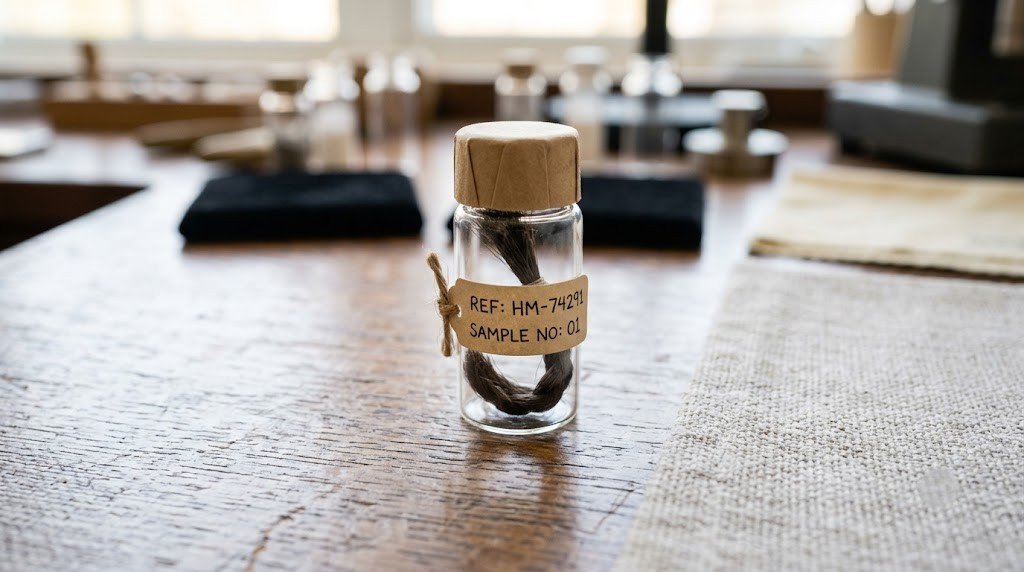
A small sealed glass vial holding a hair sample with a numbered reference label attached

Start the son hair diamond questions with quantity, because it is the only one with a hard floor. Industry wide a hair based stone typically needs a small lock or a few grams, palm sized, or a few wisps, far less than ash based work requires. What a laboratory actually asks for varies by provider, so get their figure rather than a general one.

Condition is the next of the son hair diamond questions. Hair is roughly 50% carbon by weight as a starting material, which is why so little of it is needed. But permanent dye, bleach, relaxers and years of heat styling all alter what is there, and providers differ on what they will accept.

Ask about age directly. A lock cut in 1994 and one cut last month are chemically closer than most people expect, but storage matters, damp, mold or adhesives all cause problems.

And ask what happens if you send less than they need. The son hair diamond questions that prevent the worst outcomes are the ones about stopping: does the laboratory pause and telephone you, or proceed with what arrived?

What If You Are Not Certain the Hair Is His?

Of the son hair diamond questions, this is the one almost nobody says out loud, and it deserves a plain answer rather than an embarrassed one.

Hair kept for years sometimes loses its label. An envelope in a memory box may carry a date and no name. A brush may have held more than one person’s hair. Something collected in a hospital or funeral home means trusting a chain you were not present for.

So put two of the son hair diamond questions to the provider. What do you ask me to declare about the origin of this sample, and in what form? And is there any verification step on your side, or does the certificate rest entirely on what I tell you?

Take the written answer at face value and do not assume either way, nothing standard across this industry settles whether verification of that kind happens at all. Of all the son hair diamond questions here, this is the one most worth asking in your own words rather than borrowing theirs.

How Is Something This Small Kept Track Of?

A few grams of hair is easy to misplace in a way that a sealed ash container is not, so the son hair diamond questions about custody are worth pressing harder than politeness suggests.

Begin the son hair diamond questions about handling with arrival. Is the sample transferred to a labeled, sealed vessel, weighed, photographed? Is there a reference number you can be told, and is it attached to the container or only to a database record?

Ask how many handovers occur between arrival and the growth cell. Purification, graphitization and growth are distinct stages with distinct staff, and what happens at each one is worth understanding first.

Ask whether his hair ever shares a batch or a growth cell with another family’s carbon. Some laboratories are built for batch work and some are not. Neither arrangement is automatically wrong, but you should know which you are buying before the envelope is sealed.

How Much of the Finished Stone Will Be Him?

Ask for a figure. Of all the son hair diamond questions, this is the one where an honest answer is provider specific rather than an industry constant.

Here is what can be said cleanly. Hair is roughly 50% carbon by weight, a fact about the starting material, about what enters the purification stage, not a statement about the finished diamond. Purified carbon from any personal source is blended with supplemental lab carbon to reach the volume a growth cell needs.

What cannot be said cleanly is the finished stone percentage. No equivalent published figure exists for hair the way one does for the ash route, and any number you are quoted is that company’s own. So put it among your son hair diamond questions in writing: what proportion of the finished stone’s mass will be carbon recovered from his hair, and where does the rest come from?

If you are told the stone is 100% your son, that is not how the chemistry works, and it is a reason to look elsewhere. A real, traceable portion of his own carbon inside the crystal is the accurate claim, and it is not a lesser one.

Who Should Be Asked Before the Lock Is Sent?

Begin the son hair diamond questions about consent by asking what declaration the provider requires, then think about your own household before you answer.

The rules families run into around authority are aimed at remains themselves, burial, cremation, what happens to ashes. A lock of hair already sitting in your keeping is usually the simpler question in practice. That is not the same as saying nobody else has an interest in it.

A decedent’s belongings can fall to an estate, and this varies by state. If your son was married or had adult children of his own, they may hold authority over decisions about him that a parent does not, and anything he set down in writing while living can shape that further. If the hair is held by someone else, his widow, a sibling, an aunt who kept a curl, that is a conversation to have rather than a decision to make alone.

Say plainly where the sample came from and who holds it when you first make contact. The son hair diamond questions about consent are much easier asked at the beginning than unpicked at month seven. Whether more than one stone can come from one family’s material often belongs in the same conversation.

What Documents Come Back With the Diamond?

Two separate documents exist and they answer two different questions, so the son hair diamond questions here begin with which one you are actually being offered.

An origin or authenticity certificate is usually issued in house and records provenance: that this stone was grown from the material your family submitted. It is a custody document. It does not assess quality, and it does not come from an outside body.

A grading report from an independent gemological laboratory describes the stone itself against the standard measures of cut, color, clarity and carat. It is optional across this industry, usually costs extra, and says nothing about where the carbon came from. Finished memorial stones are chemically genuine diamonds, the hardest known natural mineral, graded on the same scales as any other.

Ask which is included, who issues it, and whether you can see a specimen with another family’s details removed. Ask too whether the certificate names him and whether you approve the wording before it is printed. The son hair diamond questions about paperwork should never need chasing.

Which Son Hair Diamond Questions Cover Time and Money?

The son hair diamond questions here are two: what the schedule is measured from, and what the quote excludes. Those two questions catch most unpleasant surprises.

On timing, six to ten months from receipt of material to finished stone is the industry norm, with larger stones and specialty colors running toward twelve. Ask for the provider’s own range, whether it begins at payment or arrival, and what contact you will have during the long middle stretch when nothing photographable is happening. Where those months actually go is worth having explained before you commit.

On price, industry figures run roughly $1,500 to $3,500 for entry tier stones around 0.10 to 0.25 carats, roughly $5,000 to $15,000 between half a carat and one carat, and from about $20,000 upward past $75,000 for two carats and above. Colorless costs more than yellow or champagne at equal weight. What actually moves that number is worth understanding too.

Then work through the son hair diamond questions about extras, what is quoted separately: grading, engraving, fancy cuts, settings, insured return shipping. And ask for the payment schedule and what happens to money already paid if you stop.

What Can and Cannot Be Said About Color?

Ask what range is realistic for hair derived carbon, and treat a confident single shade promise as a warning rather than a reassurance.

The mechanism is not mysterious. Trace elements present while the crystal grows set its tone: nitrogen lends yellow, boron lends blue, and a colorless result requires the near absence of both. Carbon drawn from a person carries trace elements a synthetic feedstock would not, so memorial stones lean toward yellow, blue and champagne. What shade to realistically expect is its own subject.

So ask three things. Is colorless available, what extra processing does it require, and what does that add? Is irradiation offered for red, pink, green or black stones, and is it recorded on the paperwork? And what is the provider’s position if the finished tone differs from the sample you were shown?

Among the son hair diamond questions, this is where guarantees should make you cautious. Nobody controls trace chemistry closely enough to promise an exact shade from organic material.

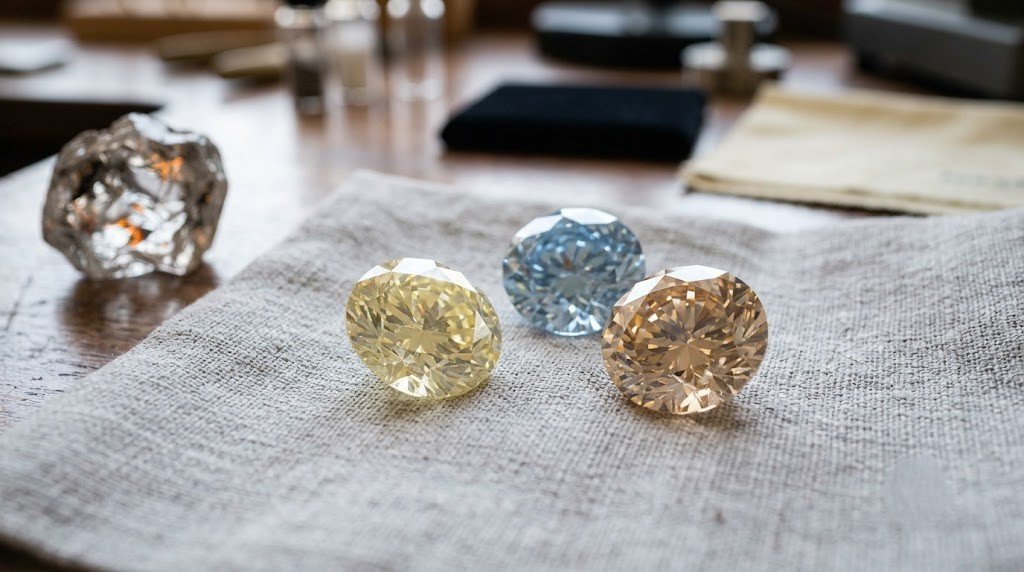
Three memorial diamonds in yellow, blue and champagne tones arranged on a pale gray surface

What Happens If the Growth Fails and the Hair Is Gone?

Ask this one of the son hair diamond questions before anything is posted, because it is the scenario a hair based project cannot recover from and the one families almost never raise.

Growth cycles occasionally fail. Crystals fracture in the cutting room. A parcel can be delayed or, rarely, lost. With ashes there is often more in an urn. With a single childhood lock there may be nothing left at all.

So ask directly: if the cycle fails, do you rerun from remaining material, and at whose cost? If none remains, what is your obligation, refund, partial refund, nothing? What insurance covers the parcel each way, and for what value? Is any portion of the sample held back against this possibility, and can I request it?

That last one is worth asking even if the answer is no. The son hair diamond questions about failure are the least comfortable to write and the most useful to have answered. The sequence from first call to finished stone will tell you where each risk sits.

How Do You Read the Answers You Get Back?

Compare replies to the son hair diamond questions, not impressions. Two companies can both sound kind; only one of them may be telling you anything you could hold them to.

What you askedA useful replyA reply that dodges
How much hair do you need?“A lock of about this weight, here is our stated minimum.”“Just send what you have.”
Does dye or bleach matter?“Yes, here is what we can and cannot work with.”“We handle all kinds of hair.”
What percentage of the stone is his?“Ours is X%, no industry figure is published for hair.”“It’s entirely made from him.”
Is there any verification of origin?“Here is exactly what we check and what we rely on you for.”“We treat every sample with respect.”
If the growth fails and nothing remains?“Clause four, I’ll paste it below.”“We’ve never had that happen.”

Notice the shape of a dodge rather than its tone. An adjective standing in for a number. A reassurance standing in for a clause. A question about process answered with a sentence about feeling. None of those is proof of anything, and all of them mean the son hair diamond questions need asking again.

Frequently Asked Questions

Can a diamond be made from hair kept for twenty years?

Usually yes. Hair is stable and does not decay the way soft tissue does, so age alone is rarely the obstacle. Tell the provider how it has been stored, since damp, mold or adhesive residue matter considerably more than the number of years.

Does hair from a hairbrush work?

Ask the provider, because practice varies. Brush hair raises two separate issues worth naming: whether there is enough of it by weight, and whether it is certainly all his. Both are better raised in your first email than later.

How much of the diamond will actually be his hair?

Ask for that company’s own figure in writing. Hair is around 50% carbon as a starting material, but no published industry figure exists for what proportion of a finished hair grown stone is personal carbon, so any percentage you are given is theirs.

Is anyone’s permission needed to use his hair?

Ask the provider what declaration they require. Rules about authority are aimed at remains themselves, so a lock you already hold is usually simpler in practice, but belongings can fall to an estate, this varies by state, and a sample someone else keeps is a conversation first.

Can I get some of the hair back?

Ask before sending. Some providers return unused material, some do not, and with samples this small there may be nothing left to return. Ask whether any portion can be deliberately reserved and sent back to you.

Should I ask two companies the same questions?

Yes, and send both the identical son hair diamond questions. Comparing replies side by side reveals differences in specificity that no amount of reading marketing pages will. The company that answers in numbers and clauses is telling you how it operates.

Final Thoughts on Asking Before You Send His Hair

A lock of hair is a strange kind of valuable. It cost nothing, it cannot be bought again, and for months it will be somewhere you are not. That is the whole reason to ask carefully rather than politely.

If you get through only four of the son hair diamond questions on this page, make them these: how much do you need and what happens if I send less, what percentage of the stone will be his carbon, who is authorized to make this decision in my family, and what happens if the growth fails with nothing left. Between them they cover nearly all of the real exposure.

Then stop researching and decide. Careful is good; endlessly careful becomes its own weight. The wider picture is here whenever you want it.

Learn More About Son Memorial Diamonds

Talk With Memorial Diamond

If putting the son hair diamond questions to a person suits you better than another page of reading, that is a fair way to start. Memorial Diamond can be reached at memorialdiamond.us to talk through samples, handling, documentation and what a realistic schedule looks like. No obligation attaches to a first conversation.

son-hair-diamond-color

What Color Will a Diamond Made From Your Son’s Hair Be?

Most parents have pictured the stone long before they type the question. Here is the plain answer: son hair diamond color usually lands somewhere in the yellow, blue or champagne to brown range, because shade is set by trace elements caught in the crystal lattice during growth, and a lock of hair is an organic, individual starting material. Colorless is achievable with additional processing and a higher price, and no laboratory can honestly promise a particular son hair diamond color before the run is finished.

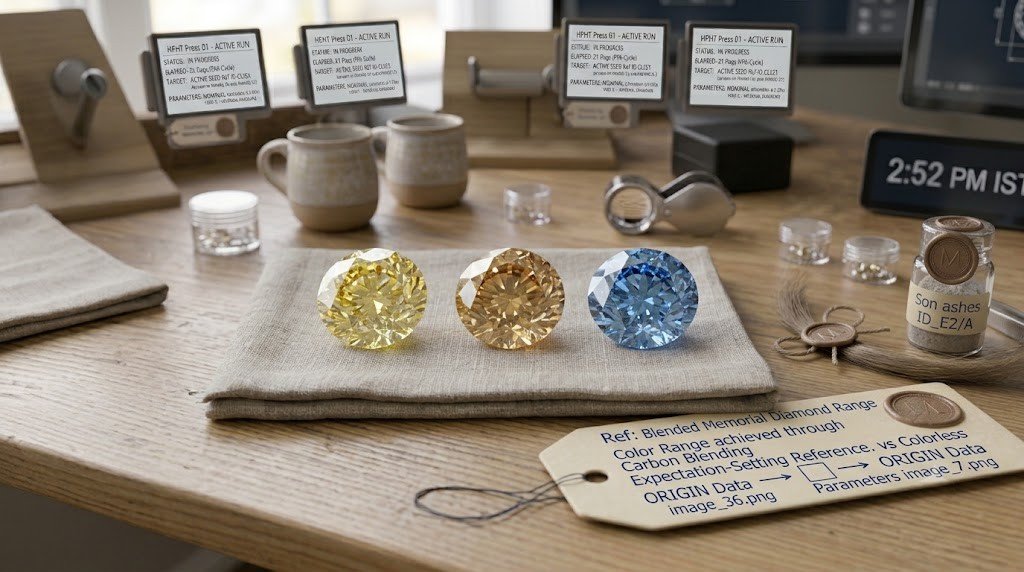
Son hair diamond color shown as three loose memorial stones in pale yellow, blue and champagne tones on linen

What Actually Decides a Diamond’s Shade?

Nothing you can see in the sample, and nothing about how carefully it was kept, which is the first uncomfortable truth about son hair diamond color. A diamond is a lattice of carbon atoms, and wherever an atom that is not carbon slips into that lattice while the crystal is forming, it changes how the finished stone handles light.

Two intruders do nearly all the work. Nitrogen sitting in the structure absorbs at the blue end of the spectrum and leaves the stone reading yellow. Boron does the opposite and leaves it reading blue. A crystal that took up neither has nothing to tint it, which is why colorless is best understood as an absence rather than as an added quality.

That single mechanism is the whole of the son hair diamond color question. Whatever is present in the growth cell as the crystal builds itself gets written into the structure permanently, and it is not a coating that could later be stripped and redone.

It is also why son hair diamond color cannot be adjusted afterward the way a metal or a cut can. How a memorial diamond is made from his hair follows the material through the stage where this is settled.

Does Hair’s Carbon Content Make the Stone Lighter?

No, and this is the assumption worth taking apart first, because it sounds so reasonable that most parents arrive already half convinced of it.

Hair is roughly 50% carbon by weight, a far richer starting material than cremated remains, where the recoverable carbon is a small fraction of the total. From there it seems to follow that a hair grown stone begins cleaner and must therefore finish whiter. It does not follow. Carbon content tells you how much usable material a sample yields. It tells you nothing at all about which trace elements travel along with it.

Purification takes the recovered carbon to roughly 99.9% purity or better on either route, and son hair diamond color is decided in the sliver left over plus the conditions inside the press itself. A richer source shortens the collection problem; it does not hand anyone a lever on the finished shade.

So nothing at your end makes son hair diamond color predictable. Not sending a longer lock, not sending a fresher one, not the care you take packing it. That is the honest position, and it is the same one taken about the ashes version of this question, neither route is the tidy one.

Which Son Hair Diamond Color Results Turn Up Most?

Five broad outcomes account for nearly everything families actually receive. Read the table as a map of the territory, not as a menu:

Shade familyWhat produces itHow often it appearsEffect on price
Yellow through amberNitrogen taken up during growthVery commonBaseline
BlueBoron taken up during growthCommonBaseline to a modest premium
Champagne and brownCombined trace elements plus growth conditionsCommonBaseline
Near colorless to colorlessBoth nitrogen and boron excludedLess commonPriced well above the rest
Red, pink, green or blackIrradiation applied after the crystal exists, where offeredCompany dependentExtra charge; black is slowest
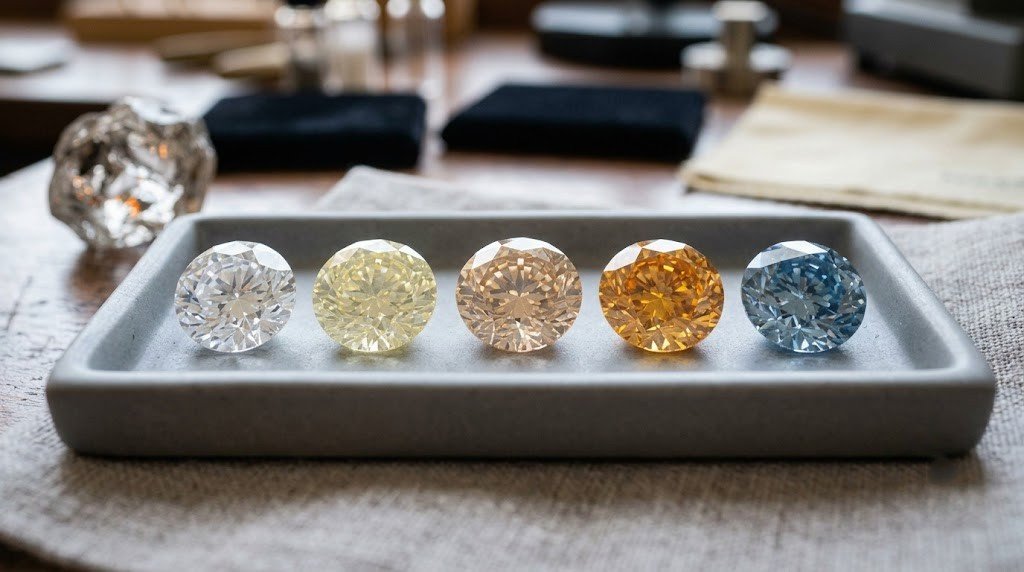
Five hair-grown memorial diamonds arranged from colorless through yellow, champagne and blue on a neutral tray


The third column describes tendency across the category, not the odds for your particular run. Nobody can look at a lock of hair and tell you which row your son hair diamond color will occupy.

What the table is genuinely good for is settling expectations before anything is commissioned. A parent who already knows that warm tones are the most frequent son hair diamond color outcome is far less likely to be jolted by the stone that eventually arrives in the post.

Does His Natural Hair Color Carry Through?

This is the son hair diamond color question parents ask most, and the one with the least satisfying answer: there is no reliable published basis for saying that a fair haired son produces a pale stone or a dark haired son a deep one.

The reason is structural. Hair color comes from melanin pigment held in the hair shaft, and that pigment does not survive the process. The material is heated in a controlled, oxygen free environment until everything that is not carbon has been stripped away, then converted to graphite before it ever reaches a growth cell. Pigment is one of the things stripped.

So son hair diamond color is not a continuation of the shade you remember. It is decided further downstream, by trace elements and press conditions rather than by how his hair looked in the light.

If a provider suggests otherwise to you, treat it as a claim to be tested rather than a fact. Ask them directly what evidence they hold for a link between natural hair shade and finished son hair diamond color, and ask whether they will put that answer in writing. A company comfortable being asked is telling you something useful either way.

What Would a Colorless Stone Take?

It is possible. It is worth understanding what a white result involves, though, because a colorless son hair diamond color is not a checkbox on an order form.

Reaching colorless means keeping both nitrogen and boron almost entirely out of the growth environment. That calls for tighter process control and additional handling than a run where trace elements are simply allowed to express themselves, and across the industry a colorless outcome typically costs noticeably more than a yellow, blue or champagne stone of identical carat weight.

There is a second cost, less often mentioned: extra processing improves the odds without converting them into a guarantee. A laboratory aiming for a colorless son hair diamond color is still aiming.

If white matters to you, raise it in the first conversation rather than after a deposit has moved. Ask what proportion of their attempts at that outcome actually land, ask what happens if yours arrives tinted, and ask whether the additional charge applies regardless of result. The complete guide to a son hair diamond sets the rest of the commissioning conversation out in order.

Where Do Pink, Green, Red and Black Come From?

From a different route entirely. Red, pink, green and black come out of post growth irradiation, which some providers offer once the crystal has already been grown.

Two things are worth holding onto. First, availability varies from company to company, so a treated son hair diamond color you have set your heart on may simply not be on offer from the provider you otherwise like best. Ask early rather than assuming.

Second, treatment is added to growth rather than substituted for it. Carbon recovered from his hair still forms the crystal itself; what irradiation alters is the way that finished crystal reads to the eye. A treated son hair diamond color does not make the stone any less genuinely his.

Black stones in particular tend to run long. Specialty shades and larger carat weights are the two factors most likely to push a project toward the far end of the usual schedule. How long the wait usually runs covers that side of it properly.

How Much of the Stone Is His Hair?

Here the honest answer is that the reference figures quoted around this industry do not cover the hair route. Published percentages describing how much of a finished memorial stone came from the personal source are ash figures; they were measured on carbon recovered from cremated remains, and no equivalent published figure exists for hair.

That matters because it is easy to see a percentage quoted somewhere and assume it transfers. It does not, and a provider who quotes an ash percentage at a hair customer is being careless at best. Ask your provider what proportion of the finished stone their own hair process delivers, and ask for the answer in writing before you commit anything.

What can be said plainly is the shape of it. The recovered carbon is purified, then combined with additional lab sourced carbon until there is enough feedstock for a growth run, so the stone is part him and part supplementary material, never one hundred percent hair. Any company claiming total purity is overstating the physics.

None of that changes the son hair diamond color question, since blending does not make the shade any more forecastable. It is simply the thing to have straight before money changes hands, alongside the son hair diamond color question itself.

What Can a Provider Tell You Before You Commit?

Less than most parents expect about son hair diamond color, and how a company handles that gap is one of the more revealing things you will learn about it.

What a provider can legitimately offer is a stated aim and a described process, an intention to work toward blue, say, with an explanation of which variables sit under their control and which do not. What nobody can honestly offer is a guaranteed son hair diamond color written onto a form as though it were a carat weight or a cut.

Before anything is signed, get these answered plainly:

  • Which shade family will you be aiming for, and what in your process influences that?
  • How often does that aim actually land, in your own experience?
  • What happens if the finished stone comes out noticeably different?
  • Is any part of the fee adjusted, or a second growth run offered, in that event?
  • Will the finished son hair diamond color be documented, and by whom?

That last point deserves a sentence of its own. An independent grading report assesses cut, color, clarity and carat weight on the same basis used for any diamond, which makes it the only genuinely third party record of the son hair diamond color you actually received. It is normally an optional extra rather than something included by default, so ask.

Who Decides Whether His Hair Is Used at All?

Usually the person who signs the commissioning paperwork also sets the son hair diamond color being aimed for, which is worth thinking about before the form is in front of anyone, because that person may not be who you assume.

Most states publish a ranked list of who may decide what becomes of a person’s remains. A surviving husband, wife or registered partner is commonly placed high on it, and children he had of his own may be placed above the people who raised him. Written instructions he left behind can reorder that list, and no two states word it identically.

Hair you already hold is usually the simpler question in practice when a son hair diamond color is being commissioned, since those rules are aimed at the remains themselves rather than at a lock kept in a drawer. That is not the same as saying it sits outside every consideration; a decedent’s belongings can fall to an estate, the treatment varies, and a sample somebody else is keeping is a conversation to have rather than a decision to make alone.

Parents are also not always of one mind about this, and one parent arranging it by themselves is entirely ordinary. Where any of it is unclear, a short call with a local attorney resolves it far faster than family debate will.

How Does Son Hair Diamond Color Affect Cost and Waiting?

Son hair diamond color moves the figure, though carat weight moves it much harder. These are 2026 industry wide bands, not this brand’s published prices. A stone of 0.10 to 0.25 carats generally lands between roughly $1,500 and $3,500; half a carat to a full carat sits between $5,000 and $15,000; past two carats, quotes typically open around $20,000 and climb well beyond $75,000.

Inside any tier, a colorless result typically carries a real premium over a warm or blue stone of matching weight, because of the extra control needed to keep trace elements out. Treated shades normally add a charge of their own. Mountings, engraving, unusual cut shapes and an independent grading report are each billed apart from the stone.

On the calendar, the category wide norm runs from about six months to ten from the day material is received. A specialty son hair diamond color, black most of all, or a larger stone can stretch that toward a full year. What a son memorial diamond costs breaks the tiers down properly, and how much hair a laboratory actually needs covers the quantity side.

How Will the Shade Read Once It Is Worn?

Differently from how it looks loose in a box, which catches most families off guard. The metal surrounding a stone genuinely changes how a son hair diamond color registers to the eye.

Yellow gold warms a stone and can make a faint yellow tint recede into its setting. White metals such as platinum work by contrast and tend to push warmth forward instead. A blue stone usually reads strongest against white metal, and champagne tones often sit beautifully in rose gold.

Scale matters too. An identical tint is more visible in a larger stone than a small one, because there is simply more material for light to pass through on its way out.

If you can, ask to see the finished stone before the setting is fixed, or ask what flexibility exists to change metal after you have held it in daylight. Photographs taken under laboratory lighting rarely match how a son hair diamond color looks on a hand near a window. Rings, pendants and other settings goes through the options, and a submission combining both materials behaves no differently once it is set.

The same champagne-toned memorial diamond photographed set in rose gold and in platinum for comparison

Frequently Asked Questions

Will a blonde son produce a paler stone than a dark haired one?

There is no reliable published basis for that. Pigment is destroyed during purification long before growth begins, so his natural shade does not carry into the son hair diamond color you receive. Ask any provider who suggests otherwise what evidence they actually hold.

Can two locks from the same head produce matching stones?

Not dependably. Separate growth runs vary in their own conditions, so two stones from one submission can differ visibly in son hair diamond color. If matching pieces matter to you, say so before commissioning and ask what the laboratory can realistically achieve.

Does a hair grown diamond fade or yellow with age?

No. The shade sits in elements locked inside the crystal structure during growth, not in any coating or surface treatment, so it is permanent. Everyday wear, cleaning, sunlight and decades of handling will not alter it.

Is a tinted stone worth less than a white one?

A colorless son hair diamond color carries a premium because excluding trace elements demands more process control, not because a warm stone is a lesser diamond. Cut, clarity and carat are graded independently of shade, and a champagne memorial stone can grade very well.

Can the shade be changed after the diamond is finished?

Sometimes. Irradiation after growth can move a finished stone toward red, pink, green or black, where a provider offers it at all. Cost, availability and the added wait differ by company, so ask first and ask whether it is documented.

What if the shade that arrives is not what I hoped for?

Tell the provider and ask what their policy allows, but give yourself a little time before deciding anything. Plenty of parents describe a first reaction that shifted considerably once the stone was set and worn rather than seen loose.

Final Thoughts on the Color of a Diamond Grown From His Hair

Of everything in this process, shade is the part that stays furthest outside your control, which is hard, when so much else about the last year has already been outside it.

What is worth carrying is the reason the shade varies at all. The stone reads warm, or blue, or somewhere between, because the carbon in it came from one specific person rather than from a drum of industrial feedstock. A uniform result would mean something had been substituted for him.

Ask for the intended son hair diamond color in writing, ask what happens if the run misses it, and then let the press do what it does over the months that follow. Whatever son hair diamond color arrives will have arrived because of him, and no other family’s stone will be quite the same.

Learn More About Son Memorial Diamonds

Talk With Memorial Diamond

Wanting a particular shade is an ordinary thing to want, and it is better to find out early whether it is achievable than to hope quietly for months. Memorial Diamond can be reached at memorialdiamond.us for a plain account of what sits inside a laboratory’s control. No obligation follows from the question.

son-ashes-hair-diamond-steps

Step by Step: Turning Your Son’s Ashes and Hair Into a Diamond

Some families have both, an urn, and a lock kept from a haircut nobody thought twice about at the time. The son ashes hair diamond steps run to eleven, because two materials mean two samples, two possible permission conversations and two things to package rather than one. The laboratory work behind them is the standard six to ten months; the extra stages all sit at your end, before anything is sent.

The son ashes hair diamond steps beginning with two sealed samples, an ash vial and a tied lock, beside a finished stone

What Makes the Son Ashes Hair Diamond Steps Different?

Everything inside a laboratory is essentially the same. What changes is the front end, where a combined submission doubles several things a single material order does once.

Two samples. Two containers. Potentially two people whose agreement matters, since rules about remains and a keepsake in a drawer are different questions. And one honest uncertainty neither single material route carries.

StageAsh onlyHair onlyBoth
Samples to prepareOneOneTwo
Permission questionsOneUsually onePotentially two
Cremation requiredYesNoYes, for the ash portion
Published carbon share of stoneRoughly 10 to 15%None publishedNone published for a blend
Typical growth wait6 to 10 months6 to 10 months6 to 10 months

Laid end to end, the son ashes hair diamond steps number eleven: decide what you want back, settle the ash authority, settle the hair question, choose a provider, ask the combined questions, gather documents, choose the stone, prepare the ash, prepare the hair, ship both, and wait. The complete guide to a son ashes and hair diamond fills in what sits behind each one.

Step 1: What Do You Want Back at the End?

Answer this before anything else, because it changes the shape of every stage after it. The son ashes hair diamond steps branch here in a way the single material routes never do.

Three things families commonly want, and they are not the same order. One stone grown from both materials. Two stones, one from each material, so ash and hair stay distinct. Or two stones from one combined charge, because two people each want something to hold.

Each of those has a different price and a different schedule. Two stones means two growth runs, whether they come from one submission or two.

Decide provisionally. You will refine it once a provider answers the questions at stage five.

Step 2: Who Can Authorize Releasing His Ashes?

The ash half of the son ashes hair diamond steps runs through whoever holds authority over his remains, and that is not automatically a parent.

Every state sets its own order of priority. A surviving spouse or registered partner is frequently first in line. Where a son left adult children, they can sit ahead of his mother and father. And anything he committed to writing, a directive, a will clause, a prepaid funeral arrangement, may displace that order altogether.

So the signature on a release form may belong to someone other than the parent organizing every one of the son ashes hair diamond steps. Discovering that at stage two costs a phone call; at stage ten it costs weeks.

Where the position is unclear, the funeral director who handled the cremation usually knows the local rule, and an attorney can confirm it.

Step 3: Whose Call Is the Hair?

A separate question, and treating it as the same one is how families get caught out midway through the son ashes hair diamond steps.

Those statutory rules about priority are written about a person’s remains. They are aimed at the ashes, which is why a lock of hair already in your own keeping tends to be the simpler of the two questions in practice.

In practice is the operative phrase. A decedent’s possessions can be part of an estate, the position differs from state to state, and where the hair sits in somebody else’s home, an ex partner, a grandparent, a sibling who cleared his things, the honest description is a conversation rather than a decision.

It is also worth saying that parents do not always agree about the son ashes hair diamond steps, and that one parent arranging all of this without the other is common rather than remarkable.

Step 4: How Do You Find a Provider That Takes Both?

By asking, plainly, in the first email. Not every company handles combined submissions alike, and the son ashes hair diamond steps depend on knowing that before you build plans.

Ask whether both materials are accepted, whether they can be grown into a single stone, and whether the company has done it before. A straight answer to the third is worth a great deal.

Ask too where growth physically takes place, since some providers operate their own presses and others contract to a partner laboratory. Neither is inherently better, but a combined submission adds handoffs and you are entitled to know how many.

A company that answers clearly by email is showing you something about its record keeping, precisely what matters when two samples travel together. Questions worth asking before you commit sets out a fuller list.

Step 5: What Must You Ask About a Combined Submission?

Five things, and this is the stage most specific to the son ashes hair diamond steps. Generic process pages do not cover it, because the answers differ between companies.

  1. How much of each material do you require, in grams or ounces?
  2. Does sending both change either of those figures?
  3. Are the two samples processed into a single growth charge, or handled in stages?
  4. If one sample is insufficient on arrival, does the other proceed or does everything pause?
  5. What documentation will trace the finished stone back to both materials?

The second question deserves particular attention. Nothing published in this industry says that a combined submission reduces either requirement, so do not assume a discount that nobody has offered you.

Get the replies by email before the later son ashes hair diamond steps begin. A written answer you can point to months later; a remembered call is not. How much of each material is needed sets out the industry typical quantities behind those questions.

Step 6: What Documents and Signatures Are Needed?

Usually a death or cremation certificate, identification for whoever signs, the provider’s authorization form, and chain of custody paperwork for each sample.

That last detail is where the son ashes hair diamond steps differ from a single material order. Two samples generally mean two custody records, so check the forms you were sent accommodate both rather than assuming one line covers everything.

Where somebody else signs for the ashes, build waiting time into your expectations. An unsigned form in another household is the commonest reason a first month disappears.

Keep every document from the son ashes hair diamond steps together, the quote, the quantity figures, the tracking numbers, the forms. In month seven you will be grateful not to be searching an inbox.

Step 7: How Do You Choose Carat, Color and Cut?

Early. This is the stage of the son ashes hair diamond steps that sets both the price and the length of the wait, and a provider cannot quote properly without it.

Carat is the lever that matters. The range on offer generally starts near a tenth of a carat and reaches five carats or beyond, and size depends on time in the press rather than on how much material arrives. Sending more of either sample changes nothing about the son ashes hair diamond steps that follow.

Color is part choice, part chemistry. Nitrogen present during growth draws a crystal toward yellow; boron toward blue; a colorless stone depends on the near total absence of both. Organic carbon tends to carry trace elements, so warm and blue tones are common. What color a stone from his ashes and hair will be treats that honestly.

Cut is the last of the three and can reasonably wait until a rough crystal exists.

Step 8: How Do You Prepare the Ash Sample?

Industry wide the ask lands somewhere between a couple of tablespoons and 4 oz, near enough 100 grams, which is a small share of what a full adult cremation produces. Most of the remains stay where you planned.

If a kit has been sent, use the container in it; the son ashes hair diamond steps assume each material travels in its own. Work over a tray, in good light, taking breaks as needed. Cremated remains are largely bone mineral and handle more like coarse sand than like anything powdery.

Do not fight a sealed urn. A funeral home will open, portion and reseal one as an ordinary service, and many will do the measuring for you.

Nothing in the son ashes hair diamond steps requires that this particular job be yours. Asking a sibling, a friend or the funeral director is entirely reasonable, and plenty of parents do. The ashes only version of this sequence covers the stage in more depth.

Step 9: How Do You Prepare the Hair Sample?

Far more simply, and this is the lightest of the son ashes hair diamond steps. Hair runs to roughly 50% carbon by weight as a starting material, so the usual request is a lock you could hold in one hand, or a few grams, rather than ounces.

Tie the lock at one end with thread if it is loose, so it arrives as a bundle rather than a scatter. Use the paper envelope provided; paper beats plastic for anything that might trap moisture.

Disclose dye, bleach, heavy styling product, or adhesive residue from a locket or memory frame before the son ashes hair diamond steps go further. None of it is automatically disqualifying, but a laboratory told in advance can plan for it.

Keep a portion back if there is enough to divide. It costs nothing and removes the worst outcome: an undersized sample with no reserve. The hair only version of this sequence covers sample condition in more detail.

Step 10: How Do You Ship Two Samples in One Parcel?

As two clearly separate, clearly labeled items inside one tracked package. Do not combine them to save room, the son ashes hair diamond steps depend on the laboratory receiving each material distinctly.

Photograph both sealed containers before the box closes, the cheapest insurance in the son ashes hair diamond steps. Put the signed forms inside the parcel rather than mailing them separately, and write the tracking number somewhere you will find it without hunting.

If the provider offers a prepaid insured courier label, use it. Not the stage to economize.

An acknowledgement listing both samples by name is the formal handover point. Everything up to it is yours; everything after belongs to the laboratory. If it names only one sample, say so immediately rather than assuming clerical shorthand.

A collection kit laid out with two labeled containers and separate chain-of-custody forms for each sample

Step 11: What Happens Across the Waiting Months?

Four processes, none of which need anything from you, and this final stage of the son ashes hair diamond steps is where nearly the whole calendar lives.

Purification first: each material is heated in a controlled, oxygen free environment that strips away everything that is not carbon, leaving purity at roughly 99.9% or better. Ash gives up little for its weight, since usable carbon is only about 0.5% to 4% of cremated remains.

Graphitization second, the hottest point in the son ashes hair diamond steps: the purified carbon is taken to somewhere near 2,500 to 2,700°C and converted into graphite, the feedstock a press can use.

Growth third: the graphite is combined with additional lab carbon until the charge is viable, then loaded into a press around a diamond seed at roughly 6 to 8 GPa and 1,400 to 2,500°C, or fed into a chemical vapor deposition chamber at the minority of providers using that method. Cutting and polishing come fourth, with optional irradiation and optional independent grading against the standard four quality factors afterwards.

What Can Nobody Tell You About a Blended Charge?

How much of the finished stone came from him, not from any published figure, at least. This is the honest limit of the son ashes hair diamond steps, better stated plainly than papered over.

For the ash route, the industry figure is that personal carbon recovered from cremated remains accounts for roughly 10 to 15% of a finished stone’s mass, with some providers citing as little as 3% depending on size and quantity submitted. That number belongs to ash alone, and nothing in the son ashes hair diamond steps stretches it any further.

For hair, no equivalent published percentage exists. And for a blended charge, both materials grown into one crystal, there is no published figure at all. Anyone quoting a tidy number for a combined stone is extrapolating, not citing.

So ask your provider, in writing, for its own figures before the son ashes hair diamond steps begin, separately for ash, hair, and the two together. Whether the stone is genuinely made from his ashes and hair works through how that link is documented instead.

 A rough memorial diamond crystal shown beside the same stone after cutting and polishing

What Do the Son Ashes Hair Diamond Steps Cost and How Long Do They Run?

Six to ten months from receipt is the usual industry span, reaching toward twelve for larger stones or specialty colors. The son ashes hair diamond steps you personally handle rarely occupy more than a few weeks of that.

As general 2026 industry ranges, not any one company’s published rate:

  • A tenth of a carat up to a quarter: $1,500 to $3,500 as a rule
  • Half a carat through one: $5,000 to $15,000
  • Anything from two carats: $20,000 at the low end, occasionally over $75,000
  • Colorless: more expensive than a warm or blue tone of matching weight
  • Quoted on their own: mountings, engraving, fancy shapes, optional independent grading

Combining two materials does not by itself double anything. Two stones would, two growth runs, two prices, two schedules, but one stone from two samples is one commission. What a son memorial diamond costs breaks the tiers down properly.

Where Do the Son Ashes Hair Diamond Steps Trip Families Up?

Almost never in the laboratory. The son ashes hair diamond steps fail, when they fail, in the two weeks before a parcel is sent.

The most common is a missing signature on the ash release, sitting in somebody else’s house. Identifying the right signatory at stage two removes it.

Second is an assumed discount, a family sends less ash because hair is going too, and lands below the threshold. Nothing published supports that trade off, which is why stage five asks directly.

Third is a mismatch of expectation about what the son ashes hair diamond steps can deliver. Sending more of either material will not produce a larger stone, and no honest provider can promise a color in advance. Hearing that at stage one is easier than by month eight.

Frequently Asked Questions

Can both materials really go into one diamond?

Many providers accept combined submissions, but not all run the son ashes hair diamond steps the same way, and some process each material in stages rather than as one charge. Ask directly in your first email.

Does the hair let me send less of his ashes?

Nothing published in this industry supports that, so do not plan around it. Ask your provider whether either figure changes when both materials arrive together, and get the reply in an email before you measure anything out.

What proportion of the stone is actually him?

For a blended stone, no published figure exists. The commonly quoted 10 to 15% applies to carbon recovered from cremated ashes alone, and nothing equivalent is published for hair or for a combination. Ask your provider for its own numbers in writing.

Can we have two stones, one from each material?

Often, yes. Each stone repeats the growth stage of the son ashes hair diamond steps, so expect two prices and two timelines rather than one of each. Raise it at the quoting stage, since it changes what a provider needs.

Will the two stones match if we order a pair?

Not necessarily. Growth conditions vary between cells, so separate runs from one submission can differ visibly. If matching matters to two parents or two siblings, say so explicitly before anything is commissioned rather than afterwards.

Who has to sign when the ashes and hair are held separately?

Releasing ashes runs through whoever a state’s priority rules put first, which can be a spouse, a registered partner, or his adult children ahead of his parents. Hair kept by another relative is a discussion with them. Check your own state.

Final Thoughts on the Steps of Combining His Ashes and Hair

Eleven son ashes hair diamond steps sounds like a great deal until you notice that six of them are emails and two are afternoons. The laboratory’s half is identical to every other route; what the combined version really adds is care at the front.

The son ashes hair diamond steps reward one habit above all: not assuming. Not assuming the ash requirement drops because hair is coming too. Not assuming one signature covers both materials. Not assuming a published percentage exists for a blend, when it does not.

Ask the five questions, get the answers in writing, and prepare two samples rather than one. What comes back is a single object carrying a traceable line to both of the things you had left of him.

Learn More About Son Memorial Diamonds

Talk With Memorial Diamond

If you have both an urn and an envelope and would rather talk than read another page, that is a reasonable place to start. Memorial Diamond can be reached at memorialdiamond.us to discuss the son ashes hair diamond steps, the two samples involved, and what happens at each stage. Nothing is committed by asking.

Word count: 3,011 words · Reading time: about 15 minutes

son-ashes-hair-diamond-question

Questions to Ask Before Turning Your Son’s Ashes and Hair Into a Diamond

Sending two things instead of one doubles everything quietly, two packages, two permissions, two ways for a plan to go sideways. The son ashes hair diamond questions that matter most are therefore about how the two are handled together: whether they are combined into a single charge or run apart, what happens if one of them falls short, who authorized each, and what the finished certificate will actually say. Put all of it in writing first.

Son ashes hair diamond questions on a printed list beside a sealed ash container and a labeled hair envelope

Why Do Two Samples Change the Son Ashes Hair Diamond Questions?

Because almost nothing about a provider’s process is published for the combined route, while a great deal is published for each material on its own. That gap is where the son ashes hair diamond questions live.

The son ashes hair diamond questions begin with a material difference. Cremated remains are dominated by calcium phosphate, with usable carbon at roughly 0.5% to 4% of ash by weight. Hair is roughly 50% carbon by weight as a starting material, a completely different yield, from a completely different chemistry, arriving in a completely different form.

A laboratory handling both makes decisions about sequencing, proportion and what to do when one input disappoints, and the son ashes hair diamond questions exist to surface them. Few companies volunteer those decisions, and none of them are visible on a website.

So the son ashes hair diamond questions on this page are not a longer version of the single material list. They are the specific ones that only arise when two irreplaceable things are in the same building at the same time, being turned into one object.

Which Son Ashes Hair Diamond Questions Belong on Your List?

Ten. Each is written so that a one word answer is impossible, which is the whole point of sending the son ashes hair diamond questions as an email rather than raising them on a call.

#AreaThe question to put in writing
1ProcessAre the two samples purified separately and combined later, or handled as one charge from the start?
2ProcessIs one material ever used as a substitute for the other without telling me?
3ProcessIf one sample is insufficient, do you pause and contact me before proceeding?
4CustodyWhat separate identifiers are assigned to the ash and the hair on arrival?
5CustodyIs either sample ever processed alongside another family’s material?
6ContentWhat proportion of the finished stone’s mass comes from each of the two?
7DocumentsWill the certificate name both materials, and who issues it?
8DocumentsIs independent grading included, offered at extra cost, or unavailable?
9TermsWhat is billed separately, and does sending two samples change the price?
10TermsIf the growth cycle fails, what remains and what is your obligation?

Of the son ashes hair diamond questions above, two and three are unique to this route, and the ones most worth having answered before a single parcel is packed.

Are the Two Samples Combined or Run Separately?

Ask this first of the son ashes hair diamond questions, and ask for the sequence in plain language rather than a diagram.

There are two broad possibilities and a provider should be able to say which describes their work. Either the ash derived and hair derived carbon are purified along separate paths and then combined before graphitization, or the two are brought together earlier and processed as a single input. Both produce a stone containing carbon from both sources, but they are not the same process and do not carry the same risk.

The distinction matters because of what happens when something goes wrong partway, which is why it heads the son ashes hair diamond questions. Carbon kept separate until late can often be salvaged individually. Carbon combined early cannot be unpicked.

So among the son ashes hair diamond questions, this is the structural one. Ask at which stage the two meet, ask whether you are told when that happens, and ask whether the sequence the laboratory follows is the same for every combined order or varies with what arrives.

What If One Sample Fails or Falls Short?

Of the son ashes hair diamond questions, this is the one the combined route creates and the single material routes do not, and almost no family thinks to ask it.

Picture the realistic version. The hair weighs less than the laboratory needs, or the ash yields less usable carbon than expected. A choice then arises about proceeding on one source alone, and the honest issue is not whether that is possible, but whether anyone tells you.

So ask this one of the son ashes hair diamond questions flatly. If one of the two is insufficient, do you proceed using more of the other? Do you stop and contact me first? Will the certificate still describe the stone as made from both if, in practice, one contributed almost nothing?

Get the answer in writing. Of all the son ashes hair diamond questions here, this is the one where a vague reply should genuinely change your decision, because the substitution can happen invisibly and you would never know to ask afterward.

Who Authorized Each of the Two Samples?

The two halves of this raise two different kinds of permission, so the son ashes hair diamond questions about consent come in pairs, and treating them as one is how families get stuck at month two.

For the ashes, authority over remains is the governing issue. Should your son have had a wife, or adult children of his own, that authority may rest with them rather than with you. Statutes differ from one state to the next, and anything he recorded in writing during his life can rearrange the order completely. The answer is legal and local, and it reflects nothing about who loved him.

For the hair, the framing is different. Those rules are aimed at the remains themselves, so a lock you already have at home tends to be the more straightforward matter in practice. That does not make it unowned. A decedent’s belongings may pass to an estate, the position differs by state, and where the hair sits with his widow, a sibling or an aunt, you are opening a conversation rather than making a decision.

Put both son ashes hair diamond questions to the provider directly: whose signature do you need for the remains, and what declaration do you need for the hair? Where several relatives each want a stone is worth raising at the same time.

How Are Two Chains of Custody Kept Apart?

One container of ash and one envelope of hair are physically unlike each other, which makes the son ashes hair diamond questions about custody more answerable than you might expect.

Begin the son ashes hair diamond questions about intake with identifiers: ask what each receives on arrival, and whether they share an order number or carry distinct references. Ask whether both are weighed and logged at intake and whether you can be sent those figures.

Ask how many handovers each sample passes before they meet, and whether the same staff handle both. Extraction, purification, graphitization and growth are distinct stages, and a careful laboratory logs a transfer at each.

Then ask the batching question twice, because it has two answers. Is his ash ever processed alongside another family’s? Is his hair? Some laboratories batch one and not the other. Ask too what happens to anything unused, returned, retained, or destroyed. Practice varies genuinely, so these belong among your son ashes hair diamond questions rather than your assumptions.

How Much of the Stone Comes From Each Source?

Of the son ashes hair diamond questions, this one needs two numbers, and the second is harder to get than the first.

Two numbered intake labels being applied to separate sample containers on a laboratory benc

For the ash route on its own, industry figures put the personal carbon recovered from ashes at somewhere around 10 to 15% of a finished stone’s mass, with some providers citing figures as low as 3%. That is an ash figure. It describes stones grown from cremated remains alone.

For hair, and for a blended charge of the two, no equivalent published figure exists. Hair being roughly 50% carbon by weight describes the starting material, not the finished stone, and nothing in the public record states what share of a combined stone comes from each input. Any percentage you are quoted for this route is that company’s own, which makes it one of the son ashes hair diamond questions to have in writing rather than over the phone.

What can be said plainly is that personal carbon from either source, once purified, is topped up with lab grown carbon until there is enough of it to fill a growth cell. A provider claiming the stone is 100% your son is claiming something the physics of diamond growth does not permit.

What Will the Paperwork Actually Say?

Two documents exist, and the son ashes hair diamond questions here add a third thing to check for a combined stone, whether either of them mentions both materials at all.

An origin or authenticity certificate is normally issued in house and records provenance: that this stone was grown from what your family submitted. Ask whether it names the ashes and the hair separately, or whether it refers only to “submitted material” in a way that would read identically had one been left out.

A grading report from an independent gemological laboratory measures the stone against the usual grading scales for cut, color, clarity and carat. Independent grading is optional everywhere in this field, normally carries a fee of its own, and reveals nothing at all about where the carbon started. Do not accept one as evidence of the other.

Ask who issues each, ask for a specimen with another family’s details removed, and ask whether you approve the wording before printing. These son ashes hair diamond questions take five minutes to answer and reveal how carefully a company documents anything.

Which Son Ashes Hair Diamond Questions Cover Time and Cost?

Ask whether a combined submission changes either figure, because these son ashes hair diamond questions have counterintuitive answers: families reasonably assume it does, and it may not.

On timing, the industry norm runs from six to ten months between a laboratory receiving material and a finished stone, stretching toward twelve for larger stones or specialty colors. Growth time, not the amount of material submitted, is what sets carat size, so sending two samples does not automatically lengthen or shorten anything. Ask the provider for their own range, ask whether preparing two inputs adds a stage, and ask what the months are actually spent on.

On price, the industry wide picture is about $1,500 to $3,500 at the entry tier of roughly 0.10 to 0.25 carats, about $5,000 to $15,000 from half a carat up to one carat, and anywhere from $20,000 past $75,000 at two carats or more, colorless being dearer than yellow or champagne at matching weight. What genuinely moves that figure is worth knowing before you ask for a quote.

Then finish the son ashes hair diamond questions about money: is there a surcharge for two samples, what is billed separately, and what is the refund position at each stage?

What Color Should You Expect From a Blended Charge?

Start the son ashes hair diamond questions about color by asking what range is realistic, and treat any confident single shade promise for a two source stone as a reason to slow down.

The mechanism is well understood. Trace elements present during growth set the tone: nitrogen produces yellow, boron produces blue, and a colorless result requires the near absence of both. Carbon from a person carries trace elements that a purely synthetic feedstock would not, which is why memorial stones lean yellow, blue and champagne rather than white. What shade to expect has its own answer.

What nobody publishes is how a blended charge behaves compared with either material alone. So ask that directly rather than assuming the ash answer or the hair answer transfers.

Then ask the usual three: is colorless offered and at what additional cost, is irradiation available for red, pink, green or black stones and is it recorded, and what is your position if the finished tone differs from the sample shown? Guarantees here should make you more cautious, not less.

Three memorial diamonds in yellow, champagne and blue tones photographed together on a neutral surface

What If You Would Rather Have Two Stones?

Worth adding to the son ashes hair diamond questions even if it is not what you want, because the answer tells you how flexible a provider is.

Because only a portion of either material is consumed, more than one stone can often be grown from a single submission. That opens a choice the combined route hides: one blended diamond, or two stones, one from his ashes, one from his hair, in different settings or with different people.

So ask what a second stone costs, whether it runs concurrently or consecutively, and whether both can be grown from one submission or a second would need more material. Ask how the quantity requirements change if you want two.

If your family is divided about this, that is common and no provider will be surprised by it. Raising these son ashes hair diamond questions early gives everyone something concrete to decide about instead of an argument in the abstract.

How Do You Judge the Answers?

Put the same son ashes hair diamond questions to two or three companies and lay the replies side by side. Warmth is universal in this field and therefore worthless as a signal. Detail is not.

What you askedA reply you can useA reply that tells you nothing
Are the two combined or kept separate?“Purified separately, combined before graphitization.”“Everything goes in together.”
If the hair is short, do you substitute?“We stop and contact you, here is the clause.”“We work with whatever arrives.”
What percentage comes from each?“Ours is roughly X and Y; nothing industry wide is published for blends.”“It’s completely made from him.”
Does the certificate name both?“Yes, both are listed, here is a specimen.”“It comes fully certified.”
Is either batched with other families?“Neither. One growth cell per order.”“Every stone is unique to its family.”

Three things mark a reply worth trusting: it contains a number, it points to a written term, and it distinguishes between the two materials instead of collapsing them into one word. A reply failing all three means the son ashes hair diamond questions need sending again.

Frequently Asked Questions

Can ashes and hair really go into the same diamond?

Yes. Both are carbon sources, and purified carbon from either can enter the same growth cell. Ask the provider at which stage the two are combined and whether they are tracked separately until that point, since practice differs between companies.

Does sending both make the diamond more “him”?

Not in the way most families expect. Carat size follows growth time rather than the quantity of material supplied, and purified carbon from either source is blended with supplemental lab carbon regardless. Sending both is a meaningful choice, not a chemical advantage.

What if I only have a little of one of them?

Ask before sending. The important point is whether the laboratory pauses and contacts you or quietly proceeds on the other material. Ask what the certificate would then say, and get that answer in writing rather than by telephone.

Do I need the same permission for both samples?

Ask the provider what each requires. Authority over remains governs the ashes, and a spouse or his adult children may hold it ahead of a parent depending on state law and anything he left in writing. The hair is usually a simpler matter in practice.

Can one stone be made from ashes and another from hair?

Often, yes, since only a portion of either is used. Ask whether both can come from one submission, whether they grow at the same time or one after another, and how a second stone is priced.

Is a blended stone graded any differently?

No. Independent grading assesses cut, color, clarity and carat exactly as it would for any diamond, and it says nothing about origin. It is optional across this industry and generally billed separately from the stone.

Final Thoughts on Asking Before You Send Both

The combined route asks something slightly harder of a family than either single material does. Two things leave the house, two permissions have to hold, and the process that joins them is the part nobody writes about publicly.

That is exactly why the asking matters here. If you only get four of the son ashes hair diamond questions answered, make them these: are the two kept separate until they are combined, what happens if one falls short, whose authorization covers each, and what the certificate will actually name. Everything else is comparatively easy to recover from.

Then let it be decided. The full background is here if you want it, but at some point the reading stops and a parcel goes out, and that is allowed.

Learn More About Son Memorial Diamonds

Talk With Memorial Diamond

If you would rather talk the son ashes hair diamond questions through than work from a checklist, that is a perfectly good way to begin. Memorial Diamond can be reached at memorialdiamond.us to discuss how two samples are handled, what documentation follows them, and what a realistic schedule looks like. Asking carries no commitment.

Word count: 2,975 words · Reading time: about 15 minutes

son-ashes-hair-diamond-color

What Color Will a Diamond Made From Your Son’s Ashes and Hair Be?

Families who send both usually hope the combination gives them some say in how the stone turns out. It does not, and the honest answer is this: son ashes hair diamond color most often settles into the yellow, blue or champagne to brown families, because impurities trapped in the lattice during growth decide the shade and both of your materials came from a person rather than a supplier. White is possible with extra work and extra money, and no laboratory can name your son ashes hair diamond color in advance.

Son ashes hair diamond color shown as a single champagne-toned memorial diamond resting beside a small lock of hair and a sealed ash vial

How Does a Diamond End Up Tinted at All?

Son ashes hair diamond color, like the color of any diamond, is an impurity story. The crystal is carbon arranged in a rigid repeating pattern, and any atom that is not carbon which finds a place in that pattern as it grows alters how light leaves the finished stone.

Where nitrogen occupies some of those positions, the eye reads the result as yellow. Where boron occupies them instead, the eye reads blue. Only a lattice that took up neither comes out water white, which is why colorlessness is best described as what was kept out rather than what was put in.

That is the entire basis of son ashes hair diamond color, and it is worth internalizing before any sales conversation. The shade is structural. It is not a polish, a plating or a finish, and it cannot be undone later by recutting.

It also means son ashes hair diamond color is settled inside a sealed press over a period of months, with nobody watching. How a memorial diamond is made from his ashes and hair walks through that stage in order.

Does Blending Ashes and Hair Shift the Result?

Not in any direction you could plan around. This is the specific hope that brings most parents to the combined route, so it deserves a blunt answer rather than a hedge.

The thinking usually runs that ash is the messy material and hair the clean one, so mixing in hair ought to pull son ashes hair diamond color toward something lighter or at least more predictable. Neither half of that holds. Both materials are reduced to purified carbon, roughly 99.9% or better, before anything is grown, and the trace elements that set son ashes hair diamond color live in whatever survives that purification on both sides, plus in the growth conditions themselves.

So a blend does not average two outcomes together, and it does not dilute anything. It produces one crystal, whose son ashes hair diamond color falls wherever the chemistry of that particular run puts it.

That is the same position this library takes about the ashes only question and about the hair only question. No route is the controllable one.

Purified carbon feedstock in a laboratory crucible before being loaded into a diamond growth cell

Which Son Ashes Hair Diamond Color Outcomes Are Most Common?

Five families of son ashes hair diamond color cover almost everything that actually reaches a parent’s hands, in a category with a longer history than most families realize. Treat this as a description of the landscape rather than an order form:

Shade familyOriginFrequency across the categoryPrice impact
Yellow to golden amberNitrogen in the latticeThe most frequent outcomeNo premium
BlueBoron in the latticeFrequentNone to modest
Champagne through brownMixed trace elements and run conditionsFrequentNo premium
Near colorless and colorlessNitrogen and boron both held outUncommonSubstantial premium
Irradiated red, pink, green, blackTreatment applied after growth, where offeredDepends entirely on the providerPremium; black runs longest

The frequency column reflects tendency across the industry, not a probability anyone can calculate for your submission. No test looks at a portion of ash and a lock of hair and forecasts which row your son ashes hair diamond color will land in.

The practical value of a table like this is calibration. A parent who already understands that warm tones dominate is far less likely to be blindsided by the son ashes hair diamond color that eventually arrives.

Does One Material Overrule the Other?

There is no published basis for saying that whichever material you send more of will dominate son ashes hair diamond color, and it is worth being suspicious of anyone who implies otherwise.

Part of the reason is that the two materials are not weighed against each other in any meaningful sense by the time growth begins. Each is stripped to carbon, and that carbon is combined with supplemental lab sourced carbon to reach a workable volume. What reaches the growth cell is one feedstock, not two competing ones.

So sending a heavier portion of ash will not push son ashes hair diamond color toward amber, and adding an extra lock will not pull it toward white. If a provider tells you the ratio is a lever you can pull, ask them to explain the mechanism and to put the claim in writing.

The genuinely useful question to ask instead is procedural: does this laboratory process both materials in a single run, or handle them separately and combine later? That affects chain of custody and paperwork rather than son ashes hair diamond color, but it is worth knowing. Whether the finished stone is genuinely his covers the verification side of that.

Can a Blended Submission Come Out Colorless?

Yes, and it is worth knowing what that actually asks of a laboratory before you request it, because a colorless son ashes hair diamond color is not a preference you simply state.

Achieving white means keeping nitrogen and boron almost entirely out of the growth environment. That takes tighter control and additional processing steps than a run where trace elements are simply allowed to do what they do, and across the category a colorless stone typically costs considerably more than a warm or blue stone of the same carat weight.

The part that gets undersold is that additional processing buys better odds on son ashes hair diamond color, not certainty. A laboratory working toward white is still working toward it, and a blended submission does not improve those odds.

Raise it at the first conversation if white matters to you, not after a deposit. Ask how often that target is met in their hands, what happens when a stone arrives tinted anyway, and whether the extra charge stands regardless. The complete guide to a son ashes and hair diamond sets out the rest of the questions in sequence.

Where Do Red, Pink, Green and Black Stones Come From?

From a separate step that happens after the crystal already exists. Some providers offer post growth irradiation, which can move a finished stone into red, pink, green or black territory.

Two caveats matter. Availability differs sharply between companies, so a treated son ashes hair diamond color you have in mind may not be on the menu at the provider whose process you otherwise prefer. That is a question for the first call, not the last.

The other caveat is about meaning rather than logistics. Treatment changes how the stone reads; it does not change where the carbon came from. A treated son ashes hair diamond color is still a stone grown from his ashes and his hair.

Timing is the practical trade off with any treated son ashes hair diamond color. Black stones and larger carat weights are the two things most likely to stretch a commission toward the long end of the normal schedule. How long a son memorial diamond takes covers the waiting properly.

How Much of a Blended Stone Is Actually His?

This is where families are most often given a number that does not apply to them, so it is worth separating carefully.

The percentages quoted around this industry describing how much of a finished stone came from the personal source are ash figures. On the ash route, personal carbon recovered from cremated remains is usually said to account for something in the region of 10 to 15% of a finished stone’s mass. Lower numbers circulate too, 3% appears in some published material, and the figure moves with stone size and with the quantity a family sent. There is no equivalent published figure for hair, and none at all for a blended charge of ash and hair together.

So nobody can tell you what share of a combined stone is his without their own data. Ask your provider for their figure for a blended submission specifically, and ask for it in writing rather than over the phone.

What is safe to say is the shape of the thing. His carbon is purified and then combined with supplemental lab sourced carbon to reach growth volume, so the stone is part him and part supplementary feedstock, never wholly one or the other. That has no bearing on son ashes hair diamond color, but it is the claim most worth pinning down before money moves.

What Can Anyone Promise You About Son Ashes Hair Diamond Color?

A target and a described process. Nothing beyond that, and how a company responds when you press on this is one of the better tests of its honesty.

A provider can reasonably say which shade family they will aim for and explain which variables they control. What no provider can honestly write onto a contract is a guaranteed son ashes hair diamond color, in the way they can guarantee a carat weight or a cut shape.

Get these five answered before you sign anything:

  1. Which shade family are you aiming for with a blended submission, and why that one?
  2. How often does that aim land, in your own recent experience?
  3. What happens if the finished stone comes out well away from it?
  4. Is any fee refunded, reduced, or a second run offered in that case?
  5. Will the finished son ashes hair diamond color be documented independently?

That last question carries more weight than it looks like it does. An independent grading report assesses the stone on the same four quality factors used for any diamond, which makes it the only third party record of what you actually received. It is usually an optional extra rather than standard, so ask whether it is included.

Is There a Reason to Send Both Rather Than One?

Yes, but the reasons are practical and emotional rather than chromatic. Sending both will not steer son ashes hair diamond color anywhere.

Some parents have only a modest portion of ash left because the rest was scattered or interred, and a lock of hair makes up the shortfall. Others want the hair included simply because it was cut while he was alive. Both are good reasons.

There is also a redundancy argument. If one material proves unusable, having submitted both means the commission does not stall while a family decides what else to send. Ask the provider how they would proceed in that situation.

What should not sway you is a suggestion that combining materials improves the stone. It does not improve clarity, it does not improve son ashes hair diamond color, and it does not shorten the wait. How much of each material a laboratory needs sets out the quantities involved.

Who Has to Agree Before Both Materials Are Used?

The two materials sit in slightly different positions, and it helps to separate them before you fill in a form.

His cremated remains are governed by a statutory order of priority that most states set out. A surviving spouse or partner commonly sits at or near the top of it, and adult children of his own can rank above parents. Written instructions he left behind can reorder that, and the detail varies state by state. In practice the person holding that authority is the one a provider will want signing for the ash, and that same signature usually sets the son ashes hair diamond color being aimed for.

A lock of hair you have kept is generally the more straightforward half in practice, because those statutory rules are written about remains rather than about a keepsake in a drawer. It is not a question with no dimensions at all, though: a person’s belongings can form part of an estate, treatment differs between states, and hair that somebody else has been keeping is a conversation to have rather than a decision to take on your own.

It is also entirely normal for two parents to want different things here, or for one parent to be arranging all of it alone. Where authority is genuinely unclear, the funeral director who handled the cremation or a local attorney will settle it quickly.

How Do Shade, Price and Waiting Time Connect?

Son ashes hair diamond color nudges the price; carat weight sets it. Working from category wide 2026 figures rather than any one company’s list, a stone between 0.10 and 0.25 carats typically falls between $1,500 and $3,500, half a carat to a full carat runs roughly $5,000 to $15,000, and two carats and up starts near $20,000 and can pass $75,000.

Within a tier, a colorless result carries a real premium over a warm or blue stone of the same weight, for the process control reasons above. Irradiated shades usually carry their own premium, and grading reports, engraving, fancy cuts and settings are quoted separately from the stone.

On timing, the industry norm runs roughly six to ten months from the day material is received. A specialty son ashes hair diamond color, black in particular, or a larger stone can push that toward a full twelve. What a son memorial diamond costs breaks the tiers down in detail.

What Should You Expect on the Day It Arrives?

The same memorial diamond photographed under laboratory lighting and again in natural daylight for comparison

Something that looks different from the photographs, almost always. Laboratory lighting is unforgiving and flattening in equal measure, and a son ashes hair diamond color that looked one way on a screen frequently reads warmer or cooler in daylight at a kitchen window.

Setting changes it again. Yellow gold absorbs a faint warm tint into its surroundings, while platinum throws the same tint into relief. A blue stone usually looks strongest against white metal, and champagne tones settle beautifully into rose gold.

Give yourself permission not to have an instant reaction. Some parents love the stone the moment the box opens; others need weeks, and some find it only makes sense once it is worn rather than examined.

Neither response says anything about you. It is an unusual object to receive, and there is no correct way to feel about a son ashes hair diamond color the first time you see it.

Frequently Asked Questions

Does sending more hair than ash make the stone lighter?

No, and there is no published basis for the idea that the ratio steers the shade. Both materials become purified carbon before growth begins, and trace elements plus press conditions decide the son ashes hair diamond color. Ask any provider claiming otherwise to explain the mechanism.

Can I ask for the ash and the hair to be grown separately?

Some providers can grow more than one stone from a submission, which is a different question from blending. Ask directly whether separate runs are possible, what each would cost, and whether the paperwork documents which material went into which stone.

Will a blended stone look different from an ashes only one?

Not in any way a family could predict or a grader could attribute to the blend. Both routes produce shades clustered in the same yellow, blue and champagne families, and neither can be forecast before the growth run has finished.

Does the shade fade over the years?

No. The tint comes from elements built into the crystal structure while it formed, not from any coating or treatment applied to the surface. Normal wear, cleaning, sunlight and decades of handling leave it unchanged.

Is a warm toned stone lower quality than a white one?

No. A colorless result costs more because holding trace elements out demands more process control, not because a tinted diamond is inferior. Cut, clarity and carat are assessed separately from shade on any grading report.

What if I dislike the color when it arrives?

Tell the provider and ask what their policy permits, but allow yourself some time first. Many parents describe an initial reaction that changed once the stone had been set, worn and seen in ordinary daylight rather than under a lamp.

Final Thoughts on the Shade of a Blended Memorial Stone

Sending both his ashes and a lock of his hair is often about wanting to include everything that remains of him, and that instinct deserves better than a sales answer about shade.

The truthful version is that the combination will not give you more control over son ashes hair diamond color than either material alone would. What it gives you is a stone grown from two different traces of one person, one taken while he was alive, one after, and a shade that arrived out of that specific chemistry rather than out of a catalogue.

Ask for the intended son ashes hair diamond color in writing, ask what recourse exists if the run misses it, and then let the months pass. Whatever son ashes hair diamond color comes back, it came back from him.

Learn More About Son Memorial Diamonds

Talk With Memorial Diamond

If you are holding both his ashes and a lock of his hair and trying to work out what is realistic, that is a reasonable place to start from. Memorial Diamond can be reached at memorialdiamond.us for a straight account of what a blended submission can and cannot do. Nothing is committed by asking.

Word count: 3,009 words · Reading time: about 15 minutes

A memorial diamond made from your wife's hair: a small blue lab-grown diamond resting beside a lock of gray hair tied with thread in an open paper envelope

How a Memorial Diamond Is Made From Your Wife’s Hair

A lock in an envelope. Strands still in the brush on her side of the dresser. Hair is the part of her most families find they still have, cremation or not. A memorial diamond made from your wife’s hair goes through the same seven stages as one made from ashes, collection, carbon extraction, graphitization, growth, cutting, optional irradiation, and grading, but because hair is roughly 50% carbon while ashes are 0.5% to 4%, the second stage behaves completely differently, no cremation is ever required, and a few grams of hair does the work that ounces of ash would.

Why Hair Starts With an Advantage Ashes Never Have

Hair is built from keratin, a fibrous protein whose backbone is chains of carbon atoms; by weight, hair is roughly half carbon. Cremated remains are the opposite case: cremation has already burned away almost all the body’s carbon, leaving calcium phosphate, bone mineral, with only 0.5% to 4% usable carbon.

That difference is why a diamond made from your wife’s hair is a simpler chemical job than one made from her ashes. Gram for gram, hair yields ten to a hundred times more carbon. A laboratory that would need a few tablespoons to roughly 4 oz of ashes typically asks for a small lock, a few grams, often called palm sized, for a stone made from your wife’s hair.

It also changes what the second stage is for. With ashes, extraction is a hunt for a small carbon fraction inside a large mineral one. With hair, extraction is closer to a clean up: carbon is already the main component, and the job is to strip away the nitrogen, oxygen, sulfur, and hydrogen keratin also contains. Same furnace, same oxygen free atmosphere, very different proportions. Wife Hair Diamond: The Complete Guide covers the whole decision; this page stays with the process.

What Is Different at Each Stage When the Diamond Is Made From Your Wife’s Hair?

The table below runs the seven stages side by side. The right hand column tells you which stages genuinely change for a diamond made from your wife’s hair and which are identical regardless of source.

StageWith ashesWith hairDiffers or identical?
1. CollectionSealed container of cremated remains, weighed and logged under a referenceLock in a labeled paper envelope, weighed and logged under a referenceDiffers only in packaging; the custody record is the same
2. Carbon extractionOxygen free heating separates a small carbon fraction from calcium phosphate; most of the ash leavesOxygen free heating drives off the non carbon parts of keratin; roughly half the hair’s mass is carbonDiffers most, far more carbon per gram, far less starting material
3. GraphitizationPurified carbon heated to roughly 2,500 to 2,700°C and converted to graphite at 99.9%+ puritySameIdentical
4. Diamond growthGraphite blended with lab carbon, grown around a seed by HPHT, roughly 6 to 8 GPa, 1,400 to 2,500°C, or CVDSame; the personal share is often higher because more carbon was recoveredIdentical process; proportions can differ
5. Cutting and polishingRough cut to the chosen shapeSameIdentical
6. Optional irradiationFor red, pink, green, or blackSameIdentical
7. Grading and certificationOrigin certificate plus, ideally, an independent grading reportSame, the certificate names hair as the sourceIdentical, apart from the wording
A lock of hair and a small dish of cremated remains side by side on a laboratory scale, each labeled with its carbon percentage

Five of seven stages are literally the same. The process difference for a diamond made from your wife’s hair is concentrated in stage 2, with a knock on effect at stage 4. Is it a real diamond, what color, how long, all answered identically for hair and ashes, because those questions belong to stages 3 through 7. How a memorial diamond is made from your wife’s ashes walks those shared stages as a chain of custody.

Why No Cremation Is Needed

A diamond made from your wife’s hair needs no cremation because the carbon is already in the hair. Cremation is not a step in making a diamond, it is simply how ashes came to exist. This matters for three groups of families:

  • She was buried. If there was no cremation, ashes were never an option, but a lock kept from a hospital, hospice, or funeral home still is, and so is hair found later in a brush. A diamond made from your wife’s hair is often the only memorial diamond open to a family after a burial.
  • The ashes are spoken for. If her ashes were scattered, interred, or are held by someone else in the family, a diamond made from your wife’s hair sidesteps the question of dividing them.
  • Cremation was a religious concern. No tradition has an official position on memorial diamonds specifically; views vary by denomination and clergy. But where the objection is to cremation itself, a hair based stone sits outside it, worth raising with your own clergy in those terms.

None of this makes hair the better material. It makes it the available one for families who would otherwise have none. How to turn your wife’s hair into a diamond covers finding and checking the lock before anything else happens.

Does Old, Dyed, or Gray Hair Still Work Chemically?

Yes, for the same reason hair works at all. What the laboratory wants for a diamond made from your wife’s hair is the carbon in keratin’s backbone. Pigment, dye, age, and product sit on top of that backbone or alongside it, and every one of them leaves during extraction.

Hair conditionWhat the laboratory seesDoes it work for a diamond made from your wife’s hair?
Gray or whiteKeratin with little or no melaninYes, melanin was never the carbon source
Dyed, bleached, or permedKeratin plus organic dye molecules or altered bondsYes, dyes and treatments burn off in the oxygen free furnace
Decades old, kept dryKeratin, chemically stableYes, dry keratin does not degrade meaningfully over time
From a brush or combShed hair, sometimes with rootYes, root or no root, the shaft is keratin
Damp, moldy, or stored in plasticKeratin with biological contaminationUsually still usable, but tell the provider; some will want to inspect it first
Three labeled paper envelopes, each holding a lock of hair in a different color and condition

Keratin is stable. Locks kept from the nineteenth century still exist in museum drawers because dry hair does not rot the way tissue does. A lock from a childhood haircut, hair from the bathroom brush, hair cut on the day she died, chemically, the laboratory treats them the same. The one thing to tell a provider in advance is heavy contamination, such as mold.

Quantity matters more than condition, and a few grams is typically enough for a diamond made from your wife’s hair. How much hair you need for a wife memorial diamond gives the industry’s typical figures and what to do if you have less.

Why the Diamond’s Color Has Nothing to Do With Her Hair Color

Most families ask this at some point, and the answer is a relief for some and a small loss for others: a diamond made from your wife’s hair will not be the color of her hair.

Hair color comes from melanin, a pigment. Melanin is an organic molecule and it is destroyed at stage 2, it leaves with everything else that is not carbon. By graphitization her carbon is 99.9%+ pure, with no pigment in it, and pure carbon has no color of its own.

Diamond color is decided at stage 4, by trace elements present during growth:

  1. Nitrogen in the growth cell produces yellow to champagne tones, the most common outcome for any memorial diamond.
  2. Boron produces blue.
  3. Neither produces a colorless stone, which requires extra processing and typically costs more.
  4. Post growth irradiation at stage 6 produces red, pink, green, or black on request.

So a diamond made from your wife’s hair grows the same range of colors whether that hair was dark brown, blond, or gray. What you choose, and what the growth cell’s trace chemistry does, decides the result, not the pigment that left in the furnace. What color a diamond made from your wife’s hair will be walks through the choice.

Where Lab Carbon Still Enters, and How Much of the Stone Is Hers

A diamond made from your wife’s hair is still not made only from her hair, better to hear that here than from a skeptic later.

Even at 50% carbon, a few grams of hair yields a gram or two of graphite. A growth cell needs more for a stone of meaningful size, so at stage 4 her graphite is blended with supplemental lab carbon, exactly as with ashes. Industry wide, the personal carbon in a finished memorial diamond is typically around 10% to 15% of the stone’s mass; some providers cite figures as low as 3%.

Because hair yields more carbon, the personal share in a stone made from your wife’s hair can sit toward the higher end of that range for a given carat, but it depends on how much hair was sent and what size you chose. Ask the provider for their figure.

Three small lab-grown diamonds in yellow, blue, and colorless on white, none matching any hair color

Growth then proceeds by HPHT, the industry standard, in a press at roughly 6 to 8 GPa and 1,400 to 2,500°C, or by CVD, which a minority of providers use. Both are described on the synthetic diamond page. Growth time, not hair quantity, sets carat. Sending a whole ponytail instead of a lock does not produce a larger stone; it leaves the house with less of her hair for no reason.

Weeks to months in the press, then cutting, then grading to the cut, color, clarity, and carat standards GIA describes. A diamond made from your wife’s hair grades exactly as any other diamond; the report does not know where the carbon came from. Clarity typically lands between SI2 and VVS. The origin certificate, a separate document, records that the stone was made from your wife’s hair, and it should say so in those words. Is a memorial diamond really made from your wife’s hair takes the skeptic’s version of this question seriously.

What Happens to the Hair You Didn’t Send

Nothing, and that is the point. Hair you keep stays exactly as it is, in the envelope or the locket, as long as it stays dry.

The reason to keep some is one families sometimes learn too late: a lock cannot be topped up. Once a diamond made from your wife’s hair has grown, no carbon can be added to it. And unlike ashes, which usually exist in quantity, hair is finite in a way that is easy to underestimate. If the lock you hold is the only hair of hers you have and you send all of it, then if anything goes wrong in transit, or you later want a second stone for a daughter or son, there is no more.

Three habits cover it:

  • Divide before you send. Keep at least a third of the lock, tied with thread, in a labeled paper envelope, paper, not plastic, so it stays dry.
  • Photograph what leaves and what stays, with the date visible.
  • Ask about unused hair. Most providers return material they did not need; confirm it in writing at the start.

Some families set the kept hair inside the back of the finished pendant or locket, so stone and source travel together, one small advantage of a diamond made from your wife’s hair over one made from ashes.

What to Ask the Laboratory, Stage by Stage

For a diamond made from your wife’s hair, the questions worth asking track the stages where hair behaves differently. The step by step for turning your wife’s hair into a diamond puts them alongside the practical steps.

  1. Collection, “What is the minimum for this carat, and do you return unused hair?”
  2. Extraction, “How much carbon did you recover from her hair?” A meaningful fraction of the hair’s weight is the sign of a laboratory that understands keratin.
  3. Graphitization, “Is there a log entry for the run?”
  4. Growth, “What proportion of the finished stone’s carbon came from her hair?” and “HPHT or CVD?”
  5. Cutting, “Rough weight versus finished weight?”
  6. Irradiation, “Was any treatment applied, and is it disclosed on the report?”
  7. Grading, “Does the origin certificate say hair, and is the grading report independent?”

None of these is a trick question. A provider who has made a diamond from hair before will have answered all seven many times.

Frequently Asked Questions

Does it matter that her hair was dyed or gray?

No. The laboratory extracts the carbon in keratin’s backbone; dye molecules, bleach damage, and melanin all leave during oxygen free extraction. Gray hair is simply keratin without pigment. A diamond made from your wife’s hair grows the same regardless of color or treatment history.

Can a diamond be made from her hair if she was buried?

Yes. A hair based memorial diamond needs no cremation, because the carbon is already in the hair. A lock kept from a hospital, hospice, funeral home, or found afterward in a brush is enough. This is the main reason many families with a burial choose hair.

How much hair does the process need?

Typically a small lock or a few grams, often described as palm sized. Hair is roughly 50% carbon, so far less is needed than the few tablespoons to roughly 4 oz of ashes a laboratory would otherwise ask for. Sending more does not make a larger stone; growth time sets carat.

Will the diamond be the color of her hair?

No. Hair color comes from melanin, which is destroyed during extraction. Diamond color is set during growth by trace nitrogen, yellow to champagne, or boron, blue, with colorless requiring extra processing. Dark, blond, and gray hair all produce the same range of possible colors.

How much of the finished diamond is actually her carbon?

Industry wide, roughly 10% to 15% of a memorial diamond’s mass is personal carbon, with some providers citing as low as 3%. Because hair yields more carbon than ashes, a hair based stone can sit toward the higher end for a given carat, but ask the provider for their specific figure.

Can I add more hair later, or make a second diamond from the same lock?

Nothing can be added once a diamond has grown. A second stone is possible only if enough hair remains, which is why keeping part of the lock matters. Ask the provider before sending whether one submission can yield two stones, and keep some regardless.

Does hair from her brush work as well as a cut lock?

Chemically, yes. Shed hair from a brush or comb is keratin like any other, with or without the root. Gather it into a paper envelope and keep it dry. The only condition worth flagging to a provider is mold from damp storage, which they will want to plan around.

Final Thoughts on a Diamond Made From Your Wife’s Hair

Five of the seven stages are the same for hair and ashes. The two that differ, extraction, and the share of her carbon that reaches the press, differ in hair’s favor, and neither requires that a cremation took place. What a diamond made from your wife’s hair asks of you is smaller in quantity and larger in care: a lock you divide before it leaves, a paper envelope for what stays, and a provider who can tell you how much carbon came out and what the certificate will say.

Learn More About Wife Memorial Diamonds

Talk With Memorial Diamond

If you are holding a lock and want to know the minimum for the carat you have in mind, how much carbon is typically recovered from hair, and what the origin certificate will say, reach out to Memorial Diamond, all three are answerable before the envelope is sealed.

Word count: 2,898 · Reading time: about 14 minutes

: Memorial diamond made from partner ashes and hair, featuring a diamond, cremated ashes, and a lock of hair.

How a Memorial Diamond Is Made From Your Partner’s Ashes and Hair

Some people end up with both because of how the year went, a lock kept early, a portion of remains later.

A memorial diamond made from partner ashes and hair is not one process. Each material is purified on its own track, ash to recover the 0.5% to 4% carbon it holds, hair to recover roughly half its weight in carbon, and each is graphitized separately at about 2,500 to 2,700°C. The two tracks meet only when both charges enter a single HPHT growth cell at roughly 6 to 8 GPa. Five stages in total.

That meeting point is the whole story of a memorial diamond made from partner ashes and hair. Everything that can be separately evidenced about the two materials happens before it, and nothing can be after.

Single champagne-toned memorial diamond made from partner ashes and hair, photographed beside two small sealed sample containers

Why Two Materials Means Two Separate Tracks

Ash and hair are not the same chemical problem, and nothing in the making of a diamond made from partner ashes and hair pretends they are.

Cremated remains are mostly calcium phosphate, which is bone mineral. The usable carbon inside that comes to roughly 0.5% to 4% of ash by weight, which means extraction is a long subtraction. Most of what you send is removed as mineral residue. Hair is keratin, roughly 50% carbon by weight, so extraction there is comparatively quick and far less lossy.

Two materials with yields that differ by more than an order of magnitude cannot be purified in the same vessel on the same settings. So a memorial diamond made from partner ashes and hair begins as two parallel operations that happen to be running for the same person, and for the same stone, at the same time.

That is not a complication to be apologized for. It is the reason a diamond made from partner ashes and hair can have its two materials separately weighed, separately logged, and separately accounted for right up to the moment they are combined. This provides more evidence, not less, than a single material stone can offer.

The Five Stages of a Memorial Diamond Made From Partner Ashes and Hair

1. Two intakes. The portion of ashes and the lock of hair arrive and are logged independently. This means separate weights, separate identifiers, and ideally separate dated photographs. Ask for two records rather than one combined receipt. This is where a diamond made from partner ashes and hair gains the documentation that makes it different from a single source stone.

2. Two purifications. Each material is heated in a controlled, oxygen free process that strips away everything that is not carbon, reaching roughly 99.9% or higher purity. The ash track loses the overwhelming majority of its submitted mass. The hair track loses roughly half. Two batches of purified carbon come out, still separate. At this stage a diamond made from partner ashes and hair still has two independently verifiable histories.

3. Two graphitizations. Each purified batch is heated to about 2,500 to 2,700°C and converted into graphite, the feedstock form a diamond press can use. There are now two graphite charges, still distinguishable because they are still in different containers, not because anything about them is chemically different.

4. One growth cell. Both charges, combined with supplemental lab grown carbon, are loaded into a single HPHT growth cell around a tiny diamond seed and held at roughly 6 to 8 GPa and 1,400 to 2,500°C for weeks to months. This is the convergence point, and it is the only one.

5. One stone, cut and graded. The rough crystal is cut and polished, then assessed against the same cut, color, clarity, and carat standards used for any diamond, ideally by an independent third party laboratory. One stone comes out. A diamond made from partner ashes and hair has no ash half and no hair half.

Where Do the Two Tracks Actually Converge?

For a diamond made from partner ashes and hair, convergence happens at stage four. Both graphite charges are weighed into the growth cell alongside the supplemental lab carbon, and the cell is sealed.

Up to that moment, everything is separable. Two weights at intake. Two purification runs with two batch records. Two graphite charges sitting in two containers with two identifiers. A memorial diamond made from partner ashes and hair has, at that point, a paper trail with two distinct branches, each traceable back to a different material and a different day.

The instant the cell is sealed and pressurized, those branches end. Carbon purified from ash and carbon purified from hair are the same element in the same form. Graphite is graphite, whatever it used to be part of. They do not layer, settle, or occupy separate regions of the crystal. They dissolve into the same molten metal flux and deposit onto the same seed, atom by atom, in no particular order.

StageAsh TrackHair TrackWhat Can Be Separately Evidenced
1. IntakePortion weighed, logged, identifiedLock weighed, logged, identifiedTwo weights, two dates, two identifiers
2. PurificationLong subtraction. Most mass removed as mineralShorter run. Roughly half the mass retainedTwo batch records, two yields
3. GraphitizationAsh derived carbon to graphite at 2,500 to 2,700°CHair derived carbon to graphite at 2,500 to 2,700°CTwo charges, two container records
4. Growth CellCharge loaded with lab carbonCharge loaded with lab carbonNothing after this point. The cell is sealed.
5. Cutting and GradingOne stoneOne stoneThe stone’s own 4Cs, and nothing about origin
two separate purification vessels processing ash-derived and hair-derived carbon on parallel runs


After Convergence, Can Anyone Tell the Two Apart?

No. This is the part of a diamond made from partner ashes and hair worth stating plainly, because a reader who suspects it and is never told clearly may assume the worst.

Once both charges are in the growth cell, no test performed on the finished diamond can identify which carbon came from the ashes, which came from the hair, and which came from the supplemental lab feedstock. A grading report will not show it. A gemologist with a loupe will not see it. There is no analysis of a diamond made from partner ashes and hair that separates the sources, because after purification there is nothing left to separate. There are only carbon atoms, chemically identical regardless of what they used to be part of.

That also means nobody can verify a stated proportion after the fact. If a stone is described as using both, the honest meaning of that statement is that both entered the process and both are recorded as having done so. It does not mean both are measurable in the finished crystal.

Two consequences follow for anyone considering a diamond made from partner ashes and hair, and they are the practical reason to read this before starting rather than after.

The first is that the value of the two track structure in a diamond made from partner ashes and hair is entirely upstream. Insist on the separate records while the tracks are still separate, because the window closes at stage four and does not reopen.

The second is that any provider claiming to demonstrate the split in a finished stone is claiming something that is not physically available. That is a useful test of how the rest of their answers should be read.

So What Can Be Documented About a Diamond Made From Partner Ashes and Hair?

Quite a lot, as long as you ask for it in the right window. What can be documented is every fact created before the cell was sealed.

  • Two intake records, each with its own date, weight, identifier, and ideally a photograph of the material as received.
  • Two purification batch records, tying each identifier to a specific run rather than to a general statement that material was processed.
  • Two graphitization records, confirming both charges existed as separate feedstock before loading.
  • A cell loading record naming both identifiers and the supplemental lab carbon added. This is the single most important document for a memorial diamond made from partner ashes and hair, because it is the last one that mentions two sources.
  • An origin or authenticity document that names both submissions explicitly, rather than referring vaguely to submitted material.
  • A grading report, which describes the stone’s quality and says nothing at all about origin. The two documents answer different questions and neither substitutes for the other.

Neither track yields the volume a growth run consumes, not separately and not added together. Both purified batches are made up with lab grown carbon before the cell is sealed, which means the personal carbon in a diamond made from partner ashes and hair is real, traceable to two named submissions, and still a minority of the crystal’s mass. Any description that implies otherwise is describing a stone that does not exist.

Does Using Both Materials Change the Stone Itself?

Not in a way anyone can see, and it is better to know that now.

Color. Trace elements drive color. Nitrogen can contribute toward yellow, boron can contribute toward blue, and colorless material requires the absence of both. Both ash and hair are organic sources that bring trace elements with them, so a memorial diamond made from partner ashes and hair sits in the same realistic range as a single material stone. Yellow, blue, or champagne are possible, while colorless material can require more process control and typically costs more. Nobody can forecast a precise shade from either material or from the combination.

Size. For a diamond made from partner ashes and hair, carat is bought as growth time, not as quantity of material. Submitting two materials instead of one does not produce a larger stone, and does not shorten the run.

Timeline. Industry wide, the whole sequence typically runs six to ten months, sometimes twelve for larger or specialty color stones. Two purification tracks can add a little at the front end if they are run sequentially rather than in parallel. The press is where almost all of the months live, and the press does not care how many sources fed it.

Quality. A diamond made from partner ashes and hair is graded on exactly the same 4Cs as any other stone. There is no separate scale, no allowance, and no penalty.

Can the Two Tracks Become Two Separate Stones Instead?

Two finished memorial diamonds of similar size displayed separately rather than set together

Yes, and this is the option most people do not realize they have until someone says it out loud.

If the two materials never enter the same growth cell, they never converge. This means they stay separately evidenced permanently. An ash grown stone and a hair grown stone, each with its own intake record, its own batch history, and its own origin document, preserve a distinction that a diamond made from partner ashes and hair gives up at stage four by design.

There are real trade offs, and they run in both directions.

  • Two stones cost more than one. Each needs its own growth run, and growth time is the dominant cost in every memorial diamond. Two half carat stones will not cost what one half carat stone costs.
  • Two stones take the same time, not twice as long, if the runs happen in parallel. Sequential runs would change that answer considerably.
  • Two stones can go to two people. This is often the deciding factor. One stone has to live somewhere. Two can be shared without anyone having to give anything up.
  • One stone concentrates everything. For many people that is precisely the point, and the loss of separability is a price they are glad to pay.
  • You can also do one of each and keep the rest. A memorial diamond typically uses only a portion of the available material, so choosing one route now rarely forecloses the other later.

The question to sit with is not which option is more meaningful. Both follow the same physics. The question is whether the distinction between the two materials is something you want to be able to point at in ten years. If it is, a diamond made from partner ashes and hair is the wrong shape for it, and two stones are the right one. If it is not, one stone is simpler and cheaper.

Why Families Choose Both Anyway

Knowing that the combination is invisible in the finished stone does not make a diamond made from partner ashes and hair pointless, and it is worth being clear about why.

The reason for a diamond made from partner ashes and hair is usually circumstantial rather than symbolic. A lock of hair was kept at some point, from a haircut before an illness, from a hospital stay, or from a drawer nobody had cleared. A portion of ashes became available later. Using both is less a decision than an acknowledgment that both exist and neither felt right to leave out.

Sometimes it is about standing. Who controls a person’s remains is settled state by state rather than by any nationwide statute, and a written direction left by your partner can shift it again on top of that. The standing does not attach to a partner as a matter of course, and it attaches least reliably where the relationship had no recognition in law or was not known to everyone. Hair may be the material you can act on without permission. Ashes may become available only later, or only partly. A diamond made from partner ashes and hair sometimes reflects that sequence rather than a plan.

And sometimes it is simply that the two materials represent different periods, one from when your partner was alive, one from after. That is a real reason. It does not need to be measurable in the crystal to be true.

What matters is that the reason is yours, and that the record describes what actually happened.

Frequently Asked Questions About a Memorial Diamond Made From Partner Ashes and Hair

Are the ashes and hair processed together?

No. In a diamond made from partner ashes and hair, each material is purified and graphitized on its own track, because their carbon yields differ by more than an order of magnitude. The two only meet when both graphite charges are loaded into a single growth cell.

Can a lab prove both materials were used?

Not from the finished stone. Proof exists only as records created before the growth cell was sealed. These include two intake logs, two batch records, and a cell loading document naming both identifiers. Ask for those specifically.

Can I choose the proportion of each material?

You can specify how much of each is submitted and have those weights recorded. What you cannot do is verify a proportion in the finished crystal, because purified carbon carries no marker of its origin.

Does using both materials make the diamond more genuinely my partner’s?

Not measurably. A diamond made from partner ashes and hair draws real personal carbon from both sources, and both are blended with lab grown carbon to reach a viable volume. What changes is the documentation, which traces two submissions instead of one.

Will it cost more than a single material stone?

A diamond made from partner ashes and hair can add process steps, and some providers price that separately. Size, color, and whether an independent grading report is included drive cost far more than the number of source materials.

What if one material turns out to be unusable?

Ask what happens before you send anything, whether the run proceeds on the remaining material, whether you are told first, and what is recorded. This is a question to settle in advance, not one to discover partway through.

Final Thoughts on a Memorial Diamond Made From Partner Ashes and Hair

The honest shape of a memorial diamond made from partner ashes and hair is two lines that run parallel for four fifths of their length and then become one line permanently. Almost everything you might want proven about the two materials is provable while those lines are apart, and none of it is provable afterward.

So the useful work happens early. Two records at intake, two batch records, and one loading record that names them both. Ask for those while asking still changes something. After the cell is sealed, the only honest answer anyone can give you about which carbon came from where is that the paperwork says so, which is a good answer, provided the paperwork exists.

Learn More About Partner Memorial Diamonds

Talk With Memorial Diamond

If you have both materials and want to understand how each would be handled, reach out to Memorial Diamond and ask what gets recorded at each intake and what the cell loading document will say. Those are the questions worth asking while the two tracks are still separate.