What Color Will a Diamond Made From Your Grandmothe

What Color Will a Diamond Made From Your Grandmother’s Hair Be?

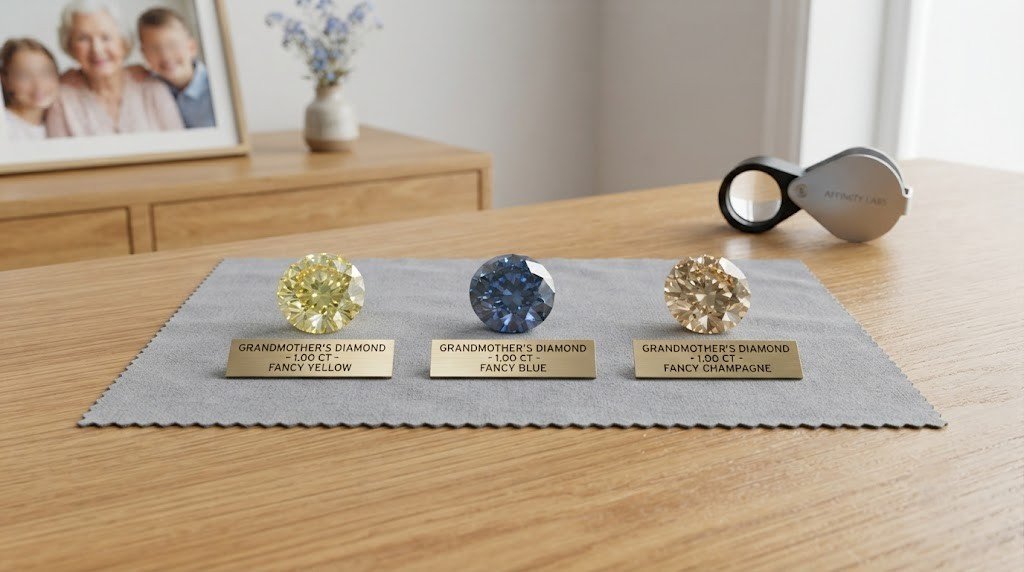
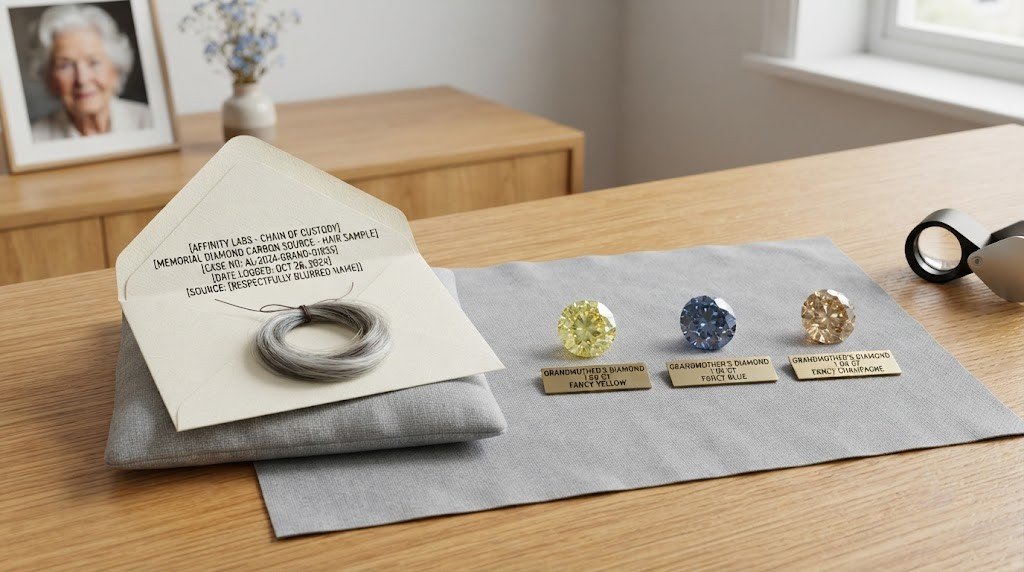
Maybe it is a lock tucked into an envelope, or strands someone thought to save from her brush, and now you are wondering what it could become. The grandmother hair diamond color you are most likely to see is a yellow, blue, or champagne-to-brown tone, and the exact shade is not known until the stone is grown. Hair is rich in carbon, but trace elements still steer the hue, so hair does not give a lighter or more predictable stone than ashes. Colorless and treated shades are available from some providers.

Nothing here requires a decision today. The sections that follow each answer one part of the grandmother hair diamond color question, from chemistry to cost to who should be consulted about using her hair.
grandmother hair diamond color

Does hair make grandmother hair diamond color lighter or more predictable?

No. Hair is built mostly from keratin, a protein that is about 50% carbon by weight, which is why only a small lock or a few grams is usually needed and why no cremation is involved. That high carbon share is a practical advantage; it gives grandmother hair diamond color no head start.

Grandmother hair diamond color still depends on which trace elements end up inside the crystal as it grows. Nitrogen gives yellow tones and boron gives blue tones; a stone free of both shows no body color. Recovered carbon is purified to roughly 99.9% or higher, yet a personal, organic source still tends to produce tinted stones, so yellow, blue, and champagne results are typical.

How much of the finished stone is her carbon?

For hair, no industry-wide figure for the share of personal carbon in the finished stone has been published. Providers typically blend recovered carbon with supplemental lab carbon to grow a stone of useful size, and the blend varies. Ask each provider to state in writing roughly what share of your stone will come from her hair and how they arrive at that figure. The post on whether a memorial diamond is really made from her hair looks at that question closely.

The explanation of how a memorial diamond is made from her hair covers extraction, graphitization, and growth in more detail, which helps show where grandmother hair diamond color is actually set.

What if her hair was gray, dyed, permed, or chemically treated?

Hair that had gone gray or turned white, hair she colored for years, or hair that was permed or relaxed: families ask about all of it. No claim can fairly be made here that any of these changes grandmother hair diamond color, and you should be wary of anyone who says otherwise without explaining why.

Whether dyed or chemically treated hair is accepted at all is a separate question from grandmother hair diamond color, and each provider answers it for itself. Some may have preferences about how recent the hair is or how it was stored. Ask before you send anything.

A practical approach if you have several samples

If the family kept more than one lock, perhaps one from years back and one more recent, describe both to the provider and ask which they would prefer to work with and why. Ask, too, whether they expect the choice to affect grandmother hair diamond color in any way, and listen for a reasoned answer rather than a promise. Their answer will tell you a fair amount about how carefully they handle the material.

Which shades does grandmother hair diamond color usually fall into?

Five broad outcomes cover nearly every grandmother hair diamond color you will see quoted. Three of them are natural results of growth, one comes from controlled processing, and one comes from treatment after the crystal is finished.

ShadeSource of the tintNatural or treatedQuestion to put to the provider
YellowNitrogen in the crystal latticeNaturalHow often do your hair-grown stones come out yellow?
BlueBoron in the crystal latticeNaturalCan you show finished blue examples grown from hair?
Champagne to brownA warm tone common with organic sourcesNaturalHow do you describe this tone on paperwork?
ColorlessNitrogen and boron excluded during growthNatural, extra processingWhat does colorless add to price and time?
Red, pink, green, or blackPost-growth irradiationTreatedWhich treated shades do you offer, and how are they disclosed?

Whichever of the three natural shades appears, that grandmother hair diamond color is an ordinary result, not a defect. None of them can be selected in advance with certainty, since the source material is organic and every growth run is separate.

How will a report describe grandmother hair diamond color?

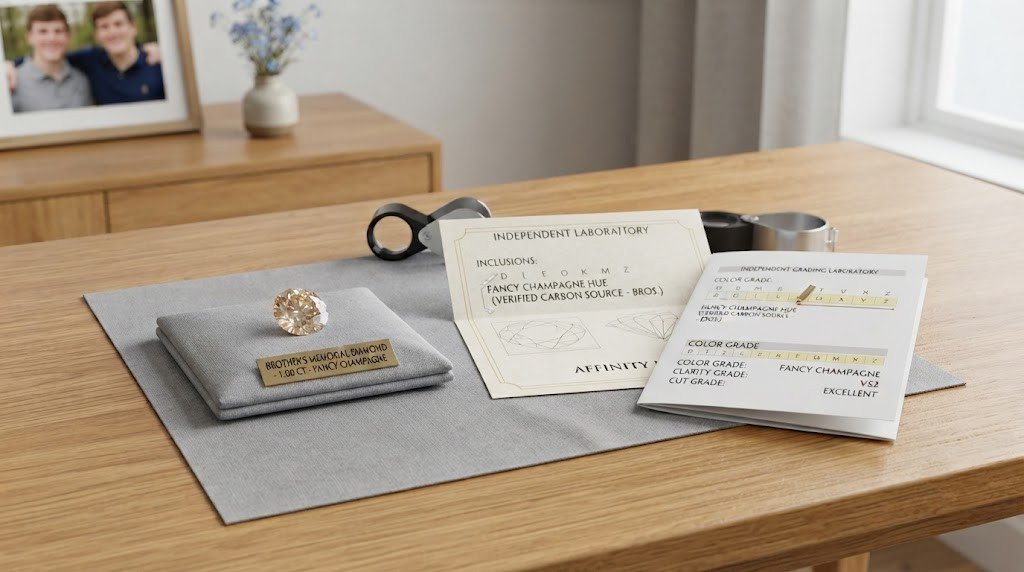
A stone grown from her hair may come with two kinds of paperwork, and only one of them records grandmother hair diamond color. An authenticity or origin certificate, usually issued by the provider itself, records chain of custody and ties the finished stone to the hair your family sent. A grading report is different: it assesses cut, color, clarity, and carat, the same four Cs used for any diamond.

The most trusted grading reports come from an independent third-party lab, typically one working to GIA standards, with IGI used by some. Independent grading is usually an optional purchase rather than part of the base price. For a primer on what each grade means, the GIA guide to how diamond quality is judged is a reliable place to start.

Reading the color entry

As a general gemology convention, white and near-white stones receive a letter grade, while tinted stones are described by hue and depth with terms along the lines of “fancy yellow” or “fancy light blue.” A treated grandmother hair diamond color is usually flagged as treated by independent labs. Ask the provider for a sample report so the wording does not surprise you later.

Clarity for memorial diamonds usually falls somewhere between SI2 and VVS, and it appears on the same document as grandmother hair diamond color. If independent grading matters to your family, raise it when you request a quote, not after the stone is finished.

Does grandmother hair diamond color change what you pay?

It does, though carat weight moves the price far more than grandmother hair diamond color does. The figures below are broad 2026 ranges seen across the industry; they are not Memorial Diamond’s prices, which have not been published.

  • About 0.10 to 0.25 carat: roughly $1,500 to $3,500, with natural tones generally toward the lower side.
  • 0.5 to 1 carat: roughly $5,000 to $15,000; at this size a colorless stone costs meaningfully more than a yellow, blue, or champagne one.
  • 2 to 5 carats and above: roughly $20,000 to $75,000 or more, with longer growth and further cost for colorless or treated shades.

Several items tend to sit outside those numbers: a separate grading report, engraving, a fancy cut, and the ring, pendant, or earrings that hold the stone. When grandmother hair diamond color is tied to your budget, request one quote for a natural tone and one for colorless at the same carat weight and compare them line by line.

What does a colorless stone from her hair involve?
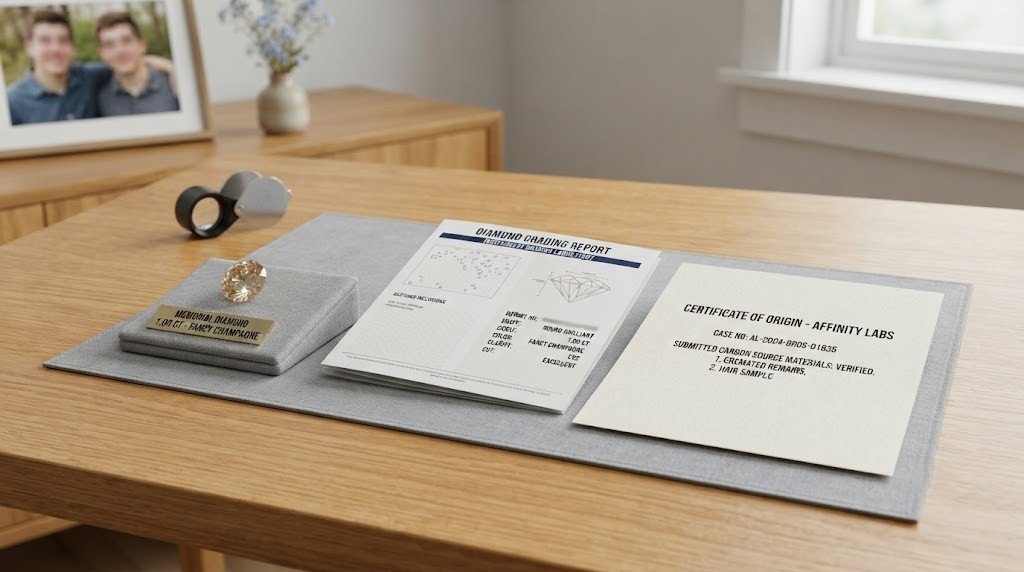
Colorless is an achievable grandmother hair diamond color. The provider has to keep both nitrogen and boron out of the lattice during growth, which calls for added processing and tighter control. That extra effort is the main reason colorless typically costs more at the same size.

People settle on colorless as the grandmother hair diamond color they want for many reasons. It might sit beside a wedding band already worn every day, or the wearer may simply like a bright white stone. Others prefer to let the natural tint stand. Both are reasonable, and neither honors her more than the other.

Before committing to colorless, ask whether the provider offers it for hair-grown stones, how they handle a run that ends up with a visible tint, and whether that outcome changes the price. Those answers are set by each company, so get them in writing.

Which irradiated colors do some providers offer?

Irradiation is a treatment some providers apply after growth to shift or intensify grandmother hair diamond color. Red, pink, green, and black are the usual results. The stone remains a real diamond, with the same hardness of 10 on the Mohs scale of mineral hardness, because the treatment changes how the crystal absorbs light rather than covering it.

Availability varies widely. One provider may offer all four treated shades, another only one or two, and some none at all. A specialty grandmother hair diamond color, such as black, can also stretch the timeline toward the upper end of the range.

If a treated shade appeals, ask how it is described on any grading report, what it adds to the cost, and whether the provider considers the color stable in everyday wear.

How should the wearer’s taste shape grandmother hair diamond color?

The stone will be worn by someone in particular: you, a parent, an aunt, a sibling, a cousin. Their everyday style matters as much as anything about her. A person who wears mostly silver might lean toward colorless or blue; someone who favors warm gold might like how champagne looks against it.

Meaning can come from her side as well, as long as it comes from who she really was. If she spent her working life outdoors, a natural tone might feel right. If she had a favorite color she wore without fail, that may tip a family toward a particular treated shade. These links belong to your memories, not to any idea of what grandmothers are supposed to like.

Some families decide to accept whatever grandmother hair diamond color the growth produces and find the meaning afterward. Others choose a controlled option from the start. A stone handed down a generation later carries its story either way, and that story does not depend on the shade.

Do carat weight and shape change how the tint looks?

Generally, yes, although carat and shape change how grandmother hair diamond color looks rather than what it is. In a larger stone, light travels farther through the crystal, so a tint of the same chemistry can appear more saturated. Memorial diamonds are commonly offered from about 0.10 carat up past 5 carats, a span wide enough that the same tone can look quite different at each end.

Shape matters too. Round brilliants and other brilliant-style cuts break light into sparkle that can mute a faint tint, while step cuts such as emerald or asscher can display body color more openly. The metal around the stone adds its own cast, cooler with platinum or white gold and warmer with yellow or rose gold.

When grandmother hair diamond color is a priority, ask the provider for photos of finished stones in a few shapes and metals. Seeing the options side by side is easier than imagining them.

How long does it take, and how much of her hair is needed?

Industry-wide, the full process usually runs about 6 to 10 months after the provider receives the hair. Stones larger than about 2 carats, and specialty-color stones, can take up to roughly 12 months. Carat size is set mainly by growth time in the press rather than by how much material is supplied.

Because hair is so carbon-rich, the usual request is a small lock or a few grams. Sending more will not deepen or lighten grandmother hair diamond color, and it will not make the stone larger or faster. It can sometimes allow more than one stone, which matters when several relatives each hope for one; confirm that with the provider.

The guide to how much hair a grandmother memorial diamond needs goes further into quantities, storage, and what to do if only a small amount survives. What happens to any hair that is not used is a provider decision, so ask how it is tracked and whether it is returned.

Who should be asked before her hair is used?

Hair kept at home is usually a simpler practical matter than ashes, since nothing has to be released by a crematory. Still, personal possessions may count toward what she left behind, and each state handles estates its own way. If someone is acting as executor or settling her affairs, a short conversation with them first is sensible.

Family feelings matter as much as the grandmother hair diamond color itself. An aunt or uncle may have kept her hairbrush, a cousin may already have a lock, and her surviving spouse or partner, if there is one, may have views of their own. Talking openly before choosing a grandmother hair diamond color keeps the stone from becoming a point of friction later.

When faith is part of the picture

No religious tradition has issued a position on memorial diamonds as such; teaching addresses cremation and the handling of remains. A hair-grown stone involves no cremation, which matters where the concern is cremation itself: major schools of Islamic thought consider cremation impermissible, for instance, and a stone from hair never touches that question. Her clergy or community is still the right place to ask.

For the full family and practical picture, the complete guide to a grandmother hair diamond brings these threads together.

What should you ask a provider about grandmother hair diamond color?

A short written list makes conversations about grandmother hair diamond color easier to compare across providers. These questions cover the points that are decided company by company:

  1. Which natural tones do your hair-grown stones most often come out in?
  2. Do you accept dyed, permed, or chemically treated hair, and does that affect your process?
  3. Do you offer colorless for stones grown from hair, and at what price difference?
  4. Which irradiated shades do you offer, and how are they disclosed?
  5. Roughly what share of the finished stone will be carbon from her hair?
  6. Is independent grading included, or is it a separate add-on?
  7. What happens if the result differs from the color we hoped for?

Keep every answer in writing alongside the quote. If you want to see how the whole journey unfolds, the overview of how to turn your grandmother’s hair into a diamond sets the questions in order. Families weighing the other route can compare with what color a stone from her ashes tends to be, which follows the same chemistry.

Frequently Asked Questions

Will her gray hair produce a white diamond?

Not necessarily. No published evidence links the color of someone’s hair to the color of the diamond grown from it. Grandmother hair diamond color depends on trace elements such as nitrogen and boron and on the provider’s process. A white stone requires the colorless option.

Can a lock of her hair from decades ago still be used?

That depends on the company and on how the hair was kept. Describe its age and storage honestly, ask in writing whether it is suitable, and ask whether its age could affect yield, timing, or the finished stone.

Would hair from her and hair from a grandchild give different colors?

There is no basis for predicting that. Each stone’s color comes from what enters the lattice during its own growth run and from processing choices. Two stones from the same person’s hair can differ too, so treat any prediction like that cautiously.

Is it possible to have two stones in different colors from one lock?

Sometimes. If the lock holds enough carbon for two stones, a provider may grow one as a natural tone and one colorless, or treat one after growth. Whether that is offered, and at what cost, varies, so ask directly.

If grandmother hair diamond color comes out blue, is the stone lower quality?

No. Blue comes from boron in the lattice, and a blue stone is graded on cut, color, clarity, and carat like any other diamond. Color is a description of the stone, not a measure of its worth or of how it was made.

Can grandmother hair diamond color be changed after the stone arrives?

Some providers offer post-growth irradiation, which shifts color, but whether a finished stone can be sent back for treatment is a provider decision. Ask about it before ordering, since changing course afterward may add cost and time.

Final Thoughts on the Color of Her Hair Diamond

Grandmother hair diamond color will most likely be a soft yellow, blue, or champagne tone, and the exact hue will be a discovery rather than a choice. Hair makes the process practical with very little material, but it does not make the color any more certain.

What you can control is the conversation: what to ask, what to put in writing, and who to include. The color can be left to the crystal.

Learn More About Color and Her Hair

Talk With Memorial Diamond

Whenever you are ready to talk about her hair, the colors that might come from it, or how to raise the idea with family, Memorial Diamond is here to listen and answer what we can. Take your time; there is nothing to decide in one conversation.

Reach out through memorialdiamond.us at whatever pace suits you.
What Color Will a Diamond Made From Your Grandmother Ashes Be

What Color Will a Diamond Made From Your Grandmother’s Ashes Be?

Whether her ashes rest with you, with an aunt or uncle, or in a place the family has not yet settled on, it is natural to picture the stone they could become before anyone commits to anything. The most likely grandmother ashes diamond color is a yellow, blue, or champagne-to-brown tone, and no provider can tell you the exact shade until the crystal has finished growing. A colorless stone is achievable with extra processing, usually at a higher price, and some providers also offer treated colors such as pink or black.

That short answer leaves real questions open about grandmother ashes diamond color: why the tones fall where they do, what a grading report will say, and whether color changes the cost or the wait. Each section stands on its own, so go straight to the part you need.

grandmother ashes diamond color

What grandmother ashes diamond color is most likely?

Across the memorial diamond industry, grandmother ashes diamond color, like the color of any stone grown from cremated remains, trends toward three families of tone: yellow, blue, and champagne or brown. Any of the three is a normal result. A stone in one of these shades is a real diamond, graded on the same four Cs (cut, color, clarity, carat) as a mined one.

Which of the three appears depends mostly on trace elements present while the crystal grows. Think of grandmother ashes diamond color as an outcome of chemistry and process choices rather than a menu item. A provider can tell you which tones their natural, untreated stones usually come out in, and that is a fair first question to ask.

Here is how the main possibilities for grandmother ashes diamond color compare:

Grandmother ashes diamond colorWhat usually produces itNatural or treatedRelative cost at the same size
YellowNitrogen present during growthNatural resultLower to middle of the range
BlueBoron present during growthNatural resultLower to middle of the range
Champagne or brownA warm tone common in stones grown from an organic sourceNatural resultLower to middle of the range
Colorless (white)Extra processing that keeps both nitrogen and boron outNatural result, controlled processMeaningfully higher
Red, pink, green, or blackPost-growth irradiation, offered by some providersTreatedVaries by provider; ask for a quote

Why do trace elements shape grandmother ashes diamond color?

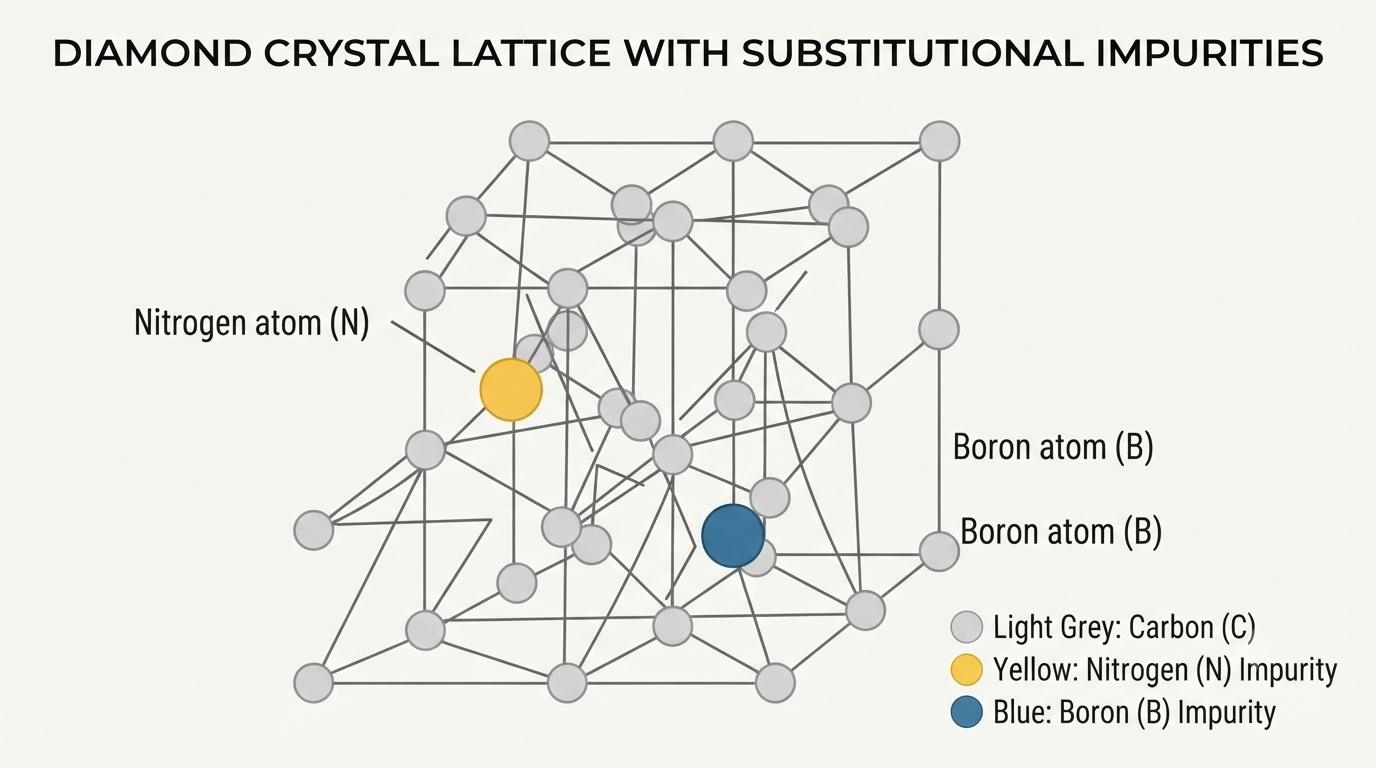
Diamond is carbon arranged in a tight crystal lattice. When a few atoms of another element slip into that lattice during growth, the stone absorbs some light and shows a tint. Nitrogen produces yellow tones. Boron produces blue tones. A stone with neither shows no body color at all.

That is the whole basis of grandmother ashes diamond color: carbon recovered from ashes comes from an organic, personal source rather than a carefully controlled lab feedstock. After the crematory, most of what remains is calcium phosphate, the mineral of bone, and only roughly 0.5% to 4% of the ash by weight is usable carbon. That carbon is purified to around 99.9% or better, but trace elements are still common in this kind of source, which is why tinted results are the norm.

How much of the stone is her carbon?

For a stone grown from ashes, the recovered carbon is typically blended with supplemental lab carbon so there is enough to grow a stone of useful size. Industry figures put her share near 10% to 15% of the finished mass. A few providers quote figures closer to 3%, others go higher, and stone size and the amount of ash sent both play a part. Any claim that the stone is made entirely from ashes does not match how the process works.

Knowing that blend is part of the picture helps explain why grandmother ashes diamond color cannot be read off the ashes themselves. The final hue reflects the purified carbon, the supplemental carbon, the growth conditions, and any steps the provider takes to include or exclude particular elements. You can read more about how her ashes become a finished stone, from purification through growth and polishing.

Can a stone from her ashes be colorless?

Yes, a colorless result is an achievable grandmother ashes diamond color. Getting there means the provider has to keep both nitrogen and boron out of the growing crystal, which takes additional processing and closer control in the press. That extra work is the main reason colorless stones typically cost more than tinted ones of the same carat weight.

Some families want colorless because it matches jewelry already in the family, or because the wearer simply prefers a white stone. Others feel a natural grandmother ashes diamond color is closer to the point of the whole thing. Neither choice is more respectful than the other.

If colorless matters to you, ask each provider three things in writing: whether colorless is offered for ash-based stones, how the price compares with their natural tones at the same size, and what happens if a colorless run does not reach the intended result. That last answer is entirely provider-dependent, so get it on paper before you send anything.

What are the treated colors, like pink, red, green, or black?

Some providers offer post-growth irradiation, a treatment applied after the crystal has formed that shifts or deepens grandmother ashes diamond color. Red, pink, green, and black are the shades usually produced this way. These are still real diamonds; the treatment changes how the lattice absorbs light rather than adding a coating.

Irradiated colors are not offered everywhere. A specialty grandmother ashes diamond color, black among them, can also add time, with some stones taking up to about 12 months in total.

Questions worth asking before choosing a treated shade:

  • Is the treatment disclosed on the grading report, and in what words?
  • Which treated colors does the provider offer for stones grown from ashes?
  • How much does the treatment add to the price and to the timeline?
  • Does the provider describe the treated color as stable under normal wear?

Why can’t a family pick or match an exact natural shade?

Natural color in a memorial diamond comes from whatever trace elements end up in the lattice, and that is shaped by an organic source no lab can fully predict. A provider can steer toward colorless by excluding nitrogen and boron, or shift the color afterward with irradiation. What nobody can honestly promise is a particular untreated shade, such as the exact blue of a photograph or a paint chip.

That uncertainty is easier to live with when it is expected from the start. A useful way to frame grandmother ashes diamond color is as something you find out rather than specify. Some families come to value that, since the tone emerged from this one growth run rather than from a catalog.

If you are comparing quotes, be cautious about any promise of an exact grandmother ashes diamond color. Ask the provider to explain, in plain terms, what is and is not under their control, and keep that explanation with your paperwork. The step-by-step process for a stone grown from her ashes shows where in the sequence color is actually decided.

How is grandmother ashes diamond color graded on a report?

Two different documents often arrive with a memorial diamond, and only one of them records grandmother ashes diamond color. An authenticity or origin certificate, usually issued in-house, documents the chain of custody: that this stone was grown from carbon recovered from the ashes your family sent. A grading report describes the stone’s own quality, covering cut, color, clarity, and carat.

Grading is ideally done by an independent lab, most commonly referencing GIA standards and sometimes IGI, and is typically an optional, separately priced add-on. GIA’s overview of the diamond quality factors is a clear plain-language introduction to what the four Cs mean.

What the color line on a report usually says

In general gemology, colorless and near-colorless diamonds are placed on a letter scale, while yellow, blue, and other tinted stones are described by their hue plus an intensity term such as “fancy light” or “fancy intense.” Independent reports also commonly note whether a color comes from treatment. Exact wording varies by lab, so ask to see a sample report before you choose.

Typical clarity for memorial diamonds falls in the SI2 to VVS range, listed beside grandmother ashes diamond color on the same report. If your family wants a grading report, ask about it at the quoting stage so the cost is clear from the start.

Do carat size and cut change how the color looks?

In general, yes, though the effect is about how grandmother ashes diamond color appears, not the underlying chemistry. A larger stone gives light a longer path through the crystal, so a tint can look a little stronger in a bigger diamond than in a small one with the same composition. Memorial diamonds run from about 0.10 carat to more than 5 carats, so that range covers very different looks.

Cut shape plays a part too. Brilliant-style cuts scatter light in a way that can soften how a tint reads, while some step cuts and elongated shapes show body color more openly. Ask the provider for examples of the same tone in different shapes.

Setting metal matters as well: white metals can make a pale tint look cooler, and yellow or rose metals warm it up. If grandmother ashes diamond color is one of your main concerns, ask to see photos of finished stones in a few cuts and settings before deciding.

How does grandmother ashes diamond color affect the price?

Size drives most of the price, and grandmother ashes diamond color comes second. These are general 2026 industry ranges, not quotes from Memorial Diamond, and the final figure depends on carat, color, cut, and whether an independent grading report is included.

Size tierTypical industry rangeWhere grandmother ashes diamond color fits
About 0.10 to 0.25 caratRoughly $1,500 to $3,500Natural tones usually at the lower end
0.5 to 1 caratRoughly $5,000 to $15,000Colorless costs meaningfully more than yellow, blue, or champagne
2 to 5+ caratsRoughly $20,000 to $75,000+Longer growth; colorless and treated colors add further

Engraving, fancy cuts, settings such as a ring or pendant, and an independent grading report are usually priced separately from the loose stone. When grandmother ashes diamond color is a deciding factor in the budget, ask for side-by-side quotes at one carat weight so the difference between a natural tone and colorless is plain.

Does grandmother ashes diamond color change the timeline or ash needed?

Grandmother ashes diamond color can affect the timeline. Across the industry, the full process typically takes about 6 to 10 months from the day the provider receives the ashes. Larger stones, roughly those over 2 carats, and specialty-color stones can take up to about 12 months.

The amount of ash is a separate question. Providers typically ask for somewhere between a few tablespoons and roughly 4 ounces, about 100 grams, which is usually a small fraction of the full remains. Growth time in the press, not the volume sent, sets carat size, so a full urn does not produce a bigger or faster stone.

Sending more ash is also not a way to steer grandmother ashes diamond color toward a particular tone. Color comes from trace elements and from the provider’s process choices. What a larger portion can sometimes allow is more than one stone, so that several relatives each receive one; the guide to how much ash a grandmother memorial diamond needs covers that in more depth.

What to ask about leftover ash

What happens to unused ash is decided by each company. Ask in writing before you ship, and ask how the ashes are tracked from arrival to finished stone.

Who in the family weighs in on the color and the ashes?

Settling on a grandmother ashes diamond color can feel like a small, personal decision, yet it often sits on top of a bigger one: who has the right to decide what happens to her remains. Two things answer that: the law of the state involved, and whatever she put in writing. States rank relatives differently, so no single national order applies. Commonly, a surviving spouse or partner ranks first, followed by her adult children, with grandchildren further down.

If you are a grandchild, the respectful route is usually to ask whoever holds that authority for a small portion. The funeral home or crematory can often tell you who signed the cremation authorization, which is a good starting point. Her ashes may already have been divided, scattered, or kept by an aunt, an uncle, or one of your parents, and she may have died some years ago; a conversation is still possible in each case.

When cousins want different colors

When several grandchildren are involved, grandmother ashes diamond color is worth talking through early. One cousin may want colorless to match an engagement ring, while another prefers whatever natural tone appears. Since a modest portion of ash can often support more than one stone, each person may be able to choose separately; confirm that with the provider. The complete guide to a grandmother ashes diamond walks through the wider family side in detail.

Faith can shape these conversations as well. Religious teaching speaks to cremation and to keeping or dividing ashes; none of the major traditions has ruled on memorial diamonds as such. If faith matters in your family, her clergy or community is the right place to ask.

How do families tie grandmother ashes diamond color to who she was?

For some people, grandmother ashes diamond color is where the stone starts to feel like hers. A blue result might call to mind the lake town she grew up in, or the uniform she wore through her working years. A champagne tone might bring back the desert roads she loved, or the color of a jacket she reached for again and again.

Those links come from your own memories, not from any rule about what suits a grandmother. She may have been bold or reserved, a traveler or a homebody. The stone will also be worn by a particular person, maybe you, a cousin, or one of her children, and their taste deserves equal weight.

Some families wait to see the natural result and build the meaning around it. Others choose colorless or a treated shade to suit how the wearer dresses. Both approaches are sound. If you are still deciding whether hair might be an option alongside or instead of ashes, the post on what color a stone from her hair might be answers the same question for that route.

A note on stones grown from more than one source

Some families combine ash and hair in one stone. The same principles behind grandmother ashes diamond color apply, and the outcome is no more predictable. The page on color for a stone grown from her ashes and hair together looks at that combined route specifically.

Frequently Asked Questions

Can grandmother ashes diamond color be clear like an engagement ring?

Probably not unless you request it. Stones grown from ashes usually come out yellow, blue, or champagne to brown. A colorless result is achievable when the provider excludes nitrogen and boron during growth, which takes extra processing and typically raises the price at the same carat weight.

Can I choose blue for a stone grown from her ashes?

You can tell the provider you hope for blue, but an exact natural shade cannot be promised. Blue comes from boron in the lattice, and an organic source is unpredictable. Ask whether the provider’s process tends toward blue and what happens if the result differs.

Does grandmother ashes diamond color reveal anything about her health or habits?

No reliable link of that kind has been published. Grandmother ashes diamond color depends on trace elements such as nitrogen and boron, the supplemental lab carbon blended in, and the provider’s process. Treat claims that a hue reflects personality, diet, or health as unsupported.

Is a treated pink or black stone from her ashes still a real diamond?

Yes. Irradiation, offered by some providers, changes how the crystal absorbs light after growth; it does not coat or replace the diamond. An independent grading report usually notes that a color is treated, so ask to see how the lab you choose words that disclosure.

If my cousins and I each get a stone, will they all match?

Not necessarily. Grandmother ashes diamond color can differ between stones grown separately from the same ashes, because each growth run is its own process. If matching matters, ask whether every stone can be grown colorless, or accept that slight differences are part of having several stones.

Can her ashes still be used if they were cremated many years ago?

Ashes kept for years raise a fair question. Whether older ashes are workable, and whether storage conditions matter, is a question for each provider. Ask in writing before shipping, and ask whether the age of the ashes affects color, yield, or timeline in their experience.

Final Thoughts on Your Grandmother’s Diamond Color

Grandmother ashes diamond color is one of the few parts of the process that stays a little uncertain right up to the end. For some families, that turns out to be fine. A yellow, blue, or champagne stone is a normal and honest result, and colorless or treated shades remain on the table if they suit the person who will wear it.

The most useful step now is asking clear questions and keeping the answers in writing.

Learn More About Color and Her Ashes

Talk With Memorial Diamond

If you would like to think through color, size, or how to approach your family about a portion of her ashes, Memorial Diamond is glad to talk it over with you. There is no rush and no obligation; questions are welcome at any stage.

You can start whenever it feels right at memorialdiamond.us.

Word count: 3,195 words · Reading time: about 16 minutes

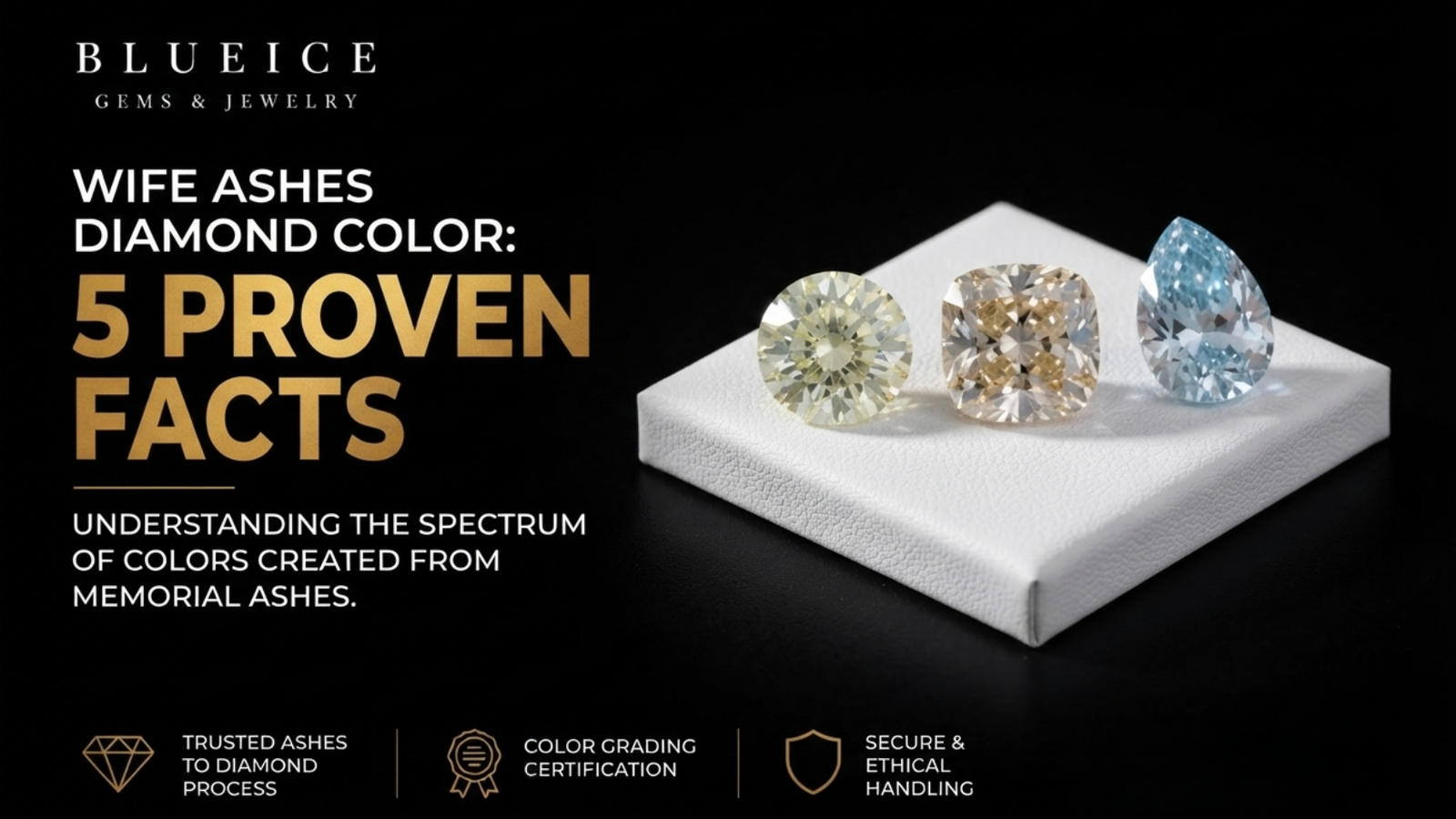
Wife ashes diamond color: three loose lab-grown memorial diamonds — pale yellow, champagne, and light blue — on a white grading tray

What Color Will a Diamond Made From Your Wife’s Ashes Be?

You may have already pictured it on your hand, or on a chain you never take off, and the picture is probably colorless, because that is what the word “diamond” has always meant. The honest wife ashes diamond color answer is that the stone will most likely be yellow, champagne, or blue rather than colorless, because trace nitrogen or boron carried in personal carbon tints the crystal as it grows; colorless is achievable with extra processing and costs more, and red, pink, green, and black come from post growth irradiation.

Why Is a Wife Ashes Diamond Color Usually Not Colorless?

A diamond is carbon atoms locked in a lattice. Color enters through the atoms that are not carbon, trace elements in the growth cell that get built into the crystal. Three cases cover almost everything:

  • Nitrogen in the lattice absorbs blue light, and the stone reads yellow. In heavier concentrations, or in certain lattice arrangements, the yellow deepens toward champagne and brown.
  • Boron absorbs red light, and the stone reads blue.
  • The absence of both is what a colorless diamond requires, nothing in the lattice but carbon.
Simple diagram of a diamond crystal lattice with a nitrogen atom and a boron atom marked in the carbon structure

Now consider where the carbon behind a wife ashes diamond color comes from. Cremated remains are almost entirely calcium phosphate, with only about 0.5 to 4% usable carbon. A laboratory extracts that carbon, purifies it to 99.9%+, and converts it to graphite at roughly 2,500 to 2,700°C. Purification is very good, not perfect; the residual fraction of a percent is where nitrogen, present in every protein in a body, tends to survive. Boron is rarer but present.

The personal carbon, typically around 10 to 15% of the finished stone’s mass once blended with supplemental lab carbon, is then grown around a seed in an HPHT press at roughly 6 to 8 GPa and 1,400 to 2,500°C. A minority of providers use CVD; both methods are described on the synthetic diamond page.

That is the whole mechanism behind the wife ashes diamond color question. A commercial lab grown diamond can be grown colorless because its feedstock is nothing but carbon. A memorial diamond starts with organic, personal carbon, and organic carbon carries passengers. The yellow, champagne, blue tendency is the source material being what it is.

The five facts in one place

If you read nothing else about wife ashes diamond color, these five hold up across the industry:

  1. Color comes from trace nitrogen or boron during growth, not from her, and not from how the ashes look.
  2. The natural wife ashes diamond color tendency is yellow, champagne, or blue.
  3. Colorless requires additional processing to exclude trace elements and costs more at every carat.
  4. Red, pink, green, and black are produced after growth by irradiation, not by anything in the ashes.
  5. Two stones grown from the same ashes can, and often do, come out different colors.

What Is on the Wife Ashes Diamond Color Menu?

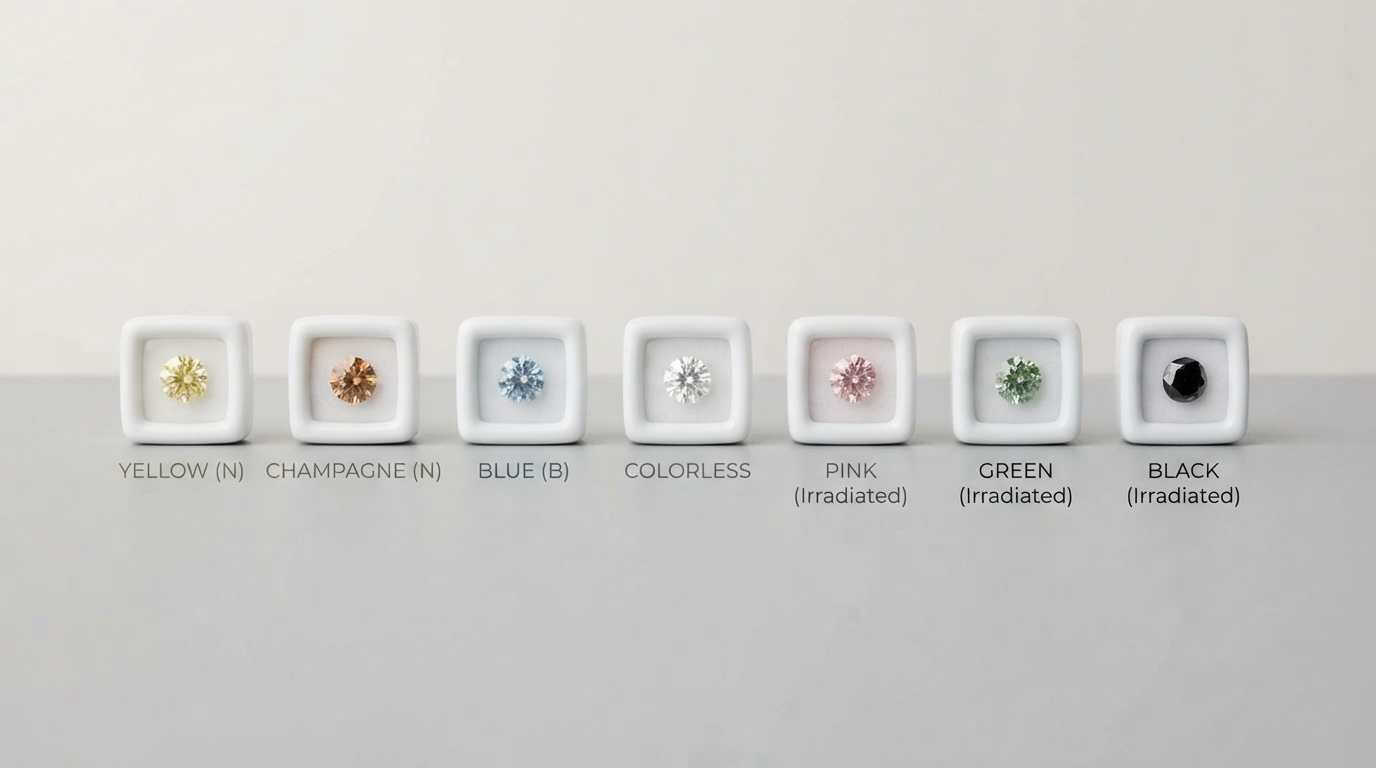
The table below is the wife ashes diamond color range as the industry generally offers it, with the cause, the usual effect on price, and the metals that flatter each tone.

ColorCauseTypical cost effectMetals that flatter
YellowTrace nitrogen in the lattice during growthBaseline, usually the least expensive option at a given caratYellow gold deepens it; white metals make it read brighter and more obviously yellow
Champagne / brownHeavier nitrogen, or particular nitrogen arrangementsBaseline, sometimes slightly below yellowRose gold and yellow gold, warm tone against warm metal
BlueTrace boron in the latticeBaseline to modestly above; varies by providerWhite gold and platinum; the cool metal keeps the blue clean
Colorless / near colorlessExtra processing to exclude nitrogen and boronHighest of the grown colors, meaningfully more than yellow, champagne, or blue at the same sizePlatinum and white gold for an icy look; yellow gold for contrast
Red / pinkPost growth irradiationAdd on above the grown colorRose gold and platinum
GreenPost growth irradiationAdd on above the grown colorYellow gold and platinum
BlackPost growth irradiation, sometimes with longer growthAdd on; can extend the timeline to around 12 monthsAny metal; black reads strongly against white and yellow gold alike
Seven small diamonds in a row — yellow, champagne, blue, colorless, pink, green, black — beside their labels

Two things the menu does not say. “Yellow” on a price list is a family of tones, from pale straw to deep gold, and you will not know where a particular wife ashes diamond color lands in it until the stone is out of the press. And an irradiated wife ashes diamond color is a real, permanent color of a real diamond, the process rearranges the lattice, but the lab chose it rather than the carbon producing it. Either is fine, as long as you know which you are buying.

How Does a Grading Report Describe Color, and What Will It Look Like on a Hand?

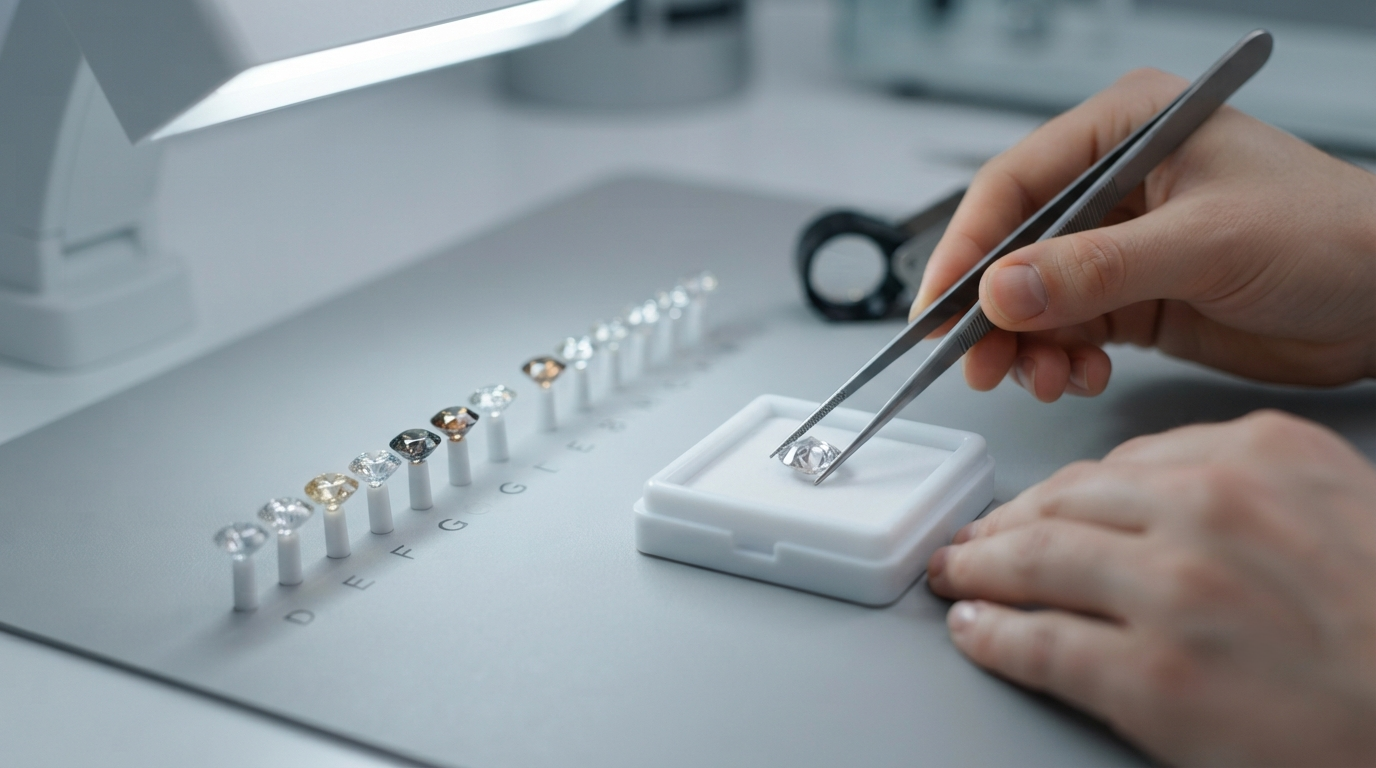
An independent grading report describes a wife ashes diamond color in one of two languages, and neither is quite the same as what you see.

For near colorless and faintly tinted stones, gemologists use the GIA D to Z color scale: D is completely colorless, and each letter toward Z carries slightly more visible yellow or brown. A stone at K or M on that scale would be described as “faint” or “very light” yellow, and, set in yellow gold, would look warm rather than obviously colored. Grades are assigned face down against white, under controlled light, deliberately not how anyone looks at a ring.

Gemologist comparing a loose diamond face-down against a row of master stones under a daylight lamp

For stones with more color than Z, most blues, deeper yellows, champagne, and every irradiated stone, the report switches to the fancy color vocabulary: hue, tone, and saturation, from “Fancy Light” through “Fancy,” “Fancy Intense,” and “Fancy Vivid.” Here, more color is not a lower grade. It is a description.

On a hand: a stone in the lower D to Z letters looks warm, not yellow, at arm’s length, especially in yellow or rose gold; a “Fancy Light Blue” is a clear, soft blue, not sapphire; champagne stones photograph darker than they wear and read as warm honey in daylight. Ask to see the stone under ordinary light before you accept it, and read the report as a controlled measurement, not a verdict on whether you will like the wife ashes diamond color on your hand.

How Does Color Interact With Carat and Cost?

Color, carat, and cost move together.

Carat is set by growth time in the press, not by how much ash you send, and cost rises steeply with size. Wife ashes diamond color enters that equation in two ways. Colorless requires the extra processing that excludes trace elements, and that premium applies at every carat, a 1 carat colorless costs meaningfully more than a 1 carat yellow from the same provider. And larger stones show color more visibly: the faint tint that vanishes in a 0.25 carat stone is easy to see across a 1.5 carat table. A large stone that reads colorless is paying for both the size and the exclusion process, and the two compound.

As general 2026 industry ranges, not Memorial Diamond’s published pricing, memorial diamonds run roughly:

  • $1,500 to $3,500 for 0.10 to 0.25 ct
  • $5,000 to $15,000 for 0.5 to 1 ct, with colorless costing meaningfully more than blue, yellow, or champagne at the same size
  • $20,000 to $75,000+ for 2 to 5+ ct

Irradiated colors add to the grown color; grading, engraving, and the setting are usually priced separately. If budget is the constraint, the least expensive path to a wife ashes diamond color you will love is usually to accept the natural tendency at the carat you want and let the metal do the rest. How much a wife memorial diamond costs breaks the tiers down in more detail.

Which Metal Should Hold Each Color?

Choose the setting after the stone exists, pick the metal for the wife ashes diamond color that actually arrived, not the one you hoped for. A few principles hold across jewelers:

  • Warm stone, warm metal hides tint. Yellow gold around a faint yellow stone makes the piece read as one warm object rather than a slightly off white diamond.
  • Warm stone, cool metal shows tint. A faint yellow in platinum looks more yellow, because the white metal gives the eye a reference, the pairing to choose if you want a deliberate yellow diamond.
  • Blue in white metal stays clean; yellow gold can make a light blue look grayish.
  • Colorless in white metal is the traditional icy look, and also where any residual tint shows most. Near the bottom of the near colorless range, yellow gold can be the kinder choice.
  • Irradiated colors are saturated enough that metal is taste, not correction.

If the piece will sit against a wedding band, hold the stone next to that band’s metal first. Memorial diamond settings and jewelry ideas for a wife covers the setting families themselves.

What Should You Specify in Writing Before Growth Begins?

The wife ashes diamond color you receive is chemistry; what you were promised is paperwork. Growth takes 6 to 10 months, and a verbal understanding from month one is hard to reconstruct in month nine. Before the ashes leave the house, get the following in writing on the order:

  1. The color you are ordering, named the way the provider names it, “natural, as grown,” “blue,” “colorless,” “irradiated red,” and so on.
  2. The range that counts as delivered, a band on the fancy scale or a span of D to Z letters. “Yellow” alone is not a specification; “Fancy Light to Fancy Yellow” is.
  3. What happens if the stone falls outside that range, regrow, recolor, discount, or refund, and who pays.
  4. Whether the color will be independently graded, by whom, and whether the report is included in the price.
  5. Whether irradiation is applied by default if the natural color disappoints, or only on your instruction.
  6. The timeline for that color, black and some large stones run to around 12 months.

A provider comfortable with the wife ashes diamond color question will have answers to all six. “It will be beautiful, don’t worry” is not wrong, exactly, but it is not a specification. The questions to ask before turning your wife’s ashes into a diamond include these six among the rest.

What Recourse Do You Have if the Stone Is Outside the Promised Range?

No lab can redo a wife ashes diamond color once the crystal has grown; the nitrogen or boron is in the lattice. What a provider can do is grow a second stone, if enough submitted carbon, or additional ashes, remain, irradiate the stone into a different color family, adjust the price, or refund. Which of those is on offer, and at whose cost, is what item 3 above pins down.

Recourse also depends on evidence: the range has to have been written down, and the stone graded against it. An independent grading report is what makes “you promised Fancy Light Blue and this is Very Light Blue” a fact rather than an opinion.

Finally, keep some of the ashes. A stone typically needs only a few tablespoons to roughly 4 oz, about 100 g, and a family that kept the remainder has the option of a second stone; a family that sent everything does not. Wife Ashes Diamond: The Complete Guide covers what to keep, and why.

Why Do Two Stones From the Same Ashes Come Out Different?

Families who order more than one stone from the same submission are sometimes surprised when the stones do not match. Wife ashes diamond color is not a property of the ashes; it is a property of each growth run.

Each stone grows in its own cell, around its own seed, for its own length of time. The carbon blend in each cell is not identical to the atom, and each run’s pressure and temperature profile is close but not the same. Nitrogen distributes unevenly through a growing crystal. Two runs from one purified batch can therefore give a pale yellow and a warm champagne, or a light blue and a near colorless, and neither wife ashes diamond color is the “wrong” one.

If matching matters, a pair of earrings, stones for two sisters, say so in writing, ask what the provider can do to narrow the spread, and accept that “similar” is a more honest promise than “identical.” Others feel each stone being its own wife ashes diamond color is the point. More than one family member getting a diamond from the same wife’s ashes covers multiple stones. If you also hold a lock of her hair, what color a diamond made from your wife’s hair will be answers the one question hair adds, and the ashes and hair color page covers a combined stone.

Frequently Asked Questions

Will the diamond be colorless like a traditional diamond?

Probably not by default. Personal carbon carries trace nitrogen or boron that survives purification and tints the crystal yellow, champagne, or blue as it grows. Colorless is achievable with additional processing that excludes those elements, and it costs meaningfully more than the natural tones at the same carat.

Does the wife ashes diamond color say anything about her?

No, not her personality, her health, or anything else. The color comes from trace elements built into the lattice during growth and from the conditions of that growth run. Treat it as the stone’s own character rather than a message; it would differ on a different day.

Can I choose the color in advance?

You can specify a wife ashes diamond color family, natural as grown, blue, colorless, or irradiated red, pink, green, or black, and a provider grows or treats toward it. The exact shade within a grown family is not controllable. Put the family and range in writing before growth.

Why does colorless cost more?

Because it requires excluding the trace nitrogen and boron that personal carbon naturally carries, which means additional processing and tighter control during growth. That premium applies at every carat, and it compounds with size, since larger stones show faint tint more visibly than small ones do.

Are irradiated colors real, or a coating?

Real and permanent. Irradiation rearranges the diamond’s lattice to produce red, pink, green, or black; there is no coating to wear off. The distinction is that the lab chose the color rather than the carbon producing it, worth knowing, but not a mark against the stone.

What does a grading report’s color grade actually mean?

For near colorless stones, a D to Z letter assigned face down under controlled light against master stones; for more saturated stones, a fancy color description of hue, tone, and saturation. Both are measurements, not predictions of how the stone looks face up on a hand in daylight.

What if the stone is not the color I was promised?

Once grown, a wife ashes diamond color cannot be undone, but a provider can regrow, irradiate to a different color family, discount, or refund. Which applies should be written into the order before growth, and an independent grading report is what proves the stone fell outside the promised range.

Final Thoughts on the Wife Ashes Diamond Color Question

The picture in your head is probably colorless, and the stone that arrives will probably not be. That gap is worth closing now rather than at the end of ten months. A wife ashes diamond color is the record of one growth run around carbon that came from her, yellow if nitrogen rode along, blue if boron did, colorless if the lab was asked to exclude both. Decide which you want, write the range down, keep some of the ashes, and choose the metal after the stone exists. Then whatever wife ashes diamond color turns up will be the one you asked for.

Learn More About Wife Memorial Diamonds

Talk With Memorial Diamond

If you would rather ask the color question before the ashes leave the house than after the stone arrives, reach out to Memorial Diamond, which wife ashes diamond color families are offered, how the range is written into an order, and what happens if a stone falls outside it can all be settled first.

memorial diamond colors husband expect

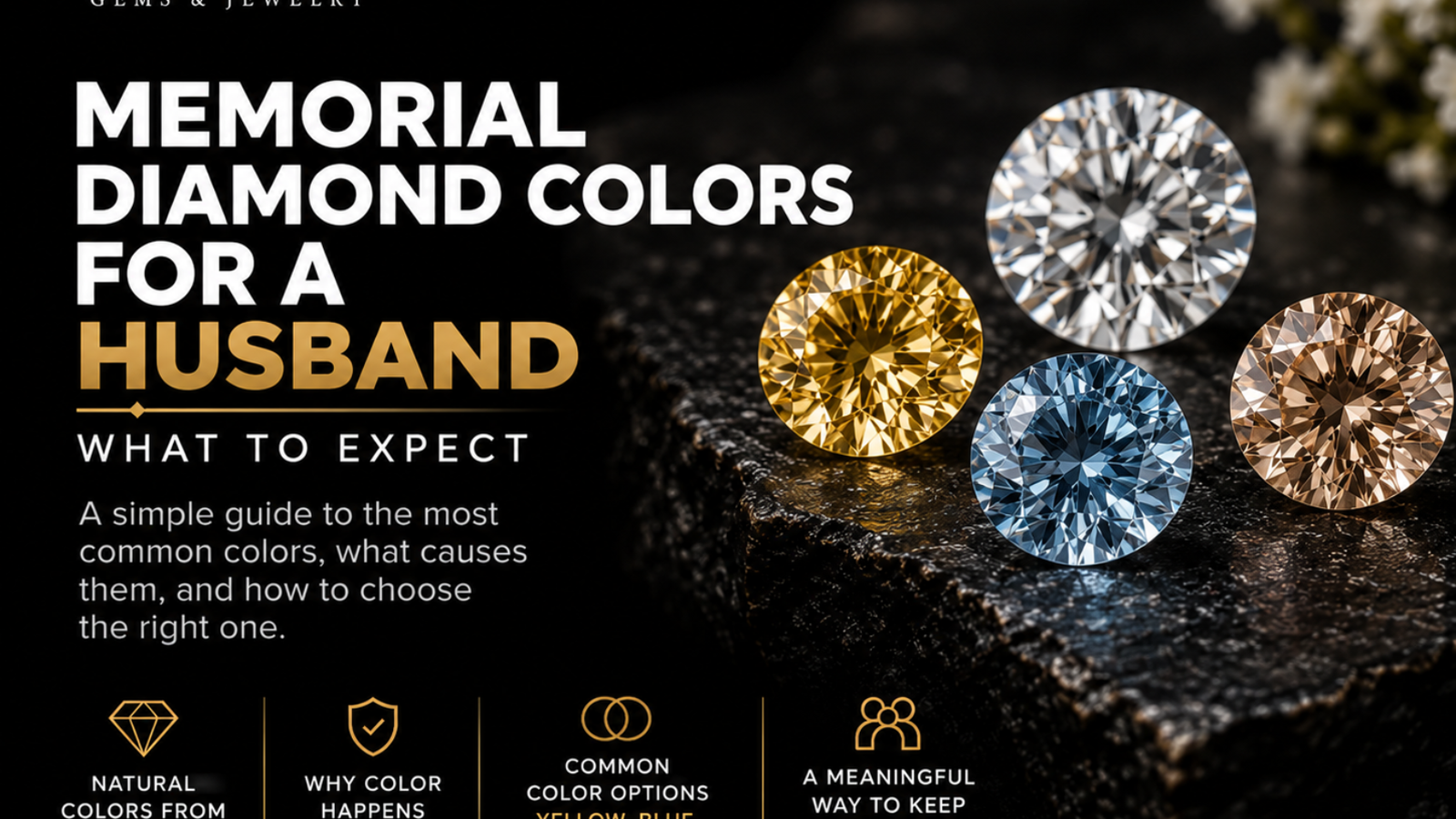
Memorial Diamond Colors for a Husband: What to Expect

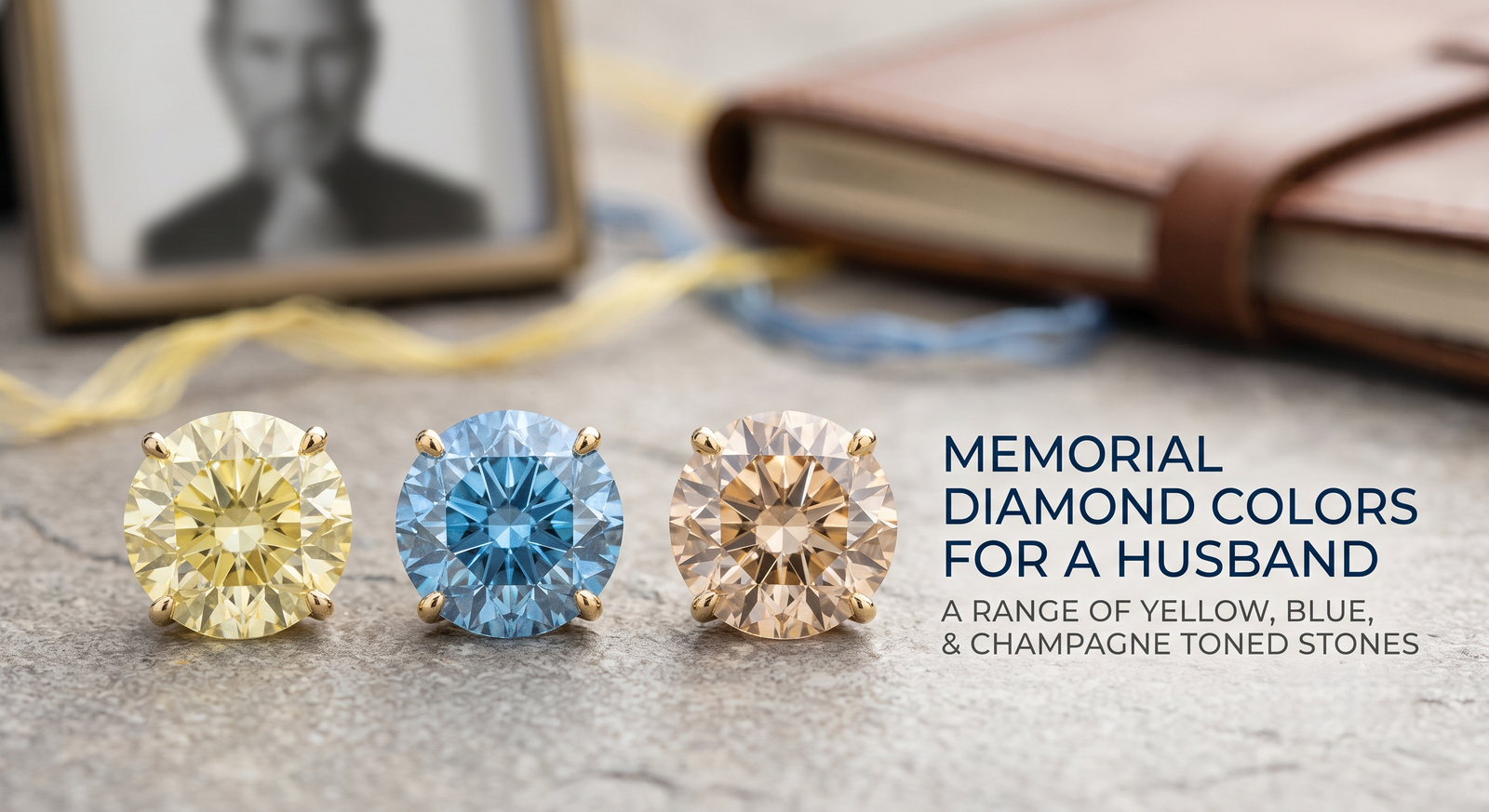
diamond colors for a husband shown as a range of yellow, blue, and champagne toned stones


A showcase of the diverse tones in husband memorial diamonds.

The Short Answer: Memorial Diamond Colors Husband Expect

When reviewing what memorial diamond colors husband expect, families find that stones typically trend toward yellow, blue, and champagne or brown tones rather than colorless. This natural palette is a direct result of trace elements naturally present in ash or hair derived carbon, not a flaw or an inconsistency in the process. A fully colorless stone is achievable, but it requires additional processing to exclude those trace elements and typically costs more.

If you are picturing a classic white diamond and wondering whether that is realistic, the honest answer is: it is possible, but it is not the default outcome, and there is a real, interesting reason why.

Why Color Happens at All

Diamond color comes from trace elements present during crystal growth. Specifically, boron produces blue tones, nitrogen produces yellow tones, and the complete absence of both is required for a colorless stone.

A controlled synthetic feedstock, with nothing in it but carbon, tends to grow colorless by default because there is nothing else present to introduce color. Ash and hair derived carbon is different: it comes from an organic, personal source, so trace elements are common. That is precisely why the spectrum of memorial diamond colors husband expect skews toward yellow, blue, and champagne rather than white. It is a direct consequence of the carbon’s real, human origin, not something that went wrong in growing it.

The Common Color Range

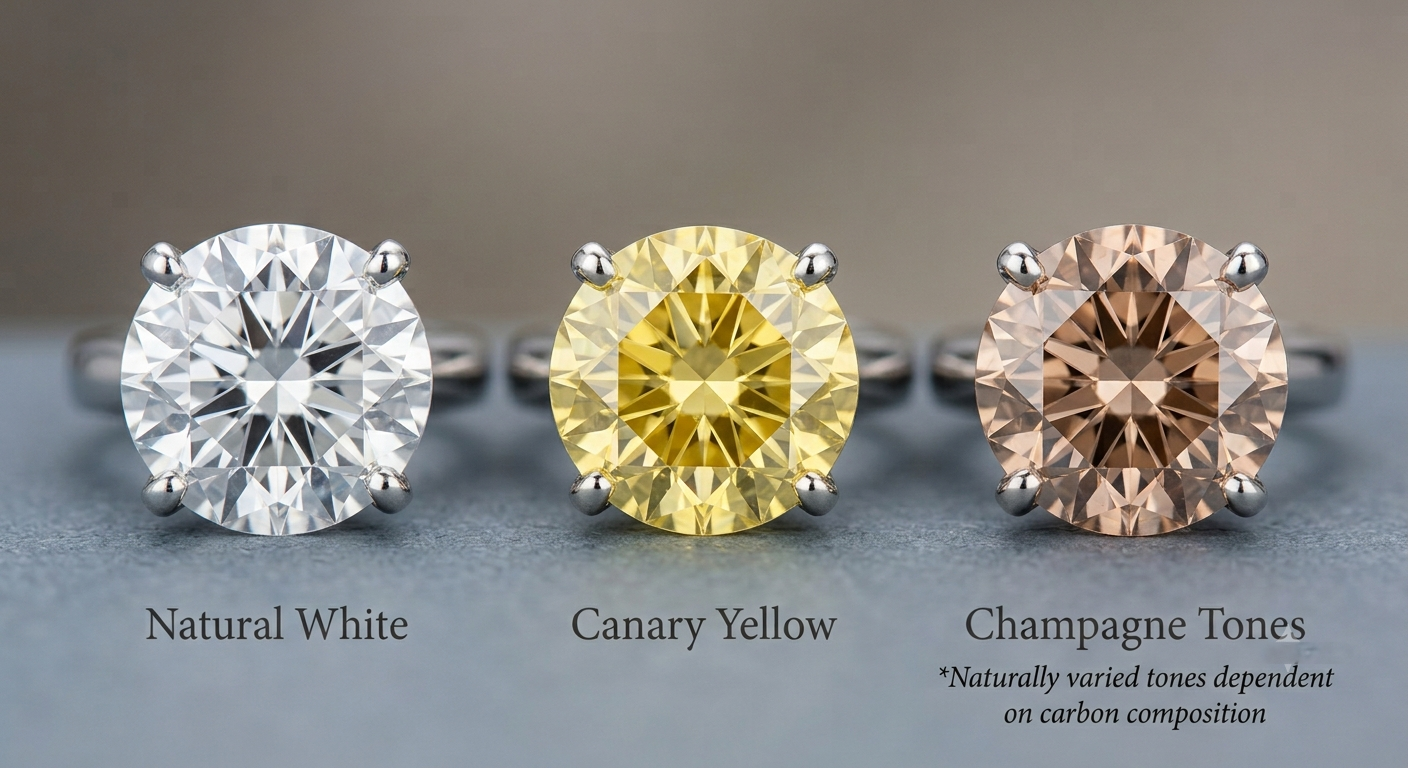
Side-by-side comparison of memorial diamonds in white, yellow, and champagne tones
Side by side comparison of white, yellow, and champagne tones.
ToneWhat causes itHow common it is
YellowTrace nitrogen present in the carbonCommon
BlueTrace boron present in the carbonLess common than yellow, but not rare
Champagne / brownA mix of trace elements and growth conditionsCommon
Colorless / whiteRequires processing to exclude both boron and nitrogenAchievable, but not the default; typically costs more
Red, pink, green, blackPost growth irradiation, offered by providers such as Blue Ice GemsAvailable where a provider specifically offers it

None of these outcomes reflects anything about your husband specifically. The baseline of memorial diamond colors husband expect varies the same way it would for any family member’s stone, based strictly on the carbon’s trace element profile, not on any personal trait.

Can You Request a Specific Color?

To a degree, yes, but it is worth understanding what is actually being requested in each case.

  • Colorless/white: Can be requested, but achieving it requires additional processing beyond standard growth, since natural trace elements must be excluded or minimized. This typically costs more than accepting the natural color range.
  • Yellow, blue, or champagne: These are the natural outcomes of standard growth from organic carbon and do not require special processing, though the exact shade within that range is not fully controllable in advance.
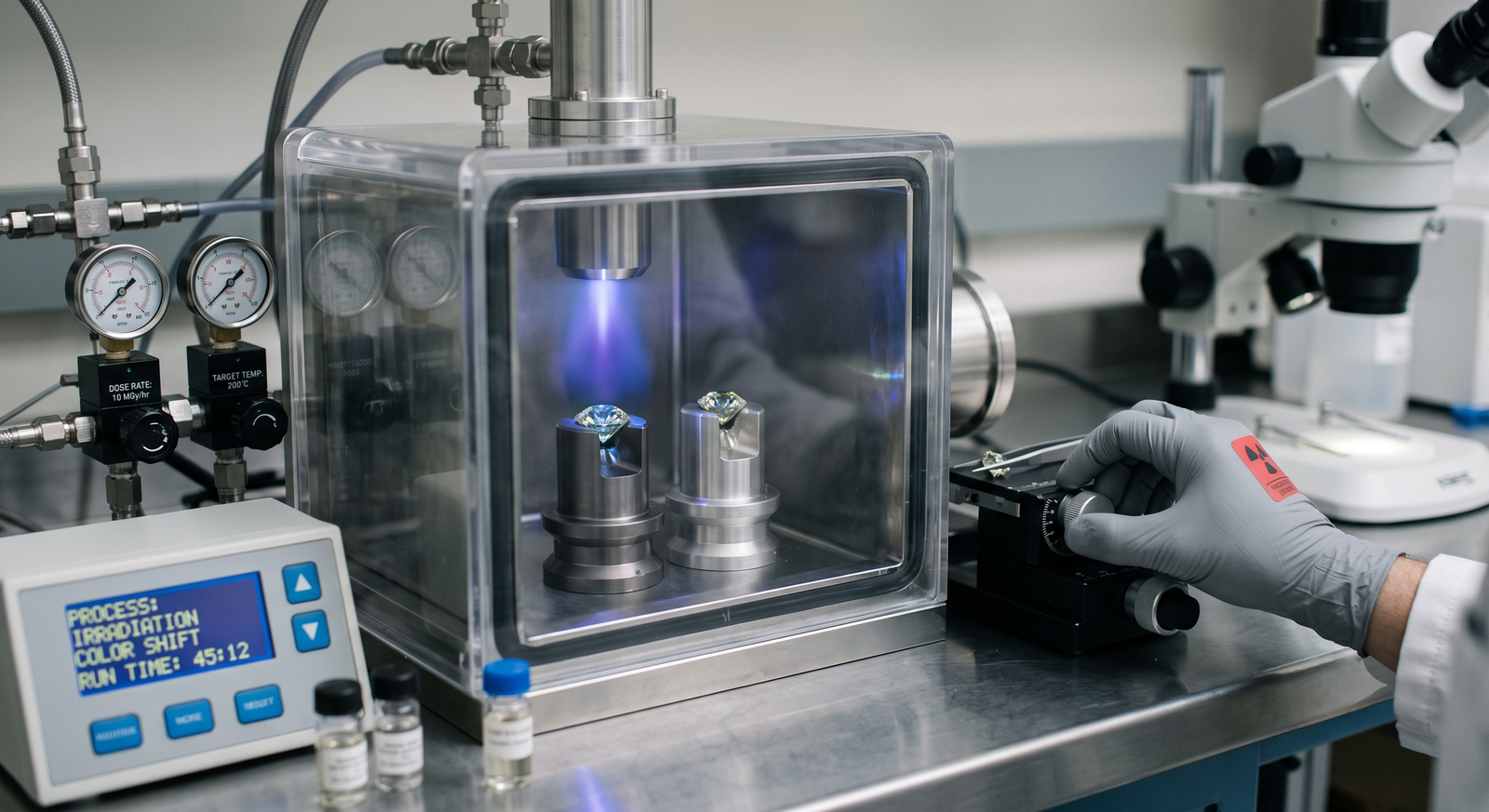
  • Red, pink, green, or black: These are available through post growth irradiation at some providers. Always ask specifically whether your provider offers this service, since it is not universal across the industry.

Ask your specific provider what is realistically achievable for your submitted material before committing to an expectation, since trace element profiles vary by individual submission and cannot be predicted with total precision before synthesis.

Post-growth irradiation process used to shift or intensify a memorial diamond's color memorial diamond colors husband expect

What the Color Doesn’t Tell You

It is worth saying plainly: color has no bearing on how “much” of your husband is in the stone, on the stone’s durability, or on its structural quality as a genuine diamond. A yellow toned memorial diamond is not a lesser diamond than a colorless one. Cut, color, clarity, and carat are independent qualities, and color here is simply a natural fact of origin, not a marker of emotional value or purity.

Frequently Asked Questions

Does gray hair produce a different color diamond than dark hair?
No. Diamond color comes from trace elements present during crystal growth, not from the visible pigmentation of the hair itself. Gray, dark, or light hair does not predict the finished stone’s tone.

Is a colorless memorial diamond better than a colored one?
No. Colorless simply reflects a different, more refined chemical process, and typically costs more. Color and quality are independent; a colored stone is fully authentic.

Can I know the exact color before the stone is grown?
Not precisely. Trace element profiles vary by individual submission, so while a general range can be planned, the exact resulting shade cannot be completely predicted in advance.

Is irradiated color less real than natural color?
No. Irradiation is an established, accepted diamond treatment across the global jewelry industry, not an inferior process.

Does a bigger stone come out a different color than a smaller one from the same material?
Not inherently. Color and carat are governed by separate variables (trace elements versus growth cycle duration), so stone size alone does not dictate hue.

Will the color match if more than one family member gets a stone from the same ashes?
Not guaranteed. Trace elements distribute unevenly and each stone grows in its own cycle, so two gems from the same source can display distinct tones. See can more than one family member share the same ashes for additional details.

Final Thoughts on Memorial Diamond Colors Husband Expect

The natural array of memorial diamond colors husband expect is not a limitation to work around. It is a genuine scientific reflection of how these stones are formed. Whatever tone your stone grows into, it embodies the authentic chemistry of the carbon it originated from, which is deeply meaningful and truly unique.

Learn More About Husband Memorial Diamonds

Talk With Memorial Diamond

If you would like to discuss which shades are realistic for your husband’s ashes or hair, consult with the specialists at Memorial Diamond to get clear guidance before making your decision.

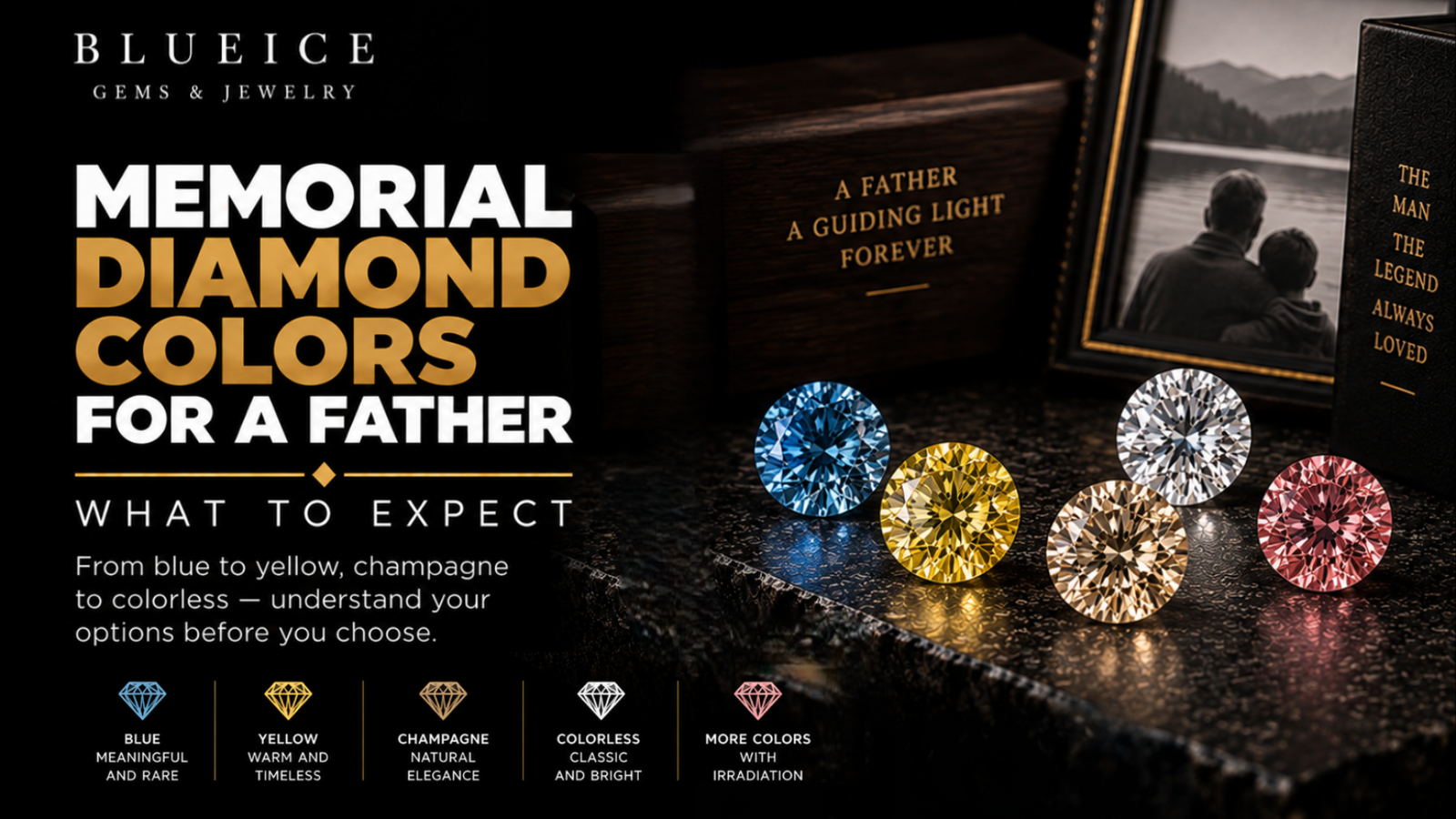
Memorial diamond colors for a father featuring blue, yellow, champagne, colorless, and pink diamonds with a father's keepsake box

Memorial Diamond Colors for a Father: What to Expect

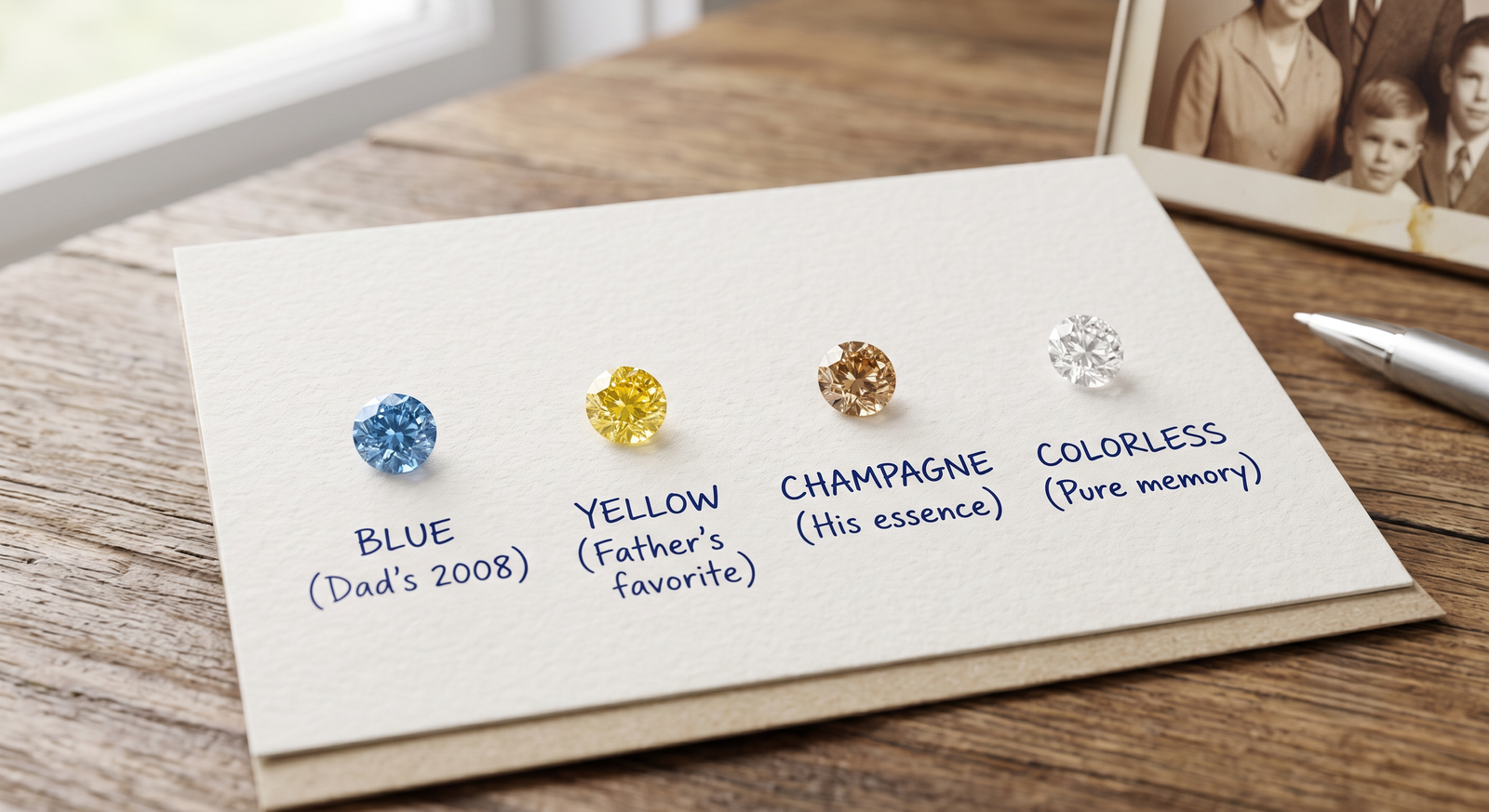
The order form asks for a color months before there is anything to look at. So here is what memorial diamond colors for a father come down to: you can specify a color family, blue, yellow, champagne, colorless, or a color applied after growth, with an agreed range around it. What you cannot specify is a shade. Write the family and the range into the order, and settle who decides whether the finished stone sits inside it.

One disclosure first: Memorial Diamond grows and sells memorial diamonds, which makes us one of the providers this page tells you to pin down. Read the recourse section as something to put to us in writing as readily as to anyone else.

Memorial diamond colors: four small lab-grown stones in blue, yellow, champagne and colorless laid in a row on white card, each above a handwritten label

What Can You Actually Specify About Memorial Diamond Colors?

Memorial diamond colors are agreed in words, held for months, then checked once at the end against an object nobody has yet seen.

What you can specifyWhat you cannotWhat to put in writing
A color family, blue, yellow, champagne or colorlessWhich shade inside it arrivesThe family, plus the range you will accept
Whether the color is grown in or applied by irradiation afterwardsWhether an organic source cooperates first timeThat these are different products, and which you are buying
That the stone reads warm or coolThe exact depth of tone at the carat chosenThe carat and the color on one line, since a tint reads differently at different sizes
That a color grade appears on a grading reportWhat your eye will make of that gradeWhich laboratory grades it, on which scale, and that the report travels with the stone
That two stones ordered together carry one specificationThat two separately grown stones will matchThat you want a shared specification, not a matched pair
Who signs the finished color offThat everyone agrees at first sightThe named person who accepts or declines, and what follows
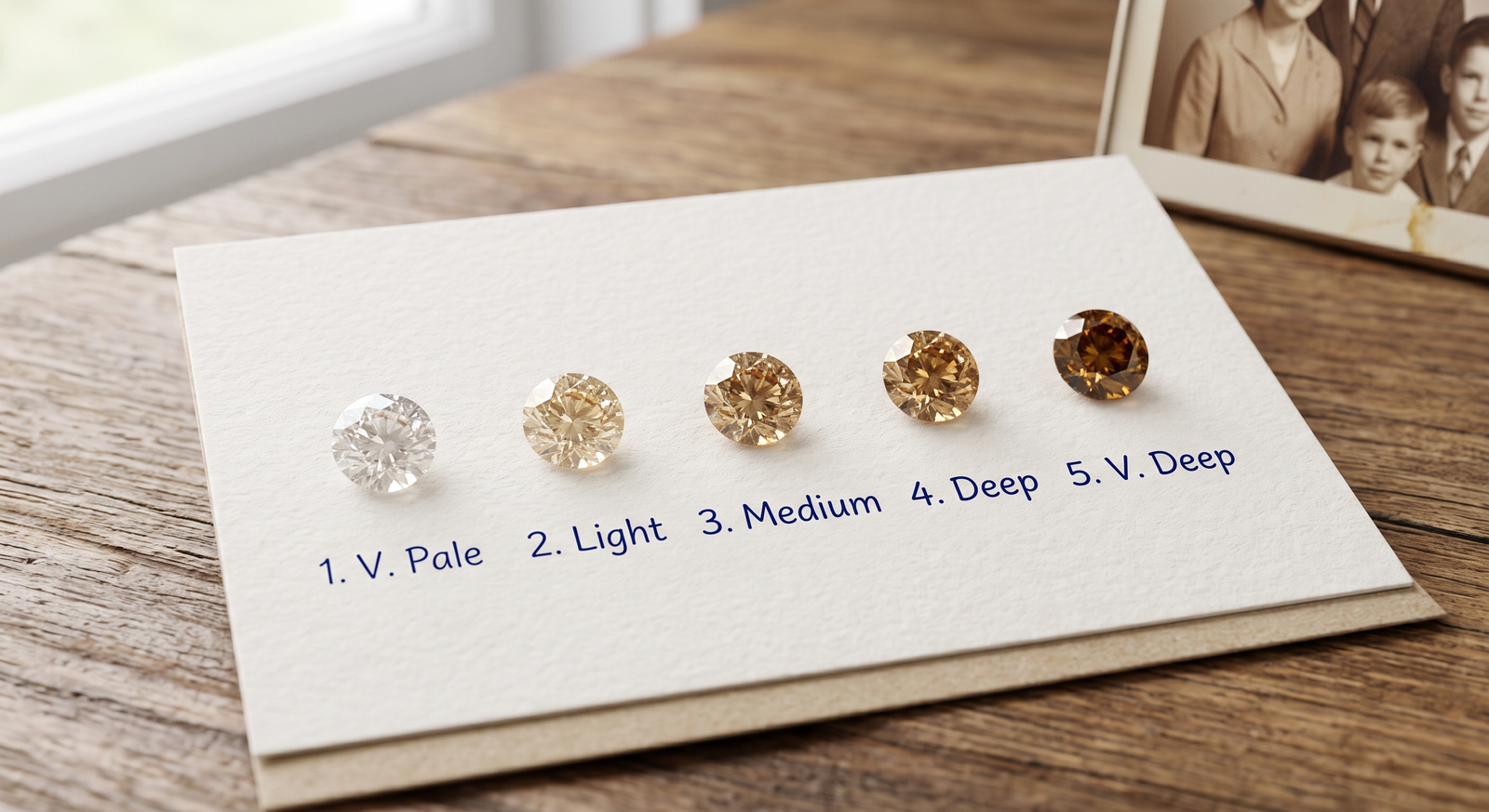
Five champagne-toned diamonds arranged from palest to deepest to show one color family's range

Which Memorial Diamond Colors Exist, and What Puts Them There

Color comes from trace elements present while the crystal grows. Boron produces blue. Nitrogen produces yellow. A colorless stone requires the near total absence of both which an industrial feedstock is manufactured to deliver, and which an organic source can reach only with additional processing to exclude those trace elements, at meaningfully higher cost. Some providers also offer post growth irradiation, applied to a finished crystal, for red, pink, green or black.

The memorial diamond colors you agree apply to a crystal only partly his. Carbon recovered from ash or hair is purified to around 99.9%, then combined with lab sourced carbon to reach the volume a growth run needs, the published figure for ash derived stones puts his share at roughly 10–15% of the finished mass, with no equivalent figure published for hair.

What a particular submission tends to produce is a separate question: the ashes version, the hair version, which also covers why the color his hair went has no bearing, and the combined version. Why memorial diamonds are rarely colorless has the chemistry.

A Color Word Is Not a Color Specification

“Champagne” is a family, not a shade, and so are “blue” and “yellow.” Each spans a range of grades, and stones at either end of that range are recognizably different objects under one word. Memorial diamond colors are described in family names because that is the honest level of precision before growth.

That matters because of when memorial diamond colors get named. You say it in month one, to someone who works with that color family routinely and has a working average in mind. Neither of you has said what would count as too pale or too dark. The missing half is the tolerance, the range nobody has written down, and the thing there is no agreed answer to point at when a box is opened eight months later.

Three things narrow it before the order is placed:

  • Ask what vocabulary the provider works in. A named grading scale, in house color names, sample stones, photographs, these are not equivalent, and the order should record which one it is judged against.
  • Ask to see the extremes rather than the middle. One representative image shows the average; the pale end and the deep end show what you are agreeing to.
  • Ask what carat those references were. A tint barely visible in a small stone is unmistakable in a larger one, so a reference at the wrong size is not a reference.

How Do You Write a Color Down So Two People Mean the Same Thing?

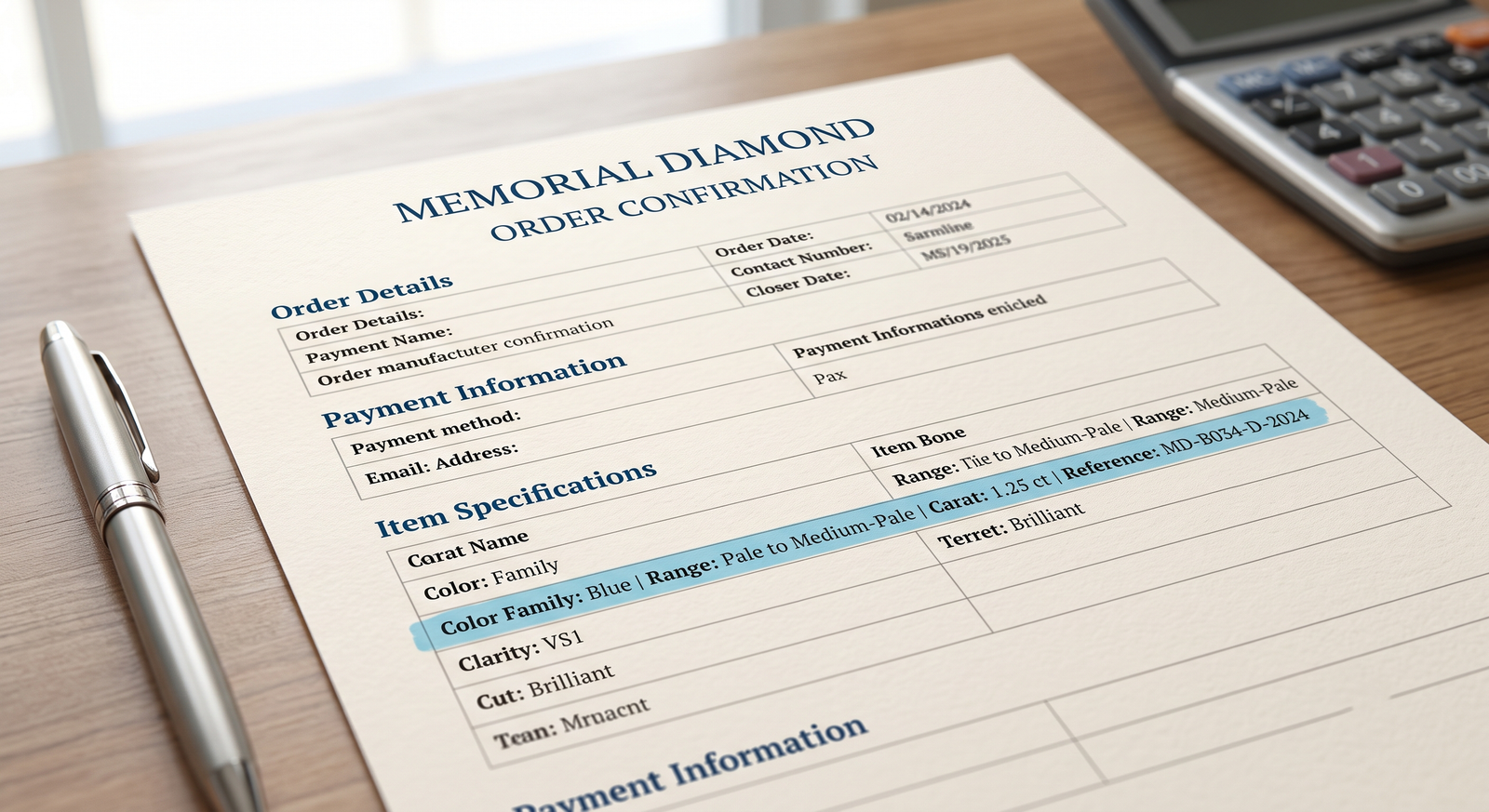
 An order confirmation with a single highlighted line naming color family, range, carat and reference

A line describing memorial diamond colors should survive being read by someone who was not in the conversation. Six things put memorial diamond colors in that state:

  1. The color family, in the provider’s vocabulary as well as your own words.
  2. The acceptable range, expressed the way that provider grades color.
  3. Whether the color is grown in or applied after growth, different products, priced differently.
  4. The reference being used, a named scale, a sample stone, a photograph, and who holds it.
  5. The carat it applies to, on the same line, because the two move together.
  6. The date, and the person on each side who agreed it.

Ask for that line to appear in the order confirmation itself, not only in the email thread that produced it.

What memorial diamond colors do to the price sits in what a father memorial diamond costs; what a setting metal does to the color you see sits in memorial diamond settings and jewelry ideas for a father.

What a Grading Report Says About Color, and What It Does Not

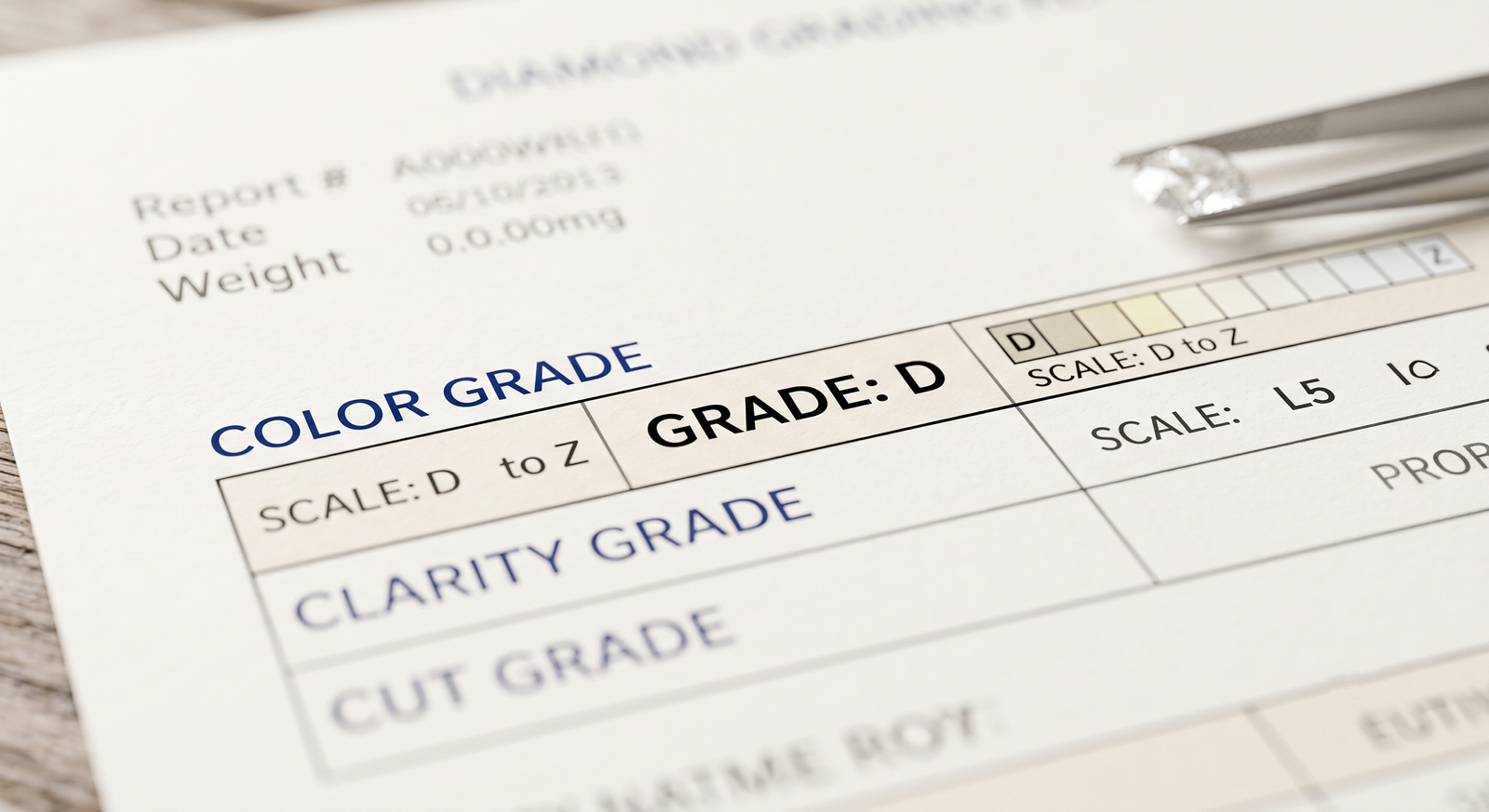
A grading report is the diamond’s own quality document: cut, color, clarity and carat, against a stated scale, ideally from an independent third party laboratory. It is not the in house origin certificate, which records whose carbon the stone was grown from and says nothing about how it looks. How memorial diamonds are graded and certified sets out what each establishes.

Three limits are worth knowing about how a report handles memorial diamond colors. It is issued after the stone exists, so it verifies rather than commissions. A grade is a band rather than a point, so two stones can share a grade and not look alike. And it is assessed under controlled conditions, not on a hand at a kitchen window, so a report and an eye can honestly disagree.

That makes the report a check on the memorial diamond colors you specified rather than a substitute for the specification. Ask early whether the stone is graded independently or in house, and on which scale.

 Close-up of a diamond grading report with the color grade line in focus

What Should You Ask About Recourse?

Nothing published about this category establishes a standard procedure for a stone that arrives outside an agreed color range, no norm, no default remedy, no assumed sequence. Which is why it is worth asking before ordering, and treating the answer as a term of the order. Six questions for an email about memorial diamond colors:

  • Who judges whether the stone is inside the agreed range, you, the provider, or the report?
  • What happens if those three disagree, and who breaks the tie?
  • Is color reviewed before the rough is cut, and does the family see it?
  • Is any outcome available other than accepting the stone, and what is it?
  • If an outcome involves growing again, what does that mean for his material, is more needed, and where does the timeline restart?
  • How long do we have to raise it after the stone arrives?

Write the answers down beside the specification and the reference. No procedure is described here because none is settled, only that the answer is cheaper to obtain in month one than to look for in month ten. The wider question list for a father memorial diamond sorts the rest by who can answer them.

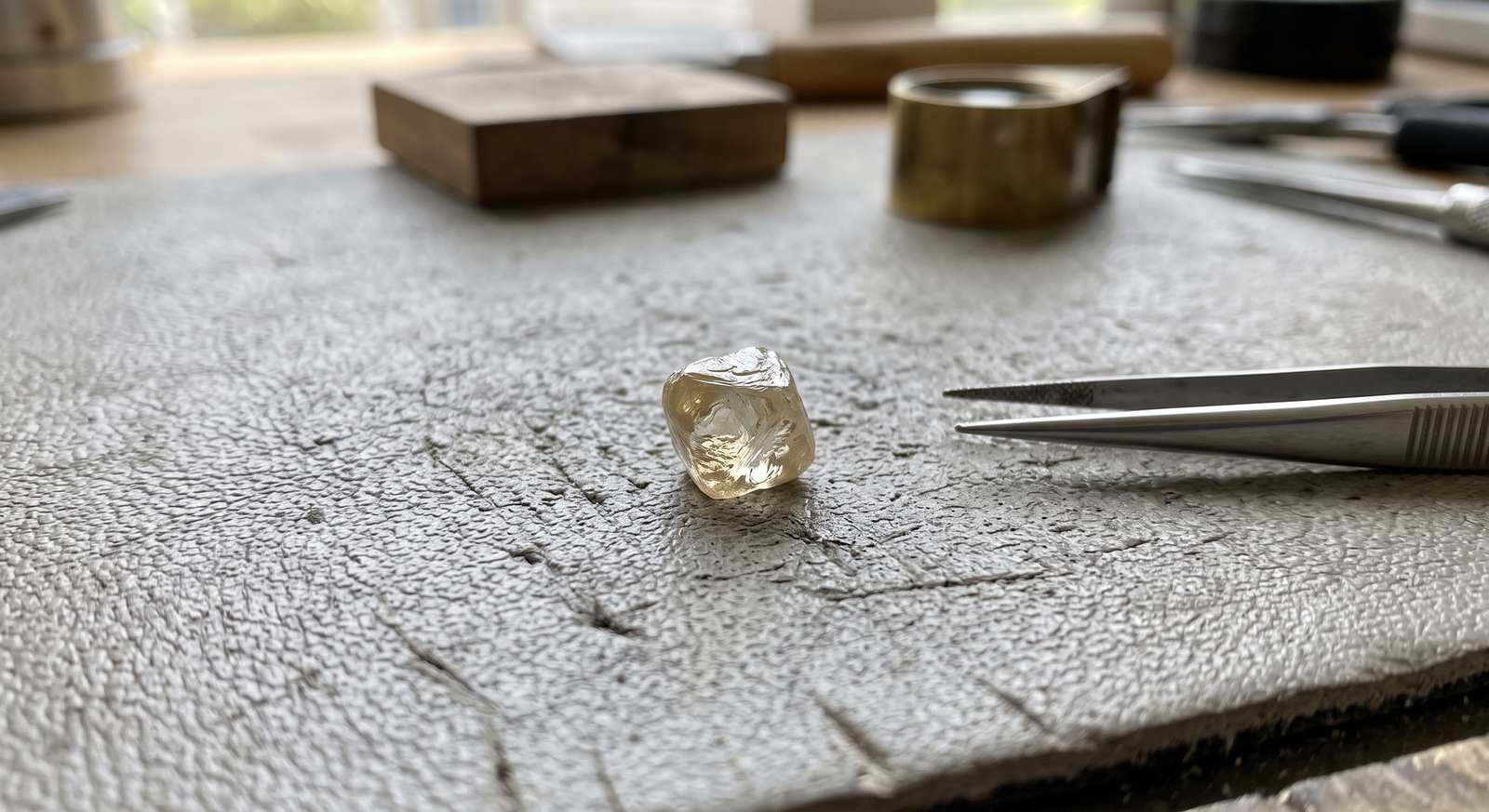
 Rough diamond crystal on a bench mat before cutting, showing its tint

Frequently Asked Questions

Is “champagne” a specification for memorial diamond colors?

Not on its own. It names a family of warm tones spanning several grades, so two people can use the word and picture different stones. It becomes a specification once the acceptable range and the reference are written beside it.

Should memorial diamond colors be agreed before the carat is settled?

Agree them together. The same tint reads differently at a quarter carat and at a carat and a half, so a color line that does not name its carat is only half written. Settle both on one line.

Who decides whether a finished stone is inside the agreed color range?

Ask before ordering, because nothing published about this category settles it. Establish whether the judgment rests with you, with the provider, or with an independent grading report, and what happens if the three disagree.

Can I ask to see a comparison stone before the color is signed off?

Ask. Whether a provider can show a comparable finished stone, a sample set or photographs varies by company, and it is worth knowing which your order is judged against. Record the reference agreed.

Does a grading report settle a disagreement about memorial diamond colors?

Only partly. A report records a color grade under controlled conditions on a stated scale, not how the stone reads in daylight in your hand. Agree in advance whether the grade or the eye governs.

Can two of us specify matching memorial diamond colors on separate orders?

You can specify the same family and range for both. Separate growth runs are separate events, so expect a family resemblance rather than a match. Say at the order that a shared specification is what you want.

Final Thoughts on Memorial Diamond Colors for a Father

With memorial diamond colors, the word is the easy part. The range, the reference, the carat it applies to, who signs it off and what happens if it lands outside, those take one email, and they are the difference between a specification and a hope. Write them down before the deposit. It costs nothing, delays nothing, and it is the leverage you have on a decision you cannot inspect until it is finished.

Learn More About Father Memorial Diamonds

Talk With Memorial Diamond

Reach out to Memorial Diamond at memorialdiamond.us to talk through which memorial diamond colors are realistic for his material, what a written specification looks like, and what to ask us, in writing, about what happens if the stone does not match it. The same questions are worth putting, in the same words, to anyone else you are weighing up.

Word count: 1,852 · Reading time: about 9 minutes

Father ashes and hair diamond in an even champagne tone, shown loose on a white card with no visible variation across the stone

What Color Will a Diamond Made From Your Father’s Ashes and Hair Be?

Two materials going into one stone invites a picture: a boundary, a swirl, two tones meeting somewhere in the middle. The stone that comes back has none of that.

A father ashes and hair diamond is a single crystal in a single color, most often yellow, champagne, or blue, or colorless with extra processing. It is not an average of an “ashes color” and a “hair color,” because neither material has one. Both materials are reduced to pigment free carbon before growth, and the stone’s color is set by trace nitrogen or boron in the growth cell, exactly as it would be for either material alone.

Memorial Diamond takes combined ashes and hair orders, so this is a seller explaining a seller’s product. That is the reason to read skeptically, and the reason it tries to earn the read.

What Does a Father Ashes and Hair Diamond Actually Look Like?

Like any other memorial diamond. One even tone throughout, no seam, no gradient, no visible sign that two sources were used. Under a loupe a gemologist will see inclusions and growth features the way they would in any lab grown stone, and nothing that says “ashes here, hair there.”

That is because the two materials stop being two materials before growth begins. Cremated remains go through extraction to remove calcium phosphate and everything else that is not carbon. Hair goes through extraction to remove the non carbon parts of keratin. Each ends as carbon at roughly 99.9% purity. Whatever the two materials contribute, supplemental lab carbon makes up the balance of the growth feedstock, and the finished crystal is genuinely, partially his rather than purely so.

Once blended and grown, every carbon atom in the lattice is the same element in the same structure, whichever container it came from. A father ashes and hair diamond therefore does not display separate visual sections for the two sources.

The three colors most families end up with, yellow, champagne, blue, and the one they can pay extra for, colorless, are the same four available for a father ashes and hair diamond as for any single source stone.

Why the Color Is Not an Average of the Two

An average needs two values to average. Neither ashes nor hair has a “color” in the sense that matters here.

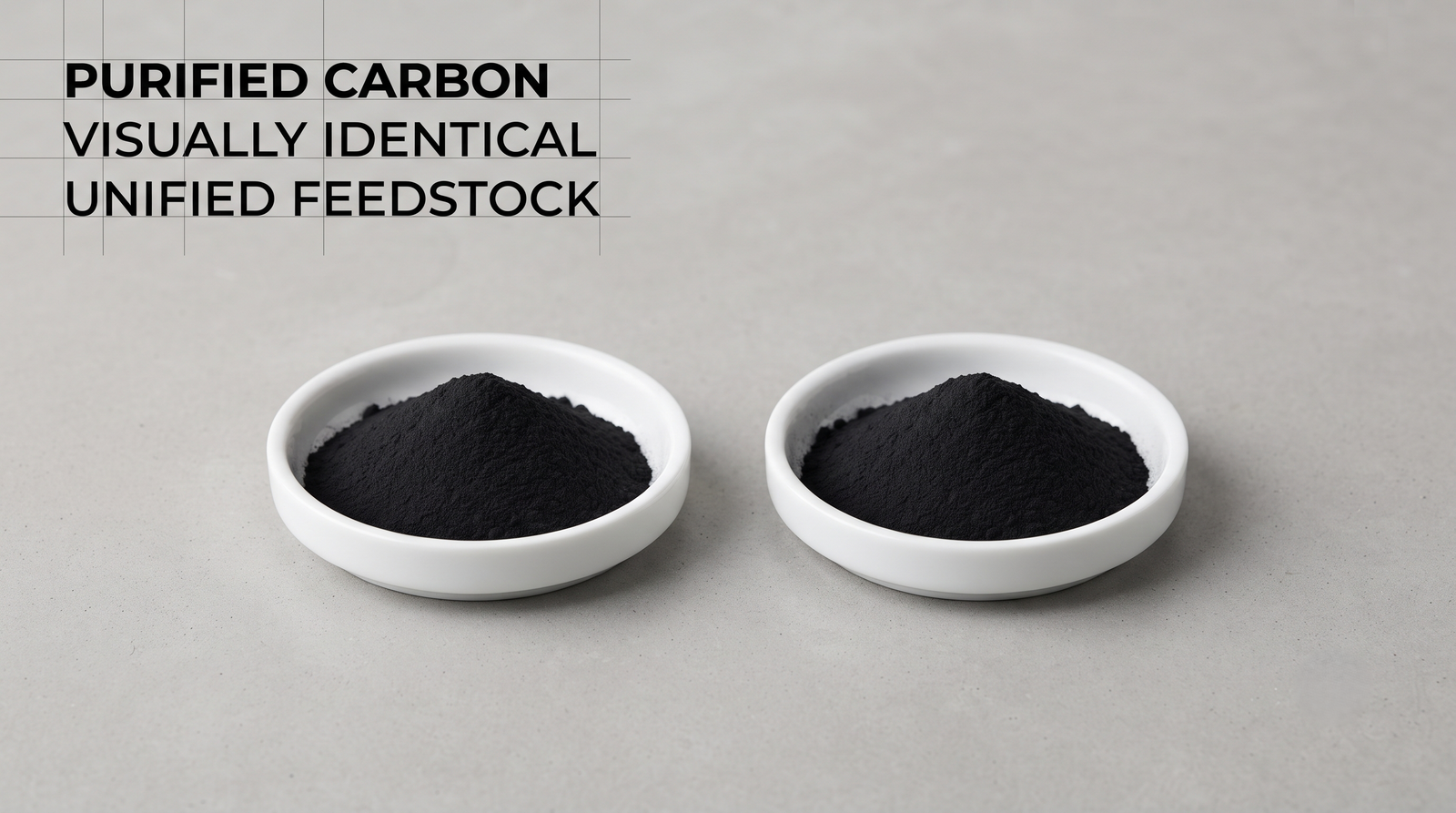
Ashes are gray because of minerals that are removed in extraction. Hair is brown or gray because of melanin, which is also removed. By the time either material is carbon, it is black powder with no pigment, and black carbon powder from ash and black carbon powder from hair are indistinguishable. There is nothing for the stone to split the difference between.

Two small dishes of purified black carbon powder side by side, visually identical

What sets the color is what was in the growth cell besides carbon: nitrogen tints yellow, boron tints blue, and neither gives colorless. Carbon recovered from organic sources tends to carry a little nitrogen along, which is why the whole category leans warm. A combined feedstock is not more or less prone to that than a single one; the chemistry does not know the carbon had two origins.

This means a father ashes and hair diamond does not become a mixture of two visible colors. The final color comes from the growth environment and trace elements rather than the original appearance of the ashes or hair.

For additional information about how diamond quality and grading work, see the GIA Diamond Quality Factors.

Which of the Two Actually Contributes More?

By carbon, hair, by a wide margin per gram. Hair is roughly 50% carbon by weight. Cremated remains yield somewhere between 0.5% and 4%. A lock the size of a fingertip can outweigh, in usable carbon, a considerably larger quantity of ash.

MaterialApproximate carbon yieldWhat that means in a combined order
HairAbout 50% by weightSmall samples yield a lot; usually the larger carbon contributor
AshesAbout 0.5% to 4% by weightLarger samples yield little; usually the smaller contributor
Lab carbonAdded to reach growth volumeMakes up the balance; the finished stone is typically 10% to 15% personal carbon or less

None of this shows in the color, and this is the point families sometimes want and cannot have: a father ashes and hair diamond does not come out “more hair colored” because more of its personal carbon came from hair.

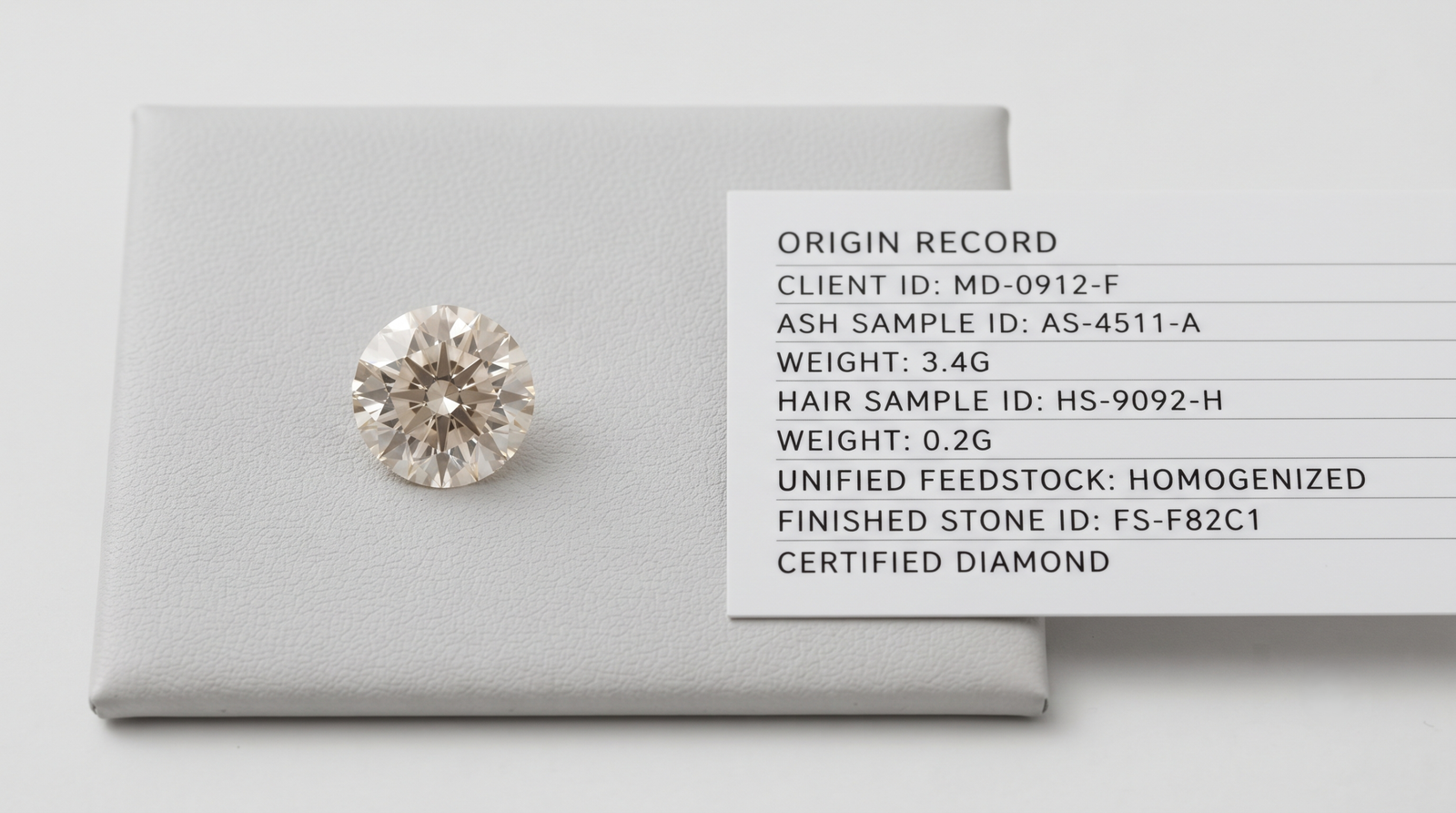
The contribution ratio lives in the provider’s records, if they itemize it, and nowhere else. Ask whether they do; it is a fair question and not every provider answers it the same way.

Printed origin record listing two sample IDs with weights, beside a finished stone

Does Combining Make the Shade Harder to Predict?

No harder than usual, and “usual” already includes some uncertainty. No provider can promise an exact tone before growth for any memorial diamond; trace element levels vary run to run, and two stones ordered as “yellow” can differ in depth.

Combining does not add to that variance in any meaningful way, because the feedstock is homogenized before it goes into the press.

What combining does add is a second record to check. If exact shade matters, such as a match to an existing family piece, or two sibling stones that need to sit together, say so before growth, and ask how the provider handles it.

Selection from a run is the usual method; guaranteed identical shade in advance is not something an honest provider offers.

The colors page for a father goes into what a provider’s color words do and do not promise.

What to Settle Before You Order

Three decisions, and none of them is about the ashes or the hair:

  1. Who keeps the stone and what it goes into. Metal shifts every tint: a yellow stone deepens in yellow gold and reads faintly off white against platinum, while blue and colorless hold steady in any setting. Decide the piece before the shade.
  2. Grown color or treated color. Yellow, champagne, blue, and colorless are grown; red, pink, green, and black are typically post growth irradiation. Ask which is which on the provider’s menu, and know that a treated color is a treatment, not a reflection of either material.
  3. What you want written down. For a combined order, ask whether the origin record itemizes each material’s contribution and whether the color is described using a standardized grading scale or the provider’s own words. A father ashes and hair diamond has two chains of custody; make sure the paperwork reflects both.

Frequently Asked Questions

Could the Stone Come Out Two Toned, or Show a Boundary?

No. The ash derived and hair derived carbons are blended into one feedstock before growth, and the crystal grows as a single, uniform lattice. There is no boundary because there is nothing left to mark one; a combined stone looks exactly like a single source stone of the same color.

Would Sending More of One and Less of the Other Change the Color?

No. The proportions change what the provider’s records say about contribution, not the tint. Color is set by trace nitrogen or boron in the growth cell, and the feedstock is homogenized before growth, so the ratio of ash carbon to hair carbon has no visible effect on a father ashes and hair diamond.

Does His Hair Color Affect It, If the Hair Went Gray?

No. Melanin, the pigment that makes hair brown, black, or red, is removed during carbon extraction along with everything else that is not carbon. Gray hair has less melanin, not less carbon, so a gray lock contributes the same pigment free carbon a dark one would.

Is a Combined Stone More Likely to Be Colorless?

No. A colorless crystal needs a growth cell free of nitrogen and boron, and keeping them out is a separate processing step whatever the carbon’s origin. Two organic sources neither help nor hurt that; if you want colorless, order it explicitly and expect it to cost more at the same carat.

Can Two Combined Stones for Two Siblings Be Matched?

Approximately, and only by asking before growth. Trace element levels vary between runs, so two stones ordered in the same color can differ slightly in depth. Providers who match siblings typically select from the same run; ask what the provider can and cannot promise in writing.

Does the Color Say Anything About Which Material Contributed More?

Nothing at all. Hair contributes far more carbon per gram than ashes, but that ratio is invisible in the finished stone. If knowing the contribution matters to you, it has to come from the provider’s origin record. Ask whether they itemize it, because a father ashes and hair diamond will not tell you by its shade.

Final Thoughts on the Color of a Father Ashes and Hair Diamond

The picture of two tones meeting is a natural one, and letting it go is part of understanding what the stone actually is.

A father ashes and hair diamond is one crystal, one color, grown from carbon that no longer remembers which container it arrived in.

The color will suit the ring or the pendant, or it will not, and that is decided by the metal and the person who wears it, not by the ashes, not by the lock.

Where the two sources still exist as two is in the paperwork, and that is worth asking for. The combined question about whether the diamond is really made from both sources is where that record is described.

Learn More About Father Memorial Diamonds

Talk With Memorial Diamond

If you are planning a combined order and want to know what color is realistic for the piece you have in mind, reach out to Memorial Diamond.

Ask which colors are grown and which are treated, and whether the origin record for a father ashes and hair diamond will itemize both materials.