
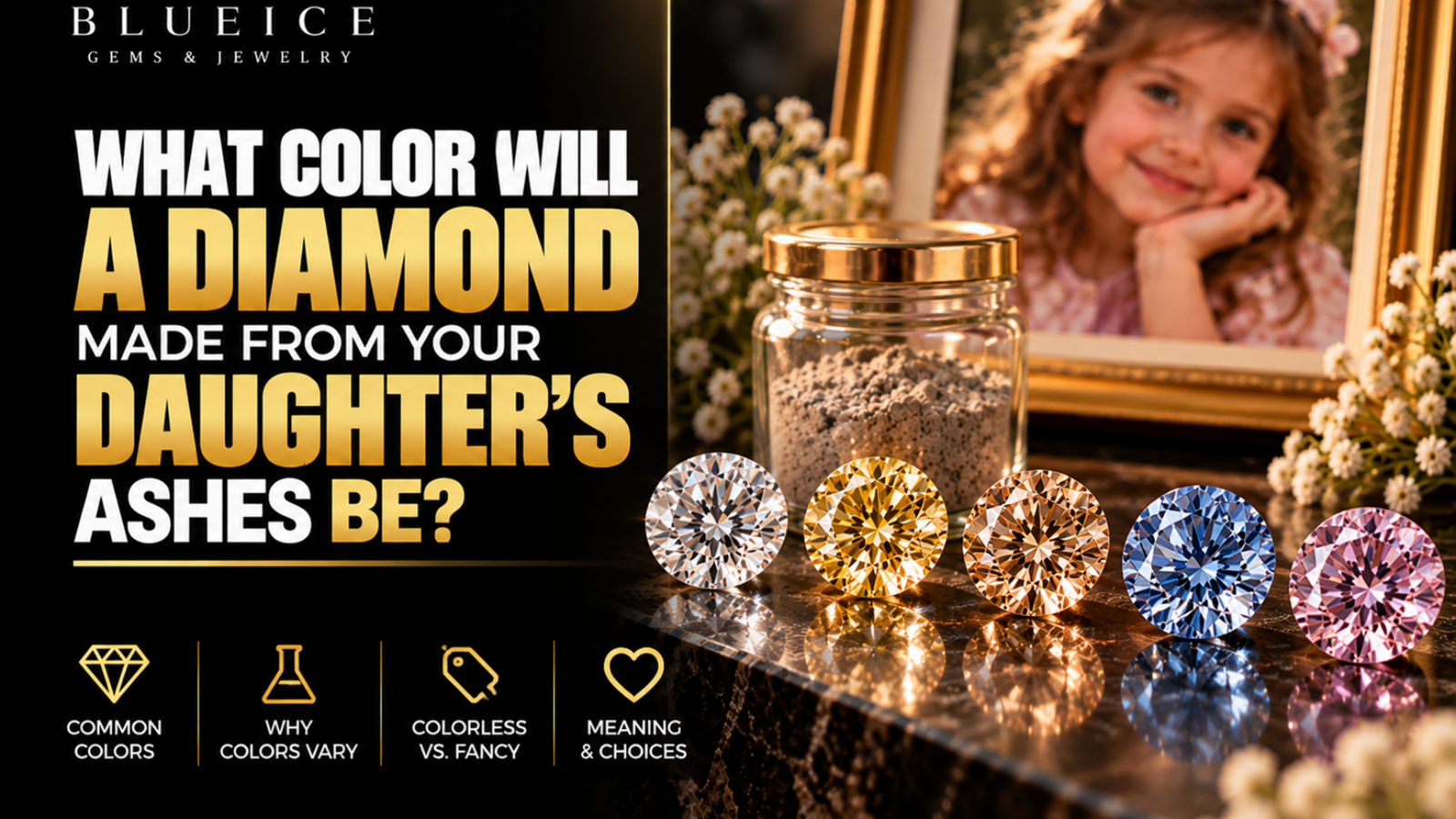
Many parents picture the stone long before any form is signed. The honest answer on daughter ashes diamond color is that most stones grown from cremated remains come out yellow, champagne or blue, because trace nitrogen and boron from an organic source tint the crystal as it forms. Colorless is achievable but is a deliberate, costlier outcome, and nobody can tell you in advance exactly which shade her stone will be.
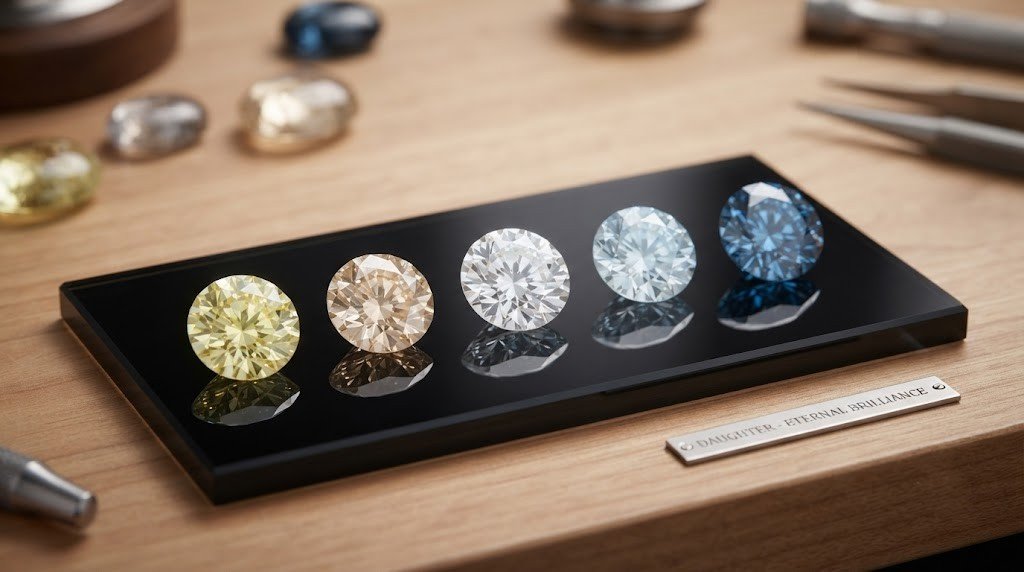
Table of Contents
What Is the Most Likely Daughter Ashes Diamond Color?
Warm or cool tints are far more likely than a clear white stone. Across the industry, the typical daughter ashes diamond color falls somewhere along a spectrum from pale straw to deep amber, through soft champagne and brown, or into blue when boron is present during growth.
That surprises families who picture a colorless engagement stone. Memorial stones are real diamonds, but their carbon arrives from a personal source rather than a purpose made feedstock, and that difference is the whole story behind the daughter ashes diamond color most families end up holding.
Here is how the main daughter ashes diamond color outcomes compare, as broad industry patterns rather than any one company’s results:
| Color outcome | What usually causes it | How often on the ash route | Relative cost at the same size | Effect on the wait |
|---|---|---|---|---|
| Yellow, pale to deep | Nitrogen in the growing crystal | Common | Usually the lower end | Standard |
| Champagne or brown | Nitrogen plus other trace elements and growth conditions | Common | Usually the lower end | Standard |
| Blue | Boron in the growing crystal | Fairly common | Often similar to warm tones | Standard |
| Colorless or near colorless | Near total exclusion of nitrogen and boron | Less common; requested deliberately | Meaningfully higher | Can run longer |
| Red, pink, green or black | Optional post growth irradiation | Only when chosen | Extra charge | Can run toward 12 months |
None of these is a better or worse result; each is simply the daughter ashes diamond color her carbon and the growth conditions produced. The complete guide to a daughter ashes diamond sets color alongside every other decision.
Why Does Daughter Ashes Diamond Color Lean Toward Yellow, Champagne and Blue?
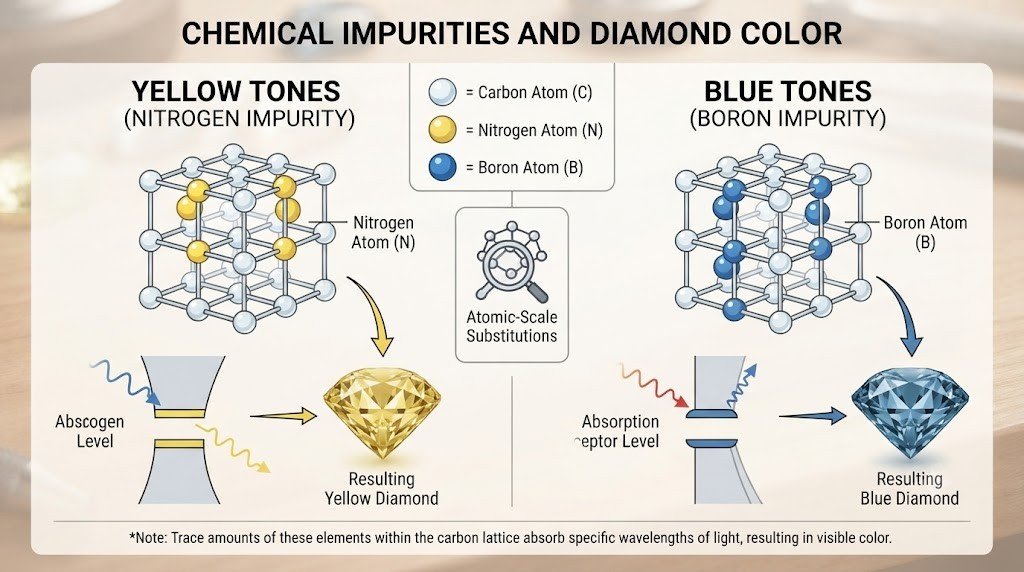
Because tiny amounts of other elements get built into the crystal lattice alongside the carbon. Nitrogen pulls a diamond toward yellow. Boron pulls it toward blue. A colorless stone needs almost none of either.
Cremated remains are overwhelmingly calcium phosphate, the mineral part of bone, and usable carbon makes up only around 0.5% to 4% of the ash by weight. Laboratories extract that carbon in a controlled, oxygen free heating process and refine it to roughly 99.9% purity or better. The last fraction of a percent still matters, since even trace amounts of nitrogen or boron are enough to shift the daughter ashes diamond color noticeably.
After purification comes graphitization at around 2,500 to 2,700°C, which turns the carbon into graphite. On the ash route, that graphite is blended with supplemental lab carbon so there is enough volume to grow a stone. Industry descriptions generally put her own carbon at about 10% to 15% of the finished diamond’s mass, with some providers quoting figures as low as 3%. How a memorial diamond is made from her ashes walks through each of these stages more slowly.
Growth itself usually happens in an HPHT press, at roughly 6 to 8 GPa and 1,400 to 2,500°C, around a small diamond seed. A minority of providers use chemical vapor deposition instead. Both methods are well documented in the scientific literature on lab grown diamond, and in both, trace elements present during growth show up as color.
So the champagne, straw or blue tones are not signs of a flawed process. They are the ordinary chemistry of an organic source, and many families come to see the resulting daughter ashes diamond color as one of the few things about the stone that nobody chose for her.
Can Anyone Predict Her Stone’s Color Before It Is Grown?
No. A provider can tell you which color families are typical, and it can steer the process toward or away from certain outcomes, but nobody can look at a portion of ash and name the exact daughter ashes diamond color that will emerge months later.
Several variables shape the daughter ashes diamond color and sit outside anyone’s control: her remains’ trace element profile, cremation conditions, the blend ratio with lab carbon, the growth run itself and the size of the finished stone.
So a careful provider speaks about daughter ashes diamond color in likelihoods and ranges, not promises. Be cautious with anyone who guarantees a precise hue from untreated ash.
Families sometimes hear that a cleaner starting material makes the result predictable, or that hair produces lighter stones. Neither holds: hair grown diamonds are not automatically lighter. The color question for a diamond from her hair and the color picture when ashes and hair are combined cover those routes on their own terms.
If you need certainty about the final look, the reliable route is not prediction but choice: either request a colorless process, or decide in advance that you will accept whatever natural daughter ashes diamond color the growth produces.
Can Her Stone Be Colorless, and Why Is That Pricier?
Yes. Colorless is the one daughter ashes diamond color that has to be engineered, so it usually costs more. Producing a colorless stone means keeping nitrogen and boron out of the growing crystal almost entirely, which calls for additional purification steps, tighter control of the growth environment and, often, more careful selection of what goes into the press.
Across the industry, a colorless stone at a given carat weight is generally priced meaningfully higher than a yellow, blue or champagne one of the same size. The gap is largest in the mid tier, roughly half a carat to a full carat, where general 2026 ranges run from about $5,000 to $15,000 and colorless stones sit toward the upper part of that span or beyond it.
Specialty outcomes can also stretch a typical six to ten month process closer to twelve months, so ask for the estimate in writing.
Choosing colorless is not a lesser or more authentic option than accepting the natural daughter ashes diamond color. Some families want a stone that reads as a classic white diamond in a ring they will wear daily. Others would rather keep whatever the growth produced. Both are sound choices, and neither changes how much of her carbon is inside the stone.
What Are Irradiated Colors, and Should You Consider Them?
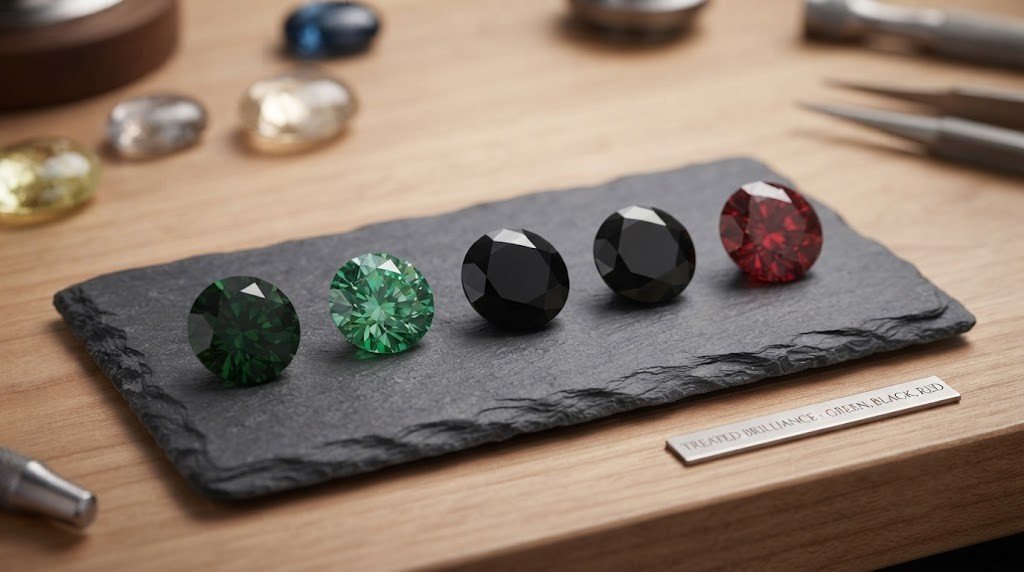
Irradiation is an optional treatment applied after growth that shifts or deepens a diamond’s color. Some providers use it to produce red, pink, green or black stones, which sit outside the natural daughter ashes diamond color range entirely.
It adds cost, can add time, and is separate from anything that happens during growth. Many families decline it because they want the daughter ashes diamond color to be whatever came from her remains without further treatment. Others choose a specific color because it connects to something she genuinely loved: a green she painted her room, the black of a guitar she played for years, the red of a team she followed.
That last point deserves care. The reason to pick a treated color should be her, specifically, not an assumption about what a daughter would have wanted. A pink stone is a fine choice if pink meant something to her. It is not a default because she was a girl, any more than blue would be a default for a son. Plenty of daughters, at whatever age, had no particular fondness for pastels, sparkle or jewelry at all.
How Does Daughter Ashes Diamond Color Change the Price and the Wait?
Daughter ashes diamond color is one of four levers on price, alongside carat, cut and clarity, and it can move the timeline too. Carat is the largest lever; color comes next.
As general industry figures for 2026, not any one provider’s price list:
- Around a tenth to a quarter of a carat: roughly $1,500 to $3,500, with natural warm or blue tones at the lower end
- Half a carat to one carat: roughly $5,000 to $15,000, with colorless stones usually priced noticeably above tinted ones
- Two carats and above: roughly $20,000 to $75,000 or more
- Irradiated colors: an added charge on top of the stone
- Independent grading report, engraving, fancy cuts and settings: usually quoted separately
On timing, the industry norm is six to ten months from the day the laboratory logs your material. Larger stones and specialty colors can extend that toward twelve. Size is set by time spent growing, not by how much ash you send, so a heavier parcel does not buy a bigger stone or a quicker one.
A practical way to plan: settle the carat first, then weigh how much the daughter ashes diamond color matters against budget. Accepting a natural champagne tone can leave room for a larger stone at the same spend. The step by step sequence in the stages of turning her ashes into a diamond shows where that choice falls in the order of decisions.
How Is Daughter Ashes Diamond Color Graded, and Do You Need a Report?
A grading report is optional, and it is different from the certificate of origin a provider usually issues. The origin certificate links the stone to the material you submitted. A grading report describes the diamond’s own qualities, the same way it would for any diamond.
Independent laboratories most commonly work from the GIA framework for cut, color, clarity and carat. For stones in the colorless to light yellow range, color is expressed on a letter scale running from D, fully colorless, down through Z. Stones with more saturated tints, such as a distinct yellow or blue, are described as fancy colors with terms that reflect how strong and even the color is.
Whether you need one depends on the stone’s future: a piece you intend to insure benefits from third party paperwork, while a stone kept at home may need only the origin certificate. Either way, the daughter ashes diamond color does not change based on whether someone grades it; the report simply puts a standard name to what is already there.
Clarity is reported alongside it, and memorial stones typically land between SI2 and VVS.
Should the Color Say Something About Her?
Only if you want it to, and only in ways that come from her rather than from a category she belonged to. There is no rule that the stone must symbolize anything.
Some parents value the natural result precisely because nobody picked it: the daughter ashes diamond color becomes a small, unrepeatable fact about her. Others prefer to make a deliberate choice: colorless because she wore a plain silver ring every day, blue because of a coastline she loved, black because of her sense of style.
Whether she was a little girl or a grown woman with a family of her own, the question worth asking is what she actually liked, not what daughters are supposed to like. If you do not know, or if family members remember her differently, the untreated result can be a gentle way around that disagreement.
It is also fine if this question barely moves you; for many families, the stone simply existing because of her matters more. Whether a memorial diamond is really made from her ashes addresses that deeper question directly.
What Should You Ask a Provider About Color?
Ask in writing, before any ash is sent. Useful questions on daughter ashes diamond color include:
- What range of colors do your untreated ash grown stones typically fall into?
- Do you offer a colorless process, and what does it add to the price and the timeline?
- Which irradiated colors, if any, do you offer, and how is that treatment disclosed?
- Will you tell me the color of the rough crystal before cutting begins?
- If the result falls outside the range I was told to expect, what are my options?
- Is an independent grading report included, or optional at extra cost?
- What happens to any unused ash or extracted carbon once the stone is finished?
The last question is not strictly about color, but leftover material policies differ between providers and are worth knowing in advance.
Before any of this, it is worth confirming who holds the legal authority to release her remains. That varies by state, and there is no single national rule. Her parents may find that a spouse or partner comes before them, as may any grown children she had, and written wishes she left behind can override the default order. How much ash you need for a daughter memorial diamond and how to turn her ashes into a diamond both cover the practical steps that sit around this conversation.
Frequently Asked Questions
What is the most common daughter ashes diamond color?
Yellow and champagne tones are the most common outcomes on the ash route, with blue also appearing fairly often when boron is present during growth. These tints come from trace elements in an organic carbon source. Colorless stones are possible but are usually requested deliberately and cost more. Treat any color range a provider describes as a likelihood, not a guarantee.
Can I choose her diamond’s color in advance?
Partly. You can request a colorless process or an optional irradiated color, and either one narrows the outcome considerably. What you cannot do is pick an exact natural daughter ashes diamond color from untreated ash, because the trace element profile of her remains and the growth run itself shape the final tone. Ask the provider what it can and cannot control before you order.
Does a blue or yellow stone contain less of her carbon?
No. Color comes from trace elements such as nitrogen and boron, not from the share of personal carbon in the crystal. On the ash route, her carbon typically makes up around 10% to 15% of the finished stone’s mass, with some providers citing lower figures, regardless of whether the diamond turns out yellow, blue, champagne or colorless.
Would a diamond from her hair be lighter in color?
Not automatically. Hair has a much higher carbon content than ash, but a cleaner starting material does not make the final color predictable, and hair grown stones still show yellow, champagne and blue tones. If you have both hair and ashes, ask each provider what color range it typically sees for each material rather than assuming.
Does irradiation change what the stone is?
Irradiation is an established post growth treatment used across the diamond trade to shift color, and the finished stone remains a real diamond. It is optional, adds cost, and can lengthen the timeline. Ask whether the treatment will be disclosed on any grading report, and choose it only if a specific color genuinely matters to you.
Does sending more ash change the color?
No. The quantity requested is typically a few tablespoons up to about 4 oz, and sending extra does not shift the daughter ashes diamond color, enlarge the stone or speed the process. Color depends on trace elements and growth conditions, and size depends on how long the crystal grows in the press.
Can two stones from the same ashes be different colors?
Yes, they can. Even when both stones come from one submission, separate growth runs can produce slightly different tones, and a family might also choose colorless for one and the natural result for another. Each stone is priced and scheduled on its own, so confirm both quotes and timelines in writing before you proceed.
Final Thoughts on the Color of Her Diamond
Very few decisions in this process are genuinely open ended, and daughter ashes diamond color is one of them. You can accept whatever the chemistry produces, ask for colorless, or choose a treated color for a reason rooted in who she was.
What you cannot do is know the natural daughter ashes diamond color ahead of time, and a provider who is honest with you will say so plainly. That uncertainty is not a defect in the process. It is a reflection of the fact that the carbon came from one particular person.
Whatever shade arrives, it will be a real diamond, grown in part from her.
Learn More About Daughter Memorial Diamonds
- Everything behind a daughter ashes diamond — the complete guide to the ash route
- How her ashes become a diamond — extraction, graphitization and growth in plain terms
- The stages, in order — what you do and when
- Color when the stone comes from her hair — the hair route’s color picture
- Color when ashes and hair are combined — what a blended submission means for tone
Talk With Memorial Diamond
If you would like to talk through daughter ashes diamond color options, or simply ask what is realistic before deciding anything, Memorial Diamond is available at memorialdiamond.us. There is no obligation, and no question is too small.