
Table of Contents
The Short Answer
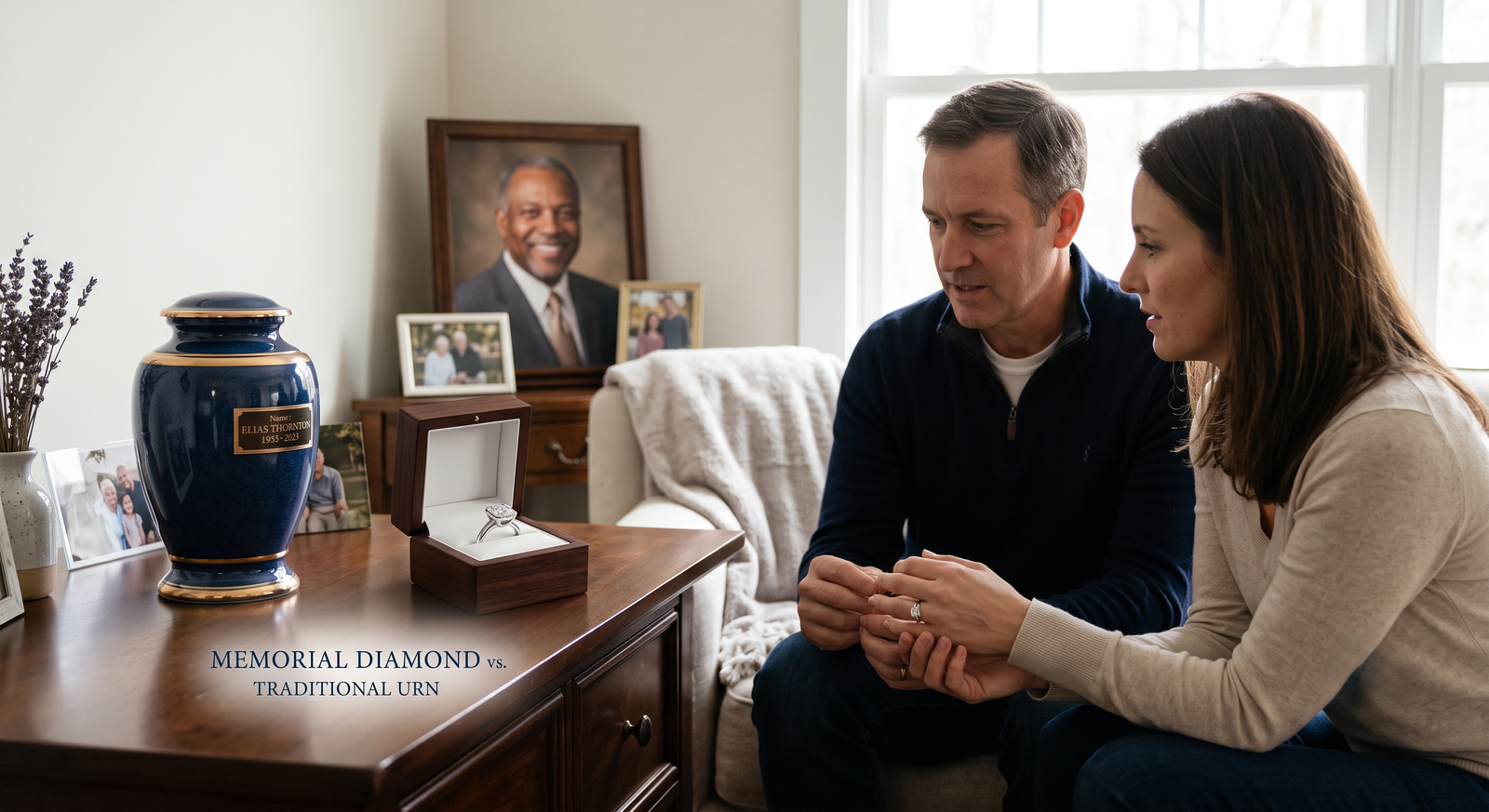
Evaluating a husband memorial diamond vs traditional urn is rarely an either or proposition for grieving families. A traditional urn is designed to hold the full volume of cremated remains, whereas a memorial diamond is synthesized in a laboratory using only a small portion of extracted carbon from his ashes or hair. When evaluating a husband memorial diamond vs traditional urn, selecting one does not compel you to forgo the other.
The core distinction in the husband memorial diamond vs traditional urn debate rests in how each keepsake functions in your everyday life over decades. An urn serves as a sacred, stationary vessel that preserves what remains in a dedicated space. A memorial diamond represents an active elemental transformation, creating a durable, wearable gemstone that travels wherever you go. In the question of a husband memorial diamond vs traditional urn, neither approach is objectively superior. They address distinct emotional and practical needs, leading many surviving spouses to embrace both pathways simultaneously.
Understanding the Options: Husband Memorial Diamond vs Traditional Urn
Before weighing a husband memorial diamond vs traditional urn against each other, it is vital to be precise about what each object represents physically, scientifically, and functionally. They fulfill fundamentally different roles in honoring a spouse.
What Is a Traditional Urn?
A traditional cremation urn is a vessel crafted from ceramic, solid wood, cast bronze, stainless steel, marble, or biodegradable composites. In the husband memorial diamond vs traditional urn discussion, the primary function of an urn is containment and preservation. Following cremation, the full volume of remains : typically averaging four to eight pounds, or roughly 200 cubic inches for an adult male : is placed inside the urn.
An urn can be displayed prominently in the home, interred within a cemetery burial plot, or permanently secured inside a columbarium niche. As shown in data from the NFDA 2025 Cremation and Burial Report, cremation rates continue to rise across the country, making urn selection a foundational step in contemporary memorial planning. An urn preserves and shelters remains; it does not alter their chemical or structural state.
What Is a Memorial Diamond?
When analyzing a husband memorial diamond vs traditional urn, a memorial diamond is an authentic laboratory grown diamond created by extracting and purifying carbon from a small sample of your husband’s cremated remains or hair clippings. The isolated carbon is refined into graphite, combined with laboratory grade carbon foundation material, placed alongside a natural diamond seed crystal, and subjected to High Pressure High Temperature (HPHT) conditions that replicate the natural geological forces deep within the Earth mantle.
The resulting crystal possesses identical chemical, physical, and optical characteristics to a mined gemstone. It is graded by certified gemological laboratories according to the traditional 4Cs : carat, cut, color, and clarity. A memorial diamond is not a container for remains; it is a permanent molecular transformation of his biological carbon into a genuine gemstone.
Side by Side Comparison: Husband Memorial Diamond vs Traditional Urn
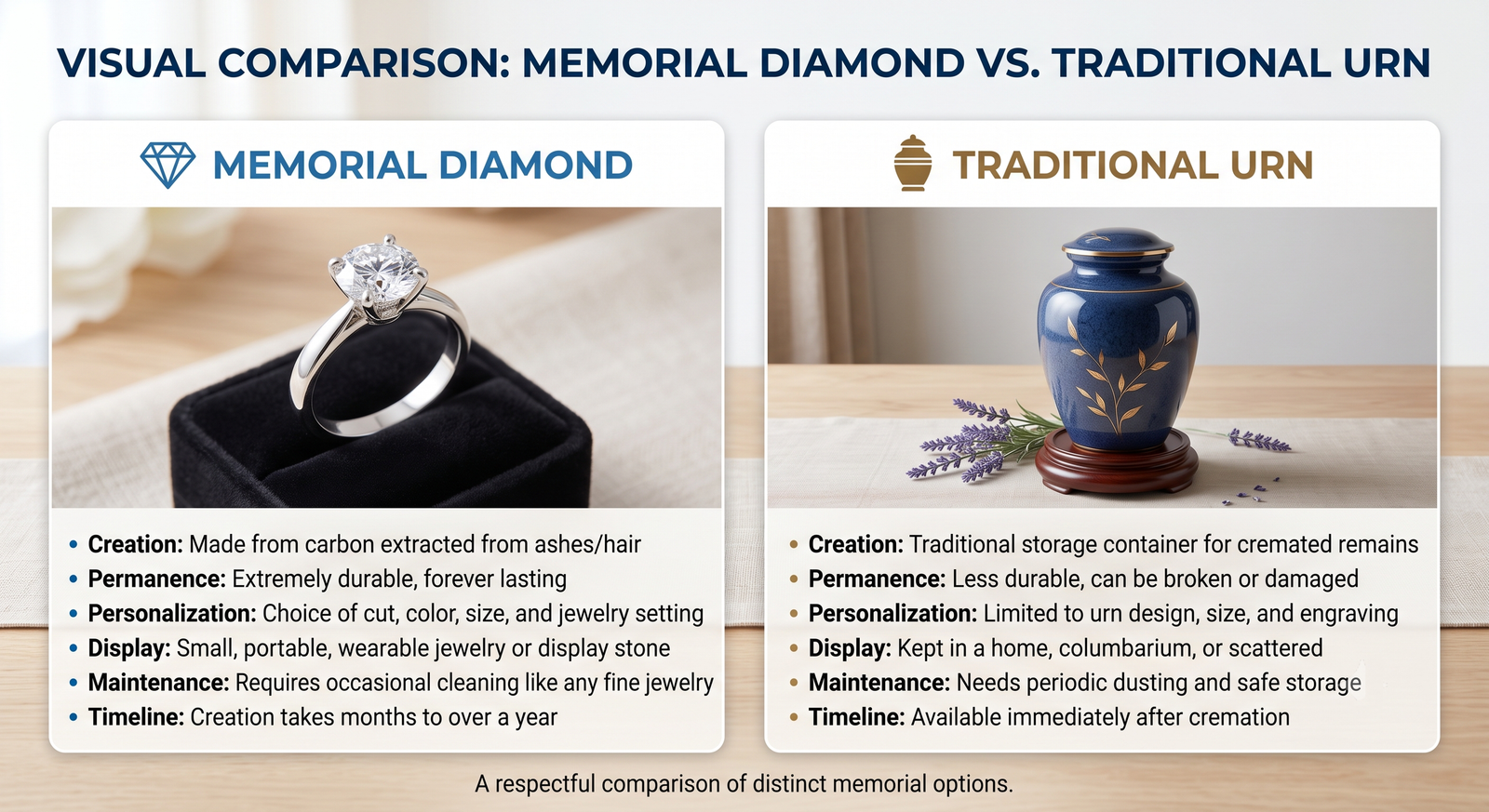
| Comparison Factor | Traditional Cremation Urn | Husband Memorial Diamond |
|---|---|---|
| Primary Purpose | Vessel designed to hold and protect physical cremated remains | Permanent gemstone synthesized from extracted biological carbon |
| Volume of Ashes Utilized | Accommodates the full volume (typically 180 to 220 cubic inches) | Requires approximately one half cup (about 8 ounces or 100 to 200 grams) |
| Physical Location | Stationary : shelf, mantel, columbarium niche, or cemetery plot | Wearable fine jewelry (ring, pendant) or loose heirloom gemstone |
| Material Hardness and Durability | Varies widely : ceramic and glass can chip; metals and stone resist impacts | Rated 10 on the Mohs scale; impervious to scratches and everyday wear |
| Creation Timeline | Immediate : available immediately following cremation services | Requires roughly 6 to 10 months of technical HPHT growth and cutting |
| Typical Cost Range | $100 to $2,500 depending on materials, artistry, and customization | Starting around $1,500 to $3,500 for entry carats, scaling upward with size |
| Portability | Difficult to transport safely; susceptible to travel damage or loss | Highly portable; travels securely on your person every single day |
| Disposition of Remaining Ashes | All ashes remain inside the urn unless manually separated | Over 90 percent of original ashes remain available for scattering or secondary urns |
| Multi Family Accessibility | Single physical object localized in one home or location | Multiple stones can be grown from one submission for surviving children or relatives |
Durability, Material Science, and Long Term Preservation
When choosing how to honor a husband, permanence is an understandable priority. Examining the durability differences in a husband memorial diamond vs traditional urn illustrates how these two options withstand time, accidents, and environmental exposure.
Urn Material Vulnerabilities
The physical longevity of a traditional urn depends heavily on the substance from which it is manufactured:
- Ceramics and Glass: While visually striking and artistically distinct, ceramic and blown glass vessels are inherently fragile. An accidental fall from a shelf, a curious pet, or an earthquake can shatter the vessel, risking the loss or scattering of the remains.
- Wood: Hardwoods like mahogany, walnut, and oak offer classic warmth. However, wood reacts to ambient humidity and temperature fluctuations. Over decades, wood can warp, crack, or suffer surface degradation if exposed to sunlight or moisture.
- Stone and Marble: Natural stone urns provide substantial weight and permanence, though they remain vulnerable to chipping or structural cracking along natural geological fault lines if dropped.
- Metals (Bronze, Brass, Pewter): Metal urns provide the greatest structural integrity among containment vessels, resisting breaks or punctures. Nevertheless, surface finishes can oxidize, tarnish, or scratch over extended periods.
Diamond Structural Immortality
In contrast, when studying a husband memorial diamond vs traditional urn, a memorial diamond possesses the highest hardness rating possible in the physical sciences. Because diamond is the hardest known natural mineral, scoring a perfect 10 on the Mohs scale, it cannot be scratched by any substance other than another diamond. It is impervious to water damage, chemical corrosion, ultraviolet degradation, and normal household accidents. Set into platinum or solid gold, a memorial diamond provides structural durability that survives for generations as an enduring family heirloom.
Portability, Accessibility, and Daily Connection
One of the most consequential differences in a husband memorial diamond vs traditional urn is how you interact with the memory of your spouse in your physical environment.
The Presence of a Traditional Urn
An urn creates a defined memorial anchor. It establishes a dedicated sanctuary inside the family home : often positioned on a bedroom nightstand, a living room mantel, or a private bookshelf. For many surviving partners, this permanent presence brings deep comfort. You know precisely where his remains rest, offering a quiet, physical location for reflection, prayer, or conversation.
However, an urn is intentionally stationary. It cannot accompany you on family travels, milestone events, or daily commutes without substantial logistical anxiety. Relocating to a new home requires careful packing to avoid accidental damage, and airline regulations governing the transport of cremated remains introduce emotional stress during travel.
The Intimacy of a Memorial Diamond
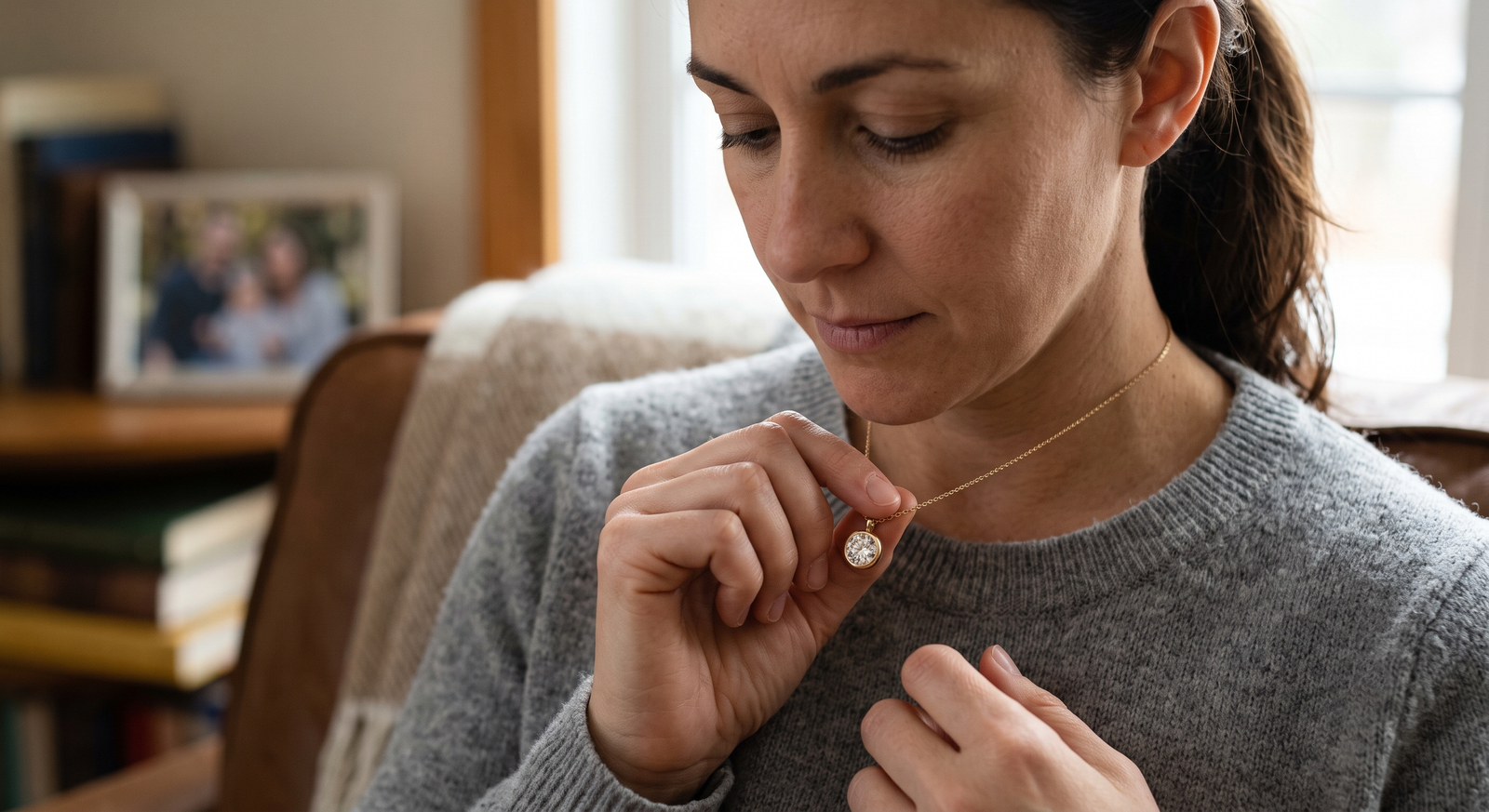
A memorial diamond transforms his memory into an intimate, tactile companion. Mounted into a daily ring, a pendant resting over your heart, or a pair of earrings, the diamond moves with you throughout your daily life. When comparing a husband memorial diamond vs traditional urn for mobility, the gemstone is present during morning routines, celebrations, family weddings, and quiet moments away from home.
Surviving spouses frequently describe touching the stone during moments of stress or grief as a grounding source of strength. The diamond does not require you to sit in a specific room to feel close; it integrates your remembrance into your living world.
Ash Volume Mathematics: Why It Is Rarely an Either Or Choice
A widespread misconception regarding a husband memorial diamond vs traditional urn is that creating a memorial diamond requires consuming all of your husband’s cremated remains. Understanding the actual quantities involved reveals that families rarely need to choose between an urn and a diamond.
During standard adult cremation, the process yields between 180 and 220 cubic inches of cremated remains, which equates to roughly four to eight pounds of material. The vast majority of this material consists of dense calcium phosphate bone minerals, alongside a fractional percentage of elemental carbon.
To synthesize a memorial diamond, a laboratory requires approximately one half cup of ash (roughly 8 ounces or 100 to 200 grams), or about 2 to 10 grams of hair. This requirement represents less than 5 to 10 percent of the total volume produced during cremation. Consequently, in the husband memorial diamond vs traditional urn decision, more than 90 percent of his ashes remain entirely untouched for an urn.
This allows families to pursue multiple memorial avenues at the same time:
- Keep the Main Urn: Place 90 percent or more of his ashes into a beautiful primary urn for permanent home display or columbarium placement.
- Grow a Memorial Diamond: Use the dedicated half cup portion to grow a sparkling gemstone for the surviving spouse.
- Scatter a Portion: Scatter a remaining portion at a cherished outdoor location, ocean shoreline, or national park.
- Create Sibling or Child Keepsakes: Divide the remaining ashes into smaller keepsake urns or grow secondary diamonds for children.
Emotional Dimensions in the Husband Memorial Diamond vs Traditional Urn Choice
Navigating the loss of a husband involves complex emotional realities, particularly when evaluating a husband memorial diamond vs traditional urn alongside multiple family members who hold different perspectives on memorialization.
Public Visibility vs Private Remembrance
An urn placed in a communal living area is an unmistakable visual statement. Visitors immediately recognize it as a funeral vessel, which can prompt condolences or uncomfortable conversations when you may not feel equipped to discuss your grief. Some spouses welcome this visibility as an honored tribute, while others find an urn in the living room an overwhelming daily reminder of loss.
In the context of a husband memorial diamond vs traditional urn, a diamond offers complete conversational discretion. To the outside world, a diamond ring or necklace appears simply as a stunning piece of fine jewelry. You retain total control over who learns about its origin. You can share its story with close friends and family while moving through public settings without drawing unwanted inquiries.
Navigating Multi Generational Family Opinions
In many families, adult children, in laws, or extended relatives hold strong preferences regarding traditional burial practices or the preservation of ashes. Relatives from traditional backgrounds may feel uneasy about dividing cremated remains or scattering them completely. Because growing a diamond leaves the vast majority of ashes intact inside an urn, resolving the husband memorial diamond vs traditional urn question by combining both options frequently serves as a peaceful compromise that honors everyone’s grief journey.
Financial Investment and Timeline Comparisons
Understanding the economics and manufacturing horizons of a husband memorial diamond vs traditional urn helps ensure realistic planning during a sensitive time.
Traditional Urn Timelines and Costs
Urns are available almost immediately. Most funeral homes provide basic containment options at the time of cremation, and custom artisan vessels can be purchased and delivered within days. Urn costs vary widely based on craftsmanship:
- Basic composite and metal utility urns: $100 to $300
- Carved solid wood and cast bronze vessels: $300 to $900
- Handcrafted art glass, specialty porcelain, or sculpted stone: $800 to $2,500+
Memorial Diamond Timelines and Costs
When weighing a husband memorial diamond vs traditional urn financially, creating a memorial diamond is an advanced scientific and artisanal process requiring months of precise laboratory execution. From carbon purification to crystal growth, laser cutting, polishing, and gemological certification, the process typically requires 6 to 10 months.
Because the process requires dedicated high pressure machinery, certified metallurgists, and master gem cutters, diamond creation represents a larger financial commitment:
- Entry size diamonds (0.10 to 0.25 carat): Typically starts around $1,500 to $3,500
- Mid range diamonds (0.50 to 0.90 carat): Typically ranges from $4,000 to $8,000
- Full carat and multi carat gemstones (1.00+ carat): Scales upward from $9,000 depending on color complexity (such as colorless, canary yellow, or blue) and cut geometry
While an urn is an upfront, one time purchase, many diamond providers offer flexible installment plans throughout the multi month growth window.
Where Memorial Diamond Fits into This Perspective
It is important to state openly: Memorial Diamond specializes in growing certified memorial diamonds from ashes and hair. Our perspective on a husband memorial diamond vs traditional urn is informed by deep experience in the laboratory growth and jewelry design space, rather than as an unattached third party observer.
However, we firmly believe that memorial choices should never be treated as commercial competitions. An urn is a timeless, dignified memorial container that has brought solace to families for centuries. In assessing a husband memorial diamond vs traditional urn, choosing to preserve his remains in a traditional urn, electing to scatter his ashes in nature, or choosing to grow a memorial diamond are all valid, deeply personal decisions. Our role is simply to provide clear, honest information so you can make the decision that best honors your husband and supports your healing.
Frequently Asked Questions
Does choosing a husband memorial diamond vs traditional urn mean giving up the urn?
No. The diamond synthesis process only requires about one half cup of cremated remains (or a small lock of hair). The remaining 90 percent or more of his ashes remains safely in your care to place in a traditional urn, inter in a cemetery, or scatter at a favorite destination.
Can I keep his ashes in an urn now and decide on a husband memorial diamond vs traditional urn later?
Yes. Cremated remains do not degrade or lose their chemical carbon content over time. You can keep your husband’s ashes in an urn for years or decades before deciding to set aside a small portion for a diamond.
In a husband memorial diamond vs traditional urn comparison, which is more durable over a lifetime?
A memorial diamond possesses superior structural hardness. Because diamond is rated 10 on the Mohs scale, it cannot be scratched, chipped, or weathered by everyday exposure. Urns made from bronze or stone are also durable, though ceramic and glass models can break if dropped.
What if my husband was not cremated, but I am still weighing a husband memorial diamond vs traditional urn?
A memorial diamond can be grown entirely from hair clippings collected before burial or from hair preserved throughout his life. This allows families who chose traditional casket burial to create a wearable diamond keepsake without cremation.
Can multiple family members have diamonds from the same urn?
Yes. Because only a half cup of ash is needed per production run, families resolving the husband memorial diamond vs traditional urn question can grow multiple individual diamonds from a single submission, allowing children or siblings to each carry a personal gemstone while leaving ample remains in the primary urn.
Is it considered disrespectful to divide ashes between an urn and a diamond?
No. In modern memorial practices, dividing cremated remains among several meaningful tributes : such as sharing keepsake urns, scattering a portion, and creating jewelry : is widely embraced as a loving and inclusive way to remember a spouse.
Final Thoughts on Husband Memorial Diamond vs Traditional Urn
The conversation surrounding a husband memorial diamond vs traditional urn is not about finding the single correct answer. An urn preserves his physical presence in a restful sanctuary; a diamond transforms a fragment of his elemental being into a radiant token of enduring love that travels at your side.
Take all the time you need to reflect on what brings you comfort. Whether you resolve the husband memorial diamond vs traditional urn question by choosing an urn, a diamond, or a combination of both, the right decision is the one that gives you peace, connection, and a meaningful way to carry his memory forward.
Learn More About Husband Memorial Diamonds
- How Much Does a Husband Memorial Diamond Cost?
- Choosing a Memorial Diamond for Your Husband: Where to Start
- Husband Ashes and Hair Diamond: The Complete Guide
- How Much Ash and Hair Do You Need for a Husband Memorial Diamond?
- Husband Memorial Diamond FAQ: Everything Families Ask
Talk With Memorial Diamond
If you are exploring a husband memorial diamond vs traditional urn and would like to learn how a memorial diamond can fit alongside your existing plans for his ashes, reach out to Memorial Diamond. Our team is here to guide you with care, clarity, and compassion.