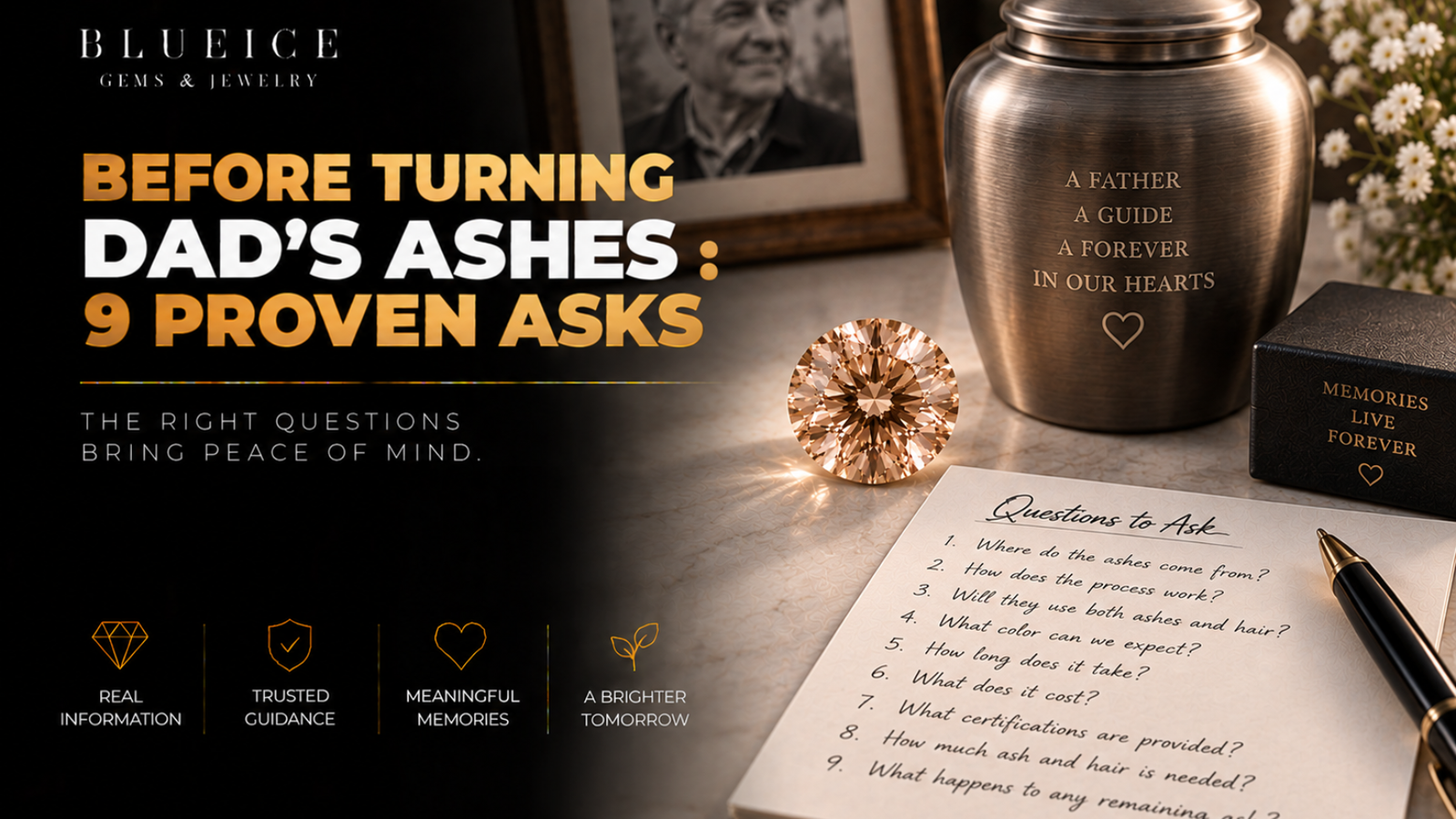
Families tend to arrive at this with a list and point all of it at one company. The questions worth asking before turning your father’s ashes into a diamond actually divide across four parties: the provider, the funeral director or crematorium, whoever controls his interment or scattering, and your own family. Sending each question to the party that owns the answer is what turns a month of waiting into a week.
Two weeks can otherwise go by waiting on an answer a diamond laboratory was never in a position to give. What follows is the full list of what to settle before turning anything over, sorted by who to ask rather than by topic.
Memorial Diamond is itself one of the providers these questions are aimed at. Ask them of us as readily as of anyone else.
Table of Contents
Which Questions Belong to Which Party?
| Ask this | Who owns the answer | Why it goes there |
|---|---|---|
| Can a portion be separated and labeled before release? | Funeral director or crematorium | It is their handling procedure, and it has to happen on their premises |
| Is there still a retained portion on file? | Funeral director | Only their records show it |
| Has anything already been interred or scattered, and can it still be? | Whoever controls the interment, cemetery, executor, or the family | A provider has no visibility of this and no standing to advise on it |
| How much material is required, and how is it assessed? | Provider | It is their process minimum |
| What happens if the material yields less carbon than expected? | Provider | Their procedure, not an industry constant |
| What documentation arrives, and when? | Provider | Their chain of custody practice |
| What is the total cost, including grading and setting? | Provider | Their pricing |
| Who is the order in, and who receives the stone? | Your family | Nobody outside the family can settle it |
| What happens to the rest of his ashes? | Your family | A decision, not a question |
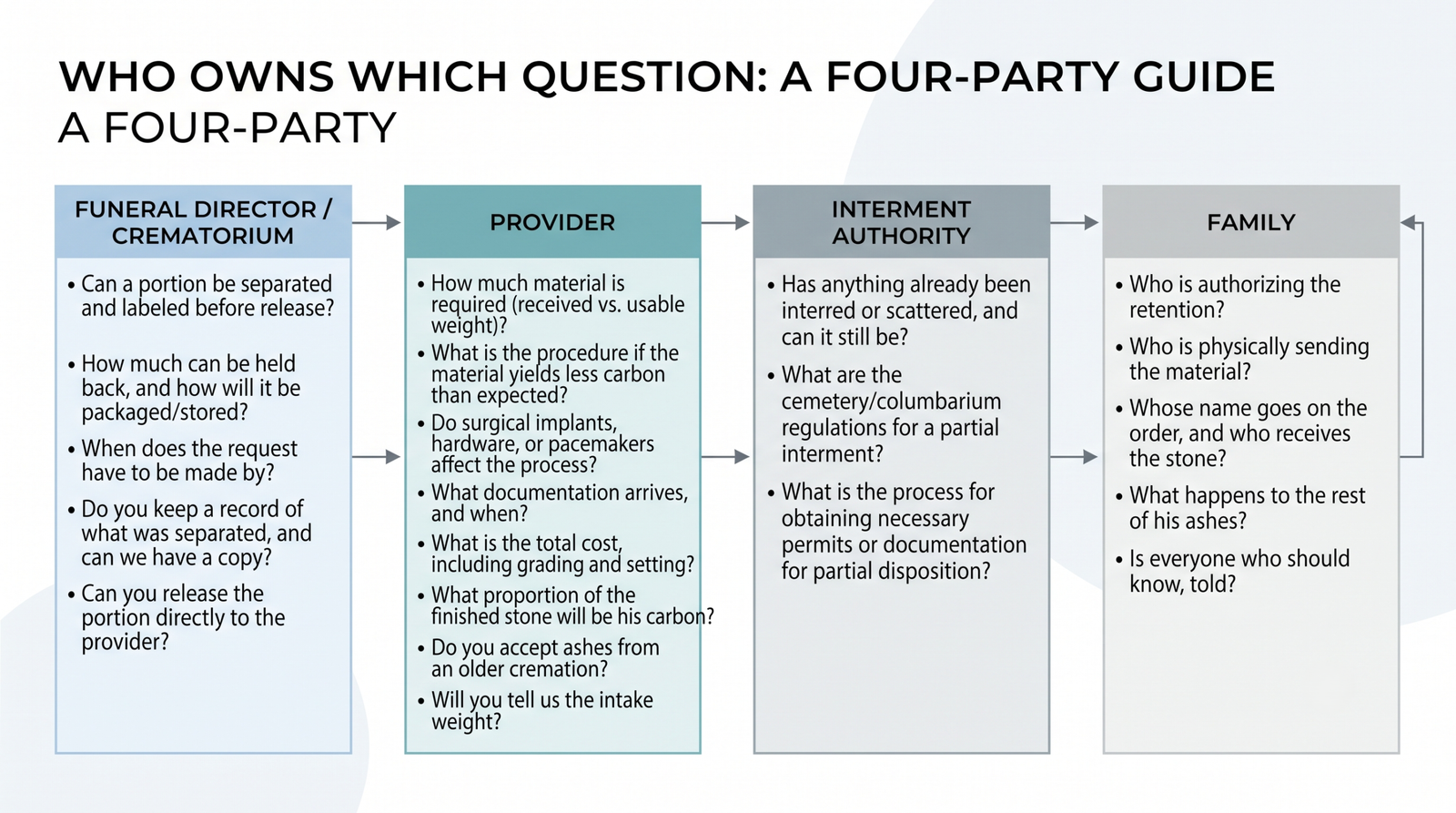
Read the right hand column before the left. A question that stalls before turning into an answer is rarely a hard question. More often it has arrived somewhere that could not answer it.
What Can Only a Funeral Director Answer Before Turning Anything Over?
These are also the ones with a deadline, which makes them the first calls to make, before turning to a provider at all.
- What is your procedure for separating and labeling a portion? Ask what the procedure is rather than whether it can be done. Practice varies between firms, and the answer tells you whether you are dealing with something routine for them or something they will have to arrange.
- How much can be held back, and how will it be packaged and stored? Bring a figure to this conversation. How much ash is needed covers the industry typical quantity to ask for.
- When does the request have to be made by? This is the only genuinely closing door in the process. Once remains are interred or scattered, the ash route is usually over.
- Do you keep a record of what was separated, and can we have a copy? For a portion retained months or years ago, this record may be the only documentation of that stage.
- Can you release the portion directly, or does it come through us?
The complete guide to father ashes diamonds covers working backwards from an interment date if one is already booked.
What Should You Ask a Provider About His Ashes?
These are the questions to put in writing before turning his ashes over to anyone.
- How much do you require, and is that a received weight or a usable one?
- What is your procedure if the material yields less carbon than expected? Usable carbon in cremated remains runs at roughly 0.5% to 4% by weight, and no provider can know in advance where a particular person’s remains sit in that range.
- Do surgical implants, hardware or a pacemaker affect what you can use?
- What happens to material that extraction does not consume? Does it come back as a matter of course, or on request? Ask which, in writing. The two answers are very different in practice.
- Do you accept ashes from a cremation that happened years ago, and does anything need checking before turning them over?
- Will you tell us the intake weight when the parcel arrives?
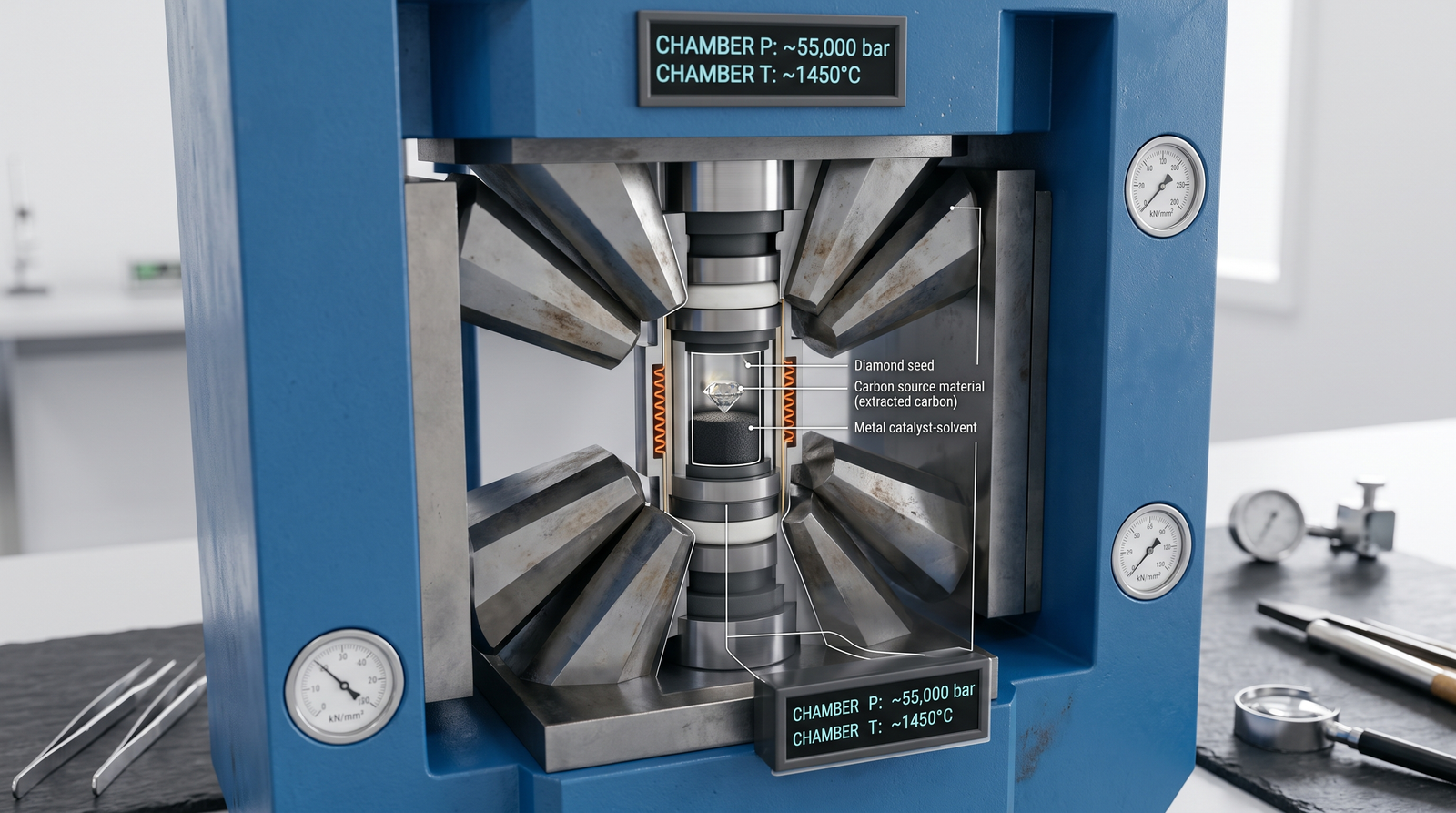
- What proportion of the finished stone will be his carbon, and what is supplemental lab grown carbon? No honest answer to this is 100%. The purified carbon is blended with lab grown carbon before growth in an HPHT press, and personal carbon in ash derived stones is commonly cited at around 10% to 15% of the finished stone’s mass. Ask for the figure in writing. Whether a memorial diamond is really made from your father’s ashes covers what can and cannot be proven on this point.
What to Ask When the Executor and the Urn Holder Are Different People
This is the situation the four party split exists for, and the one to resolve before turning to any company. It is common enough after a second parent’s death to plan for: one sibling was named executor, another was given the urn, and a third is the one making inquiries.
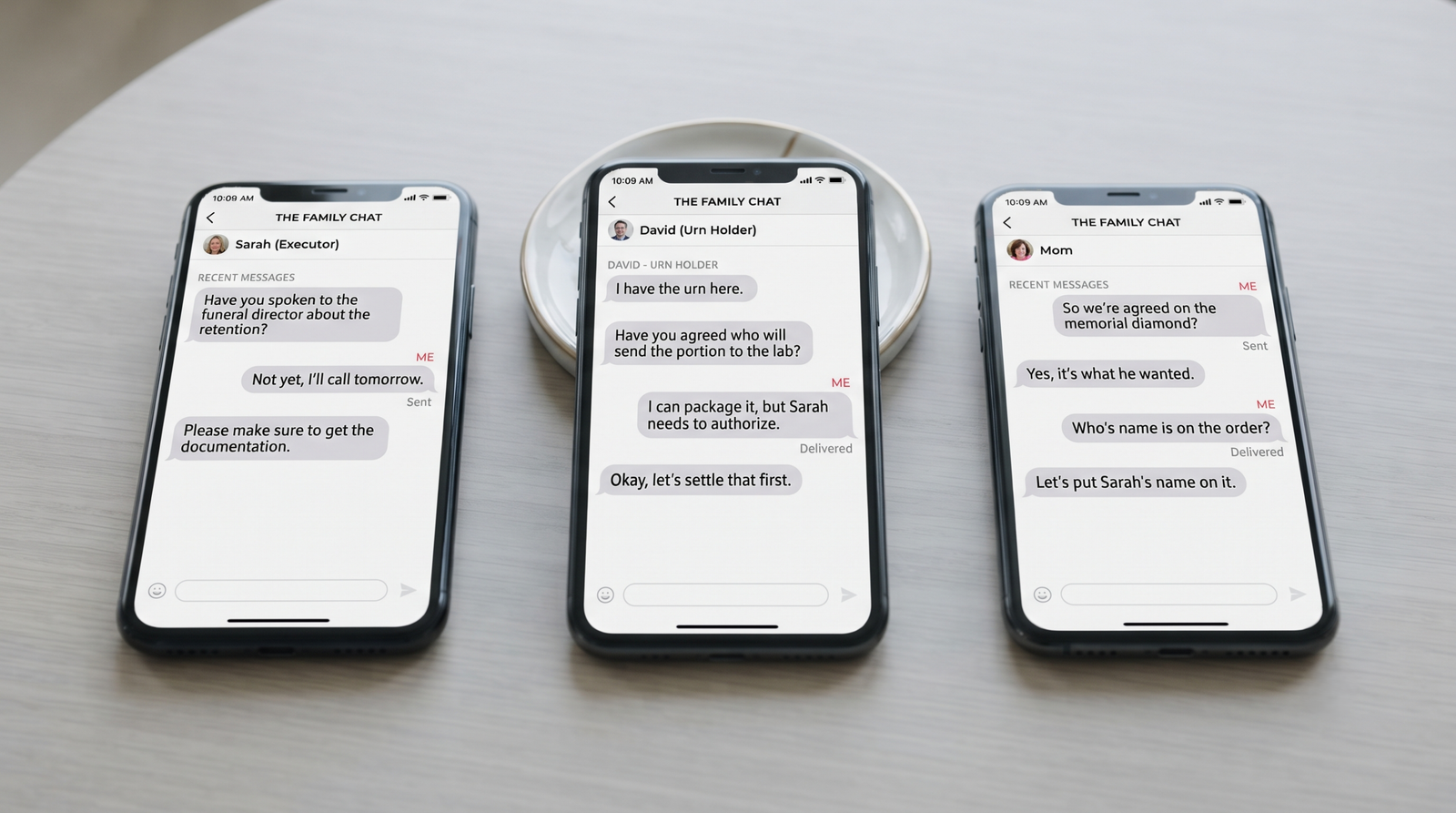
Three questions have to be settled between those people before turning to a provider, who is no use until they are.
- Who is authorizing the retention? The funeral director will act on one person’s instruction, and it should be a person the rest of the family knows about.
- Who is physically sending the material, and do they agree to? Whoever holds the urn has to open it. That is not a small thing to ask of someone by email.
- Whose name goes on the order? It does not have to be the executor, and it does not have to be whoever holds the urn, but it should be settled before a company is contacted rather than after.
Legal authority over a parent’s remains varies by state and by circumstance and is not something a jewelry company can advise on. What can be said plainly is that this is a conversation to have before, not during. How to talk to family about a father memorial diamond covers how families open it.
What Should Arrive With the Stone, and What Comes Back?
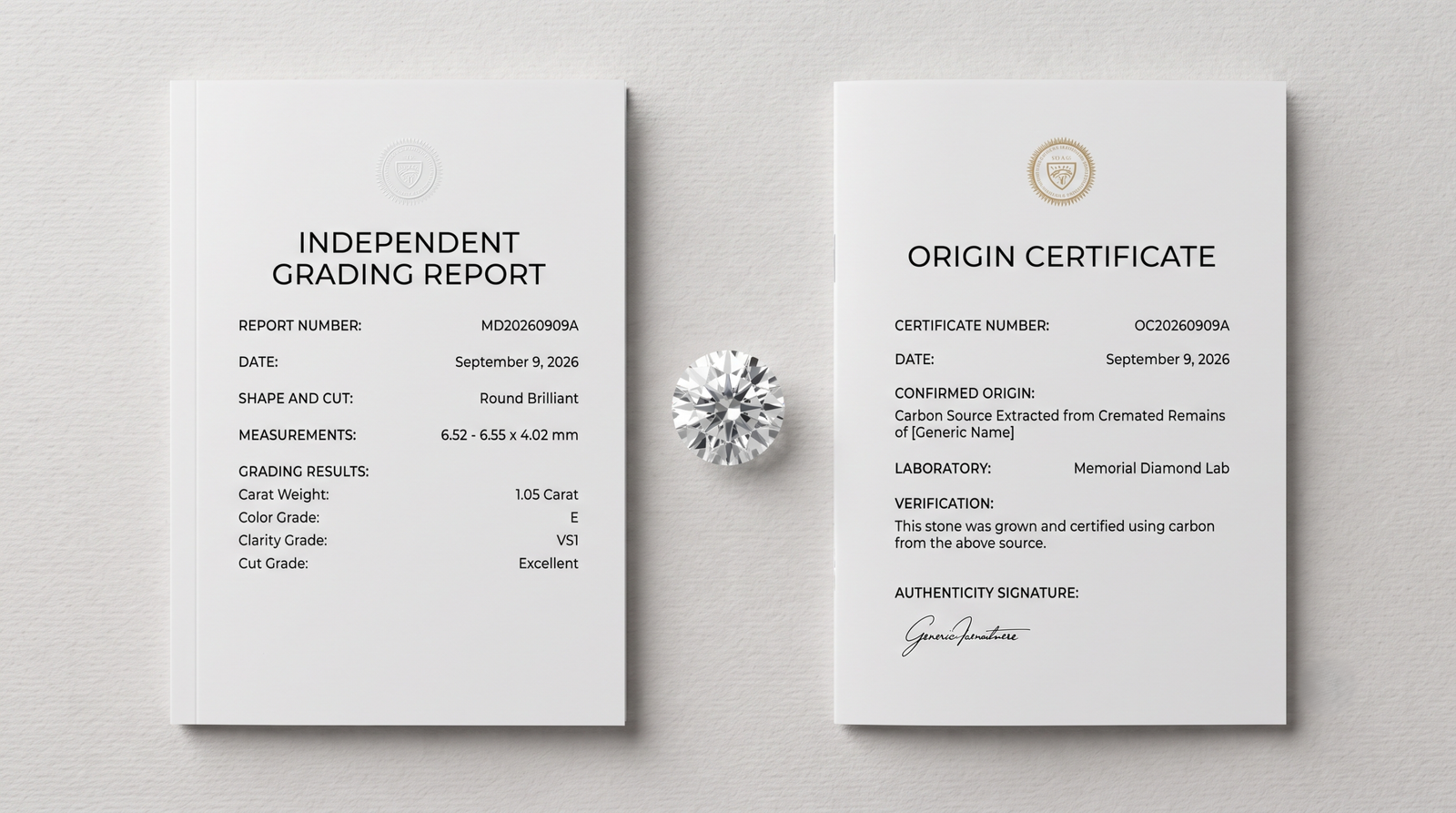
- What chain of custody reference do we get, and at what point? Before turning the material over, or after?
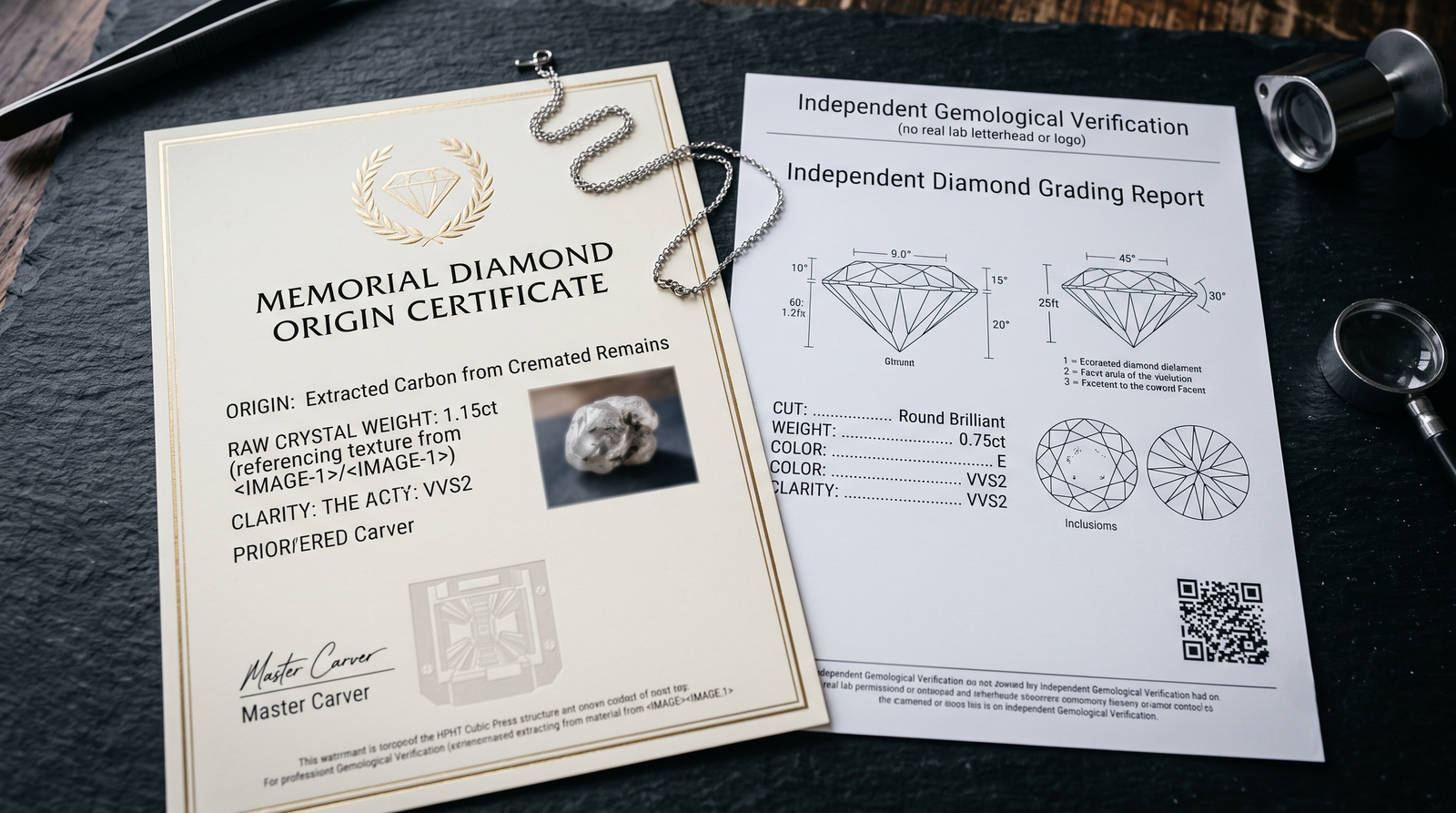
- Is the stone graded by an independent third party laboratory, or in house? These are different documents doing different jobs. A grading report grades the diamond’s cut, color, clarity and carat; an origin certificate ties it to your father. How providers track a loved one’s ashes covers what a chain of custody record should actually contain.
- What does the certificate say, and does it name him?
- What is returned to us at the end, and in what condition?
- What is the full price, including grading, setting, engraving and shipping? What a father memorial diamond costs covers which of those line items sit outside a quoted price.
Ask all five before turning any material over. Every one of them is easier to get in writing before a parcel exists than after.
Which Questions Must Your Own Family Answer First?
No provider can answer these, and leaving them open before turning the ashes over is what makes a straightforward order difficult in month nine.
- Whose name is the order in, and who is the single point of contact?
- Who receives the finished stone, and what happens to it afterwards?
- Is everyone who should know, told, before turning the ashes over, not after?
- What happens to the rest of his ashes? A memorial diamond submission is typically a small fraction of a full cremation, so this is usually a decision rather than a constraint.
Where Does a Service or Veterans Interment Add a Fifth Party?
Where a national or service cemetery is involved, one question is added and it goes to the funeral director rather than to the cemetery: when do you release, and can a portion be separated before that happens? Honoring military service with a memorial diamond covers how that timetable works and why the date is not the family’s to move. Ask it early, before turning to anything else on this page, if a service interment is planned.
Frequently Asked Questions
Should the funeral director be told a memorial diamond is planned?
Yes. Say so plainly rather than asking in the abstract. A director who knows why a portion is being retained can package and document it appropriately, and can tell you what their firm’s procedure actually is before turning anything over.
Can the executor decide this without the rest of the family?
Legally that varies and is not something a jewelry company can advise on. Practically, a decision about a father’s remains taken without telling his other children can be hard to unpick afterwards, whatever the paperwork says.
How long should a provider take to answer these?
Days rather than weeks is a reasonable expectation before turning to a decision on the factual ones: quantity, documentation, pricing, timeline. How quickly those arrive is worth noting, given the process runs for most of a year.
Should these questions be asked before or after his ashes are released?
Before, wherever possible. The funeral director questions have a genuine deadline attached, while the provider questions have none, so the order to work in is funeral home first, provider second, before turning anything over to either.
Does the crematorium hold any record we can still ask for?
Frequently yes, particularly where a portion was separated at the time. Ask before turning to the provider, since the record is theirs. Ask what they hold and request a copy. For a retention made years ago, that record may be the only documentation of what was set aside and when.
If a provider’s answers and the funeral home’s answers conflict, which one governs?
Neither automatically. Write both down and put the conflict to each of them. A contradiction of this kind is often two parties describing different stages, but check rather than assume, and do it before anything is shipped.
Final Thoughts on What to Ask Before Turning His Ashes Into a Diamond
The whole list above fits into three messages and one family conversation: one to the funeral director, one to whoever controls the interment if a date already exists, and one to the provider. None of them commits you to anything, and the first is the only one with a clock on it. Asked in that order, before turning anything over, the answers arrive in a week instead of a month.
Learn More About Father Memorial Diamonds
- Father Ashes Diamond: The Complete Guide
- Step by Step: Turning Your Father’s Ashes Into a Diamond
- How to Turn Your Father’s Ashes Into a Diamond
- Questions to Ask Before Turning Your Father’s Hair Into a Diamond
- Father Memorial Diamond FAQ: Everything Families Ask
Talk With Memorial Diamond
Put the provider half of that list to Memorial Diamond: what is needed, what comes back, what documentation arrives, and what the total is. Ask it before turning anything over, and get the answers in writing. Start at memorialdiamond.us.