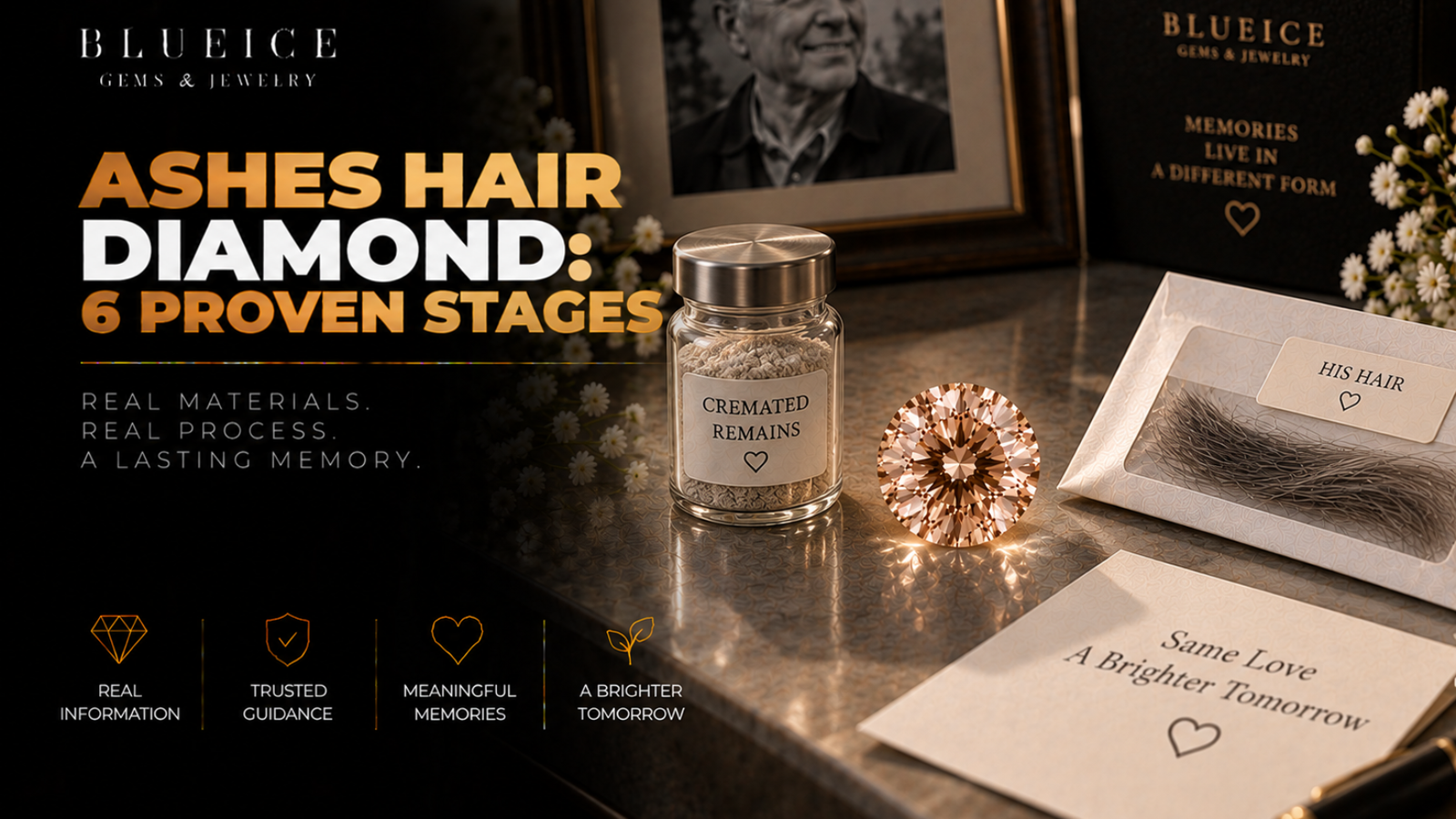
Ashes hair diamond: a small container of cremated remains and a labelled envelope of hair on either side of a champagne-toned lab-grown diamond

How a Memorial Diamond Is Made From Your Husband’s Ashes and Hair

One of these materials has already been through fire. The other has never been warmer than his own body. An ashes hair diamond made from your husband’s cremated remains and a lock of his hair is a single lab grown diamond, grown over roughly six to ten months from carbon purified separately out of each material, then combined at the graphite stage and grown around a seed crystal. Nearly every practical difference between the two halves of the process follows from that thermal history, and the point of no return sits exactly where you might not expect.

Two Thermal Histories, One Ashes Hair Crystal

Cremation has already burned away nearly all the carbon in his remains. What is left is mostly calcium phosphate, the mineral of bone, with usable carbon at roughly 0.5% to 4% by weight. His hair, by contrast, has never been heated: it is intact keratin, roughly 50% carbon, with the sulfur, nitrogen, and oxygen his body bonded around that carbon still in place.

So the ashes arrive carbon poor and mineral rich; the hair arrives carbon rich and organic. That is the ashes hair difference in one line. An ashes hair diamond has to treat them differently right up to the moment the two purified carbons are identical, and that moment comes later than most families assume.

The Two Track Process, Stage by Stage

NumberStageAshes trackHair trackSame or separate?
1Division and collectionA few tablespoons to approximately 4 oz set asideA small lock, a few grams, kept drySeparate; two records
2Shipment and intakeHandled as cremated remainsHandled as an ordinary sampleSeparate; two intake weights
3Carbon purificationMinerals removed in an oxygen free furnaceKeratin’s non carbon elements driven offSeparate tracks, separate yields
4GraphitizationPurified carbon converted to graphitePurified carbon converted to graphiteStill separate; now indistinguishable
5Blending and growthCombined with hair carbon and laboratory carbonCombined with ash carbon and laboratory carbonOne growth cell, one crystal
6Cutting and gradingOne stoneOne stoneOne grading report, one origin document naming both
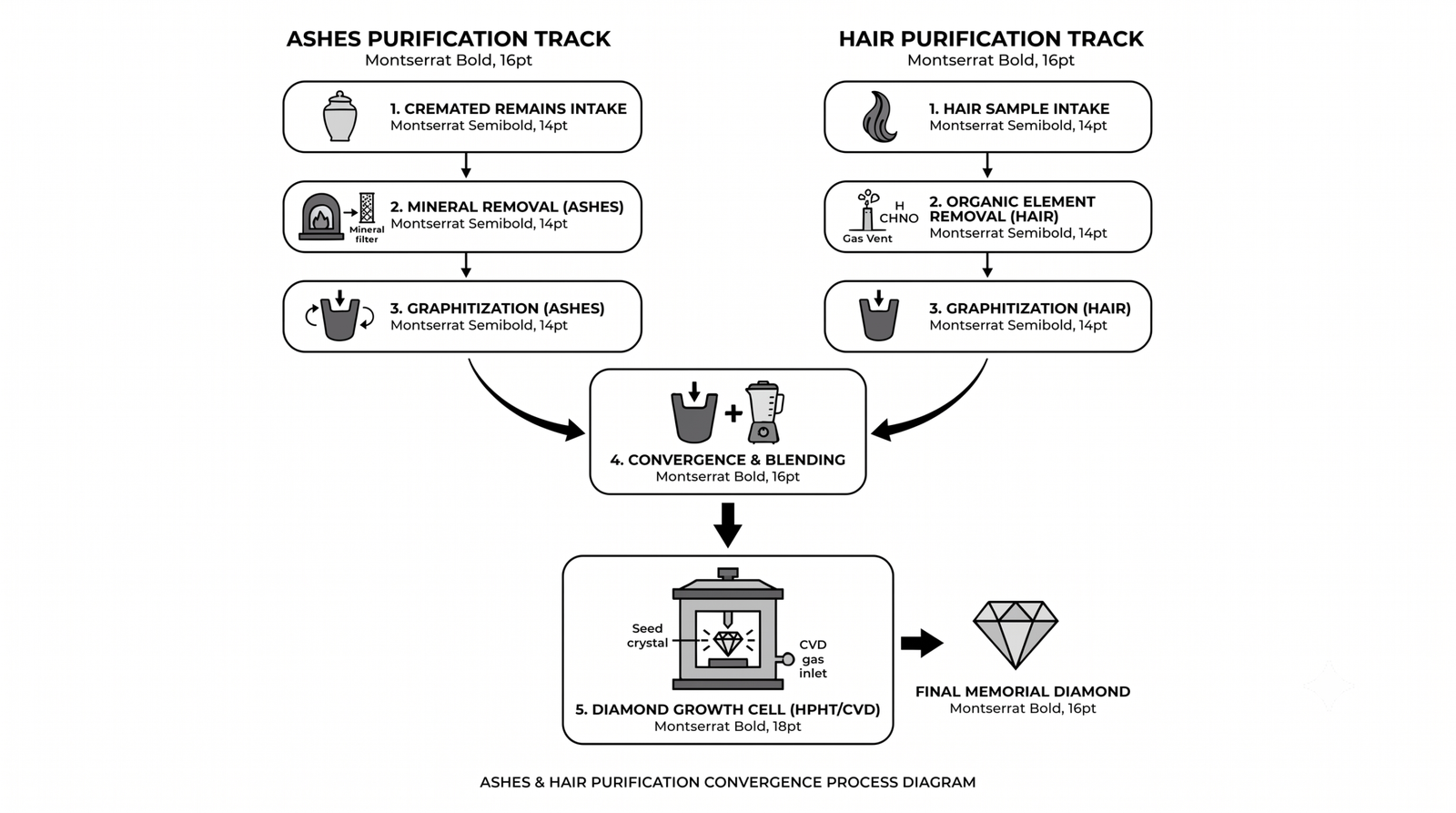
A diagram showing two separate purification tracks converging at the graphite stage into one growth cell

Stages 1 and 2: Intake, and Why Two Records Matter

Because the ashes hair pairing arrives with two different histories, they should arrive with different paperwork. Ask whether the provider keeps two intake records for a combined order, each with its own recorded weight, and whether the origin document at the end names both sources. If the answer to either is no, the hair you chose with such care is present in the stone but absent from its record.

The two halves of an ashes hair order travel differently: cremated remains are typically shipped under carrier rules that hair is not, so confirm the provider’s current instructions for each on the day rather than assuming one package covers both. Whichever travels first, send the hair with the greater care; it cannot be re cut.

Stage 3: Two Purification Tracks

Both halves of an ashes hair diamond go through a controlled, oxygen free, multi stage heating process, but the process is removing different things from each. From the ashes it strips calcium phosphate and other minerals. From the hair it drives off the nitrogen, oxygen, sulfur, and hydrogen of keratin. Both tracks end at carbon of roughly 99.9% purity.

Each track on its own is described in how a memorial diamond is made from your husband’s ashes and how a memorial diamond is made from your husband’s hair. The yields are very different. Four ounces of ashes produce a few grams of carbon; a few grams of hair produce a meaningful fraction of their own weight. In an ashes hair diamond, this is the stage where a provider learns whether one material has under yielded.
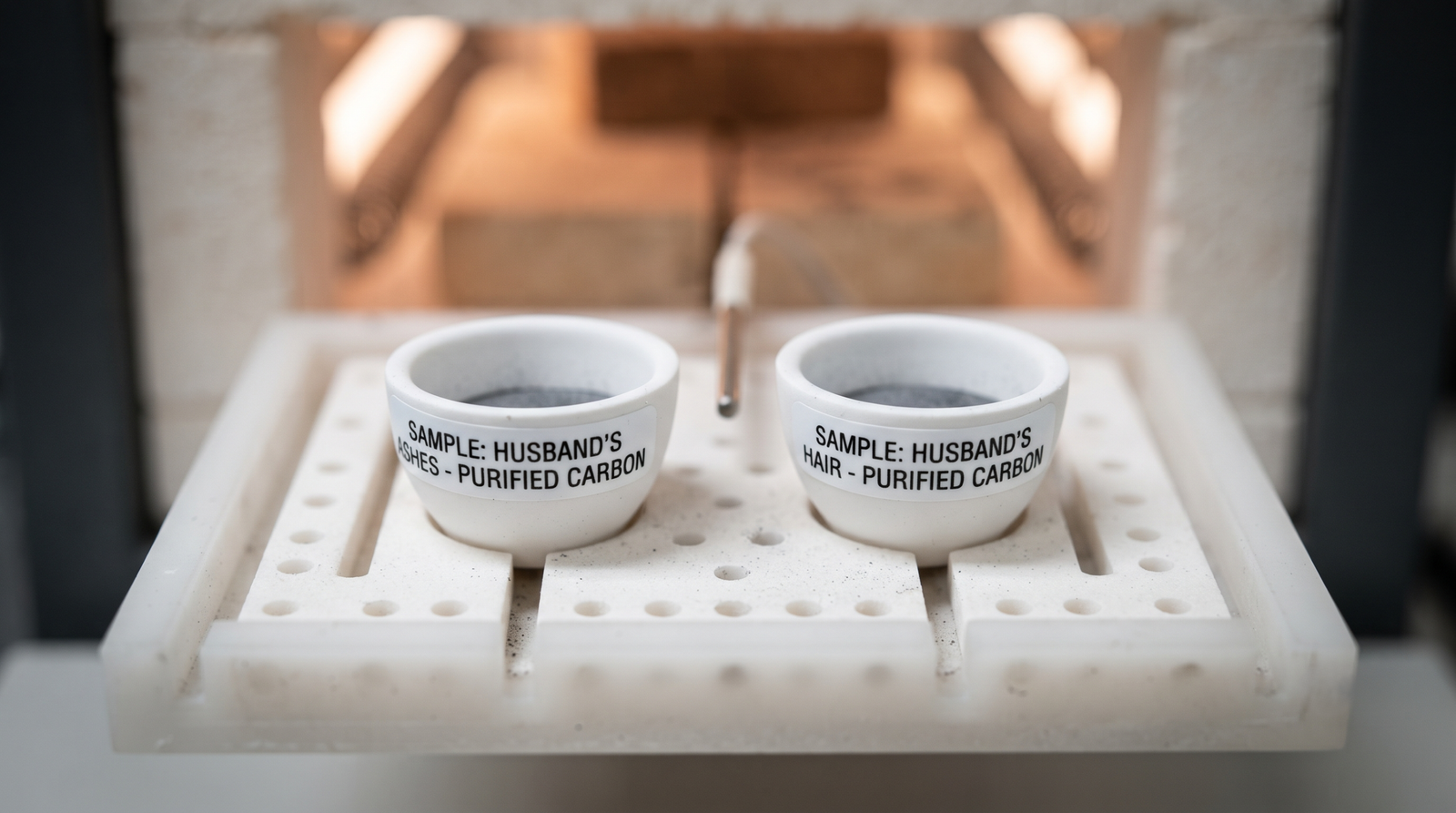
Two labelled crucibles side by side in a laboratory furnace tray

Ask, before ordering, whether you will be told at this point or whether the shortfall is quietly covered by laboratory carbon in the next stage. What happens to the mineral residue from the ashes, and to any hair not consumed, are separate questions and worth asking separately.

Stage 4: Graphitization, the Real Point of No Return

Most guides to an ashes hair diamond place the point of no return at blending. It sits one stage earlier. Each purified carbon is heated to roughly 2,500 to 2,700°C, hotter than the growth run itself, and converted to graphite, the layered crystalline form a diamond press uses as feedstock. After this stage, the carbon from his ashes and the carbon from his hair are physically identical: two portions of graphite, distinguishable only by the label on each crucible.

Blending in Stage 5 merely combines two things that are already the same. Graphitization is where they became the same. If a family wants the option of two separate stones instead of one ashes hair diamond, the decision has to be made before Stage 4, not before Stage 5. The alternatives are set out in the husband ashes and hair diamond guide.

Stage 5: Blending and Growth

The two graphites of an ashes hair diamond are combined, supplemented with laboratory carbon to reach the volume a viable crystal needs, and placed with a tiny diamond seed in a growth cell. Most memorial providers grow by HPHT, a press recreating roughly 6 to 8 GPa and 1,400 to 2,500°C; a minority convert the carbon to gas for CVD. Both are the standard HPHT and CVD diamond growth methods. Growth takes weeks to months, and growth time, not the quantity of either ashes hair material, sets the carat.

The proportion is the same for an ashes hair diamond as for any memorial stone: personal carbon typically makes up around 10 to 15% of the finished crystal, with the balance laboratory carbon. What the combined route changes is not the share that is him, but the record of which parts of him it came from.

Stage 6: Cutting, Grading, and One Document Naming Both

A gemologist cuts and polishes the rough crystal. Reputable providers then have it graded by an independent laboratory on the same cut, color, clarity, and carat scale as any diamond; memorial stones typically fall between SI2 and VVS for clarity. Color is set by trace elements during growth, not by which material the carbon came from, so an ashes hair diamond trends toward yellow, champagne, or blue like any other, and combining materials does not blend two colors. The options are covered in what color diamond can be made from your husband’s ashes and hair.
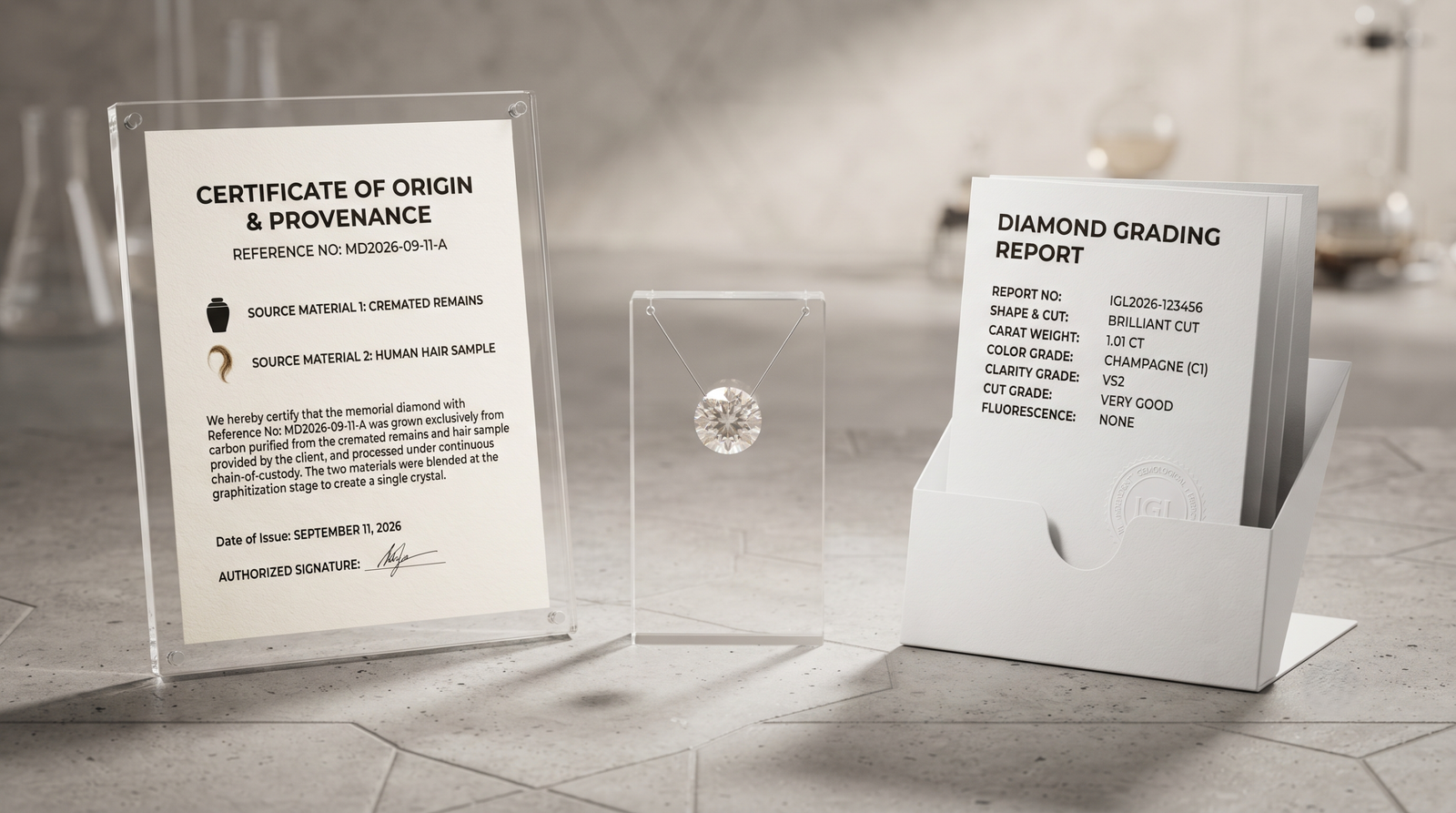
An origin document listing two source materials beside a loose memorial diamond and a grading report

Two documents should return with an ashes hair diamond: the grading report, and an origin document that names both the ashes and the hair as sources and traces back to the two intake records. That single document is the reason to have asked the two record question at the start, and the reason the doubt a combined stone attracts is answered in is a memorial diamond really made from your husband’s ashes and hair.

Frequently Asked Questions

Are the ashes and hair processed together or separately?

Separately, until the graphite stage of an ashes hair diamond. Each material is purified on its own track because the ashes need minerals removed and the hair needs keratin’s other elements driven off. The two purified carbons are converted to graphite, then combined and grown as one crystal.

Where is the point of no return for an ashes hair diamond?

At graphitization, not at blending. Once each carbon is converted to graphite, the two are physically identical and cannot be separated by any test. If you want two separate stones instead of one, that decision has to be made before this stage.

Will the diamond show which carbon came from ashes and which from hair?

No. In an ashes hair diamond, both are reduced to pure carbon and become one crystal lattice. The only thing that distinguishes them afterward is the paperwork: two intake records and an origin document naming both materials. Ask that those exist before you order.

Does adding hair change how much of the diamond is him?

Not the proportion. Personal carbon typically makes up around 10 to 15% of any memorial diamond, with laboratory carbon supplying the rest. What hair changes is the source mix within that share, and, with some providers, how much ash is required.

What if one material yields less carbon than expected?

The provider learns this at the purification stage. Whether they tell you before blending, or cover the shortfall with laboratory carbon without saying so, varies. Ask this question in writing before sending anything; it is the most important one for a combined order.

Does an ashes hair diamond take longer to make?

Not meaningfully. The two ashes hair purification tracks run in parallel, and most of the six to ten months is spent in the growth press, where the crystal grows exactly as a single material stone would. Larger or specialty color stones can extend that to twelve months.

Final Thoughts on How a Memorial Diamond Is Made From Your Husband’s Ashes and Hair

The ashes have already been through their fire; the hair goes through its first here. By the end of Stage 4 the two are the same graphite, and by the end of Stage 5 they are one crystal. What an ashes hair diamond preserves that a single material stone cannot is not a chemical trace of each, but a written record that both were there. Choose a provider who will write that record.

Learn More About Husband Memorial Diamonds

Talk With Memorial Diamond

If you are holding both materials and want to know what would be recorded at each stage before you send either, reach out to Memorial Diamond to talk through what’s possible with your husband’s ashes and hair.
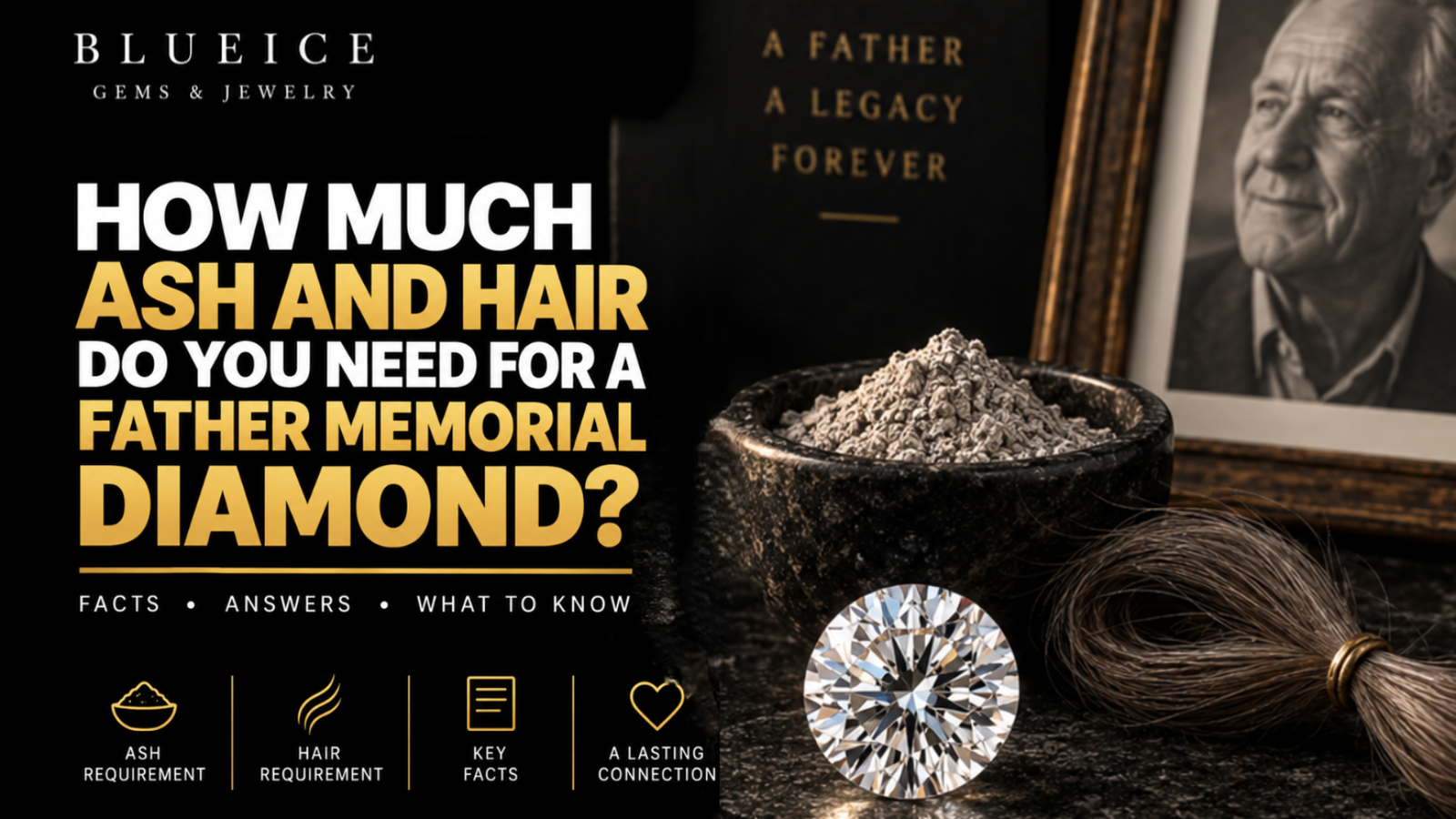
How much ash and hair a father memorial diamond needs, showing cremated ashes, a lock of hair, and a memorial diamond

How Much Ash and Hair Do You Need for a Father Memorial Diamond?

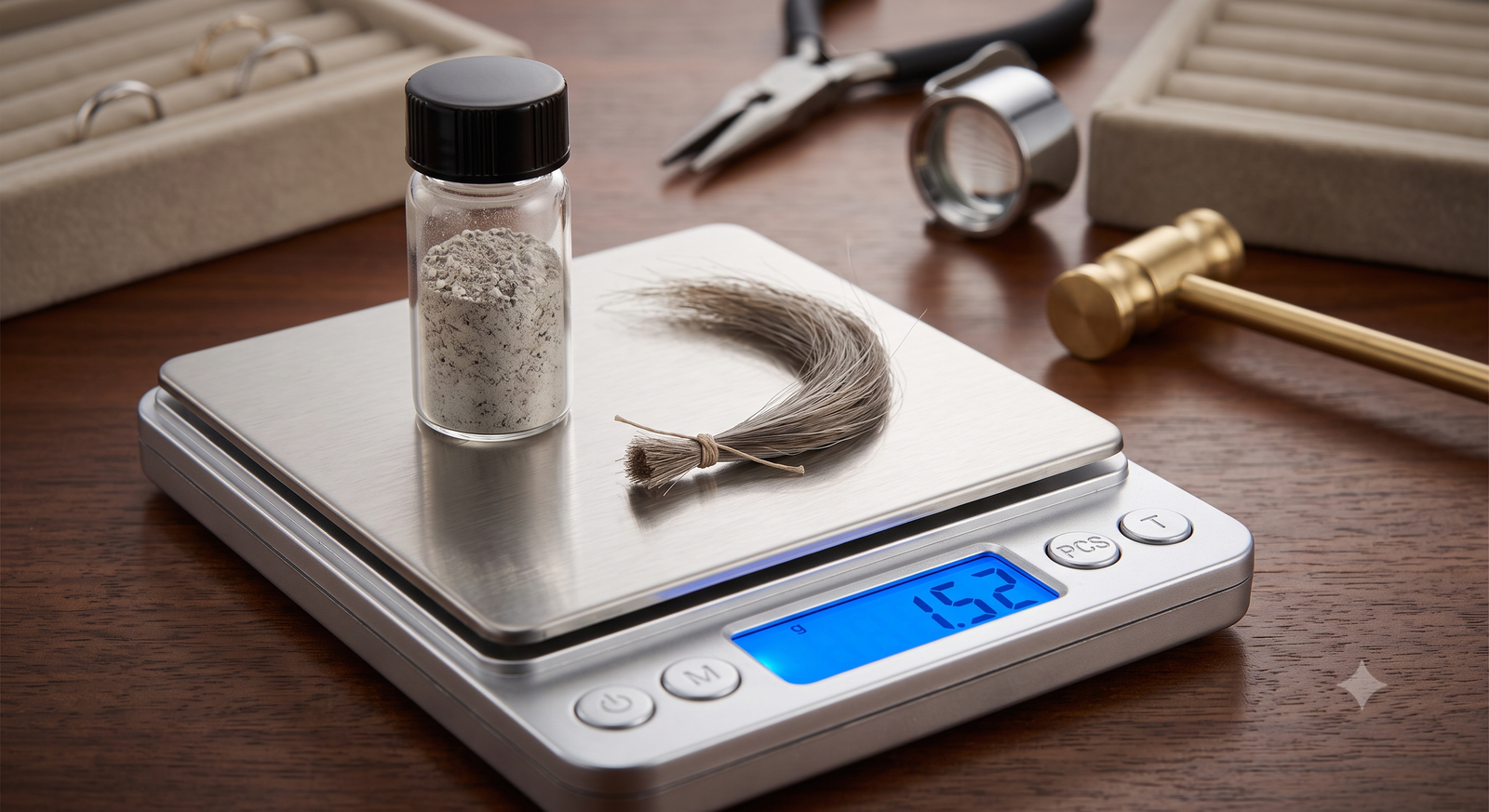
How much ash and hair a father memorial diamond needs: a small vial of cremated remains beside a tied lock of hair on a jeweler's scale

Of the two materials, there is usually one you have plenty of and one you are counting, and most people can say which before they finish reading the question. So how much ash and hair does a father memorial diamond need? Industry wide, plan on each material meeting its own figure in full: a few tablespoons up to roughly 4 oz (about 100 g) of cremated remains, and a few grams of hair, a palm sized lock. Ask before assuming that sending both lowers either number.

What matters far more than the figures is which side you are short of, because a shortfall in ashes and a shortfall in hair are not the same kind of problem. One is often recoverable. The other frequently is not.

Memorial Diamond is one of the companies that grows these stones; the questions below are meant for any of them, us included.

How Much Ash and Hair Does Each Material Have to Meet on Its Own?

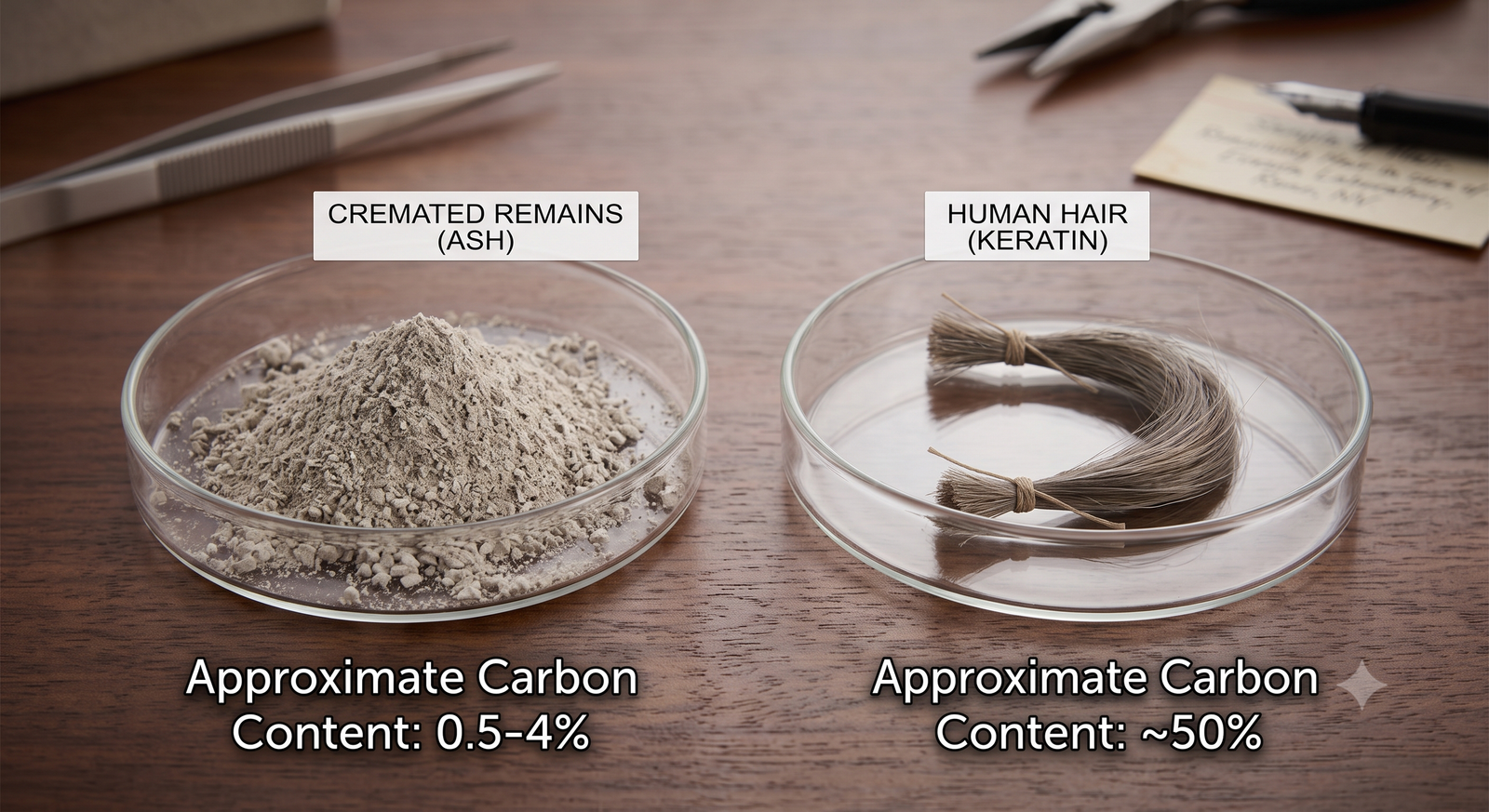
Side-by-side comparison of a dish of cremated remains and a coil of hair with their approximate carbon content noted, 0.5–4% against about 50%

The two figures for how much ash and how much hair are quoted in different units because the two materials are chemically nothing alike.

Cremated remains are dominated by calcium phosphate, the mineral structure of bone, with usable carbon at roughly 0.5% to 4% of ash by weight. That low yield is why how much ash you need is stated in tablespoons and ounces, and why a family submitting a portion still keeps most of what they have.

Hair is roughly 50% carbon by weight, built from keratin. That is why the hair requirement is stated in grams, and why hair works at all for a father who was buried rather than cremated.

Whichever material it came from, the recovered carbon is topped up with lab grown carbon before an HPHT growth run can use it. What each of the two contributes is a provable share of him rather than the whole stone, the honest framing, and the reason a claim of total purity should be treated as a warning sign.

Neither figure is standardized across the industry, and the individual numbers belong to the posts that own them: how much ash is needed and how much hair is needed each go into the specifics. This page is about what happens when you are holding both.

Should You Expect Combining to Lower Either Threshold?

Plan on no, and ask, how much ash and hair you need is set per material.

The reason to expect independence is that the two materials do not meet until late. Providers commonly describe preparing each separately, cleaning, extraction, purification to roughly 99.9% carbon, graphitization, with the two coming together only at the growth cell. On that description each material carries its own minimum, so how much ash and hair you need is two questions rather than one. The complete guide to father ashes and hair diamonds sets out where those lanes converge and why.

The consequence for planning is worth stating flatly: plan for both figures in full, and treat any flexibility a provider offers as a concession rather than an assumption. A family that plans on halves and discovers otherwise has often already divided something irreversible.

Why Are the Two Shortfalls Different Problems?

This is the distinction that actually decides what you do next, more than how much ash or hair sits in either container.

If you are short ofCan more usually be found?What finding out costsEffect on the other material’s requirement
His ashes, still in the family’s keepingUsually yes, a submission is typically a small fraction of a full cremationA phone call to whoever holds the urnNone
His ashes, already interred or scatteredUsually no, and disinterment is a legal and family matter rather than a practical oneA conversation with the cemetery or the executorNone, but this is often the point at which hair becomes the primary route
His hair, one sample onlyOften no. A lock is finite and does not replenishA scale and ten minutesNone
His hair, several possible sourcesSometimes, a comb, a razor, a hat, a barber’s clippingsA search, plus a provider’s acceptance policyNone
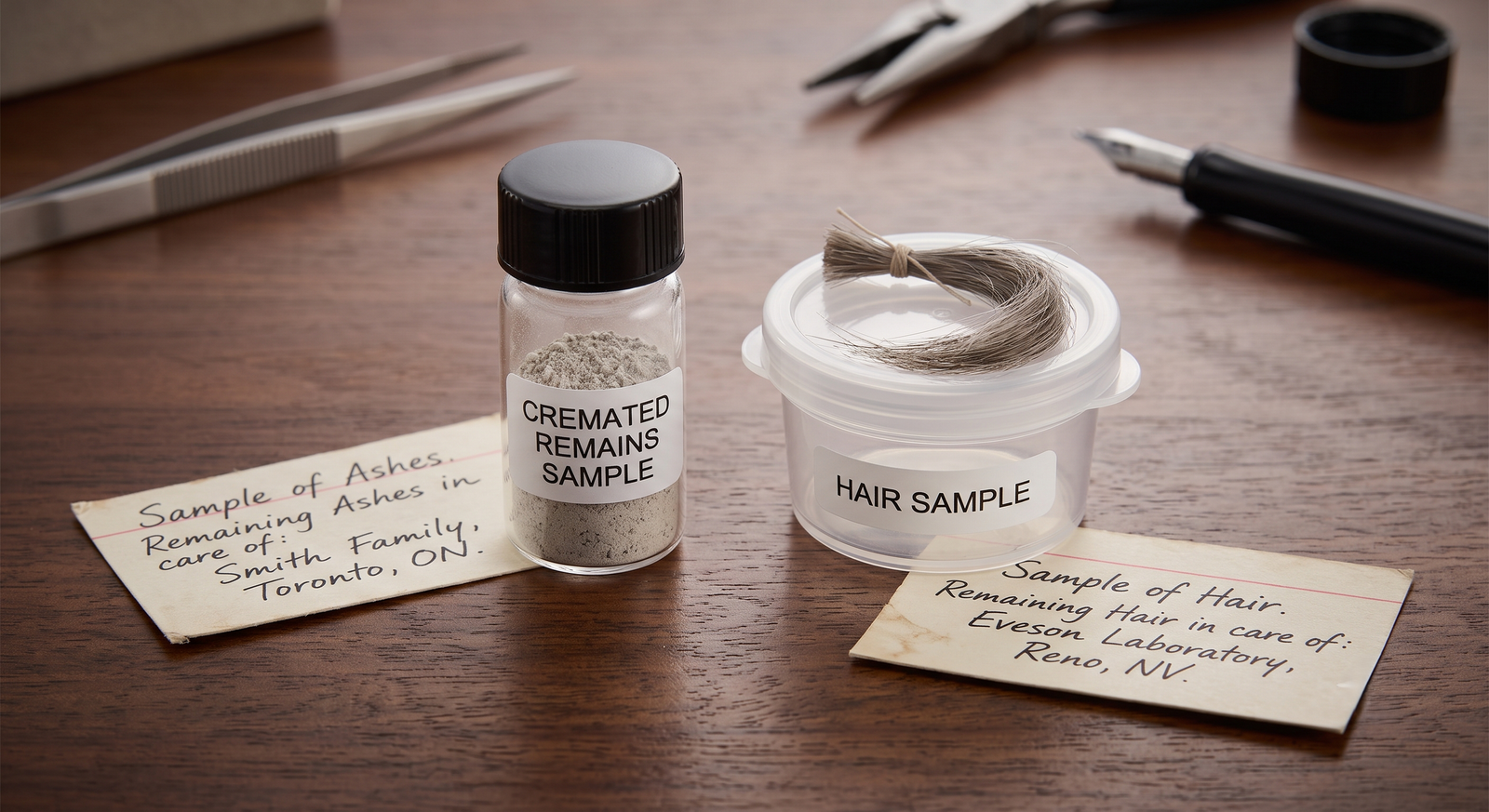
Two small labeled containers, one of cremated remains and one of hair, with a handwritten note beside each recording who holds the rest

Read the table twice for the same reason it is laid out this way, however much ash and hair you are holding: the ash rows describe a problem with a phone number attached, and the hair rows describe a problem with an ending. That asymmetry should decide the order you do things in.

Before anything is divided, opened or cut, establish these four things:

  1. Who currently holds his ashes, and how much ash is actually there. This is often not the person who assumes they know.
  2. What the hair sample weighs, on a scale that reads to a tenth of a gram, weighed in its container and subtracted.
  3. Whether any plan already exists for the remainder, a scattering, an interment, a shared plot, and whether it has a date.
  4. Whether the provider you are considering accepts combined submissions at all. It is not a given, and it is the question that makes the other three matter.

What Can Be Done if the Hair Falls Short?

Several things, in roughly this order of preference, and none of them depends on how much ash you have.

Look further before you conclude. Short clippings are not disqualified by being short, weight rather than length is what the process consumes, and the complete guide to father hair diamonds sets out where they tend to be found. Whether a given company accepts very short or mixed source clippings is a policy question that varies, so ask with a weight and a photograph rather than a description.

Ask whether a below minimum sample can be included as a supplementary contribution rather than as a lane of its own. Some providers may treat it that way; whether any given one does is not something the chemistry decides.

And if the answer is genuinely no, an ash only stone is not a lesser outcome. It is the longer established of the two routes, memorial diamonds were grown from cremated remains long before hair was offered, and the hair can stay exactly where it is. Keeping a lock is not a failed plan.

What Can Be Done if the Ashes Fall Short?

Often more than expected. How much ash a memorial diamond submission needs is a fraction of what a cremation produces, so a shortfall is more often a question of access than of how much ash exists, a sibling holding the urn, a portion already divided among family, a funeral home that still has a retained portion on file.

Where the remains have already been interred or scattered, the ash route may genuinely be closed, and that is the situation hair based options for loved ones who were not cremated exists to answer. A hair sample that seemed like an addition becomes the whole basis of the stone, and it works.

One thing that does not help either way: sending far more than the minimum. Carat size follows growth time in the press, not how much ash or hair arrived, so a fuller parcel buys nothing.

Which One Gets Assessed First?

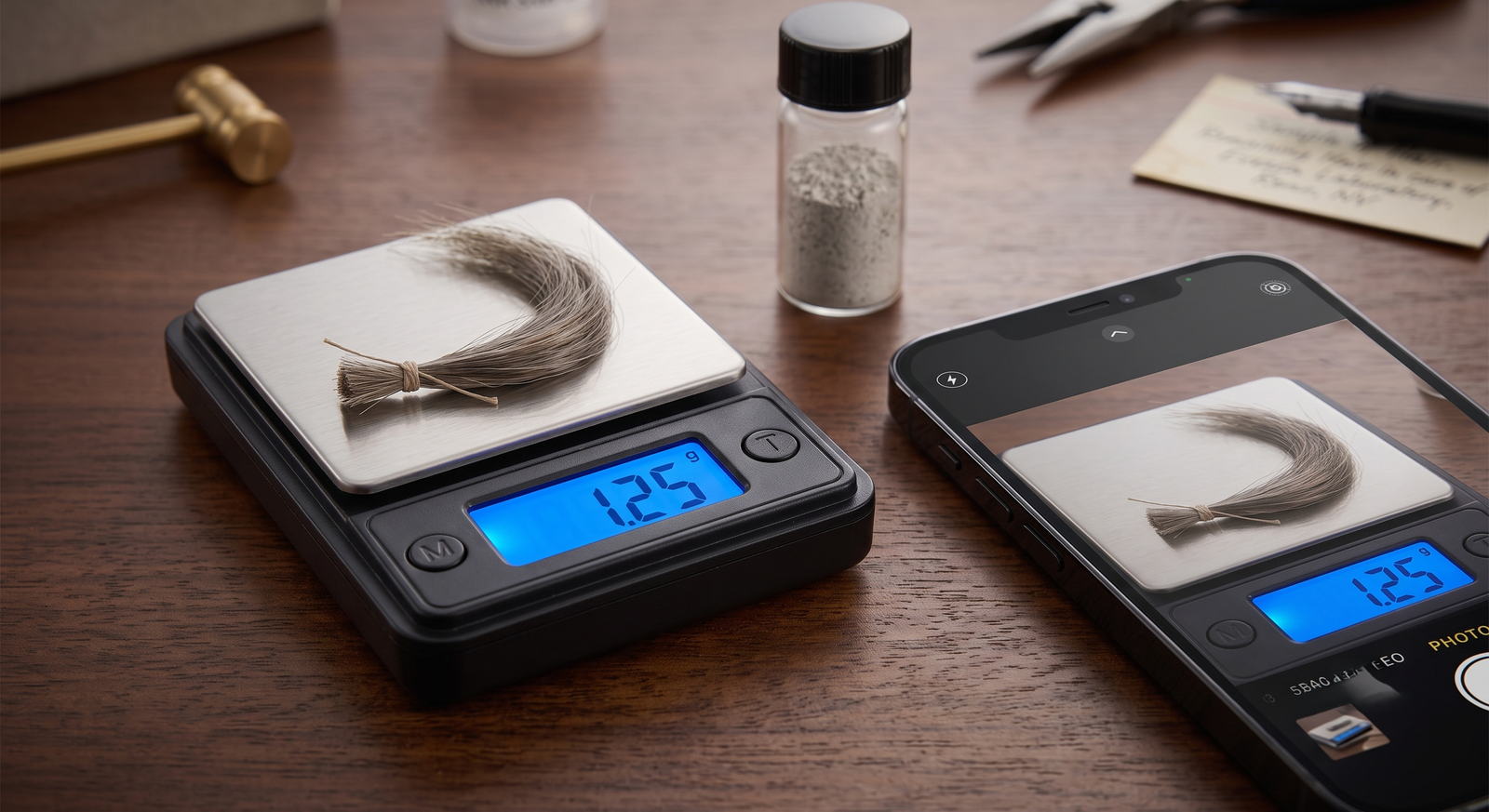
A lock of hair on a pocket scale photographed with the reading in frame, ready to send to a provider for pre-assessment

Hair, in most cases, it is the material that can fail assessment, and assessing it is quick. How much ash you have rarely decides anything at this stage.

A hair sample can often be evaluated from a stated weight and a clear photograph before anything is posted, though whether a particular provider will pre assess on that basis is worth confirming rather than assuming. Ashes are more often assessed on arrival, by volume and weight at intake.

The practical order that follows: settle the hair question first, in writing, then decide how much ash to send, then choose the carat. Questions to ask before a combined order covers what else belongs in that first email, and the step by step sequence covers where each material goes afterwards.

Frequently Asked Questions

Which Material Should Be Assessed First?

Hair, generally, it is finite, it is the one that can be judged inadequate, and a weight and a photograph can often settle it before anything is posted. Ashes are more often assessed at intake, by weight and volume.

Do the Two Figures Change if We Want a Larger Stone?

Generally not. Carat is bought in growth time rather than in how much ash and hair you submit, so a larger stone usually means more months and more money rather than more material. Confirm it, since minimums vary between companies.

Should We Weigh His Ashes, or Is a Volume Measure Enough?

Ask which the provider works in. How much ash is required is quoted both ways across the industry, in tablespoons and in ounces, and a family measuring by volume against a figure stated by weight can send materially more or less than intended.

Who Weighs and Measures Each Material, Us or the Laboratory?

Both, at different points. Weighing the hair at home tells you whether to proceed; the laboratory records its own intake figures for chain of custody purposes. Ask for those intake figures to be reported back to you in writing.

Is There Any Point Sending Much Ash or Hair Beyond What the Figure Asks For?

Not for size or speed, those follow the growth run. A little margin above a stated minimum can be sensible where a sample is marginal, but sending everything you have puts material out of your hands for no gain.

Is There Any Advantage to Sending Both if Either One Alone Would Be Enough?

Not in size, speed or cost, those follow the carat and the growth run. The reason families combine is that both materials came from him and both were kept, which is a reason about meaning rather than about the process.

Final Thoughts on How Much Ash and Hair a Father Memorial Diamond Needs

Everything on this page turns on one piece of information that costs nothing to obtain: whether the constraint in your family is the ashes or the hair. Ten minutes with a scale and one phone call to whoever holds the urn will tell you how much ash and how much hair you are actually working with, and neither commits you to anything. The figures themselves are the easy part; knowing which side is short is what decides the order everything else happens in.

Learn More About Father Memorial Diamonds

Talk With Memorial Diamond

Memorial Diamond can give you both figures for your father, how much ash and how much hair a combined stone would need, and say what happens if one of the two falls short. Nothing has to be opened, cut or posted to ask. Start at memorialdiamond.us.