
People believe ashes hold something of a person. A lock of hair in an envelope feels, to most of us, too small and too ordinary to become anything. A memorial diamond is really made from your wife’s hair and chemically it is the stronger of the two claims: hair is roughly 50% carbon by weight, against under 4% for cremated ashes, so a small lock yields far more of her actual carbon than a few tablespoons of ash, which is then purified, blended with lab carbon, and grown into a genuine diamond.
Table of Contents
Doubt 1: Is a Lock of Hair Really Enough of Her?
This is the doubt underneath all the others about a stone really made from your wife’s hair, and the answer is the most counter intuitive fact in the category.
Hair is built from keratin, a carbon rich protein, and is roughly 50% carbon by weight. Cremated ashes are almost entirely calcium phosphate, bone mineral, with usable carbon at only 0.5% to 4%. Gram for gram, a lock of her hair holds roughly ten to a hundred times more of her carbon than her ashes. That is why the hair route needs so little material: typically a small lock, a few grams, often described as palm sized, against a few tablespoons to roughly 4 oz of ash.
So when you ask whether a memorial diamond is really made from your wife’s hair, the question of whether there was enough of her to work with is the easy part. There was. The purification process, heating the hair in a controlled, oxygen free, multi stage process that strips away the non carbon components of keratin, leaves carbon at 99.9%+ purity, which is then heated to roughly 2,500 to 2,700°C and converted to graphite, the feedstock a diamond press uses.
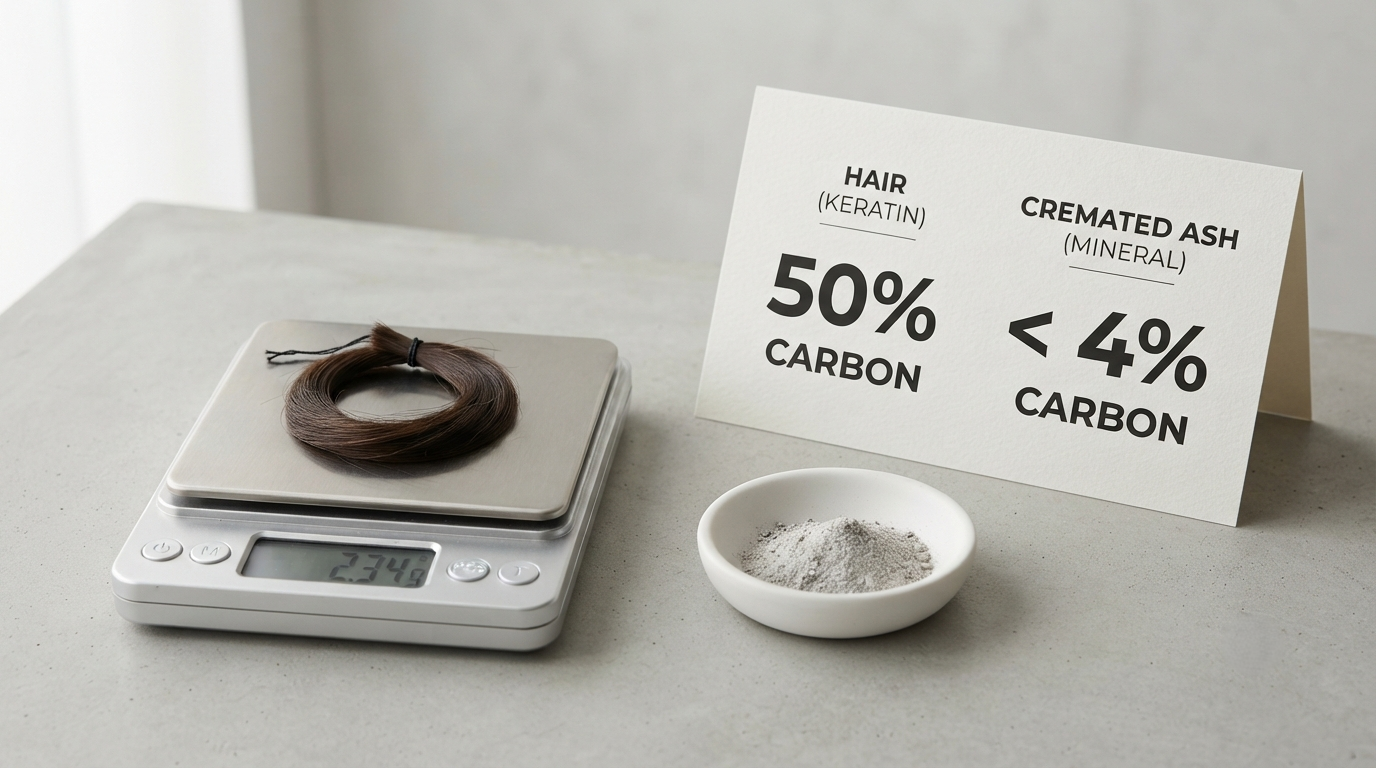
One honesty point still applies, and a stone really made from your wife’s hair is not exempt from it. Even hair carbon is blended with lab sourced carbon to reach the volume the growth cell needs, and the personal share of the finished stone typically lands around 10% to 15% across the industry. No provider produces a diamond that is 100% her from any material. The difference with hair is that this blend is a choice about stone size, not a limit forced by how little carbon there was to begin with. How a memorial diamond is made from your wife’s hair follows the lock through every stage.
Doubt 2: Her Hair Was Dyed or Gray; Does That Ruin It?
No. Nothing about the condition of the hair changes whether the diamond is really made from your wife’s hair, and it is worth going through the specific worries one by one, because each has the same answer for the same reason.
| The worry | What actually happens | Effect on the diamond |
|---|---|---|
| She colored her hair for years | Dye molecules sit in the hair shaft; they are destroyed and removed at purification with everything else that is not carbon | None |
| Her hair had gone gray or white | Gray hair is hair with little or no melanin; the carbon in the keratin is unchanged | None |
| She had keratin or chemical treatments | Treatment residues are removed at purification exactly as dye is | None |
| The lock is decades old, from a wedding, a first haircut kept by her mother | Carbon does not degrade in a way that matters; old hair works | None |
| The only hair you have is from her brush | Brush hair is hair; a few grams is enough | None, provided there is enough |
| The hair was washed, conditioned, or sprayed the day it was cut | All product is removed at purification | None |
The reason is the same in every row: purification is indiscriminate. It removes everything that is not carbon, and dye, pigment, treatment, and product are all not carbon, so a diamond really made from your wife’s hair is the same diamond whatever she did to it. A provider who says dyed or gray hair cannot be used is working with an unusual process or turning away material for a reason they have not explained.
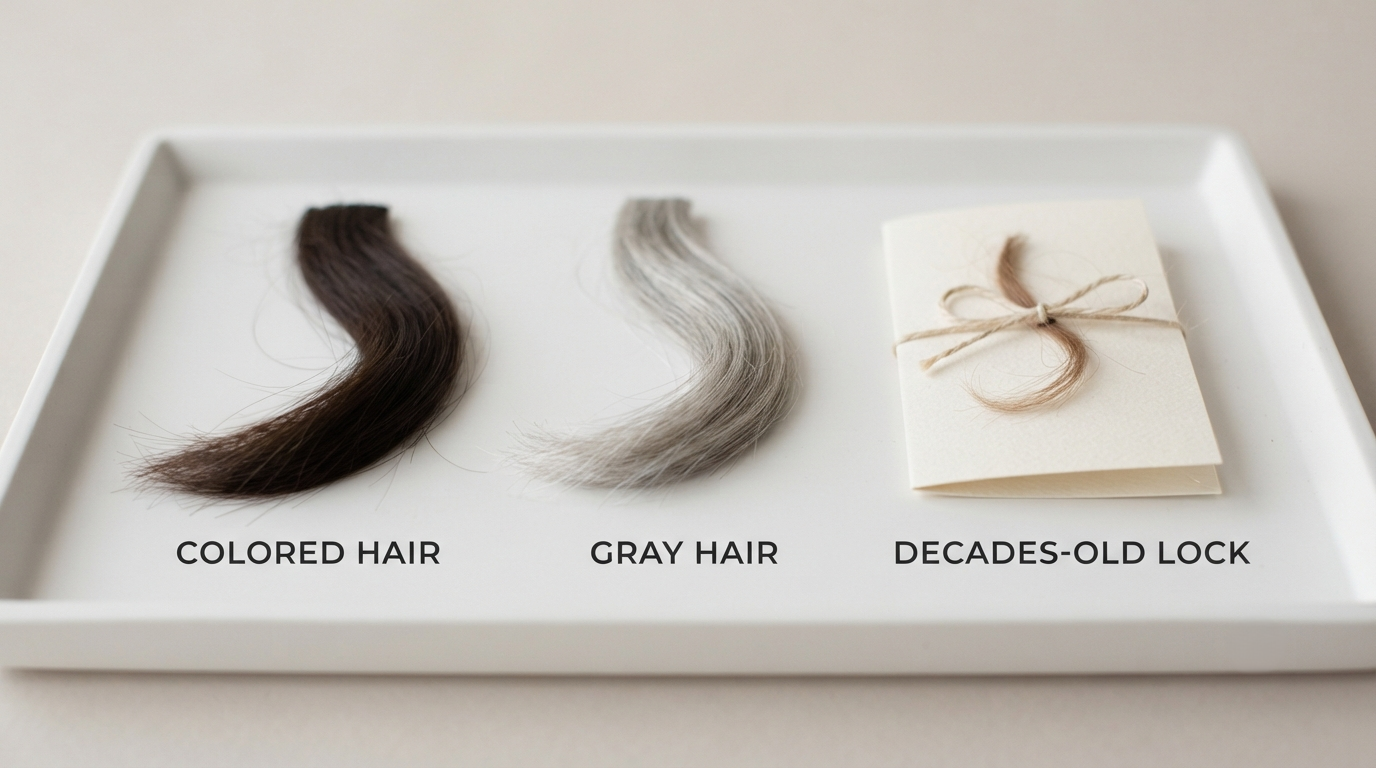
The one condition that matters for a diamond really made from your wife’s hair is quantity, not quality. If the lock is small, ask the provider for their minimum before assuming. How much hair you need for a wife memorial diamond covers what “a few grams” looks like in an envelope.
Doubt 3: If It Is Really Her Hair, Why Isn’t the Diamond Her Color?
Because the color of a diamond has nothing to do with the color of its carbon source. A diamond really made from your wife’s hair does not inherit her hair color, and expecting it to is reasoning from the wrong end.
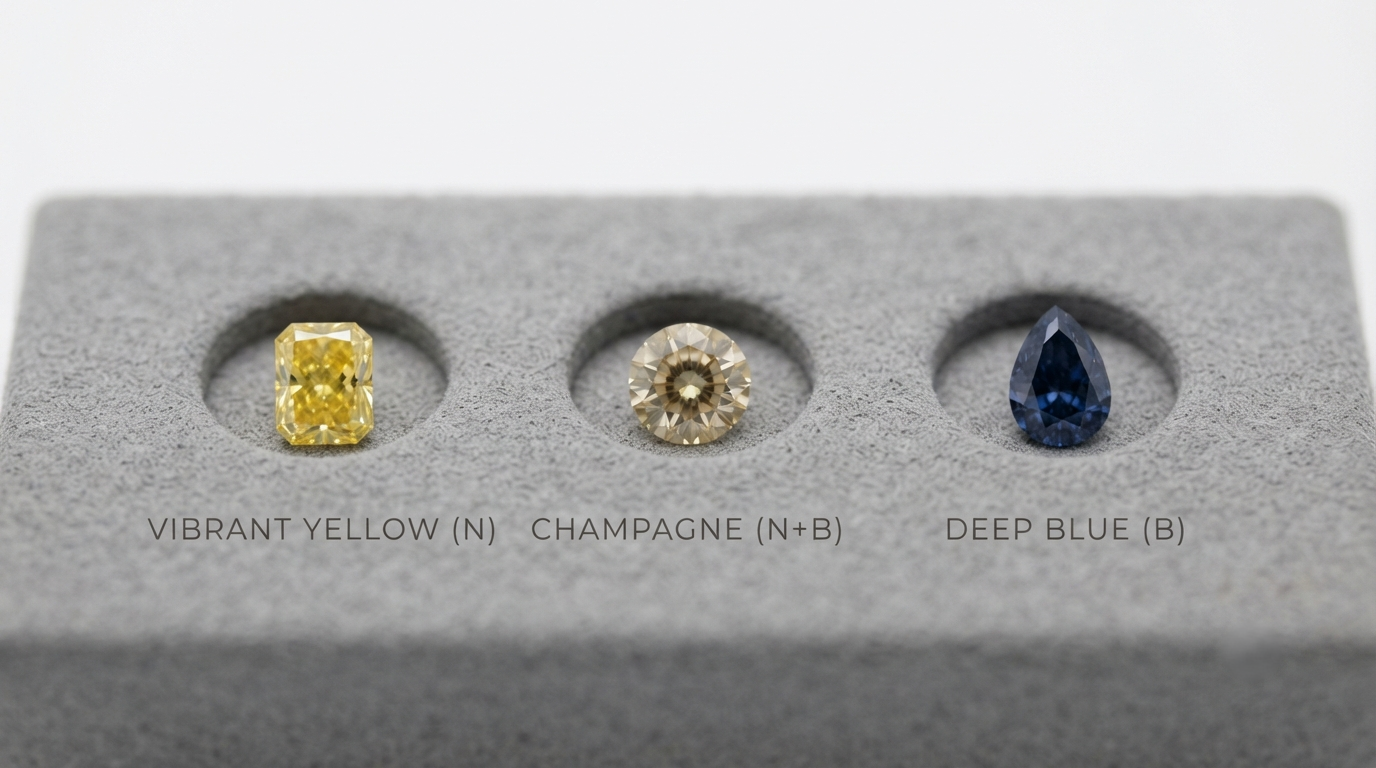
Her hair’s color came from melanin. Melanin is destroyed at purification, along with dye and everything else that is not carbon. What survives is carbon atoms, and carbon atoms have no color of their own. A diamond’s color comes instead from trace elements that are present in the growth cell as the crystal forms:
- Nitrogen produces yellow to champagne tones, the most common outcome for memorial stones, because an organic carbon source tends to carry trace nitrogen with it.
- Boron produces blue.
- The absence of both is what a colorless diamond requires, and excluding trace elements takes additional processing that typically costs more at the same carat.
- Post growth irradiation, offered by some providers, shifts the stone toward red, pink, green, or black.
So a diamond really made from your wife’s hair will most often be yellow, champagne, or blue, and that is true whether her hair was black, blonde, red, or white. The color is a feature of the growth conditions and of the trace elements her carbon carried, not a reproduction of her appearance. What color a diamond made from your wife’s hair will be covers how far you can steer it.
If anything, the mismatch is reassuring. A provider promising to “match her hair color” is promising something the chemistry cannot deliver, which tells you how carefully they describe the rest.
Doubt 4: Couldn’t They Swap In Any Carbon and I’d Never Know?
This doubt deserves the most direct answer, because it is correct in one respect and wrong in another.
Correct: no chemical test can tell you whose carbon is in a diamond. A carbon atom from her hair is identical to a carbon atom from a lab feedstock. There is no DNA in a diamond, no isotope signature that says “this person,” nothing a spectrometer can find. A jeweler can confirm the stone is a real diamond rather than a simulant, and an independent lab can grade it and identify it as lab grown by the HPHT or CVD method described on the synthetic diamond page, but neither can confirm it is really made from your wife’s hair.
Wrong: that this means you have no way of knowing. You do; it is just not a test. The proof that a stone is really made from your wife’s hair is procedural, the provider’s chain of custody record and the origin certificate that summarizes it. Two documents arrive with a stone really made from your wife’s hair, and they answer different questions:
| Document | Issued by | Answers | Does not answer |
|---|---|---|---|
| Origin authenticity certificate | The provider | Was this stone grown from this submission? It should carry your intake reference, the material “hair,” and dates | Anything about quality |
| Grading report | Ideally an independent lab, to GIA style cut, color, clarity, and carat standards | Is this a genuine diamond, and of what quality? | Where the carbon came from, a lab cannot know |
A provider who points to the grading report when you ask whether the stone is really made from your wife’s hair is answering the wrong question. The questions that get the right one answered, before the lock leaves the house:
- “How is my hair logged at intake, is it weighed, photographed, and given a reference number?”
- “Is the hair kept sealed and separate from other families’ material through extraction?”
- “Is the recovered carbon weighed and recorded against my reference?”
- “Can I see a sample chain of custody record before I send anything?”
- “Will the origin certificate name the material as hair and carry my reference number?”
A provider with a real process will be relieved you asked whether the stone is really made from your wife’s hair. One who answers with a brochure sentence instead of a record has told you something. Questions to ask before turning your wife’s hair into a diamond expands each of these into what a good answer sounds like. The equivalent doubt for cremated remains, where the small carbon fraction makes the percentage question sharper, is in whether a memorial diamond is really made from your wife’s ashes.
Doubt 5: Why Do Some Providers Say Hair Gives a “Purer” Stone?
Because at small carats, some do reach a higher personal carbon share in a stone really made from your wife’s hair than in one from ash, the same 50% versus 4% fact as Doubt 1.
A few grams of hair yields far more purified carbon than a few tablespoons of ash. For a small stone, that recovered carbon can cover a larger portion of what the growth cell needs, so less lab carbon has to be added. Some providers therefore report a higher personal share for hair stones at low carats than the industry typical 10% to 15%. How much higher is provider dependent, it varies with the amount of hair, the carat, and the process, so ask for the figure rather than accepting the word “purer.”
Three things to keep straight when a provider makes this claim about a stone really made from your wife’s hair:
- “Higher share” is not “100%.” No provider grows a meaningful stone from personal carbon alone. If the answer to “what percentage is her” is “all of it,” the answer is wrong.
- The share falls as carat rises. A larger stone needs more carbon; the hair contributes a fixed amount; the rest is lab carbon. A provider quoting one percentage for every size has not thought about it.
- Sending more hair does not make a bigger stone. Carat is set by growth time in the press. A provider asking for a large quantity of hair is either confused about that or wants the material for reasons they should explain.
The right way to hear “purer” is: hair makes the honesty point easier, not unnecessary. A provider who gives a specific range for your carat, and explains why it would drop at a larger one, understands what a diamond really made from your wife’s hair is.
What the Hair Route Allows That Ashes Cannot
Once the five doubts about a diamond really made from your wife’s hair are settled, the practical differences are worth knowing, because several are reasons families choose hair even when ashes exist.
- No cremation is needed. If she was buried, or if cremation was against her wishes or her family’s tradition, a lock of her hair is still a route to a diamond really made from your wife’s hair. Note that no tradition has an official position on memorial diamonds specifically; views on cremation and on keeping remains vary by denomination and by clergy.
- You can keep part of the lock. Unlike ashes, a lock of hair cannot be topped up later, once it is gone, it is gone. Divide it before sending, and keep some. This is the single most important piece of practical advice on this page.
- Old hair works. A lock from decades ago, kept in a card or a locket, can still become a diamond really made from your wife’s hair.
- The material is unmistakable. You can photograph the lock beside the labeled envelope and the submission form before it leaves, and confirm receipt of “hair,” not just “your package.”
Everything else, carat from 0.10 to 5+ ct, the 6 to 10 month timeline, up to 12 for large or black stones common across the memorial diamond category, the general 2026 industry price ranges of roughly $1,500 to $3,500 for 0.10 to 0.25 ct, $5,000 to $15,000 for 0.5 to 1 ct, and $20,000 to $75,000+ above 2 ct, not Memorial Diamond’s published pricing, and the choice of setting, is the same as for any memorial diamond. Wife Hair Diamond: The Complete Guide covers all of it, and how to turn your wife’s hair into a diamond puts the steps in order.
Frequently Asked Questions
Is a memorial diamond really made from your wife’s hair, or is the hair just symbolic?
It is really made from your wife’s hair. Carbon is extracted from a small lock, purified to 99.9%+, blended with lab carbon, and grown into a genuine diamond. Hair is roughly 50% carbon, so the claim is chemically stronger than for ashes. The stone physically contains her carbon.
How much hair does it take?
For a diamond really made from your wife’s hair, typically a small lock or a few grams, often described as palm sized, because hair’s carbon content means far less is needed than for ashes. Ask for the minimum in writing, and keep part of the lock.
Does dyed, gray, or treated hair still work?
Yes. Dye, pigment, and treatment residues are all removed at purification, which strips away everything that is not carbon. Gray hair simply lacks melanin; its keratin carbon is unchanged. Old hair from a keepsake or brush also works. Only the quantity of hair matters, not its condition or color.
Will the diamond be the same color as her hair?
No. Hair pigment is destroyed at purification, and diamond color comes from trace elements during growth, nitrogen gives yellow and champagne, boron gives blue. Colorless costs more. A diamond really made from your wife’s hair is most often yellow, champagne, or blue whatever her hair color was.
Can a test prove the diamond contains her carbon rather than lab carbon?
No. Carbon atoms carry no personal signature, so no test can identify whose carbon a diamond holds. The proof that it is really made from your wife’s hair is procedural: a chain of custody record from intake to finished stone, and an origin certificate naming your reference and the material.
Is a hair diamond “purer” than one from ashes?
Sometimes, at small carats. Because hair yields far more carbon per gram, some providers reach a higher personal carbon share than the industry typical 10% to 15% for small stones. The figure is provider dependent and falls as carat rises. No provider reaches 100%; ask for the specific range at your carat.
Final Thoughts on Whether It Is Really Made From Your Wife’s Hair
The instinct that says a lock of hair is too small to matter is exactly backwards. Hair is the richer carbon source by a wide margin, and a diamond really made from your wife’s hair rests on a stronger chemical footing than one from ashes. What it shares with every memorial diamond is that the proof is on paper rather than in the atoms, a custody record you can ask to see, and a certificate that names the material and your reference. Ask for both, keep part of the lock, and the stone you receive will be what it claims: really made from your wife’s hair, in the only sense the physics allows, and honestly described.
Learn More About Wife Memorial Diamonds
- Wife Hair Diamond: The Complete Guide
- How a Memorial Diamond Is Made From Your Wife’s Hair
- Is a Memorial Diamond Really Made From Your Wife’s Ashes?
- How Much Hair Do You Need for a Wife Memorial Diamond?
- What Color Will a Diamond Made From Your Wife’s Hair Be?
Talk With Memorial Diamond
If you hold a lock of her hair and want to ask the five custody questions on this page, and hear a specific personal carbon range for a diamond really made from your wife’s hair at the carat you have in mind, reach out to Memorial Diamond before anything is sent. Keep part of the lock either way; there is no deadline on the rest.
Leave A Comment