Two people sitting at a kitchen table in daylight, mid-conversation, illustrating how to talk to family about a partner memorial diamond

How to Talk to Family About a Partner Memorial Diamond

You have already had a version of this conversation at three in the morning, and it goes badly. The conversation about a partner memorial diamond goes better when the ask is narrow, specific and answerable, one small portion, named in advance, raised before anything has been arranged, and when it is held separately from the older, harder conversation about the relationship itself. Keeping those two apart is the technique. It will not make anyone say yes.

Memorial Diamond grows these stones, so this page has an interest in the outcome. It is written for the reader whose position is weakest when a family talks about a partner memorial diamond: someone who may not be the legal next of kin, whose relationship may never have been recognized, and who may be raising it with people who do not know there was one.

Who Do You Tell First About a Partner Memorial Diamond?

Not the person you are closest to. Not the person most likely to agree. The person who holds legal authority over the remains. Every other conversation about a partner memorial diamond is downstream.

That sounds cold and it is the kindest order available: everyone else’s view is advisory, theirs is decisive. Going to a sympathetic sibling first feels easier and builds a coalition, which is what makes a decision maker dig in. If you do not know who holds authority, a funeral director will usually say, at no cost. It follows state law and anything your partner put in writing, so there is no general rule to look up.

WhoWhat you are actually asking them forWhy they come in this orderIf they say no
Whoever holds legal authority over the remainsPermission to set aside a small portionTheir answer is the only one that settles anything about a partner memorial diamondNothing proceeds, and every other conversation becomes optional
Anyone who would be hurt to hear it second handNothing. You are telling, not askingHearing about a partner memorial diamond late is its own injury, separate from the decisionNothing changes about the material, but it costs you something
Adult children, if anyUsually nothing formal, sometimes a veto in practiceThey often carry more weight with the decision maker than youWorth knowing before, not after
Everyone elseNothing at allConsulting people who do not decide invites a voteThey were never deciding
A funeral director talking with a visitor across a desk, illustrating finding out who holds legal authority over remains

Two rules make the table work. Talk to people one at a time, a group produces a position, an individual an answer. And never announce it to a room. An announcement about a partner memorial diamond sounds like a decision already taken.

When Should You Raise It?

Before material moves, and before money is spent. Those are the two deadlines governing any conversation about a partner memorial diamond, and they are not the same deadline.

Once ashes have been divided, posted, scattered or interred, the conversation changes character. A request becomes a disclosure. Even people who would have said yes hear a completed act as something done around them, and the resentment outlives the argument. If a scattering is booked or a niche is paid for, raise it now and say the date is why, people accept urgency far better than surprise.
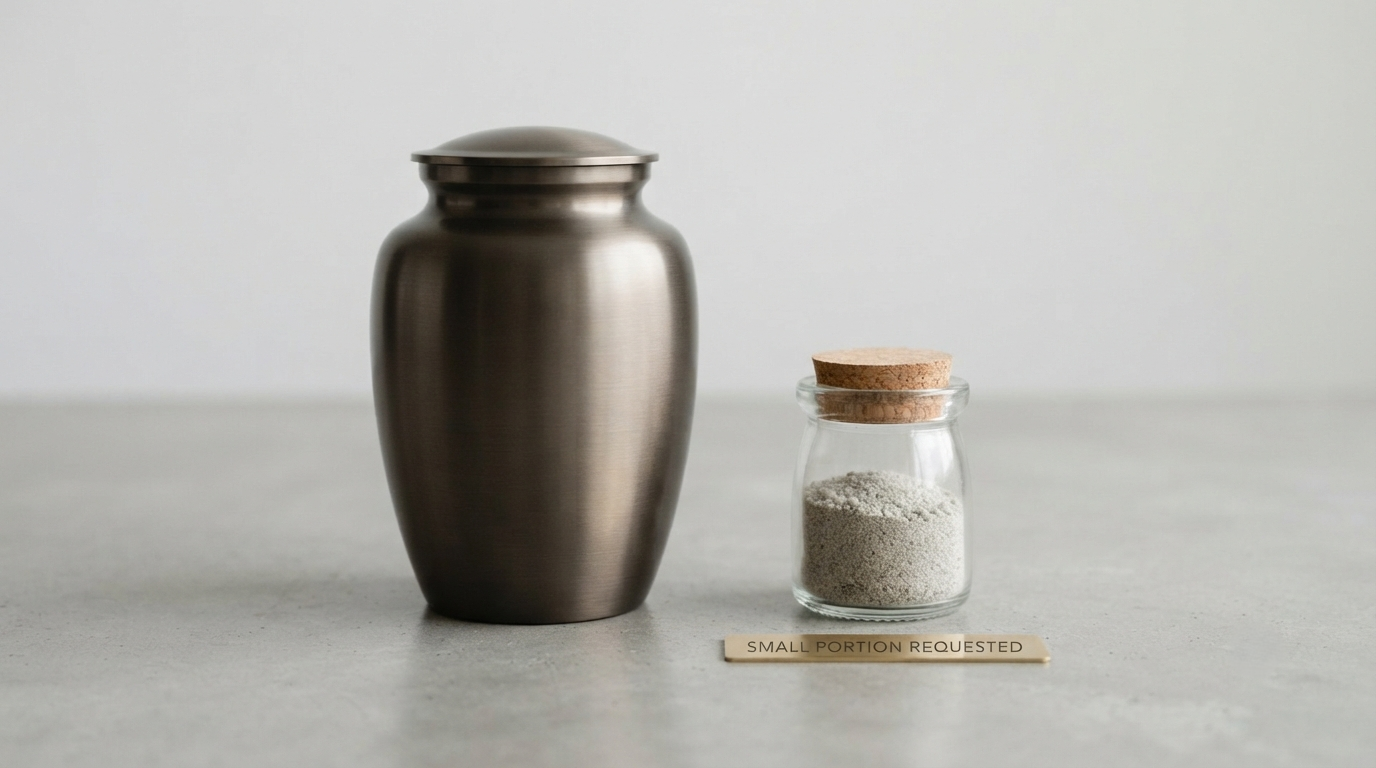
A few tablespoons of cremated remains in a small jar beside a full urn, showing the proportion actually being requested

Money is a second deadline for a separate reason. A deposit turns a request into pressure. Nobody should be told about a partner memorial diamond in a sentence that also mentions what you already paid.

On timing after a death there is no correct interval, only two bad ones. Do not raise it at the funeral, where nobody can hear a new idea. Do not wait so long that the ashes are already settled somewhere. Between those, later usually beats sooner, except that disposition runs on its own timetable, and nothing about a partner memorial diamond makes it wait for you.

What Does the Ask Actually Sound Like?

Short. The ask about a partner memorial diamond should be far shorter than you think, and it should have a number in it.

The fear you are speaking into is almost never about diamonds. It is that you are asking for all of it, or for the part already promised elsewhere. Numbers do the work reassurance cannot:

  • Name the quantity. Industry wide, a stone takes between a few tablespoons and roughly 4 oz, about 100 g, of cremated remains. How much ash a partner memorial diamond actually takes explains why.
  • Name what stays. A cremation is measured in pounds. Whatever was planned for the rest still happens.
  • Name the timeline. Typically 6 to 10 months from receipt, up to 12 for larger stones. Nothing happens next week, and saying so lowers the temperature.
  • Name what you are not asking to change. The plot, the service, the scattering date, the urn on somebody’s shelf.
  • Offer them one, if you mean it. More than one stone can come from a shared source, and whether several people can each have a diamond is the most effective thing to put on the table when a conversation about a partner memorial diamond stalls.

Then stop talking. The instinct is to follow the ask with the science, carbon, presses, purification, but science answers the second question about a partner memorial diamond, never the first. If they want it they will ask, and whether a memorial diamond is really made from a person’s ashes is better sent afterwards.

One more thing belongs in any honest ask about a partner memorial diamond: the stone is not made entirely of your partner. What is recovered gets combined with lab grown carbon until there is enough of it to work with. Where ash is the source, published figures place that fraction near 10 to 15% of the finished stone, and some cite as little as 3%; nothing comparable is published for hair or for a blended charge. Ask a provider what share your own sample will contribute. Better they hear it from you than discover it later and feel misled.

How Do You Keep This Separate From the Relationship?

By refusing, politely and repeatedly, to let one conversation become the other.

This is what makes a partner’s version different. A parent asking for a portion of a child’s ashes is having one conversation. A partner asking a family that never acknowledged the relationship is having two at once, and the second is older, angrier and unwinnable in one sitting. Everything said about a partner memorial diamond in that room is heard through it.

What they sayWhat is often underneath itA reply that does not escalate
“That’s not what the family does”An objection to you, phrased as one to the method“I understand. Can I ask separately, just about the portion?”
“It’s morbid”Unfamiliarity with the category“It’s more common than it was. Can I send you something to read?”
“You weren’t really family”The relationship conversation, arriving early“I don’t want that conversation today. I’m only asking about the ashes.”
“We already decided”A decision made without you, not reopenable in public“I know. I’m not asking to change it. Only about a portion of what’s left.”
“Why do you need an object?”A real question, asked badly“I want something I can keep. That’s all.”
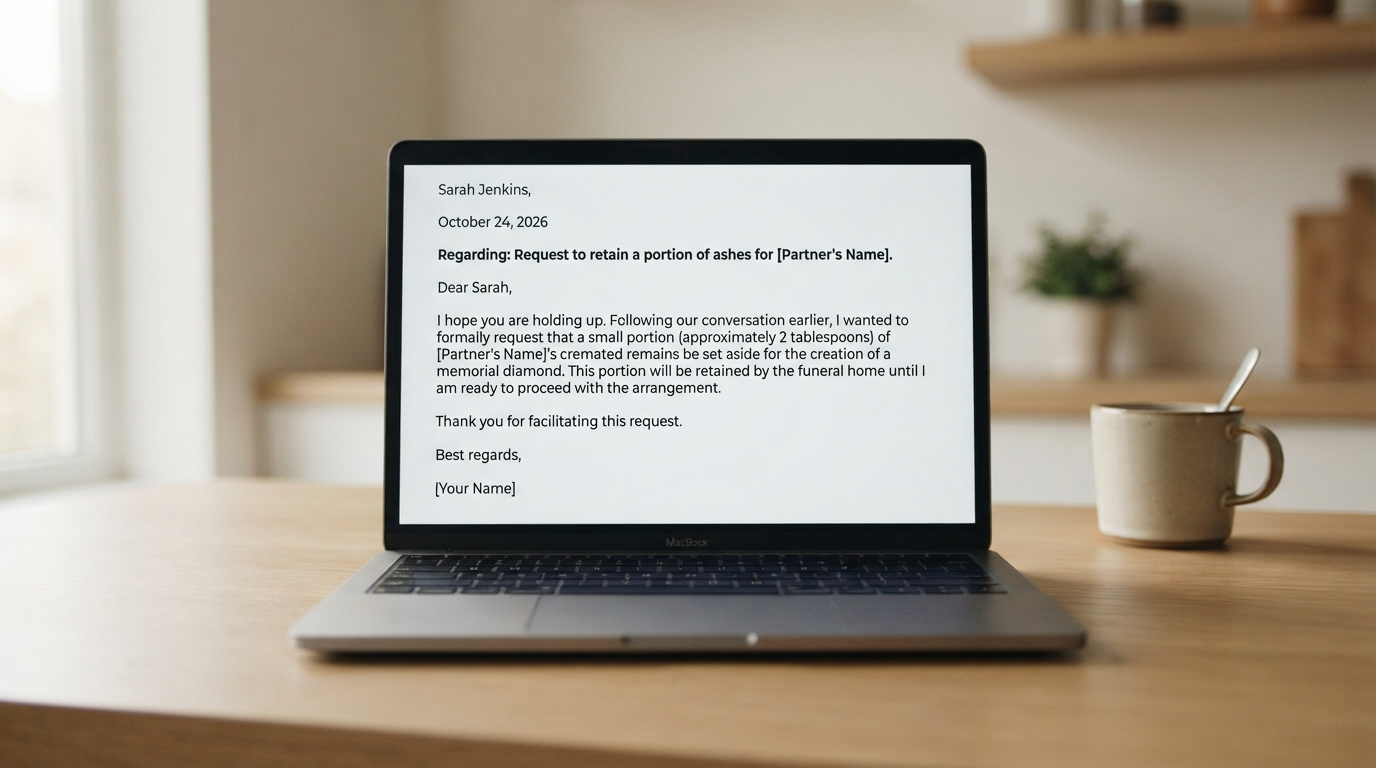
A short written request open on a laptop screen at a kitchen table, illustrating putting the ask in writing

Three habits hold the line. Say the ask in one sentence and let silence work. Do not defend the relationship inside the request, because a defense turns a portion of ashes into a verdict on whether you were allowed to grieve. And name the split out loud when it comes, “that’s a separate conversation, and I’d like to have it, just not today”, which is not a trick but an accurate description of what is happening.

Accept a yes that arrives without acknowledgment. Permission to take a portion is not a ruling on the relationship. A grudging yes about a partner memorial diamond is still a yes, and the stone does not know how it was granted.

Then say so to yourself, clearly, before you say it to anyone else.

Authority over cremated remains is set by state law, and by whatever your partner left in writing: a will, a disposition directive, an instruction lodged with a funeral home. Where a relationship was legally recognized this is usually straightforward. Where it was not, the remains may belong legally to a parent, an adult child, a sibling or an earlier spouse, whatever the shared history. No decision you make on your own about a partner memorial diamond can set material aside, and you cannot compel anyone.

What is still available to you:

  • Ask the funeral home who holds authority. Do it early, before the cremation if you can, because afterwards it is harder to act on.
  • Ask whether anything was left in writing, and whether anybody has read it rather than recalled it.
  • Make the request in writing. A short, calm email about a partner memorial diamond survives being forwarded, misquoted and reread six months later. A conversation does not.
  • Ask for a portion, not for a say. You are not asking to co decide the disposition, only for one specific, small thing.
  • Consider hair instead. The route most often missed. Hair is roughly 50% carbon by weight, needs no cremation, and may already be in your house, on a brush, in a hat, in an envelope. The law here speaks to cremated remains rather than to keepsakes, which is why hair you already hold tends to be the less obstructed route, though belongings can be drawn into an estate, states differ, and hair kept by someone else is something you ask about, not something you decide.

That last point deserves its own sentence, because it reframes the whole question about a partner memorial diamond for people with no standing: if the material you need has never been in anyone else’s custody, the practical question is usually a far simpler one, but where it matters, check rather than assume.

What If the Answer About a Partner Memorial Diamond Is No?

It is a real answer. Treat it as one.

The useful next step is establishing which kind of no it is, and that takes one question. “Is that a no for now, or a no altogether?” Grief runs on different clocks, and an answer six weeks after a death is often not the one the same person gives two years later. Ask once, accept what you get, and do not ask again that month.

To leave a door open without pushing on it:

  • Ask what would change it. Sometimes the objection is specific and solvable, a fear that the whole urn goes away, a belief that the stone is fake, a worry about cost nobody wanted to raise.
  • Offer the shared version once. People refuse things they feel excluded from, and a stone each changes the request.
  • Leave it in writing and leave it alone. A short note saying you would still like to, and will not raise it again unless they do, ages best.
  • Do not escalate. There is no second person to appeal to, and going over someone’s head turns a maybe into a permanent no.

And the honest ending, unsoftened: sometimes the answer stays no. If it does, what you have is what is already in your house, photographs, handwriting, a coat, the hairbrush. A memorial diamond set against a traditional urn is worth reading because neither option is the better one, and a family keeping an urn intact has made a complete and reasonable choice.

What If They Never Knew About the Relationship?

Then you are delivering two pieces of news in one sentence, and the second will not be heard.

Think hard about whether the diamond belongs in that conversation. If the relationship is the news, let it be the only news. Tell them, let it settle, and raise the question about a partner memorial diamond weeks or months later as a separate request. Asked together, the portion becomes evidence in an argument about who your partner was. Asked apart, it is only a request about ashes.

If the timetable will not allow that, if a scattering is days away, say the sequencing out loud: that you know this is a great deal at once, what the relationship was in one sentence, and then the narrow ask about a partner memorial diamond. People are often better at this than expected, and sometimes they are not. Do not walk in believing it will go well. Walk in having decided what you will do either way.

There is a third option people overlook. You are allowed not to tell anyone, if the material you need is hair that was always yours. That is not deception. It is a decision about a partner memorial diamond that, in practice, usually involves nobody else, and for readers with no standing and no acknowledgment it is sometimes the only route open.

Frequently Asked Questions

Should I speak to a provider before or after I speak to the family?

Before, for information, and never in a way that commits money. Knowing the real quantity and timeline makes a conversation about a partner memorial diamond concrete rather than theoretical. A deposit paid first turns a request into pressure.

Can they stop me if the ashes are already in my possession?

Possession and authority are not the same thing, and the answer varies by state and by what was left in writing. Holding an urn does not always mean you may divide it for a partner memorial diamond. Ask a funeral director or a lawyer before acting, not after.

What if the family is split down the middle?

Work out who actually decides and talk only to that person. A divided family produces a debate, and a debate about a partner memorial diamond rarely produces permission. Others can be told once something is agreed.

Do I have to tell them what the portion is for?

Nothing obliges you to. But explained requests are granted more often than unexplained ones, and a truth kept quiet about a partner memorial diamond has a way of surfacing later at the worst possible moment.

How long should I wait after the funeral?

There is no right interval, only the constraint that ashes may be settled on a timetable you do not control. If nothing is scheduled, a few weeks is kinder than a few days for a conversation about a partner memorial diamond. If something is scheduled, raise it this week.

They want one too, and I cannot afford two. What do I say?

Say exactly that. Industry wide ranges are public, roughly $1,500 to $3,500 at entry sizes, $5,000 to $15,000 for 0.5 to 1 ct, so what a partner memorial diamond costs is a better answer than an evasion.

Final Thoughts on Talking to Family About a Partner Memorial Diamond

Nothing here guarantees an outcome, and anything promising one would be a lie. Some of these conversations go well. Some reopen an argument that was never settled, and you will have raised it knowingly.

What you control is the shape of the ask. Seven things, in this order:

  1. Go to whoever decides, not whoever will agree.
  2. Raise it before anything moves, and before anything is paid.
  3. Ask one person at a time, never a room.
  4. Put a number in the ask, say how small the portion is.
  5. Say what stays: the plot, the service, the date, the urn.
  6. Do not defend the relationship inside the request.
  7. Take the answer you are given, the one decision about a partner memorial diamond you get to make alone, however the rest of it goes.

Learn More About Partner Memorial Diamonds

Talk With Memorial Diamond

If it would help to walk into that room with facts about a partner memorial diamond rather than adjectives, three do most of the work, and none commits you to anything.

Ask what quantity is actually needed, so you can name it. Ask what the timeline really is. Ask whether more than one stone can come from a single portion, because that answer changes more conversations about a partner memorial diamond than any other. memorialdiamond.us will answer all three without asking you to decide, and questions worth asking first covers the rest.

If sending someone a neutral explanation would help more than a company’s, the encyclopedia entry on memorial diamonds is a reasonable place to point them, and the NFDA’s 2025 cremation and burial report is worth having for anyone who thinks cremation itself is unusual.
A small lock of hair beside an opened paper envelope on a wooden table, the kind of kept sample a son hair diamond is grown from

Son Hair Diamond: The Complete Guide

An envelope at the back of a drawer. A curl taped into a baby book. A brush nobody has been able to empty.

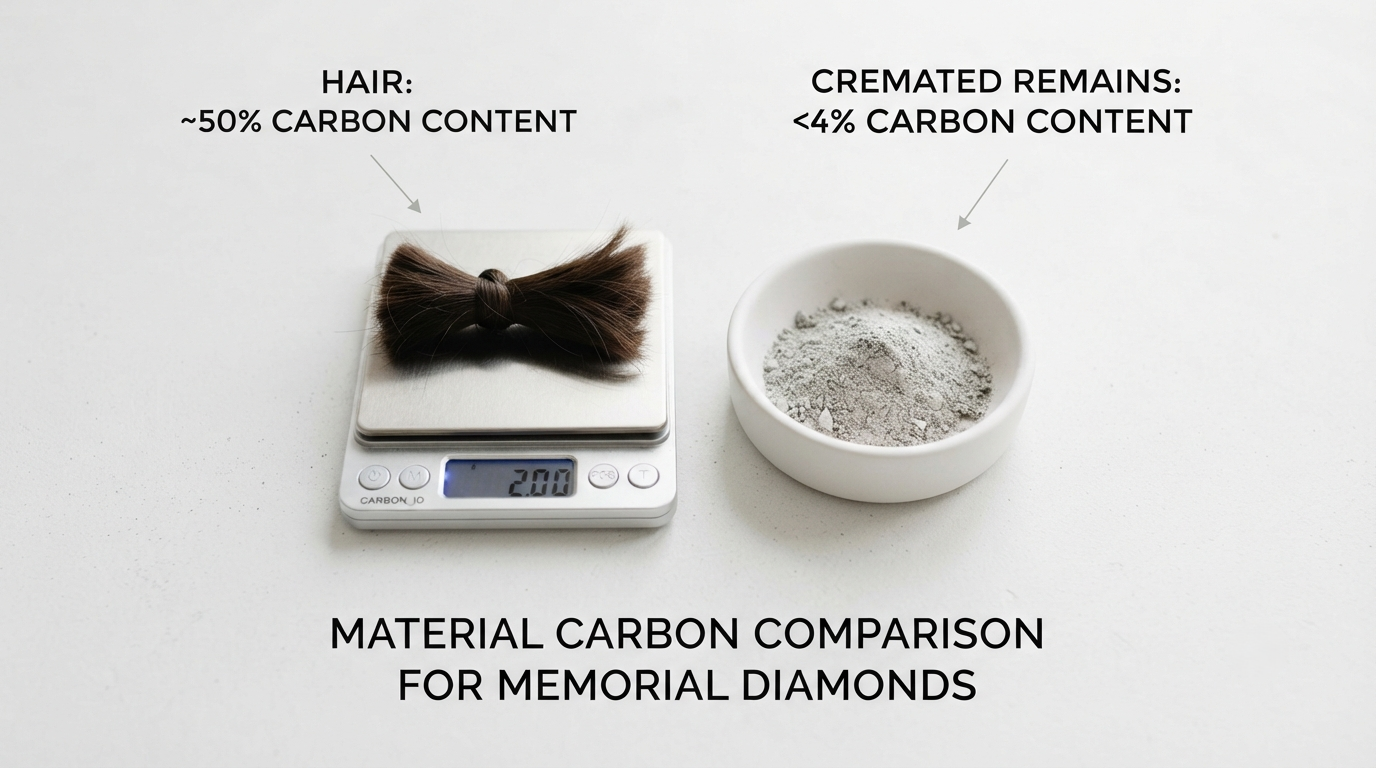
A son hair diamond is a real, lab grown diamond grown from carbon taken out of a sample of your son’s hair, and it requires no cremation whatsoever. Hair is roughly 50% carbon by weight, against the 0.5% to 4% found in cremated remains, which means a small lock does the work that a far larger portion of ash would have to do.

That single difference is why this page stands apart from the ash guide. A son hair diamond is the route that stays open after a burial, after a body donation, where cremation was ruled out on religious grounds, or where it simply was not what your family chose.

Memorial Diamond grows memorial stones, so treat this page as coming from an interested party. The figures below are industry wide bands rather than our own published numbers, and every question this guide tells you to ask is one you should ask us too.

Why a Son Hair Diamond Needs No Cremation

Most pages about memorial diamonds assume a cremation happened. For a great many families it did not, and that assumption is where the search usually stops.

Hair is keratin, a protein about half carbon by weight, and nothing has to be burned to reach it. Dry keratin at room temperature is remarkably stable, so a sample sealed in an envelope twenty years ago is the same material it was the day it was cut. A son hair diamond is therefore available in situations where the ash route never was:

  • He was buried. The grave stays undisturbed; nothing is exhumed and nothing is asked of a cemetery.
  • His body was donated to a medical school or research program, and what came back, if anything, was not what you expected.
  • Cremation was not chosen, for religious or family reasons, and that decision is not being revisited.
  • The remains were scattered somewhere you cannot return to, at sea, from a mountain, into a river he loved.
  • The ashes are held by someone else, and you would rather not make it a negotiation.
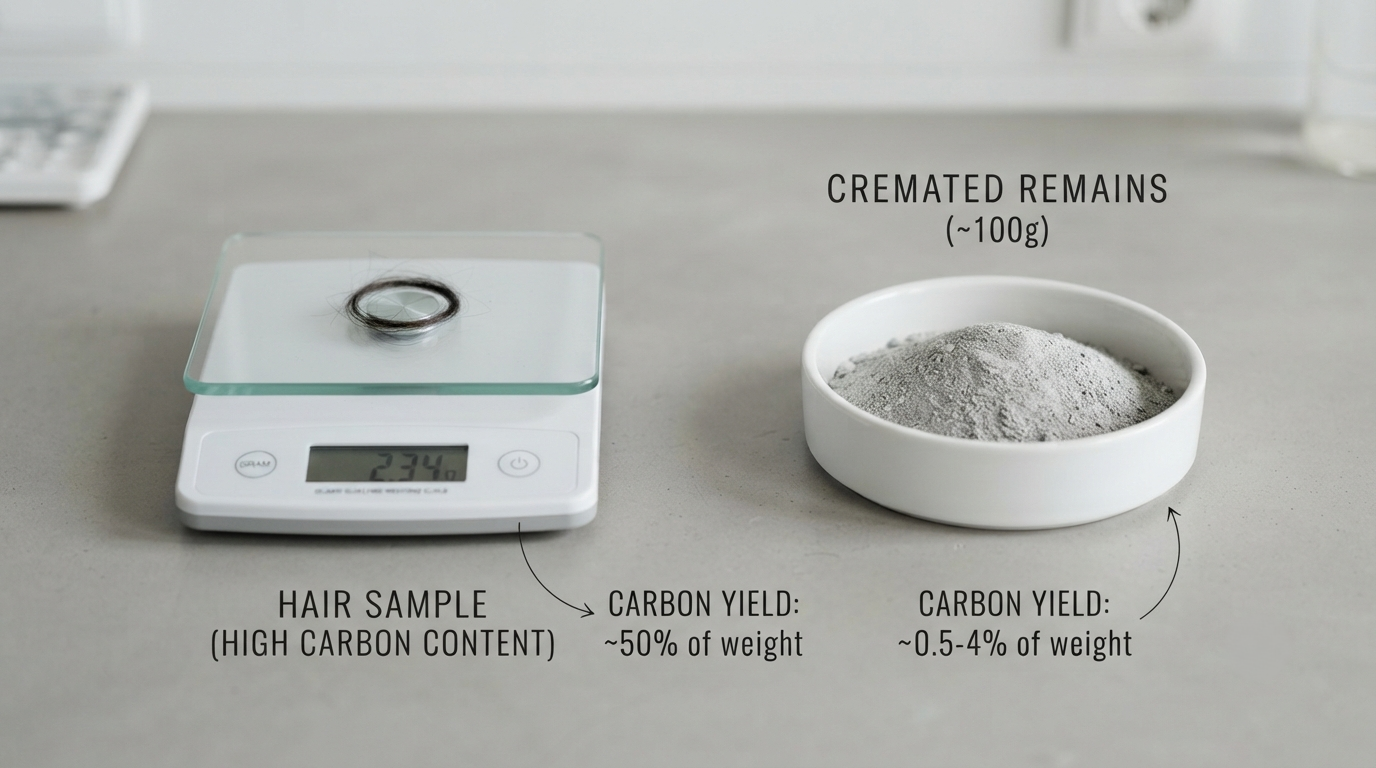
A small bundle of hair on a gram scale beside a dish of cremated remains, showing the difference in carbon content between the two materials

In all five cases the material for a son hair diamond may already be in your house, and may have been for years.

One thing belongs here rather than three sections down. Hair is a far richer carbon source than ash, and a son hair diamond still is not made entirely of your son. A growth cell takes a set amount of carbon fixed by the carat ordered, and whatever the sample yields is topped up with laboratory carbon.

The widely quoted figure of roughly 10% to 15% is published for the ash route; no equivalent industry figure exists for hair, so ask any provider what share your sample will contribute. What stays true either way is that the personal carbon is real and verifiable, atoms that came out of him, locked in the lattice for good, and a minority of the finished stone. Both halves of that stay true at once.

How Much Hair Does a Son Hair Diamond Take?

A small lock. Industry wide the ask is typically a few grams, between a pencil width bundle and a small curl, not a handful. The reason a son hair diamond needs so much less than the ash equivalent is arithmetic rather than generosity.

Source materialCarbon content by weightTypical amount requestedWhat that means in practice
Cremated remainsAbout 0.5% to 4%A few tablespoons up to about 4 oz, approximately 100 gMost of the submission is bone mineral the laboratory must remove
HairAbout 50%A small lock, a few gramsMost of the submission is the thing the laboratory actually wants

So a son hair diamond starts from a sample you could close your hand around. An envelope rather than a fresh cutting is usually enough, but weigh it, or photograph it against a ruler, before you assume, because a sample that looks generous sealed can be thin spread out.

Carat does not change this. A two carat stone does not need twice the hair of a half carat one; it needs more weeks in the press. How much hair a memorial diamond requires covers the measuring in more detail than belongs here.

What Counts as a Usable Sample?

More than most parents assume, and the disqualifiers are narrower than the worry.

Where the hair came fromUsually workable?What to flag when you ask
A lock cut and kept years agoYesAge, and whether anything else is in the envelope with it
A cutting taken by the funeral homeYesWhether it was taken before or after any embalming
A hairbrush or combOftenThat it is mixed, say so rather than hoping
A hat, a pillow, a car headrestSometimesQuantity is usually the limit, not condition
Hair that was dyed, bleached or treatedUsually yesSay which treatment; processing strips surface residue anyway
A single strandRarely enough on its ownAsk before discounting it, it may be combinable

Two notes that come up constantly. Colored or chemically treated hair is generally fine, because purification strips everything that is not carbon regardless of what was on the strand. And brush sourced hair is real material even though it is mixed, say so at intake rather than letting anyone assume a clean cutting.

What genuinely limits a son hair diamond is quantity, contamination with non organic material, and storage somewhere persistently damp. Describe all three before you send.

Hair Kept From Years Earlier

This is the part of a son hair diamond that catches parents unprepared.

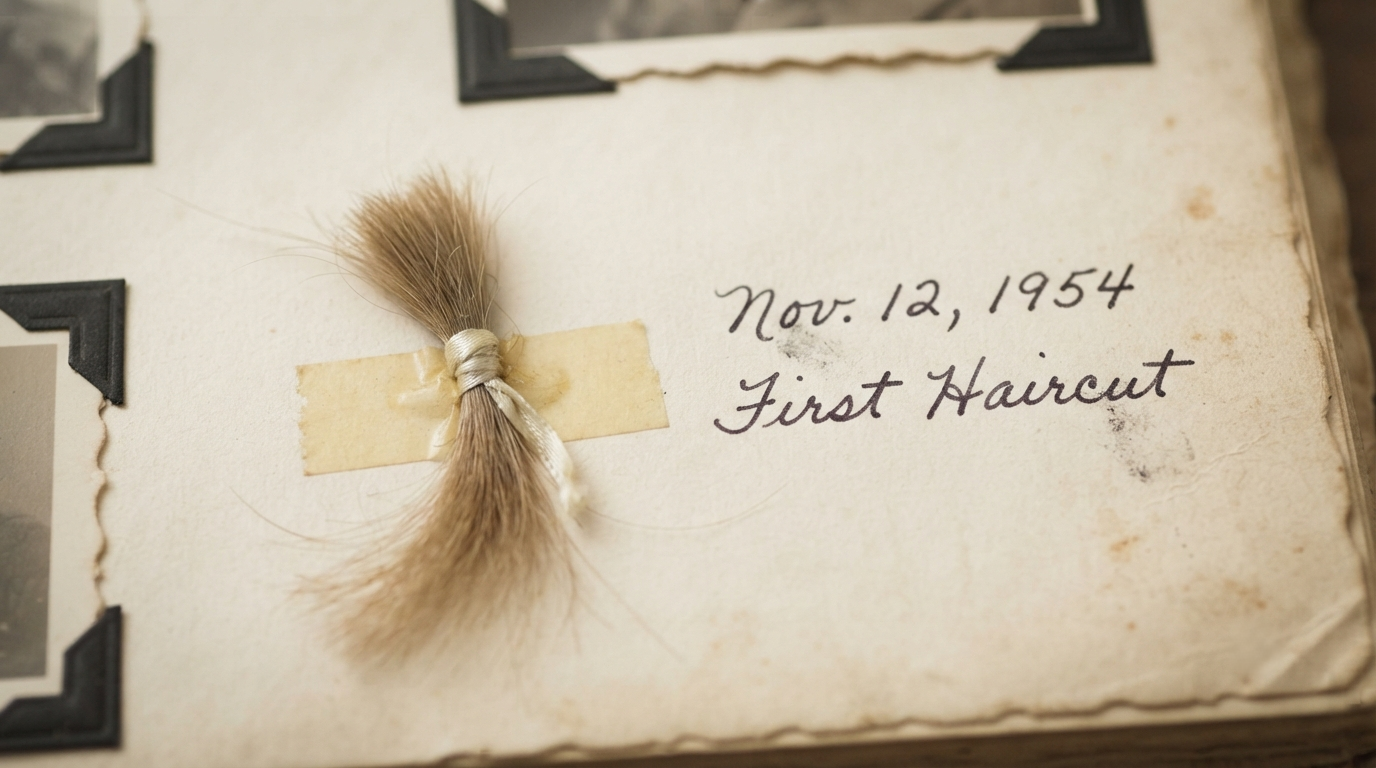
A great many families discover that the sample they have was not kept for this. It was kept for no reason at all, an envelope from a first haircut, a curl taped inside a book, a lock from a hospital stay. Whether your son was six or sixty when he died, that envelope is from one particular afternoon in his life, and it has been waiting in a drawer since.

Two things follow, pulling in different directions.

A lock of hair taped into the page of an old family album beside handwritten dates

The first is reassuring: age does not degrade a sample in any way that matters. Dry hair kept in paper or a plastic sleeve at room temperature holds its carbon indefinitely, so a son hair diamond grown from a lock cut thirty years ago is chemically no different from one grown last month. Nothing was lost by the waiting.

The second is worth sitting with: choosing a sample is choosing which part of his life the stone comes from. A first haircut envelope and a cutting from his last weeks are identical to a laboratory and not remotely identical to you. Some parents choose the earliest, some the most recent, some send one and keep the other.

There is no correct answer here. What is worth avoiding is settling it in an afternoon because a form asked you to pick, a son hair diamond will wait as long as the sample already has.

What If the Sample Was Never Labeled?

Say so, and then decide on the balance of what you know. Envelopes get filed without writing on them. Baby books hold locks from more than one person. A memory box turns out to contain two curls and no note about which is which, and parents discover it at exactly the wrong moment.

Here is the honest position. Providers do not generally offer DNA verification of a submitted sample. What intake does is chain of custody tracking, the sample is weighed, logged and given a reference number, which follows the parcel from the moment it arrives rather than establishing where it came from before that. Ask any company directly what it does and does not check. In practice, identity rests on that chain of custody and on what you state at intake, so the responsibility does sit with you, and it is better known now than a year from now.

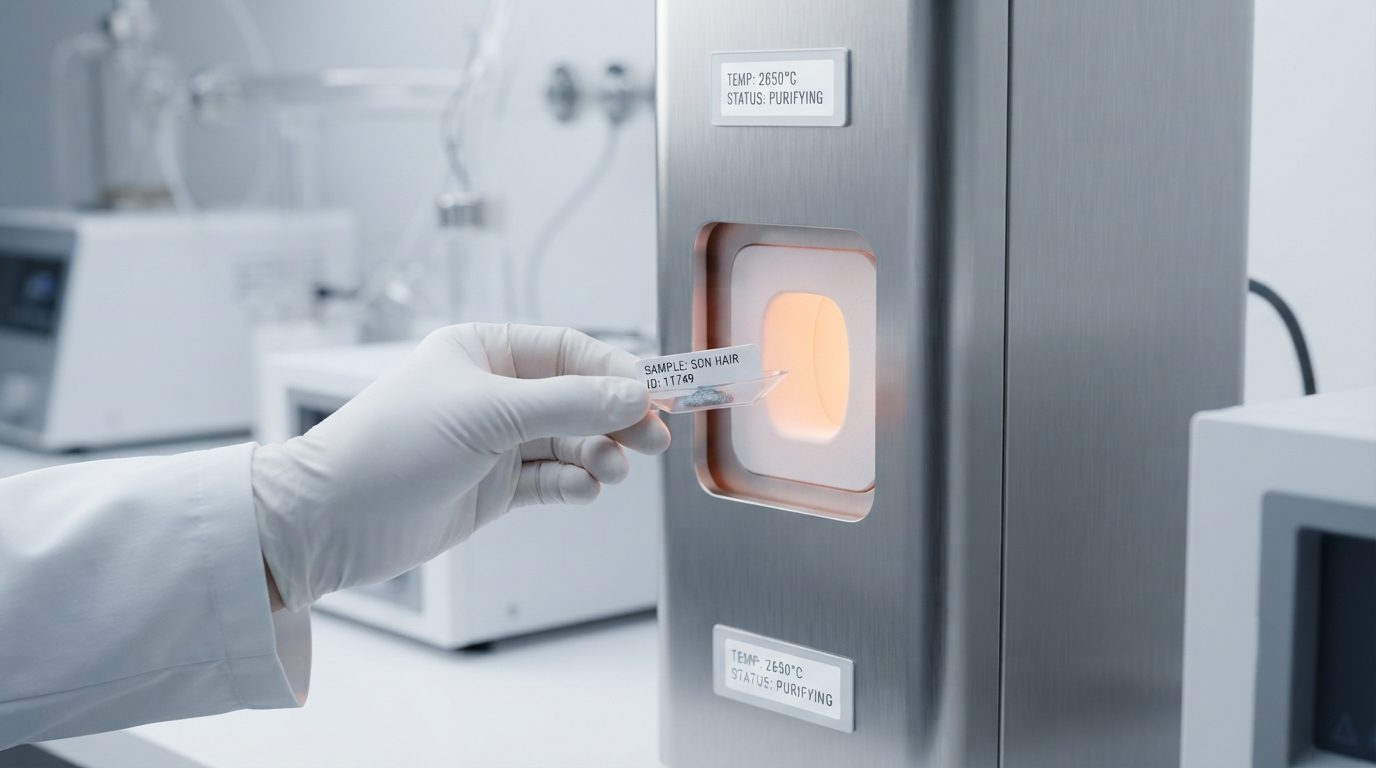
A labeled sample being loaded into a high-temperature purification furnace in a diamond laboratory

What a son hair diamond leaves you with, then, is ordinary reasoning rather than proof:

  • Ask whoever else was there, a sibling, a grandparent, the parent who kept the box. Someone often remembers the handwriting or the year.
  • Read the context it was stored in: what else was in the envelope, which page it was taped to, what else is in that drawer.
  • Compare color and texture against photographs from the period you think it came from. Not evidence, but information.
  • If two samples are both candidates, ask whether both can go into one submission rather than choosing wrongly.

If you genuinely cannot resolve it, name that out loud rather than swallow it. A son hair diamond grown from a sample you are unsure of is still a beautiful object, with a private reservation attached, and only you can judge whether that is bearable.

Who Decides, When There Is No Urn?

A son hair diamond usually sidesteps the hardest legal question in this subject, and it is worth knowing why.

Authority over a person’s remains is assigned by state law rather than by any national rule, and a surviving spouse and then adult children commonly rank ahead of parents in that order, which anything your son put in writing can rearrange again. That framework governs a body and it governs cremated remains. A lock of hair that has been in your own house since long before he died generally sat outside it from the beginning, because it was never part of the remains anyone had to make a decision about.

That is a genuine difference, and for some parents it is the whole reason this route is the one they can actually take.

But do not over read it. If the only sample that exists is one his spouse or his children hold, a cutting taken at the hospital, the contents of his own hairbrush in his own house, then it is theirs, and you are asking rather than deciding. The move there is the same as for ashes: ask directly, early, and for something small. A few grams of hair is a far easier thing to say yes to than any change to what has already been arranged.

The second complication is closer to home. Parents are not always aligned or even in touch; one may hold the envelope while the other wants the stone, and one may be doing all of this alone. There is no rule that a son hair diamond must be a shared decision, and none that it be kept quiet, but deciding in advance beats improvising when asked, and what happens when two family members each want a stone is worth reading before that conversation rather than during it.

Inside the Laboratory: Making a Son Hair Diamond

The sequence for a son hair diamond is shorter than the ash sequence by one demanding step, which is the extraction of carbon from bone mineral. Hair arrives already carbon rich.

StageWhat happens to the hairNotes
IntakeWeighed, logged, given a reference numberAsk for the weight and date the day it arrives, not in a summary later
CleaningProduct, oils and surface residue removedThis is where dye and treatment come off
PurificationCarbon driven toward 99.9% or higher purityWhere the ash route does its heaviest work; hair needs less
GraphitizationPurified carbon converted to graphite at roughly 2,500°C to 2,700°CThe last point at which the material is still traceable to your sample
GrowthThe graphite, with lab carbon added, crystallizes around a seed under 6 to 8 GPa at 1,400°C to 2,500°CWeeks to months; this is what carat buys
Cutting, optional grading, settingThe rough is cut, mounted if you ordered jewelry, and graded if you order gradingIndependent grading happens only if you ask for it, on the ordinary diamond scale

What comes out is a diamond in the full sense, same crystal structure, same behavior, the top of the Mohs hardness scale at 10, scratched by nothing softer than another diamond. It can be set, insured, valued and worn daily. It is not a keepsake with a strand sealed inside it; the strand is gone, and what remains is the carbon that was in it.

Note the fourth row. Everything documentable about a son hair diamond is documented before the growth cell is loaded; after that, no test separates carbon from your sample from any other carbon. The intake record is the record.

How Long Does a Son Hair Diamond Take, and What Does It Cost?

A son hair diamond takes roughly 6 to 10 months industry wide, measured from the day the sample is received rather than the day you order, and stretching toward twelve for a large carat or an unusual color. Hair does not speed it up, press time is press time whatever the carbon came from.

Memorial Diamond publishes no rate card. The bands below are the category’s 2026 shape rather than a quote, and their real use is as a checklist for what a number might quietly leave out.

Industry bandCarat it usually buysAsk specifically whether this includes
About $1,500 to $3,5000.10 to 0.25 ctAn independent grading report
About $5,000 to $15,0000.5 to 1 ctGrading, a fancy cut, engraving
About $20,000 to $75,000+2 to 5+ ctAll of the above, the setting, and an insurance appraisal

A son hair diamond is not priced differently from an ash sourced stone in any structural way. Carat drives the number, then color, then cut, then what is bundled in. The source material is not the variable. What sits inside a memorial diamond quote takes the line items apart properly, and ring, pendant and keepsake settings covers what happens after the stone exists.

What Color Will a Son Hair Diamond Be?

Start by discarding the assumption almost everyone brings. His hair color has nothing to do with it. Dark hair does not produce a dark stone and blond hair does not produce a yellow one. Everything that gave hair its color is removed at the purification stage, long before anything crystallizes.

What actually sets the color is which trace elements happen to be present in the growth cell. Nitrogen in the mix reads as yellow. Boron reads as blue. Colorless is the difficult one, because it is not something added, it is what appears when both of those are very nearly absent, an absence that has to be engineered, which is why colorless generally costs more rather than less. Clarity across the category typically runs somewhere between SI2 and VVS.

So a son hair diamond comes out within a range, steered but not dictated. Before growth starts, get three things settled:

  • The color range the provider will put in writing, not the one described on the phone.
  • What happens if the finished stone falls outside that range.
  • Whether the quote you are holding assumes a tinted stone or a colorless one.

What color a hair grown memorial diamond turns out to be goes deeper into how wide that band honestly is.

Nine Checks Before You Cut or Send Anything

Nine things to have answered, in writing, before a sample leaves the house for a son hair diamond. None of these describes what any particular company does.

  1. The minimum sample size, and whether that figure is the weight received or the weight still usable after cleaning.
  2. Whether your sample qualifies as it is, send a photograph against a ruler and a weight before you cut anything else.
  3. Whether a mixed or unlabeled sample changes anything, stated openly at intake rather than left to be assumed.
  4. What happens to hair the process does not consume, returned, retained, or destroyed.
  5. Whether the intake record reaches you at intake: date, weight, reference number, on the day.
  6. Whether growth is done in house or subcontracted, and how custody is recorded at that handover.
  7. The committed color range, and the remedy if the stone lands outside it.
  8. Whether an independent grading report is included or priced separately.
  9. Whether a second stone could be grown later from the remainder, if a sibling or his own family may want one. Far easier to settle now than to reopen in a year.

If you are weighing this against the cremated remains route, the complete guide to a son ashes diamond sets out that pathway on its own terms, and the guide to sending both covers what combining them does and does not change.

Frequently Asked Questions

Is hair from thirty years ago still usable?

Yes. Dry hair stored at room temperature holds its carbon indefinitely, so a son hair diamond grown from a first haircut envelope is chemically no different from one grown from a recent cutting. Mention the age when you ask, but do not treat it as a barrier.

He was buried. Does any of this require the grave?

No. Nothing about a burial changes, nothing is exhumed, and no cemetery permission is involved. That is the practical reason a son hair diamond exists as a separate route, the material is hair you already have, entirely outside the grave.

Will the stone match the color of his hair?

No. Purification removes everything that gave hair its color before growth begins. The finished shade comes from trace elements in the growth cell, nitrogen toward yellow, boron toward blue, not from whether he was fair or dark.

We have two unlabeled envelopes and cannot tell them apart. What now?

Say so when you ask. Some providers will accept both samples in one submission rather than making you choose. If not, weigh what you know, who kept the box, what else was in the drawer, and decide with your eyes open rather than guessing silently.

Can we use hair from his hairbrush?

Often yes, and it is worth asking rather than discarding it. Flag that it is mixed with other people’s hair, because that is honest and because the provider may handle a son hair diamond differently when the sample is not a clean cutting.

Can more than one stone come from one lock?

Sometimes, provided each half would still clear the minimum by itself. Ask first, because splitting a barely sufficient sample between two orders is the commonest way a workable submission stops being one.

Final Thoughts on a Son Hair Diamond

The thing worth carrying away is the one this guide opened with: no cremation is required, and never was. If your family buried him, donated him, scattered him somewhere unreachable, or made a decision nobody is revisiting, the door is still open, and what it opens onto is probably already in a drawer in your house.

That envelope has waited a long time without deteriorating, and it can wait longer. A son hair diamond is not a decision that expires. Weigh the sample, ask the nine questions, and talk to whoever else has a claim on the answer, or deliberately decide not to yet.

Then, when you are ready and not before: a small lock, six to ten months, and a stone you can wear.

Learn More About Son Memorial Diamonds

Talk With Memorial Diamond

You do not have to cut anything or commit to anything to find out whether what you have is enough.

The useful first message is short: a photograph of the sample beside a ruler, an approximate weight, a line about where it came from and roughly when, and a note if it is mixed or unlabeled. That is enough for anyone to say whether a son hair diamond is possible from what is in that envelope. While you are asking, find out what becomes of hair the process does not use, and roughly how long the carat you are imagining would sit in the press.

memorialdiamond.us replies to both without asking for a decision, and any provider worth using will do the same. The envelope goes back in the drawer either way.

Two separately labeled containers side by side on a table, one holding cremated remains and one a small lock of hair, the two materials a son ashes hair diamond is grown from

Son Ashes and Hair Diamond: The Complete Guide

Two containers, and in a great many families, not in the same house.

A son ashes hair diamond is one lab grown stone whose carbon comes from two sources: a portion of your son’s cremated remains and a sample of his hair. Combining them does not double anything. It does not enlarge the part of the stone that is him, it does not make the color easier to predict, and it does not yield two stones. What it changes is where the carbon came from, two different points in one life instead of one.

Memorial Diamond makes memorial stones, so this is a page with a commercial interest behind it. Treat every figure here as an industry wide band rather than a quote, and put these questions to us as readily as to anyone else.

This guide is written for the version of a son ashes hair diamond that comes up most often in practice: a parent holding an envelope of hair kept from years ago, and someone else, frequently his spouse or his own adult children, holding the ashes.

What a Son Ashes Hair Diamond Actually Changes

Start here, because most of the reasons families give for wanting a son ashes hair diamond turn out to be reasons the process cannot deliver on, and the one real reason usually goes unnamed.

What parents expect combining to doWhat a son ashes hair diamond actually does
Make the stone more genuinely himNothing. The personal share of the crystal is unchanged
Produce a larger stoneNothing. Carat is bought in weeks under pressure, not in feedstock
Make the color more certainNothing, and arguably the reverse, see below
Produce two stones instead of oneNo. One submission grows one stone unless you order two
Shorten the waitNo. If anything it lengthens it, because growth waits on the later parcel
Change which part of his life the carbon came fromYes. This is the only thing on this list that is real
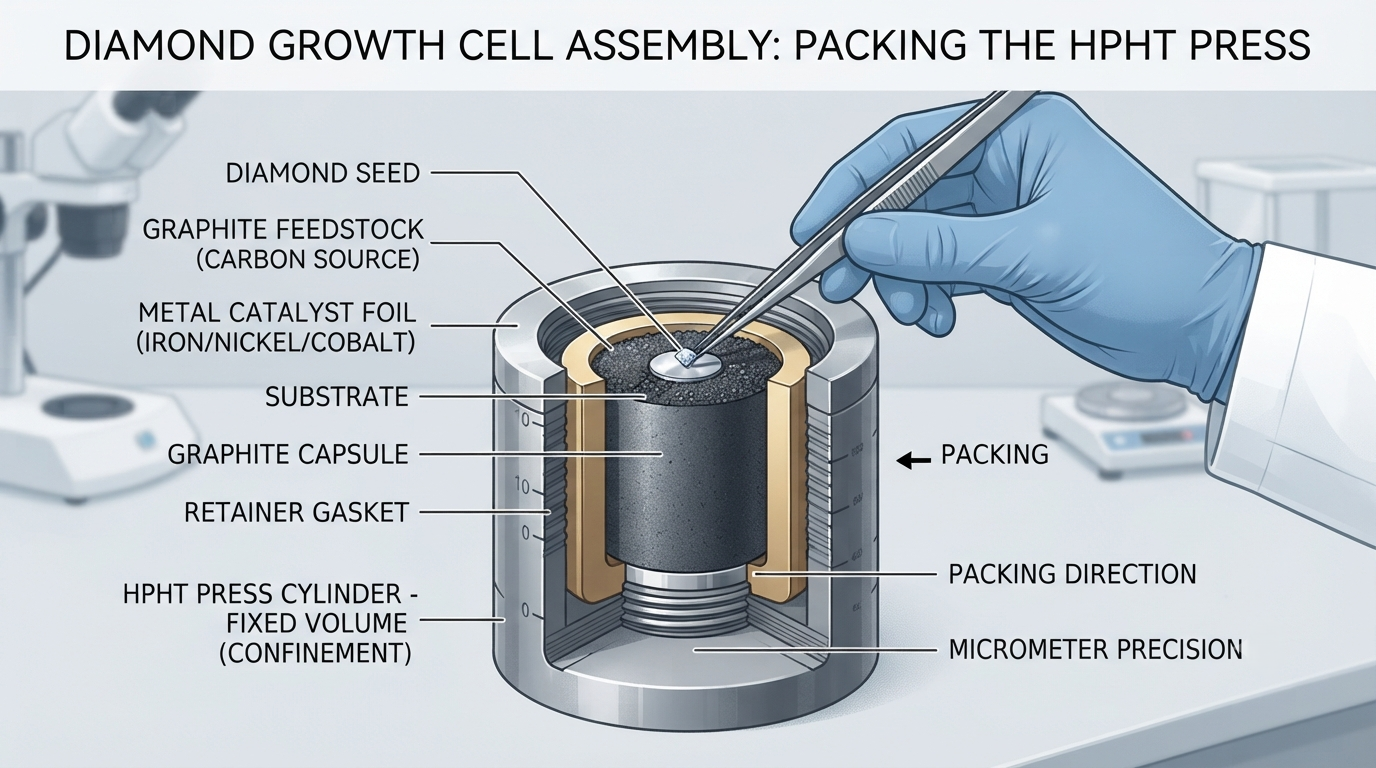
A diamond growth cell being packed with graphite feedstock around a seed, showing the fixed volume a press requires

That last row is not a consolation prize. For a lot of parents it is precisely the point: the ashes are from the end of his life and the hair is very often from somewhere much earlier, and a son ashes hair diamond is the only arrangement that puts both into one object. Whether your son was six or sixty when he died, those two materials come from two different men in a sense, and holding them in one stone is a real thing to want.

What it is not is a way to get more. Everything below explains why, in the order the questions usually arrive.

Does a Son Ashes Hair Diamond Contain More of Him?

No, and the arithmetic behind a son ashes hair diamond is worth seeing rather than being told.

A growth cell holds a fixed quantity of carbon. That quantity is decided by the carat you ordered and by the physics of the press, and it does not move because two parcels arrived instead of one. Whatever your materials yield after purification is topped up to that fixed quantity with laboratory carbon. The 10% to 15% personal share usually quoted across the industry is published for the ash route, and no published figure covers a blended charge of ash and hair, so ask a provider what share your two parcels will actually contribute. What the arithmetic does say plainly is that two materials divide whatever that share is between them rather than enlarging it.

There is a second piece of arithmetic in a son ashes hair diamond that nobody mentions, and it surprises people.

MaterialCarbon by weightTypical amount sentLikely contribution to the personal share
Cremated remainsAbout 0.5% to 4%A few tablespoons up to about 4 oz, approximately 100 gSmaller than its bulk suggests
HairAbout 50%A small lock, a few gramsOften larger than its size suggests
A few grams of hair on a gram scale beside a larger dish of cremated remains, illustrating the difference in carbon content

So in a son ashes hair diamond, the envelope of hair that weighs almost nothing may well contribute more carbon than the far heavier portion of ash. That is not a reason to send less ash or more hair. It is a reason to stop thinking of the two as halves of anything, the stone has no halves, no seam, and no recoverable ratio, and no test on earth will ever separate one source from the other once both have been purified to carbon.

If you want either pathway on its own terms, the complete guide to a son ashes diamond and the complete guide to a son hair diamond each run a single route from decision to finished stone.

Does a Son Ashes Hair Diamond Have a More Predictable Color?

It does not, and there is a case that a son ashes hair diamond makes the result slightly harder to reason about.

Color in a grown diamond comes from whichever trace elements are sitting in the cell as the crystal forms. Nitrogen present in that mix reads as yellow. Boron reads as blue. Colorless is the awkward one, because it is not an addition but a subtraction, what you get when both are very nearly absent, which has to be engineered and is the reason colorless generally carries a premium rather than a discount. Clarity across the category typically falls between SI2 and VVS, and the cut, color, clarity and carat framework grades a memorial stone on the ordinary scale.

Both of your materials are organic, both arrive carrying their own trace elements, and both are indistinguishable by the time growth starts. The practical consequence for a son ashes hair diamond is this: if the finished stone comes out warmer or cooler than you hoped, there is nothing to attribute it to and nobody to ask. With one material you at least have a single variable. With two you have a blend that was already inseparable before the press closed.

One more expectation worth putting down gently. Parents sometimes hope that hair kept from early in his life will somehow show, a lighter cast, a warmer tone, something visible. It will not. Everything that gave hair its color is stripped at the purification stage, long before anything crystallizes. What carries over is carbon, and carbon has no memory of what it used to be part of.

What you can do is pin the range down in advance:

  • Ask for the committed color range in writing, before growth begins rather than after.
  • Ask what the remedy is if the stone lands outside it.
  • Ask whether the quote assumes a tinted stone or a colorless one, the gap between those two is not small.

When the Hair and the Ashes Are Held by Different People

This is the situation this guide exists for, and for a son ashes hair diamond it is common rather than unusual.

Authority over a person’s remains is set by state law, not by any national rule, and anything your son left in writing can rearrange it. Within that framework a surviving spouse, and then his adult children, commonly rank ahead of parents, which means the ashes may be entirely lawfully in someone else’s keeping while the hair has been in your drawer for thirty years. A lock cut long before he died was generally never part of the remains anyone had authority over. One of your two materials sits inside that legal question; the other, usually, never did.

That asymmetry gives a son ashes hair diamond its practical shape.

Who holds whatCan you proceed alone?What to ask for
You hold hair; someone else holds the ashesYes, with hair aloneA small portion of ash, framed as a request that changes nothing else
You hold bothYesNothing from anyone, though telling people is still a choice worth making deliberately
Someone else holds bothNoA cutting or a portion, asked for directly and early
Two parents hold one material eachOnly with both agreeingAn honest conversation before anything is ordered

The single most useful thing to understand about a son ashes hair diamond is that it needs two yeses, and the hair only route needs one. If asking for a portion of ash would cost you a relationship, or reopen something that has only just settled, it is entirely reasonable to grow a stone from hair alone and say nothing more about it. Nothing about that is a lesser version.

Where you do want to ask, ask small and ask early. A few tablespoons is a request that leaves an interment, a scattering, or an urn on a shelf exactly as they were, and it is granted far more often than parents brace for, partly because it is so obviously not a challenge to anyone’s arrangements.

Two people talking across a table with funeral paperwork between them, illustrating a conversation about who holds authority over remains

The other split is closer in. Parents are not always in agreement, and are not always in contact. One may hold the envelope and the other may be the one who wants the stone; one may be arranging this alone and paying for it alone. There is no rule that a son ashes hair diamond has to be a joint decision. There is also no rule that it has to be disclosed. Deciding which of those you are doing before anyone asks is easier than deciding it mid conversation. If more than one person may eventually want a stone, whether several can come from the same source is worth reading before anything is divided.

What Happens If the Two Parcels Arrive Months Apart?

Growth on a son ashes hair diamond generally waits for whichever parcel arrives last, which means the clock most families are counting has not started yet.

That matters more for a son ashes hair diamond than for any single material order, because the two materials are so often in different hands and on different timetables. A permission conversation can take a season. An envelope can take an afternoon.

SituationEffect on the scheduleWhat to ask before you send
Both parcels sent togetherThe quoted window starts at intakeWhether each is logged separately, with its own weight and reference
Hair now, ash laterGrowth waits for the ashHow the first parcel is stored meanwhile, and for how long
Ash now, hair laterGrowth waits for the hairThe same, plus whether there is a deadline after which it is returned
One parcel never arrivesDepends entirely on provider policyWhether the order can convert to a single material stone, and at what cost

That last row is the one to settle in advance rather than discover. If you send hair while you are still asking for ashes, you want to know now what happens if the answer turns out to be no. Ask whether a son ashes hair diamond order can simply become a hair order, whether that changes the price, and whether anything you have already paid moves with it.

One more request worth making at the start: ask for two intake records rather than one. Two dates, two weights, two references. Once both materials are purified and loaded together, nothing distinguishes them again, so the paperwork made at intake is the only record that will ever exist of what went in. What a combined submission requires of each material covers the quantities in more detail.

Timeline and Cost of a Son Ashes Hair Diamond

Across the industry, production runs roughly 6 to 10 months from receipt of material to a finished stone, and toward twelve months for a large carat or a specialty color. For a son ashes hair diamond, read “receipt” as the arrival of the second parcel, not the first.

Those months cover laboratory work alone. They do not cover the part that comes before, which in this cluster is often much longer, the asking, the waiting to be ready, the agreeing or not agreeing among people who are all grieving differently.

Memorial Diamond does not publish prices, and the bands below are not a rate card. They describe where the category sits in 2026, and their honest use is as a way of checking what a quote has quietly left out.

Industry bandCarat it usually buysConfirm whether this covers
About $1,500 to $3,5000.10 to 0.25 ctIs grading quoted separately?
About $5,000 to $15,0000.5 to 1 ctGrading, engraving, and any non round cut
About $20,000 to $75,000+2 to 5+ ctThose, plus mounting and a valuation for insurance

Two materials do not move a son ashes hair diamond into a different band. Carat drives the number, then color, then cut, then what is bundled in. There is one question specific to combining that is still worth asking directly: whether a second intake adds anything to the quote, given that it is measurably more handling. Some providers charge for it and some do not, and it is easier to ask than to assume. How a memorial diamond quote is built takes the line items apart, and the memorial diamond category as a whole is worth a look if this is all new.

Nine Things to Settle Before You Order a Son Ashes Hair Diamond

None of these describes what any particular company does. They are nine things to have answered about a son ashes hair diamond, in writing, before either parcel leaves the house.

  1. Who holds authority over the ashes, confirmed from what your son left in writing or from the funeral home, not assumed from who has the container.
  2. The minimum for each material separately, and whether those figures are received weights or weights still usable after processing.
  3. Whether two intake records are kept, two dates, two weights, two references, sent to you as they happen.
  4. What happens if only one parcel ever arrives, and whether the order can convert to a single material stone.
  5. How a first parcel is stored while the second is outstanding, and whether there is a limit on how long it will be held.
  6. What happens to material the process does not consume, for each parcel separately.
  7. The committed color range, and the remedy if the finished stone falls outside it.
  8. Whether two intakes change the price, and whether an independent grading report is included or extra.
  9. Whether a second stone could be grown later from what remains, if a sibling or his own family may want one.

A provider who answers all nine plainly has told you what you needed. One who answers warmly but in general terms has told you something as well.

If you are still weighing the two routes against each other, turning your son’s ashes into a diamond and turning your son’s hair into a diamond each walk one pathway step by step.

Frequently Asked Questions

Does sending both materials mean we get two stones?

No. One submission grows one stone, whatever went into it. If two people each want a stone, that is two orders with two growth runs and two sets of months, say so at the start rather than after, because the material has to be divided before anything is sent.

My son’s wife has the ashes and I have his hair. Can I start with the hair?

Yes. Where the sample has been in your own keeping all along, the hair route usually sidesteps the authority question in practice, since the rules here attach to remains rather than to a keepsake in a drawer, check rather than assume if anything about that is unclear. A son ashes hair diamond can wait until, or unless, the conversation about the ashes happens. Starting with hair does not close the door on asking later.

Will the hair from early in his life show up in the stone somehow?

No. Purification strips everything that gave hair its color before growth begins, so nothing about its origin survives visually. What a son ashes hair diamond carries is carbon from two moments in his life, not a visible trace of either.

Do both parcels have to travel in the same box?

No, and they are handled as separate jobs regardless. Send them together if it is simple, but the real question is what happens in between, ask how the first is stored and for how long, since growth generally waits for the second.

If one material yields less than expected, does the other make it up?

Effectively yes, because both are topped up with laboratory carbon to the fixed volume a growth cell needs. That is also why a son ashes hair diamond does not contain a larger personal share than a single material stone, the total is set by the carat, not by what you sent.

Could his ashes and his hair go into separate stones instead?

Often, if each meets its own minimum. Two stones from two materials is a different order from one combined stone, and it costs two stones’ worth of months and money. Ask before dividing anything, and decide deliberately rather than by default.

Final Thoughts on a Son Ashes Hair Diamond

Strip away what combining cannot do, and one thing is left standing, which is the thing that was probably true from the beginning: the ashes are from the end and the hair is very likely from long before it, and a son ashes hair diamond is the only object that holds both.

That is worth doing. A son ashes hair diamond is not worth doing under a misunderstanding about what it buys, no extra fraction of him, no surer color, no larger stone, and one more permission to obtain than the simpler route needs.

So decide what you are actually after with a son ashes hair diamond. If it is both materials together, the work ahead is a conversation and two parcels. If the conversation is not one you can have right now, the hair alone makes a stone that is no less his, and it can be arranged this month or in five years. Neither answer is the wrong one, and neither has an expiry date.

Learn More About Son Memorial Diamonds

Talk With Memorial Diamond

Nothing here asks you to commit to anything, and the first conversation costs nothing but an email.

If you are considering a son ashes hair diamond, the useful opening message has four things in it: roughly how much hair you have, whether you hold the ashes or someone else does, whether the two might arrive months apart, and what carat you have in mind. That is enough for anyone to tell you what is possible and what it would take.

Ask in the same message what becomes of material the process does not use, whether two intakes change the quote, and what the order turns into if only one parcel ever arrives. memorialdiamond.us will put all three in writing with nothing owed either way, and so should anyone else on your list.

If the ashes are not yours to send, ask that question first and the rest afterwards. The envelope in the drawer is not going anywhere while you do.

A small measured portion of cremated remains in a glass dish beside a closed urn, showing how little ash a son ashes diamond requires

Son Ashes Diamond: The Complete Guide

Somewhere in your house there is a container, and near it there is a decision nobody ever prepared you to make.

A son ashes diamond is a real, lab grown diamond grown from carbon recovered out of your son’s cremated remains. It takes a portion rather than the whole: carbon makes up only about 0.5% to 4% of ash by weight, so what a laboratory can actually work from is a fraction of a fraction, and nearly everything you are holding now stays exactly where it is.

Memorial Diamond grows these stones, so this page comes from a company with something to sell. Every number below is an industry wide band, not our published figure, and you should put the same questions to us that you would put to anyone else.

This guide takes the son ashes diamond route end to end, what is recoverable, what stays with the family, how the work is done, how long it runs, what color to expect, what it costs, and the one question that has to be settled before any of the rest of it matters.

What a Son Ashes Diamond Is, in Plain Terms

Take the simplest question first, because families ask it in a lowered voice as though it were rude. Yes, it is a diamond.

A son ashes diamond is carbon locked into the cubic lattice that makes a diamond a diamond. It is not resin with ash suspended in it, not a coated stone, not a simulant with a certificate attached. The method is high pressure and high temperature, the same HPHT growth used across the lab grown diamond trade, running at roughly 6 to 8 GPa and somewhere between 1,400°C and 2,500°C. What comes out is scratched by nothing softer than another diamond and can be cut, set, appraised and insured like any stone on any counter. The cut, color, clarity and carat framework gemologists use is applied to it without modification.

Now the part a page like this owes you early, because a page that hides it until the end is not being straight. A son ashes diamond is not made entirely of your son, and no honest description of this category claims otherwise.

A growth cell holds a fixed volume of carbon, set by the carat ordered and by the physics of the press. Whatever the submission yields after purification is topped up with laboratory carbon before growth begins. Industry figures for the ash route usually cite that personal share at 10% to 15% of the finished stone by mass, and some providers cite figures as low as 3%. Those atoms are genuinely in the lattice, genuinely came out of your son, and are genuinely a minority of what you will be wearing. Both halves of that sentence are true and neither cancels the other.

How Much Ash Does a Son Ashes Diamond Actually Use?

Less than almost anyone expects, and the reason is chemistry rather than mercy.

Cremated remains are mostly calcium phosphate, bone mineral, not carbon. Only about 0.5% to 4% of ash by weight is carbon a laboratory can recover and use. That is why the industry typical request sits where it does, and why it sounds larger than it needs to be.

FigureIndustry typical bandWhat it means for a son ashes diamond
Carbon content of cremated remainsAbout 0.5% to 4% by weightThe only fraction of the ash that can become a stone
Portion usually requestedA few tablespoons up to about 4 oz, approximately 100 gSized as insurance against a thin yield, not as a price of entry
Personal carbon in the finished stoneAbout 10% to 15% of its mass, the figure cited for the ash route; some providers cite as low as 3%Real and physically present, not the whole crystal
What a larger carat changesGrowth time in the pressNot the size of the portion you are asked to send
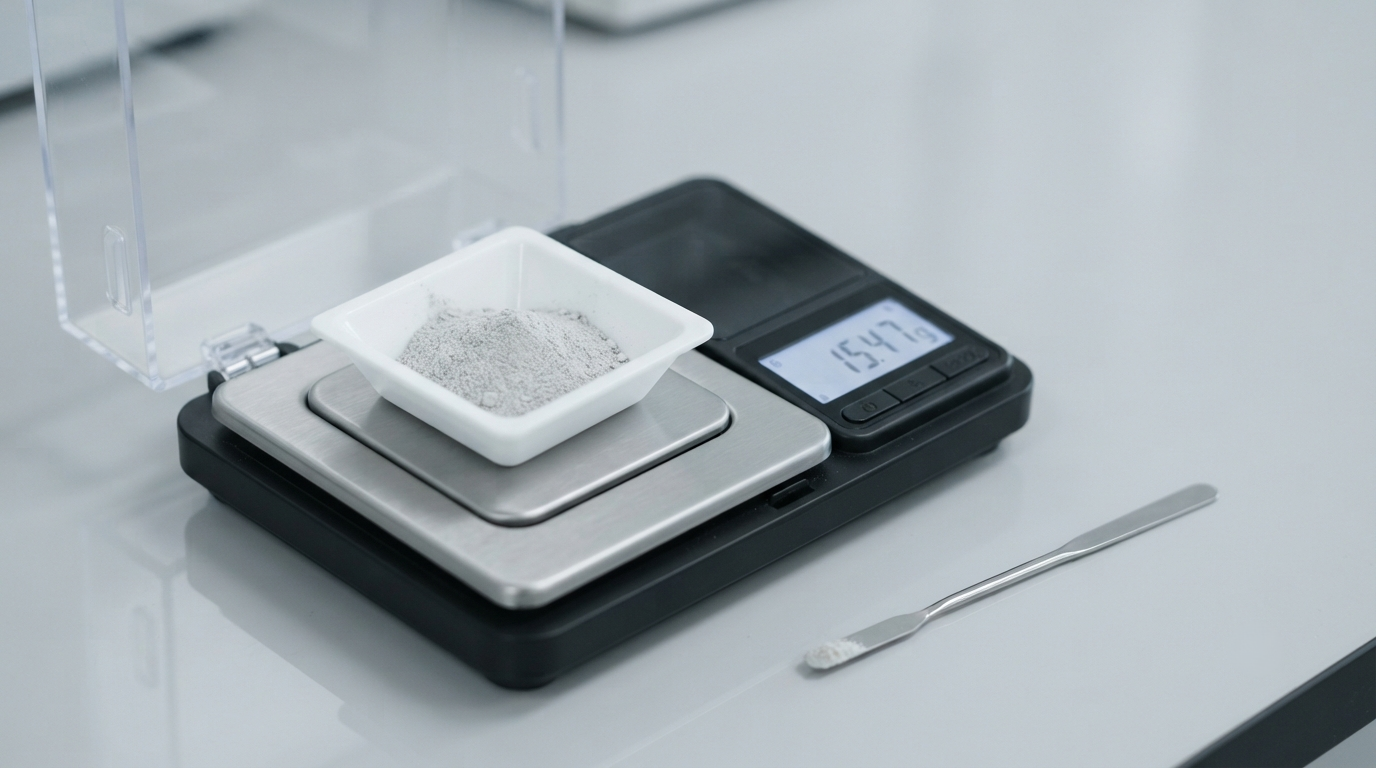
Cremated remains on a laboratory weighing dish beside a digital gram scale

Read the last row twice, because it undoes an assumption almost every parent arrives with. Ordering a bigger stone does not mean handing over more of him. Carat is bought in weeks under pressure, not in spoonfuls. A one carat son ashes diamond and a quarter carat one can start from portions of much the same size.

Which leaves the thing that actually matters here: whatever you decide, the great majority of what you hold does not move. An interment can still happen. A scattering he asked for can still happen. A shared urn can stay on the shelf it has been on. A son ashes diamond is a portion set aside, not a substitute for the arrangements you have already made.

If you want the quantity question on its own, the step by step walkthrough of turning your son’s ashes into a diamond handles measuring and packing in more detail than belongs on a page this wide.

Who Has the Authority to Say Yes?

This is the section to read before any other, and it is the one most guides bury.

If your son had a spouse, a registered domestic partner, or adult children of his own, the legal right to direct what happens to his remains may rest with them and not with you. Across most of the United States the order of priority runs through next of kin, and a surviving spouse, then adult children, commonly sits ahead of parents in that order. But the order is written state by state rather than nationally, and anything your son himself left in writing, from a will to a signed cremation authorization, can reorder it completely.

So the honest position is this: you may hold the ashes and still not be the person whose signature releases a portion of them, or you may be exactly that person and not know it yet. Both are common. Neither is a verdict on how much you loved him.

Two people reading funeral paperwork across a kitchen table, illustrating a conversation about who holds authority over remains

There is no national rule to look up, so find out locally. A funeral director who handled the cremation can usually tell you in one phone call who signed what, and that call costs nothing. Where authority sits with your son’s spouse or children, a son ashes diamond becomes a request rather than a decision, and requests of this particular kind are granted far more often than parents fear, because what is being asked for is small and changes nothing else that was planned.

A second version of this question is quieter and just as real. Parents are not always in agreement, and are not always in contact. One parent may be arranging this alone, paying for it alone, and unsure whether to raise it with the other at all. What helps is deciding in advance which conversation you are willing to have and which you are not, so the answer is ready when it comes. Whether more than one family member can each have a stone from the same ashes is often the practical shape that conversation takes.

If the ashes were interred or scattered years ago, that becomes a permissions question rather than a chemistry one. Cemeteries and columbaria set their own rules about removing interred remains, and state or local law may add more on top. Ask the cemetery directly, in writing, before assuming the answer either way.

From the Shelf to the Finished Stone

Six stages turn a portion of ash into a son ashes diamond, and only one of them is fast. Knowing the sequence makes the months feel less like silence.

StageWhat is happeningTypical share of the wait
Intake and loggingThe portion is weighed, given a reference, and recordedDays
Carbon extraction and purificationCarbon is separated from bone mineral and driven toward 99.9% or higher purityWeeks
GraphitizationPurified carbon is converted to graphite at roughly 2,500°C to 2,700°CDays to weeks
GrowthGraphite plus lab carbon grows around a seed at 6 to 8 GPa and 1,400°C to 2,500°CWeeks to months, this is where carat comes from
Cutting and polishingThe rough crystal is cut to the shape chosenWeeks
Optional grading and settingIndependent grading if you order it, then mounting if you have ordered jewelryWeeks

Two things in that table are worth pulling out.

The first is that every piece of evidence a son ashes diamond can ever carry is created in the top three rows. Once purified carbon goes into the cell, nothing about its origin is recoverable by any test. So the intake weight, the reference number and the date are not paperwork, they are the whole record, and they should reach you when they happen rather than in a summary afterwards.

The second is that the growth row is the only one you control, and you control it by choosing a carat. Everything above and below it runs at roughly the same pace regardless of what you ordered.

How Long Does a Son Ashes Diamond Take?

Industry wide, production runs about 6 to 10 months from the day material is received to a finished stone, stretching toward twelve months for a large carat or a specialty color.

That figure covers the laboratory work on a son ashes diamond only. It does not include the part that comes first, which for most families is longer: the months of not being ready, of raising it with people who may not want to hear it, of putting the brochure in a drawer and taking it out again. Nobody’s clock starts when the website says it does.

Three practical notes about the wait:

  • The clock starts at receipt, not at order. If you are sending from another state or another country, the transit and intake time sits before the quoted window rather than inside it.
  • Bigger stones wait longer. A son ashes diamond around 2 ct or above can push the schedule out by months, because the press time is the schedule.
  • Ask what happens if it fails. Growth runs do not always produce what was intended. Ask, before you send, what a provider does when a run comes out unusable, and whether a second attempt uses new material.

There is no urgency built into any of this from the material’s side. Cremated remains are chemically stable and do not spoil. Waiting a year to decide costs you nothing, and the timeline written out stage by stage covers what is happening during each month if the silence is the hard part.

What Color Will a Son Ashes Diamond Be?

Honestly: a son ashes diamond lands within a range, and not precisely.

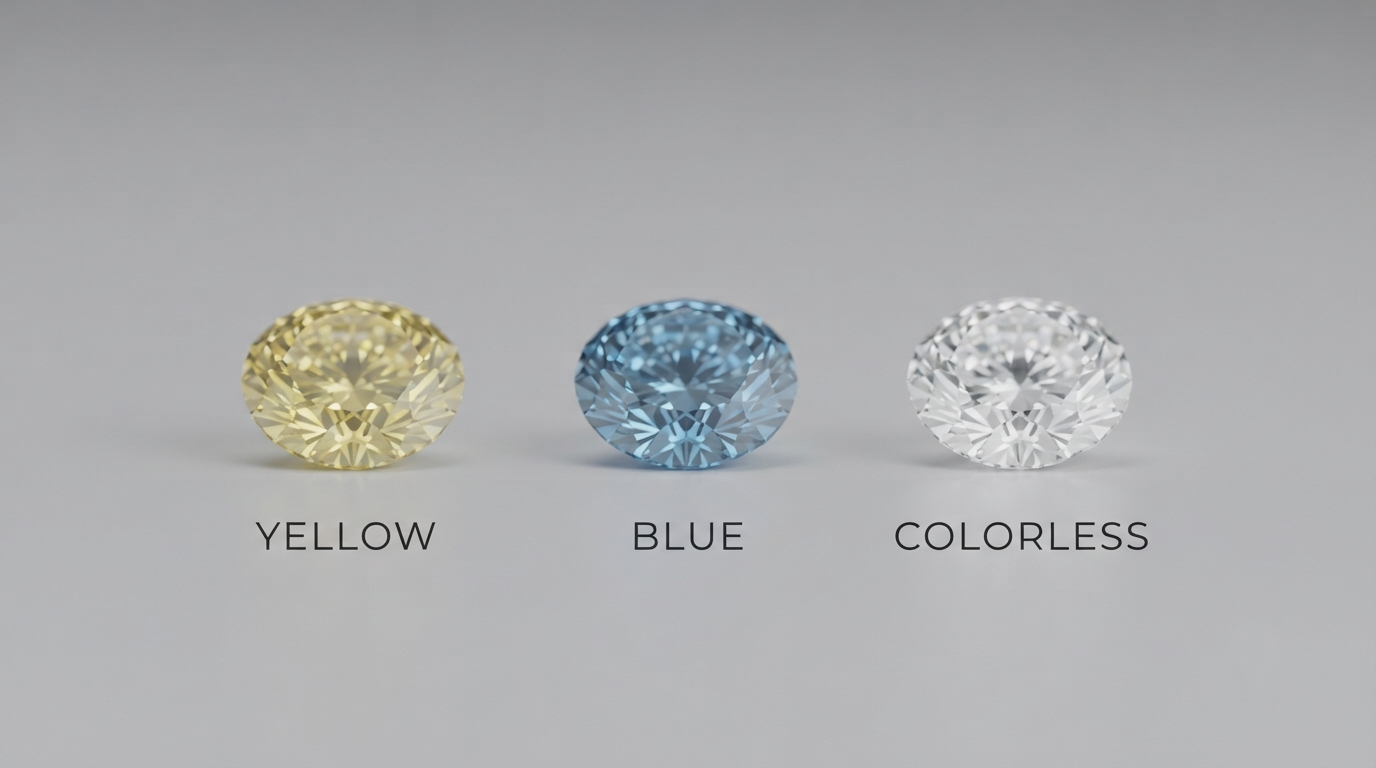
Color in any diamond comes from trace elements sitting in the crystal while it forms. Nitrogen present in the growth cell pushes the stone toward yellow. Boron pushes it toward blue. Colorless is not a third ingredient, it is what is left when both are almost entirely absent, which has to be engineered rather than added, and is the reason colorless usually costs more than a tinted stone rather than less.

Three loose lab-grown diamonds shown side by side in yellow, blue and colorless to illustrate the trace-element range

Because cremated remains are organic and variable, the trace element profile arriving with any given submission is not identical to the next one. A provider can steer toward a target and can narrow the band, but a son ashes diamond is not a paint chip and nobody can hand you an exact shade in advance. Clarity behaves similarly, the range across the category typically runs from SI2 up to VVS.

What you can do is make the range explicit before growth begins:

  • Ask what color range the provider will commit to in writing, not in conversation.
  • Ask what happens if the finished stone lands outside it, remake, refund, or neither.
  • Ask whether the price you have been quoted assumes a tinted stone or a colorless one, because the gap between those two is not small.

What color to expect from a memorial diamond goes further into how wide the honest range really is.

What a Son Ashes Diamond Costs

Memorial Diamond does not publish a price list for a son ashes diamond, and the bands below are not one. They are where the category sits across the industry in 2026, and they are useful mainly as a way to read whether a quote you have been given is complete.

Industry bandCarat it usually buysWhat to make anyone confirm is included
About $1,500 to $3,5000.10 to 0.25 ctWhether an independent grading report is priced on top
About $5,000 to $15,0000.5 to 1 ctGrading, plus whether a fancy cut or engraving is extra
About $20,000 to $75,000+2 to 5+ ctAll of the above, plus the setting and an insurance appraisal

What moves a son ashes diamond up or down those bands is carat first, then color, then cut, then whether grading and a setting are inside the number or outside it. The source material does not move the price: what a carat buys is time in the press, not a larger portion of him. If a quote seems to vary with the material rather than the carat, ask what that difference is for.

One question is worth more than a price comparison: ask what the quote does not cover. A number that looks lower than everyone else’s is sometimes a stone without a grading report, without a setting, and without return shipping. How a memorial diamond quote is actually built breaks the line items apart.

Nine Things to Settle Before Anything Is Sent

Not a description of what any company does. Nine things to get answered about a son ashes diamond, in writing, before a portion leaves your house.

  1. Who holds legal authority over the remains, confirmed with the funeral home or from what your son left in writing, not assumed from who has the container.
  2. How much is being asked for, and whether that is a received weight or a usable weight after processing. Those are different numbers.
  3. What happens to material the process does not consume, returned, retained, or destroyed. Get this before you send, not after.
  4. Whether the intake record reaches you at intake, date, weight, reference number, sent the day the parcel arrives.
  5. Whether growth happens in house or is subcontracted, and how custody is documented at that handover if it is.
  6. What color range is committed to, and what the remedy is if the stone falls outside it.
  7. Whether an independent grading report is included in the price or added to it.
  8. What happens if a growth run fails, second attempt, new material required, or refund.
  9. Whether more than one stone can come from the same portion, if siblings or a surviving spouse may want one later. Deciding this in advance is far easier than revisiting it in a year.

A provider who answers all nine plainly has told you something. One who answers warmly and generally has also told you something, and it is worth hearing.

Frequently Asked Questions

Do we have to decide before the cremation happens?

No. Cremated remains are stable and do not deteriorate on a shelf, so a son ashes diamond can be arranged months or years later just as well. The only decision that is genuinely time sensitive is not scattering the whole of what you have.

Our son’s wife holds the ashes. Can we still do this?

Ask her rather than assume. Where a surviving spouse holds authority, which varies by state and by anything he put in writing, a son ashes diamond becomes a request for one small portion, which changes nothing else that was arranged and is granted more often than parents expect.

He was buried rather than cremated. Is there any route for us?

Yes, and it does not involve the grave. Hair is roughly 50% carbon and requires no cremation at all, so a diamond grown from his hair is the open door for families where cremation was never part of it.

Can his brother and sister each have one from the same ashes?

Often, if each portion still meets the stated minimum on its own. Ask before dividing anything, because splitting one barely sufficient portion into three is how a workable submission stops being one. Each son ashes diamond is grown separately and each takes its own months.

Does it matter how long the ashes have been in the house?

Age is not the issue, storage is. If the container has been opened many times, or has sat somewhere damp, say so plainly when you request an assessment of a son ashes diamond. Providers would far rather know in advance than find out at intake.

Can we send hair as well as ashes?

Yes, and the combined route has its own guide. Sending both does not enlarge the personal fraction of the stone or make the color more predictable, it means the carbon comes from two different points in his life rather than one.

Final Thoughts on a Son Ashes Diamond

The chemistry of a son ashes diamond turns out to be the easy part. A small portion, a long wait, a stone that is partly him and partly not, and a color nobody can promise you in advance.

What is harder, and what this guide has tried not to smooth over, is that a son ashes diamond often sits behind a question about permission, whose signature, whose agreement, whose turn to be asked. That question has an answer, usually a faster one than the dread around it suggests. One call to the funeral director. One conversation with his spouse or his children. One honest exchange with the other parent, or a decision not to have it yet.

Settle that, and everything else on this page becomes logistics. Nothing here needs to be decided this month, or this year. The container is not going anywhere while you think.

Learn More About Son Memorial Diamonds

Talk With Memorial Diamond

Nothing on this page asks you to commit to anything, and there is no version of this where hurrying helps.

If it would be useful to know what a son ashes diamond would mean in your particular situation, start with three questions rather than a quote: what portion is required and whether that figure is a received or a usable weight; what becomes of the part the process does not consume; and how many months the carat you are picturing would actually need. memorialdiamond.us answers all three with nothing to sign, and so does any provider worth using.

If the authority question is still open, ask that one first and everything else second. The urn stays where it is in the meantime.