
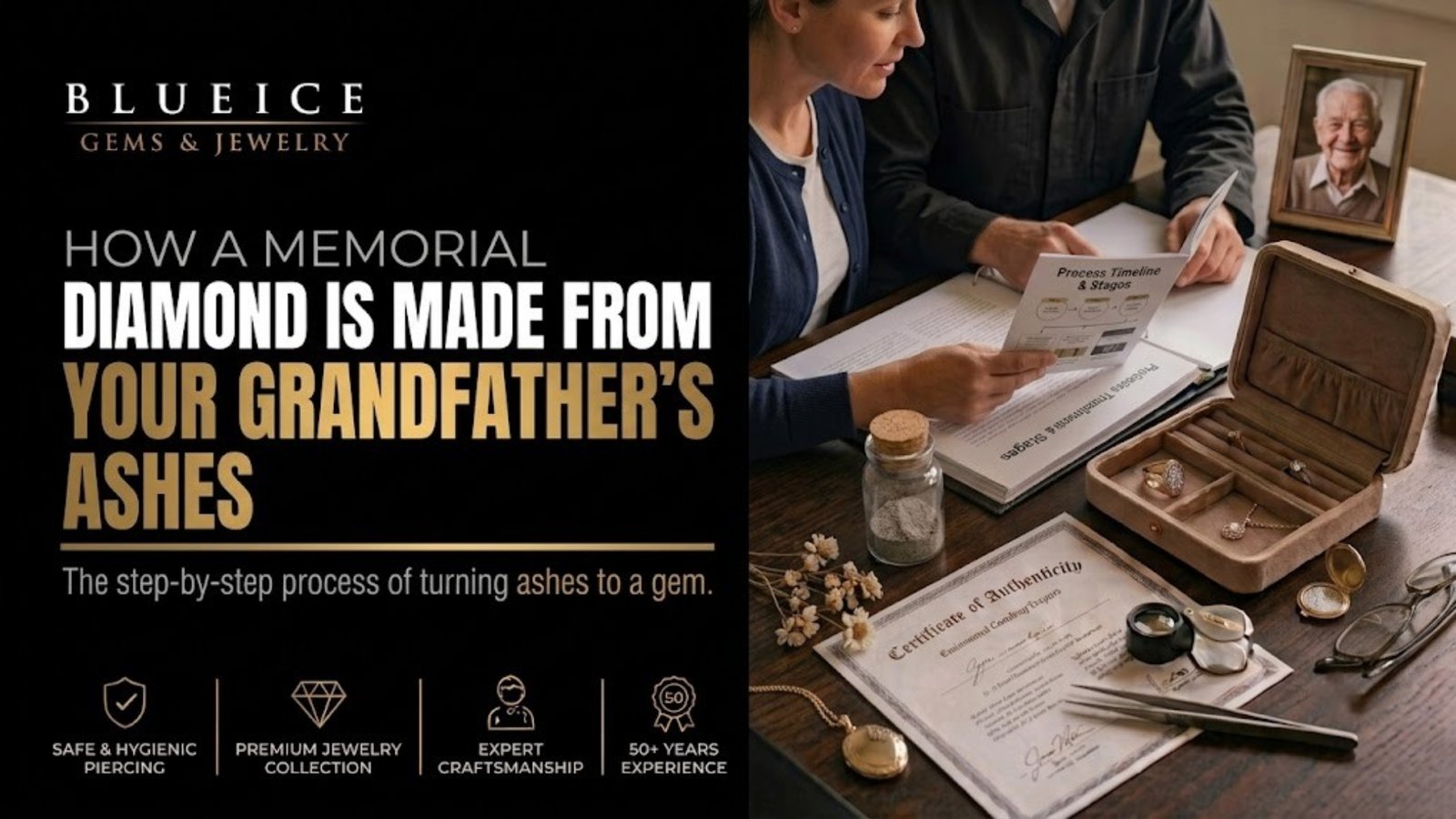
It is natural to want to understand exactly what happens to his ashes once they leave your hands. A memorial diamond made from grandfather ashes begins with a small portion of his cremated remains, from which a lab extracts and purifies the carbon, converts it to graphite, blends it with supplemental lab carbon and grows it into a real diamond under extreme pressure and heat, before cutting, polishing and grading.
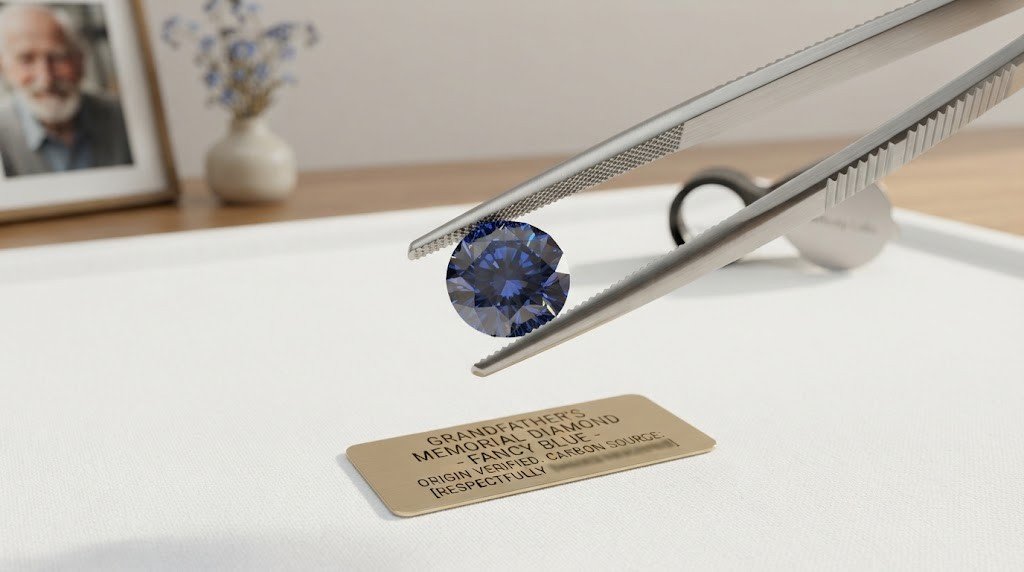
Table of Contents
What Are Cremated Remains Made Of, Chemically?
Cremated remains are mostly calcium phosphate, the mineral that gives bone its structure, and only a small fraction is carbon. Industry figures put usable carbon at roughly 0.5% to 4% of ash by weight, varying from person to person and with the cremation process itself.
That small carbon fraction is the whole reason a stone made from grandfather ashes is possible. Cremation burns away most of the body’s organic material, but some carbon survives within the ash, and that remaining carbon is what a lab works to recover. Everything else in the portion you send, which is to say the great majority of it, is mineral that the lab separates out and does not use in the crystal.
It also explains why a lab works with only part of what you have. A portion of his ashes, typically a few tablespoons up to roughly 4 oz (about 100 g), is usually enough to start, so the rest can stay in an urn, be scattered or be interred as your family planned. Exact amounts vary by provider and are worth confirming in writing, along with whether the amount needed for a stone made from grandfather ashes changes with the carat you choose.
Why Is His Carbon Blended With Supplemental Lab Carbon?
Because the carbon recovered from ash is a small quantity, it is typically blended with supplemental lab-sourced carbon to reach the volume a growth press needs. In a stone grown from ash, his own carbon typically accounts for something like 10–15% of the finished diamond’s mass; a few providers quote a share closer to 3%, and some quote more.
That honest figure matters. A diamond made from grandfather ashes is not made entirely of him, and any description that implies otherwise is overstating what the physics allows. What the stone does contain is a real, recoverable portion of his own carbon, locked into the crystal lattice of a genuine diamond.
That point deserves care. The diamond is not a symbol standing in for him; part of it physically came from him. If you want to weigh that question further, the article on whether a memorial diamond is really made from your grandfather’s ashes looks at what can and cannot be verified.
The exact share in any particular stone depends on the provider, the size of stone chosen and how much ash was sent. Asking for that expected percentage in writing, before you send anything, is a reasonable request.
If this figure feels disappointing at first, that reaction is understandable. You may also find that knowing the honest number makes a diamond made from grandfather ashes feel more trustworthy, because nothing about it has been exaggerated. Either response is valid, and neither needs to be settled before you ask a provider more questions.
What Are the Stages of a Diamond Made From Grandfather Ashes?
A diamond made from grandfather ashes typically passes through seven stages: receipt and identification, carbon extraction and purification, graphitization, growth, cutting and polishing, optional color treatment, and grading with certification. Each stage changes the material in a specific way.
| # | Stage | What happens | What it means for his ashes |
|---|---|---|---|
| 1 | Receipt and identification | The lab logs the incoming ashes and assigns an identifier that follows them through the process | His ashes are tracked as his alone from the moment they arrive |
| 2 | Carbon extraction and purification | Heat in a controlled, oxygen-free process strips away calcium phosphate and other minerals, leaving carbon refined to roughly 99.9% purity or better | Most of the portion sent is mineral, so only a small amount of carbon remains |
| 3 | Graphitization | A second, hotter heating step (around 2,500–2,700°C) turns the purified carbon into graphite | His carbon becomes the crystalline form a growth press can use |
| 4 | Growth | Graphite, typically blended with supplemental lab carbon, is grown on a diamond seed under extreme pressure and heat | His carbon becomes part of a growing diamond crystal |
| 5 | Cutting and polishing | A rough crystal is cut and polished into the chosen shape | The stone takes its final form and sparkle |
| 6 | Optional color treatment | Some providers offer post-growth irradiation to shift color | Applied only if you request a color such as red, pink, green or black |
| 7 | Grading and certification | The stone may be graded independently, and an in-house certificate documents its origin | You receive paperwork about quality and about where the carbon came from |
The sections that follow explain each stage a diamond made from grandfather ashes goes through, in plain language. How long any single stage takes is not something providers publish in a consistent way, so it is best treated as a question for the provider rather than a fixed figure.
How Is Carbon Extracted and Purified From His Ashes?
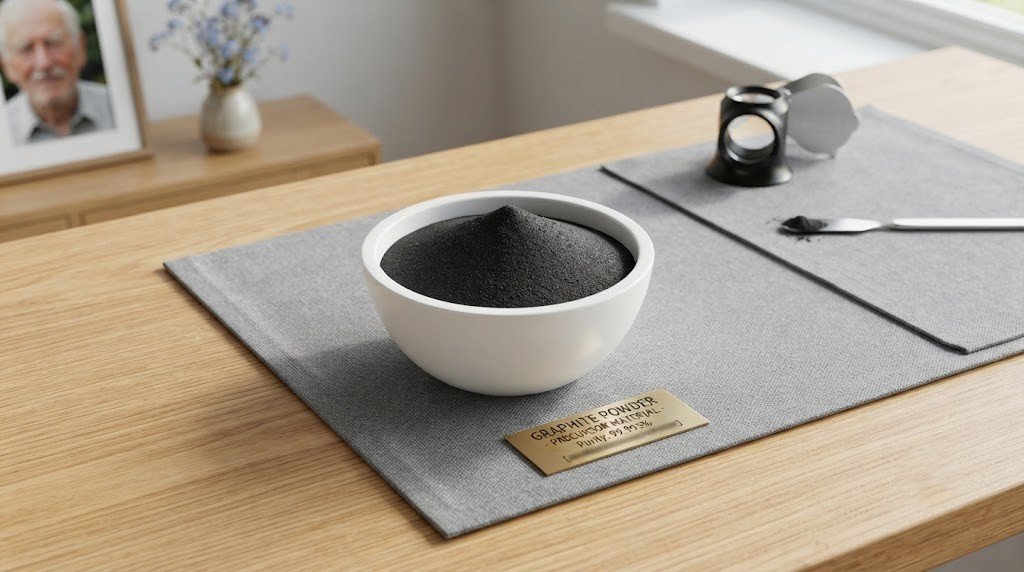
Carbon is extracted by heating the ashes in a controlled, oxygen-free environment that separates carbon from the calcium phosphate and other minerals. Additional purification steps then refine the recovered carbon to roughly 99.9% purity or higher.
Oxygen is kept out deliberately. If oxygen were present at these temperatures, the carbon would burn off as gas instead of being recovered. Working without it lets the lab pull carbon away from the mineral bulk of the ash rather than lose it.
Purity matters for what comes next. Any diamond made from grandfather ashes needs clean carbon feedstock, because trace elements left behind can influence the color the stone takes. The specific chemistry differs from lab to lab, and providers vary in how much detail they share, so asking how a given lab purifies carbon is a fair question.
This is also the stage where the small carbon yield becomes visible. A portion of ash that looks substantial in a container produces a strikingly small amount of carbon once the minerals are gone, which is why a stone made from grandfather ashes typically relies on supplemental lab carbon for most of its volume.
What Happens During Graphitization?
Graphitization converts the purified carbon into graphite by heating it to roughly 2,500–2,700°C. Graphite is a crystalline form of carbon, and it is the feedstock that diamond-growth presses are built to use.
At this point the carbon in a stone made from grandfather ashes has changed form but not identity. The atoms are the same carbon recovered from his remains; they are simply arranged in flat, layered sheets rather than the scattered state they were in after extraction.
The next stage rearranges those same atoms again, from graphite’s sheets into diamond’s rigid three-dimensional lattice. Both forms are pure carbon. The difference lies entirely in how the atoms are bonded together. For anyone wondering whether a stone made from grandfather ashes really keeps any of him after so much heat, this is the reassuring chemistry: carbon atoms survive each change of form, and only their arrangement shifts.
How Does a Lab Grow the Diamond Itself?
Most memorial providers use high-pressure, high-temperature growth, often called HPHT. A press recreates conditions found deep in the Earth, roughly 6–8 GPa of pressure and about 1,400–2,500°C, and carbon crystallizes as diamond around a tiny seed.
In an HPHT growth cell, the graphite, typically blended with supplemental lab carbon, is the feedstock from which the crystal forms. Over a growth period lasting weeks to months, a diamond made from grandfather ashes builds up into a rough crystal.
A minority of providers use chemical vapor deposition, or CVD, for a stone made from grandfather ashes instead. In that method, carbon is converted to a carbon-bearing gas and deposited onto a seed plate inside a vacuum chamber. The synthetic diamond overview explains both methods in more technical depth.
Whichever method a lab uses, the result is a real diamond, not a simulant or a coated stone. It shares the hardness of any diamond, 10 on the Mohs scale of mineral hardness, the highest of any natural mineral, though a hard knock at the wrong angle can still chip it. Asking a provider which method it uses for stones made from grandfather ashes is a reasonable part of choosing one.
Why Does Growth Time, Not the Amount of Ash, Set the Carat?
Carat size depends mainly on how long the crystal is allowed to grow in the press, not on how much ash you send. A larger stone needs longer growth and closer process control, which is why bigger stones cost more and take longer.
This surprises people. Sending a whole urn would not produce a larger diamond made from grandfather ashes, because the supplemental carbon supplies most of the volume and the press sets the pace. Carat is a choice you make, and that choice in turn shapes the timeline.
Memorial diamonds are generally offered from about 0.10 carats up to 5 carats and beyond. From the day a lab receives the ashes to a finished stone, the industry norm is around 6 to 10 months; a specialty color or a stone near 2 carats or above can stretch that toward a year.
Price climbs steeply with size. Typical 2026 industry figures put a stone under a quarter carat (about 0.10–0.25 ct) at around 1,500–3,500, a half carat to one carat at around 5,000–15,000, and stones between 2 and 5+ carats anywhere from about $20,000 to $75,000 and up. A setting, engraving, a fancy shape or independent grading normally adds to that. Colorless stones made from grandfather ashes typically cost more than yellow, blue or champagne stones of the same size.
How Is the Rough Crystal Cut and Polished?
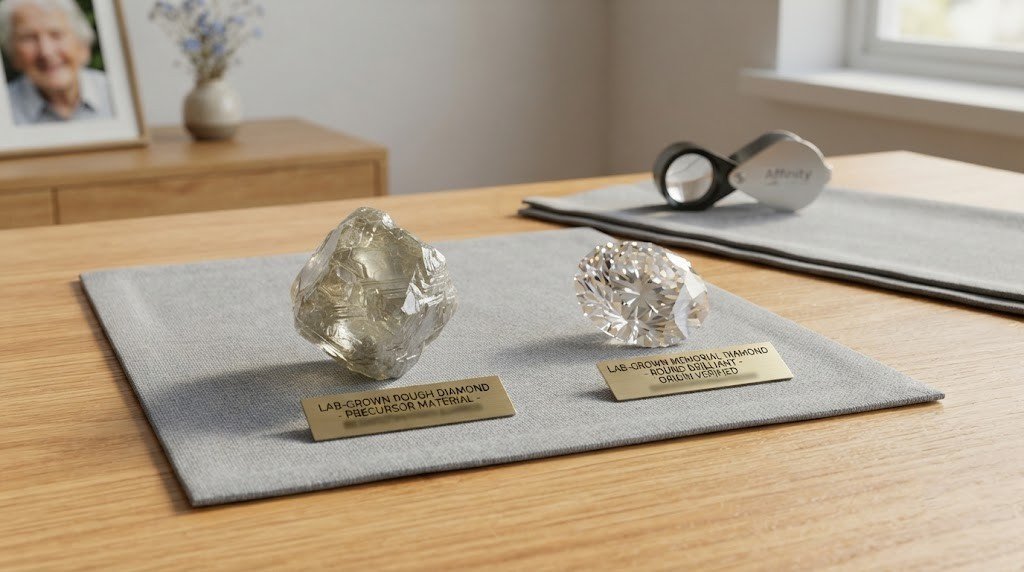
After growth, a gem cutter shapes the rough crystal into a finished stone, such as a round brilliant, cushion, princess, oval or another cut, and polishes its facets. This is the same craft used for any diamond.
A rough crystal made from grandfather ashes looks nothing like a finished gem when it comes out of the press. Cutting shapes the rough into a clean, well-proportioned stone, and some of the crystal is lost along the way. When you order a stone made from grandfather ashes, ask the provider to confirm in writing whether the carat quoted refers to the finished, polished gem.
Cut choice affects how light moves through the stone and how it suits a setting. Cufflinks, a ring, a pendant, a pin or a loose stone in a small case are all possible, and the choice belongs to whoever will wear or keep it; there is no style a man’s memorial has to follow.
Where Does the Color of a Diamond Made From Grandfather Ashes Come From?
Color comes from trace elements present during growth. Nitrogen produces yellow tones, boron produces blue, and a colorless stone requires the absence of both. Memorial diamonds commonly trend toward yellow, blue and champagne or brown.
Because a diamond made from grandfather ashes draws part of its carbon from a personal, organic source, trace elements are common, and colorless results take additional process control and usually cost more. Some providers also offer optional post-growth irradiation to produce red, pink, green or black stones.
No source makes the color of a stone made from grandfather ashes predictable from the ashes themselves. It is a conversation to have with a provider: which colors they can achieve, how reliably, and what each option adds to the cost and timeline.
What Is the Difference Between a Grading Report and an Authenticity Certificate?
A grading report describes the stone’s quality; an authenticity certificate documents its origin. The two serve different purposes, and a careful family will want to understand both.
An independent grading report, often referencing GIA standards and sometimes issued by IGI, assesses a stone made from grandfather ashes against the 4Cs of diamond quality: cut, color, clarity and carat. Clarity for memorial stones typically falls between SI2 and VVS. Independent grading is usually optional and priced separately.
The provider itself normally supplies the authenticity or origin certificate. This document confirms that the stone was grown from the carbon recovered from your family’s submitted ashes, and functions as a chain-of-custody document rather than a quality assessment. For a diamond made from grandfather ashes, this certificate is the paper link between the stone in your hand and the ashes you sent.
| Document | Who usually issues it | What it tells you |
|---|---|---|
| Grading report | An independent gemological lab | The stone’s cut, color, clarity and carat |
| Authenticity or origin certificate | The memorial diamond provider | That the stone was grown from his recovered carbon, and how it was tracked |
How Is Chain of Custody Kept for a Stone Made From Grandfather Ashes?
Chain of custody is the record that keeps his ashes identified as his from arrival to finished stone. Reputable providers assign an identifier at receipt and track the material through extraction, graphitization, growth and cutting, so it is never confused with another family’s.
For a family, this record is what ties a stone made from grandfather ashes to him rather than to anyone else, since a grading report describes quality, not origin. Ask any provider to describe in writing how it labels, separates and records each family’s material at every stage, and what that record will show on the origin certificate.
Before you commit to a diamond made from grandfather ashes, these questions are worth putting to a provider in writing:
- How do you identify and separate each family’s material at every stage of the process?
- What percentage of the finished diamond’s carbon will his ashes likely supply?
- Do you use HPHT or CVD for memorial stones, and why?
- What happens to any portion of his ashes that is not used, and is it returned?
- Will the origin certificate describe how his material was tracked?
Clear written answers to those questions can matter as much as the science, since a diamond made from grandfather ashes depends on trust in the lab as well as on the chemistry.
If you are ready for the practical side, including who to speak with in the family about a portion of his ashes, the step-by-step guide on how to turn your grandfather’s ashes into a diamond covers it. For the broadest overview, see the grandfather ashes diamond complete guide.
If his hair was also saved, the lab process for keratin differs at the extraction stage, as the walkthrough of how a memorial diamond is made from your grandfather’s hair explains, and the process for a diamond made from his ashes and hair together covers the combined route.
Frequently Asked Questions
Is any of his DNA preserved in the finished diamond?
That is a question to put to the provider rather than one this guide can settle. What the process recovers and grows into a stone made from grandfather ashes is purified carbon, so ask the lab in writing what, if anything, survives beyond that.
Could a jeweler tell that the stone came from cremated remains?
Not from a standard grading report, which describes cut, color, clarity and carat rather than origin. The fact that a diamond was made from grandfather ashes is documented through the provider’s chain-of-custody records and origin certificate, so ask what those papers will show.
Can ashes that have been stored for many years still be used?
Ask the provider before assuming either way. Whether long-stored ashes are accepted, and whether their age or storage affects how much carbon a lab can recover, is for each provider to answer, so describe how and for how long they were kept.
Does the type of cremation affect how much carbon is recovered?
It can. Usable carbon in ash varies roughly from 0.5% to 4% by weight, depending on the person and the cremation process. A provider can explain how it assesses a sample and whether the amount sent will be enough.
Can more than one diamond be grown from the same ashes?
Often, yes. Because each stone made from grandfather ashes typically uses only a portion of them, several diamonds can often come from one source. Confirm with the provider how much material each additional stone needs before dividing anything among relatives.
Is a lab-grown memorial diamond as hard as a mined diamond?
Yes. It is chemically and physically diamond, rating 10 on the Mohs scale, the same as a mined stone. Hardness resists scratching, but a sharp knock can still chip any diamond, so a protective setting is worth considering.
Final Thoughts on How His Ashes Become a Diamond
Knowing the science does not make the decision for you, but it can make a diamond made from grandfather ashes feel less mysterious. Every stage, from the first carbon recovered to the last facet polished, can be explained, questioned and documented, and you are entitled to ask about all of it.
Learn More About Grandfather Memorial Diamonds
- Grandfather Ashes Diamond: The Complete Guide the wider overview, from first questions to pricing
- How to Turn Your Grandfather’s Ashes Into a Diamond the practical steps, from family conversations to ordering
- Is a Memorial Diamond Really Made From Your Grandfather’s Ashes? an honest look at what is verifiable
- How to Turn Your Grandfather’s Ashes and Hair Into a Diamond planning a stone that draws on both materials
Talk With Memorial Diamond
If you have questions about any stage of the process, we are happy to walk through them with you, at whatever pace suits you. Visit memorialdiamond.us when you are ready to talk.
Leave A Comment