
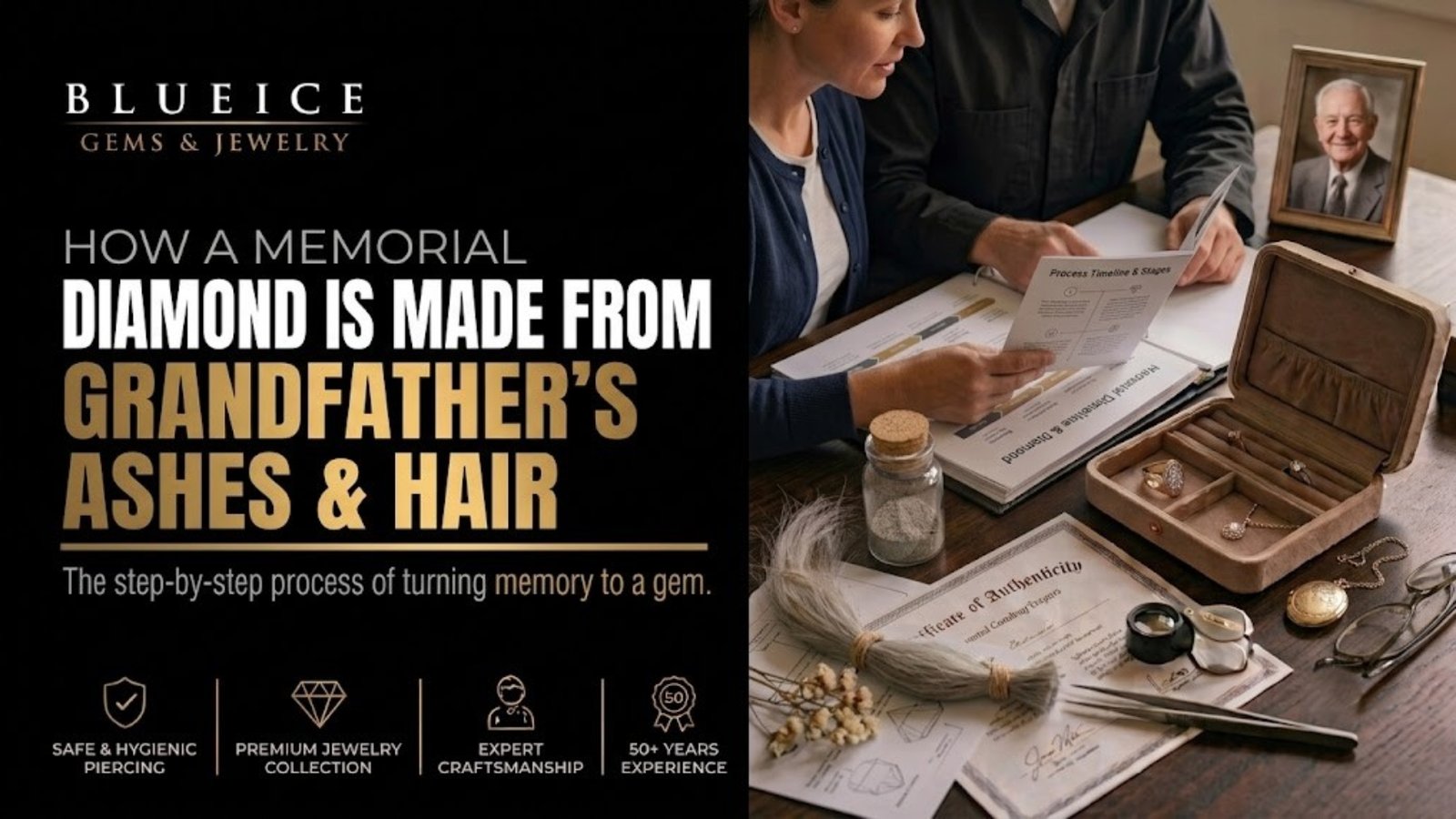
Some families hold two things of his: a portion of his ashes and a lock of his hair. A memorial diamond made from grandfather ashes and hair starts from both, and the lab treats them as separate raw materials, recovering carbon from each, purifying it, converting it to graphite and growing a real diamond, typically with supplemental lab carbon added. Whether and how the two are combined depends on the provider, so that is something to confirm in writing.
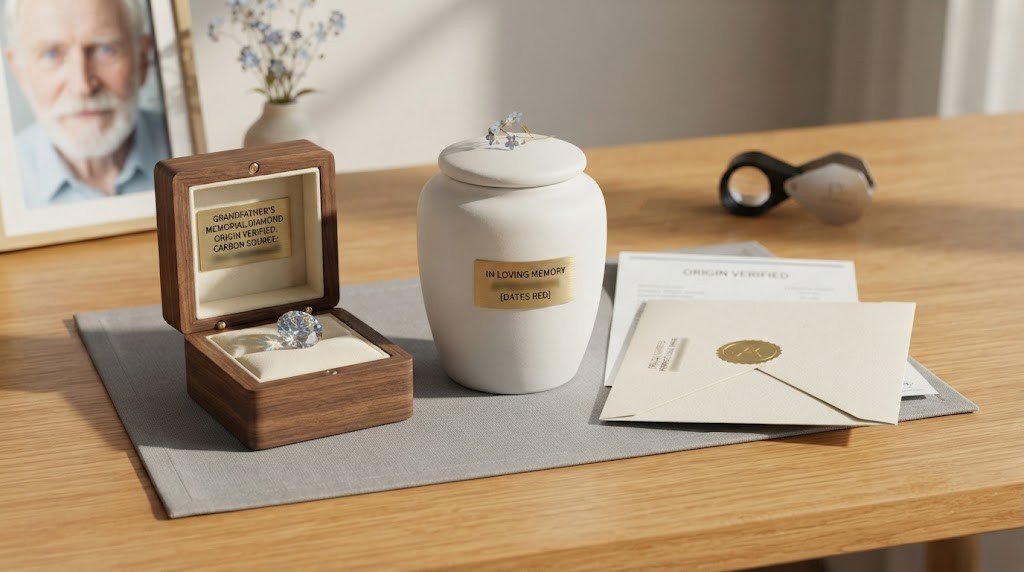
Table of Contents
How Do Ash Carbon and Hair Carbon Differ?
They begin at opposite ends of the carbon scale. Ashes are mostly calcium phosphate, with usable carbon at roughly 0.5–4% by weight, whereas hair is built from keratin and is roughly 50% carbon. A stone made from grandfather ashes and hair would therefore draw on one lean source and one rich one.
The gap between the two sources behind a diamond made from grandfather ashes and hair comes from what each material is. Cremation burns away most organic matter and leaves the mineral framework of bone, so carbon survives only in small traces. Hair is protein, and that protein keeps its carbon until a lab deliberately extracts it.
| Cremated ashes | Hair | |
|---|---|---|
| Main substance | Calcium phosphate (bone mineral) | Keratin (protein) |
| Carbon by weight | Roughly 0.5–4% | Roughly 50% |
| Typical amount requested | From a few tablespoons to ~100 g (about 4 oz) | A few grams, often one small lock |
| What extraction must remove | Calcium phosphate and other minerals | Hydrogen, oxygen, nitrogen, sulfur and residues |
| Needs cremation? | Yes | No |
| Published finished-stone carbon share | For ash, usually ~10–15% of the finished stone’s mass (some providers cite ~3%, others more) | None published |
| Who typically holds it | Whoever received the cremated remains | Whoever saved the lock |
Seen side by side, the two materials ask different things of a lab. Ash demands careful recovery of a small carbon fraction from a large mineral mass; hair demands the removal of several non-carbon elements from a carbon-rich protein. A diamond made from grandfather ashes and hair has to satisfy both sets of demands before the carbon ever reaches a press.
Does a Provider Actually Combine the Two Materials?
That depends entirely on the provider, and no single method is standard or publicly documented across the industry. Some labs may offer a single stone made from grandfather ashes and hair; others may only work with one, or may suggest two separate stones.
Even among labs that accept an order for a diamond made from grandfather ashes and hair, the details are theirs to explain. Whether ash carbon and hair carbon are pooled, at what stage, in what proportion, and whether you have any say in that proportion are all process decisions this guide cannot describe as fact. Ask, and keep the answers.
Eight questions are worth putting to any lab before you agree to a diamond made from grandfather ashes and hair:
- Do you grow one stone from both materials, or do you recommend separate stones?
- If both are used, at what point in your process are the two carbons brought together?
- Can you tell me the proportion of ash carbon to hair carbon, or is that not tracked?
- How much of each material do you need for the carat size I am considering?
- How is supplemental lab carbon handled, and can you state its share for my order?
- Will my documents name both ashes and hair as source materials?
- How do you keep each material identified and separate before it is combined?
- What happens to any ashes or hair you do not use, and can they be returned?
There are no wrong answers here, only unclear ones. A lab that explains its approach plainly, in writing, gives you something you can compare; a vague reply is a reason to ask again, not a reason to assume.
What Does the Lab Do to the Ashes?
For a stone made from grandfather ashes and hair, the ash portion goes through a controlled, oxygen-free heating process designed to separate a small amount of carbon from a large quantity of mineral. Calcium phosphate and other minerals are stripped away, and what carbon survives is collected.
Because carbon makes up such a small share of cremated remains, ash is the more demanding of the two sources for any diamond made from grandfather ashes and hair. The yield from one cremation can vary with the person and with how the cremation was carried out, which is part of why providers ask for more ash than hair.
The recovered carbon is then refined in further stages until it reaches roughly 99.9% purity or higher. At that point the ash carbon intended for a stone made from grandfather ashes and hair is chemically just carbon, ready to be converted to graphite.
The step-by-step account of a memorial diamond made from your grandfather’s ashes follows the ash route on its own in more depth.
What Does the Lab Do to the Hair?
The hair destined for a diamond made from grandfather ashes and hair is also heated without oxygen, but here the task is reversed: carbon is plentiful, and the lab is driving off the hydrogen, oxygen, nitrogen and sulfur bound up in keratin, along with any natural oils or product residue the strands carried.
After extraction, the hair carbon is purified to the same roughly 99.9% standard as the ash carbon. By the end of purification, hair carbon and ash carbon intended for a stone made from grandfather ashes and hair have both been refined to the same high-purity standard.
Gray, white, short, sparse, beard or treated hair may be what was saved. Nothing published shows these behave differently in extraction, and nothing shows they are a problem either, so whether a lab accepts each type, and in what amount, belongs on your list of written questions. The full process for a memorial diamond made from your grandfather’s hair explains the hair-only route in detail.
How Much of Each Is Usually Requested?
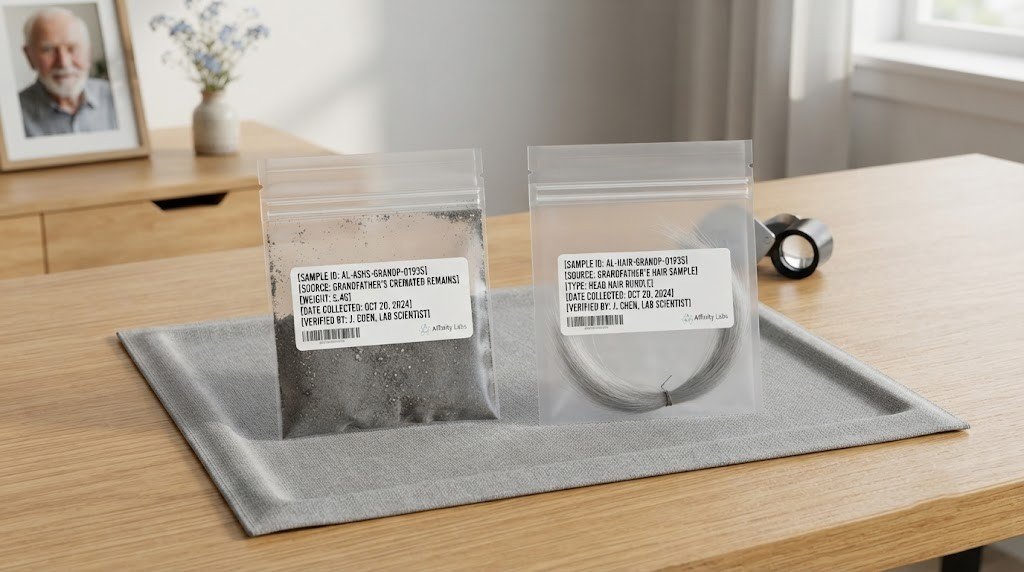
For ashes, industry-typical requests range between a few tablespoons and around 100 g (roughly 4 oz); for hair, a few grams, often one small lock, is the usual ask. A stone made from grandfather ashes and hair may need a different amount of each than a single-material order, so the exact figures come from the provider, not from general guidance.
Material quantity does not set the carat of a stone made from grandfather ashes and hair. Size depends on growth time in the press, so sending extra ashes or a larger lock will not by itself produce a bigger stone, and a small contribution does not limit the size you can choose.
Only part of each material is typically used in a diamond made from grandfather ashes and hair. That can leave most of his ashes for an urn, a burial or a scattering already planned, and some of his hair to keep. Several stones can often be grown from the same source, which matters if more than one relative would like a piece.
How Is a Diamond Made From Grandfather Ashes and Hair Grown and Cut?
Once purified, the carbon is graphitized at roughly 2,500–2,700°C and then grown into diamond, usually by HPHT, the industry-standard method. From that point, a diamond made from grandfather ashes and hair grows and is cut under the same physics as any lab-grown diamond.
In an HPHT press, graphite, typically blended with supplemental lab carbon, is pressed to roughly 6–8 GPa and heated to about 1,400–2,500°C, with a tiny diamond seed at its center. Carbon atoms gradually build onto the seed as a diamond crystal. A minority of providers use CVD, converting the carbon to a gas and depositing it onto a seed plate in a vacuum chamber; the Wikipedia article on synthetic diamond covers both techniques.
Growth runs for weeks to months, and the length of the run decides how many carats a rough crystal made from grandfather ashes and hair reaches. Memorial stones are generally available from about 0.10 to 5+ carats. Afterward, a cutter shapes and polishes the rough into a round, oval, cushion or other cut.
The whole journey for a memorial diamond made from grandfather ashes and hair typically takes 6–10 months, and as long as about 12 for stones of roughly 2 carats and up or for specialty colors. Providers do not publish reliable timings for individual stages, so ask yours how it reports progress.
How Much of a Stone Made From Grandfather Ashes and Hair Is His Own Carbon?
No personal-carbon figure is published for a two-material stone. The only widely cited figure is for ash alone, and it cannot simply be carried over to a diamond made from grandfather ashes and hair.
For ash-only stones, personal carbon from the ashes is usually put at around 10–15% of the finished stone’s mass, with some providers citing as little as ~3% and others more. That range reflects ash’s low carbon yield and nothing else. Hair has no published finished-stone share, and a blend has none either.
So what can honestly be said? Supplemental lab carbon is typically part of the growth mix, so a stone made from grandfather ashes and hair should not be described as nothing but him. A real, documented portion of his own carbon, from one or both materials, becomes part of the crystal lattice. For the percentage that applies to your stone, ask the provider to state it in writing, and if they cannot, ask why.
For a closer look at that question for ash, see whether a memorial diamond is really made from your grandfather’s ashes.
What Decides the Color of a Diamond Made From Grandfather Ashes and Hair?
Trace elements present while the crystal grows decide it. Nitrogen gives yellow, boron gives blue, and colorless requires the near-absence of both; memorial stones commonly lean yellow, blue or champagne to brown, partly because personal carbon sources tend to carry trace elements, and colorless typically costs more.
Some providers add an optional post-growth irradiation step to reach red, pink, green or black. That is a choice made after the stone is grown, not a result of anything in the ashes or hair.
No published source lets anyone predict how a diamond made from grandfather ashes and hair will look from its materials. Neither ashes nor hair, nor gray or dyed hair, has been shown to make a stone lighter or darker. Treat the color of a stone made from grandfather ashes and hair as a decision you discuss with the lab.
What Should the Paperwork Say When Two Materials Are Sent?
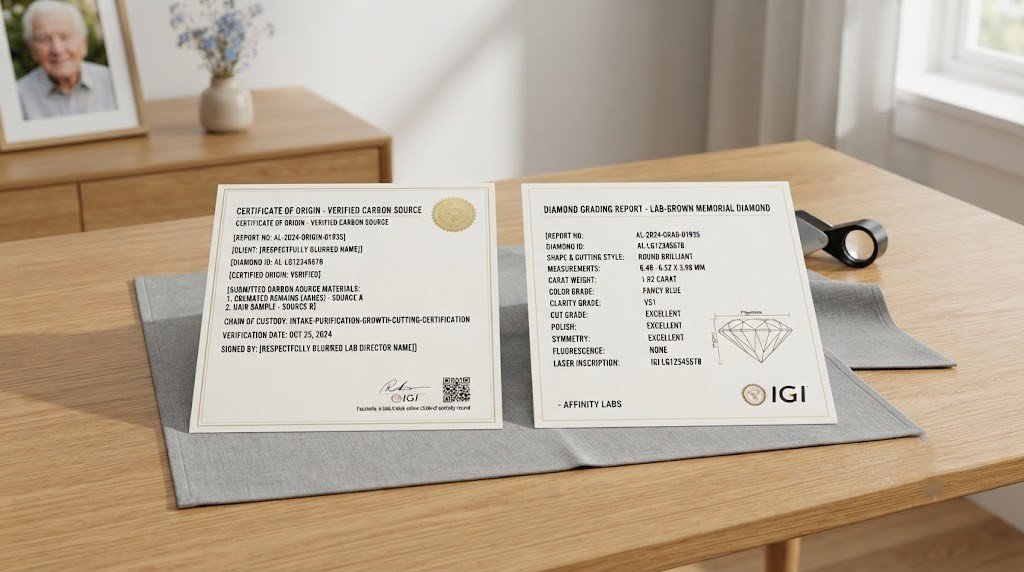
Ideally, two kinds of document arrive with the stone: an authenticity or origin certificate that names both ashes and hair as source materials, and, if you choose one, a grading report describing the diamond’s quality.
The authenticity certificate is usually issued in-house. For a stone made from grandfather ashes and hair, it should reference the identifiers both materials were given at receipt, so the record of origin accounts for every material that went into it.
A grading report for a diamond made from grandfather ashes and hair is a separate, optional document. It assesses cut, color, clarity and carat using standards such as the GIA 4Cs, sometimes through IGI, and memorial stones typically grade between SI2 and VVS. It describes the diamond, not where its carbon came from, so it does not replace the origin certificate.
How Is Chain of Custody Kept for Two Separate Materials?
Through a documented trail for each material, from the moment it arrives until its carbon is grown, and then a trail for the finished stone. Grading reports cover quality, not origin, so these records are what you rely on; ask the provider whether anything beyond them can confirm where the carbon came from.
Two materials mean twice the handoffs. When you ask about a diamond made from grandfather ashes and hair, check:
- whether each material gets its own identifier at receipt
- whether the two are logged separately until any combining step
- who signs off when they are brought together, if they are
- whether you can see the log or receive progress updates, and how often
- whether unused ashes and hair are recorded, and whether they can come back to you
Answers to these will differ between providers, so get them in writing. A lab that can clearly describe how it tracks a stone made from grandfather ashes and hair from both starting points is giving you a reason to trust it.
Who Should Be Part of the Decision?
Anyone who holds his ashes, and usually anyone who kept his hair, has a stake in a diamond made from grandfather ashes and hair. Authority over cremated remains varies by state, with no single national rule; a surviving spouse or partner and his adult children commonly rank ahead of grandchildren, and written wishes can change that order.
If you are a grandchild and the ashes are with someone else, a respectful request for a small portion is often the place to start. Hair offers another route, since a lock kept by you or a relative may be easier to use. Rules on remains focus on the remains themselves, so hair in your keeping is usually simpler, though belongings can form part of an estate and rules vary by state. Hair held by someone else is a conversation, not a decision.
Faith may matter too. No tradition has an official position on memorial diamonds; teachings concern cremation and the handling of ashes.
A Catholic family may want to ask about guidance on dividing ashes, and for Muslim families or Orthodox and Conservative Jewish families, where cremation itself is the concern, a hair-only stone avoids cremation entirely. Your own clergy can advise.
When you are ready to plan the order, how to turn your grandfather’s ashes and hair into a diamond lays out the practical steps, and the grandfather ashes and hair diamond complete guide covers cost and settings.
Frequently Asked Questions
Can I ask for two stones, one from ashes and one from hair?
Some providers can grow separate stones from separate materials, though offerings differ. Ask whether each stone is priced individually, how much of each material a separate order needs, and whether the documents for each stone name only its own source.
Is a two-material stone harder to grow than a single-material one?
Once carbon has been purified and graphitized, growth follows the same physics as any memorial diamond. Any added work would sit in handling and tracking two materials first, so if a provider offers a combined order, ask whether it changes the timeline, price or documentation.
Does adding hair mean less ash is needed?
Not necessarily. Hair is carbon-rich, but how a lab balances the two depends on its process and on the size you choose. Ask how much ash and how much hair your specific order needs, and get the figures in writing before sending.
Will the stone look different because two materials were used?
No published evidence shows that using two materials changes a stone’s appearance. Color comes from trace elements present during growth and any optional irradiation, and no source makes it predictable. A stone from two sources shares the structure, hardness and grading terms of any diamond.
Can the ashes be ones that were already divided among relatives?
A portion already given to a relative can be a starting point, provided whoever holds it agrees. Authority over remains varies by state and family situation, so talk with the relatives involved first and ask the provider how much of that portion it would need.
What if only a very small amount of each material was kept?
That may still be workable, but the minimum is a provider question. Describe exactly what you have, including weight if possible and the type of hair, and ask whether one stone, two stones, or a single-material stone suits it best.
Final Thoughts on a Diamond Made From Grandfather Ashes and Hair
Bringing two parts of him into one decision can feel weighty, and it is fine to take the time you need. The science is settled enough to describe; the provider-specific parts are not, and asking about them plainly is how you protect what you hold. Whatever you choose, you can take the questions one at a time.
Learn More About Memorial Diamonds for a Grandfather
- Grandfather Ashes and Hair Diamond: The Complete Guide every choice for a two-material stone
- How to Turn Your Grandfather’s Ashes and Hair Into a Diamond the practical steps, in order
- How a Memorial Diamond Is Made From Your Grandfather’s Hair the hair-only route
- Grandfather Ashes Diamond: The Complete Guide when ashes are the only material
Talk With Memorial Diamond
Whenever you are ready, we can talk through what you have kept and what a diamond made from grandfather ashes and hair would need from each material. Visit memorialdiamond.us to ask a question; there is no pressure to decide anything.