
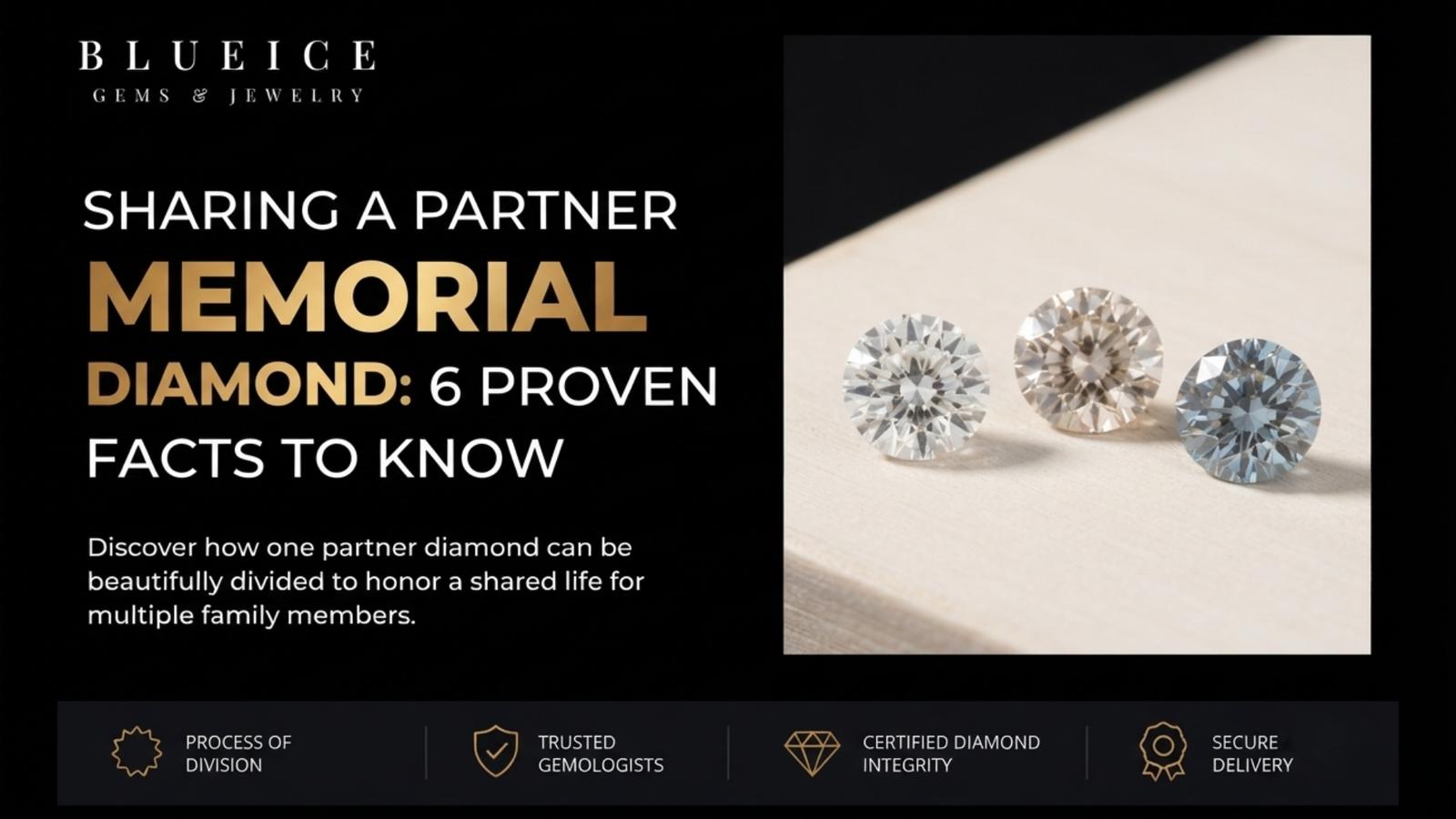
It usually surfaces sideways, in a kitchen, after someone has already said yes to the idea. A sibling asks whether they could have one too. Sharing a partner memorial diamond across several people is usually possible, because only a small portion of what a family holds is ever used, but the material was never the hard part. The hard part is who has the standing to authorize it, and what everyone has agreed before anything is posted.
One disclosure up front: Memorial Diamond grows these stones, so treat this as a company describing its own category rather than a neutral referee. Every figure below is an industry wide band, not a published policy of ours.
Table of Contents
Why One Portion Can Supply Several Stones
Start with the physical facts, because they are the reassuring end of this subject. Materially, sharing a partner memorial diamond is the easy part.
A cremation produces remains measured in pounds. What a laboratory asks for is measured in tablespoons, industry wide, somewhere between a few tablespoons and roughly 4 oz, about 100 g. That gap is what makes sharing a partner memorial diamond feasible at all. Several separate portions can be drawn from one urn and nothing visible changes in it. How much ash a single stone actually takes sets out the arithmetic behind that figure in full.
The reason the request is so small is that cremated remains are not a carbon source in any generous sense. They are overwhelmingly calcium phosphate, the mineral scaffolding of bone. By weight, only about 0.5% to 4% of ash is usable carbon. So each portion set aside for sharing a partner memorial diamond is a mineral sample from which a thin recovery of carbon will be pulled, purified to around 99.9%, and then blended with supplemental lab carbon to reach the volume a growth cell needs.
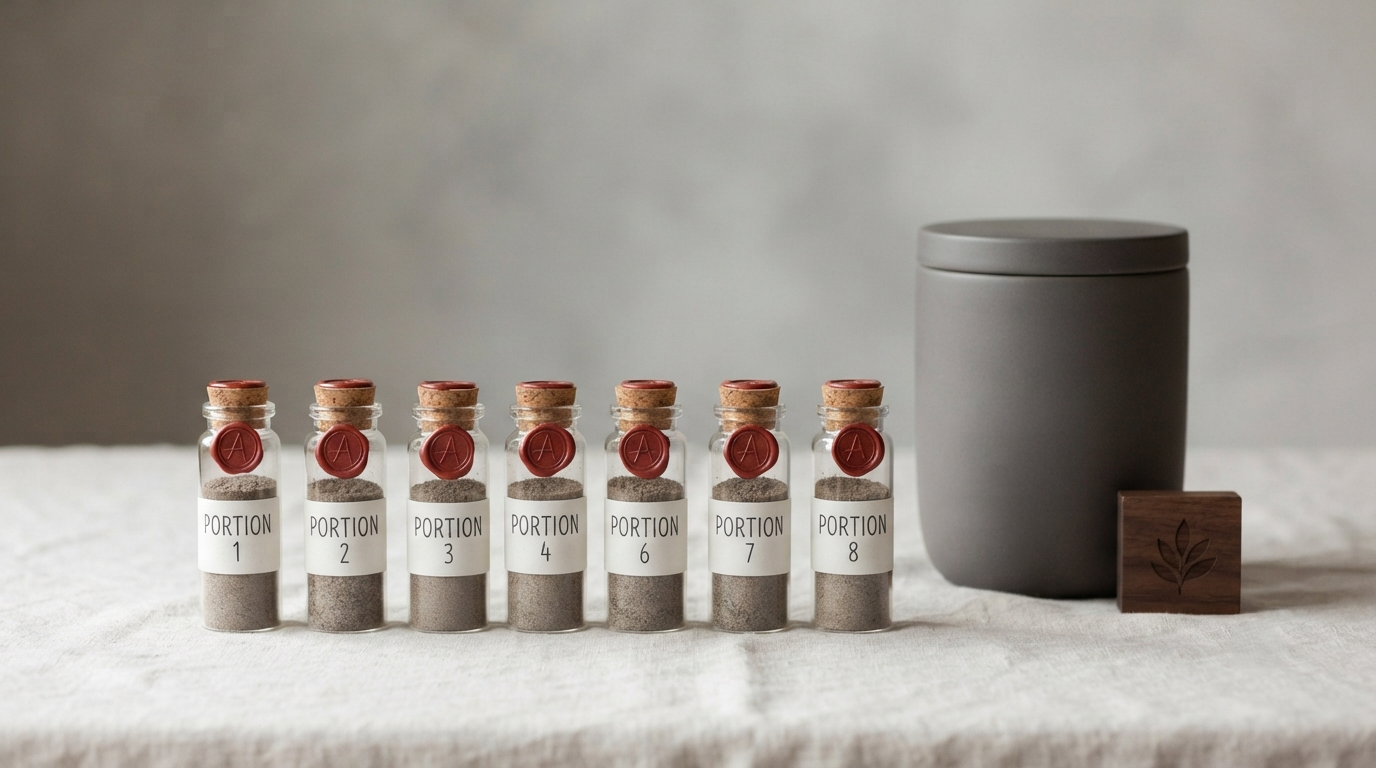
That blend is worth stating plainly rather than skipping. For the ash route, the industry figure for personal carbon is somewhere around 10% to 15% of a finished stone’s mass, and some providers cite as little as 3%. No comparable figure is published for hair. Nobody receives a diamond that is entirely the person, that is not how the chemistry works. What each person receives is a real diamond containing a real, traceable share of their carbon, which is a more defensible claim and, once you sit with it, not a smaller one.
Hair changes the arithmetic considerably. Hair is roughly 50% carbon by weight, and no cremation is involved at all, so a household that kept a lock has a second route into sharing a partner memorial diamond even where the ashes are out of reach. What a hair based submission requires covers the quantities, which are far smaller than most people assume.
Practical limits that do apply when sharing a partner memorial diamond:
- Each stone needs its own portion. Portions are not subdivided after arrival, so sharing a partner memorial diamond means sending one portion per stone.
- The number of stones is limited by what you hold, not by any rule about how many people may take part.
- A partial share can still work. A keepsake urn’s worth is often enough for one stone, sometimes two.
- Hair and ash are assessed separately, not pooled into a single total, if a family is drawing on both.
Who Actually Has Standing to Say Yes?
This is where sharing a partner memorial diamond stops being a logistics question, and it deserves a direct answer rather than a comforting one.
No nationwide rule decides who may authorize a division. State law does, and a written direction from your partner, a will, a disposition directive, a form signed at the funeral home, can displace whatever the default would otherwise have been. Legal recognition of the relationship usually keeps this simple. Without it, the entitled decision maker may turn out to be a former spouse, a sibling, an adult child, or a parent, whatever the living arrangements looked like, which is why sharing a partner memorial diamond so often turns on a document nobody has actually read.

That matters more here than in almost any other question in this cluster. Sharing a partner memorial diamond means dividing remains between people, and the person who authorizes a division may not be you. It may be someone who never used the word “partner” about your relationship at all.
None of that makes it impossible. It changes the order of operations for sharing a partner memorial diamond:
- Establish who the law treats as the decision maker in the state where the cremation happened, a funeral director will usually say, at no charge.
- Find out what was left in writing, and whether anyone has actually read the document rather than recalled it.
- Ask the person with authority, which is a separate question from whether they are entitled, and frequently a warmer conversation than people brace for.
- Get the agreement on sharing a partner memorial diamond recorded, even as an email thread, before money moves or material is packed.
There is a quiet advantage in this particular request. A family reluctant to acknowledge a relationship is often far more willing to grant one small portion than to change anything about the main arrangement, and sharing a partner memorial diamond, framed as one each, can be easier for them to say yes to than a request made by you alone. It reads as inclusion rather than as a claim. How to open that conversation without it becoming a confrontation goes through the wording in detail.
Say the awkward part out loud too: this is irreversible. Once a portion has been set aside and processed, it does not come back. That is exactly why sharing a partner memorial diamond is worth slowing down over, even when everyone in the room is currently agreeing.
What to Settle Before Any Material Is Sent
Most of the regret in this subject comes from decisions that were assumed rather than agreed. Sharing a partner memorial diamond involves several people, several invoices, and a wait long enough for circumstances to change.
Settle these before sharing a partner memorial diamond goes any further, in writing, however informal:
- How many stones, and for whom. Names, not “the family.” If someone is undecided, note that too.
- Who pays for what. Each stone is bought separately, so a shared decision does not create a shared bill unless someone chooses to split one.
- Who the provider’s point of contact is. One person, or the correspondence about sharing a partner memorial diamond fragments across a group and nobody knows what was approved.
- What happens if someone withdraws after the portion has been sent but before the growth run begins.
- What happens to material the process does not consume, and whether it returns by default. This is company policy rather than chemistry, so it varies and must be asked.
- Whether anyone expects the stones to match, which is the single most common misunderstanding in sharing a partner memorial diamond and is addressed directly below.
- Who physically receives the finished stones, and whether they are shipped separately or together.
One scheduling note that saves arguments: stones commissioned at different carats finish at different times. Industry typical timelines run 6 to 10 months from receipt, stretching toward 12 months for larger or specialty color stones. If three people order and one chooses a much larger stone, that person waits longest, which feels like unfairness if nobody said so in advance. How the timeline actually breaks down stage by stage is worth circulating to everyone involved before orders are placed.
Will the Stones Match Each Other?
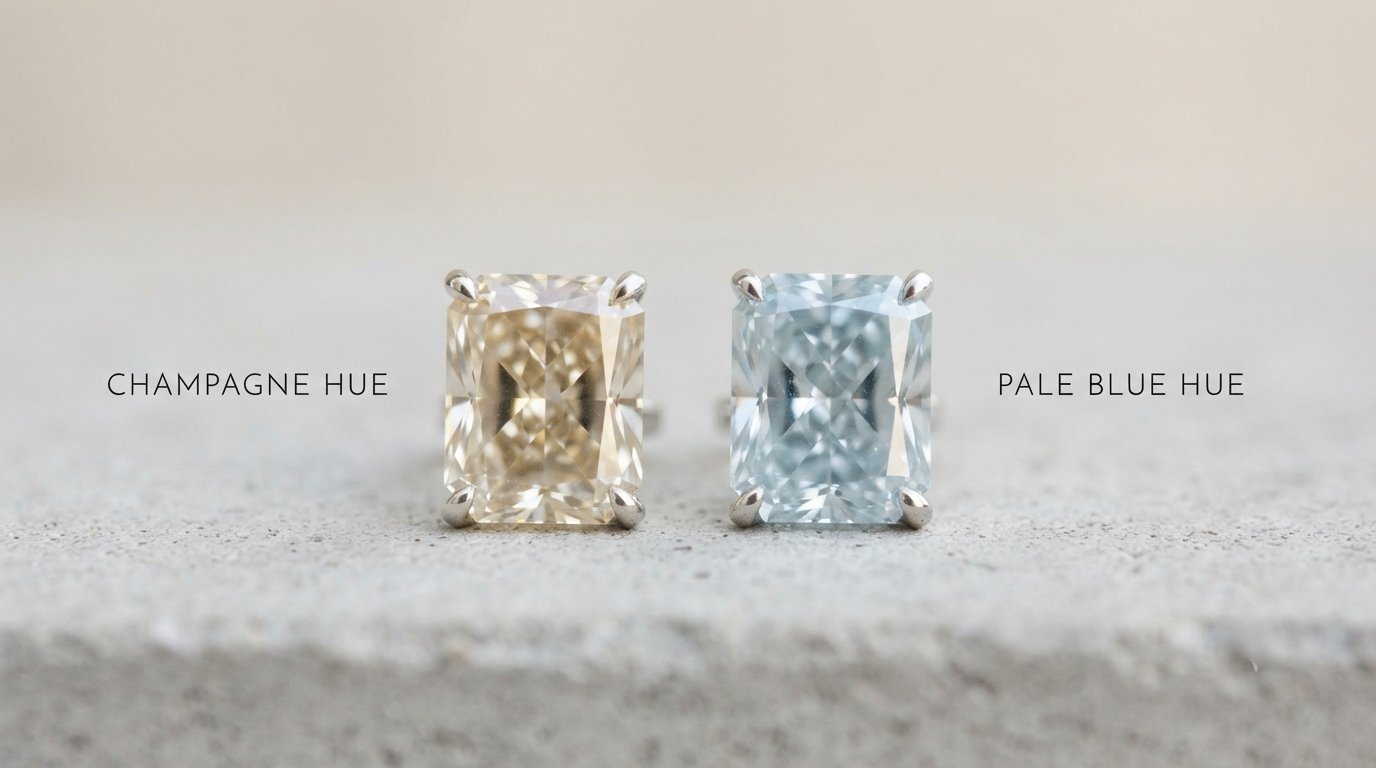
No, and this is the expectation most worth correcting early when sharing a partner memorial diamond. Stones from one shared source are siblings, not twins.
Each diamond is grown in its own run. Color in any diamond comes from trace elements present during crystal growth, nitrogen pushes toward yellow, boron toward blue, and the absence of both is what produces a colorless stone. Because personal carbon is an organic, uncontrolled feedstock, those traces vary between batches, which is precisely why memorial stones trend toward yellow, champagne and blue rather than colorless. The general reference on how these crystals are grown explains the mechanism; what color to expect from a partner’s carbon covers what that means in practice.
Clarity varies too, and it is the second surprise in sharing a partner memorial diamond. Memorial stones typically land somewhere in the SI2 to VVS range, graded against the same 4Cs as any other diamond. Two stones from one urn can differ in tone, in saturation, and in where their inclusions sit.
Three ways families handle it when sharing a partner memorial diamond:
- Accept the variation. Many people prefer it. Each stone is visibly its own thing rather than a set of copies.
- Order the same carat and cut. Matching the specifications you can control narrows the visible difference even when color does not match.
- Ask about color treatment. Post growth irradiation is sometimes used to shift a stone’s color, which can bring stones closer together. Ask whether it is offered at all, and what it costs, before assuming.
What no provider can honestly promise is a matched set produced on demand from one person’s carbon. If someone in your group is expecting that, better to find out now than at the unboxing.
How Much Does Sharing a Partner Memorial Diamond Cost?
Here is the part that changes plans. Sharing a partner memorial diamond does not divide a cost, it multiplies one. Each stone is an independent growth run, occupying its own press time, and is priced as its own purchase.
The bands below are industry typical figures for the category as a whole, not Memorial Diamond’s published pricing, and final cost turns on carat, color, cut, and whether you order an independent grading report:
| Stones from one shared source | Industry typical entry tier, 0.10 to 0.25 ct each | Industry typical mid tier, 0.5 to 1 ct each |
|---|---|---|
| One stone | roughly $1,500 to $3,500 | roughly $5,000 to $15,000 |
| Two stones | roughly $3,000 to $7,000 combined | roughly $10,000 to $30,000 combined |
| Three stones | roughly $4,500 to $10,500 combined | roughly $15,000 to $45,000 combined |
| Larger or rare stones, any number | priced individually; 2 to 5+ ct runs roughly $20,000 to $75,000+ each | Not applicable |
Read that table as a caution rather than a quote. The useful takeaway for anyone sharing a partner memorial diamond is that a group of three at a modest carat frequently spends less, in total, than one person at a large carat, so the honest opening question for a group is not how many of us but what size each. Settings, engraving and any grading report are usually quoted separately from the stone, worth confirming. What drives the price of a single stone breaks down each variable.
Two cost realities catch groups out when sharing a partner memorial diamond:
- Do not assume a discount for ordering together. Each stone is its own growth run, so ask whether any provider prices several differently, and do not build a budget on the answer being yes.
- A smaller stone is not a lesser stone. An entry tier diamond carries the same proportion of personal carbon as a larger one; carat is bought from growth time, not from the amount of ash submitted.
When the Answer Is No, or Not Yet
Sometimes the person who decides about sharing a partner memorial diamond simply declines. Sometimes the ashes were scattered years ago. Sometimes the group cannot agree, and pressing it would cost more than the stones are worth.
Options that remain open when sharing a partner memorial diamond is off the table for now:
- One stone, shared in a different way. A single diamond can be held by one person and worn at family occasions, or set in a piece designed to be passed on. Settings that can be changed or converted later matter more than usual when a stone is meant to move between people.
- The hair route. If anyone kept a lock, no cremated remains are needed and the authority question over the urn does not arise in the same form.
- Waiting. Cremated remains are stable and keep indefinitely. A family that says no this year is not saying no permanently, and nothing degrades while you wait.
- Reading the full route first. The complete guide to a partner ashes diamond lays out every stage, which is often what an undecided relative actually needs before agreeing to anything.
Frequently Asked Questions
How many diamonds can realistically come from one person’s ashes?
It depends on how much you hold rather than on any fixed limit. With a full cremation’s remains, several stones are usually feasible, since each takes only a few tablespoons up to roughly 4 oz. With a keepsake portion, often one or two.
Can each person choose a different size and color?
Yes. Each stone is a separate order with its own carat, cut and color specification, its own invoice, and its own finish date. Sharing a partner memorial diamond does not mean sharing one set of choices.
Do all the stones have to be ordered at the same time?
No. A second stone can be commissioned later from the same held ashes, provided material remains. The catch is timing: prices and offerings shift, and a later stone will differ visibly from the first regardless.
My partner’s family controls the ashes and barely acknowledged me. What now?
Ask anyway, and ask for one small portion rather than a change to the main arrangement. Authority varies by state and by anything left in writing. A framing of one stone each is often easier for a reluctant family to accept.
Can a portion be taken from ashes that are already interred?
That becomes a cemetery permissions question, not a material one. Columbaria and cemeteries set their own rules for removing interred remains, and local law may add more. Ask the cemetery in writing before planning anything around it.
If we split the cost of one stone, who owns it?
Nothing about the process settles that, so settle it yourselves in writing before ordering. Joint purchases of a single irreplaceable object cause the most friction later. Agree now who holds it, who insures it, and what happens eventually.
Final Thoughts on Sharing a Partner Memorial Diamond
The material answer to sharing a partner memorial diamond is the easy one: yes, in almost every case, because the portion each stone needs is small enough that one urn can serve several people without visibly changing.
Six things sharing a partner memorial diamond comes down to, in the order they decide it:
- The material is rarely the constraint. A stone takes a few tablespoons up to roughly 4 oz; a cremation is measured in pounds.
- Each stone needs its own portion. Portions are not subdivided after they arrive.
- Standing decides it, not arithmetic. Authority varies by state and by anything left in writing.
- The stones will not match. Separate growth runs, separate results.
- Sharing multiplies the cost. Three stones is three prices, not one split three ways.
- It cannot be undone. Waiting costs nothing; remains are stable and keep indefinitely.
The rest of it is a conversation, and it is a conversation worth having slowly. Who has the standing to authorize a division. What everyone expects the finished stones to look like. Who is paying for what, and what happens if someone changes their mind in month seven. Handled in that order, sharing a partner memorial diamond usually turns out to be one of the less contested decisions a family makes in a difficult year, and occasionally the one that brings people who disagreed about everything else into one room.
Learn More About Partner Memorial Diamonds
- How to Talk to Family About a Partner Memorial Diamond
- How Much Ash Do You Need for a Partner Memorial Diamond?
- Partner Ashes Diamond: The Complete Guide
- How Much Does a Partner Memorial Diamond Cost?
- Memorial Diamond Colors for a Partner: What to Expect
Talk With Memorial Diamond
If your family is weighing sharing a partner memorial diamond and you want a straight answer about what is possible with the material you actually hold, reach out to Memorial Diamond at memorialdiamond.us. Bring the numbers, how much you have, how many people, what carat each has in mind.
Leave A Comment