
The urn is usually already in the house by the time anyone reads a page like this, sitting somewhere you have not decided about. Read partner memorial diamond vs. urn as a fork in the road and you will get the decision wrong, because only a small portion of cremated remains is ever used for a stone. Most families do both. The rest is kept, interred, or scattered exactly as planned, which is why partner memorial diamond vs. urn is so often a false choice.
Now the disclosure this page cannot do without: Memorial Diamond grows memorial diamonds. We sell one of the two things being compared here, so this is not a neutral referee, and you should read every line below knowing that. What we can do is keep the comparison factual, keep the industry figures labeled as such, and not pretend an urn is a lesser choice. It is not. For many families it is the whole answer.
Table of Contents
Why This Is Rarely a Straight Either/Or
The arithmetic dissolves most of the conflict in partner memorial diamond vs. urn before the values question even starts.
A cremation produces remains measured in pounds. What a laboratory asks for is a few tablespoons up to roughly 4 oz, about 100 g, industry wide. Set them side by side and the framing collapses: a stone takes a jar’s worth, and the urn stays on the shelf, or goes into the ground, or goes out over the water in spring. The full arithmetic on how much ash a stone actually needs sets out why the figure is as small as it is.
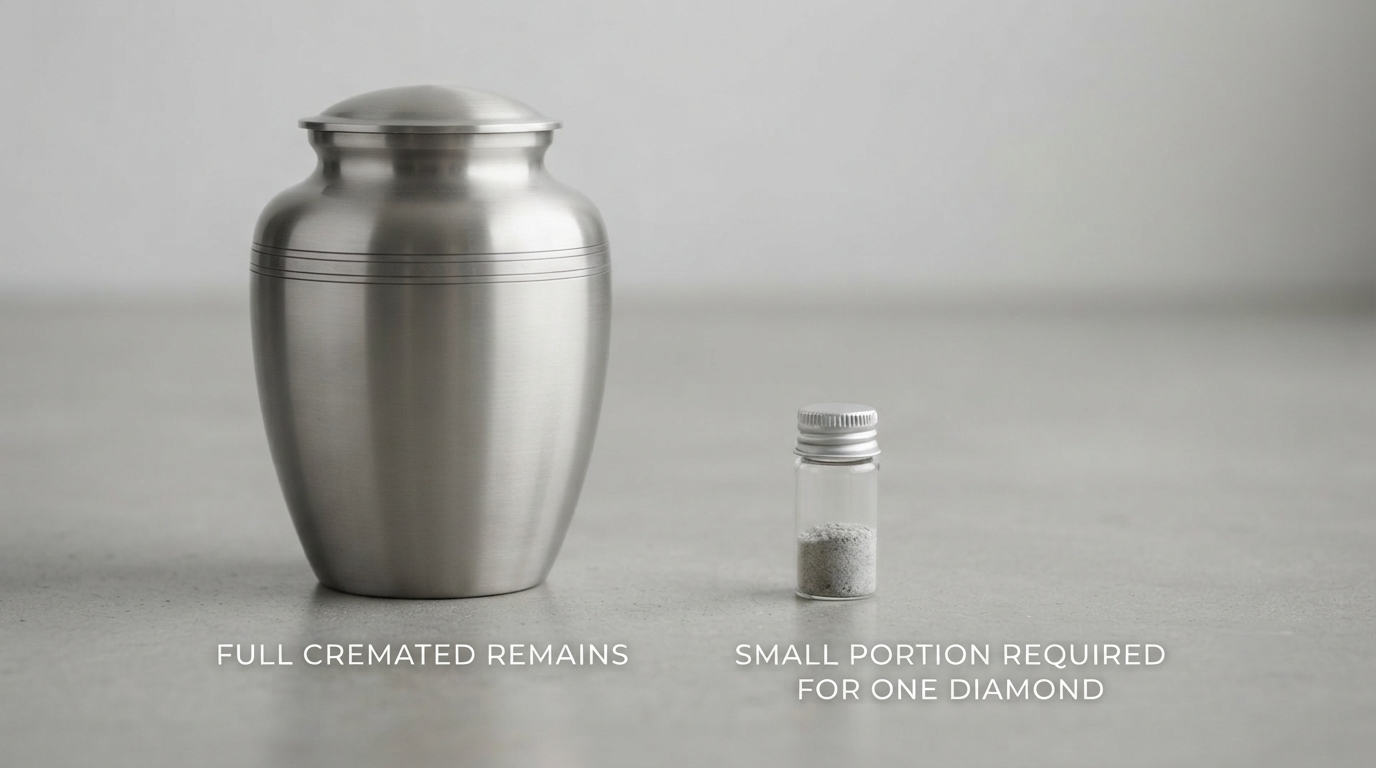
So the practical shape of partner memorial diamond vs. urn, for families who take both paths, looks like this:
- A portion leaves a small, measurable amount, set aside and documented.
- The remainder stays in whatever vessel or place was already chosen.
- Both plans proceed. An interment date does not move; a scattering is not canceled.
- More than one person can be served several stones usually come from one shared source, one per person, as this post on sharing one set of ashes explains.
There is a version of partner memorial diamond vs. urn that genuinely is either or: where the family holds only a keepsake portion, or where the person with authority over the remains will permit one thing and not the other. That is a permissions problem rather than a material one, addressed further down.
Cremation is now the majority path in the US. The NFDA’s 2025 cremation and burial report puts the projected 2025 rate at 63.4% against 31.6% for burial. That is why this comparison arises now and did not two generations ago.
What Each Option Actually Is
Set both things out plainly first, since partner memorial diamond vs. urn is often argued without either side being defined. Half the confusion in partner memorial diamond vs. urn comes from comparing a vessel to a process.
A traditional urn, the first half of partner memorial diamond vs. urn, is a container. Ceramic, metal, wood, biodegradable, or a niche in a columbarium. It holds the remains whole, it can be opened, its contents can later be divided, scattered, interred, or moved. It costs what the vessel costs, exists the day the remains are released, and asks nothing afterwards except a place to be.
A memorial diamond, the other half of partner memorial diamond vs. urn, is a real lab grown diamond containing carbon recovered from a portion of those remains. The carbon is extracted and purified to around 99.9%, converted to graphite at roughly 2,500 to 2,700°C, then grown into a crystal under about 6 to 8 GPa at 1,400 to 2,500°C. Because cremated remains are overwhelmingly calcium phosphate rather than carbon, usable carbon sits at roughly 0.5% to 4% of ash by weight, the recovered material is blended with supplemental lab carbon to reach a workable volume.
That figure matters in a partner memorial diamond vs. urn comparison and gets glossed over constantly. An urn holds all of what was returned to you. A diamond holds a real, traceable, verifiable fraction. A stone described as entirely the person is describing something the chemistry does not do. The honest claim, a genuine share of their carbon, permanently inside a crystal lattice, is remarkable enough.
Partner Memorial Diamond vs Urn: The Side by Side
The seven dimensions below are the ones that actually decide partner memorial diamond vs. urn. Cost is only one of them, and it is rarely the one that settles it.
| Dimension | Memorial diamond | Traditional urn | What tends to decide it |
|---|---|---|---|
| Portability | Wearable or pocketable; travels through airports and house moves | Fixed by weight and by where it sits; a niche cannot move at all | Whether your address or your access may change |
| Divisibility | Several stones can be grown from one shared source, one per person | Divisible, but dividing an urn is a visible, sometimes contested act | How many people feel they have a claim |
| Reversibility | None once carbon is extracted and grown | High. Ashes can be moved, divided, interred or scattered later | How settled the family is right now |
| Cost | Industry typical $1,500 to $3,500 at 0.10 to 0.25 ct; $5,000 to $15,000 at 0.5 to 1 ct; $20,000 to $75,000+ at 2 to 5+ ct | Typically the least costly option; a columbarium niche adds one off or ongoing fees | Budget, but also whether a niche carries recurring costs |
| Time to receive | Industry typical 6 to 10 months, up to 12 for large or specialty color stones | Immediate, at release from the crematory | Whether a date, an anniversary, a service, is driving this |
| What happens to the remainder | Unaffected; the remainder stays with whatever plan exists | Is the remainder, by definition | Almost nothing, which is the point of this row |
| What it asks of the next generation | No upkeep, but it needs an explanation and a named recipient | A place, a decision, sometimes a renewal fee, often deferred to whoever survives you | Whether anyone will be there to decide, and whether you want them to have to |
Two rows in that grid do more work than the rest. Reversibility is the one people underestimate. Partner memorial diamond vs. urn is not a symmetrical choice, because an urn keeps every option open and a growth run closes one permanently. And the last row is the one nobody raises at the funeral home, though it is often what the decision is really about.
Which One Travels, and Which One Stays?
This is where partner memorial diamond vs. urn stops being general and becomes specific to your situation, because partners are more likely than most to face a question about where an urn is allowed to live.
You may not own the home the urn sits in, or be the person the crematory released the remains to. If a relationship was not legally recognized, or not recognized by one or both families, the urn may be in a house you no longer have standing to enter. None of that is unusual, and all of it is worth facing before money is spent, because it can settle partner memorial diamond vs. urn on your behalf.
Who controls cremated remains has no nationwide answer. It is a matter of state law, modified by whatever your partner left in writing, a will, a disposition directive, a form signed at the funeral home. With legal recognition, the person who has the urn is generally also the person who may decide about it. Without it, that right can sit with an adult child, a parent, a sibling, or a former spouse.
This belongs in a partner memorial diamond vs. urn comparison rather than a legal footnote because it changes which option is even available to you:
- If the urn is yours, partner memorial diamond vs. urn is open in both directions, and doing both costs you nothing but a portion.
- If the urn is not yours, a portion set aside for a stone may be the only part of this you can hold, a far smaller ask than requesting the urn itself.
- If the urn will be interred or scattered, timing matters: once remains are in a niche or on the water, retrieval becomes a permissions question answered differently everywhere.
- If nobody has decided yet, that is the easiest position.
How to raise this with a family that may not see the relationship as you do covers the wording, which matters more in this conversation than in almost any other.
Can the Decision Be Undone?
One can, one cannot, and this asymmetry is the strongest practical argument in any honest partner memorial diamond vs. urn discussion.
An urn is the reversible side of partner memorial diamond vs. urn, in almost every direction. Remains can be moved, divided years later, interred, scattered, or split between people who did not speak at the funeral and do now. Nothing about keeping an urn forecloses anything, including a diamond later, and cremated remains are stable while a family works out what it wants.
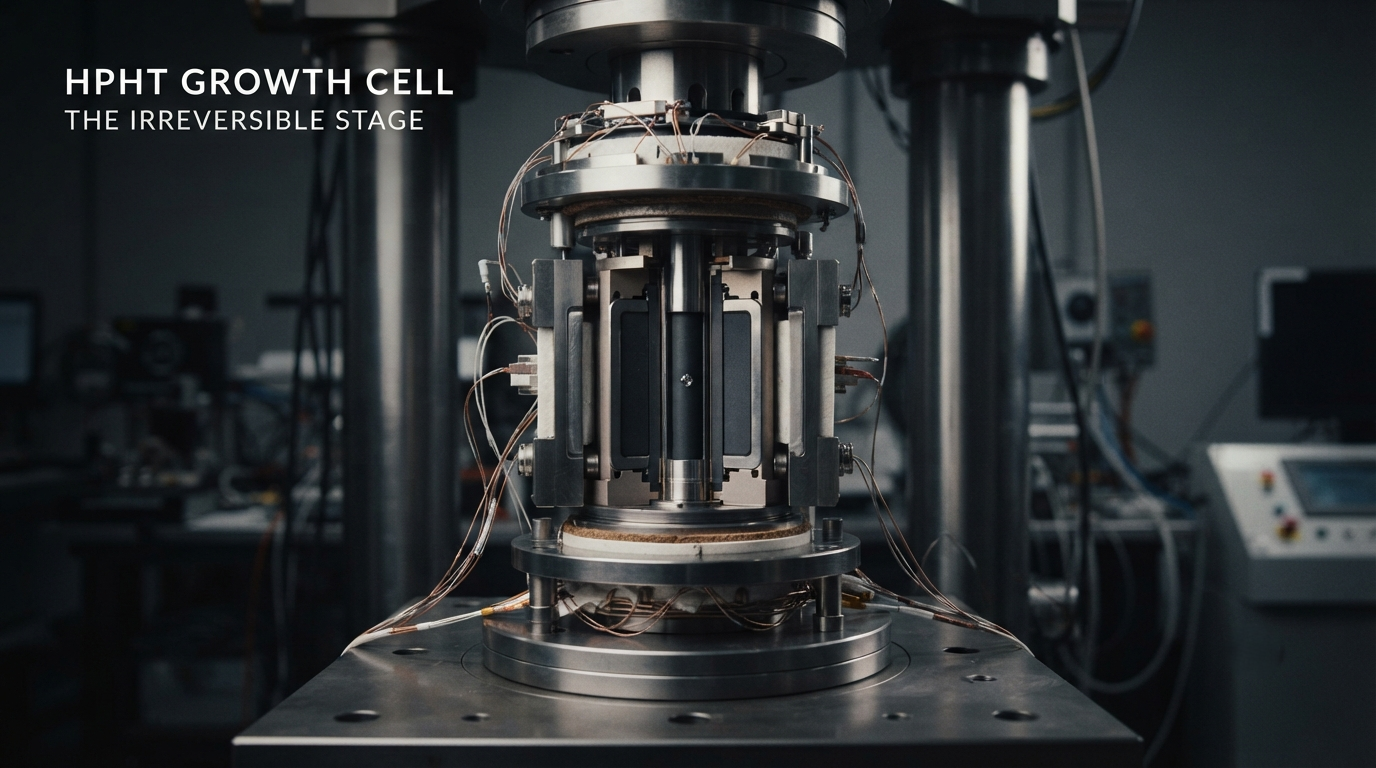
A memorial diamond, the other side of partner memorial diamond vs. urn, is not reversible. Extraction is chemical: once a portion has been purified and graphitized, it no longer exists as remains. That is the fact that should slow anyone deciding inside the first weeks after a death.
So the sequencing advice that falls out of partner memorial diamond vs. urn, stated plainly:
- Keep the remains intact while anything is unresolved. There is no deadline.
- Decide who has authority before you decide what to do, not after.
- Take the reversible step first if you are unsure. That is the urn, and it costs nothing in options.
- Commission the stone when the answer has stopped moving for many families, past the first year.
The one genuine counter pressure in partner memorial diamond vs. urn is timing rather than urgency: the industry typical wait is 6 to 10 months, up to 12 for larger or specialty color stones, so a family aiming at a particular anniversary works backwards from it. How the timeline breaks down stage by stage is the place to check that before promising anyone a date.
What Does Each One Ask of the Next Generation?
Most partner memorial diamond vs. urn comparisons stop at cost. This row is the one families wish they had thought about, and it cuts both ways.
An urn asks for a place. Someone has to house it, pay for the niche, or decide what happens when the person who chose the shelf is no longer there. In practice that often lands on someone who never knew your partner. Not a criticism of urns, simply what a physical object in a home becomes.
A diamond asks something different, and this is the least discussed row in partner memorial diamond vs. urn. It needs no upkeep: nothing scores above diamond on the Mohs scale of mineral hardness, where it sits at 10, and the stone outlasts every setting it is ever mounted in. But a small, unlabeled stone means nothing to anyone who does not know what it is. Three things make the difference:
- Name a recipient, in writing. A stone with no named destination ends up in an estate sale.
- Keep the paperwork with the piece. An origin or authenticity document, plus any grading report, is what turns a gem into a record.
- Tell at least one other person what it is. The object does not carry its own story.
Those three habits are the difference between an heirloom and a puzzle, and they cost nothing, which is why this row of partner memorial diamond vs. urn rarely turns on money. What to have the stone set in, and which settings can be changed later matters here, since a piece meant to be handed on is designed differently from one worn daily.
Where Memorial Diamond Fits, and Why We Are Not a Neutral Voice
Stated once more, plainly, because it belongs in the body of a comparison and not in small print: Memorial Diamond grows memorial diamonds. This page runs partner memorial diamond vs. urn as a comparison between our own product and an alternative we do not sell. That is a structural conflict of interest, and the appropriate response is to weigh the factual claims and discount the framing.
What can be said without conflict:
- An urn is a complete and honorable answer, and nothing in partner memorial diamond vs. urn changes that. So is burial. So is scattering. None of them is a lesser choice, and no reader should take anything on this page as an argument otherwise.
- The figures above are industry wide bands, not Memorial Diamond’s own price list. What drives the price of a single stone breaks the variables down.
- The honest case for a diamond in partner memorial diamond vs. urn is narrow and specific: it is portable, it is divisible among several people, it requires no maintenance, and it takes only a portion. That case does not require an urn to be worse.
- The honest case against is equally specific: it costs more, takes most of a year, and cannot be undone.
For the full route rather than the comparison, the complete guide to a partner ashes diamond covers every stage; where to start if the decision is still open is the better first read in the early weeks.
Frequently Asked Questions
Do I have to choose between an urn and a diamond at all?
Usually not. A stone takes a few tablespoons up to roughly 4 oz, so the urn, the interment or the scattering all still go ahead. Partner memorial diamond vs. urn is an either or only when you hold a keepsake portion.
Is a diamond more permanent than an urn?
On permanence, partner memorial diamond vs. urn is not really a hardness question. The stone is harder, at 10 on the Mohs scale, but permanence here is social. A ceramic urn in a stable family outlasts a diamond nobody can identify. Naming a recipient matters more.
Which costs less overall?
An urn, almost always, and often by a wide margin. A columbarium niche can carry recurring or renewal fees worth asking about, but nothing in the diamond tiers competes with a vessel on price.
Can we start with the urn and decide about a diamond later?
Yes, and in partner memorial diamond vs. urn it is the safer order. Cremated remains are stable and keep indefinitely, so nothing is lost by waiting a year. The reverse is not true, since extraction cannot be reversed once a portion has been processed.
My partner’s family holds the urn. Does that end it?
Not necessarily. Authority over remains varies by state and by anything left in writing, and a request for one small portion is a much smaller ask than a request for the urn. Find out who holds authority before anything is spent.
What happens to the part of the portion that is not turned into carbon?
That is company policy rather than chemistry, and providers differ. Before sending anything, get it in writing: is the remainder returned as a matter of course, in what form, and at what point in the process?
Final Thoughts on Partner Memorial Diamond vs Urn
The one thing to take from this page: partner memorial diamond vs. urn is a smaller question than it feels. A portion, not the whole. A jar’s worth out of something measured in pounds. Whatever was already planned for the rest still happens, on the same date, in the same place.
What remains is genuinely a choice, and not one a diamond company should make for you. An urn on a shelf, a niche with a name on it, a stretch of water in spring, each is a full answer, and partner memorial diamond vs. urn is a live question only because a portion can be set aside without disturbing any of them. Decide who has authority, decide what is reversible, then take your time.
Learn More About Partner Memorial Diamonds
- How Much Ash Do You Need for a Partner Memorial Diamond?
- Partner Ashes Diamond: The Complete Guide
- How Long Does It Take to Make a Partner Memorial Diamond?
- Choosing a Memorial Diamond for Your Partner: Where to Start
- How Much Does a Partner Memorial Diamond Cost?
Talk With Memorial Diamond
If you are working through partner memorial diamond vs. urn and want a straight account of what a portion would and would not affect, reach out to Memorial Diamond at memorialdiamond.us. Ask what we cannot do as readily as what we can, a fair test of any company here, including this one.
Leave A Comment