
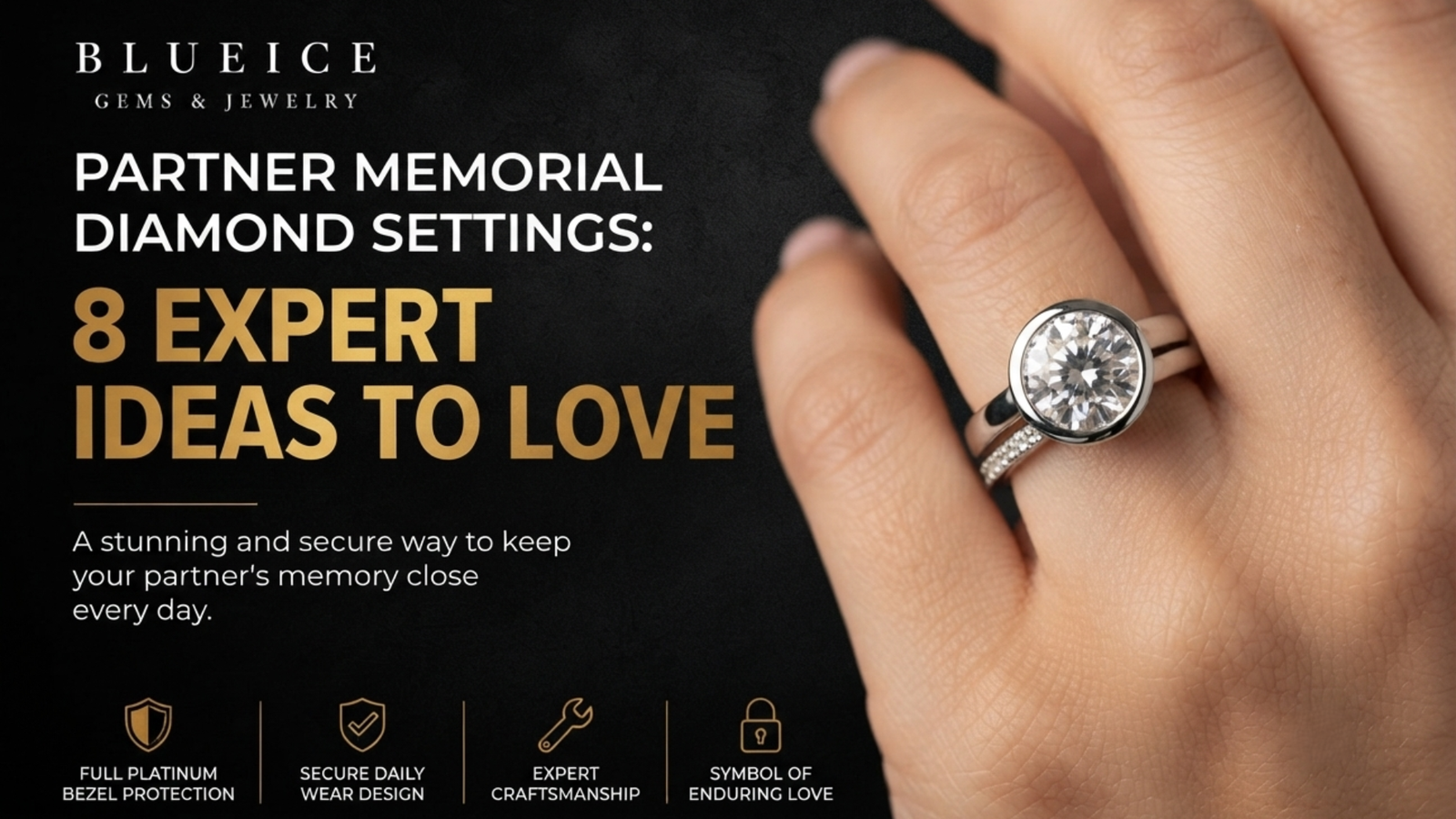
You already know you want to wear it. What nobody tells you then is that the stone is the durable half of the object and the setting is the half that fails. Partner memorial diamond settings should be chosen the way you would choose a mount for something that cannot be replaced: metal that deforms rather than wears away, a setting style that covers as much of the girdle as you can accept, and a jeweler who is told in writing what they are holding. The diamond is Mohs 10. Nothing around it is.
Memorial Diamond grows these stones, so this page is not disinterested. It assumes you have already decided on jewelry. The concept level tour of rings, pendants and keepsakes lives in partner memorial diamond ideas. What follows is the engineering underneath those ideas, which is where partner memorial diamond settings are actually decided.
Table of Contents
The One Fact That Governs Everything Else
Diamond sits at 10 on the Mohs scale of mineral hardness, and that is why a memorial stone outlives everyone reading this. Hardness only describes resistance to scratching, though. It says nothing about toughness, and diamond has cleavage planes. A sharp strike at the wrong angle can chip a girdle that a lifetime of abrasion never would.
So there are two failure modes worth designing partner memorial diamond settings against, and only one of them involves the stone at all:
- The stone leaves. A worn prong, a bent claw, a loosened bezel. Much the likelier of the two, and a property of the metal and the workmanship in partner memorial diamond settings rather than of the diamond.
- The stone chips. Rare, but possible on an exposed girdle or a sharp corner in a princess or marquise cut, and not repairable without recutting to a smaller weight.
The reason to think hard about partner memorial diamond settings is not that the diamond is fragile. It is that the diamond is the only part of the assembly that cannot be remade, and every part holding it is consumable.
Which Metal Should Hold a Stone You Will Never Replace?
Metal is the decision most people make last and should make first. It sets how partner memorial diamond settings age, whether they can be altered, and how often a bench jeweler has to handle the stone.
| Metal | How it wears | Aging and upkeep | Can it be resized or re tipped? | What it does to a tinted stone |
|---|---|---|---|---|
| Platinum | Displaces rather than abrades. A worn prong moves metal aside instead of losing it | Develops a matte patina; polishing restores shine | Yes, readily. The usual recommendation for prongs in partner memorial diamond settings | Neutral and cool; shows a tint honestly |
| 18k yellow gold | Softer than 14k; prongs thin faster in daily wear | Stable color, no plating to renew | Yes, by any competent bench | Warms the stone; can make a light yellow read almost colorless |
| 14k yellow gold | Harder alloy, longer prong life than 18k | Stable color, minimal upkeep | Yes | Warms, less than 18k |
| White gold | Wears as gold does, under a rhodium plate | Plating dulls and yellows; replating every one to three years is normal | Yes, though replating follows any bench work | Bright and cool while plated, warmer as the plate goes |
| Rose gold | Copper content makes it hard wearing | Stable; deepens slightly over decades | Yes | Flatters warm stones; argues with blue |
| Sterling silver | Soft; prongs deform under ordinary knocks | Tarnishes; needs frequent cleaning | Yes, but the softness does not change | Cool toned, and the wrong choice regardless |
| Titanium, tungsten, ceramic | Extremely hard, effectively wear proof | Almost no upkeep | No. Cannot be sized, and setting options are limited | Not a realistic carrier for an irreplaceable stone |
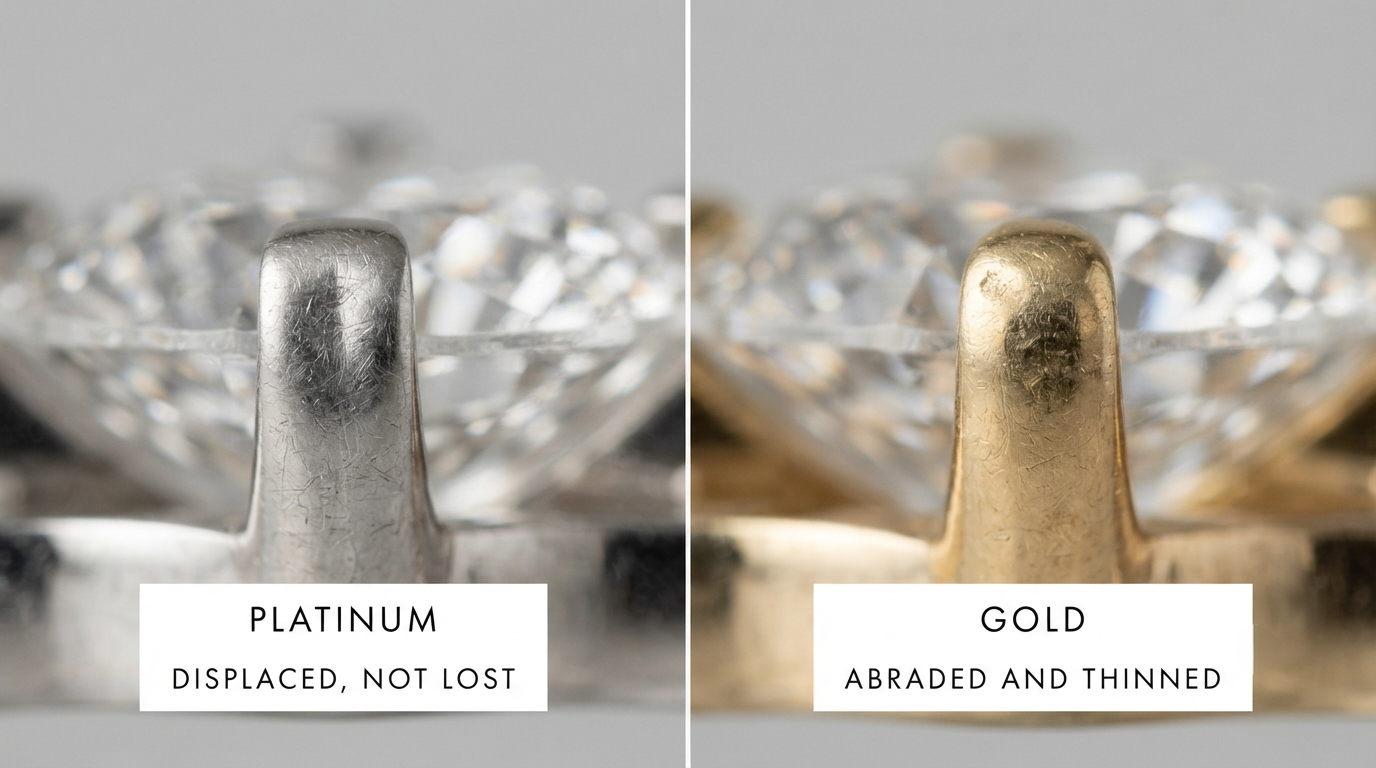
One label before you use that table: none of it is a published figure. It is general jewelry bench practice, how these metals behave at the bench, and how a tinted stone reads against them in ordinary light, and a bench jeweler may put it differently. Read the fourth column before the fifth. Among partner memorial diamond settings, the metals that cannot be resized or re tipped are the ones to rule out first, because this object has to follow hands that change over forty years.
Two notes decide most of these choices:
- Platinum and 14k are the workhorse answers for partner memorial diamond settings. Platinum for prongs, because worn metal stays on the ring; 14k because it resists thinning better than 18k.
- White gold is a subscription. Replating is cheap, but it is a recurring appointment for the life of the piece, and every appointment is another handling of the stone.
If the stone’s color is not settled, decide the two together. What to expect from memorial diamond colors for a partner explains why yellow gold tends to hide a warm tint and white metal to expose it. Again, this is general practice, not a measured figure.
Which Partner Memorial Diamond Settings Protect the Stone Best?
One trade off governs this whole list: every millimeter of metal protecting the girdle is a millimeter of stone you cannot see. The table runs from most protective to most exposed, an editorial ranking from general bench practice rather than a measured scale.
| Setting | How much of the stone it covers | Protection in daily wear | What it costs you | Best suited to |
|---|---|---|---|---|
| Full bezel | A continuous rim around the whole girdle | The highest available; eliminates snagging | Side light; the stone can look smaller | Hands on work, healthcare, anyone who cannot remove a ring |
| Half bezel | Two opposing arcs of the girdle | Nearly bezel grade where covered, open elsewhere | Less than a full bezel, and a cleaner line | The compromise most people settle on |
| Flush or gypsy | Sunk into the metal, table level with the surface | Very high; nothing protrudes | Only the table shows; no side sparkle | Broad bands, anything worn under gloves |
| Halo with a bezel center | The girdle plus a ring of accent stones | High for the center; the accents need watching | Complexity, and more bench work near your stone | Making a small stone read larger |
| Six prong | Six narrow points on the girdle | Good; losing one of six is survivable | Prongs snag on fabric and thin over time | Round brilliants |
| Four prong | Four points on the girdle | Adequate, but losing one of four is not survivable | The same snagging, less redundancy | Maximum light and visibility |
| Tension or floating | Almost nothing; held by pressure or a minimal cage | The lowest of the partner memorial diamond settings here, and rarely resizable | High visual impact | Stones not worn daily |
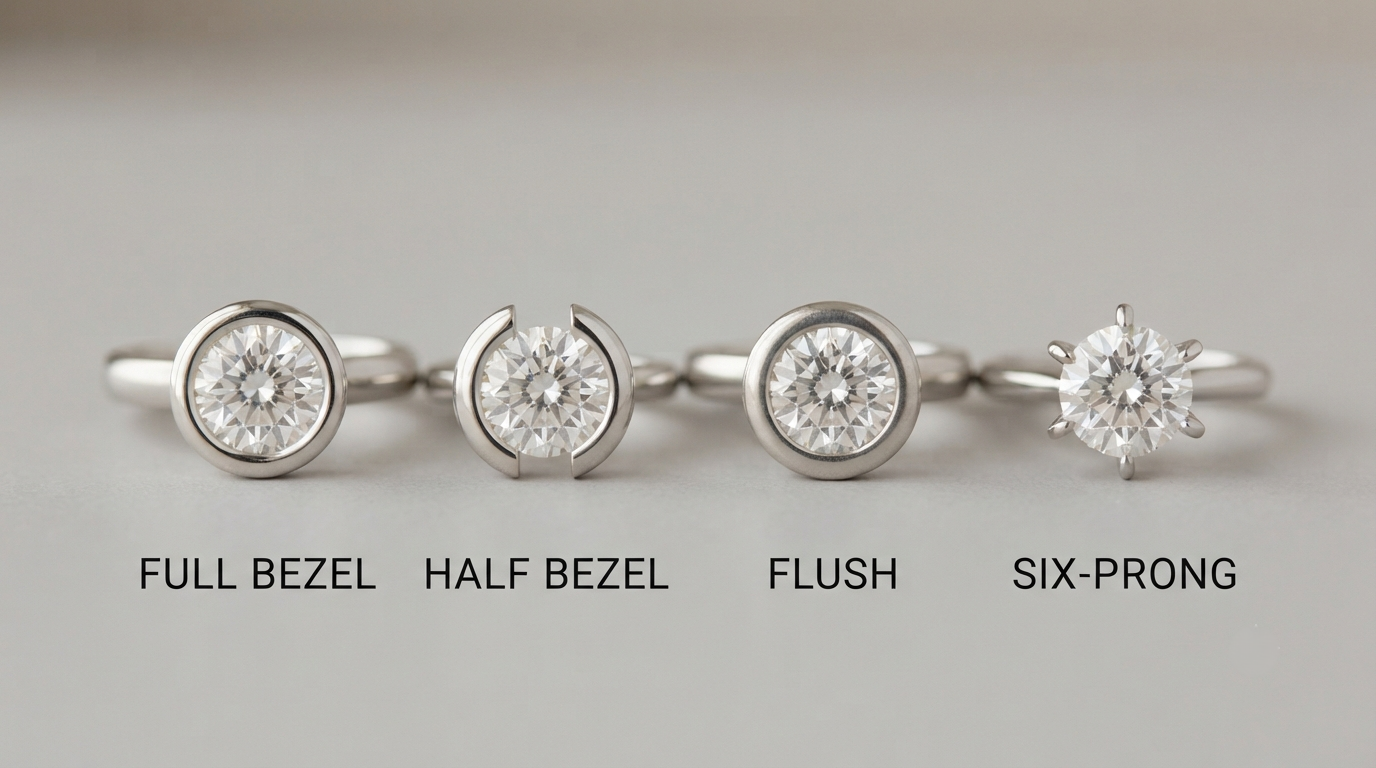
Rank your own life before you rank the list. Among partner memorial diamond settings, the bezel family keeps turning out to be the right answer for people who never take the piece off; prong settings are the ones that photograph best the week they arrive.
A pendant changes the arithmetic. A stone on a chain takes far less impact than one on a hand, so more exposed partner memorial diamond settings become defensible. The failure mode moves to the bail and the clasp. Specify a soldered jump ring and a clasp rated above the weight it carries, and have the chain checked as often as you would check prongs.
Can It Be Resized or Reset Later?
Usually. Whether partner memorial diamond settings can be altered later depends almost entirely on decisions taken at the start.
Rings get resized. Fingers change with age, weight, pregnancy, arthritis and heat. If a ring has to follow yours, partner memorial diamond settings need a plain, unset section at the bottom of the shank. A band set all the way round cannot be cut and rejoined without dismantling part of it.
Resetting is a different job. A stone set in a ring at forty may become a pendant at seventy, or may move into a new mount when the first one wears out. That is normal, and what makes it safe is procedural:
- Get the stone’s measurements, and any grading report, at handover, and keep them apart from the piece. That is how you confirm the stone coming back is the stone that went in.
- Photograph it in good light, top and side, before any bench work.
- Ask for the stone to be unset before any torch work, not protected in place. Heat near a set diamond is the risk worth avoiding, and removal takes minutes.
- Ask whether the work is done on site. Pieces sent to a trade workshop travel, and travel separates paperwork from stones.
- Keep the original mount. It is part of the object’s history and costs nothing to store.
Rebuilding partner memorial diamond settings takes ordinary jewelry timelines, measured in weeks. That bears no relation to the 6 to 10 months the stone itself typically takes to grow, up to 12 for larger or specialty color stones, which how long a partner memorial diamond takes sets out in full.
What Does a Jeweler Need to Know Before Touching It?
That it is irreplaceable, and that they should say so back to you before they take it.
Be direct, because a jeweler handles hundreds of interchangeable stones and cannot know yours is not one of them. Partner memorial diamond settings are ordinary bench work; the stone in them is not, and the gap between those two facts is where accidents live.
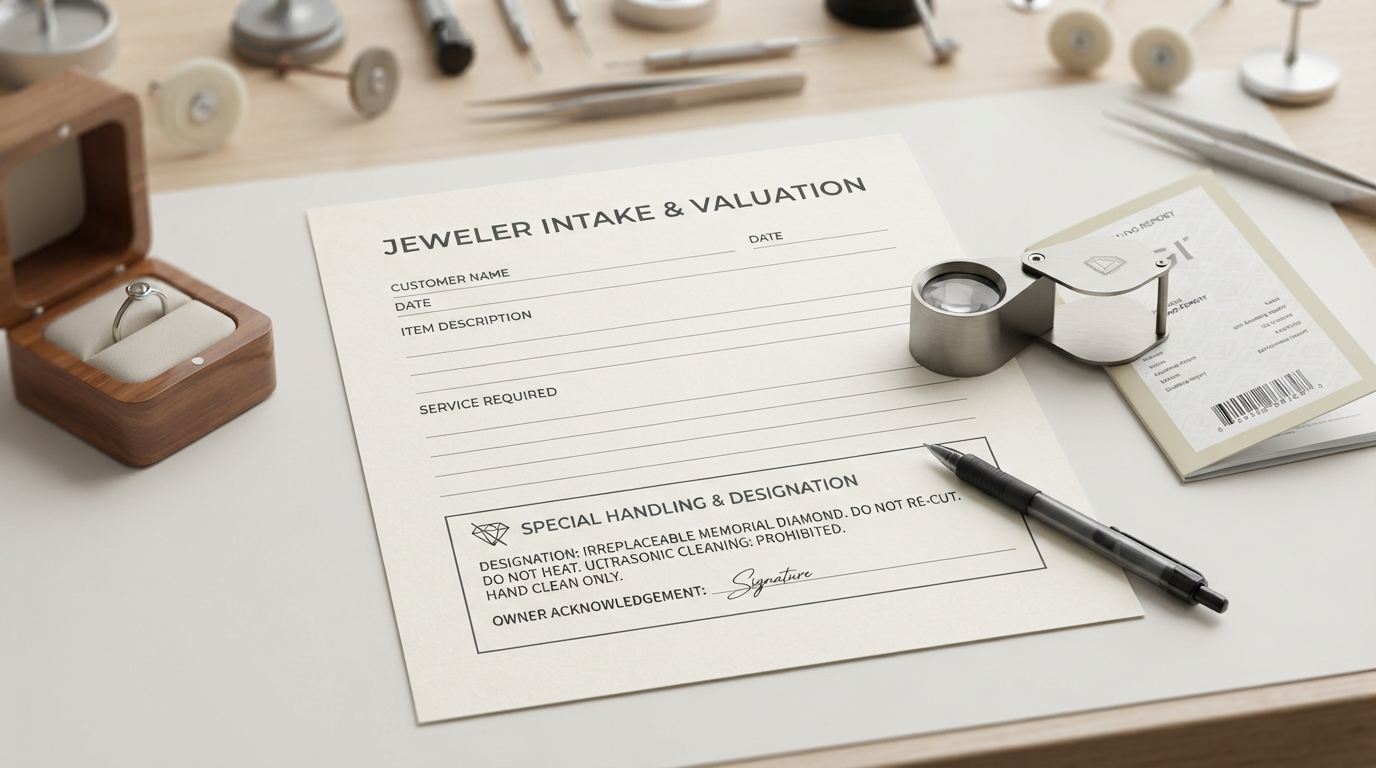
Put the following in the intake paperwork, not in conversation:
- A written description of the stone, carat, cut, color, clarity, measurements, any report number.
- A statement that the stone is a memorial diamond and cannot be replaced. Ask for it on the job ticket, not merely acknowledged.
- No recutting, repolishing or laser inscription without written approval, which guards against a well meant “we tidied up the girdle for you”.
- Your instruction on ultrasonic and steam cleaning. Clarity across memorial stones typically runs SI2 to VVS, and stones with feathers or reaching inclusions are not automatically safe in either. Ask for hand cleaning if you would rather not find out.
- Who to call if something is found wrong before work starts rather than after.
Any bench that finds this fussy is telling you something useful for free, and any bench that writes it down is the one to hand your partner memorial diamond settings to.
How Do You Insure Something With No Replacement?
Carefully, and with a professional who is not a jewelry company. Insuring partner memorial diamond settings is straightforward; insuring what sits in them is not.
Insurance here runs into one honest problem: standard jewelry cover is written around replacement, and this stone cannot be replaced. A policy may pay a sum matching the appraised value of a comparable diamond, and that money buys a diamond not made from your partner. Know which of those you are buying before you pay a premium.
That is the limit of what a jeweler can usefully say. Agreed value policies, scheduled personal property riders, deductibles and how a claim settles are questions for a licensed insurance agent or broker, and the answers vary by insurer and by state.
What you can usefully prepare in advance:
- An independent grading report, if you order one. Grading is optional, and insurers generally want a report because it puts the 4Cs on a recognized scale. The GIA’s explanation of the 4Cs covers the vocabulary any appraisal uses.
- An appraisal for the piece as set, since the mount is valued separately, and partner memorial diamond settings in platinum are a line item of their own.
- Photographs and the original invoice, stored off the premises rather than in the drawer with the box.
- A note of what the piece is, because an adjuster reading “memorial diamond” needs context to handle a claim sensibly.
A word on cost, since it shapes what you insure: entry stones of roughly 0.10 to 0.25 ct run about $1,500 to $3,500 industry wide, 0.5 to 1 ct typically $5,000 to $15,000, and 2 ct and above from roughly $20,000 to $75,000 and beyond, before partner memorial diamond settings are added on top. Those are category wide figures rather than Memorial Diamond’s published prices, and what a partner memorial diamond costs breaks down what moves them.
Who Holds It After You?
This lands differently for partners than for anyone else, and it is worth answering early.
A piece of jewelry is personal property. It passes under a will, or under your state’s intestacy rules if there is none, and those rules are written around marriage and blood relationships. If your relationship was not legally recognized, the person you would want to have this may have no automatic claim. Partner memorial diamond settings holding a stone grown from someone’s remains are exactly the object families argue over later.
Three things close that gap, none of them expensive:
- Name the piece specifically in a will, by description rather than category. “My platinum bezel ring set with the memorial diamond” leaves no room for interpretation.
- Write down what it is and where the paperwork lives, so whoever opens the drawer understands the object.
- Say it out loud to the people concerned, before it is relevant. How to talk to family about a partner memorial diamond covers that conversation, which is easier held once than litigated later.
The same reasoning runs the other way if more than one person wants a stone from the same source. Several mounts from one shared origin is a common arrangement, and whether more than one family member can have a diamond is worth settling before the first run rather than after the first ring.
Frequently Asked Questions
How often should the setting be checked?
Every six to twelve months for a ring worn daily, yearly for a pendant. A jeweler checks prong tension, wear at the claw tips and bezel security. Stones lost from partner memorial diamond settings are almost always lost to a prong nobody inspected.
Is a bezel really safer, or does it just look safer?
Genuinely safer. A bezel covers the girdle, removes protruding claws and cannot snag. It is the most protective of the common partner memorial diamond settings, and the trade is side light and a slightly smaller looking stone.
Can the stone go into an existing ring of my partner’s?
Often yes, and it is a meaningful thing to do. Have the old mount assessed first for metal fatigue and a thin shank, because existing partner memorial diamond settings may need rebuilding before carrying a stone you cannot replace.
Does the stone need special cleaning?
Warm water, mild soap and a soft brush handle almost everything. Ask before an ultrasonic or steam clean, since some inclusions respond badly to both. The metal in partner memorial diamond settings needs the attention, not the diamond.
Can I have it engraved?
The mount, yes. A date, a name, a few words inside a shank, on most partner memorial diamond settings. Laser inscription on the girdle of the stone itself is a separate question, raised with the grower before the stone is finished rather than after.
What if I want a completely different piece in twenty years?
Normal, and entirely possible. Stones move between mounts throughout their lives. Keep any report and the measurements, use a jeweler who unsets before applying heat, and partner memorial diamond settings can be rebuilt around the same stone as often as you like.
Final Thoughts on Partner Memorial Diamond Settings
The stone will be fine. It is harder than anything it will meet in an ordinary life. What needs attention is everything around it. Partner memorial diamond settings come down to four things: a metal that can be worked on, a setting that covers the girdle, a jeweler told in writing what they are holding, and a six monthly appointment that takes ten minutes.
Get those four right and partner memorial diamond settings stop being a risk and become what they should be: a design decision you can change your mind about in thirty years, with the same stone still in the middle of it.
Learn More About Partner Memorial Diamonds
- Partner Memorial Diamond Ideas: Rings, Pendants, and Keepsakes
- Memorial Diamond Colors for a Partner: What to Expect
- How Much Does a Partner Memorial Diamond Cost?
- Can More Than One Family Member Get a Diamond From the Same Partner’s Ashes?
- How Long Does It Take to Make a Partner Memorial Diamond?
Talk With Memorial Diamond
Setting decisions are reversible. That is the most reassuring sentence here, worth holding onto if you are choosing among partner memorial diamond settings while nothing else feels settled.
Three questions are worth asking any provider first. Ask whether the stone can be supplied loose. Ask what documentation comes with it, measurements, report, invoice, and whether it arrives with the stone. Ask which partner memorial diamond settings they will and will not build in house. memorialdiamond.us will answer those plainly, and so should anyone else.
Take as long as you need over the ring. The stone is not going anywhere.
Leave A Comment