
Two materials means two of almost everything, two assessments, two sets of permissions, two lines on an intake record, right up until the moment they stop being two things at all. The partner ashes hair diamond steps are best understood as two tracks running at different speeds that converge once, late, at the growth cell; before that point the ash and the hair are handled, judged and documented separately. Where they converge, and what happens if one track fails, is the whole of the decision making here.
Memorial Diamond grows these stones, so read this as an interested account. Figures given below are industry wide bands rather than requirements we publish.
Table of Contents
The Partner Ashes Hair Diamond Steps Run on Two Tracks
The temptation with a dual source order is to picture one parcel going out and one stone coming back. That is not how the partner ashes hair diamond steps behave, and the model matters because it changes what you decide and when.
Ash and hair are chemically different problems. Cremated remains are dominated by calcium phosphate, with usable carbon at roughly 0.5% to 4% by weight. Hair is roughly 50% carbon, keratin being a carbon rich protein. A facility extracting carbon from each runs two recoveries with two yields and two failure modes.
So the partner ashes hair diamond steps carry a duplicate structure through their early stages: separate assessment, separate permission questions, separate identifiers, separate purification. Only after both have become purified carbon does a single decision, one growth charge, make them one object.
That convergence point is the useful thing to know. Everything before it can be staged, delayed or abandoned one track at a time. Everything after it is joint and final.
It also explains a question families ask late and should ask early: which contribution is larger in the finished stone. There is no answer, because once two purified carbons are weighed into one charge alongside lab grown carbon, no analysis distinguishes them. The only decision that controls the proportions is how much of each material you send, and the partner ashes hair diamond steps place it before intake rather than after.
Are the Two Sources Assessed Separately or Pooled?
Separately, and this is the most common misunderstanding about the partner ashes hair diamond steps.
Material requirements are normally stated per material rather than as a combined total, and the partner ashes hair diamond steps honor that separation throughout, though it is worth asking any provider to confirm it in those terms. The industry typical ash figure is a few tablespoons up to roughly 4 oz, about 100 g. The industry typical hair figure is a small lock, a few grams. Those are not two halves of one total. Sending half the ash figure and half the hair figure does not add up to a viable submission; each is assessed against its own threshold on its own terms.
| Stage | What the ash track is doing | What the hair track is doing | Are they joined yet? |
|---|---|---|---|
| Assessment | Weighed against the ash requirement; storage condition reviewed | Weighed against the hair requirement; provenance and condition reviewed | No, two separate judgments |
| Permission | Requires authority over the remains, which may rest with someone else | Usually a simpler question in practice where the sample is already in your own home | No, two different questions entirely |
| Intake | Logged, weighed on arrival, given an identifier | Logged, weighed on arrival, given its own identifier | No, ideally two records |
| Purification | Mineral matrix stripped away; thin yield, large input | Non carbon fraction of keratin removed; rich yield, small input | No, different recoveries |
| Graphitization | Purified carbon taken to roughly 2,500 to 2,700°C | Purified carbon taken to the same temperature range | Usually not, ask |
| Growth charge | Combined with the hair carbon and supplemental lab carbon | Combined with the ash carbon and supplemental lab carbon | Yes, this is the convergence |
| Cutting, then optional independent grading | One rough, one stone, one report if you order it | One rough, one stone, one report if you order it | Yes, permanently |
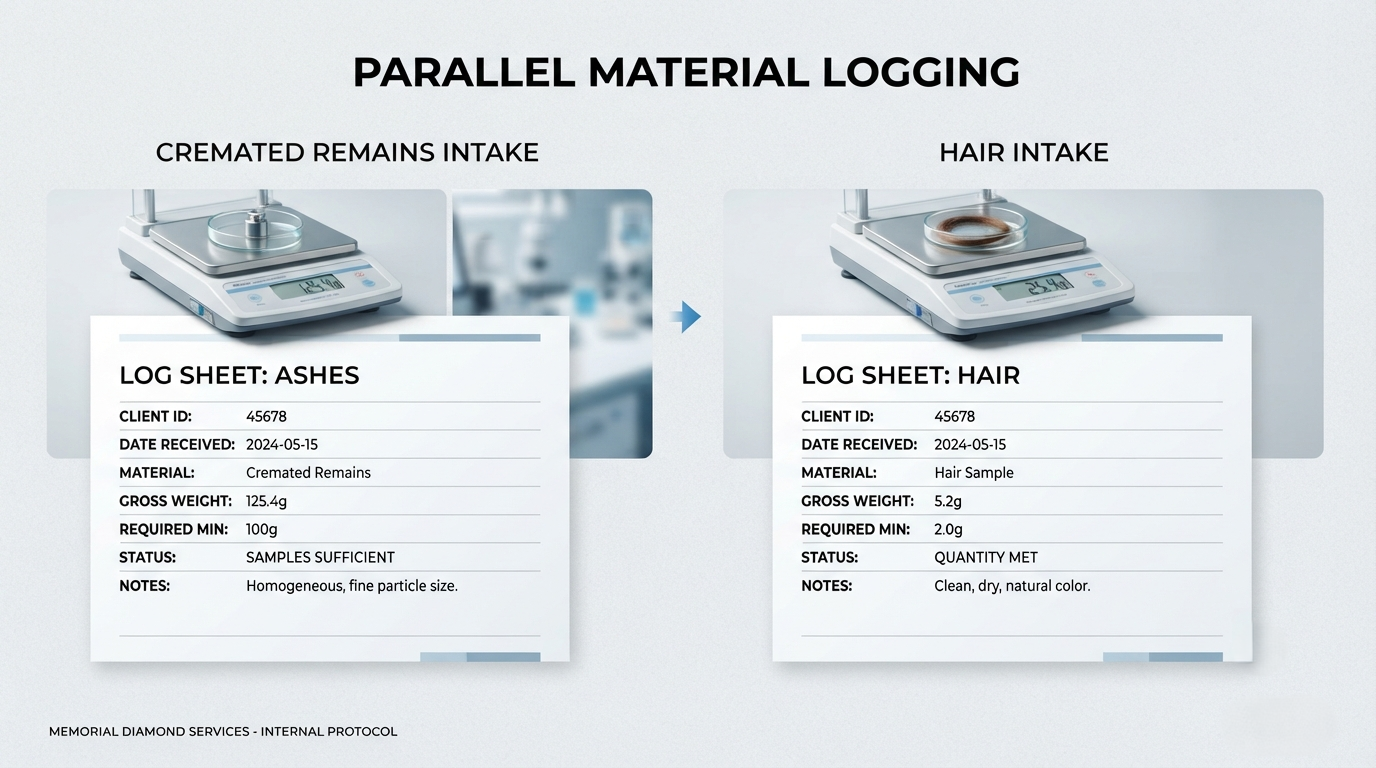
Read the right hand column as a cancellation map. Up to the growth charge, the partner ashes hair diamond steps are two projects that happen to share an order number. After it, they are one crystal and nothing distinguishes the contributions.
One qualification belongs inside the partner ashes hair diamond steps and applies to both tracks equally. Neither material supplies enough carbon to fill a growth cell on its own, so lab grown carbon makes up the bulk of the charge. The figure usually quoted for the personal share, roughly 10 to 15% of the finished stone, with some providers citing figures as low as 3%, is an ash route figure.
No published industry figure covers a blended ash and hair charge, and the partner ashes hair diamond steps do not create one. What two sources definitely do not do is double the personal share. If the proportion matters, ask what your particular submission is expected to contribute and ask for it in writing. Whether a dual source stone contains more of your partner is worth reading if that is the question underneath your question.
In What Order Do the Partner Ashes Hair Diamond Steps Run?
Seven partner ashes hair diamond steps, with the duplication concentrated in the first four.
- Separate assessment. Each material is judged against its own industry typical figure, quantity and condition for the ash, quantity, condition and provenance for the hair. Nothing is committed.
- Permissions, resolved per material. The hair is usually straightforward. The ash frequently is not, and that asymmetry is dealt with in its own section below.
- Staged commitment. You decide which material is released first, and whether the second is held back pending the first’s assessment result.
- Documented intake, twice. Each material arrives sealed and labeled, is weighed on receipt, and is logged against its own identifier.
- Purification, run separately. Each is heated in a controlled, oxygen free process to roughly 99.9%+ carbon purity, with very different amounts of material removed on each track.
- Graphitization and the growth charge. Purified carbon becomes graphite at roughly 2,500 to 2,700°C, the two contributions are weighed into one charge alongside supplemental lab carbon, and that charge sits under roughly 6 to 8 GPa at between 1,400 and 2,500°C in an HPHT cell until the crystal reaches size.
- Cutting and polishing, then optional independent grading. One rough is shaped and assessed, typically landing between SI2 and VVS clarity, at Mohs 10 like any diamond. Independent grading is ordered, not automatic.
Nothing in the partner ashes hair diamond steps speeds that up. Industry wide it runs 6 to 10 months once material is received, and nearer 12 where a stone is large or its color is a specialty, because carat is bought in growth time rather than carbon supply. Nor do two sources let you specify a color: trace elements decide it, with nitrogen leaning yellow and boron leaning blue, and a colorless stone requiring the absence of both. What color to expect from a combined submission treats that honestly. General background on the growth methods themselves sits under synthetic diamond.
Which Source Should Go First in the Partner Ashes Hair Diamond Steps?
Stage three is the only genuinely new decision the partner ashes hair diamond steps create, and it has a defensible default: release the hair first.
The reasoning is about exposure, not sentiment. The regulation here was drafted with cremated remains in mind, not with a keepsake envelope, and that is why hair you already hold usually meets fewer obstacles. Usually, not always: a person’s belongings can be drawn into an estate, the position differs state to state, and hair in someone else’s keeping is theirs to be consulted about.
Ash is a harder question again: it requires authority over cremated remains, and that authority is not automatic for a partner. Which state the cremation took place in decides the default, and it can be displaced by a will, by a disposition directive, or by an instruction signed at the funeral home. Where a relationship was never legally recognized, the person entitled to divide the remains may be a parent, an adult child, or a former spouse, and possession of the urn is not the same as entitlement to open it.
So the sequencing question is really a risk question:
- Hair first tests the provider, the paperwork and the assessment process on the material that is usually easier to authorize, though where it matters, check rather than assume.
- Ash first makes sense only where you hold clear authority and where the hair sample is doubtful, since it commits the material that cannot be recollected.
- Both together is the fastest route and the least recoverable one, and it is a reasonable choice when both assessments have already come back positive.
- Neither, yet is a real option. An assessment from a photograph, a weight and a description costs nothing and commits nothing.
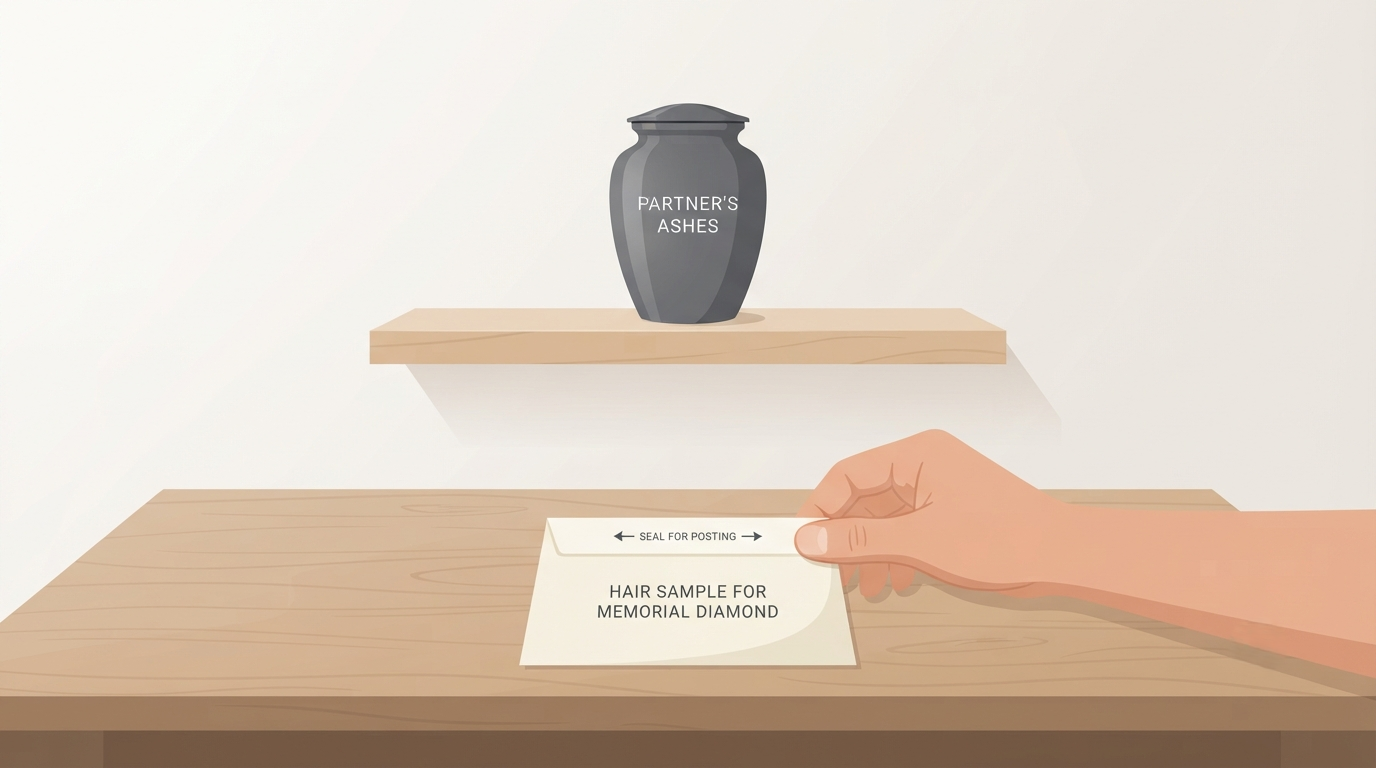
Whichever order you choose, put the interval in writing. A provider expecting both materials within two weeks runs a different process from one content to hold a first submission for three months, and that difference only surfaces when you ask.
If the ash is held by someone who has not agreed, settle that before anything else in the partner ashes hair diamond steps moves. Asking for one measured portion out of a quantity counted in pounds is a smaller request than it feels like from your side of it, and it is granted more often than partners expect. How to open that conversation is a post in itself.
If One Source Fails Assessment, What Happens to the Other?
In the partner ashes hair diamond steps this is the scenario that makes staged commitment worth an extra week, and it is not rare.
A hair sample can fail on provenance, mixed with someone else’s, impossible to place, or on condition, if it has been damp or contaminated. Ash can fail on quantity, if what you hold is a keepsake share rather than a cremation’s worth, or on permission.
What the partner ashes hair diamond steps do next depends on when the failure surfaces:
- Before either material ships. Nothing is lost. The order becomes a single source order, and the partner ashes hair diamond steps collapse into the ashes only or hair only sequence with no material consumed.
- After the first material has shipped but before the growth charge. The surviving track continues. Ask, in writing and in advance, whether the provider will proceed single source at the same carat rather than canceling.
- After the growth charge. There is nothing to separate. Both contributions are in one crystal.
The practical instruction is short: do not release the second material until the first has cleared assessment, unless you are content to proceed on one source alone. That single sentence is most of the value of understanding the partner ashes hair diamond steps as two tracks.
There is also an outcome worth naming because families arrive at it and are glad they did. Where both materials clear but you want them kept distinct, some providers will grow two stones rather than one, one from each source, rather than merging the charge. Whether more than one stone can come from a shared starting material covers that ground.
What the Intake Record Should Say About Both Materials
Paperwork is where the partner ashes hair diamond steps quietly go wrong, because most documentation is designed around one material.
Ask what the record will say before you send anything. A record built for a single submission names a weight and a date, and a second material arriving later can end up as a note in a margin rather than a logged item. Years afterwards, that margin note is the difference between a documented dual source stone and a stone you remember being dual source.
What the partner ashes hair diamond steps should produce on paper:
- Two intake entries, each with its own identifier, received date, and weight on arrival.
- Each material named explicitly, “cremated remains” and “hair”, rather than a single line reading “personal carbon” or “client material”.
- A record of which material was released when, which is what staged commitment is for.
- A statement of what happens to unused material on each track, since the residues are different and the policies may be too.
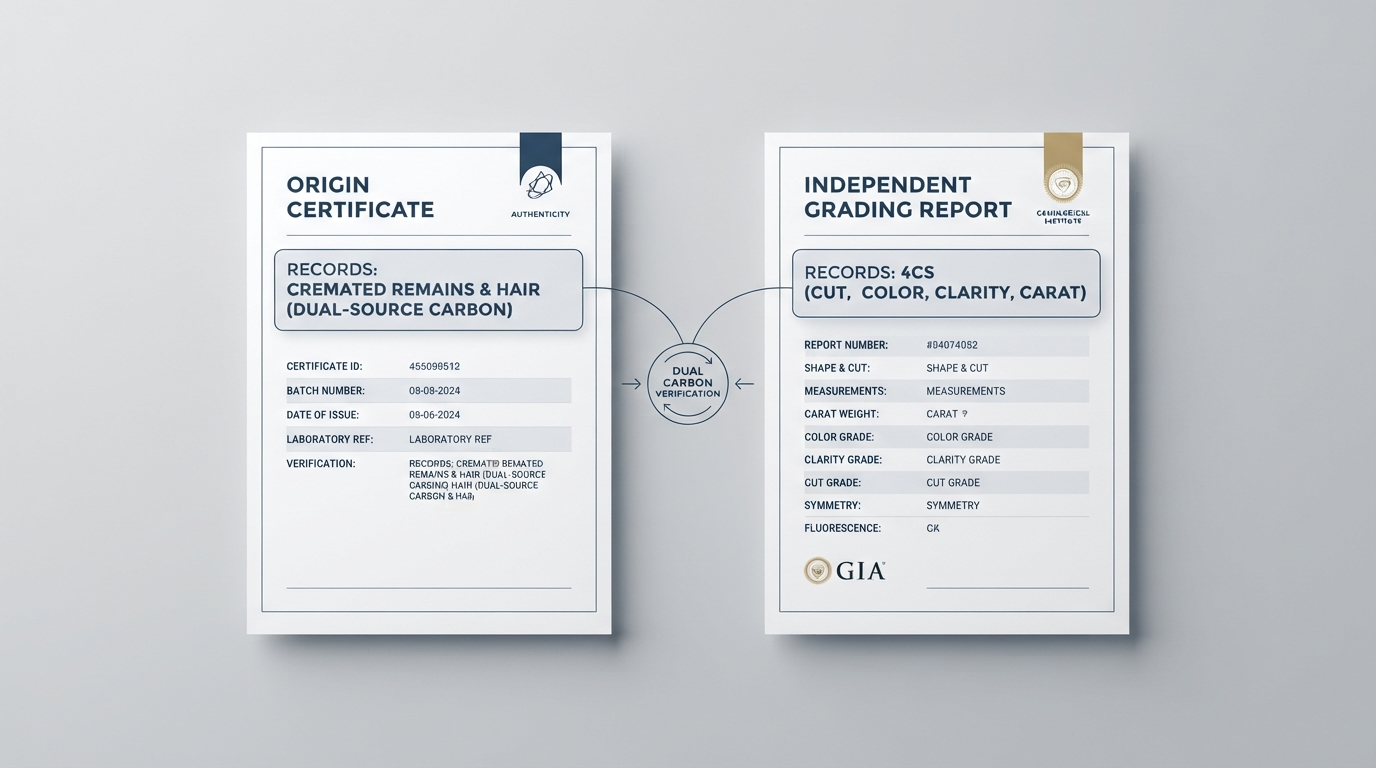
- A line on the authenticity or origin certificate naming both sources, which is the document that will outlive the paperwork around it.
That last one deserves a sentence of plain warning. An origin certificate is generally issued in house and documents chain of custody; a grading report is ideally independent and documents the stone’s own 4Cs, assessed on the same quality factors any diamond is graded against. They are different documents doing different jobs, and only one of them can record that two materials went in. Ask to see a sample of both before you commit. The complete guide to a combined partner diamond sets out the rest of the route around these stages.
Frequently Asked Questions
Are the two materials assessed as one submission or as two?
As two, and the partner ashes hair diamond steps keep them apart from the start. Each is measured against its own industry typical figure, a few tablespoons to roughly 4 oz of ash, a small lock of hair, and passing one does not offset falling short on the other.
Do the ashes and the hair have to arrive together?
No, and there is usually a good reason not to send them together. Staging the partner ashes hair diamond steps lets you see one assessment result before committing the second material, which is the only real protection a dual source order offers.
If one material is rejected at intake, what happens to the order?
Normally the surviving material continues alone, so the partner ashes hair diamond steps collapse to one track, but that is provider policy, not a rule. Confirm in writing, before shipping, whether they proceed on one source at the same carat or cancel.
At what stage do the two carbon sources actually meet?
At the growth charge, after both have been purified and graphitized. Before that point the partner ashes hair diamond steps run as two separate recoveries. After it, the contributions are indistinguishable and nothing can be separated out again.
Should the certificate record both materials by name?
Ask for it explicitly, because the partner ashes hair diamond steps do not guarantee it. An in house origin certificate is the document that can name cremated remains and hair as two logged inputs; an independent grading report covers the stone’s own quality and will not mention the source at all.
Can a second material be added once the first is in process?
Sometimes, if it arrives before the growth charge is assembled. After that the cell is loaded and the schedule is fixed. Ask for the cut off date in writing at the start rather than assuming a window exists later.
Final Thoughts on the Partner Ashes Hair Diamond Steps
A combined order is not a bigger order. It is two smaller ones, run in parallel, with a single irreversible junction late in the sequence.
Understood that way, the partner ashes hair diamond steps become much easier to manage. You stage the commitments rather than making one. You resolve the permission question on the ash while the hair is already being assessed. You keep two paper trails instead of trusting one. And you know precisely when the option to change course disappears, which is the growth charge and not a day before it.
What the partner ashes hair diamond steps will not do is make the stone more of your partner, arrive faster, or come out a chosen color. Those were never functions of how many materials went in. What two sources genuinely give you is a second route to the same stone when one route is closed, which, for a partner who may not control the ashes, is not a small thing.
Learn More About Combined Partner Memorial Diamonds
- What Color Will a Diamond Made From Your Partner’s Ashes and Hair Be?
- Partner Ashes and Hair Diamond: The Complete Guide
- How to Talk to Family About a Partner Memorial Diamond
- Is a Memorial Diamond Really Made From Your Partner’s Ashes and Hair?
Talk With Memorial Diamond
Most of the partner ashes hair diamond steps can be settled in writing before any material leaves your house, and that is the order worth insisting on.
Three questions do the heavy lifting. Ask whether each material is assessed against its own figure, and whether both can be pre assessed from photographs and weights. Ask what happens to the order if one material fails and the other passes. Ask whether the origin certificate will name both sources by name. memorialdiamond.us will answer all three in writing, and so should any provider you are weighing up.
Until those answers exist, nothing needs to move. The urn stays where it is, the envelope stays in the drawer, and the partner ashes hair diamond steps wait as long as you need them to.
Leave A Comment