
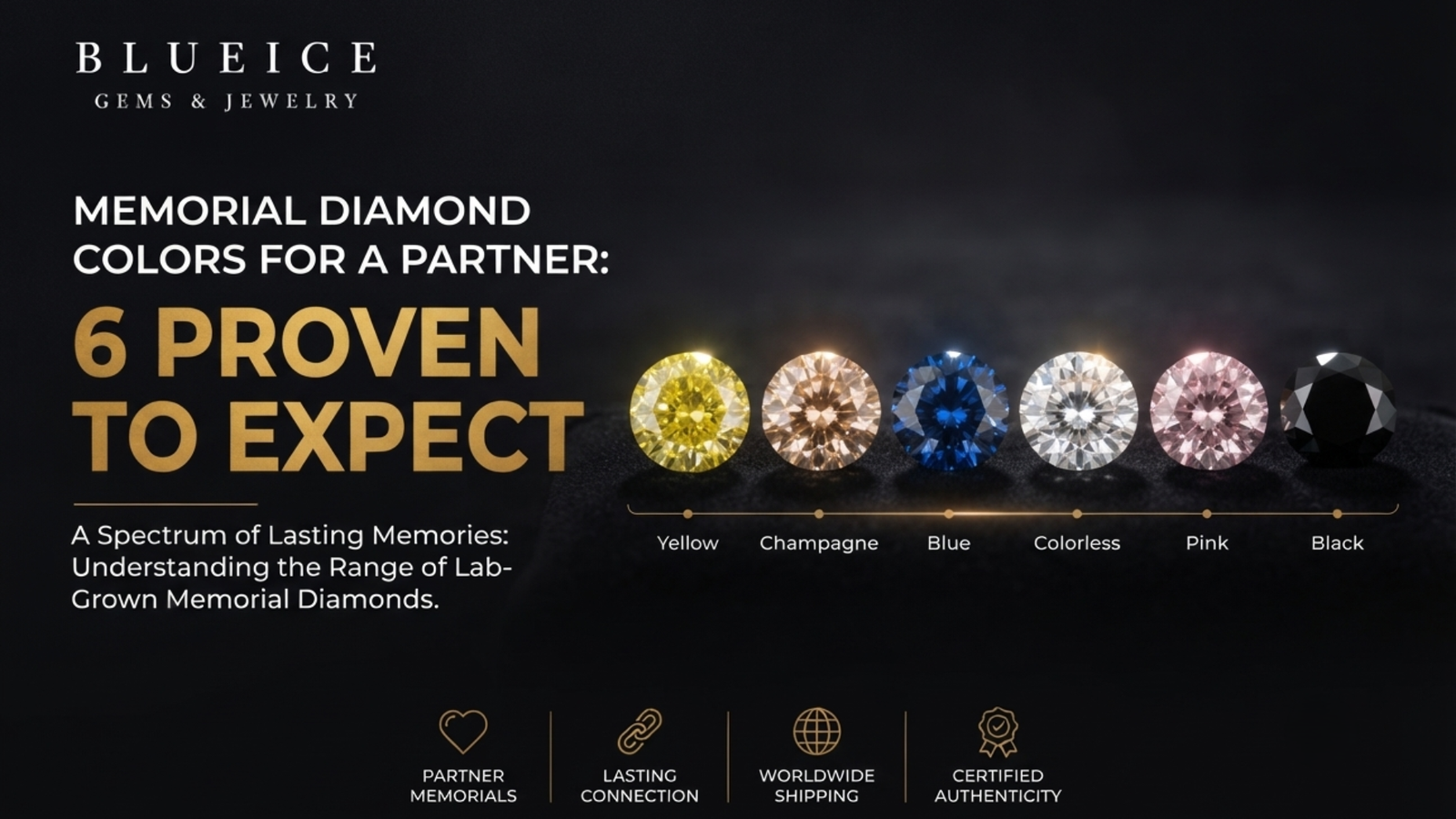
Nobody chooses this the way they choose paint. You are deciding what your own hand will look like in kitchen light, in November daylight, for the next thirty years. Memorial diamond colors for a partner realistically fall into yellow, champagne and blue, with colorless available as an engineered specification, and red, pink, green or black available only as a treatment applied after the crystal has finished growing. A family can be agreed before the run. The shade inside that family cannot.
Memorial Diamond grows these stones, so read this as informed rather than disinterested. Every figure below is industry wide practice, not one company’s offer. Settle memorial diamond colors for a partner before you order, for a plain reason: color is the one variable here you cannot revise later without starting again.
Table of Contents
The Realistic Palette, Family by Family
Start with the whole board rather than one square. The full set of memorial diamond colors for a partner divides into three grown in families, one engineered outcome, and two groups of treatments applied afterwards. Knowing which group you are quoted matters more than a shade name.
The table adds the column nobody puts on a spec sheet: how each of the memorial diamond colors for a partner behaves on a living hand, in the light you are actually in. Treat it as informed general gemology rather than a measured promise.
| Color family | What puts it there | How it behaves across a day of light | Beside white metal, and beside yellow gold | Where it sits on cost |
|---|---|---|---|---|
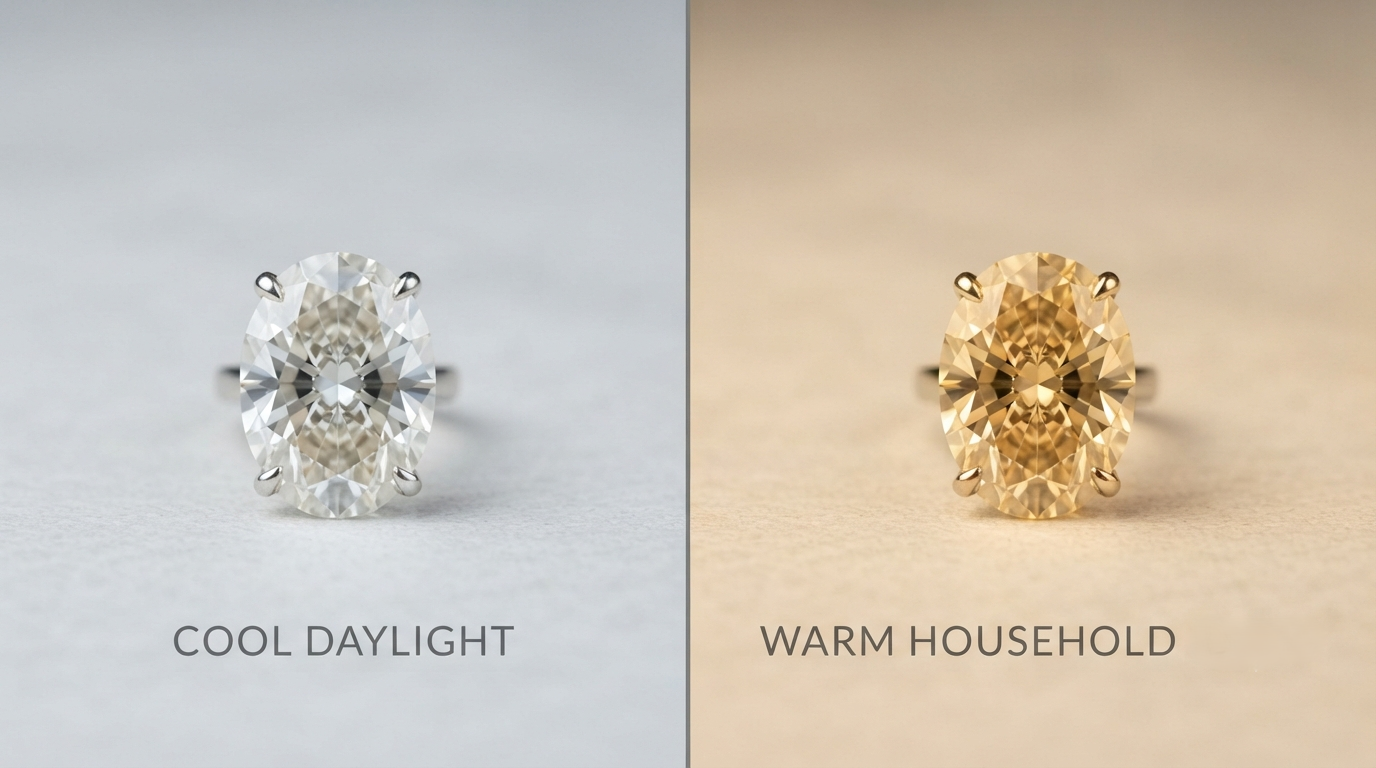
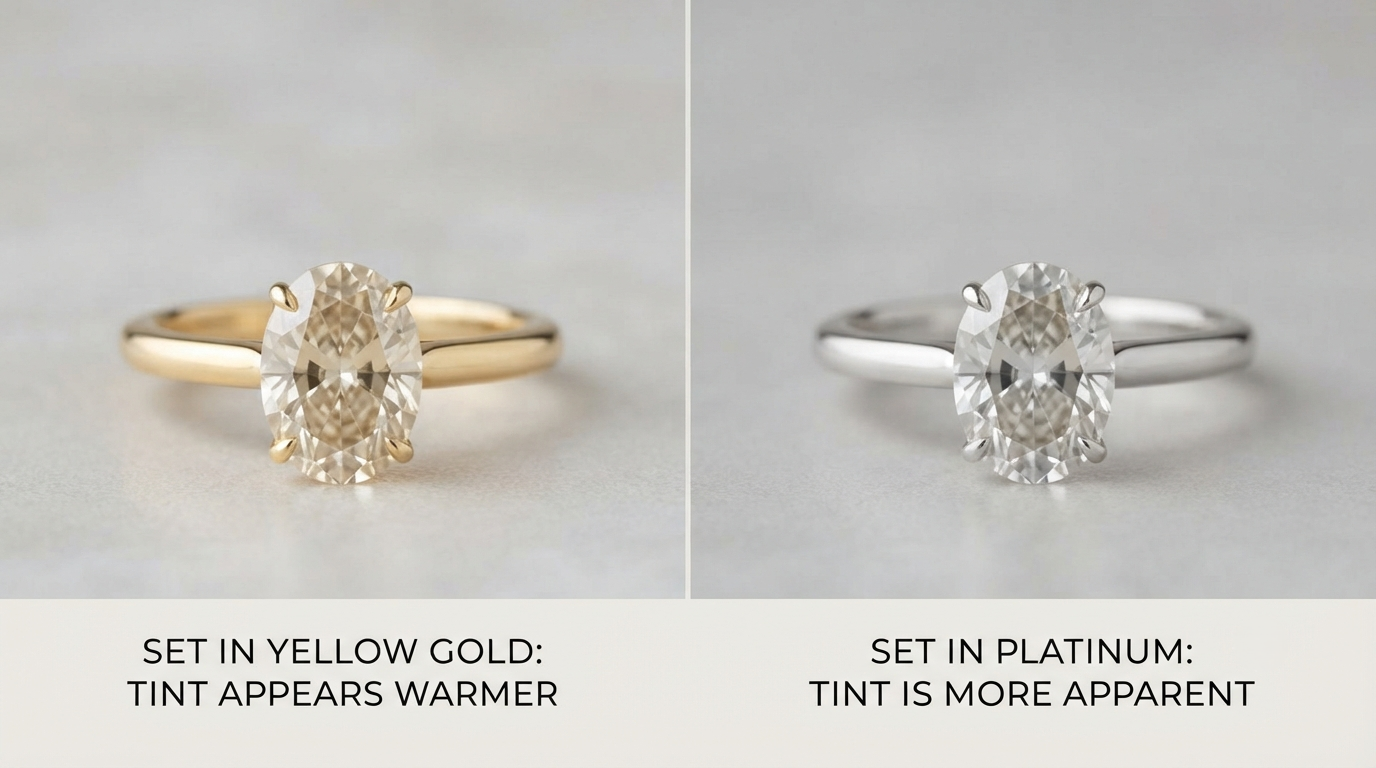
| Yellow or golden | Nitrogen present while the crystal forms, the commonest result described for an organic feedstock | Holds its warmth in daylight, deepens under household bulbs; the steadiest family hour to hour | White metal sharpens the tint; yellow gold absorbs it and can make a light stone look untinted | The usual baseline among memorial diamond colors for a partner |
| Champagne or brown | The same warm territory as yellow, in different companies’ vocabulary | Softest in overcast daylight; distinctly golden under a warm lamp | Handsome in yellow or rose gold; against bright white metal it can read as dullness rather than color | Comparable to yellow |
| Blue | Boron present while the crystal forms | The most light sensitive of the memorial diamond colors for a partner, crisp in cool daylight, flat or gray under warm bulbs | Holds up against white metal; yellow gold sits opposite it on the wheel and can fight it | Comparable to yellow, though intensity is never selectable |
| Colorless or near colorless | Both boron and nitrogen kept down to almost nothing, which takes extra work upstream | The most consistent across lighting, because there is no tint for the light to act on | Clean against white metal; against yellow gold it picks up warmth from the setting itself | Meaningfully more at the same carat, and the extra processing is why |
| Irradiated red or pink | A color center induced after growth, on a crystal that already exists | Behaves like any treated fancy color, and is generally stable in ordinary wear | Depends on saturation; a strong pink dominates whatever metal holds it | Priced as an added step, quoted separately |
| Irradiated green or black | The same post growth route aimed elsewhere on the spectrum | Black reads as an absence rather than a color, and is almost light independent | Black against white metal is the highest contrast option here | Black in particular is often a longer job in the schedule |
Six families. That is the honest scope of memorial diamond colors for a partner, wider than most people expect, narrower than a jewelry counter suggests.
The table deliberately does not rank them. A champagne stone is not a compromised yellow one, and no entry among memorial diamond colors for a partner is a failed colorless one. Grading scales sort diamonds by market convention, not by what a color means to you, and the GIA’s explanation of the 4Cs covers the vocabulary any report will use.
Why Do Memorial Diamond Colors for a Partner Trend Warm or Blue?
Because of what else is in the cell besides carbon.
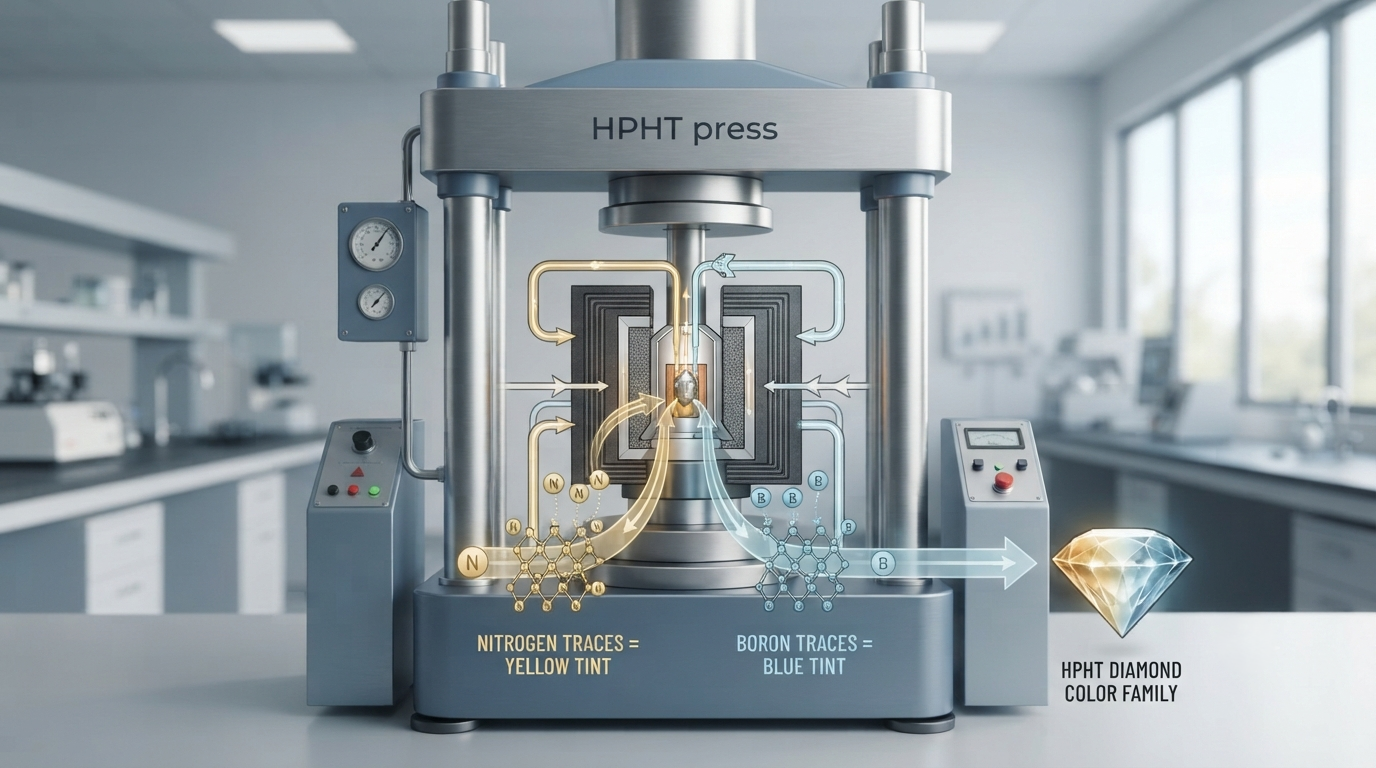
A diamond takes its color from trace elements caught in the lattice as it forms. Nitrogen reads yellow. Boron reads blue. Take both down to almost nothing and you get colorless, not because something was added, but because nothing was.
Now apply that to an organic source. Carbon recovered from cremated remains or from hair is purified to roughly 99.9%+, graphitized at around 2,500 to 2,700°C, then loaded into a press running approximately 6 to 8 GPa at 1,400 to 2,500°C. That is a demanding purification, and it still leaves a feedstock with a trace element history, because it began as a body rather than bottled industrial gas. Parts per million is enough to set a family. That is the entire mechanism behind memorial diamond colors for a partner, and the general engineering is documented under synthetic diamond growth.
Two things follow, and they matter more than the chemistry does:
- The trend is real. Warm tones and blue are the ordinary result across memorial diamond colors for a partner, not a disappointing one. Colorless is the exception that takes extra work.
- The trend is not a forecast. Knowing a source will read warm tells you nothing about pale straw versus deep gold, and nobody can say which before the crystal exists.
The other honesty point belongs here, because color conversations skate past it. Whatever carbon is recovered gets topped up with lab grown carbon until a growth cell has the volume it requires. For ash, the personal share of the finished stone is generally put at 10 to 15% by mass, some providers as low as 3%, and no equivalent figure is published for hair. That blend does not decide memorial diamond colors for a partner either way. What colors the crystal are the traces riding along with the carbon, not the ratio.
What Does Colorless Actually Cost You?
Two things: money, and the assumption that you were choosing.
Where a 0.5 to 1 ct memorial stone typically runs around $5,000 to $15,000 industry wide, expect a colorless quote to sit above a tinted one of the same weight; how far above is a question for the provider rather than something published. Entry sizes of roughly 0.10 to 0.25 ct typically run about $1,500 to $3,500, and stones from 2 ct upward run from roughly $20,000 to $75,000 and beyond. Those are category wide ranges rather than Memorial Diamond’s prices, and a quote moves with carat, cut, color and grading. What a partner memorial diamond costs goes through how those variables interact.
On the second cost, be honest before you pay it. Colorless is the one entry among memorial diamond colors for a partner that is a specification rather than an expectation, an outcome a laboratory engineers, which is a genuine thing to want. But people also reach for it believing a tinted stone is a lesser stone, and that is a jewelry market reflex rather than a fact. Nothing in the range of memorial diamond colors for a partner is a compromise. A yellow stone is what that carbon did.
What Can Irradiation Do, and What Can It Not?
Post growth irradiation is why red, pink, green and black appear on the menu at all, and it is the only part of the memorial diamond colors for a partner list that happens to a stone rather than inside one.
What it can do: take a crystal that has already grown and induce a color center in it, producing tones this process does not reach on its own. It is an established treatment, and it widens the palette.
What it cannot do: repair a shade you did not like. If a stone comes out paler than you hoped, irradiation does not deepen it into the yellow you pictured, it moves it into a different family. Nor can it be unapplied.
Three consequences worth carrying into any conversation about memorial diamond colors for a partner:
- Ask which kind you are being quoted. A grown in blue and an irradiated blue green are different products, with different costs and different descriptions on a report.
- Ask whether the treatment is disclosed on paper. Ask for it in writing on whatever report accompanies the stone, rather than described in conversation.
- Ask what it does to the schedule. The category’s typical timeline is 6 to 10 months from receipt, with larger or specialty color stones sometimes running to 12, and treated colors sit in that second group. How long a partner memorial diamond takes covers where the months go.
Choosing a Color You Will Wear Every Day for Decades
This is the part the material specific questions never reach, and it is the part you will live inside.
A memorial stone is not bought to be looked at once. It is worn while you cook, drive, garden, work and sleep, for longer than most marriages last. That changes which questions about memorial diamond colors for a partner are worth asking, and none are about grading.
- What light are you in? A stone chosen under a jeweler’s lamp and worn under office fluorescents is two objects. Warm tones forgive the most lighting; blue changes the most.
- What are you already wearing? If everything else on you is yellow gold, a warm stone belongs there and a cool one argues. This is half a metals decision, which is why it sits beside what a memorial stone needs from its setting.
- How visible do you want it? Among memorial diamond colors for a partner, a deep or treated color is a conversation with strangers; a soft champagne in yellow gold is near private.
- What if a second stone is grown later? Two runs from one source will not match. If siblings or adult children may each want one, choose a family that tolerates variation rather than a shade you would want copied. Whether more than one person can have a stone from the same source is worth settling before the first run.
- Will you still want it at seventy? Taste drifts, and a setting is remade far more easily than a stone is regrown. Conservative on color and adventurous on setting is the version that ages best.
One consideration is specific to this relationship. Some partners choose among memorial diamond colors for a partner for what the color points at rather than how it looks, the blue of a particular coat, a warmth only they would recognize. That reason survives daily wear better than one chosen to impress. Choose the family for the memory, and take the shade as it arrives.
What Can Be Agreed Before the Run Starts?
More than you would think, and less than you want. Everything settled in advance about memorial diamond colors for a partner belongs in an email rather than a phone call.
- The color family, named in writing, not a shade, not a reference photograph, but “yellow”, “champagne”, “blue” or “colorless” as a term on the order.
- Whether the quote covers a grown in color or a treated one, stated on the invoice.
- What counts as outside the agreement, and what happens then, a remedy negotiated before growth is a different conversation from a complaint after delivery.
- Whether an independent grading report is included, and what color language it will use, since marketing vocabulary and grading vocabulary are not the same.
- What the timeline becomes if the family you chose is one of the slower ones.
Still deciding whether to do this at all? Where to start when choosing a memorial diamond for your partner sequences these decisions, and the material specific answers sit in what color an ashes grown stone will be and what color a hair grown stone will be.
Who Holds the Say If the Ashes Are Not Yours?
A conversation about memorial diamond colors for a partner assumes you are the one placing the order, and for a great many partners that assumption does not hold.
No single national rule decides who controls cremated remains. Each state sets its own order, and a will, a disposition directive or an instruction signed at a funeral home can rearrange it. Legal recognition of the relationship tends to make this uncomplicated; its absence does the opposite, and the remains may be controlled by a parent, by an adult child, by a sibling, or by someone your partner was married to years earlier, and whoever is weighing memorial diamond colors for a partner may not be entitled to release any material at all.
Find that out before money moves. Establish who holds authority under the law where the cremation happened, find what was left in writing, then ask. A request for one small portion is narrow and answerable, and easier to grant than a request to change everything already arranged. If the answer is no, that is a real answer, and how to raise this with family covers what to do next.
Frequently Asked Questions
Can I pick the exact shade I want?
No. You can specify a family and have it written into the order, but saturation inside that family is not selectable. Anyone offering an exact shade from memorial diamond colors for a partner is describing a treated stone, or overstating what the process allows.
Does the color say anything about my partner?
Not in the way people hope. The families among memorial diamond colors for a partner come from trace elements in the feedstock, not from personality, eye color or hair color. What the stone carries from them is carbon, verifiably, which is the meaningful part.
Will a tinted stone be worth less than a colorless one?
On a resale market, generally yes, colorless commands more. That is a poor frame for this object, though. Among memorial diamond colors for a partner the tinted families are the ordinary outcome, and the stone is not bought as an asset to trade.
Can the color be changed if I do not like it?
Only by irradiating it into a different family entirely, which is not an adjustment. Nothing shifts a stone a few degrees warmer or cooler. That is why agreeing memorial diamond colors for a partner in writing beforehand matters more than any later step.
Do two stones from the same ashes come out the same color?
Not reliably. Separate runs are separate events, and memorial diamond colors for a partner vary between them even from one source. If several people want stones, plan for a family in common rather than a match.
Does the setting change how the color looks?
Considerably, and this is underrated. Yellow gold warms a stone and can hide a light tint; white metal sharpens and exposes it. Metal belongs in the same decision as memorial diamond colors for a partner, not in the one after it.
Final Thoughts on Memorial Diamond Colors for a Partner
The palette is real, it is wider than a single yellow, and it is narrower than a promise of any particular shade. Six families: three that arrive on their own, one engineered at a higher price, and two applied to a crystal that already exists.
What is worth carrying away sits underneath the chemistry. You are not picking a color for a display case. You are picking something to look down at on an ordinary Tuesday for the rest of your life, and the unfussy version usually wins, a family that suits the metal you already wear and the light you are usually in. Every other question about memorial diamond colors for a partner is detail you settle in an email before a press is loaded.
Learn More About Partner Memorial Diamonds
- What Color Will a Diamond Made From Your Partner’s Ashes Be?
- What Color Will a Diamond Made From Your Partner’s Hair Be?
- Memorial Diamond Settings and Jewelry Ideas for a Partner
- Choosing a Memorial Diamond for Your Partner: Where to Start
- How Much Does a Partner Memorial Diamond Cost?
Talk With Memorial Diamond
You do not have to decide today, and a color chosen under pressure is the one most likely to look wrong in five years. Three questions narrow memorial diamond colors for a partner down to something manageable, and all three can be answered before you commit anything. Ask which of the memorial diamond colors for a partner a provider offers as grown in families rather than as treatments. Ask what goes on the order form, word for word, and what happens if the stone lands outside it. Ask what each family does to the timeline. memorialdiamond.us will answer all three plainly, and anyone else worth considering will too.
Leave A Comment