
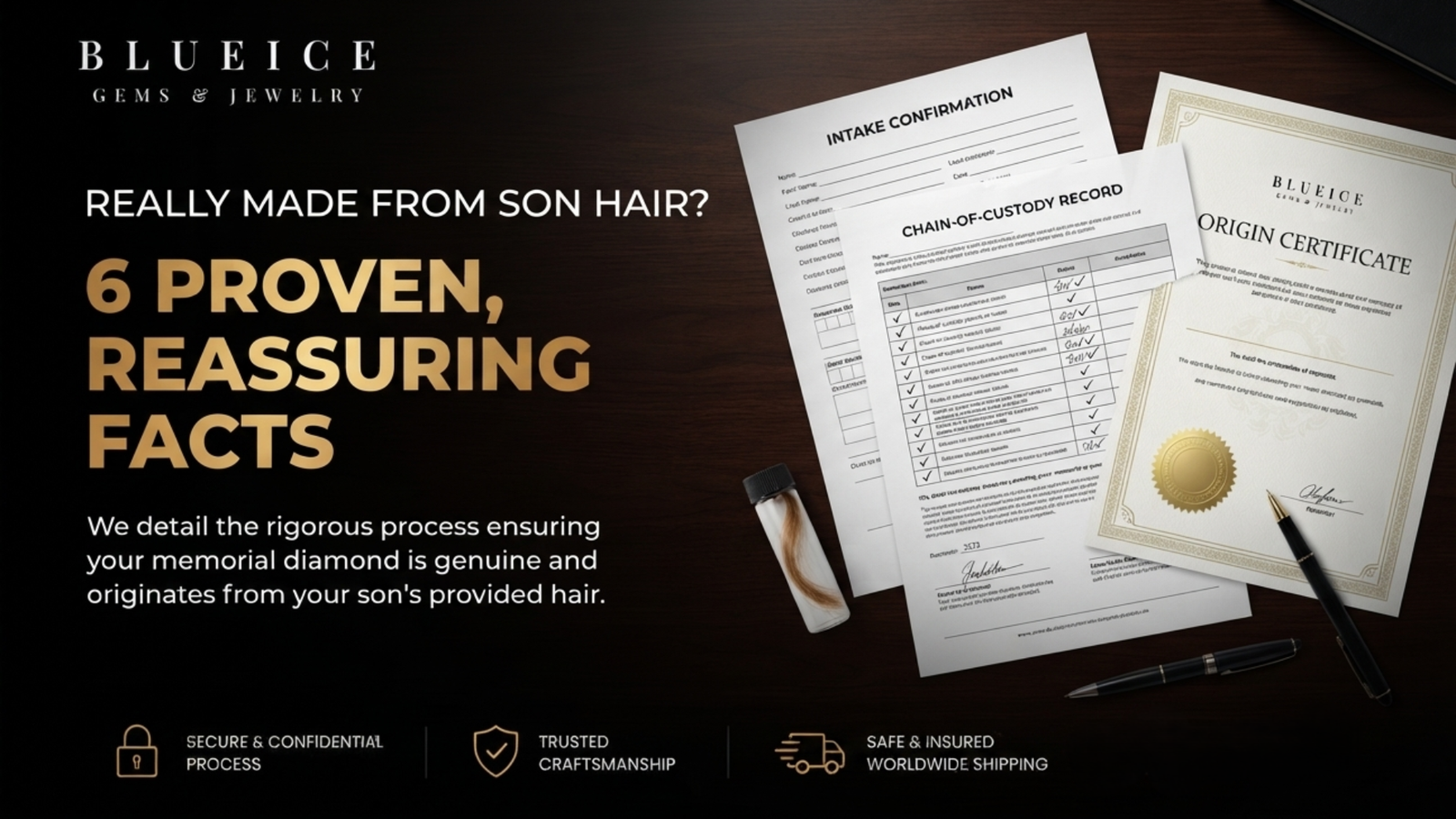
Most parents look at the envelope in their hand and cannot believe it is enough. Yes, a diamond really made from son hair is exactly that: the carbon in that hair is extracted, purified and grown into a chemically genuine laboratory diamond. It is combined with supplemental laboratory carbon to reach a workable volume, so no stone is pure hair, and the honest version of any claim about a diamond really made from son hair includes that second half.
Table of Contents
Can So Little Hair Really Become a Diamond?
Yes. What makes a stone really made from son hair possible is chemistry rather than sentiment. Hair is built largely from keratin, a carbon rich protein, which makes it roughly 50% carbon by weight as a starting material.
Compare that with cremated remains, which are dominated by calcium phosphate and yield only a small percentage of usable carbon, and the difference in starting material is enormous. It is why anything really made from son hair needs so little to begin with, providers typically describe a small lock or a few grams, sometimes as little as a palm sized wisp.
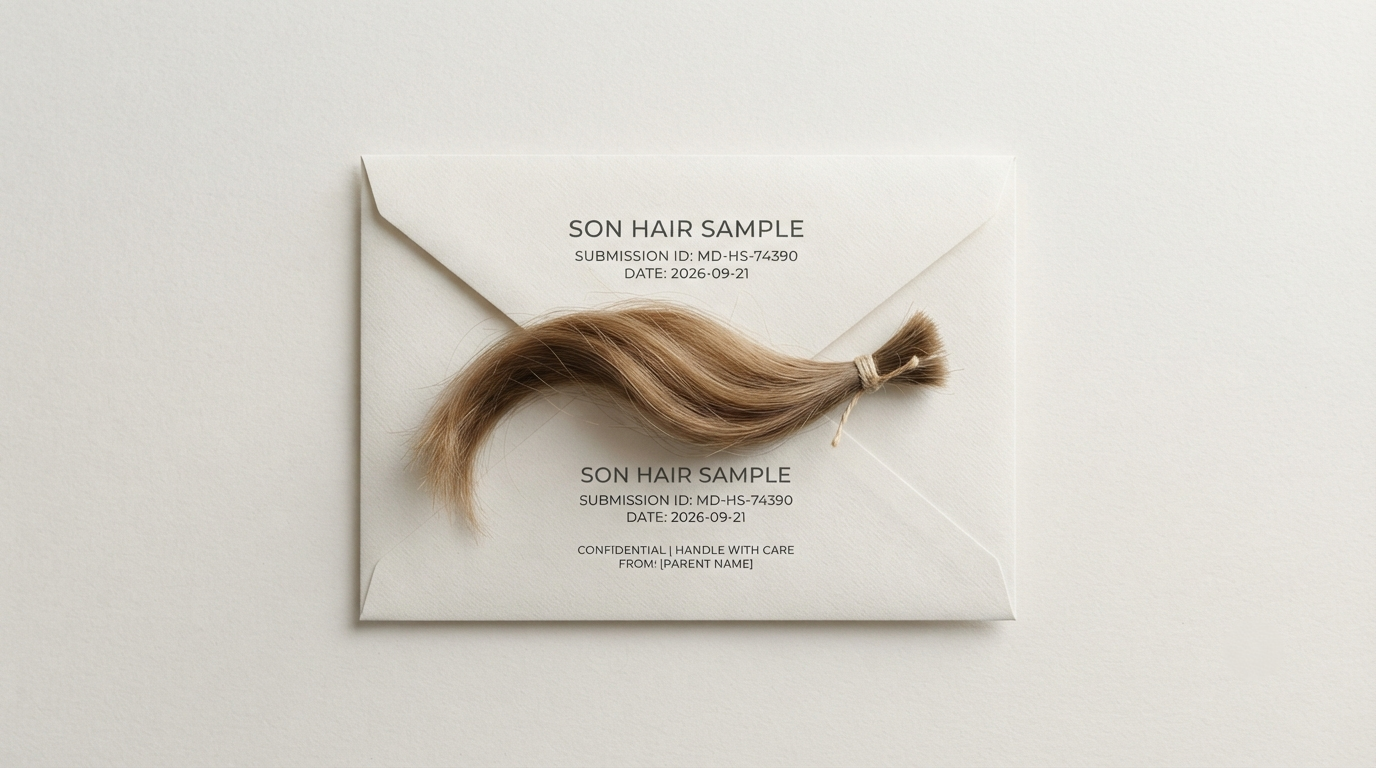
That 50% figure describes what you are sending, not what comes out the other end. It is a fact about hair, not a promise about the finished stone, and any page that slides between the two is misleading you.
One more thing worth saying plainly: because a gem really made from son hair requires no cremation at all, this route stays open to families who buried him, and to families whose traditions do not permit cremation. How much hair a laboratory needs sets out typical quantities.
Why Doesn’t the Hair Simply Burn Away?
Because the extraction is done with the oxygen taken out of the equation. Burning is oxidation; remove the oxygen and the carbon has nowhere to go.
The sample destined for a diamond really made from son hair is heated through a controlled, multi stage, oxygen free process. The non carbon components of keratin, nitrogen, sulfur, hydrogen and the rest, are progressively driven off, and what stays behind is carbon at roughly 99.9%+ purity. That purified carbon is then heated much further and converted into graphite, which is the feedstock form a growth press can actually use.

Nothing about a stone really made from son hair is destroyed in that sequence, though it is fair to say the hair stops looking like hair almost immediately. What survives is the element, not the form.
Parents sometimes ask whether color treated, bleached or medicated hair still works. Generally it does, since the carbon backbone is unaffected by most treatments, but mention it at intake anyway, a laboratory producing a jewel really made from son hair would rather know in advance than discover it mid run. How the process runs from end to end follows the material through each stage.
What Share of the Stone Is Really Made From Son Hair?
Here is where any honest page about a stone really made from son hair has to admit a gap. There is no published industry figure for what percentage of a finished stone is personal carbon on the hair route. One exists for the ash route; nothing equivalent has been published for hair.
So do not accept a number borrowed from the ash side and applied to a gem really made from son hair, and be wary of any page that quietly does so. The two starting materials behave completely differently, and a figure derived from one does not transfer to the other.
What is certain is the direction of the answer. Personal carbon is genuinely present in the crystal, and supplemental laboratory carbon is added to reach the volume a growth cell needs, a stone really made from son hair is a blend, not a pure substance.
The practical move is to ask for the company’s own figure in writing before you commit. Ask what percentage of the finished stone they expect to be his carbon at the carat size you are considering, ask whether that is measured or estimated, and keep the reply. A provider confident in its process will answer; one that changes the subject has answered anyway.
Is the Finished Gem a Genuine Diamond?
It is. Chemically and physically, a gem really made from son hair is diamond, the same material as a mined stone, not a substitute like cubic zirconia, moissanite or resin with hair set inside it.
Growth happens by one of two industry methods. Most memorial providers use HPHT, in which the cell is held under pressures of roughly 6 to 8 gigapascals at temperatures somewhere between 1,400°C and 2,500°C. A smaller number use CVD, building the crystal up in layers from carbon bearing gas inside a vacuum chamber. Either way the carbon ends up in diamond structure.
Because of that, a stone really made from son hair sits at the top of the mineral hardness scale at 10, which is the practical reason it can be set in a ring and worn every day without special care.
Testing will identify it as laboratory grown rather than mined. That is an accurate statement about how it was formed, not a finding against it, every diamond really made from son hair is grown, by definition, since nobody is mining one.
Does It Count If the Hair Came From a Hairbrush?
Parents ask this more often than any brochure about work really made from son hair would suggest, and the answer is reassuring. Yes, hair collected from a brush, a comb, a pillow, a cap or a razor is still his hair, and it carries the same carbon.
What matters practically is quantity and cleanliness rather than how it was gathered. Hair tangled with dust, product residue or other people’s hair is workable in most cases but worth flagging at intake, because it affects how much usable material a laboratory can recover for a gem really made from son hair.
Some families have a first haircut kept in an envelope since childhood. Some have a few strands from a hospital pillow. Some have what came out of the clippers at a barber weeks before he died. None of these is a lesser starting point, and a stone really made from son hair does not grade the provenance.
If what you hold is genuinely tiny, say so honestly when you inquire. It is far better to be told at the outset that more would be needed than to send everything you have and find out afterwards. How to turn his hair into a diamond covers collection in practical detail.
Does Hair Kept for Years Still Work?
Generally, yes. Keratin is remarkably stable, it is why hair survives in archaeological contexts for very long periods, and ordinary storage in a drawer, a locket or an envelope does not remove its carbon.
So a lock kept since a birthday twenty years ago is still viable material for something really made from son hair. Damp, mould or contamination are the realistic risks rather than age itself, which is a good argument for keeping any sample dry and separate while you decide.
There is no deadline here, and nobody should imply one to you. Parents come to this question weeks after a death and also decades after, and the chemistry does not care which.
If the sample has been stored somewhere humid or has visible mould, mention it before sending. A laboratory working on a gem really made from son hair will tell you honestly whether it is usable, and would far rather say so before it arrives than after.
How Should the Sample Be Packed and Sent?
Simply, dryly, and with a record of what left your house. Nothing about preparing a sample for a gem really made from son hair requires special equipment.
Leave the hair exactly as it is. Do not wash it, treat it, or try to clean it up, anything you add is another substance a laboratory has to remove, and washing can lose fine strands entirely. If it is currently tied with a ribbon or a thread, ask whether that should come off before it ships.
Keep it dry. Paper or a small envelope is generally better than sealed plastic, because plastic traps any residual moisture against the sample. Label the envelope with his name and your contact details on the outside rather than trusting the packaging to speak for itself.
Photograph the sample before it goes. That is not paranoia; it is what you would do with any irreplaceable item sent by post, and it means you and the laboratory growing a stone really made from son hair are describing the same quantity if a question arises later.
Send it by a tracked service, and ask the company to confirm receipt against their intake log the day it arrives. For something really made from son hair, that confirmation is the first link in a documentation chain you may want to read years from now.
What Paperwork Should Arrive With It?
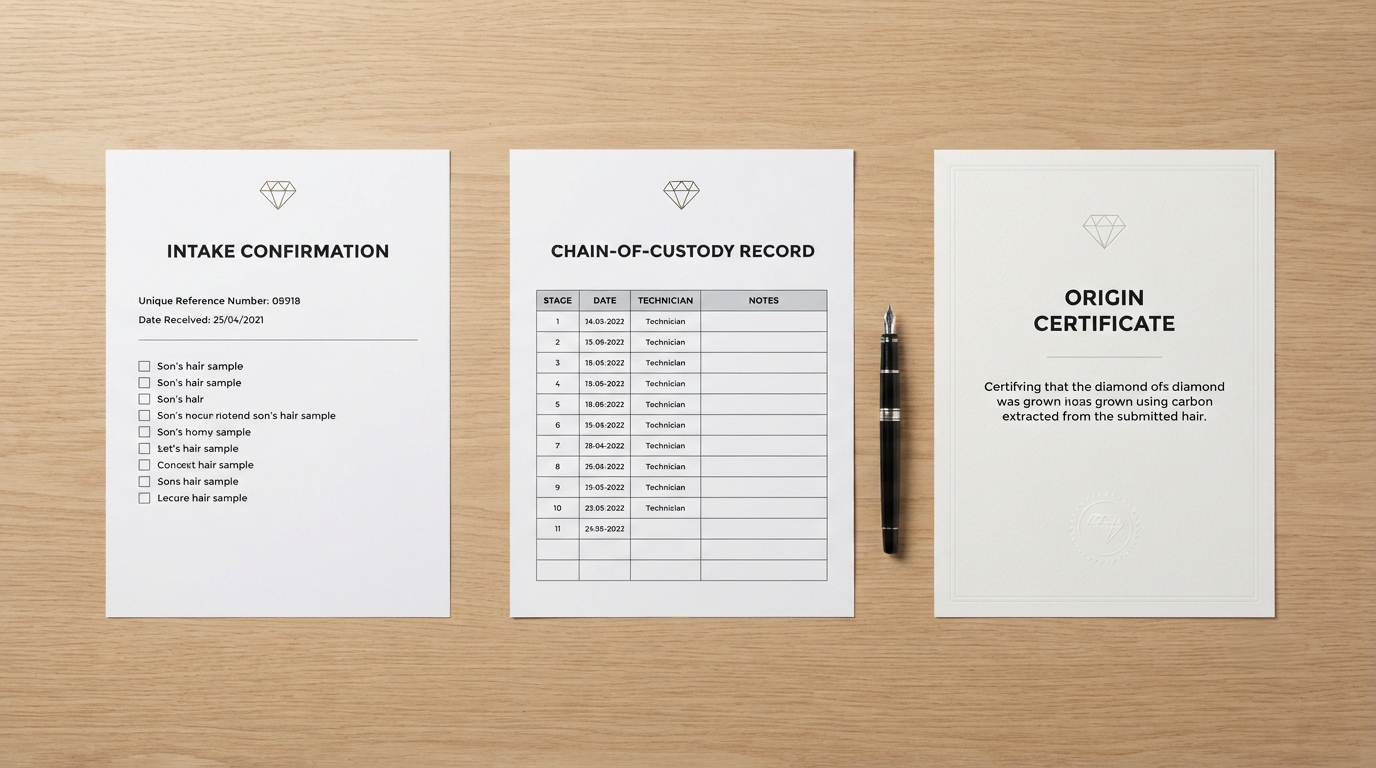
Documentation is the main verification available to a family, because the laboratory stages happen out of sight. A stone really made from son hair should come with a documented trail, and you are entitled to see what that trail consists of before you agree to anything.
- Intake confirmation, the sample logged against a unique identifier on arrival.
- Chain of custody record, the sample tracked from vessel to vessel through each stage of processing.
- Written percentage statement, the company’s own estimate of the personal carbon share, since no published industry figure covers hair.
- Authenticity or origin certificate, normally an in house document stating this stone was grown from your family’s submission.
- Independent grading report, an optional third party add on assessing the stone’s own qualities.
- Return or disposal policy, what happens to unused hair or leftover recovered carbon.
The fifth item is the one most often misunderstood. An independent grading report assesses cut, color, clarity and carat to the same standards used for any diamond, it says nothing about whose carbon is inside, and cannot confirm that a gem is really made from son hair. Only the custody trail speaks to that. The questions to ask before you commit turns this into a checklist.
Is There Any Identity Check on the Sample?
Parents often assume a laboratory must verify somehow that the hair is his. The truthful position is that nothing in the publicly available material about this industry establishes whether any provider runs a genetic or identity check on a submission, so treat confident claims in either direction, including a flat “no”, with skepticism.
That makes it a question to ask rather than a fact to look up. Put it plainly: does your process include any identity verification on material for a diamond really made from son hair, at what stage, and what record of it do I receive?
The quality of that reply tells you a great deal about a company offering something really made from son hair. A provider who says “we don’t, and here’s what we do instead” is being straight with you. One who implies a verification step without describing it is not.
Who Needs to Agree Before the Hair Is Sent?
Usually fewer people than with cremated remains, but it is not automatically nobody, and it is worth thinking through rather than assuming.
The statutory rules most states apply are aimed at the disposition of a decedent’s remains, so a lock of hair already sitting in your own home tends in practice to be the simpler question. That is a difference of circumstance, not a guarantee, a person’s belongings can form part of an estate, the position varies from state to state, and a diamond really made from son hair commissioned while an estate is unsettled can become contentious later.
There is also the ordinary human version of the question. If the sample is held by his widow, his partner, his adult child or a sibling, then sending it is a conversation, not a decision one person makes alone. Parents do not always agree with each other either, and one parent arranging a gem really made from son hair by themselves is perfectly ordinary.
Where anything is unclear, an unsettled estate, a dispute, a sample someone else holds, a short conversation with the funeral director or a local attorney will resolve it faster than guessing. The complete guide to a son hair diamond covers the surrounding decisions.
What Does a Straight Answer Sound Like?
Six questions separate a company that will talk honestly about work really made from son hair from one that will not. Here is what a good reply looks like against a poor one:
| # | Ask this | A straight answer | A worrying answer |
|---|---|---|---|
| 1 | Is the stone pure hair? | No, personal carbon blended with lab carbon | “100% your son” |
| 2 | What percentage is his carbon? | A stated range, in writing, with the basis given | Refusal, or the ash figure reused |
| 3 | Is my hair grown in its own charge? | Yes or no, stated plainly | Vagueness about batching |
| 4 | What certificate do I receive? | Named as in house origin, independent grading, or both | “A certificate” |
| 5 | What if the run fails? | A written policy on retries and fees | Improvised on the call |
| 6 | What happens to unused hair? | Returned, retained or destroyed, stated | Not addressed |
None of these are aggressive questions, and nobody credible will treat them as an insult. A jewel really made from son hair is an expensive, irreversible commission involving something you cannot replace, and any provider worth using expects to be asked.
What Does a Diamond Really Made From Son Hair Cost?
Price follows carat weight and color, not the source material, hair and ash routes are priced alike across the industry. Using general 2026 ranges rather than any company’s published rates:
- 0.10 to 0.25 ct: roughly $1,500 to $3,500
- 0.5 to 1.0 ct: roughly $5,000 to $15,000, at equal weight, colorless carries a meaningfully higher price than yellow, blue or champagne
- 2 ct and above: roughly $20,000 to $75,000 and upward
- Usually quoted separately: settings, engraving, fancy cuts and independent grading
As for waiting, the industry typical span runs from around six months to ten, and larger or specialty color stones can reach twelve. Size is a function of growth time rather than how much hair you sent, so a stone really made from son hair cannot be accelerated by sending more. What a son memorial diamond costs sets out what moves the number.
Frequently Asked Questions
How much hair does a laboratory actually need?
Typically a small lock or a few grams, often described as palm sized, sometimes less. Requirements vary between providers and with the stone size you want, so confirm the exact minimum before cutting or sending anything, especially if what you hold is limited.
Does gray, dyed or bleached hair change the result?
The carbon is unaffected by ordinary coloring, bleaching or graying, so these samples are generally workable. Mention any treatment at intake regardless, since a laboratory would rather account for it in advance than encounter it partway through processing your sample.
Does burial rather than cremation rule the hair route out?
It does not, and that is among the route’s genuine strengths. Cremation plays no part at any stage, which puts a diamond really made from son hair within reach of families who chose burial, or whose faith or tradition rules cremation out.
Will the stone be a particular color because it came from hair?
No color can be promised in advance. Trace elements present during growth drive the outcome, and because the carbon comes from a personal, organic source, results vary. Discuss color preferences early and ask what the provider can realistically control.
Can several diamonds be grown from one sample?
Sometimes, depending on how much hair you have and the sizes requested. Ask before submitting whether your quantity supports more than one stone, since the answer shapes what you collect, and whether siblings need to contribute their own samples.
What happens to hair that is left over?
That depends entirely on the provider’s policy, which is why it belongs on your list of questions. Some return unused material with the finished piece, some retain it for a possible second stone, and some dispose of it. Ask, and get the answer in writing.
Final Thoughts on Whether the Diamond Is Genuinely His Hair
The doubt that brought you to this page is a reasonable one, and it deserved a reasonable answer rather than reassurance. The carbon is genuinely his. The stone is genuinely diamond. The proportion is genuinely a blend, and on the hair route nobody has published what that proportion typically is.
That last gap is not a reason to walk away. It is a reason to ask one specific question and expect a specific reply, and to keep it in writing.
If you decide to go ahead with a stone really made from son hair, take the sample question and the paperwork question slowly, sort out anyone else with a claim on what you hold, and then let the months pass. There is no correct interval and no deadline, whatever anyone else’s timetable seems to suggest.
Learn More About Son Memorial Diamonds
- The complete guide to a son hair diamond, background on the hair route
- How the process runs from end to end, each laboratory stage in turn
- How much hair a laboratory needs, quantities, collection and storage
- The questions to ask before you commit, what to put to a company directly
- What a son memorial diamond costs, pricing by size, plus the usual extras
Talk With Memorial Diamond
Anyone holding a small envelope and wondering whether it is enough is welcome to ask. Memorial Diamond can be contacted at memorialdiamond.us for a straight reply about your particular sample, its size and its condition. No obligation follows from the conversation.
Leave A Comment