
Asking this out loud can feel disloyal, as though doubt were a failure of love, it is not. Yes: a stone really made from son ashes is exactly what the name says: carbon is extracted from a portion of his cremated remains, purified, and grown into a chemically genuine laboratory diamond. That personal carbon is blended with supplemental lab carbon to reach a workable size, so no honest provider will tell you that a gem really made from son ashes is pure ash and nothing else.
Table of Contents
What Does the Phrase Actually Describe?
It describes a physical transfer of matter, not a metaphor, and that is the whole of what the phrase promises. Carbon atoms that were structurally part of your son end up locked inside the crystal lattice of a diamond that you can hold.
That distinction matters because a great deal of memorial marketing blurs it. A locket holding a pinch of ash is a container. A gem really made from son ashes is not a container, the material is not inside a cavity, it has been chemically rebuilt into the stone itself, and it cannot be separated out again.
Three things are true at once about a diamond really made from son ashes, and a trustworthy company will say all three without being pushed. His carbon is genuinely present. It is not the only carbon present. And the finished object is a diamond by every laboratory definition, not a look alike.
If a company only ever tells you the first of those three, that silence is worth noticing. The honesty of the second point is the thing that makes the first believable. A step by step account of the whole process sets the sequence out in order.
Why Is So Little of Cremated Remains Usable Carbon?
Because cremation is designed to remove almost everything organic. What survives the retort is overwhelmingly calcium phosphate, the mineral scaffolding of bone, plus small quantities of other minerals.
Industry figures put the usable carbon at roughly 0.5% to 4% of ash by weight, varying with the individual and with how the cremation itself was run. A jar that looks substantial on a shelf reduces, once the non carbon fractions are driven off, to a quantity most parents find startlingly small. That residue is the entire personal contribution to a stone really made from son ashes.
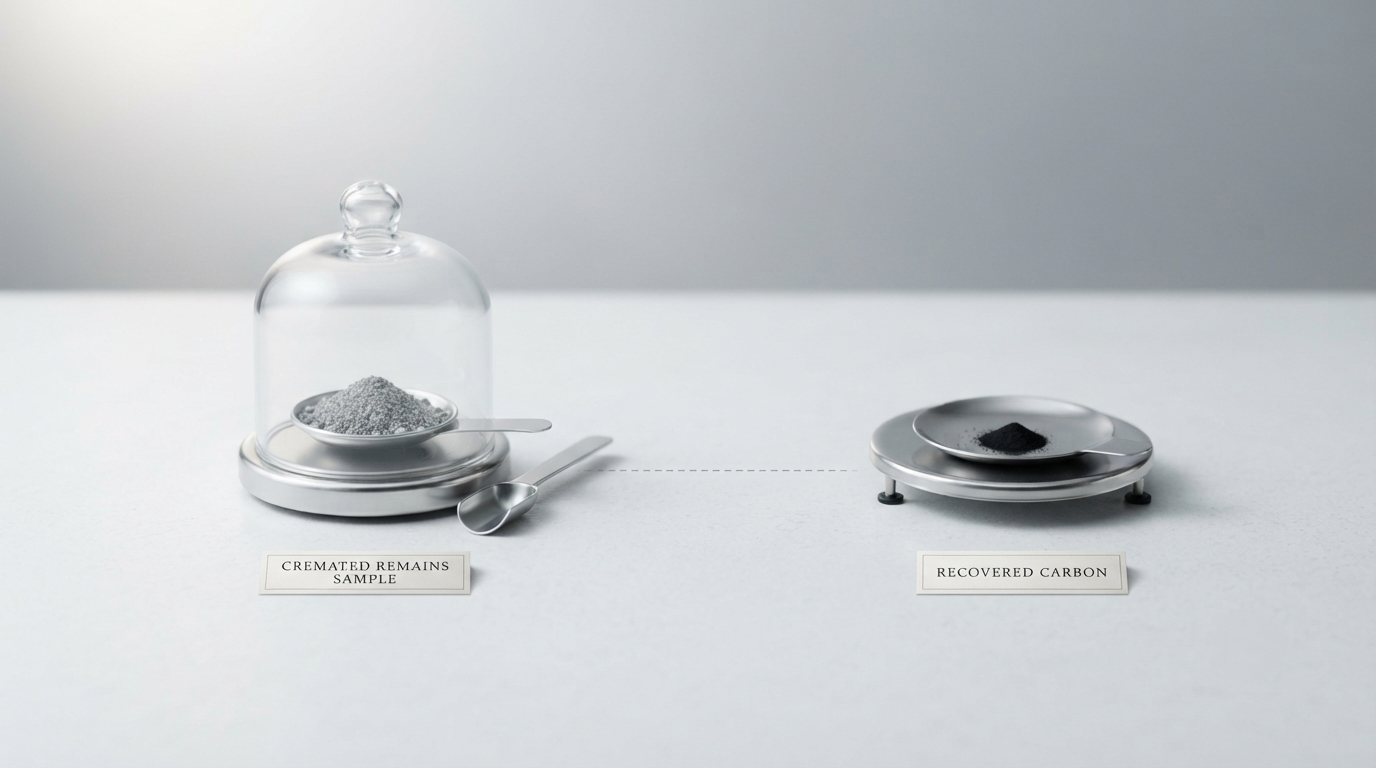
This is the single fact that makes an honest conversation about anything really made from son ashes possible. It explains the blending, it explains the finished percentage, and it explains why the amount you send does not control the size of the stone, growth time in the press does that.
Before a gem really made from son ashes can be grown, the extraction runs in a controlled, oxygen free, multi stage heating process that removes everything that is not carbon, reaching around 99.9% plus purity before anything is grown. How much ash a laboratory actually needs covers the quantities in detail.
How Much of the Finished Stone Is Really Made From Son Ashes?
Here is the number most pages about a diamond really made from son ashes avoid printing. For the ash route, the personal carbon recovered from cremated remains usually accounts for somewhere around 10% to 15% of the final stone’s mass, and some providers cite figures as low as 3%, depending on stone size and how much material was submitted.
So a diamond really made from son ashes is a blend, and the blend is not close to even. The remainder is supplemental laboratory carbon, added because the recovered quantity alone cannot fill a growth cell for a stone of meaningful size.
Parents react to that figure in two very different ways, and both are reasonable. Some find it deflating. Others find it clarifying, 10% of a physical object is not a gesture but a measurable quantity of the person, permanently held.
What matters is that you hear it before you pay, not after. Ask any provider to state their own expected percentage range for your submission in writing. A company that will not put a number near a stone really made from son ashes is telling you something about how it handles every other question.
Why Is Laboratory Carbon Blended In At All?
Not to cut costs, and not to stretch a product. It is a volume problem with no way around it.
A growth cell has to be filled to a certain level for a crystal to form properly, and the carbon recovered from a family’s submission rarely comes close to that volume on its own. So supplemental laboratory carbon, chemically identical, just not personal, makes up the difference. Carbon atoms carry no label, and once the cell closes, every atom in it behaves the same way.
This is also why sending a larger quantity of remains does not push the personal share upward as much as parents expect. The recoverable fraction of ash is low to begin with, and the cell still needs filling. Sending the entire contents of an urn will not turn a stone really made from son ashes into a pure one.
Two practical questions follow. Ask whether your submission would be grown as its own dedicated charge or combined with other material, and ask what happens to any recovered carbon left over, whether siblings can each have a stone often turns on that answer.
None of this diminishes what a gem really made from son ashes is. A blend is still a physical inheritance; it is simply an honest one, described accurately rather than sold as something the chemistry cannot deliver.
Is the Result a Genuine Diamond or an Imitation?
It is a genuine diamond. Not cubic zirconia, not moissanite, not resin with ash suspended in it, those are different products entirely, and some of them are sold under deliberately similar language.
A gem really made from son ashes is grown by the same two methods the wider lab grown industry uses. Most memorial providers use HPHT growth, where a press holds the cell at roughly 6 to 8 gigapascals while temperatures run between 1,400 and 2,500°C. A minority use CVD, depositing carbon from a gas onto a seed plate in a vacuum chamber.
The output of either route, in a jewel really made from son ashes, is carbon arranged in diamond structure. It scores 10 on the Mohs scale, refracts light identically, and is graded against the same four criteria as any other diamond. A gemological test will correctly identify it as laboratory grown rather than mined, an accurate description of origin, not a downgrade of authenticity.
So if the worry keeping you awake is that a piece really made from son ashes might turn out to be glass, set that one down. The genuine open questions are about percentage and provenance, not about whether the material is diamond, as the complete guide to a son ashes diamond sets out.
What Can a Family Actually Verify?
Less than you would like, and more than nothing. The honest position is that a stone really made from son ashes involves a stretch of laboratory work you will never personally watch, so the verification available to you is documentary rather than observational.
Here are seven things worth checking when something really made from son ashes is on the table, and what each one is genuinely capable of proving:
| # | What to ask for | What it proves | What it does not prove |
|---|---|---|---|
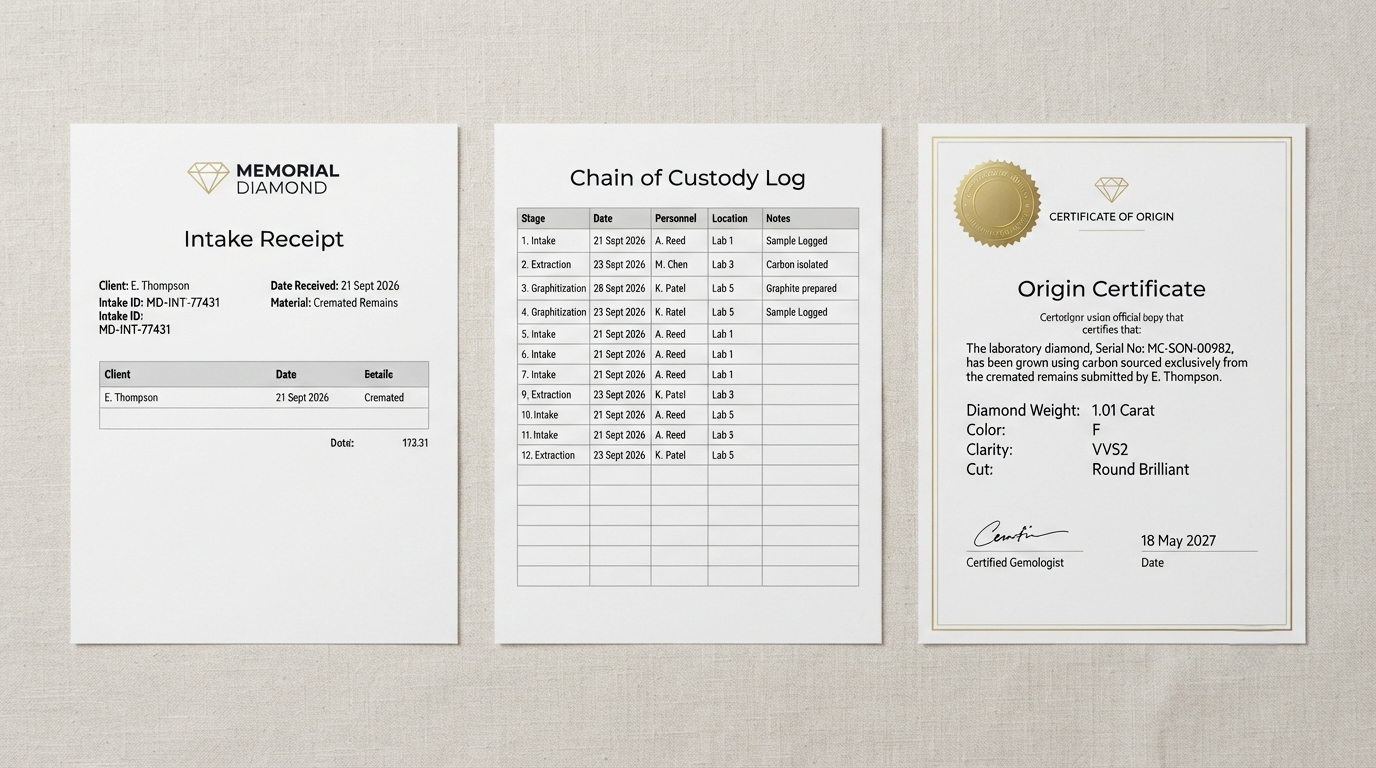
| 1 | Intake receipt with a unique identifier | The material arrived and was logged | Nothing about what happened next |
| 2 | Chain of custody log across every stage | The sample was tracked, vessel to vessel | That tracking was honest |
| 3 | Written personal carbon percentage estimate | The company will commit to a figure | The figure was met in your run |
| 4 | Authenticity or origin certificate | The provider states this stone came from your submission | Independent confirmation of that |
| 5 | Independent grading report, optional add on | The stone’s own cut, color, clarity, carat | Whose carbon is inside it |
| 6 | Return of unused remains | Only a portion was consumed | Which portion went where |
| 7 | Photographs at rough and polished stages | The stone existed at both points | Continuity between them |
Read that table as a realistic picture rather than a discouraging one. Documentation, plus a company’s willingness to answer awkwardly specific questions, is part of what you are buying alongside a jewel really made from son ashes.
Origin Certificate or Grading Report, Which Proves What?
The two documents that accompany a diamond really made from son ashes get conflated constantly, sometimes carelessly and sometimes on purpose, and the difference genuinely matters to a parent.
An authenticity or origin certificate is normally an in house document. It is the provider’s own formal statement that this particular stone was grown from the carbon your family submitted, effectively the end point of the chain of custody record. Its value depends entirely on the company issuing it.
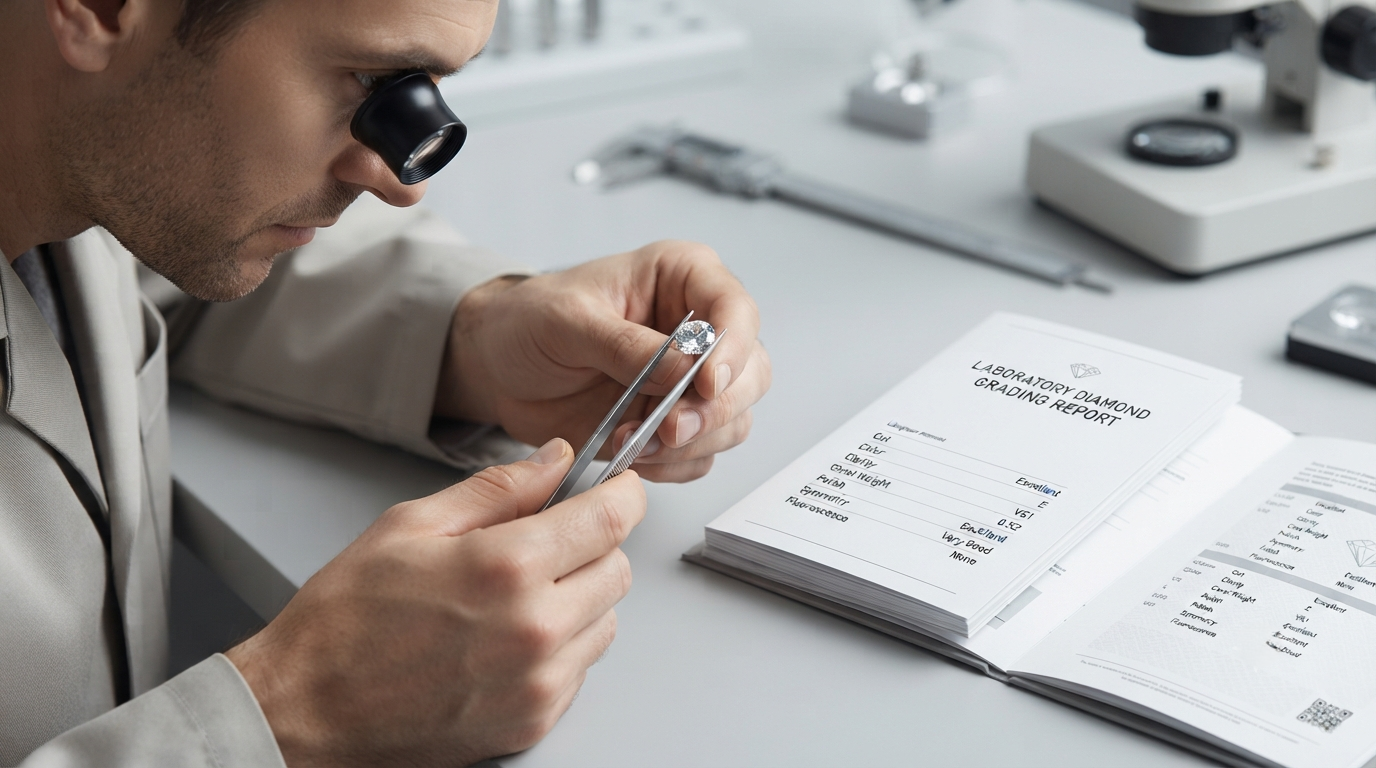
An independent grading report comes from a third party gemological laboratory and documents something different: the finished stone’s own qualities, judged by the same cut, color, clarity and carat standards applied to any diamond. Clarity for memorial stones typically lands somewhere in the SI2 to VVS range.
The distinction to hold onto is this. A grading report says the stone is a fine diamond. It does not say the stone is really made from son ashes, no third party laboratory can testify to whose carbon went into a growth cell it never saw. Independent grading is generally an optional extra across the industry, so ask whether a quoted certificate is the in house origin document, the independent report, or both. The questions worth asking before you commit puts this on a checklist.
Is His DNA Involved Anywhere?
This comes up often, and it deserves a straight non answer rather than a confident guess.
Purification of the material for a stone really made from son ashes strips it down to carbon atoms. Nothing in the publicly available material about this industry establishes whether any provider performs a genetic verification step before that happens, or whether such a step would be meaningful on cremated remains at all, so treat any page that asserts a firm yes or a firm no with caution, including this one.
What you can do is ask. Put it directly to any company offering you something really made from son ashes: is there any identity verification step in your process, and if so, what is it, and what documentation of it do I receive? The answer, or the quality of the dodge, will tell you a great deal.
That is the honest shape of this question. Not a reassurance, not a scare, a specific thing to put in an email and read the reply carefully.
Who Is Entitled to Send the Ashes in the First Place?
Worth settling before any order for a gem really made from son ashes is signed, because parents frequently assume the decision is automatically theirs and are distressed to learn late that it may not be.
Most states set out a statutory order of priority for who may direct what happens to a decedent’s remains. A surviving spouse or registered partner commonly sits at or near the top of that list, and your son’s own adult children can rank ahead of his parents. Anything he set down in writing, a will, a funeral directive, a named agent, can reshuffle that order, and the detail varies meaningfully from state to state.
None of this blocks a diamond really made from son ashes from going ahead. It simply determines whose signature the paperwork needs. A short call to the funeral director who handled the cremation, or to a local attorney, resolves it faster than reading ever will.
Parents are also not always in agreement with one another. One of you may be arranging this alone, after a separation or simply because one of you can face the logistics and the other cannot. That is ordinary. Authority is a legal question; unanimity is a family one, and they do not have to be solved together. How to turn his ashes into a diamond walks through the decision side.
What Should Make You Walk Away From a Provider?
Trust your ear for evasion. In a category this emotional, the warning signs around a diamond really made from son ashes are usually conversational rather than technical.
- A claim that the stone is 100% your son’s ashes, or any wording that implies nothing else goes into the growth cell.
- Refusal to give a personal carbon percentage range in writing, or irritation at being asked.
- A certificate described in deliberately vague terms, without saying whether it is in house or independent.
- No documented chain of custody, or no unique identifier attached to your submission at intake.
- Pressure tied to your grief, deadlines, guilt, or the suggestion that a real parent would decide faster.
- No clear written policy on what happens if a growth run fails partway through.
A provider genuinely producing work really made from son ashes has answers to all six ready, because careful families ask them constantly. Hesitation on more than one of these is a reason to keep looking, and there is no hurry: cremated remains are chemically stable and do not deteriorate while you take your time.
What Does a Diamond Really Made From Son Ashes Cost?
The price of a stone really made from son ashes tracks carat size far more than it tracks anything to do with the ash itself. Using general 2026 industry ranges rather than any single company’s published rates, entry tier stones of roughly 0.10 to 0.25 ct sit around $1,500 to $3,500; half carat to one carat stones typically run $5,000 to $15,000; and stones from two carats upward reach $20,000 to $75,000 and beyond.
Colorless costs noticeably more than yellow, blue or champagne at the same weight, because excluding trace elements takes extra process control, what color to expect explains why. Settings, engraving, fancy cuts and independent grading reports are usually quoted separately from the loose stone.
Most providers quote six to ten months once the material reaches the lab, and larger stones or specialty colors can push that out to twelve. The wait is growth time, not queue time, and a diamond really made from son ashes cannot be hurried by sending more ash. What a son memorial diamond costs breaks the tiers down further.
Frequently Asked Questions
Can the ashes be tested to confirm the diamond came from them?
No routine consumer test can trace a finished stone back to one person’s carbon. Verification that a gem is really made from son ashes is documentary, intake logs, custody records, an origin certificate, not forensic. Ask each company what identity checks, if any, their process includes.
Does a smaller stone mean less of my son is in it?
Not proportionally in the way parents expect. The personal carbon share is a percentage of the finished mass, so a smaller stone contains less total carbon overall, but the published percentage range applies across sizes. Ask your provider for their estimate at the carat you are considering.
Can anyone tell it apart from a mined diamond by looking?
No, the eye cannot. Hardness and optical behavior are identical, and the same grading criteria apply. Lab instruments do register it as grown rather than mined, a factual note on its origin rather than a judgment on its quality.
What if we already scattered most of his ashes?
A small retained portion is usually enough, since only a fraction of a full cremation is ever used. Tell the provider honestly how much you hold before committing, and ask what their minimum workable quantity is for the stone size you want.
Can we have more than one diamond grown?
Often, yes, because a single submission is rarely consumed by one stone. Families with siblings or a surviving partner frequently commission two or three stones really made from son ashes. Confirm in advance whether they are grown together or in separate runs, and how each is documented.
Is it too late if the cremation was years ago?
No. Cremated remains do not degrade in storage, so carbon recoverable from ashes kept for two decades is no different from ashes received this week. Plenty of parents come to this question long after the funeral, and nothing has been lost by waiting.
Final Thoughts on Whether the Diamond Is Really Your Son’s
Doubt in this situation is not cynicism. It is a parent doing the last protective thing still available to them, and any company that treats your questions as an insult has told you what you needed to know.
The truthful summary of a diamond really made from son ashes is narrow, and it holds. A measurable portion of his carbon, blended with laboratory carbon, permanently inside a genuine diamond, with paperwork you can demand and read, and limits you should hear stated plainly before you decide anything.
If you do go ahead with a stone really made from son ashes, get the percentage range and the custody documentation in writing first, settle the authority question with anyone else who has standing, and then let it take the months it takes.
Learn More About Son Memorial Diamonds
- The complete guide to a son ashes diamond, background on every stage
- A step by step account of the whole process, laid out as an ordered sequence
- The questions worth asking before you commit, what to raise with a laboratory
- What a son memorial diamond costs, carat tiers and what moves the number
- Whether siblings can each have a stone, dividing a single submission
Talk With Memorial Diamond
Doubts deserve specific replies, not brochure language. Memorial Diamond can be reached at memorialdiamond.us if you would like the percentage and the paperwork talked through for your own situation. Nothing is committed by asking, and nothing needs deciding on the call.
Word count: 2,985 words
Reading time: about 15 minutes
Leave A Comment