
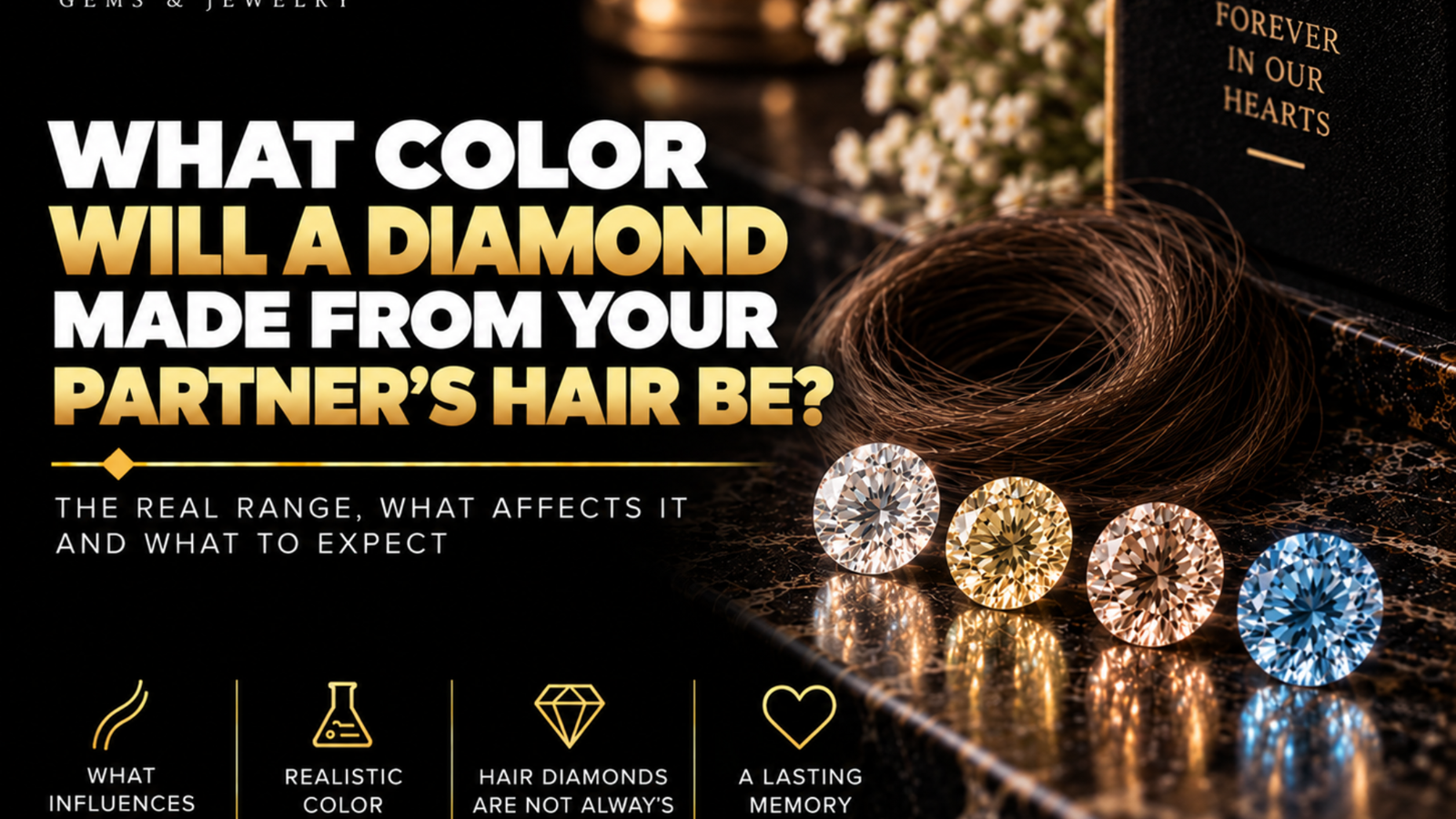
The lock in the envelope is the one thing in this decision that still looks like them, which is exactly why the color question feels as though it should have an obvious answer.
A partner hair diamond color will most likely carry a tint, yellow, champagne or blue rather than colorless, and their own hair color has nothing to do with which. Hair is a cleaner starting material than cremated remains, and that does not make the shade predictable. Hair grown stones are not automatically lighter, either. Colorless is available and has to be engineered, at a higher price for the same carat.
Memorial Diamond sells stones like these, which is a commercial interest worth factoring in as you read; treat this page as one source among several rather than the last word. Where an answer turns on a policy that differs between companies, this page tells you to ask instead of guessing on their behalf.
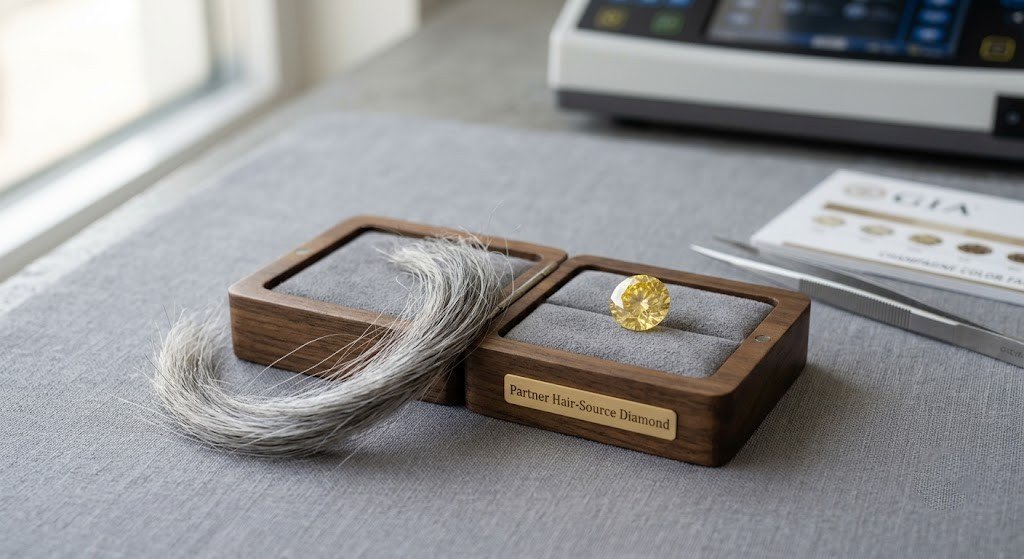
Table of Contents
Does a Cleaner Starting Material Make Partner Hair Diamond Color Predictable?
No. Purity and predictability are two different properties, and this is the single most useful distinction on the page.
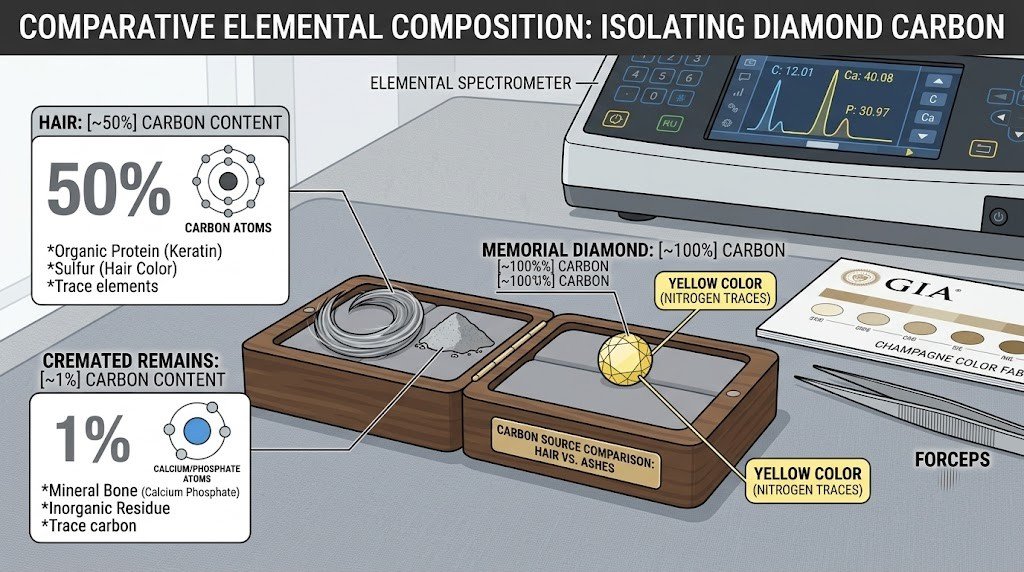
Hair is roughly 50% carbon by weight, because keratin is a carbon rich protein. Set that against ash, where the bulk of the material is the calcium phosphate of bone and the usable carbon comes to somewhere around 0.5% to 4% of the weight. So hair genuinely is the easier, richer, less lossy starting material, that much is not in dispute.
What that buys is yield, not a partner hair diamond color forecast. Purity describes how much of the feedstock is carbon. Partner hair diamond color is decided by what is present in the growth cell in trace quantities, measured in parts per million, and a high carbon source is not the same thing as a source whose residual trace elements have been characterized. Nobody assays a lock of hair and hands you a partner hair diamond color.
There is a second reason a clean source does not deliver a predictable color, and it is easy to miss. What a lock yields is still a fraction of what a growth run consumes, so lab made carbon is added to bring the charge up to working volume, which means no memorial diamond, from any material, is entirely one person. A partner hair diamond color is shaped by the whole contents of the cell and by the conditions of the run, not by the tidiness of one input.
Are Hair Grown Stones Lighter Than Ash Grown Ones?
No, and this deserves a flat answer because it is the most widespread assumption about partner hair diamond color.
The intuition runs like this: ashes are gray and mineral heavy, hair is clean and organic, so a hair grown stone must come out paler. It is a reasonable chain of thought and it is wrong at the first link, because the gray of cremated remains is mineral content that purification removes before anything is grown. Neither material carries its visible appearance into the crystal.
What reaches the growth cell in both cases is elemental carbon at roughly 99.9%+ purity, plus whatever trace elements survived. A partner hair diamond color and an ash derived one are set by the same three mechanisms, in the same kind of cell, and land in the same broad territory of tinted stones.
It is worth saying directly that neither material produces a better color, and that no partner hair diamond color advantage exists to be sold. Both routes produce color the same way. Anyone selling one source over the other on color grounds is making a claim the chemistry does not support, and it is fair to ask them what measurement it rests on. What an ash source contributes to the same question covers that half in its own terms.
Five Beliefs About Partner Hair Diamond Color, and What Is Actually True
These five are the assumptions a partner hair diamond color question usually rests on. The second column is the useful one: it shows what each belief would have to imply about the process in order to be true.
| The belief | What it would have to imply | What is actually true | What follows for your order |
|---|---|---|---|
| Their hair was pale, so the stone will be pale | That pigment survives purification and travels into the lattice | Pigment is destroyed with everything else that is not carbon. White, gray, dyed or dark, the same element leaves the sample | Nothing. Send the lock that means the most, not the one that looks the right color |
| Hair is clean, so the color is predictable | That feedstock purity and trace element content are the same property | They are different. Purity is about how much is carbon; color is about what else is there in parts per million | Agree a partner hair diamond color family rather than expecting a forecast |
| Hair grown stones are lighter than ash grown ones | That the visible appearance of the source carries through | Neither source carries appearance into the crystal, and both land in the same broad tinted territory | Choose your material on availability and meaning, never on expected shade |
| Dye, bleach or product will change the color | That surface treatments survive an oxygen free extraction to 99.9%+ carbon | Sample preparation requirements are a provider policy question, but treatments are not a color mechanism | Ask about preparation, not about color |
| Colorless is impossible from hair | That an organic source rules out engineering the absence of trace elements | Colorless is achievable from hair, requires additional processing, and costs more at the same carat | Specify it deliberately and price it separately |
Read down the third column and the pattern is clear: almost every belief about partner hair diamond color is an assumption that something visible about the sample survives into the stone. None of it does.
So What Actually Decides the Tint?
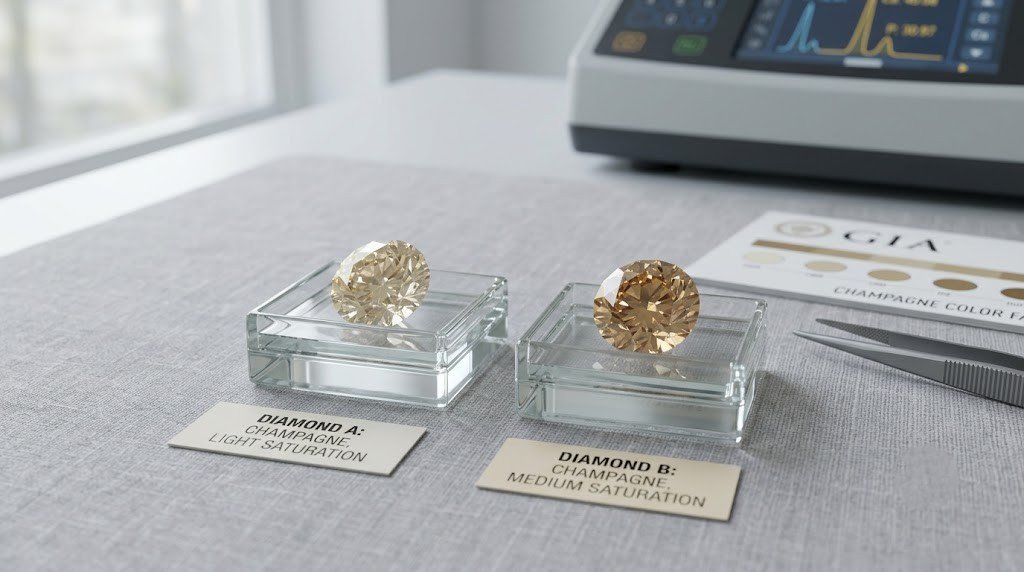
A partner hair diamond color comes from trace elements present while the crystal forms, and from nothing else the science assigns a mechanism to.
A crystal that forms with nitrogen inside it reads yellow.
A crystal that forms with boron inside it reads blue.
Hold both down to almost nothing and what you have is colorless, which is why it demands extra work in the laboratory and sits above the tinted stones on price for the same carat.
Irradiation after the fact is a fourth route entirely, applied to a crystal that already exists, and it is where red, pink, green and black come from.
Those four routes are the whole of it. A partner hair diamond color arrives through one of them, and the finished object is a genuine lab grown diamond described on the same color, clarity, cut and carat criteria as any other stone. a genuine lab grown diamond explains the broader synthetic diamond category.
Notice what is not on that list: the sample’s own shade, its age, its length, and whether it was ever colored. How a memorial diamond is made from a lock of hair follows the material through each stage, and why memorial diamonds are rarely colorless covers the category wide version of the point.
What Actually Varies, and What Does Not
Splitting these apart is how you work out which partner hair diamond color worries are worth carrying.
What varies, run to run:
- Which trace elements are present in the growth cell, and in what quantity.
- The conditions of the individual growth run, which no two runs replicate exactly.
- How much supplemental lab grown carbon a given carat requires.
- How the finished tone reads once the stone has been cut, since cut and proportions affect how color presents.
What does not vary with the sample:
- Their natural hair color, including gray and white.
- Whether the hair was dyed, bleached, permed or heat treated.
- The age of the lock, whether it was cut last month or twenty years ago.
- Its length, and whether it came from the head, a beard or a razor.
So partner hair diamond color is variable for reasons that all sit inside the laboratory, and stable with respect to every property of the sample that a person can actually see. That is an unusual shape for an answer, and it is why the question so often gets answered badly, people look for the explanation in the envelope, and it is not there.
What Can You Settle Before the Run Is Set Up?
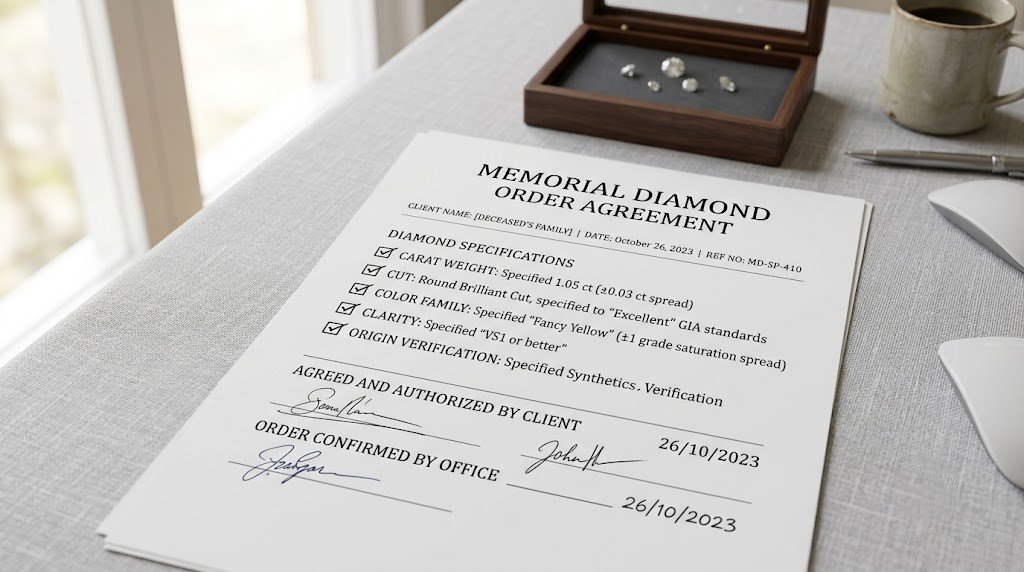
Five partner hair diamond color decisions are available now, and none of them requires knowing the shade in advance.
- Which partner hair diamond color family is on the order, blue, yellow, champagne or colorless, written down rather than agreed in conversation.
- What spread counts as normal inside that family, so the word means the same thing to both parties.
- What happens if the finished stone sits outside it: a re grow, an adjustment, or a conversation. Any answer is workable; no answer is the problem.
- Whether the color is grown in or applied afterward, since irradiated colors are a different product from a tone that arrived during growth.
- Whether an independent grading report is included, and which scale it will use, because tinted and colorless stones are described differently.
All five are cheaper to settle now than at delivery, and none of them requires any expertise to raise. The questions worth putting to a provider before anything is sent go well past color, and how memorial diamonds are graded and certified sets out what a report does and does not cover.
What If the Lock Was Taken While Your Partner Is Still Here?
The color answer is identical, and the reasons that is worth stating are practical rather than sentimental.
Hair needs no cremation at any point, which is why a hair grown stone is available for a partner who was buried, and equally available for a partner who is alive right now. A sample cut this afternoon and a sample cut in 2009 are the same material arriving at the same process, and a partner hair diamond color grown from either is decided in the growth cell rather than in the envelope. Freshness is not a color variable.
Two things do change, and both of them help. The first is quantity: where the person is present, a second sample can be taken if the first turns out to be short, which removes the one genuine constraint a small envelope imposes. How much hair a stone actually needs sets out the amounts, which are smaller than most people expect.
The second is that the color family can be agreed by both of you rather than decided alone. That is not a small thing when the stone is meant to be worn in front of the person it came from, and it turns an expectation management conversation into an ordinary joint decision about jewelry.
None of that makes a sample kept from someone who has died a lesser starting point, and nobody should read it as a reason to hurry. It is simply the one situation in which every part of this question, quantity, provenance and partner hair diamond color itself, has a straightforward answer available in the same afternoon. The complete guide to a partner hair diamond covers both cases side by side.
Does It Matter Which Lock You Send?
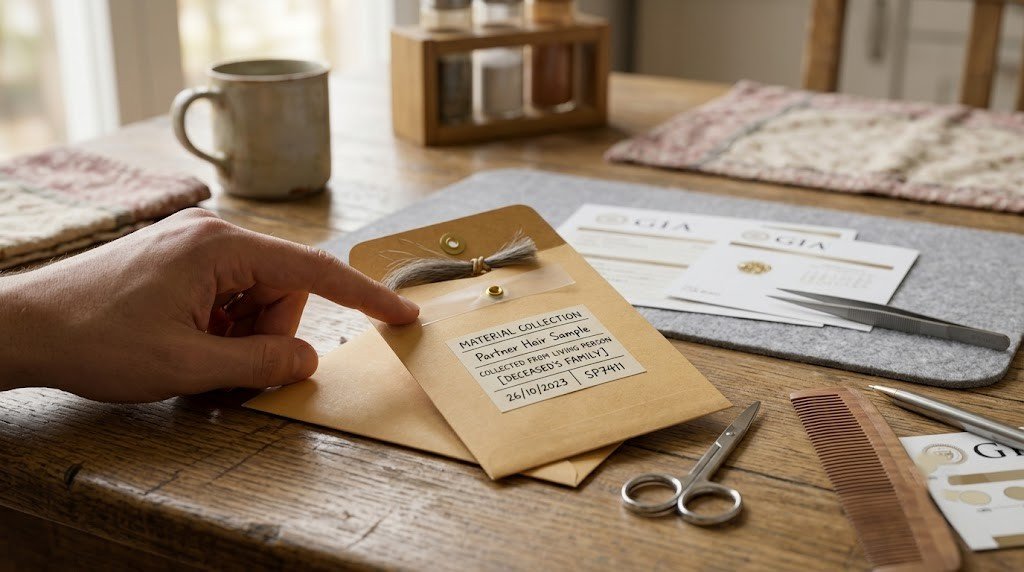
Not for partner hair diamond color. It may matter a great deal for other reasons, and it is worth being clear about which is which.
Where a household holds more than one sample, a lock kept in a drawer for years, clippings taken recently, hair collected while your partner was still alive, the color question declines to choose between them. All of them are keratin, all arrive at the same process, and none carries a shade forward. An envelope from a decade ago and one from last spring hand the growth cell the same element.
That frees the decision to be made on the things that genuinely differ: how much there is, and what each sample means to you. Quantity belongs to the question of how much hair a stone actually needs, and the separate question of whether a stone is really made from their hair belongs to whether a given lock was theirs, which matters more in this cluster than most, because a lock kept at home is sometimes the only material a partner has, particularly where the relationship was not legally recognized or not recognized by their family.
One practical note. Whichever sample you send is the one that goes, and partner hair diamond color will not be the reason to prefer another. If there is any chance more could be found, look before you seal the envelope rather than afterward.
Frequently Asked Questions
Their hair went white years ago. Does that change partner hair diamond color?
No. White, gray, dyed or dark, what leaves the sample is elemental carbon, and color is settled by trace elements present in the growth cell. The shade of the lock in your hand is not one of the inputs.
Is partner hair diamond color more predictable than an ash grown stone’s?
Not in any way you can rely on. Hair is a richer carbon source, which affects yield rather than color, and no published figure supports treating one material as producing a more predictable shade than the other.
Will a hair diamond come out lighter than an ashes diamond?
No. Neither material carries its visible appearance into the crystal, because purification removes everything that is not carbon. Both routes land in the same broad territory, and partner hair diamond color is set by the same mechanisms.
Does dyed or bleached hair need special treatment?
Ask the provider, because sample preparation is policy rather than chemistry and varies between companies. What can be said is that treatments sit on the outside of a sample that is reduced to elemental carbon before growth begins.
Can colorless be a partner hair diamond color?
Yes. Getting there means suppressing boron and nitrogen alike to near zero, which adds steps in the laboratory and carries a higher price for the same carat. Ask the provider whether it also shifts the quantity of hair needed or the timeline.
Can partner hair diamond color be chosen exactly?
A family can be specified; a precise shade cannot. Where inside that family a stone lands is settled by the individual growth run, which is why the useful work at order is agreeing the family, the spread, and the remedy.
Final Thoughts on Partner Hair Diamond Color
The honest version of this answer has two halves that people tend to hear separately. Hair is a cleaner, richer starting material than cremated remains, true, and it matters for how much you need to send. And partner hair diamond color is no more forecastable because of it, also true, and it matters for what you should expect to open.
Neither half makes hair the better material or the worse one. It makes hair the material that many families have, that requires no cremation, and that produces exactly the same kind of stone by exactly the same route.
Which leaves the decision where it belongs. Send the lock that means the most, agree the color family in writing, and let the shade be the part of this you were never going to control.
Learn More About Partner Memorial Diamonds
- How a Memorial Diamond Is Made From Your Partner’s Hair
- What Color Will a Diamond Made From Your Partner’s Ashes Be?
- Memorial Diamond Colors Explained: Why They’re Rarely Colorless
- How Much Hair Do You Need for a Partner Memorial Diamond?
- Questions to Ask Before Turning Your Partner’s Hair Into a Diamond
Talk With Memorial Diamond
If you want to know what is realistic for the sample you actually have, which families are available, what colorless would involve, and the exact wording that puts an agreed partner hair diamond color into a contract, ask. None of that is unanswerable, and all of it should be on paper before an envelope leaves your house. Reach out to Memorial Diamond and ask. Nothing has to be sent for that conversation to happen.
Leave A Comment