
A kitchen scale is a blunt instrument for this, put an envelope holding your father’s hair on one and it can read zero. So how much hair do you need for a father memorial diamond? Industry wide, a small lock or a few grams, an amount usually described as palm sized. That figure is a weight rather than a length, and it is set per stone rather than per family.
Everything below is about what that number means once the sample is in front of you, and why the reading on a home scale and the figure a laboratory works from are not the same number.
A disclosure first: Memorial Diamond sells memorial diamonds, so read the checks below as ones to put to any provider, including this one.
Table of Contents
How Much Hair Is Actually Needed?
Across the industry, providers ask for something in the region of a few grams, a small lock, a palm sized amount, a few wisps. Exact minimums vary from company to company, and no single published figure covers the category, so the number that governs your decision is the one your chosen provider states.
Two things about how much hair that figure describes are worth holding onto.
The first is that it is a weight. Length is the proxy people reach for because it is easy to see, and it is a poor one: fine hair and coarse hair of the same length weigh very different amounts. The complete guide to father hair diamonds covers where a father’s hair tends to be found in the first place; this page is about how much hair counts once it is in your hand.
The second is that it is per stone. A submission that comfortably clears one provider’s minimum has not thereby cleared it twice.
Why Is the Weight You Send Not the Weight the Process Uses?
Between the envelope on your kitchen table and the graphite that goes into a growth cell, the mass of the sample only falls. Providers commonly describe a preparation stage before extraction begins, and where a stated minimum sits relative to that stage is worth asking rather than assuming. The table below is a set of questions about how much hair survives each stage, as much as a description.
| Stage | What happens to the weight | Does a stated minimum usually account for it? |
|---|---|---|
| What you hold back at home | You keep part of the lock; only the rest travels | No, a minimum applies to what actually arrives |
| Preparation before extraction | Providers commonly describe removing product, oils, dust and non hair debris first, ask what theirs removes | Ask directly: is the stated figure a received weight or a usable one? |
| Carbon extraction | Hair is roughly 50% carbon by weight; the non carbon remainder is driven off in a controlled, oxygen free process | Ask which weight the figure refers to, do not assume it is stated after this loss |
| Blending with supplemental lab grown carbon | Mass is added, not removed, to reach a workable volume for growth in an HPHT press | Not a deduction, but the reason no stone is made only of the submitted material |
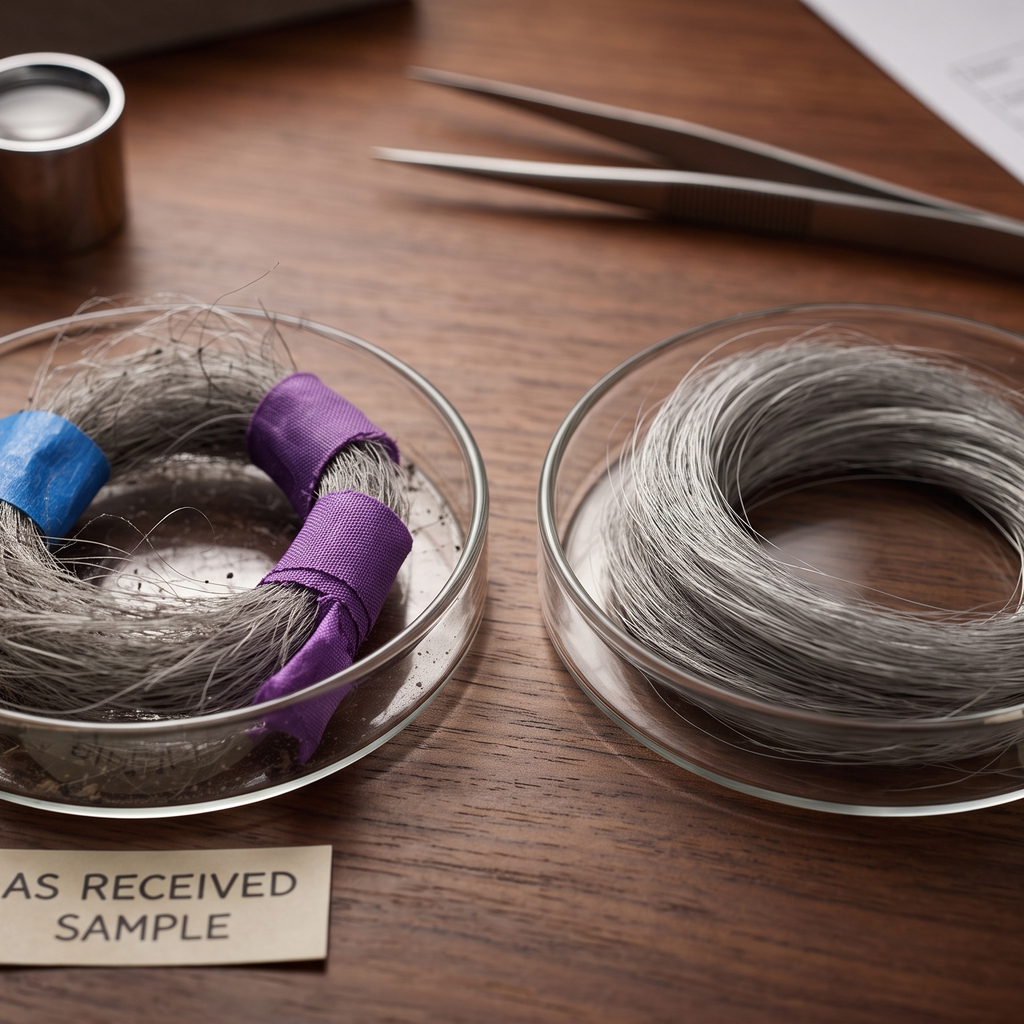
The preparation row is the one that decides whether a marginal sample passes. A lock that has been handled, sprayed, gelled or stored loose in a drawer has more to lose at that stage than one cut clean and sealed the same day. How a memorial diamond is made from your father’s hair sets out what that stage involves.
The practical consequence is simple. If what you have is anywhere near a stated minimum, send a little more than the minimum rather than exactly it, and ask which weight the figure refers to before you decide how much hair to keep back.
What Should You Weigh It On?
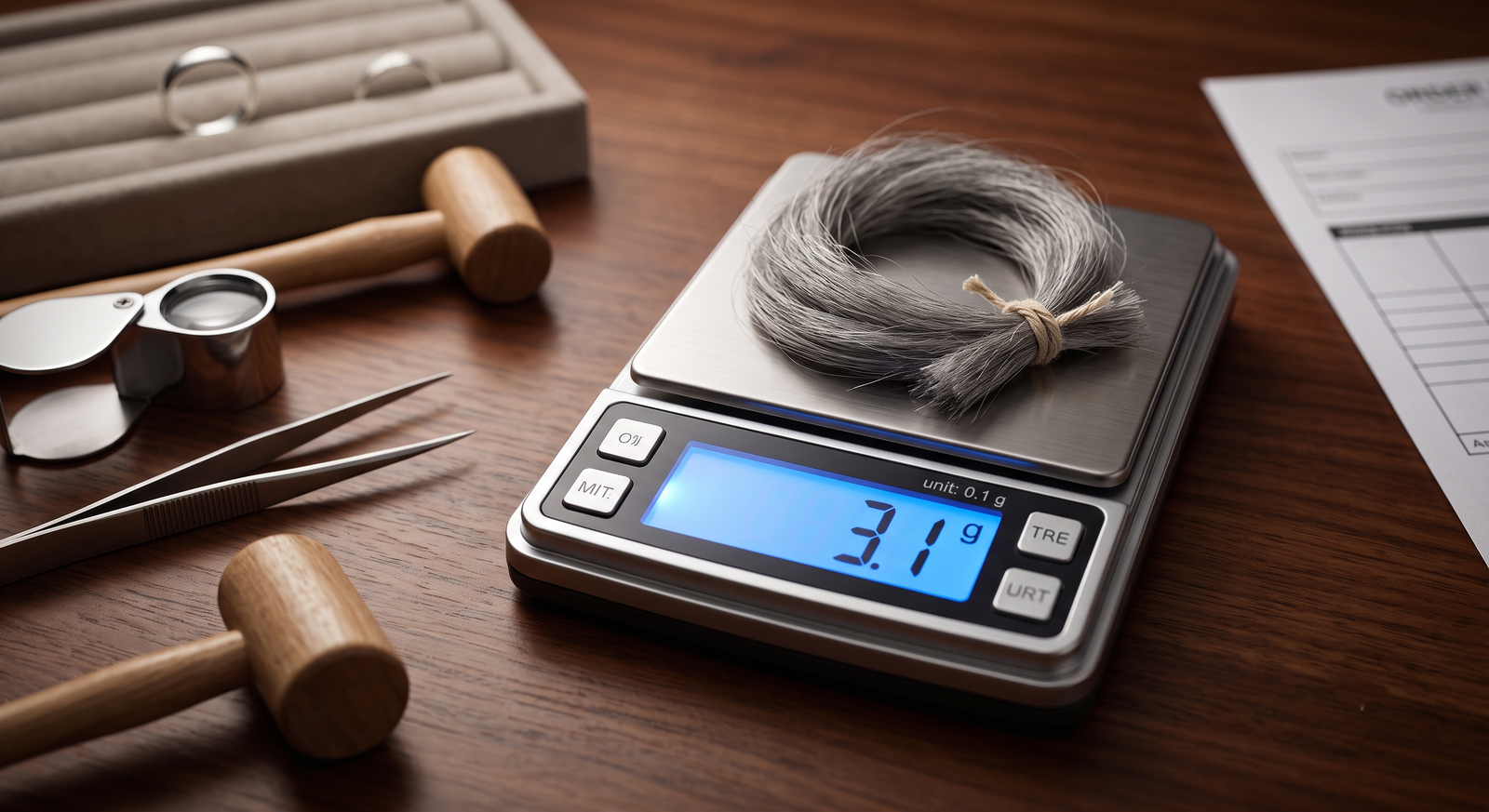
Not a kitchen scale, unless it reads to a tenth of a gram. A small jeweler’s or coffee scale with 0.1 g resolution costs very little and turns a guess about how much hair you have into a fact.
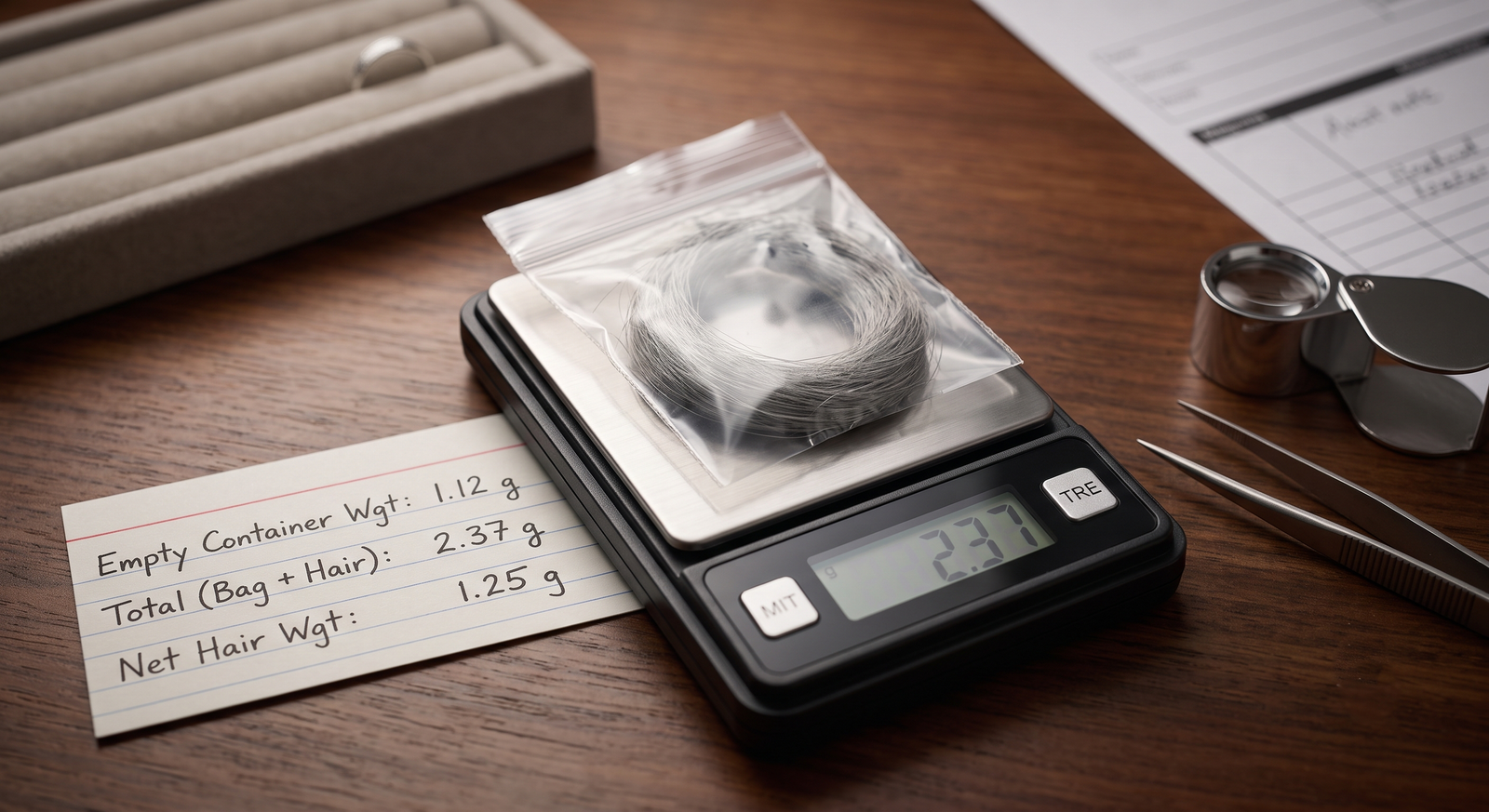
- Weigh the container empty first, then weigh it with the hair inside and subtract. Tipping a lock onto a scale pan risks losing strands you cannot replace.
- Take the ribbon, tape, tissue and elastic out of the calculation. They can weigh more than the hair does.
- Photograph the sample beside the scale display in the same frame. That single image answers the first questions a provider is likely to ask.
- Do not divide anything to find out. A whole sample can always be split later; a split one cannot be rejoined.
- Write the figure down with the date and where the hair came from. Questions to ask before turning your father’s hair into a diamond covers what else belongs in that record.
If the scale reads a figure you were not expecting, that is information about how much hair you have rather than a verdict. It is the number to quote in an inquiry.
Does Hair’s Higher Carbon Content Mean You Need Less?
Yes, dramatically less than ashes, though not in the ratio the chemistry alone would suggest.
Hair is roughly 50% carbon by weight. Cremated remains are dominated by calcium phosphate, with usable carbon at roughly 0.5% to 4% of ash by weight. That is why the ash requirement is quoted in tablespoons and ounces while how much hair you need is quoted in grams.
But the published minimums for how much hair and how much ash are needed do not sit a hundred to one apart, and the gap is worth asking about. One likely reason is that a very small sample is harder to handle, clean and weigh reliably whatever its carbon content, which would make a hair minimum closer to a practical floor than a calculation from chemistry. Ask a provider how their figure was arrived at; it is a fair question and the answer is informative.
It is also worth saying plainly what the last row of that table implies. The carbon recovered from his hair is purified and then blended with supplemental lab grown carbon to reach the volume a growth run needs. What comes out is a real, documented portion of him inside a stone that is not made only of him, the honest framing, and the one memorial diamonds as a category have always rested on.
One more thing the arithmetic explains: sending several times as much hair as the minimum does not produce a larger stone. Carat size is a function of growth time in the press, which is chosen and paid for, rather than of how much material arrived. Choosing a carat size is a separate decision from this one.
Is a Sample Near the Floor a Verdict?
No, it is a question, and one worth asking with a number attached.
A short clipping is keratin just as a long lock is, and length on its own rules nothing out. Whether a given provider will accept them is a different matter, and it is a policy question rather than a scientific one. Acceptance rules for very short clippings and for mixed provenance samples are not standardized across the industry, which means the only reliable answer is the one you get in writing from the company you are considering.
Ask it as a question about how much hair you have, with a weight and a photograph attached, rather than as a description. “4.2 grams, collected over two trims from a beard” is answerable. “A bit of his beard” is not, nobody can tell from that how much hair is actually there.
If the answer comes back as not enough, that is one company’s policy rather than a fact about the sample. Ask another before concluding anything, and remember that the ashes route may still be open alongside it.
How Much Hair Is Enough for More Than One Stone?
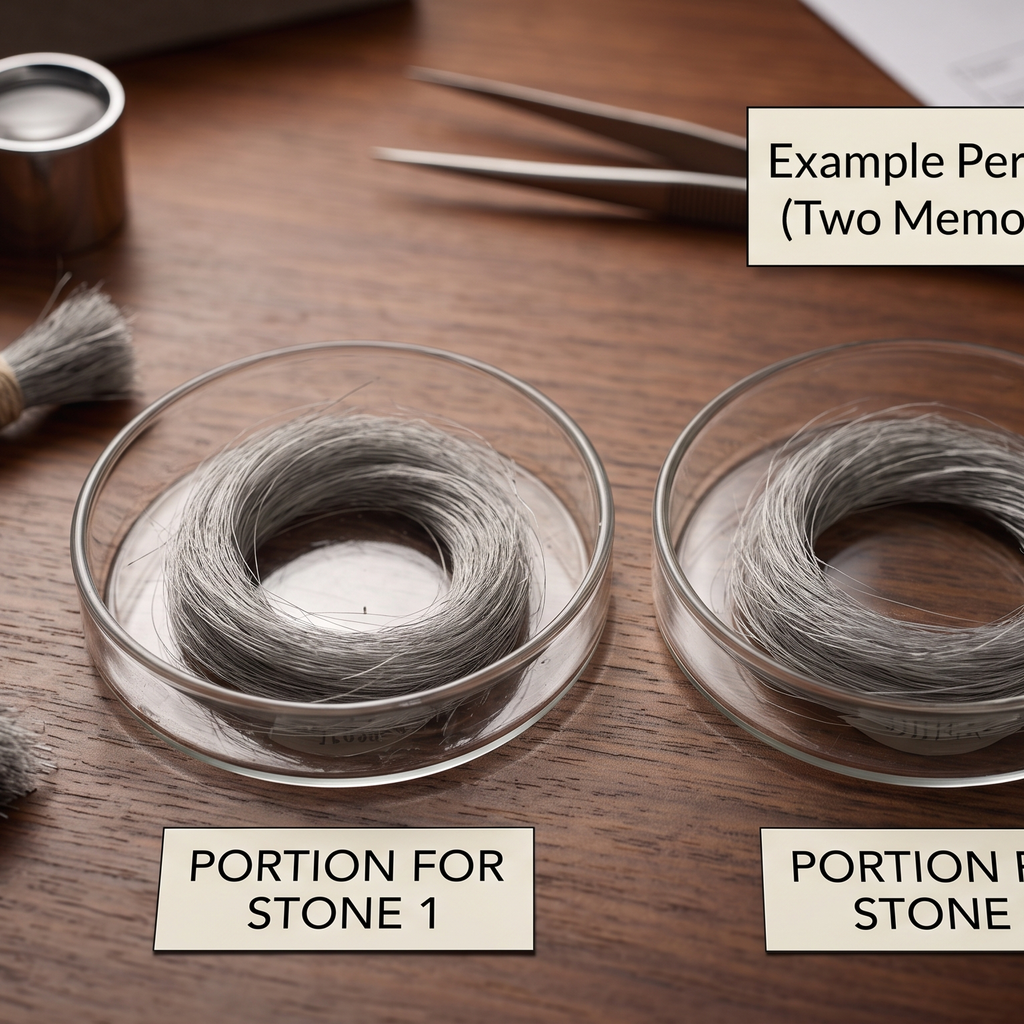
Where a submission holds twice as much hair as the per stone figure, several family members can each receive a stone from the same starting material, which is why the figure to ask for is grams per stone rather than grams outright.
Where a sample is generous, that arithmetic is straightforward. Where it sits close to the minimum, the realistic options narrow to one stone now, a smaller carat, or a combined submission with his ashes. Whether more than one family member can have a diamond from the same father covers how families divide that decision, and how much ash and hair a combined stone needs covers what two materials require between them.
Ask for it as a per stone figure in grams, how much hair per stone, not how much hair in total, and ask before you plan on two.
Frequently Asked Questions
Does the hair need to be in one piece, or will loose strands do?
Loose strands are usable, the process consumes weight, not structure. A bound lock is easier to handle, photograph and document, so if the hair is already tied, leave it tied and send it exactly as it is.
Do I weigh the hair with the ribbon and envelope it came with?
No. Weigh the packaging empty, then weigh it full, and use the difference. Ribbon, tape and tissue can easily outweigh a small lock, which is how a marginal sample gets mistaken for a comfortable one.
Is there a maximum, or can the whole lock be sent?
A stated maximum is unusual, however much hair you have, but sending everything is worth pausing over. Once a sample is in transit it is out of your hands, and keeping a portion at home costs nothing and preserves an option for later.
Will the laboratory weigh it again, and will they tell me how much hair arrived?
An intake weight is normally recorded as part of chain of custody documentation. Whether that figure is shared with the family varies, so ask for it to be reported to you at intake rather than assuming it will be.
Does damp or freshly washed hair weigh more than the process can use?
Moisture adds weight the process cannot use, so a damp sample weighs more than it is worth. Let it dry fully at room temperature before weighing, and ask the provider how they want it packaged rather than sealing a damp sample into anything.
Does how much hair you need change with the carat size chosen?
Not in the way people expect. Because size is driven by growth time rather than input volume, a larger stone usually costs more months and more money rather than more hair. Confirm it with the provider, since minimums vary between companies.
Final Thoughts on How Much Hair a Father Memorial Diamond Needs
The whole of this page reduces to one action that takes ten minutes and commits you to nothing: put the sample on an accurate scale, photograph it, write the figure down, and put the sample back exactly where it was. With that number in hand, an inquiry stops being a conversation about whether you have enough and becomes a conversation about what happens next. How much hair you have is a fact you can establish this afternoon; what it is enough for is the provider’s to answer.
Learn More About Father Memorial Diamonds
- Father Hair Diamond: The Complete Guide
- Step by Step: Turning Your Father’s Hair Into a Diamond
- How Much Does a Father Memorial Diamond Cost?
- What Color Will a Diamond Made From Your Father’s Hair Be?
- Father Memorial Diamond FAQ: Everything Families Ask
Talk With Memorial Diamond
Send Memorial Diamond the weight and a photograph, and ask the only question that matters at this stage: is this much hair enough, and for how many stones. Nothing needs to be cut, divided or posted to ask. Start at memorialdiamond.us.
Leave A Comment