
Some families find they are holding two things of hers rather than one: a portion of ashes from the crematory and a lock of hair kept separately, perhaps for years. A diamond made from sister ashes and hair is grown from carbon recovered from both, with each material purified to about 99.9% carbon, combined at a point that varies by provider, turned into graphite, typically joined by lab carbon, grown most often in a high pressure press, then cut and graded, usually over six to ten months.
Table of Contents
Why Would a Family Use Both Her Ashes and Her Hair?
Usually because both exist and both mean something. A parent or partner may hold her ashes while a sibling has kept a lock from an old haircut. Someone may feel that a stone made from sister ashes and hair is a fuller tribute than one drawing on a single source, and that feeling needs no further justification.
It is worth being clear about what a diamond made from sister ashes and hair does not do. It does not make the diamond bigger, because carat size depends on growth time. It does not let anyone predict or steer the color. And it does not give you a published figure for how much of the stone is hers, because no such figure exists for blends.
What it does offer is a single stone with two documented origins. For a family that finds meaning in that, a diamond made from sister ashes and hair is a reasonable choice, alongside an urn, a burial, a scattering, or any combination of those for the rest of her remains.
If you are still weighing whether to use one material or both, the complete guide to a sister ashes and hair diamond sets the options side by side.
What Are the Eight Stages of a Diamond Made From Sister Ashes and Hair?
There are eight stages, with two of them running as parallel purification tracks. The timings below are rough industry wide proportions. Each provider works to its own schedule, and only the overall production span is widely quoted.
| Stage | What happens | Rough timing | What a sibling sees |
|---|---|---|---|
| 1. Gathering and consent | Both materials are located, the right people agree, and a kit is requested | Depends mostly on family conversations | Forms, a kit and packing guidance |
| 2. Intake and logging | The ash container and hair packet arrive and are logged as two items under one order | Days to two weeks, largely transit | An arrival note that should list both items |
| 3. Ash purification | Staged oxygen free heating separates trace carbon from bone mineral, reaching about 99.9% purity | A few weeks, as a rule | Rarely any news |
| 4. Hair purification | Oxygen free heating removes the non carbon parts of keratin, reaching similar purity | Often alongside stage 3 | Rarely any news |
| 5. Combining and graphitization | Purified carbon from both sources is brought together at a point that varies, then heated to about 2,500 to 2,700°C to form graphite | Short beside growth | Seldom reported |
| 6. Growth | The graphite, typically blended with supplemental lab carbon, forms a crystal on a diamond seed, by HPHT in most cases and CVD in a few | Weeks to months | The longest silence; perhaps a rough crystal photo |
| 7. Cutting and polishing | The crystal is faceted and polished; optional irradiation may follow where a provider offers it | Commonly a few weeks | Sometimes images for review |
| 8. Grading and documentation | Origin paperwork for a stone made from sister ashes and hair is completed; an independent grading report may be added | A few weeks with an outside lab | The stone and its documents |
Industry wide, six to ten months is the usual total, with stones over about two carats or in specialty colors stretching toward twelve months.
Ask a provider whether purifying two materials affects its own schedule for a stone made from sister ashes and hair.
How Do Ash and Hair Compare as Carbon Sources?
They sit at opposite ends of the scale. Cremation removes most of the body’s carbon, leaving ash that is largely calcium phosphate, while hair is built from keratin, a carbon rich protein.
| Factor | Her ashes | Her hair |
|---|---|---|
| Carbon by weight | Roughly 0.5% to 4% usable carbon | Roughly 50% |
| Amount usually requested | From a few tablespoons up to about 4 oz, approximately 100 g, varying by provider | A small lock or a few grams, varying by provider |
| Requires cremation | Yes | No |
| Main purification task | Freeing a trace of carbon from bone mineral | Stripping the non carbon parts of keratin |
| Published share of a finished stone | Around 10% to 15% for ash only stones, with some providers citing as low as 3% | None published |
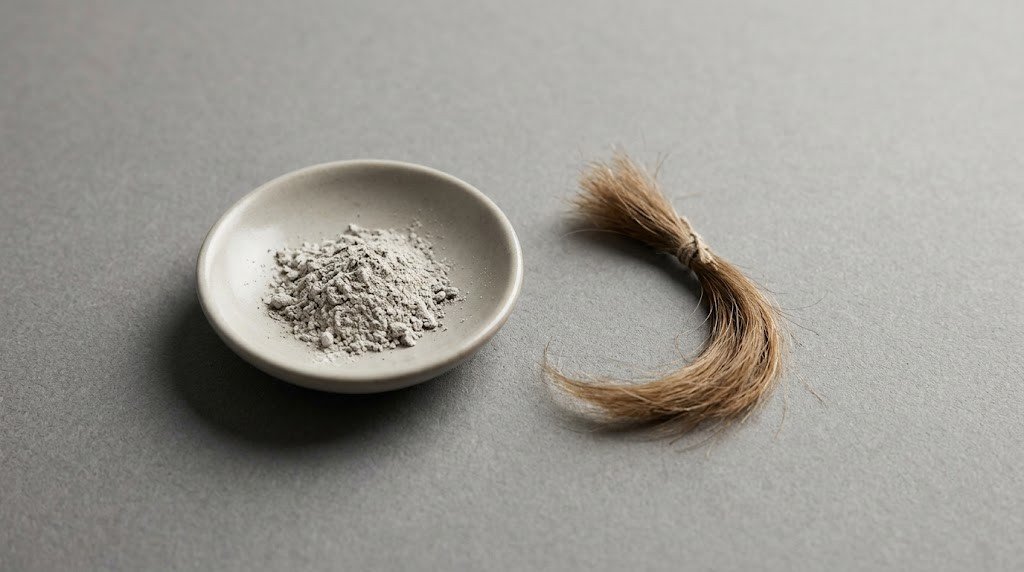
The bottom row matters most. The 10% to 15% figure describes stones grown from ashes alone, and it does not carry over to hair or to a blend.
For a diamond made from sister ashes and hair, no published finished stone percentage exists.
Each material also has its own dedicated walkthrough: the ash route on its own and the hair route on its own describe each one in more depth.
Are the Two Materials Purified Together or Apart?
That depends on the provider, and it is one of the most useful things to ask.
Ash and hair begin with very different chemistry, so it is reasonable to expect each to need its own handling before the carbon is combined, but practice is not standardized and you should not assume.
Put these questions in writing before anything is sent:
- Will her ashes and her hair be purified separately, and under separate reference numbers?
- At which stage are the two purified carbons combined?
- How much carbon do you expect to recover from each material?
- Is any of her material ever processed alongside another family’s?
- What happens to unused ash and unused hair afterward?
A provider that has handled orders made from sister ashes and hair, or any blended order, should be able to describe its sequence plainly. Vague answers here are a reason to keep asking, not a reason to stop.
What Happens in the Press to a Stone Made From Sister Ashes and Hair?
Once combined, the carbon for a diamond made from sister ashes and hair follows the same path as any memorial diamond.
It is heated to roughly 2,500 to 2,700°C and becomes graphite, the layered form a growth press uses. Around this point, supplemental lab carbon is typically blended in to reach the volume growth needs.
Most providers grow by HPHT, holding a small cell at around 6 to 8 gigapascals and between about 1,400 and 2,500°C so that carbon builds gradually onto a diamond seed.
A smaller group uses CVD, converting the carbon into a gas such as methane and depositing it in thin layers.
Either way, the result is a real diamond, a fact that applies across memorial diamonds as a category.
Growth lasts weeks to months and sets the carat weight. Adding hair to ashes does not make a larger crystal, and neither does sending more of either. A bigger stone simply needs a longer, steadier run.
Growth can also fail, with a flawed or stalled crystal and a run that has to be repeated. Ask whether carbon from both sources is held in reserve for a second attempt, and what happens if not.
How Much of a Stone Made From Sister Ashes and Hair Is Her Carbon?
Nobody publishes a figure for blends, so the honest answer is that it depends on the specific order and has to be asked.
You cannot add the ash percentage to an assumed hair percentage, and you cannot average them, because the ash figure applies only to ash only stones and no hair figure exists at all.
What can be said plainly is this: a stone made from sister ashes and hair contains a real portion of her carbon, drawn from both materials and, in typical practice, grown together with lab sourced carbon.
Once inside the crystal lattice, every carbon atom is identical, so nobody can point to which atoms came from ash, which from hair, and which from the lab.
Ask the provider, in writing, to estimate three things for the carat weight you are considering:
- How much of the finished mass comes from her ashes
- How much comes from her hair
- How much comes from supplemental carbon
If a company claims every atom of a stone made from sister ashes and hair is hers, ask how it knows.
What the evidence can and cannot confirm is worth reading before you weigh the reply.
Who Needs to Agree Before Both Materials Are Sent?
Possibly more than one person, because the two materials are often held by different people.
The ashes come under the authority of whoever is entitled to direct her remains. In many states that is a spouse or partner first, then adult children, then parents, with siblings further down. The order differs between states, and her written wishes can override it.
The complete guide to a diamond from her ashes explains this further.
Hair is a separate question. A lock you have kept may feel like your own, yet a person’s belongings can form part of her estate, and the rules vary by state.
If someone is administering her estate, mention the lock before it is sent. The complete guide to a diamond from her hair covers where a usable lock can come from.
So a sibling arranging a diamond made from sister ashes and hair may need to approach the authority holder for a small portion of ashes while also confirming the lock is theirs to use.
A calm, specific request may be easier to answer than a general one: a few tablespoons for a stone, with everything else left as the family has planned.
Several siblings may each want a stone, and twins, half siblings and step siblings may all be part of that conversation.
Whether the shared materials stretch to several stones made from sister ashes and hair depends on quantities and the provider’s minimums.
The step by step route for using her ashes and hair together covers the order of those conversations and forms.
How Is a Stone Made From Sister Ashes and Hair Tracked?
With more paperwork than a single material order, and that is a good sign.
Ask which of these a provider issues:
- An authorization covering both materials, signed by whoever needs to consent to each.
- An intake record listing the ash container and the hair packet separately, each with its own reference or a shared order number.
- A stage log that follows each material until the point where the carbons are combined, then the single stream afterward.
- An origin or authenticity certificate, usually issued in house, that ideally names both her ashes and her hair as sources.
- An optional independent grading report, which assesses the stone against the standard cut, color, clarity and carat scales but says nothing about origin.
The origin certificate and the grading report answer different questions. One is about custody. The other is about quality.
Across this industry, independent grading is generally optional and priced separately.
Ask to see a sample intake record for a blended order, with another family’s details removed. If it lists only one item, ask how a stone made from sister ashes and hair would be recorded instead.
What Does a Sibling See While a Stone Is Made From Sister Ashes and Hair?
The start can take longer than with a single material, simply because two things have to be found, agreed on and packed. Expect a few extra conversations and perhaps two signatures.
After the laboratory confirms both items have arrived, things usually go quiet.
Purification and graphitization seldom produce updates, and growth can run for weeks or months without news.
Some providers send a photo of the rough crystal. Others wait until cutting is done. Ask which applies, and whom you can contact if the silence starts to weigh on you.
The end is more tangible: images of the cut stone, sometimes a chance to approve it before setting, then delivery of the diamond and its papers.
A finished stone rates 10 on the Mohs hardness scale, so it is suited to everyday wear, and memorial stones typically grade between SI2 and VVS for clarity.
Does a Diamond Made From Sister Ashes and Hair Look Different?
Not in any predictable way.
Color in any diamond comes from trace elements present during growth. Nitrogen leans toward yellow, boron toward blue, and a colorless stone requires both to be excluded, which takes extra processing and generally costs more.
Memorial diamonds as a whole trend toward yellow, blue and champagne.
Choosing a diamond made from sister ashes and hair does not shift that range in a known direction, and neither her hair color nor the ash itself lets anyone choose, match or predict the final shade.
Some providers offer optional post growth irradiation for shades such as red, green or black, which should be disclosed on the paperwork.
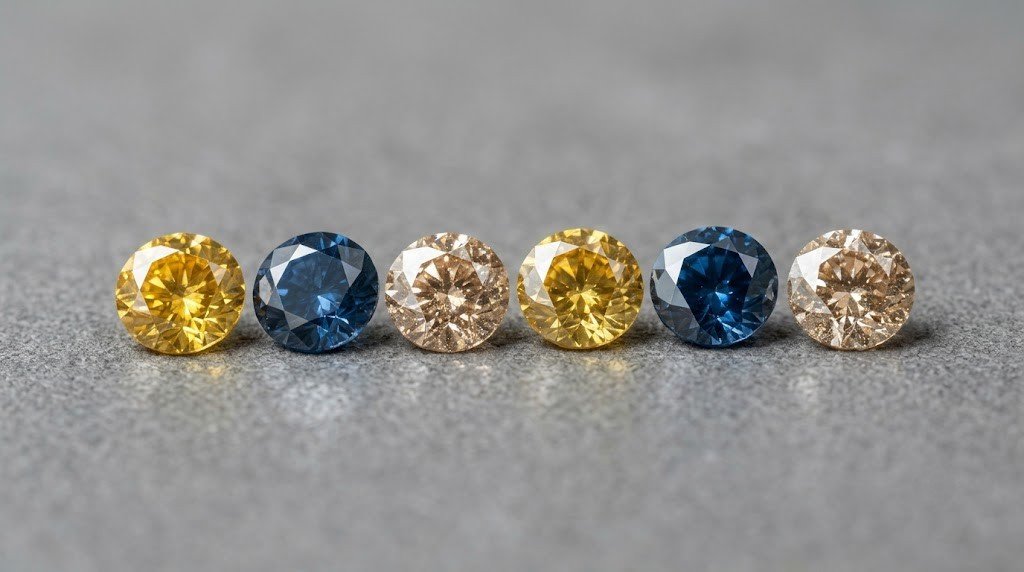
Size runs from about 0.10 carats to 5 or more, set by growth time.
General 2026 industry price ranges, not any one company’s prices:
- Around 0.10 to 0.25 ct: roughly $1,500 to $3,500.
- Half a carat to one carat: roughly $5,000 to $15,000, more for colorless.
- Two carats and up: roughly $20,000 to $75,000 or higher.
Ask whether processing two materials affects the price. Grading, engraving, fancy cuts and settings are typically billed apart from the stone itself.
Frequently Asked Questions
Is a diamond made from sister ashes and hair more her than one from ashes alone?
No one can say, because no finished stone percentage is published for blends or for hair. The 10% to 15% figure applies only to ash only stones. Ask the provider to estimate, in writing, how much comes from each of her materials.
Who signs if one person holds her ashes and another holds her hair?
Possibly both. The ashes fall under whoever holds authority over her remains, which varies by state and her written wishes. A lock may form part of her estate. Ask the provider exactly whose signatures it requires.
Does using both materials make the process take longer?
Not necessarily. Industry wide, six to ten months is typical for a diamond made from sister ashes and hair, up to twelve months for larger or specialty color stones. Gathering two materials can lengthen the start, so ask the provider whether purifying both changes its own schedule.
How much ash and hair does a combined stone need?
Requirements vary by provider. For ash, between a few tablespoons and about 4 ounces is a typical range. For hair, a small lock or a few grams may be requested. A blended order may need less of each, so ask before dividing anything.
Can the origin certificate name both her ashes and her hair?
Ask before ordering. An origin certificate is usually issued in house, so its wording is up to the provider. If you want both sources named on the certificate for a stone made from sister ashes and hair, request a sample with personal details removed.
Can each sibling get a stone made from sister ashes and hair?
Sometimes. It depends on how much of each material is available, each provider’s minimums, and agreement from whoever holds authority over her ashes. Confirm quantities with the provider before anything is divided or sent.
Final Thoughts on Combining Her Ashes and Hair
Choosing a diamond made from sister ashes and hair is a quiet decision with a lot of chemistry behind it.
Two very different sources are purified, brought together, turned into graphite and grown slowly into one crystal, usually beside lab carbon, then cut and documented.
The honest summary is short. A diamond made from sister ashes and hair is a real diamond containing a genuine share of her carbon from two parts of her, and nobody can yet put a published number on that share.
The records you request, and the answers you get in writing, are what make the stone trustworthy.
Learn More About Sister Memorial Diamonds
- Sister Ashes and Hair Diamond: The Complete Guide explains every decision about a combined stone.
- Turning your sister’s ashes and hair into a diamond explains the practical sequence from consent to delivery.
- Is a combined stone really made from her? explains what can be verified.
- The process for her ashes alone explains each stage of the ash route.
- The process for her hair alone explains each stage of the hair route.
Talk With Memorial Diamond
If you are holding some of her ashes and a lock of her hair and want to understand how a stone made from sister ashes and hair would come together, Memorial Diamond is available at memorialdiamond.us to talk through quantities, paperwork and who needs to sign.
There is no obligation in asking.
Leave A Comment