
Table of Contents
The Short Answer
This husband memorial diamond FAQ gathers the questions families actually ask, sorted by when they come up, before you’ve decided anything, while you’re gathering material, during the growth process itself, and once the stone is finished. A husband memorial diamond is a real, lab grown diamond grown in part from carbon extracted from your husband’s ashes or hair, typically taking 6 to 10 months and starting around $1,500 to $3,500 for an entry tier stone. Everything else below fills in the specifics.
Use the table of contents above to jump to whichever stage you’re actually in, this page is written so each section stands on its own.
Before You Decide Anything
Is this something only “certain” families do, or is it a mainstream option now?
It’s a genuinely available, growing category, cremation itself now accounts for a majority of arrangements nationally, and a memorial diamond is one of several ways families choose to keep something tangible from a loved one. It sits alongside urns, scattering, and other memorial jewelry as one option among several valid ones, not as a replacement for any of them.
Do I need to decide right away?
No. Ashes and hair don’t need to be used immediately; a portion can be set aside and the decision made months or years later with no loss of option. Hair especially keeps well over long periods, since it’s built from a stable protein that doesn’t break down the way soft tissue does.
Is it against my religion?
No tradition has an official position on memorial diamonds specifically, only on cremation and ash handling more generally, and views vary by faith, denomination, and individual clergy. If this matters to your family, confirm with your own faith leader rather than assuming a settled answer either way. For families where cremation itself is the concern rather than ash division specifically, a hair based memorial diamond involves no cremation at all and may be worth considering on that basis alone.
Does choosing this mean giving up a traditional urn or scattering?
No, only a small portion of ashes is typically needed for a diamond, so most families can still proceed with whatever else they’d already planned for the remainder. See husband memorial diamond vs. traditional urn for a fuller comparison.
Is this something I have to decide alone?
Not necessarily, though many people do end up being the one who holds the material and makes the initial call. Whether and how to involve other family members is entirely your choice to make on your own timeline, see the family and sharing section below.
Material and Quantity
How much ash or hair is actually needed?
Industry figures generally describe a few tablespoons up to roughly 4 oz (about 100g) of ash, or a small lock (often a few grams) of hair, genuinely small amounts in both cases, since hair carries a far higher carbon content than cremated ash. See how much ash and hair you need for the full breakdown.
Does it matter how old the material is?
Hair, built from stable keratin, doesn’t decompose the way tissue does, so an older sample is generally fine to ask a provider about, a keepsake lock kept for decades is typically no different, chemically, than a fresh one. Ash composition doesn’t meaningfully change with time either. Confirm with your specific provider rather than assuming.
Can more than one family member get a stone from the same ashes?
Often, yes, since only a portion is used per stone, and a full cremation typically leaves far more material than any single stone requires. See can more than one family member share the same ashes for what that actually requires and who ends up deciding.
What if his ashes were already scattered or interred?
Whether any portion can still be recovered depends entirely on the specific facility or arrangement, ask directly rather than assuming either way. Some cemeteries and columbaria have specific policies about family access to interred remains; that’s a question for the specific facility, not a general industry rule.
What if I only know I have “some” hair or ashes but not an exact amount?
That’s normal, and not disqualifying. Most providers can give you a rough sense of whether what you have is likely sufficient from a description or photograph, before you commit anything or measure precisely.
The Process Itself
Is the diamond really made from his ashes or hair?
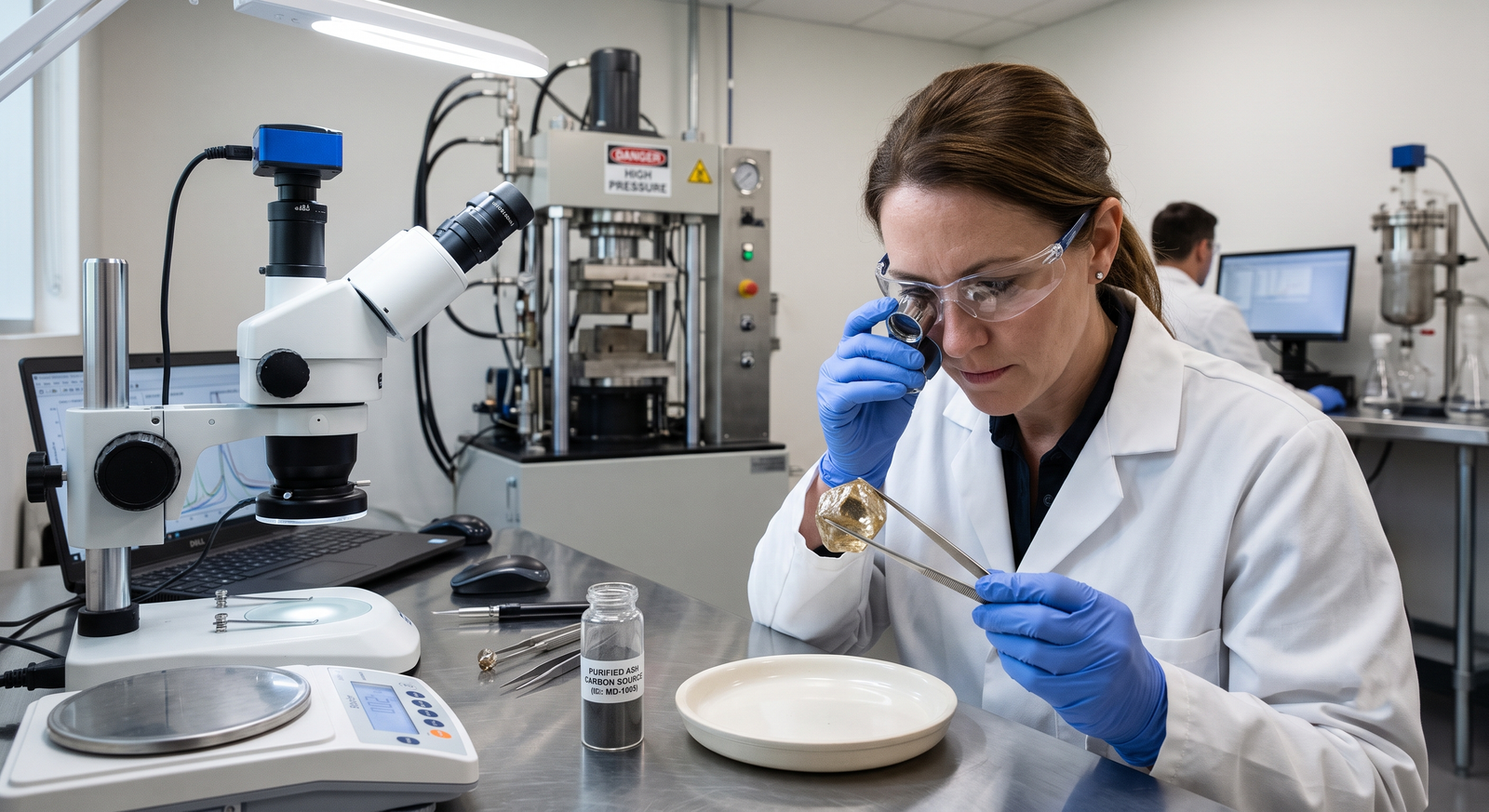
Yes, genuinely, a real, verifiable portion of his actual carbon is extracted, purified to roughly 99.9%+, and grown into the crystal lattice of the stone. It’s not “100% pure” ashes or hair, though; the extracted carbon is blended with supplemental lab sourced carbon to reach a viable size, since ash in particular yields only a small usable carbon fraction.
How does the carbon actually get extracted?
The material is heated in a controlled, oxygen free process that strips away everything that isn’t carbon, for ash, the calcium phosphate and other minerals; for hair, the non carbon components of keratin.
Is this the same process used for lab grown diamonds generally, or something different?
The same two methods, HPHT (High Pressure High Temperature) or CVD (Chemical Vapor Deposition), used across the broader lab grown diamond industry. Learn more about how HPHT and CVD diamond growth works.
What happens to the material that isn’t used?
This is a provider policy question with no single industry standard, some return unused material, some retain it under a stated policy. Ask directly before sending anything.
How is the material tracked once it’s sent?
A reputable provider should be able to describe chain of custody tracking in concrete terms, a reference number, a confirmation of receipt, a documented process for verifying your specific submission is the one entering production. Ask for the actual procedure, not just general reassurance.
Timeline and Waiting
How long does the whole thing take?
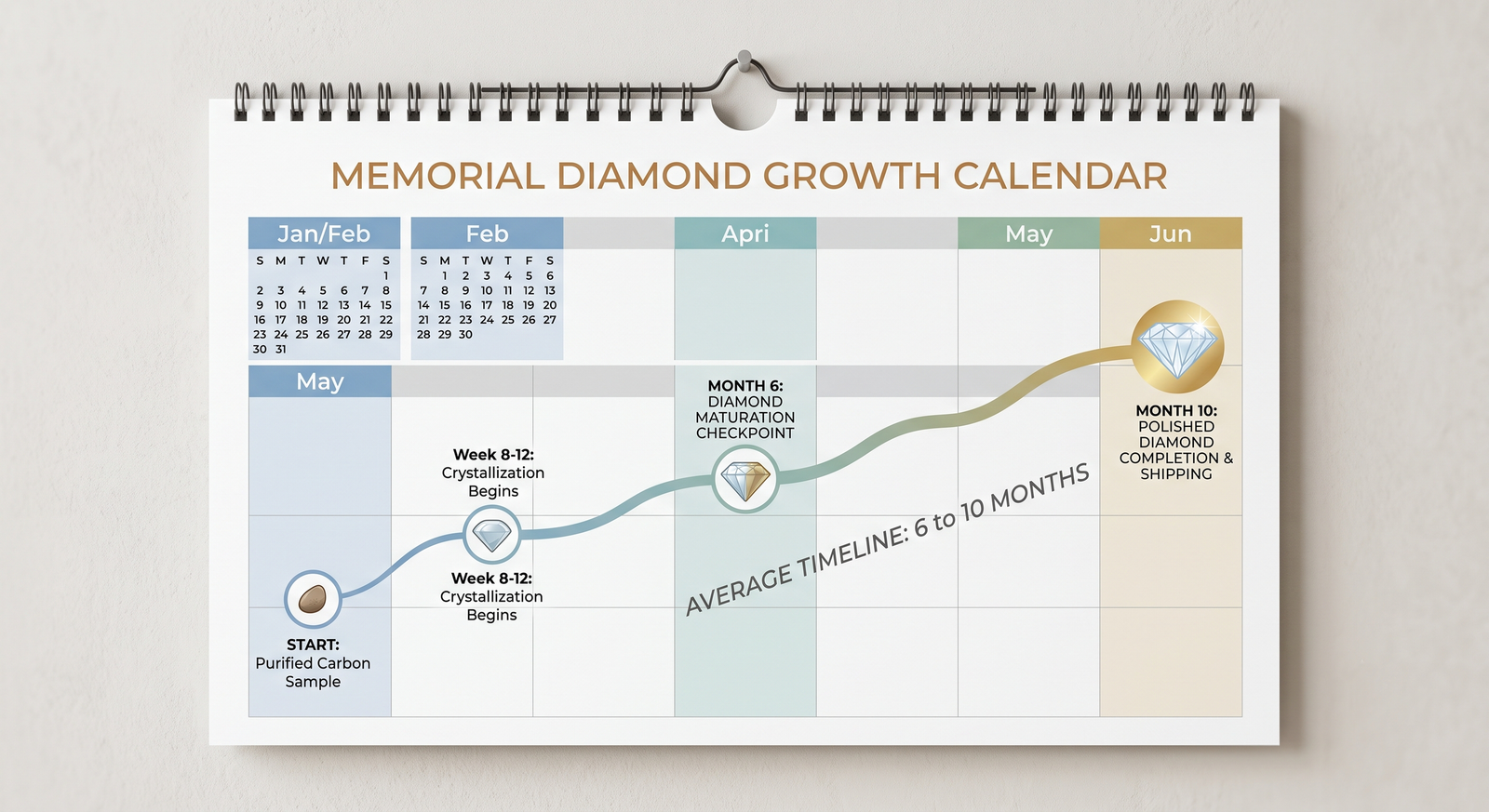
Typically 6 to 10 months from intake to finished stone, with larger or specialty color stones sometimes running up to 12 months. See how long it takes for the full stage by stage breakdown.
What determines whether it’s closer to 6 months or 12?
Carat size and color are the two real drivers, not how much ash or hair was submitted. Larger stones and certain specialty colors require longer growth time in the press, since the diamond growth stage itself is where nearly all the variation in timeline actually happens.
Can the process be rushed for a specific date?
Ask directly whether expedited service exists for your chosen carat and color; don’t assume it’s available by default.
Does the clock start when I mail the material or when it’s received?
This is a provider specific policy question. Confirm it directly, since it determines whether shipping time counts against the overall timeline you’re quoted.
Cost and Budget
How much does a husband memorial diamond cost?
Roughly $1,500 to $3,500 for an entry tier (0.10 to 0.25 ct), $5,000 to $15,000 for mid tier (0.5 to 1 ct), and $20,000 to $75,000+ for a large or rare stone (2 to 5+ ct), general industry ranges, not a fixed brand price. See the full cost breakdown.
Does sending more ashes or hair reduce the cost?
No, cost tracks the stone you choose (carat, color, cut, certification), not the volume of material submitted.
Are grading and certification included, or extra?
Typically priced as a separate add on across the industry; confirm with any specific provider’s quote. Other common add ons priced separately include engraving, fancy cut premiums, and jewelry settings.
Can I pay in stages as the stone is grown?
This is a provider specific payment structure question; ask directly rather than assuming any particular arrangement is standard.
Color, Cut, and What the Finished Stone Looks Like
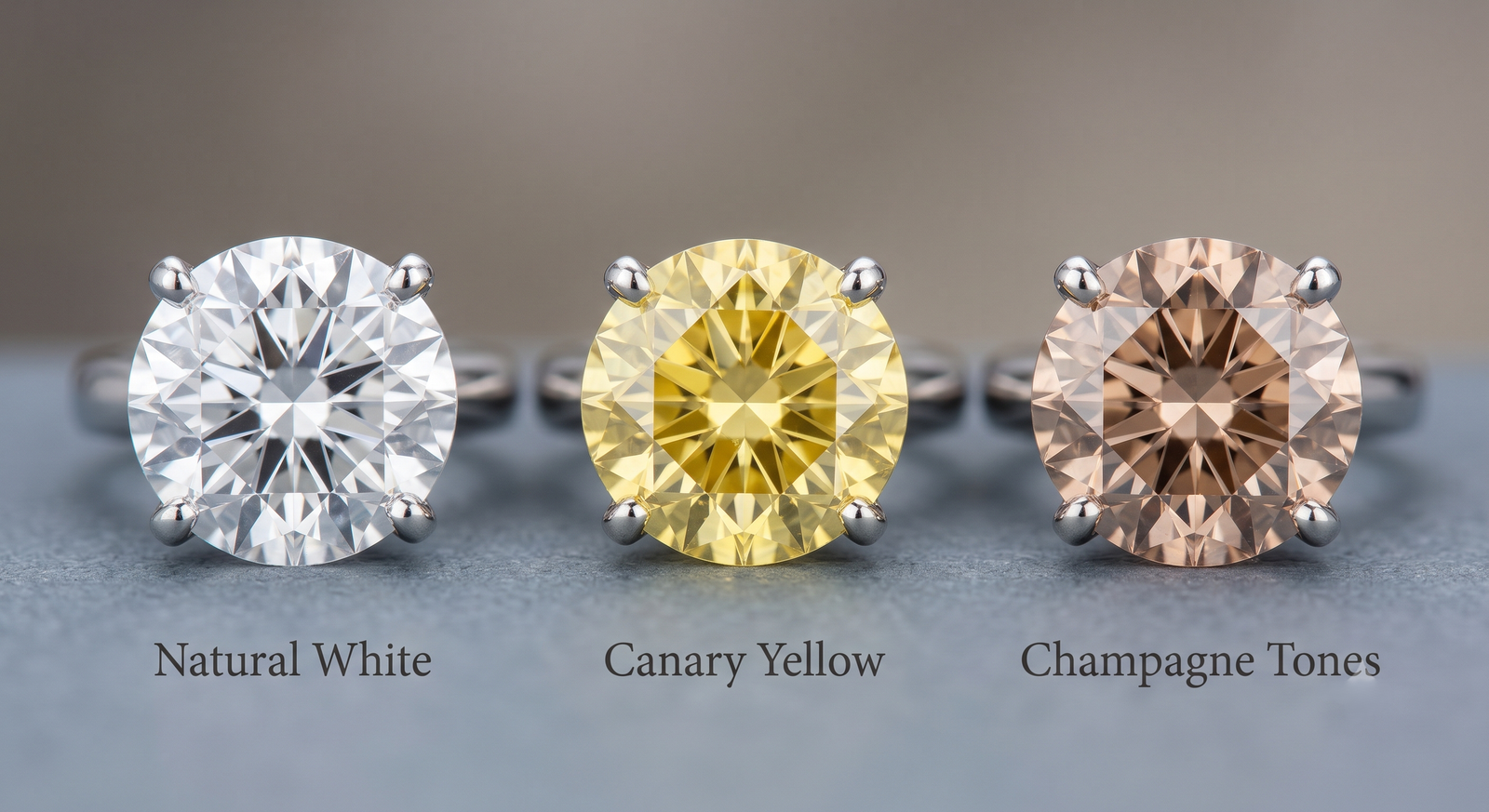
Will the diamond be colorless like a “normal” diamond?
Not necessarily, trace elements naturally present in organic, personal carbon sources (boron for blue tones, nitrogen for yellow) mean memorial diamonds often trend toward yellow, blue, and champagne tones rather than colorless. Colorless is achievable but requires additional processing and typically costs more. See memorial diamond colors for a husband for the full picture.
Can I request a specific color?
Some providers offer post growth irradiation to shift or intensify color toward red, pink, green, or black; ask what’s available for your specific provider.
What cut options are available?
A round brilliant cut is the industry default; fancy cuts (cushion, princess, emerald) are typically available, sometimes at a premium.
Does the color of his hair or the appearance of his ashes predict the diamond’s color?
No, diamond color comes entirely from trace elements present during crystal growth, not from the visible color of the starting material. A gray haired man’s diamond isn’t gray, and a lighter or darker ash sample doesn’t predict a lighter or darker stone.
Family and Sharing
Who decides how his ashes or hair get divided if more than one person wants a stone?
Whoever holds the material is generally the one making that call, this is a family decision, not a chemistry one, and there’s no obligation to divide evenly or to say yes to every request.
How do I even bring this idea up with the rest of the family?
There’s no single right way, and reactions genuinely vary. See how to talk to family about a husband memorial diamond for a fuller approach to that conversation.
What jewelry settings are available once the stone is finished?
Rings, pendants, earrings, a loose displayed stone, or incorporated into an existing wedding ring’s metal, see husband memorial diamond ideas for the full range.
After the Stone Is Finished
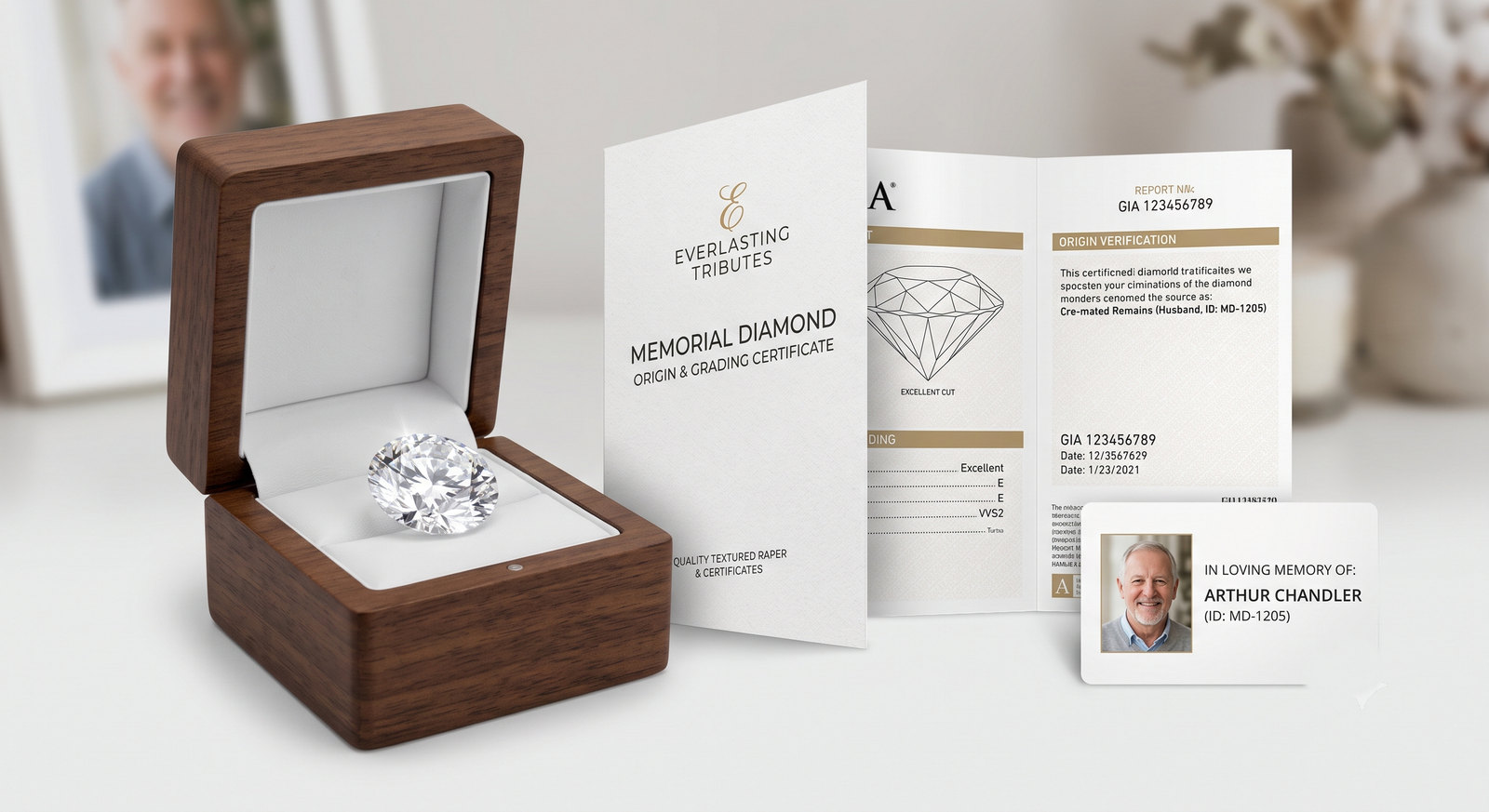
Does the stone come with documentation?
Reputable providers typically issue an origin/authenticity document (a chain of custody record specific to your submitted material) and, ideally, an independent third party grading report covering the stone’s own quality (cut, color, clarity, carat).
Is the stone as durable as a natural diamond?
Yes, it’s a real, chemically genuine diamond, with the same hardness (10 on the Mohs scale, the hardest known natural mineral) and the same optical properties as any other diamond.
What happens to the stone eventually, does it need special care?
A diamond requires no special care beyond what any fine jewelry needs; how it’s passed on later (through an estate, to another family member) is a question worth discussing with an estate professional if it matters to you, since this varies by state and by what’s documented in writing.
Final Thoughts on the Husband Memorial Diamond FAQ
However many of these questions apply to where you are right now, the honest thread running through all of them is the same: almost nothing here has to be decided today, and the practical questions, quantity, timeline, cost, usually turn out to be more answerable than they first feel. This husband memorial diamond FAQ exists so you can come back to whichever section matters, whenever it matters.
Learn More About Husband Memorial Diamonds
- How Much Does a Husband Memorial Diamond Cost?
- How Long Does It Take to Make a Husband Memorial Diamond?
- Choosing a Memorial Diamond for Your Husband: Where to Start
- Husband Ashes and Hair Diamond: The Complete Guide
- How to Talk to Family About a Husband Memorial Diamond
Talk With Memorial Diamond
Whatever question brought you here, reach out to Memorial Diamond to talk it through, there’s no obligation attached to a first conversation.
Leave A Comment