
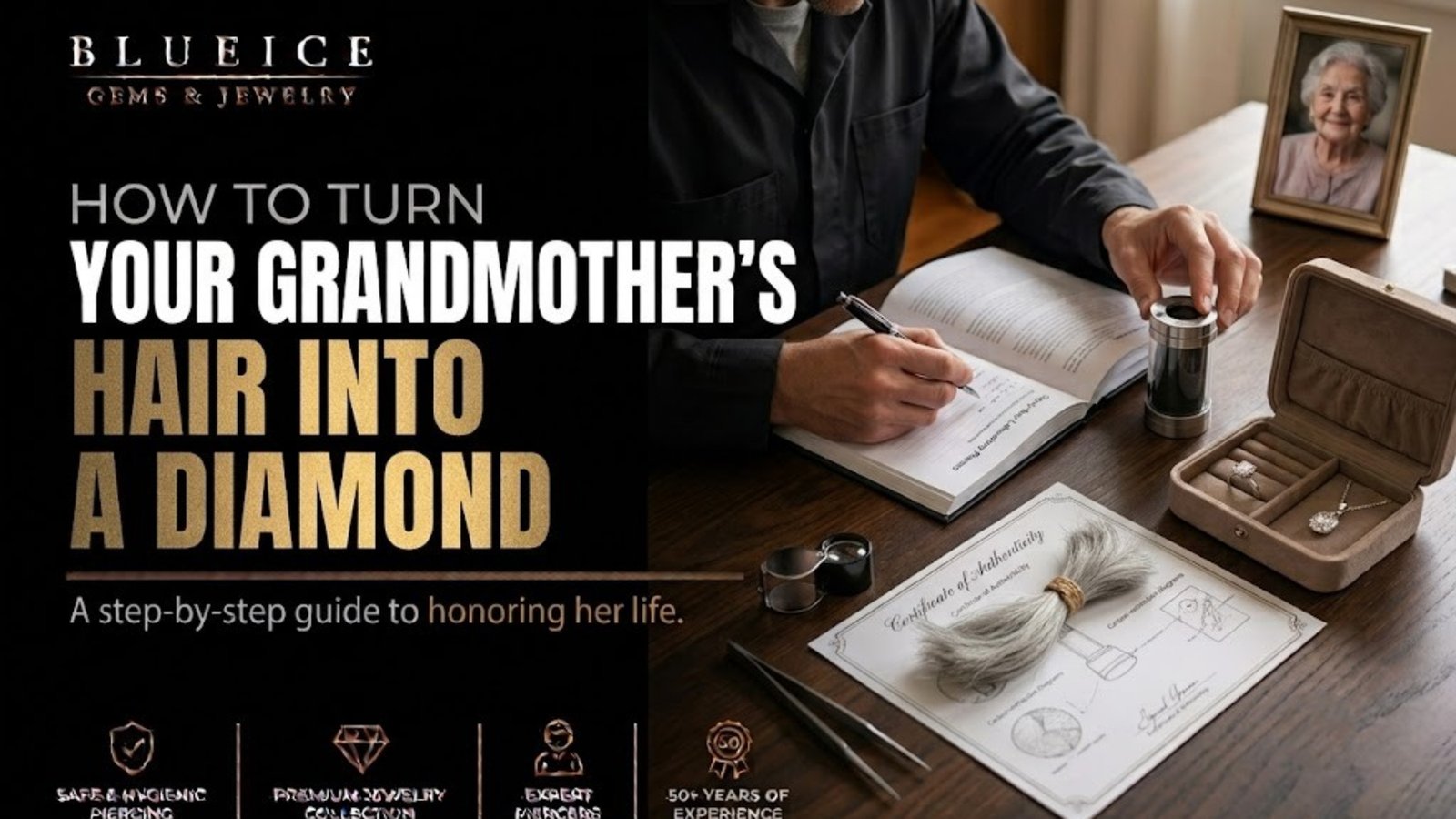
Sometimes the only part of her still within reach is a curl folded into tissue paper, or a braid someone tucked into a drawer long ago. You can turn grandmother hair into a real lab-grown diamond by finding a lock that is genuinely hers, talking with family and whoever is settling her affairs, packing it exactly as your provider instructs, and then choosing size, color and setting before a lab begins work that typically takes 6 to 10 months.
Hair suits this well because it is roughly 50% carbon by weight, so a small lock or a few grams is usually enough, and no cremation is involved at all. Families can turn grandmother hair into a stone even if she was buried, if her ashes were scattered long ago, or if the urn sits with a relative who would rather keep it whole.
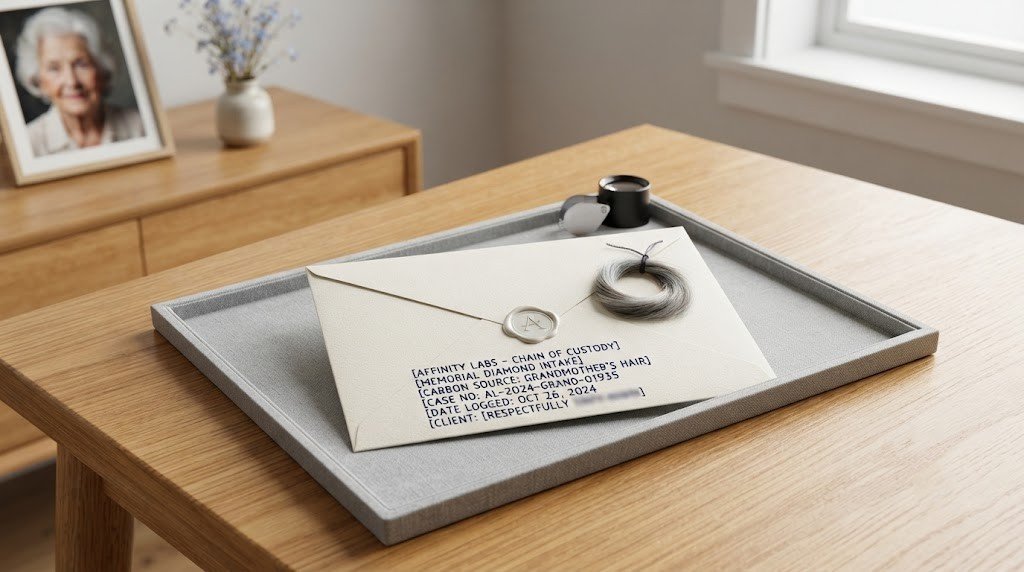
Table of Contents
What are the steps to turn grandmother hair into a diamond?
The whole project comes down to seven practical moves. Most of the work it takes to turn grandmother hair into a diamond sits in the first four, which happen at home and inside the family, well before any lab is involved.
- Find hair that is unmistakably hers. A labeled lock or one a relative kept.
- Talk with the people who share a stake in it. Her estate and any relatives holding hair.
- Put your questions to providers in writing. Rules differ between companies.
- Store and send the hair as instructed. Use the provider’s kit or guidance.
- Choose a carat size and talk through color. Growth time sets the size.
- Wait while the lab grows, cuts and grades it. Typically 6 to 10 months.
- Pick a setting and file the paperwork. Keep certificates together.
People who decide to turn grandmother hair into a diamond rarely move through these in a neat straight line, and that is fine. For background first, including how hair stones compare with ash-based ones, the complete guide to grandmother hair diamonds lays out the fundamentals.
Where might your grandmother’s hair still be?
Before you can turn grandmother hair into anything, you need to know where it is and be confident it belongs to her. A lock can surface in more places than you might expect once you start asking around.
Saved locks and keepsakes
Some people kept hair from a wedding, a first haircut or another milestone, and a grandmother may have saved a lock of her own alongside one from a child. Check memory boxes, lockets and envelopes slipped inside photo albums. An envelope labeled in her handwriting is the best possible find, because nobody has to guess whose hair it is.
If several unlabeled locks turn up together, set aside any you cannot confidently identify. It is far better to turn grandmother hair you are sure about into a stone than to wonder later whether a strand belonged to someone else.
Hair a relative already kept
An aunt, an uncle, a cousin or your own parent may have asked for a lock at the funeral home, or saved one from a haircut not long before she died. Ask gently if you would like to turn grandmother hair from that relative’s keepsake into a stone. Some relatives will gladly share a small portion; others will want to keep theirs exactly as it is, and that wish deserves respect.
Hair collected before burial or cremation
When a death is recent and arrangements are still underway, a funeral home can sometimes cut a small lock at the family’s request. The funeral director can say what they are able to do, while how the hair should be wrapped and labeled for a lab, and whether hair collected this way is accepted, are questions for the provider.
| Possible source | What to check first | Who to ask |
|---|---|---|
| Labeled lock or keepsake | That the hair is hers, not a child’s | Relatives who remember it being saved |
| Lock held by a relative | Whether they would share part of it | The relative who holds it |
| Lock taken before burial or cremation | Whether it can still be arranged | The funeral director, then the provider |
| Brush or comb strands | Whether loose hair is accepted at all | The provider, in writing |
Brush strands deserve a word of caution, since brushes can hold hair from more than one person. Some providers may accept loose hair and others may not, so ask before you plan to turn grandmother hair from a brush into a stone.
Who should you talk with before you turn grandmother hair into a diamond?
Hair kept at home is usually a simpler matter than ashes, which come with cremation paperwork and state rules on who controls remains. Even so, the things she owned can form part of her estate, and the rules on who decides what happens to them change from one state to another. If someone is acting as executor or otherwise settling her affairs, a short conversation with that person heads off misunderstandings later.
Her closest family
She may have left a surviving spouse or partner, adult children, or both, and one of those children may be your own parent. Any of them may have feelings about a plan to turn grandmother hair into jewelry, even when the hair is not formally part of anything. Let them hear the idea from you first, and read any written wishes she left before anything else is decided.
You might also be her son or daughter, arranging this for the grandchildren. Either way, people who loved her deserve to be asked rather than told.
Cousins and other grandchildren
If several relatives hold pieces of her hair, or several grandchildren each want a stone, talk together before anyone ships anything. Depending on the provider, one lock can often supply more than one stone, and families who turn grandmother hair into several stones at once can sometimes do it in a single shipment. If some relatives also hope to use a small portion of her ashes, the guide to using both her ashes and her hair in one project walks through how that coordination differs.
A simple plan for the conversation
- Say plainly that you hope to turn grandmother hair into a diamond, and why it matters to you.
- Ask who else holds any of her hair, and whether they would share.
- Ask whoever is settling her estate if they have any concerns.
- Offer to share costs, updates or a second stone with anyone interested.
- Write down what everyone agreed and send it around.
Nobody has to agree on the spot; raising the idea and returning to it a few weeks later is often kinder.
How should you store and send her hair?
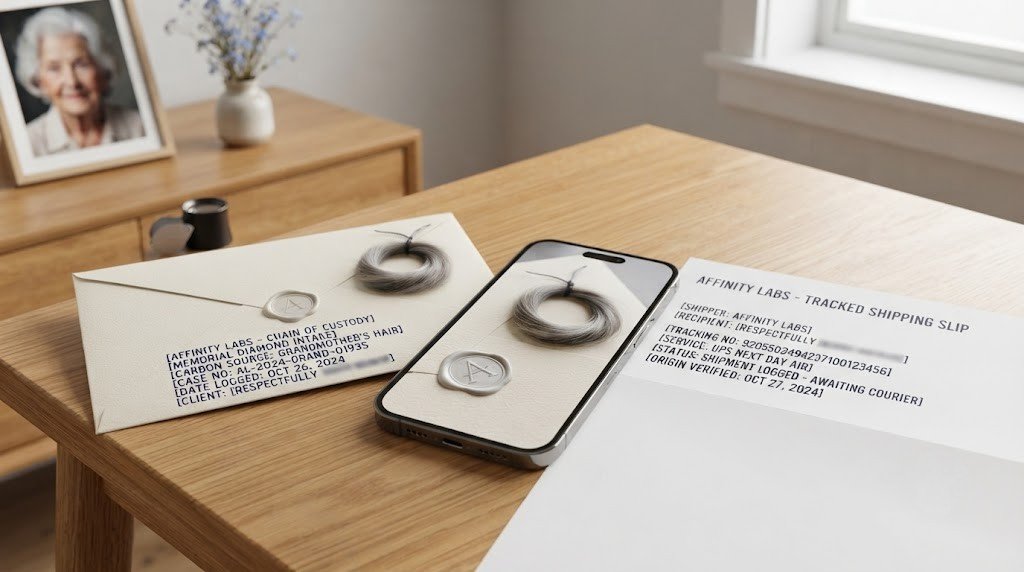
The most useful rule is to follow your provider’s packing instructions exactly, because handling requirements differ between companies. Until those instructions arrive, leave the hair where it is, keep it dry and away from direct heat, and resist the urge to wash it, trim it or move it into new packaging.
Before the hair leaves your hands
- Photograph the lock as you found it.
- Label it with her full name and where it came from.
- Ask whether you can keep back a few strands at home.
- Ask whether the original envelope or keepsake box will be returned.
Questions about tracking and custody
Anyone who sends a lock away to turn grandmother hair into a stone deserves to know where it is at every point. Chain of custody is how a provider shows that the stone you receive grew from the carbon you sent. Ask how each sample is labeled on arrival, whether you get confirmation of receipt, and what happens to any hair that is not used. Ask, too, what the provider does if a growth run fails and whether more hair would then be needed.
Some providers send a kit with tracked postage, while others leave the method to you. Ask which carrier and service they recommend before anything ships. Anyone planning to turn grandmother hair into a stone by mail will find it easier to keep every tracking number and email together in one folder.
Can you turn grandmother hair that was dyed or permed into a diamond?
Your grandmother may have colored, permed or straightened her hair over the years, or simply let it go gray. Whether a provider accepts dyed or chemically treated hair is that provider’s decision, and policies are not uniform across the industry.
There is no published basis for saying that treatments help or harm the finished stone, and this guide makes no claim either way about color or suitability. How any particular sample will behave is something only the provider can speak to, so describe the hair fully and let them answer.
What to tell the provider
When you ask a provider whether they can turn grandmother hair into a diamond after years of dye or perms, include:
- Any treatments you know of, such as dye, a perm or relaxer.
- Roughly how old the hair is and how it has been stored.
- Whether the lock is a single piece or several small bundles.
- Whether you have any untreated hair as an alternative.
Ask for the answer by email. If one provider declines, another may have a different policy, so a single refusal does not mean you cannot turn grandmother hair into a diamond elsewhere.
What happens at the lab once her hair arrives?
Once the hair is logged in, a lab follows the same basic sequence used across the memorial diamond industry. What comes out is a genuine lab-grown diamond: it scores 10 for hardness, and a gemologist assesses its cut, color, clarity and carat exactly as with any other diamond. Most providers use high-pressure, high-temperature (HPHT) growth, with a minority using CVD, both described in this overview of how synthetic diamonds are grown.
| Stage | What happens |
|---|---|
| Receipt and logging | The hair is checked in under chain-of-custody tracking |
| Extraction and purification | Controlled, oxygen-free heating isolates carbon at roughly 99.9% or higher purity |
| Graphitization | The carbon is heated to about 2,500 to 2,700°C and becomes graphite |
| Growth | Inside an HPHT press (about 6–8 GPa, 1,400–2,500°C), a crystal builds up on a tiny seed across weeks or months |
| Cutting and polishing | A gemologist shapes the rough crystal into the chosen cut |
| Optional color treatment | Some providers offer post-growth irradiation |
| Grading | The stone is graded, ideally by an independent lab |
How much of the stone is her carbon?
Because hair is about half carbon, it takes far less material to turn grandmother hair into a stone than it would take with ashes. The recovered carbon is typically blended with supplemental lab carbon to reach the volume needed for growth, and no industry-wide figure has been published for what share of a hair-based stone’s finished mass comes from the person. Ask each provider for that figure in writing. A closer look at whether the stone is genuinely grown from her hair covers the questions worth asking, and a fuller account of each stage the lab carries out goes deeper into the science.
How much does it cost to turn grandmother hair into a diamond?
Cost follows carat size and color far more than anything about the hair itself. Stones are sold in sizes from roughly 0.10 ct to beyond 5 ct, and a thicker lock does not produce a bigger stone, because size is set by how long the crystal grows.
The figures below are general 2026 industry ranges, not Memorial Diamond’s own pricing. Grading reports, engraving, fancy cuts and settings are usually priced separately.
| Size tier | Typical industry price range | Worth knowing |
|---|---|---|
| About 0.10 to 0.25 ct | Roughly $1,500 to $3,500 | Can suit several grandchildren who each want their own stone |
| 0.5 to 1 ct | Roughly $5,000 to $15,000 | Colorless costs meaningfully more than blue, yellow or champagne |
| 2 to 5+ ct | Roughly $20,000 to $75,000+ | Larger stones can take up to about 12 months |
When cousins decide to turn grandmother hair into matching small stones, the per-stone cost stays in the entry tier, while one larger shared heirloom moves the total up. If you are unsure whether your lock is enough for more than one stone, the guide to how much hair a grandmother memorial diamond usually needs explains typical amounts.
What will you decide about color and setting?
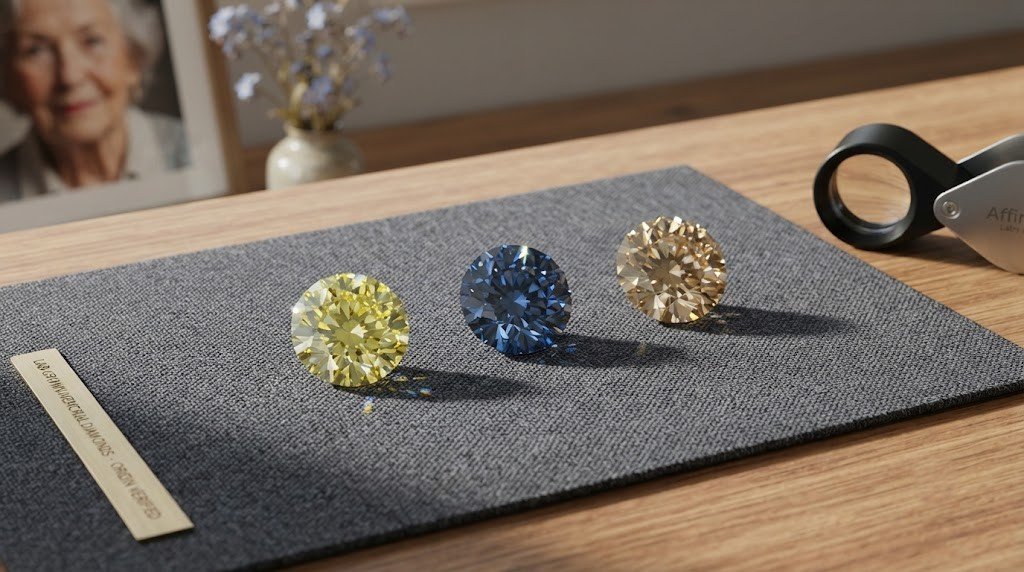
Most of the meaningful choices come when you place the order to turn grandmother hair into a finished diamond. Diamond color comes from trace elements: boron produces blue and nitrogen produces yellow. Keeping both out to reach a colorless result adds processing steps and usually raises the price. Yellow, blue and champagne-to-brown shades turn up most often in memorial stones, and irradiation after growth can push some stones toward red, pink, green or black at providers that offer it.
No provider can promise to match an exact shade. This guide to the color a grandmother hair diamond may take explains what can and cannot be chosen.
A setting that follows who she was
Let the setting reflect her and the person who will wear it, not a template. If she wore one ring every day, a ring may feel right; if the wearer never wears rings, a pendant, a stud or a tie bar might suit better. Some families keep the stone loose with its paperwork so the next generation can set it, which works well as an heirloom as long as nobody treats it as an investment.
A hard knock can still chip any diamond, so ask a jeweler about a protective setting for daily wear.
Grading and paperwork
An authenticity or origin certificate, usually issued in-house, documents chain of custody. A grading report is a separate document that measures the stone itself against GIA’s diamond quality factors, and it carries most weight when an independent lab issues it. Expect to pay extra for that report in most cases; memorial stones commonly grade somewhere from SI2 up to VVS for clarity.
How long does it take to turn grandmother hair into a diamond?
Across the industry, the lab stage typically takes 6 to 10 months from the day your sample is received. Choosing a stone above roughly 2 carats, or a specialty shade like black, can stretch that toward a year. Sending extra hair does not shorten that time.
The weeks before shipping are yours to set. Finding the hair, talking with relatives and comparing providers can happen at whatever pace your family needs. Families who turn grandmother hair into a diamond years after she died go through exactly the same process as those who start within weeks.
Planning around a date
If you want to turn grandmother hair into a stone in time for a wedding, a graduation or the anniversary of her death, ask the provider for an honest estimate in writing before you order.
If the plan grows
A hair project sometimes widens once relatives hear about it. If someone later wants a small portion of her ashes used for a separate stone, the walkthrough on turning a grandmother’s ashes into a diamond covers authority, quantities and timing for that route.
Frequently Asked Questions
Can I turn grandmother hair from her hairbrush into a diamond?
Possibly, but it depends on the provider. Brush hair can include strands from other people, so some providers may decline it while others accept it with conditions. Describe exactly where the hair came from and ask for the provider’s answer in writing first.
How much of her hair do I need to send?
Requirements vary by provider. Since about half of hair’s weight is carbon, providers usually ask for just a small lock or a few grams. Ask your provider for their specific requirement, and do not cut or divide a keepsake until you know what they need.
Can you turn grandmother hair saved decades ago into a diamond?
A saved lock sometimes turns up long after a death, and the steps are the same whenever you begin. Whether very old hair is workable depends on the provider, so describe its age and how it was stored, then ask them directly before sending it.
Do other relatives need to agree before I turn grandmother hair into a diamond?
Rules on a person’s belongings vary by state, and her hair may count as part of her estate. Talking with whoever is settling her affairs, and with close relatives, before sending anything is the simplest way to avoid hurt feelings or disputes later.
Will the diamond match the color of her hair?
No provider can promise that. Diamond color comes from trace elements present during growth, with boron producing blue and nitrogen producing yellow. Memorial diamonds tend toward yellow, blue and champagne tones, and colorless stones need extra processing and typically cost more.
Will any unused hair or the original keepsake be returned?
That depends entirely on the provider. Some may return unused hair or the original envelope and others may not. Ask before you ship, get the answer in writing, and keep back a few strands at home if the family would like that.
Final Thoughts on How to Turn Grandmother Hair Into a Diamond
The practical work needed to turn grandmother hair into a diamond is smaller than it first appears: a lock you can vouch for, a few honest conversations, careful packing, and a handful of decisions about size, color and setting. The rest is time, and most of it happens out of your hands.
Whatever you decide, the lock itself already holds meaning. Some people find comfort in having something of hers they can wear, while others keep the hair just as it is, and both are good ways to remember her.
Learn More About Making a Diamond From Your Grandmother’s Hair
- Grandmother Hair Diamond: The Complete Guide the full overview of hair-based stones
- How Much Hair Do You Need for a Grandmother Memorial Diamond? typical amounts and how to measure
- What Color Will a Diamond Made From Your Grandmother’s Hair Be? what shapes color and what can be chosen
- How to Turn Your Grandmother’s Ashes and Hair Into a Diamond planning when both materials are involved
Talk With Memorial Diamond
If you have a lock of your grandmother’s hair and are still deciding what to do with it, you are welcome to reach out with questions at any stage. You can learn more at memorialdiamond.us and ask about whatever is on your mind, whether that is where to begin, how to turn grandmother hair into a stone, or what to ask a provider, with no obligation to go further.
Leave A Comment