
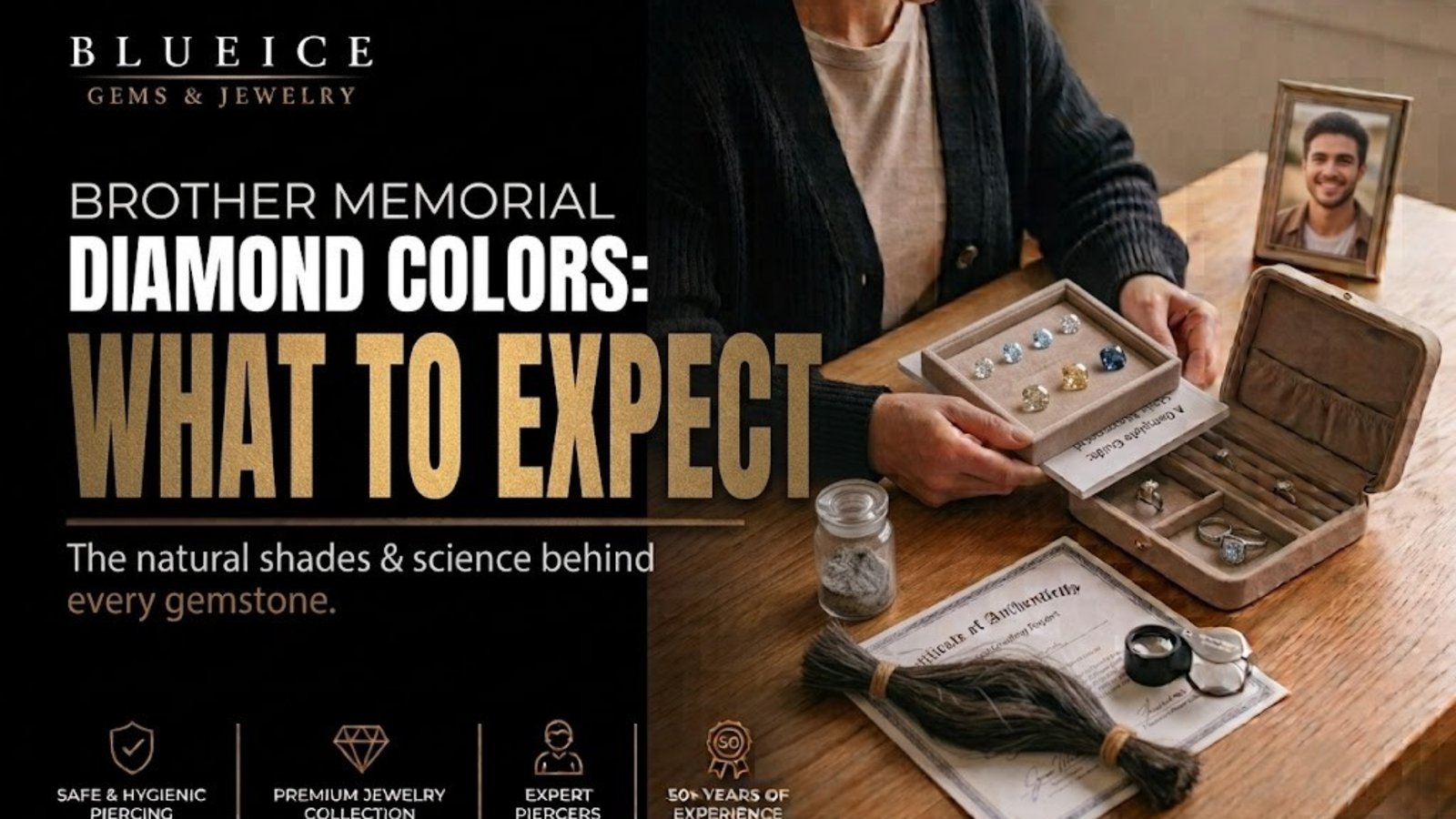
You may already have a picture in your head of how his stone should look, and it can feel strange to learn that the final color is not entirely yours to set. Memorial diamond colors for a brother follow the same chemistry as any memorial stone: most grow in yellow, blue or champagne-to-brown tones because trace nitrogen and boron tint the crystal. Colorless is achievable with extra processing and typically costs more, and some providers irradiate stones afterward for red, pink, green or black. You pick a color route; the exact shade is settled during growth.
Below, you will find where memorial diamond colors for a brother come from, how a grading report records them, and how to weigh color against who he was and who will wear the stone.
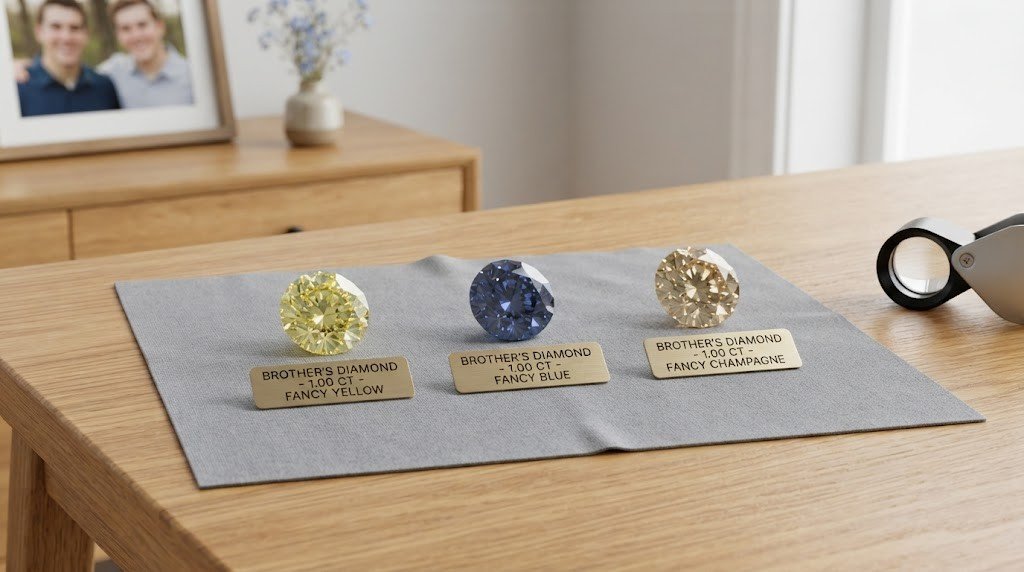
Table of Contents
What Memorial Diamond Colors for a Brother Should You Expect?
The honest answer is a range rather than a single result. Memorial diamond colors for a brother are the same colors available for anyone, because color is set by chemistry and by the provider’s process, not by the relationship or by anything about his personality.
Stones grown in part from a person’s own carbon tend to settle into a handful of color families:
- Yellow, from nitrogen caught in the crystal as it grows
- Blue, from boron caught in the same way
- Champagne to brown, warm tones linked to the trace elements an organic, personal source tends to carry
- Colorless, reached only when nitrogen and boron are deliberately kept out
- Red, pink, green or black, offered by some providers through irradiation once the stone has grown
Within each family, depth and tone vary, and two stones grown along the same route can look slightly different side by side. That is normal, not a fault. If you are still deciding whether a stone suits your family at all, the complete guide to a diamond made from your brother’s ashes covers the whole picture.
Why Do Memorial Diamond Colors for a Brother Lean Yellow, Blue or Champagne?
Diamond is carbon locked into a tight crystal lattice. When even tiny amounts of another element slip into that lattice during growth, the stone absorbs part of the light passing through it and shows color. Nitrogen produces yellow, boron produces blue, and a stone needs the near-absence of both to look colorless.
Lab diamonds for the general jewelry trade usually start from a tightly controlled feedstock. A memorial stone starts with carbon recovered from a person, purified to roughly 99.9 percent or better and converted to graphite at around 2,500–2,700°C. Its organic origin still means trace elements are common, which is why memorial diamond colors for a brother so often land in warm or blue tones instead of icy white.
What happens inside the press
Most providers grow memorial stones by HPHT, recreating roughly 6–8 GPa of pressure and 1,400–2,500°C of heat over weeks to months; a minority use CVD, where carbon is deposited layer by layer from a gas. This overview of how synthetic diamonds are grown explains both methods in more depth. The practical point for a family is that the provider’s growth conditions, and not only the material, help decide where memorial diamond colors for a brother end up.
Can His Memorial Diamond Be Colorless, and What Does It Cost?
A colorless stone is achievable, but it is not the default. Getting there means keeping nitrogen and boron out during growth, which takes additional processing. Across the industry in 2026, a stone of 0.5 to 1 carat typically runs roughly $5,000 to $15,000, and colorless sits meaningfully above blue, yellow or champagne at the same size.
Small stones of about 0.10 to 0.25 carats generally run roughly $1,500 to $3,500, and stones of 2 to 5 carats or more roughly $20,000 to $75,000 and up. These are industry ranges, not Memorial Diamond’s prices; grading, engraving, fancy cuts and settings are usually extra. Pricing two or three memorial diamond colors for a brother at one carat size shows the real gap. A fuller breakdown of what a brother memorial diamond can cost walks through each factor.
Is colorless the right choice?
Some families lean toward colorless because it looks like a classic diamond and sits easily with any metal. Others feel a tinted stone is a truer record of where the carbon came from. Both are reasonable. If colorless matters to you, ask what happens when a stone grown on a colorless route still shows a faint tint, because policies on that point vary.
How Do Providers Create Red, Pink, Green or Black Stones?
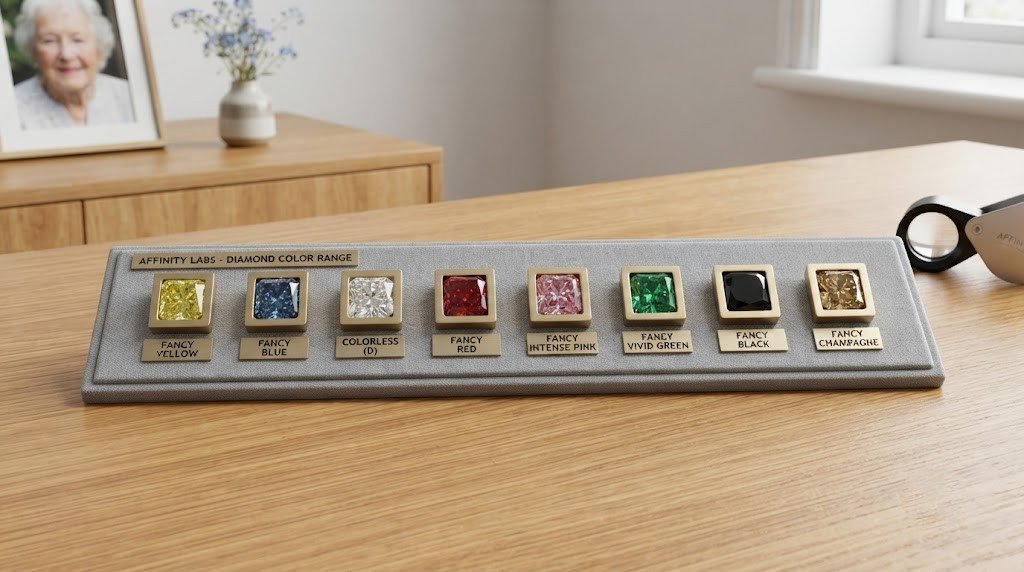
Irradiation widens memorial diamond colors for a brother beyond the natural tones. Some providers offer this treatment after growth and cutting to shift or deepen a stone’s color, typically toward red, pink, green or black, though any one provider’s list may be shorter. Specialty colors can stretch the schedule: most memorial stones take about 6 to 10 months from the day material arrives, while specialty colors such as black, and stones over roughly 2 carats, can take up to about 12 months.
Questions worth asking a provider that offers treated colors:
- Which treated colors do you offer, and at what carat sizes?
- Will the treatment be stated on the grading report?
- How much does the step add to cost and to the schedule?
For some families, treated memorial diamond colors for a brother feel more personal, such as a deep green tied to the woods he hiked or a black stone that suits how a sibling dresses. They are a choice, not an upgrade; a natural-tone stone is just as real a diamond.
Do His Ashes, His Hair or Both Change Memorial Diamond Colors for a Brother?
Many people hope one source will give a lighter or more predictable result, but ashes, hair and a combination all draw on the same memorial diamond colors for a brother. There is no published basis for saying hair produces a cleaner color than ashes, or the reverse, and the same holds for stones that combine the two. The trace content of the recovered carbon and the provider’s purification and growth process shape the outcome, so the useful question is how a particular provider handles your material.
The material does change other things:
- Ashes are mostly calcium phosphate, with around 0.5 to 4 percent of their weight usable carbon. That carbon is purified and typically blended with supplemental lab carbon, and in ash-based stones his own carbon usually makes up somewhere around 10 to 15 percent of the finished mass, with some providers citing as little as 3 percent and others more.
- Hair is roughly half carbon by weight, which means a modest lock or a few grams usually suffices and cremation plays no part. No comparable finished-stone percentage is published for hair.
- Ashes and hair together have no published finished-stone figure either, so ask each provider to state in writing how much of the stone would come from his material.
By source, read about what color to expect from a stone made with his ashes, how color works when his hair is the source, and color in a stone that combines his ashes and hair.
Why Can’t You Pick an Exact Shade?
When families talk through memorial diamond colors for a brother, matching something specific often comes up: his eyes, a jacket he wore everywhere, the paint on a room he decorated, a lake he went back to each summer. A provider can steer toward a color family, but no one can promise a precise natural shade or match a sample you send in.
The final tone depends on how much nitrogen or boron the crystal actually takes up, which varies with the material and from one run to the next. In general gemology, size and cut also change how a color reads, because light travels a different path through a larger or differently shaped stone.
What you can usually choose
- The color route: natural tone, colorless, or a treated color where offered
- The carat size, from about 0.10 to 5+ carats across the industry
- The cut and shape, which affects how the color shows
The exact hue is the one thing left open. Some families come to see that as part of the stone’s character, the tone his carbon and the process produced together, and setting expectations early keeps the arrival from feeling like a letdown.
What Causes Each of the Memorial Diamond Colors for a Brother?
This table sets out memorial diamond colors for a brother side by side, with the cause of each and how it is typically reached.
| Color | What causes it | How it is typically reached | Cost and timing notes |
|---|---|---|---|
| Yellow | Nitrogen in the crystal | Natural growth; a common outcome | Standard industry range for its size |
| Blue | Boron in the crystal | Natural growth; a common outcome | Standard industry range for its size |
| Champagne to brown | Trace elements from an organic source | Natural growth; a common outcome | Standard industry range for its size |
| Colorless | Nitrogen and boron kept out | Extra processing during growth | Typically costs meaningfully more |
| Red | Post-growth treatment | Irradiation, offered by some providers | Ask about added cost and time |
| Pink | Post-growth treatment | Irradiation, offered by some providers | Ask about added cost and time |
| Green | Post-growth treatment | Irradiation, offered by some providers | Ask about added cost and time |
| Black | Post-growth treatment | Irradiation, offered by some providers | Specialty colors can take up to about 12 months |
Read it as a map of possibilities rather than a menu with fixed results. Depth and warmth vary within any row, and a provider should say which of these memorial diamond colors for a brother they actually offer.
How Is Color Recorded on a Grading Report?
Once a stone is finished, where it sits among the memorial diamond colors for a brother is written down on a grading report, one of two documents that often arrive with it. They do different jobs. The provider’s own authenticity or origin certificate is a chain-of-custody document: it ties this particular stone to the material your family sent. A grading report records the diamond’s own qualities: color, cut, clarity and carat.
An independent third-party lab gives the more neutral view. Most reference standards set by the Gemological Institute of America, and some use IGI; GIA’s guide to the four diamond quality factors is a clear primer. Independent grading is typically an optional add-on priced separately, so check whether a quote includes it.
Two ways color gets described
In general gemology, colorless and near-colorless stones are graded on a letter scale from D toward Z, while distinctly colored diamonds are described in fancy-color terms covering hue and strength. Ask which description his stone would get and whether any treatment would be noted. Clarity for memorial stones typically falls between SI2 and VVS. A report puts memorial diamond colors for a brother into neutral, standard language, which makes quotes much easier to compare.
How Can Color Reflect Who He Was and Who Will Wear It?
Memorial diamond colors for a brother work best when they start from the person, not from assumptions about what a man is supposed to like. A brother who wore bright colors, one who only wore black, one who painted, fished or cooked for everyone: none of that dictates a color, but it gives your family something real to talk about. Some choose blue because it was his favorite; others prefer whatever natural tone emerges.
Thinking about the wearer
Whoever will wear the stone deserves as much say in memorial diamond colors for a brother as the memory of him does. The stone might be worn by a sibling, by a partner or children if he had them, by a parent, or by a friend who was family to him. Consider:
- Who will wear it, and how often
- Whether they favor warm metals, cool metals or little jewelry at all
- Whether they want something noticeable or quietly understated
- Whether several people want stones, and whether those should match
When more than one person wants a stone
Several stones can often be grown from shared material, and each may follow its own color route; whether that works, and how it affects price, is a provider question. Decisions about his ashes rest with whoever holds authority under your state’s law or his written wishes, which may be a spouse or partner, adult children or parents before a sibling. If that is not you, a gentle request to them for a small portion is a respectful start. His hair kept at home can be simpler, though his belongings may be part of his estate, so check with whoever is settling it. The post on several family members sharing one brother’s ashes covers the practical steps.
How Do Stone Color and Setting Metal Work Together?
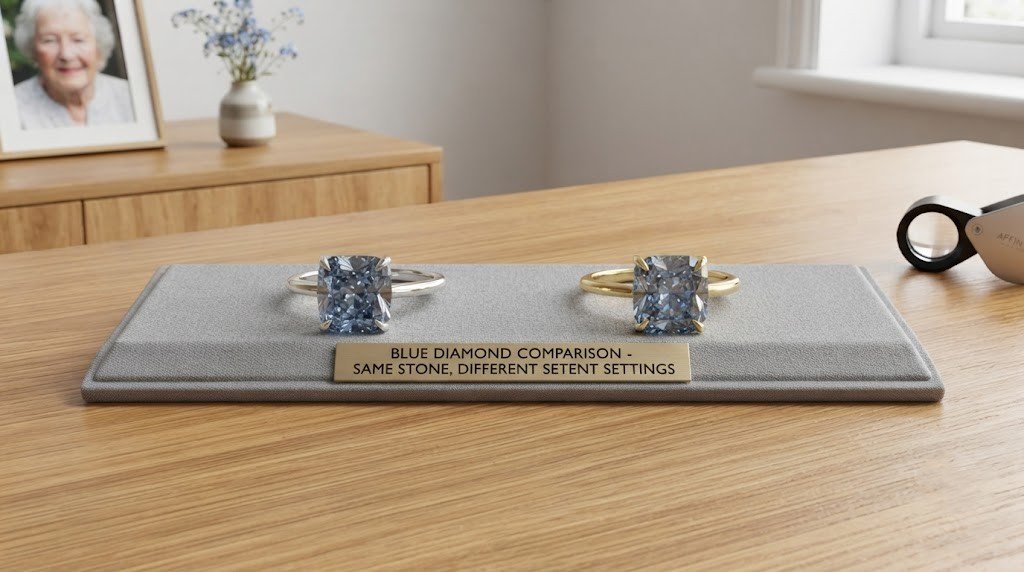
Metal changes how memorial diamond colors for a brother read once a stone is set. In broad terms, white metals such as platinum or white gold keep a stone looking cooler and can make a faint tint more visible, while yellow or rose gold warms the look and can soften a yellow or champagne tone. These are tendencies, not rules, and a jeweler can show the same stone against different metals before anything is made.
Treat color and metal as one conversation. A blue stone may look one way in a white bezel and quite another in yellow gold, so bring the grading report or the provider’s color description and ask to see examples in more than one metal. For protective settings and daily-wear trade-offs, the post on choosing a setting for his memorial diamond explains the options.
What Should You Ask a Provider About Memorial Diamond Colors for a Brother?
A short written list keeps conversations about memorial diamond colors for a brother focused:
- Which color routes do you offer, and which is your default?
- Can you show the range of tones your memorial stones have come out in?
- Is colorless available, and how much more does it cost at our carat size?
- Do you offer irradiation, and is it noted on the report?
- Does your process differ for ashes, hair or both?
- What happens if the color is far from what we expected, or if a growth run fails?
- Is independent grading included, and which lab grades your stones?
- How do you track his material from arrival to finished stone?
Ask for answers in writing and compare them side by side. A fuller checklist covering custody, unused material and refunds is in the post on questions to ask before his ashes become a diamond.
Frequently Asked Questions
Are memorial diamond colors for a brother different from colors for anyone else?
No. Memorial diamond colors for a brother depend on chemistry and each provider’s process, not on the relationship. A stone made for him draws on the same yellow, blue, champagne, colorless and treated options as one made for anyone else, with the same natural variation.
Can we ask for blue because it was his favorite color?
You can ask whether a provider offers a route toward blue, since boron produces blue tones in diamond. What no provider can promise is a particular shade of blue, so expect some variation in depth and tone, and get their description of likely results in writing first.
Will a stone grown from his hair be lighter than one grown from his ashes?
There is no published basis for that claim. Neither hair nor ashes is known to give a lighter or more predictable color than the other. The trace content of the recovered carbon and the provider’s process shape the result, so ask each provider how they handle your material.
Does a colorless memorial diamond cost more than a blue or yellow one?
Typically, yes. Excluding nitrogen and boron requires extra processing, so colorless usually costs more than the other untreated memorial diamond colors for a brother at the same carat size. Ask each provider for quotes on several color routes at one size to see the real difference.
Will an irradiated color be listed on the grading report?
Ask before you commit. Find out whether the stone will be graded independently, which lab will grade it, and whether any post-growth treatment such as irradiation will be stated on the report. Clear disclosure helps if the stone is later appraised, insured or passed down.
Can each sibling choose a different color from the same material?
Often several stones can be grown from shared material, each following its own route among the memorial diamond colors for a brother, but that depends on the provider. Whoever holds authority over his ashes under state law or his written wishes should be part of dividing them.
Final Thoughts on Choosing a Color for Your Brother’s Diamond
Color is one of the few parts of a memorial stone that stays a little uncertain until the end. You can choose a route, set a budget and ask good questions, and then the stone arrives in the tone his carbon and the process produced. For some families that small surprise becomes part of what makes it feel like his.
Whatever memorial diamond colors for a brother you lean toward, start with the person who will wear the stone and the brother you are remembering.
Learn More About Color and Design Choices for a Brother’s Diamond
- Brother Memorial Diamond Ideas: Rings, Pendants, and Keepsakes inspiration for the finished piece
- Choosing a Memorial Diamond for Your Brother: Where to Start first decisions in order
- How Long Does It Take to Make a Brother Memorial Diamond? why size and color affect timing
- Brother Memorial Diamond FAQ: Everything Families Ask quick answers on every stage
Talk With Memorial Diamond
If you would like to think out loud about memorial diamond colors for a brother, or about whether a stone suits your family at all, you are welcome to reach out to Memorial Diamond at memorialdiamond.us. There is no need to have decided anything first.
Bring whatever you have: a color he loved, a question about his ashes or hair, or simply the wish to understand the options before you talk with anyone else in the family.
Leave A Comment