
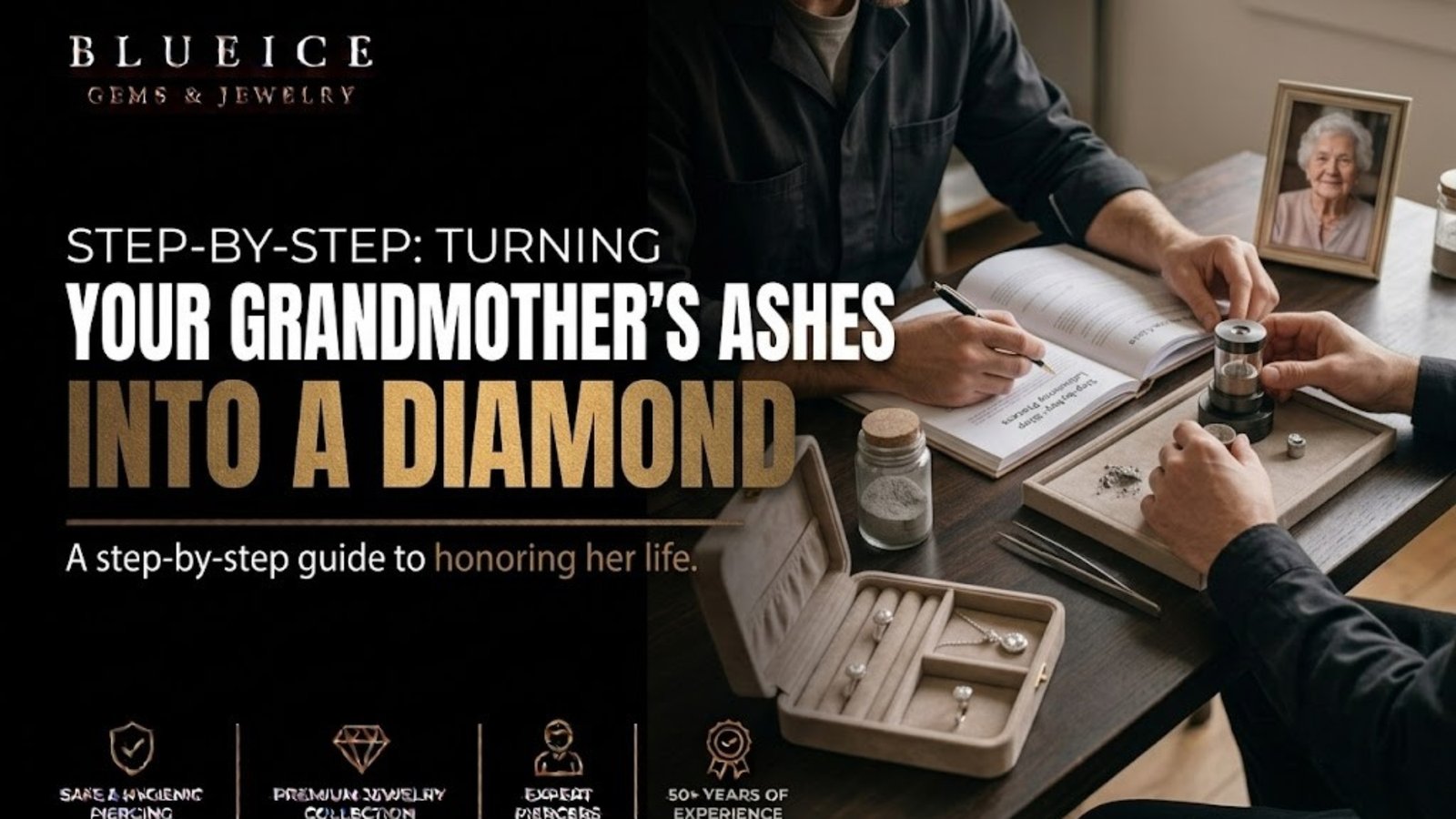
Holding a small portion of her ashes and wondering what could become of it is a quiet, serious moment. The grandmother ashes diamond steps run in a clear order: agree as a family, choose a provider, send a portion with tracking, then let a lab extract and purify her carbon, grow it into a real diamond, cut, grade and set it. Across the industry, the whole journey typically takes 6 to 10 months.
Nothing about the grandmother ashes diamond steps has to be rushed, and much of the work happens out of your hands once her ashes leave home. Knowing what each stage involves, who carries it out and where your family makes a choice can make the wait feel less uncertain.

Table of Contents
What Are the Grandmother Ashes Diamond Steps, in Order?
Twelve stages take her ashes from an urn to a finished stone: the first five belong mostly to your family, the next five happen in a lab, and the last two bring the diamond home.
- Talk with whoever holds authority, and with relatives.
- Choose a provider; ask questions in writing.
- Decide carat, color option, cut and grading.
- Receive a collection kit and portion her ashes.
- Ship the portion with tracking.
- Extraction and purification of her carbon.
- Graphitization.
- Diamond growth.
- Cutting and polishing.
- Optional irradiation for color.
- Grading and an authenticity certificate.
- Setting and delivery.
The table summarizes the grandmother ashes diamond steps: what happens, who handles it and what your family decides.
| Step | What happens | Who does it | What the family decides |
|---|---|---|---|
| 1. Family conversation | Agreement on whether to proceed and how much of her ashes to use | Your family, led by whoever holds authority | Whether to go ahead; who receives a stone |
| 2. Choose a provider | Comparing companies and getting answers in writing | Your family | Which provider to trust |
| 3. Stone details | Size, color option, cut and grading are selected | Your family, guided by the provider | Carat, color, shape, independent grading |
| 4. Collection kit | A container and instructions arrive; a portion is measured out | Your family, sometimes with a funeral home’s help | How much to send, within provider guidance |
| 5. Shipping | The portion travels to the lab with tracking | Your family and the carrier | Shipping method the provider recommends |
| 6. Extraction and purification | Carbon is separated from minerals and purified | The provider’s lab | None |
| 7. Graphitization | Purified carbon is heated into graphite | The provider’s lab | None |
| 8. Growth | Graphite is grown into a diamond crystal | The provider’s lab | Already set by carat choice |
| 9. Cutting and polishing | The rough crystal is shaped | A cutter or gemologist | Shape, chosen earlier |
| 10. Optional irradiation | Color is altered after growth | Some providers only | Whether to use it at all |
| 11. Grading and certificate | Quality is assessed; origin is documented | Lab or independent grader | Whether to pay for independent grading |
| 12. Setting and delivery | Stone is mounted and sent home | Jeweler and provider | Ring, pendant, loose stone or other |
For a broader look at the whole subject beyond the sequence itself, the complete guide to a diamond from your grandmother’s ashes covers color, cost and family questions in one place.
Who Should You Talk With Before Anything Is Sent?
Step 1: Talk with whoever holds authority, and with relatives
Before any of the other grandmother ashes diamond steps, the people who have a say need to agree. Who decides about her remains depends on state law and on any wishes she put in writing, and the ranking varies from state to state. Commonly a surviving spouse or partner comes first, followed by her adult children, which can mean your parent, aunt or uncle has the deciding voice rather than you. If nobody is sure, the funeral home or crematory involved can often say whose name is on the cremation paperwork.
You can still begin the conversation as a grandchild. A respectful approach is to ask whoever holds authority whether a small portion might be set aside, and to explain that most of her ashes can stay where the family intended. Her ashes may already be divided between households, scattered in part, or kept by one relative; any of these simply shapes what is available to work with.
Cousins and other relatives may want a voice in the grandmother ashes diamond steps, or a stone of their own. Raising the idea openly, rather than arranging it quietly, tends to protect relationships. If several people are interested, more than one stone can often come from shared material, though each provider sets its own terms, so ask about that early.
If faith shapes your family’s choices
No religious tradition has issued a ruling on memorial diamonds themselves; teachings address cremation and what is done with ashes. Catholic guidance, for example, asks that ashes be kept together in a sacred place, with only limited room for a small portion, which bears directly on dividing them. Practice differs widely among other faiths and communities, so anyone with a concern about the grandmother ashes diamond steps should talk it through with their own clergy or community leader.
If ashes are not an option for your family, a stone grown from hair is a separate route with no cremation involved; the guide to a diamond grown from your grandmother’s hair explains it. Her belongings, a saved lock of hair included, can count as part of her estate under rules that change between states, so speak first with the executor or whoever is handling her affairs.
How Do You Choose a Provider, and What Should You Ask?
Step 2: Compare providers and get answers in writing
The second of the grandmother ashes diamond steps is choosing who will make the stone. Companies vary in the growth method they use (HPHT for most, CVD for a minority), in how they document chain of custody, and in what they put in writing. Asking the same questions of each one makes a fair comparison possible.
Questions worth sending to every provider before the grandmother ashes diamond steps begin:
- How do you track her ashes from the moment they arrive until the stone ships back?
- What share of the finished stone is her carbon, and is it blended with supplemental lab carbon?
- What happens to any portion of her ashes you do not use, and can it be returned?
- What happens if a growth run does not succeed?
- Is independent grading available, and what does it cost?
- What are your refund and cancellation terms?
- Do you share photos or updates during the process?
On the carbon question, honest answers matter. Ash is mostly calcium phosphate, with usable carbon typically around 0.5–4% by weight. That carbon is purified and usually combined with lab carbon, so her personal carbon commonly makes up about 10–15% of the finished stone, though some providers cite figures as low as 3% and others higher. Any claim that a stone holds nothing but her carbon deserves a follow-up question, and an honest look at whether the stone is really made from her ashes walks through why.
Step 3: Decide on size, color, cut and grading
Carat is the choice in the grandmother ashes diamond steps that is easiest to get wrong without the right facts. Size depends on time in the growth press, so a full urn yields neither a larger nor a quicker stone. Memorial diamonds are generally offered from about 0.10 ct to more than 5 ct, and larger sizes take longer and cost more.
Trace elements decide color. Boron tints a stone blue and nitrogen tints it yellow; colorless means excluding both, an extra layer of processing that generally raises the price. Memorial diamonds often lean toward yellow, blue or champagne tones. A provider will list the color options it offers, but nobody can promise to match an exact shade, and what color a stone from her ashes may turn out is worth reading before you choose.
Shape and grading are settled here too; independent grading is usually an optional add-on.
How Are Her Ashes Collected, Portioned and Shipped?
Step 4: Receive the collection kit and portion her ashes
The fourth of the grandmother ashes diamond steps usually begins with a collection kit, if the provider supplies one; ask what it contains, since kits differ, and follow its instructions exactly, because each provider sets its own requirements for how much to send and how to package it.
The amount requested commonly ranges from a few tablespoons to roughly 4 oz (about 100 g), usually a small fraction of the whole. The guide to how much ash a grandmother memorial diamond needs covers this in more depth. If measuring out her ashes yourself feels like too much, ask whether the funeral home that handled the cremation can help with that part of the grandmother ashes diamond steps.
Step 5: Ship the portion with tracking
Shipping is the point in the grandmother ashes diamond steps where her ashes leave your care. Use the method the provider recommends, and keep the tracking number somewhere safe. Rules for sending cremated remains depend on the carrier and route, so confirm them with the provider and the carrier directly rather than assuming. Ask the provider to confirm in writing when the package arrives, and how its own chain-of-custody records will follow her ashes through the lab.
What Happens to Her Ashes Inside the Lab?
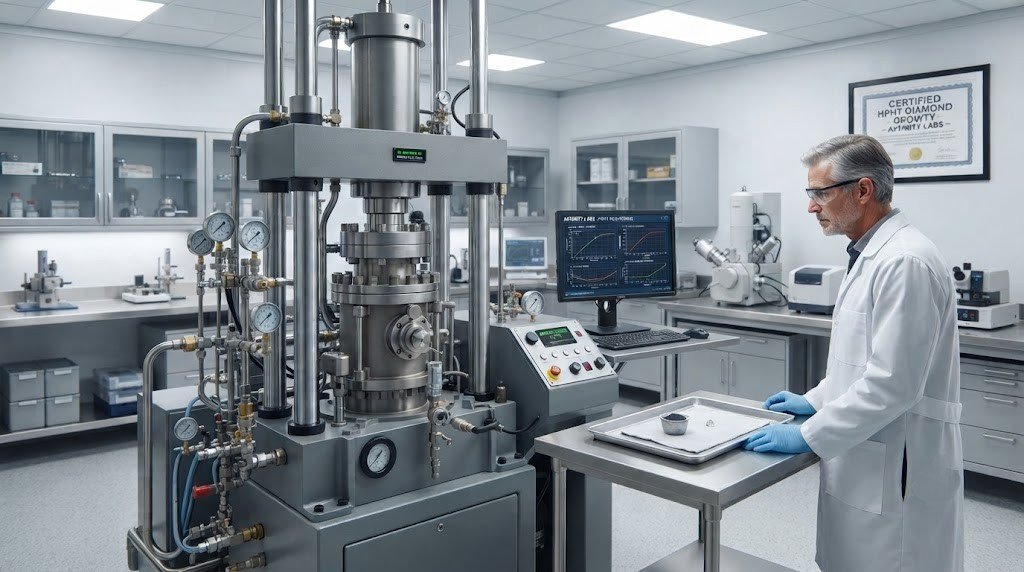
The middle stretch of the grandmother ashes diamond steps happens entirely in the provider’s facility.
Step 6: Carbon extraction and purification
Extraction opens the lab portion of the grandmother ashes diamond steps. Her ashes are heated in a controlled, oxygen-free, multi-stage process that strips away the calcium phosphate and other minerals. What remains is carbon, refined to roughly 99.9% purity or higher.
Step 7: Graphitization
Within the grandmother ashes diamond steps, graphitization is the bridge between purified carbon and growth. The carbon is heated further, to roughly 2,500–2,700°C, which converts it into graphite. Graphite is the crystalline form of carbon that growth presses use as their feedstock, so this step prepares her carbon to become part of a diamond.
Step 8: Diamond growth
Growth is where the grandmother ashes diamond steps turn carbon into crystal. Most providers grow memorial diamonds by HPHT, recreating pressures of roughly 6–8 GPa and temperatures of about 1,400–2,500°C around a tiny diamond seed. A minority use CVD instead, depositing carbon from a gas onto a seed plate. Either way, the result is a real lab-grown diamond with the same hardness and optical properties as any other. If you want a deeper explanation of this stage, how a memorial diamond is made from her ashes goes further into the science.
How Is the Rough Diamond Finished, Graded and Certified?
Step 9: Cutting and polishing
Cutting is the first of the grandmother ashes diamond steps where the stone starts to resemble jewelry, since a rough diamond leaves the press looking nothing like a finished gem. A cutter or gemologist shapes it into the cut your family chose, then polishes the facets so it catches light.
Step 10: Optional irradiation
Irradiation is an optional extra among the grandmother ashes diamond steps. Some providers use it after growth to shift a stone toward red, pink, green or black; it is a choice, not every company offers it, and specialty colors can lengthen the overall timeline.
Step 11: Grading and the authenticity certificate
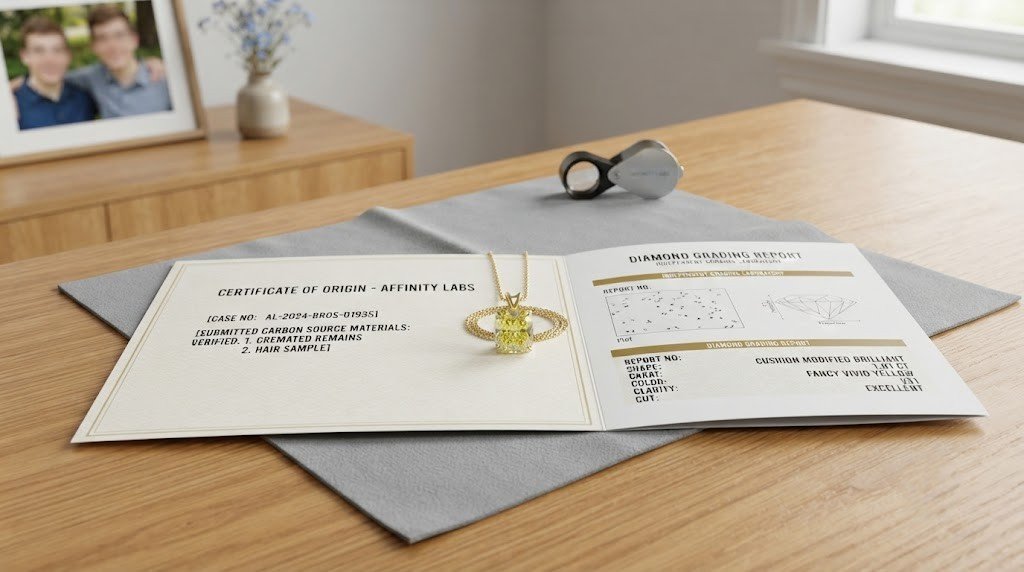
Two documents can come with the stone, and they do different jobs. An authenticity or origin certificate, usually issued by the provider, records that the diamond was grown from your family’s submitted material; in effect it is a chain-of-custody record. The other document, a grading report, assesses the 4Cs and is best issued by a third-party laboratory referencing standards such as GIA’s diamond quality factors.
Independent grading is typically a separately priced option. Clarity for memorial diamonds usually falls between SI2 and VVS. Among the grandmother ashes diamond steps, this is the one that gives you documents you can keep and show a jeweler or insurer.
How Does the Finished Stone Reach Your Family?
Step 12: Setting and delivery
The final stage of the grandmother ashes diamond steps is getting the stone into your hands. Some families take the diamond loose and choose a setting later; others have it set before it ships. Settings, engraving and fancy cuts are usually priced separately from the stone. Choose a design that suits whoever will wear it and reflects who she actually was, whether that is a simple pendant, a ring or a stone kept in a small box for a future generation.
When the stone arrives, check it against whatever paperwork came with it, keep those documents together, and ask the provider how delivery is insured and tracked. A diamond rates 10 on the Mohs hardness scale, yet a hard knock can still chip one, so a protective setting is worth discussing if it will be worn daily.
How Long Do the Grandmother Ashes Diamond Steps Take Altogether?
Across the industry, the grandmother ashes diamond steps typically take 6 to 10 months from the day a provider receives her ashes to a finished stone. Larger diamonds, roughly over 2 ct, and specialty colors can take up to about 12 months.
Because growth time decides carat size, a bigger stone simply needs more time in the press. Sending more ash does not shorten the wait. The family conversation and provider research that come first have no set length at all, and taking your time with them is entirely reasonable.
If you hope to have the stone by a particular date, tell the provider before you order and ask whether it is achievable. Providers set their own schedules, so ask each one for its current estimate of the grandmother ashes diamond steps as a whole rather than assuming any single stage will move at a particular pace.
What Do the Grandmother Ashes Diamond Steps Typically Cost?
What a family pays to complete the grandmother ashes diamond steps in 2026 generally follows size and color. The figures below are industry-wide ranges, not Memorial Diamond’s prices, which are not yet published.
| Size | Typical industry range |
|---|---|
| Small: 0.10 to 0.25 carat | Around $1,500 to $3,500 |
| Medium: half a carat to 1 carat | Around $5,000 to $15,000; colorless costs noticeably more |
| Large: 2 carats to over 5 | Around $20,000 to $75,000 and up |
Independent grading, engraving, fancy cuts and settings usually add to the total. When several relatives want stones, ask whether separate orders from the same portion change the price, and agree in writing who pays for what. Cost can also shape how the grandmother ashes diamond steps unfold, since choosing a smaller size or a non-colorless tone can bring the total down.
What Happens to the Rest of Her Ashes?
Only a portion of her ashes passes through the grandmother ashes diamond steps, so the rest can remain in an urn, be interred, be scattered, or stay with whichever relative has been keeping them. A diamond can sit alongside any of those choices rather than replacing them.
What a provider does with any ash it receives but does not use is a policy each company sets for itself. Before shipping, ask:
- Will unused ash be returned, and how?
- Is any material stored, and for how long?
- Can material be kept for a second stone later?
- Will you confirm in writing what happened to every part of what we sent?
Getting those answers in writing before the grandmother ashes diamond steps begin gives your family a clear record of where each part went.
Frequently Asked Questions
Can a grandchild start the grandmother ashes diamond steps without the family’s agreement?
It depends on who holds authority, which state law and her written wishes decide. Often a surviving spouse or partner, then her adult children, come ahead of grandchildren. Asking that person for a small portion is the respectful way to begin.
Do the grandmother ashes diamond steps use all of her ashes?
No. Providers typically ask for between a few tablespoons and roughly 4 oz, usually a small fraction of the total. The rest can stay in an urn, be interred or be scattered as the family already planned, alongside the stone.
Can several cousins each get a stone from the same portion?
Often, yes, because only part of the ashes is used for each stone. Whoever holds authority needs to agree to how the material is shared, and each provider sets its own requirements, so ask about multiple stones before you ship anything.
Which of the grandmother ashes diamond steps can the family control?
Your family controls the early decisions: whether to proceed, which provider, carat, color option, cut, independent grading and setting. Extraction, graphitization, growth and cutting happen in the lab, where your influence comes through the questions you ask beforehand.
Can her ashes still be used if she died many years ago?
Whether ashes kept for a long time are still workable is a question to ask each provider directly. Explain how and where they have been stored, and request a written answer before ordering, since policies and processes differ between companies.
Is the authenticity certificate the same as a grading report?
No. An authenticity certificate, usually issued in-house, documents that the stone came from your family’s submitted ashes. A grading report describes cut, color, clarity and carat, ideally from an independent lab, and is typically an optional, separately priced add-on.
Final Thoughts on the Grandmother Ashes Diamond Steps
Most of this journey asks patience rather than effort. Your family’s part comes at the start, in careful conversations, and at the end, when the stone arrives.
Taking each of the grandmother ashes diamond steps in order, with answers in writing, gives your family a clearer picture of where her ashes are and what is being done with them at each stage.
Learn More About the Grandmother Ashes Diamond Steps and Related Choices
- How to Turn Your Grandmother’s Ashes Into a Diamond the decision-focused companion to this sequence
- Grandmother Ashes Diamond: The Complete Guide the full picture in one place
- How Much Ash Do You Need for a Grandmother Memorial Diamond? amounts and portioning
- Is a Memorial Diamond Really Made From Your Grandmother’s Ashes? the carbon question answered honestly
Talk With Memorial Diamond
If you are weighing the grandmother ashes diamond steps for your family and want a clear answer to any of them, Memorial Diamond is happy to talk it through at whatever pace suits you.
You can reach us through memorialdiamond.us whenever you are ready.
Word count: 3,189 words · Reading time: about 16 minutes
Leave A Comment