
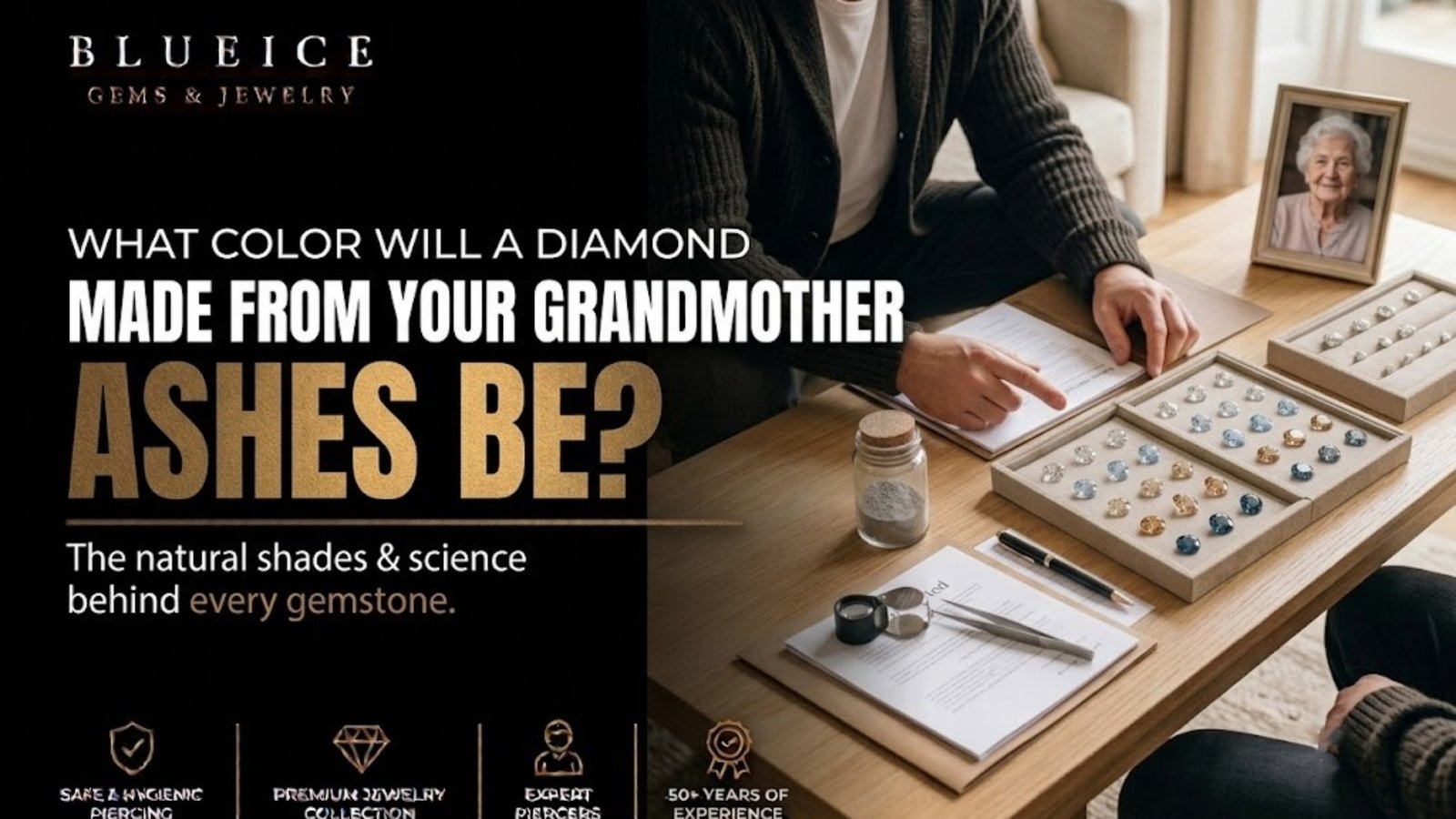
Whether her ashes rest with you, with an aunt or uncle, or in a place the family has not yet settled on, it is natural to picture the stone they could become before anyone commits to anything. The most likely grandmother ashes diamond color is a yellow, blue, or champagne-to-brown tone, and no provider can tell you the exact shade until the crystal has finished growing. A colorless stone is achievable with extra processing, usually at a higher price, and some providers also offer treated colors such as pink or black.
That short answer leaves real questions open about grandmother ashes diamond color: why the tones fall where they do, what a grading report will say, and whether color changes the cost or the wait. Each section stands on its own, so go straight to the part you need.
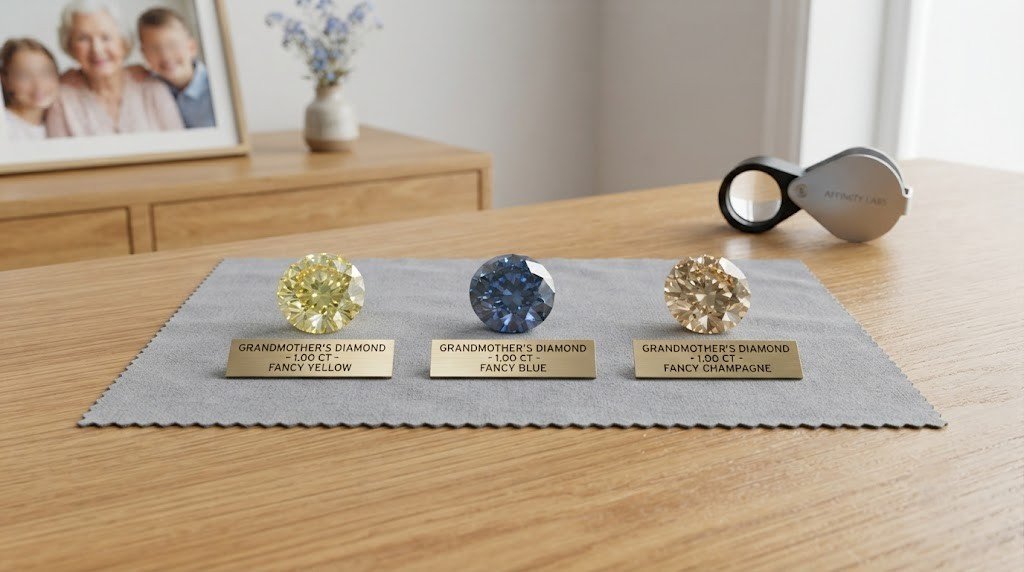
Table of Contents
What grandmother ashes diamond color is most likely?
Across the memorial diamond industry, grandmother ashes diamond color, like the color of any stone grown from cremated remains, trends toward three families of tone: yellow, blue, and champagne or brown. Any of the three is a normal result. A stone in one of these shades is a real diamond, graded on the same four Cs (cut, color, clarity, carat) as a mined one.
Which of the three appears depends mostly on trace elements present while the crystal grows. Think of grandmother ashes diamond color as an outcome of chemistry and process choices rather than a menu item. A provider can tell you which tones their natural, untreated stones usually come out in, and that is a fair first question to ask.
Here is how the main possibilities for grandmother ashes diamond color compare:
| Grandmother ashes diamond color | What usually produces it | Natural or treated | Relative cost at the same size |
|---|---|---|---|
| Yellow | Nitrogen present during growth | Natural result | Lower to middle of the range |
| Blue | Boron present during growth | Natural result | Lower to middle of the range |
| Champagne or brown | A warm tone common in stones grown from an organic source | Natural result | Lower to middle of the range |
| Colorless (white) | Extra processing that keeps both nitrogen and boron out | Natural result, controlled process | Meaningfully higher |
| Red, pink, green, or black | Post-growth irradiation, offered by some providers | Treated | Varies by provider; ask for a quote |
Why do trace elements shape grandmother ashes diamond color?
Diamond is carbon arranged in a tight crystal lattice. When a few atoms of another element slip into that lattice during growth, the stone absorbs some light and shows a tint. Nitrogen produces yellow tones. Boron produces blue tones. A stone with neither shows no body color at all.
That is the whole basis of grandmother ashes diamond color: carbon recovered from ashes comes from an organic, personal source rather than a carefully controlled lab feedstock. After the crematory, most of what remains is calcium phosphate, the mineral of bone, and only roughly 0.5% to 4% of the ash by weight is usable carbon. That carbon is purified to around 99.9% or better, but trace elements are still common in this kind of source, which is why tinted results are the norm.
How much of the stone is her carbon?
For a stone grown from ashes, the recovered carbon is typically blended with supplemental lab carbon so there is enough to grow a stone of useful size. Industry figures put her share near 10% to 15% of the finished mass. A few providers quote figures closer to 3%, others go higher, and stone size and the amount of ash sent both play a part. Any claim that the stone is made entirely from ashes does not match how the process works.
Knowing that blend is part of the picture helps explain why grandmother ashes diamond color cannot be read off the ashes themselves. The final hue reflects the purified carbon, the supplemental carbon, the growth conditions, and any steps the provider takes to include or exclude particular elements. You can read more about how her ashes become a finished stone, from purification through growth and polishing.
Can a stone from her ashes be colorless?
Yes, a colorless result is an achievable grandmother ashes diamond color. Getting there means the provider has to keep both nitrogen and boron out of the growing crystal, which takes additional processing and closer control in the press. That extra work is the main reason colorless stones typically cost more than tinted ones of the same carat weight.
Some families want colorless because it matches jewelry already in the family, or because the wearer simply prefers a white stone. Others feel a natural grandmother ashes diamond color is closer to the point of the whole thing. Neither choice is more respectful than the other.
If colorless matters to you, ask each provider three things in writing: whether colorless is offered for ash-based stones, how the price compares with their natural tones at the same size, and what happens if a colorless run does not reach the intended result. That last answer is entirely provider-dependent, so get it on paper before you send anything.
What are the treated colors, like pink, red, green, or black?
Some providers offer post-growth irradiation, a treatment applied after the crystal has formed that shifts or deepens grandmother ashes diamond color. Red, pink, green, and black are the shades usually produced this way. These are still real diamonds; the treatment changes how the lattice absorbs light rather than adding a coating.
Irradiated colors are not offered everywhere. A specialty grandmother ashes diamond color, black among them, can also add time, with some stones taking up to about 12 months in total.
Questions worth asking before choosing a treated shade:
- Is the treatment disclosed on the grading report, and in what words?
- Which treated colors does the provider offer for stones grown from ashes?
- How much does the treatment add to the price and to the timeline?
- Does the provider describe the treated color as stable under normal wear?
Why can’t a family pick or match an exact natural shade?
Natural color in a memorial diamond comes from whatever trace elements end up in the lattice, and that is shaped by an organic source no lab can fully predict. A provider can steer toward colorless by excluding nitrogen and boron, or shift the color afterward with irradiation. What nobody can honestly promise is a particular untreated shade, such as the exact blue of a photograph or a paint chip.
That uncertainty is easier to live with when it is expected from the start. A useful way to frame grandmother ashes diamond color is as something you find out rather than specify. Some families come to value that, since the tone emerged from this one growth run rather than from a catalog.
If you are comparing quotes, be cautious about any promise of an exact grandmother ashes diamond color. Ask the provider to explain, in plain terms, what is and is not under their control, and keep that explanation with your paperwork. The step-by-step process for a stone grown from her ashes shows where in the sequence color is actually decided.
How is grandmother ashes diamond color graded on a report?
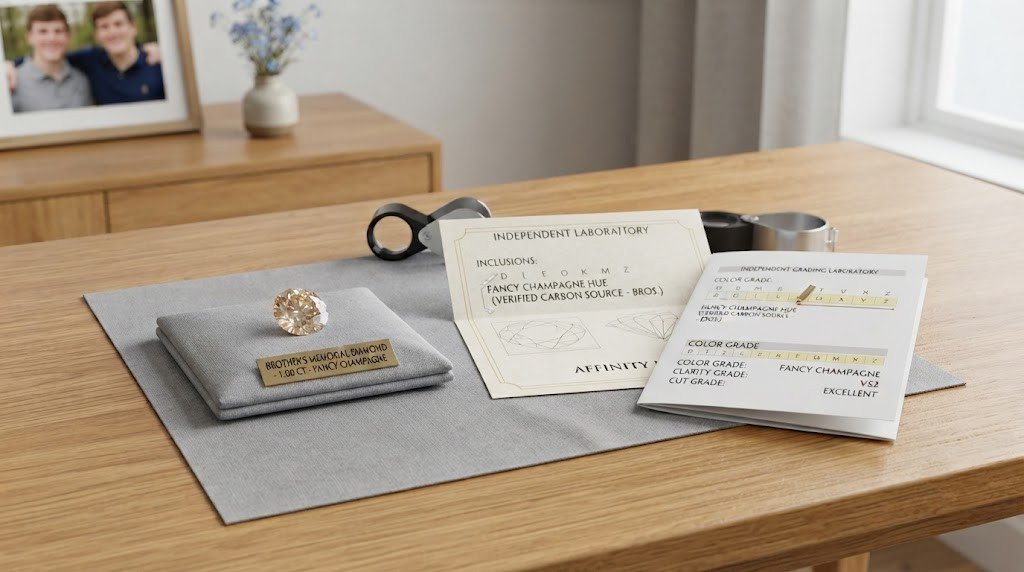
Two different documents often arrive with a memorial diamond, and only one of them records grandmother ashes diamond color. An authenticity or origin certificate, usually issued in-house, documents the chain of custody: that this stone was grown from carbon recovered from the ashes your family sent. A grading report describes the stone’s own quality, covering cut, color, clarity, and carat.
Grading is ideally done by an independent lab, most commonly referencing GIA standards and sometimes IGI, and is typically an optional, separately priced add-on. GIA’s overview of the diamond quality factors is a clear plain-language introduction to what the four Cs mean.
What the color line on a report usually says
In general gemology, colorless and near-colorless diamonds are placed on a letter scale, while yellow, blue, and other tinted stones are described by their hue plus an intensity term such as “fancy light” or “fancy intense.” Independent reports also commonly note whether a color comes from treatment. Exact wording varies by lab, so ask to see a sample report before you choose.
Typical clarity for memorial diamonds falls in the SI2 to VVS range, listed beside grandmother ashes diamond color on the same report. If your family wants a grading report, ask about it at the quoting stage so the cost is clear from the start.
Do carat size and cut change how the color looks?
In general, yes, though the effect is about how grandmother ashes diamond color appears, not the underlying chemistry. A larger stone gives light a longer path through the crystal, so a tint can look a little stronger in a bigger diamond than in a small one with the same composition. Memorial diamonds run from about 0.10 carat to more than 5 carats, so that range covers very different looks.
Cut shape plays a part too. Brilliant-style cuts scatter light in a way that can soften how a tint reads, while some step cuts and elongated shapes show body color more openly. Ask the provider for examples of the same tone in different shapes.
Setting metal matters as well: white metals can make a pale tint look cooler, and yellow or rose metals warm it up. If grandmother ashes diamond color is one of your main concerns, ask to see photos of finished stones in a few cuts and settings before deciding.
How does grandmother ashes diamond color affect the price?
Size drives most of the price, and grandmother ashes diamond color comes second. These are general 2026 industry ranges, not quotes from Memorial Diamond, and the final figure depends on carat, color, cut, and whether an independent grading report is included.
| Size tier | Typical industry range | Where grandmother ashes diamond color fits |
|---|---|---|
| About 0.10 to 0.25 carat | Roughly $1,500 to $3,500 | Natural tones usually at the lower end |
| 0.5 to 1 carat | Roughly $5,000 to $15,000 | Colorless costs meaningfully more than yellow, blue, or champagne |
| 2 to 5+ carats | Roughly $20,000 to $75,000+ | Longer growth; colorless and treated colors add further |
Engraving, fancy cuts, settings such as a ring or pendant, and an independent grading report are usually priced separately from the loose stone. When grandmother ashes diamond color is a deciding factor in the budget, ask for side-by-side quotes at one carat weight so the difference between a natural tone and colorless is plain.
Does grandmother ashes diamond color change the timeline or ash needed?
Grandmother ashes diamond color can affect the timeline. Across the industry, the full process typically takes about 6 to 10 months from the day the provider receives the ashes. Larger stones, roughly those over 2 carats, and specialty-color stones can take up to about 12 months.
The amount of ash is a separate question. Providers typically ask for somewhere between a few tablespoons and roughly 4 ounces, about 100 grams, which is usually a small fraction of the full remains. Growth time in the press, not the volume sent, sets carat size, so a full urn does not produce a bigger or faster stone.
Sending more ash is also not a way to steer grandmother ashes diamond color toward a particular tone. Color comes from trace elements and from the provider’s process choices. What a larger portion can sometimes allow is more than one stone, so that several relatives each receive one; the guide to how much ash a grandmother memorial diamond needs covers that in more depth.
What to ask about leftover ash
What happens to unused ash is decided by each company. Ask in writing before you ship, and ask how the ashes are tracked from arrival to finished stone.
Who in the family weighs in on the color and the ashes?
Settling on a grandmother ashes diamond color can feel like a small, personal decision, yet it often sits on top of a bigger one: who has the right to decide what happens to her remains. Two things answer that: the law of the state involved, and whatever she put in writing. States rank relatives differently, so no single national order applies. Commonly, a surviving spouse or partner ranks first, followed by her adult children, with grandchildren further down.
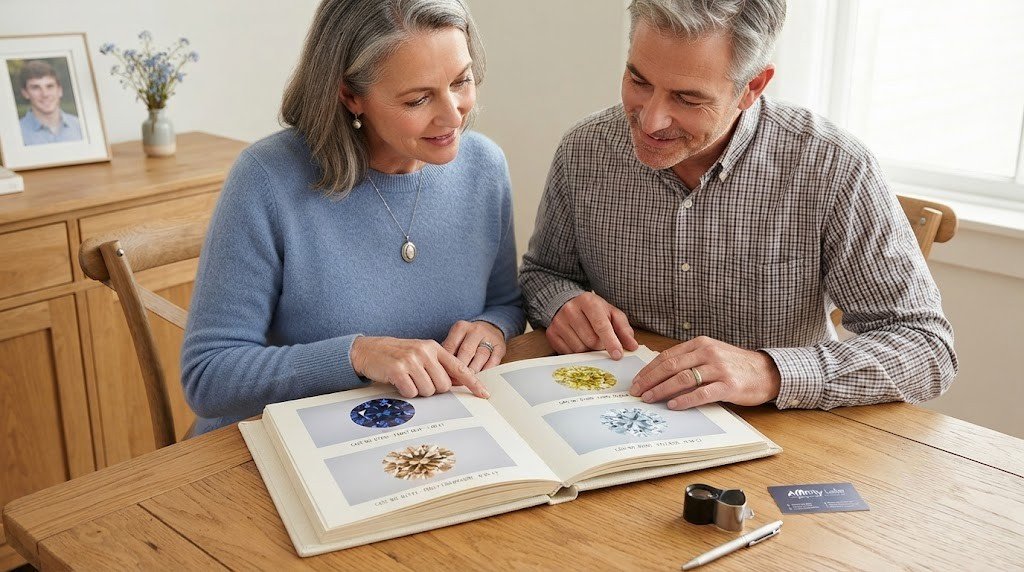
If you are a grandchild, the respectful route is usually to ask whoever holds that authority for a small portion. The funeral home or crematory can often tell you who signed the cremation authorization, which is a good starting point. Her ashes may already have been divided, scattered, or kept by an aunt, an uncle, or one of your parents, and she may have died some years ago; a conversation is still possible in each case.
When cousins want different colors
When several grandchildren are involved, grandmother ashes diamond color is worth talking through early. One cousin may want colorless to match an engagement ring, while another prefers whatever natural tone appears. Since a modest portion of ash can often support more than one stone, each person may be able to choose separately; confirm that with the provider. The complete guide to a grandmother ashes diamond walks through the wider family side in detail.
Faith can shape these conversations as well. Religious teaching speaks to cremation and to keeping or dividing ashes; none of the major traditions has ruled on memorial diamonds as such. If faith matters in your family, her clergy or community is the right place to ask.
How do families tie grandmother ashes diamond color to who she was?
For some people, grandmother ashes diamond color is where the stone starts to feel like hers. A blue result might call to mind the lake town she grew up in, or the uniform she wore through her working years. A champagne tone might bring back the desert roads she loved, or the color of a jacket she reached for again and again.
Those links come from your own memories, not from any rule about what suits a grandmother. She may have been bold or reserved, a traveler or a homebody. The stone will also be worn by a particular person, maybe you, a cousin, or one of her children, and their taste deserves equal weight.
Some families wait to see the natural result and build the meaning around it. Others choose colorless or a treated shade to suit how the wearer dresses. Both approaches are sound. If you are still deciding whether hair might be an option alongside or instead of ashes, the post on what color a stone from her hair might be answers the same question for that route.
A note on stones grown from more than one source
Some families combine ash and hair in one stone. The same principles behind grandmother ashes diamond color apply, and the outcome is no more predictable. The page on color for a stone grown from her ashes and hair together looks at that combined route specifically.
Frequently Asked Questions
Can grandmother ashes diamond color be clear like an engagement ring?
Probably not unless you request it. Stones grown from ashes usually come out yellow, blue, or champagne to brown. A colorless result is achievable when the provider excludes nitrogen and boron during growth, which takes extra processing and typically raises the price at the same carat weight.
Can I choose blue for a stone grown from her ashes?
You can tell the provider you hope for blue, but an exact natural shade cannot be promised. Blue comes from boron in the lattice, and an organic source is unpredictable. Ask whether the provider’s process tends toward blue and what happens if the result differs.
Does grandmother ashes diamond color reveal anything about her health or habits?
No reliable link of that kind has been published. Grandmother ashes diamond color depends on trace elements such as nitrogen and boron, the supplemental lab carbon blended in, and the provider’s process. Treat claims that a hue reflects personality, diet, or health as unsupported.
Is a treated pink or black stone from her ashes still a real diamond?
Yes. Irradiation, offered by some providers, changes how the crystal absorbs light after growth; it does not coat or replace the diamond. An independent grading report usually notes that a color is treated, so ask to see how the lab you choose words that disclosure.
If my cousins and I each get a stone, will they all match?
Not necessarily. Grandmother ashes diamond color can differ between stones grown separately from the same ashes, because each growth run is its own process. If matching matters, ask whether every stone can be grown colorless, or accept that slight differences are part of having several stones.
Can her ashes still be used if they were cremated many years ago?
Ashes kept for years raise a fair question. Whether older ashes are workable, and whether storage conditions matter, is a question for each provider. Ask in writing before shipping, and ask whether the age of the ashes affects color, yield, or timeline in their experience.
Final Thoughts on Your Grandmother’s Diamond Color
Grandmother ashes diamond color is one of the few parts of the process that stays a little uncertain right up to the end. For some families, that turns out to be fine. A yellow, blue, or champagne stone is a normal and honest result, and colorless or treated shades remain on the table if they suit the person who will wear it.
The most useful step now is asking clear questions and keeping the answers in writing.
Learn More About Color and Her Ashes
- Grandmother Ashes Diamond: The Complete Guide the full picture, from family conversations to finished stone
- How to Turn Your Grandmother’s Ashes Into a Diamond the practical path from first call to delivery
- Is a Memorial Diamond Really Made From Your Grandmother’s Ashes? the honest numbers behind her share of the carbon
- What Color Will a Diamond Made From Your Grandmother’s Hair Be? the same question for the hair route
Talk With Memorial Diamond
If you would like to think through color, size, or how to approach your family about a portion of her ashes, Memorial Diamond is glad to talk it over with you. There is no rush and no obligation; questions are welcome at any stage.
You can start whenever it feels right at memorialdiamond.us.
Word count: 3,195 words · Reading time: about 16 minutes
Leave A Comment