
A hair brush on sister memorial diamond her dresser, a braid saved from a haircut years ago, a lock someone thought to keep: any of these small things may be where a diamond begins. The sister hair diamond steps begin with finding her hair and agreeing, with whoever has a say over her belongings, how it will be used. You then send a small lock to a provider, settle size and color, and wait roughly 6–10 months while the lab purifies, grows, cuts, and grades the stone. No cremation is needed.
Table of Contents
How Do the Sister Hair Diamond Steps Differ From the Ash Route?
Hair changes the order of things. Because hair is roughly 50% carbon by weight, a small lock or a few grams is typically enough, and nothing about the process depends on cremation. That means the sister hair diamond steps can begin whether she was cremated or buried, and whether she passed last month or a decade ago, provided some of her hair was kept.
It also changes the paperwork. There is no portion of remains to request, but hair left among her things can form part of her estate, so a conversation with whoever is handling it still belongs near the start. If you are weighing both materials, the ash checklist shows how different the opening stages become.
Here are all ten sister hair diamond steps in one view:
| Step | What you do | Who’s involved | What you hold afterward | Timing |
|---|---|---|---|---|
| 1 | Talk it over with family | You, other siblings, close relatives | Notes on who knows and how they feel | Your own pace |
| 2 | Search for her hair | You and anyone who may have kept some | A list of where hair was found | Your own pace |
| 3 | Check who has a say over her belongings | Executor or whoever handles her estate | A written note agreeing to the use | Depends on the estate |
| 4 | Gather and protect the hair | You | Labeled, sealed envelopes and photos | Your own pace |
| 5 | Choose a provider and get answers in writing | You and any co-funders | Written answers and a dated quote | As long as you need |
| 6 | Settle carat, color, cut, and budget | You and any co-funders | A signed order confirmation | As long as you need |
| 7 | Send the hair and confirm intake | You, carrier, provider | Tracking number and intake ID | Carrier-dependent; lab clock starts |
| 8 | Purification and graphitization | Provider’s lab | An update, if offered | Ask your provider |
| 9 | Growth, cutting, and grading | Provider’s lab, optional outside grader | Origin certificate, optional grading report | Growth takes weeks to months |
| 10 | Receive, inspect, and keep or set the stone | You, a jeweler, your insurer | The stone and a complete file | Your own pace |
Where Might Her Hair Be, and Who Decides How It Is Used?
Step 1: Talk it over with family
The first of the sister hair diamond steps is a conversation, not a search. Before you go looking, say the idea out loud to the people closest to her. A relative may have kept a lock from her childhood that you never knew about. Another sibling, whether full, half-, step-, or adopted, may want a stone too, or may prefer that her hair stay exactly where it is.
Before you move on: you know who else cares about her hair and whether anyone holds some already.
Step 2: Search for her hair
Of all the sister hair diamond steps, this one is the most personal, and it can take longer than expected. Places worth checking include:
- a hairbrush or comb she used regularly
- a braid, ponytail, or lock saved after a haircut
- a keepsake envelope a relative tucked away
- a lock a funeral home clipped before services, if anyone asked for one
If services have not yet happened, it may be possible to ask the funeral director to clip a small lock now; policies differ, and the request may need to come from whoever holds authority over her remains. Brushes can be harder, since they may hold other people’s hair; acceptance varies by provider, so ask before relying on one.
Before you move on: you have a written list of every source you found and who currently has it.
Step 3: Check who has a say over her belongings
This is the point in the sister hair diamond steps where permission matters most. Hair kept in her home can count as part of her estate, and the rules vary by state. Speak with the executor, or whoever holds authority over her affairs, before taking hair from among her things. The conversation may be brief, but a written note avoids misunderstandings later.
Before you move on: you hold a dated note or email agreeing that her hair may be used for a memorial diamond.
How Should You Gather and Protect Her Hair?
Step 4: Gather and protect the hair
Careful handling here protects every later stage of the sister hair diamond steps, so touch the hair as little as possible. Place it, dry and untreated, in a clean paper envelope or the bag your provider supplies, and keep each source separate. Label every envelope with where the hair came from and the date you gathered it, then photograph each one.
Requested amounts are provider-variable, typically a small lock or a few grams. The post on how much hair providers usually ask for covers this in detail. Sending more will not make the stone larger or faster, because growth time sets carat size. If you have very little, ask whether the provider uses all of it before you send everything.
Before you move on: each envelope is sealed, labeled, and photographed, and you know exactly what you are sending.
Which Details Should You Settle With a Provider First?
Step 5: Choose a provider and get answers in writing
These sister hair diamond steps go more smoothly when every answer is written down. A fuller set of hair-specific provider questions exists, but cover at least these:
- Do you accept hair from a brush, or only cut locks?
- How is her hair tracked from arrival to finished stone?
- Is her carbon blended with supplemental lab carbon, and what share of the stone do you expect it to make up?
- If the stone cracks while it is being cut, or a growth run does not succeed, what do you do next, and at whose cost?
- Do you send back hair you did not use, store it, or dispose of it?
Before you move on: every answer exists in an email or document, alongside a dated quote.
Step 6: Settle carat, color, cut, and budget
Size is the choice in the sister hair diamond steps that most shapes cost and time. A stone meant for a slim pendant or small ring, around 0.100.25 ct, sits at roughly $1,500$3,500 in 2026 industry pricing. Moving up to half a carat or a full carat lifts that to roughly $5,000$15,000, and asking for colorless at that size pushes it meaningfully higher than a yellow, blue, or champagne stone. A larger stone of 25+ ct runs roughly $20,000$75,000+.
Those are category-wide figures rather than anything Memorial Diamond has published. Budget separately for grading, engraving, a fancy cut, or a setting, since providers usually quote those on top.
Color comes from trace elements during growth: nitrogen gives yellow, boron gives blue, and colorless needs the absence of both. There is no basis for expecting hair to give a lighter or more predictable shade than ash, and no shade says anything about who she was.
Before you move on: you have a signed order confirmation, and if more than one person is paying, ownership of the stone is agreed in writing.
Which Sister Hair Diamond Steps Happen Once Her Hair Reaches the Lab?
Step 7: Send the hair and confirm intake
Ship with signature tracking, using whatever method your provider specifies for this stage of the sister hair diamond steps. Wait for an email confirming arrival and assigning an intake or batch ID. The 610 month clock for the remaining sister hair diamond steps typically starts at this point.
Before you move on: the intake ID is filed with your order confirmation and the estate note.
Step 8: Purification and graphitization
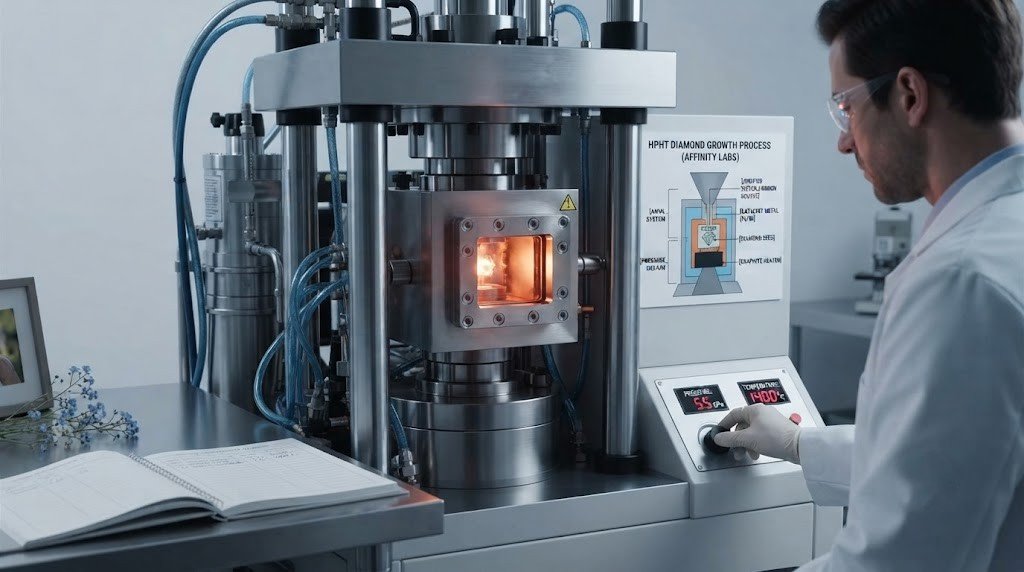
Hair is built from keratin, a carbon-rich protein. The lab heats it in an oxygen-free, multi-stage process that removes the non-carbon components, reaching roughly 99.9% carbon purity or higher. The carbon is then heated to roughly 2,5002,700°C and converted to graphite, which a growth press can use. For a closer look, read what the lab does with her hair, in more depth.
Providers commonly blend personal carbon with supplemental lab carbon to reach the volume a stone needs. There is no published percentage for how much of a hair-grown stone’s mass comes from the hair itself, so ask your provider what it expects for your order.
Before you move on: you have the provider’s own description of how her carbon is used, in writing.
Step 9: Growth, cutting, and grading
These are the longest of the sister hair diamond steps. The usual method is HPHT: a press squeezes the graphite at roughly 68 GPa while holding it somewhere between 1,400 and 2,500°C, and a diamond crystal forms on a small seed. A minority of providers use CVD instead. Growth takes weeks to months, and the carat you chose, not the amount of hair, sets the duration. A gemologist then cuts and polishes the rough crystal; some providers offer disclosed post-growth irradiation for red, pink, green, or black.
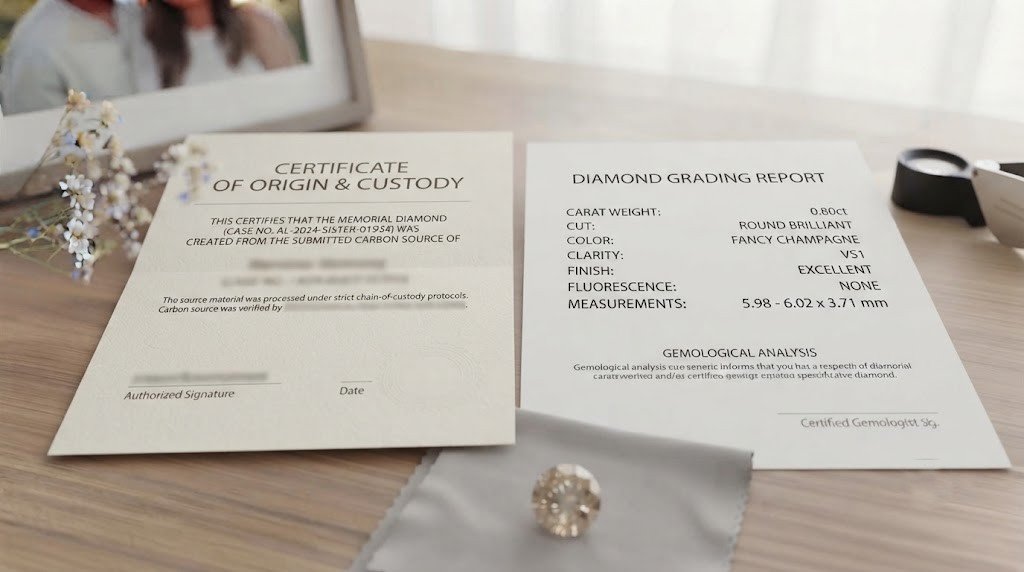
You may receive two documents. An origin certificate, usually issued in-house, ties the stone to her submitted hair. An independent grading report, usually optional and extra, describes cut, color, clarity, and carat, most often against the 4Cs as GIA defines them, sometimes against IGI’s. Memorial clarity typically falls between SI2 and VVS.
Before you move on: you know what the provider would do if a growth cycle failed or the stone fractured in cutting.
What Should You Check When the Stone Comes Home?
Step 10: Receive, inspect, and keep or set the stone
The last of the sister hair diamond steps happens in your hands. Check the stone against the origin certificate and your order confirmation: carat, color, shape, and any inscription.
Diamonds sit at 10 on the Mohs hardness scale, yet a sharp knock can still chip one, so a protective setting is worth discussing with a jeweler. Whether and how it can be insured is a question for your insurer.
Before you move on: your paper trail is complete, and you know whether any unused hair is coming back.
How Long Do the Sister Hair Diamond Steps Take From Start to Finish?
The honest answer has two parts. The steps before shipping run on your family’s timetable, with no clock attached. The lab portion is where the industry figure applies: from the day her hair arrives, expect about six to ten months, and closer to a year for a stone above roughly 2 ct or in a specialty color.
How those months divide between purification, growth, and cutting is something each provider schedules in its own way, so ask yours for a stage-by-stage estimate rather than relying on a general one.
| Phase | Where the sister hair diamond steps stand | Your one task in this phase |
|---|---|---|
| Before shipping | Steps 14: talk, search, estate check, gather | Get the estate note in writing |
| Ordering and intake | Steps 57: provider, order, shipping | File the intake ID |
| Early lab work | Step 8: purification and graphitization | Ask for an update if none arrives |
| The long middle | Step 9: growth in the press | Keep the failure policy handy |
| Finishing | Step 9: cutting, polishing, grading | Decide on independent grading |
| Delivery | Step 10: receiving and setting | Check every detail against your order |
Unless you are asking a funeral home to keep a lock before services, hair needs nothing from a crematory or funeral home, so the early sister hair diamond steps can move entirely at your family’s pace.
What Paper Trail Should the Sister Hair Diamond Steps Leave You?
By the time the stone arrives, these sister hair diamond steps should have left you with a folder you could hand to a relative years from now:
- Your list of where her hair was found and who had it (Step 2)
- The dated note from the executor or estate contact (Step 3)
- Photos of each labeled envelope (Step 4)
- The provider’s written answers and quote (Step 5)
- The signed order confirmation (Step 6)
- Tracking number and intake receipt (Step 7)
- The provider’s written description of how her carbon is used (Step 8)
- Origin certificate and, if ordered, an independent grading report (Step 9)
- Any appraisal or insurance note (Step 10)
Keep one set with the stone and a copy somewhere separate, so the record of the sister hair diamond steps outlives any single drawer.
What Can’t the Sister Hair Diamond Steps Promise?
An honest checklist names its limits. Following every one of the sister hair diamond steps carefully still will not:
- Tell you exactly how much of the stone is her. No published finished-stone figure exists for hair, and the ash percentages often quoted elsewhere do not transfer.
- Let you choose color from the hair itself. Trace elements during growth decide the shade, not her hair color.
- Speed things up with more hair. Growth time, set by carat, is the limit.
- Ensure the first growth cycle succeeds. Ask what happens if it does not.
If she was also cremated and you would like both materials in one stone, combining her hair with a portion of ashes adds coordination but follows a similar path. The conversational guide to turning her hair into a diamond suits readers who want the story rather than the checklist, and the complete guide to hair diamonds for a sister covers the wider picture.
Frequently Asked Questions
Can I follow these steps if she was buried rather than cremated?
Yes, provided some of her hair was kept, whether a lock clipped before the burial or hair left among her belongings. Hair needs no cremation, so the sister hair diamond steps work the same either way. Check with her estate contact before using hair from her home.
Will hair from her hairbrush work?
It may. Brushes can hold other people’s hair, and providers differ on whether they accept brush hair or only cut locks. Describe the source honestly when you ask, and if you also have a saved lock, mention both so the provider can advise.
Should I wash or trim her hair before sending it?
Hold off on washing, trimming, or treating it until your provider tells you what it wants. At this stage of the sister hair diamond steps, send it dry and as you found it, in a clean paper envelope or the provider’s bag, each source labeled.
Is a lock that was cut many years ago still usable?
Each provider decides for itself whether saved hair is usable. Describe its age, how it has been stored, and roughly how much there is when you ask. If it has been kept dry and sealed, say so, since that detail helps a provider judge it.
What if another relative has the only lock of her hair?
Ask whether they would share a small part; a few grams is typically all a provider asks for once the sister hair diamond steps reach the lab. Keeping the whole lock is their choice to make. If it came from her estate, the executor may need to agree.
Will any of her hair come back after the stone is made?
That depends on the provider and on how much you send. Ask before shipping whether unused hair is returned, and get the answer in writing. If you have only a little, keep a few strands back before the sister hair diamond steps begin.
Final Thoughts on Turning Your Sister’s Hair Into a Diamond
There is something quietly hopeful in the fact that hair, one of the most ordinary things a person leaves behind, carries enough of her carbon to begin a diamond. The sister hair diamond steps exist so that hope rests on something solid: agreement from the right people, careful handling, and paper you can keep.
None of the sister hair diamond steps has a deadline. Look for her hair when you feel ready, and move to the next step only when the last checkpoint feels settled.
Learn More About Sister Memorial Diamonds
- Choosing a Memorial Diamond for Your Sister: Where to Start a gentle starting point
- What Color Will a Diamond Made From Your Sister’s Hair Be? honest color expectations
- How Much Does a Sister Memorial Diamond Cost? price ranges and add-ons
- Memorial Diamond Settings and Jewelry Ideas for a Sister ways to wear or keep the stone
Talk With Memorial Diamond
If you have found some of her hair and are wondering what comes next, or you are still deciding whether to look, reach out to Memorial Diamond at memorialdiamond.us. We are happy to talk through the sister hair diamond steps with you and what may be possible with what she left.
Leave A Comment