
An envelope at the back of a drawer. A curl taped into a baby book. A brush nobody has been able to empty.
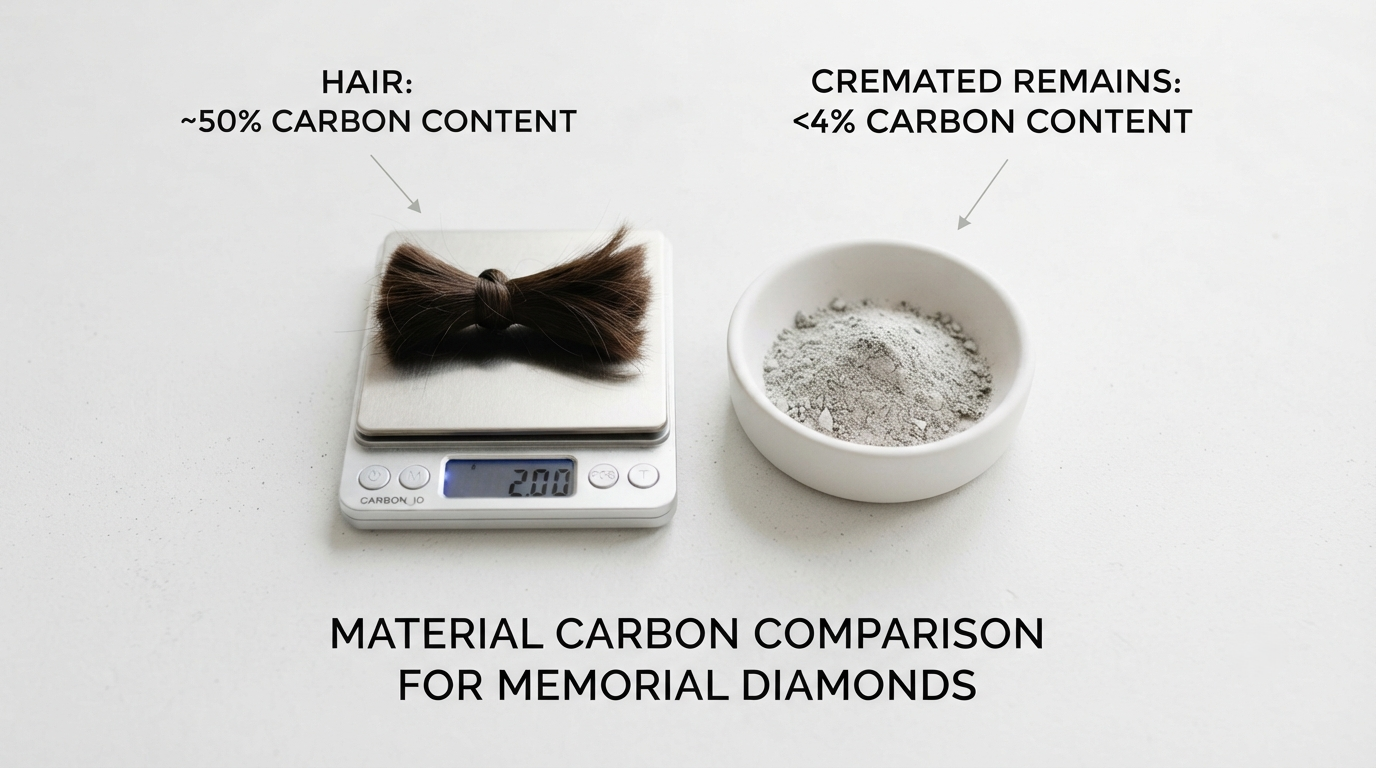
A son hair diamond is a real, lab grown diamond grown from carbon taken out of a sample of your son’s hair, and it requires no cremation whatsoever. Hair is roughly 50% carbon by weight, against the 0.5% to 4% found in cremated remains, which means a small lock does the work that a far larger portion of ash would have to do.
That single difference is why this page stands apart from the ash guide. A son hair diamond is the route that stays open after a burial, after a body donation, where cremation was ruled out on religious grounds, or where it simply was not what your family chose.
Memorial Diamond grows memorial stones, so treat this page as coming from an interested party. The figures below are industry wide bands rather than our own published numbers, and every question this guide tells you to ask is one you should ask us too.
Table of Contents
Why a Son Hair Diamond Needs No Cremation
Most pages about memorial diamonds assume a cremation happened. For a great many families it did not, and that assumption is where the search usually stops.
Hair is keratin, a protein about half carbon by weight, and nothing has to be burned to reach it. Dry keratin at room temperature is remarkably stable, so a sample sealed in an envelope twenty years ago is the same material it was the day it was cut. A son hair diamond is therefore available in situations where the ash route never was:
- He was buried. The grave stays undisturbed; nothing is exhumed and nothing is asked of a cemetery.
- His body was donated to a medical school or research program, and what came back, if anything, was not what you expected.
- Cremation was not chosen, for religious or family reasons, and that decision is not being revisited.
- The remains were scattered somewhere you cannot return to, at sea, from a mountain, into a river he loved.
- The ashes are held by someone else, and you would rather not make it a negotiation.
In all five cases the material for a son hair diamond may already be in your house, and may have been for years.
One thing belongs here rather than three sections down. Hair is a far richer carbon source than ash, and a son hair diamond still is not made entirely of your son. A growth cell takes a set amount of carbon fixed by the carat ordered, and whatever the sample yields is topped up with laboratory carbon.
The widely quoted figure of roughly 10% to 15% is published for the ash route; no equivalent industry figure exists for hair, so ask any provider what share your sample will contribute. What stays true either way is that the personal carbon is real and verifiable, atoms that came out of him, locked in the lattice for good, and a minority of the finished stone. Both halves of that stay true at once.
How Much Hair Does a Son Hair Diamond Take?
A small lock. Industry wide the ask is typically a few grams, between a pencil width bundle and a small curl, not a handful. The reason a son hair diamond needs so much less than the ash equivalent is arithmetic rather than generosity.
| Source material | Carbon content by weight | Typical amount requested | What that means in practice |
|---|---|---|---|
| Cremated remains | About 0.5% to 4% | A few tablespoons up to about 4 oz, approximately 100 g | Most of the submission is bone mineral the laboratory must remove |
| Hair | About 50% | A small lock, a few grams | Most of the submission is the thing the laboratory actually wants |
So a son hair diamond starts from a sample you could close your hand around. An envelope rather than a fresh cutting is usually enough, but weigh it, or photograph it against a ruler, before you assume, because a sample that looks generous sealed can be thin spread out.
Carat does not change this. A two carat stone does not need twice the hair of a half carat one; it needs more weeks in the press. How much hair a memorial diamond requires covers the measuring in more detail than belongs here.
What Counts as a Usable Sample?
More than most parents assume, and the disqualifiers are narrower than the worry.
| Where the hair came from | Usually workable? | What to flag when you ask |
|---|---|---|
| A lock cut and kept years ago | Yes | Age, and whether anything else is in the envelope with it |
| A cutting taken by the funeral home | Yes | Whether it was taken before or after any embalming |
| A hairbrush or comb | Often | That it is mixed, say so rather than hoping |
| A hat, a pillow, a car headrest | Sometimes | Quantity is usually the limit, not condition |
| Hair that was dyed, bleached or treated | Usually yes | Say which treatment; processing strips surface residue anyway |
| A single strand | Rarely enough on its own | Ask before discounting it, it may be combinable |
Two notes that come up constantly. Colored or chemically treated hair is generally fine, because purification strips everything that is not carbon regardless of what was on the strand. And brush sourced hair is real material even though it is mixed, say so at intake rather than letting anyone assume a clean cutting.
What genuinely limits a son hair diamond is quantity, contamination with non organic material, and storage somewhere persistently damp. Describe all three before you send.
Hair Kept From Years Earlier
This is the part of a son hair diamond that catches parents unprepared.
A great many families discover that the sample they have was not kept for this. It was kept for no reason at all, an envelope from a first haircut, a curl taped inside a book, a lock from a hospital stay. Whether your son was six or sixty when he died, that envelope is from one particular afternoon in his life, and it has been waiting in a drawer since.
Two things follow, pulling in different directions.
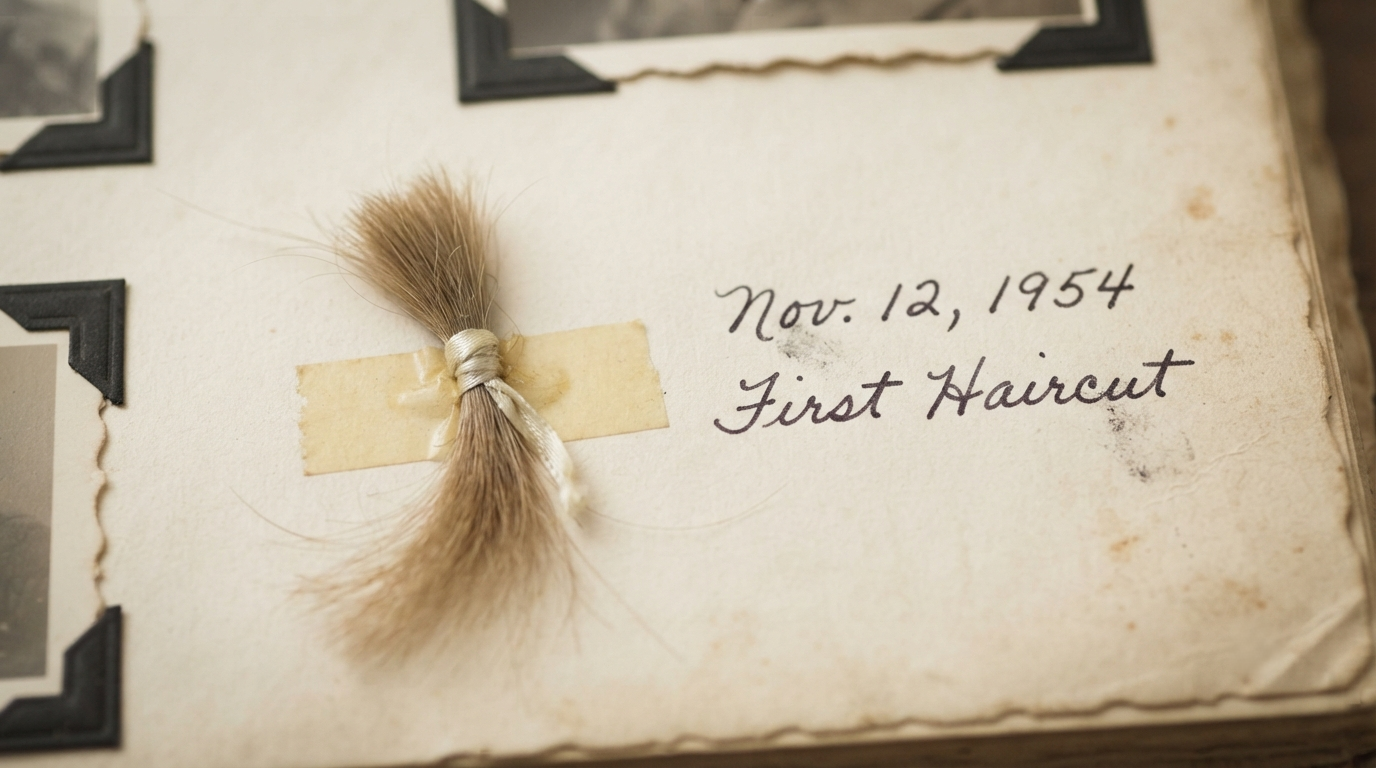
The first is reassuring: age does not degrade a sample in any way that matters. Dry hair kept in paper or a plastic sleeve at room temperature holds its carbon indefinitely, so a son hair diamond grown from a lock cut thirty years ago is chemically no different from one grown last month. Nothing was lost by the waiting.
The second is worth sitting with: choosing a sample is choosing which part of his life the stone comes from. A first haircut envelope and a cutting from his last weeks are identical to a laboratory and not remotely identical to you. Some parents choose the earliest, some the most recent, some send one and keep the other.
There is no correct answer here. What is worth avoiding is settling it in an afternoon because a form asked you to pick, a son hair diamond will wait as long as the sample already has.
What If the Sample Was Never Labeled?
Say so, and then decide on the balance of what you know. Envelopes get filed without writing on them. Baby books hold locks from more than one person. A memory box turns out to contain two curls and no note about which is which, and parents discover it at exactly the wrong moment.
Here is the honest position. Providers do not generally offer DNA verification of a submitted sample. What intake does is chain of custody tracking, the sample is weighed, logged and given a reference number, which follows the parcel from the moment it arrives rather than establishing where it came from before that. Ask any company directly what it does and does not check. In practice, identity rests on that chain of custody and on what you state at intake, so the responsibility does sit with you, and it is better known now than a year from now.
What a son hair diamond leaves you with, then, is ordinary reasoning rather than proof:
- Ask whoever else was there, a sibling, a grandparent, the parent who kept the box. Someone often remembers the handwriting or the year.
- Read the context it was stored in: what else was in the envelope, which page it was taped to, what else is in that drawer.
- Compare color and texture against photographs from the period you think it came from. Not evidence, but information.
- If two samples are both candidates, ask whether both can go into one submission rather than choosing wrongly.
If you genuinely cannot resolve it, name that out loud rather than swallow it. A son hair diamond grown from a sample you are unsure of is still a beautiful object, with a private reservation attached, and only you can judge whether that is bearable.
Who Decides, When There Is No Urn?
A son hair diamond usually sidesteps the hardest legal question in this subject, and it is worth knowing why.
Authority over a person’s remains is assigned by state law rather than by any national rule, and a surviving spouse and then adult children commonly rank ahead of parents in that order, which anything your son put in writing can rearrange again. That framework governs a body and it governs cremated remains. A lock of hair that has been in your own house since long before he died generally sat outside it from the beginning, because it was never part of the remains anyone had to make a decision about.
That is a genuine difference, and for some parents it is the whole reason this route is the one they can actually take.
But do not over read it. If the only sample that exists is one his spouse or his children hold, a cutting taken at the hospital, the contents of his own hairbrush in his own house, then it is theirs, and you are asking rather than deciding. The move there is the same as for ashes: ask directly, early, and for something small. A few grams of hair is a far easier thing to say yes to than any change to what has already been arranged.
The second complication is closer to home. Parents are not always aligned or even in touch; one may hold the envelope while the other wants the stone, and one may be doing all of this alone. There is no rule that a son hair diamond must be a shared decision, and none that it be kept quiet, but deciding in advance beats improvising when asked, and what happens when two family members each want a stone is worth reading before that conversation rather than during it.
Inside the Laboratory: Making a Son Hair Diamond
The sequence for a son hair diamond is shorter than the ash sequence by one demanding step, which is the extraction of carbon from bone mineral. Hair arrives already carbon rich.
| Stage | What happens to the hair | Notes |
|---|---|---|
| Intake | Weighed, logged, given a reference number | Ask for the weight and date the day it arrives, not in a summary later |
| Cleaning | Product, oils and surface residue removed | This is where dye and treatment come off |
| Purification | Carbon driven toward 99.9% or higher purity | Where the ash route does its heaviest work; hair needs less |
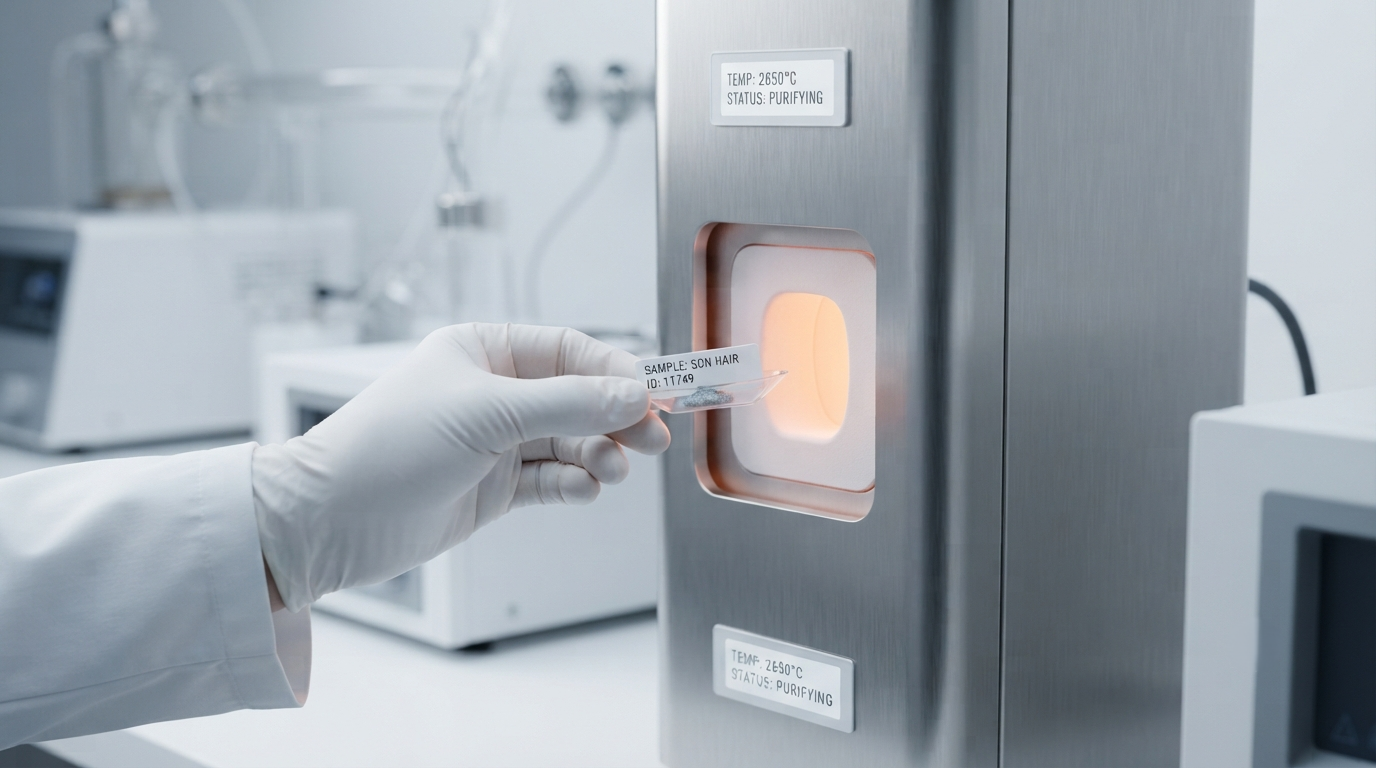
| Graphitization | Purified carbon converted to graphite at roughly 2,500°C to 2,700°C | The last point at which the material is still traceable to your sample |
| Growth | The graphite, with lab carbon added, crystallizes around a seed under 6 to 8 GPa at 1,400°C to 2,500°C | Weeks to months; this is what carat buys |
| Cutting, optional grading, setting | The rough is cut, mounted if you ordered jewelry, and graded if you order grading | Independent grading happens only if you ask for it, on the ordinary diamond scale |
What comes out is a diamond in the full sense, same crystal structure, same behavior, the top of the Mohs hardness scale at 10, scratched by nothing softer than another diamond. It can be set, insured, valued and worn daily. It is not a keepsake with a strand sealed inside it; the strand is gone, and what remains is the carbon that was in it.
Note the fourth row. Everything documentable about a son hair diamond is documented before the growth cell is loaded; after that, no test separates carbon from your sample from any other carbon. The intake record is the record.
How Long Does a Son Hair Diamond Take, and What Does It Cost?
A son hair diamond takes roughly 6 to 10 months industry wide, measured from the day the sample is received rather than the day you order, and stretching toward twelve for a large carat or an unusual color. Hair does not speed it up, press time is press time whatever the carbon came from.
Memorial Diamond publishes no rate card. The bands below are the category’s 2026 shape rather than a quote, and their real use is as a checklist for what a number might quietly leave out.
| Industry band | Carat it usually buys | Ask specifically whether this includes |
|---|---|---|
| About $1,500 to $3,500 | 0.10 to 0.25 ct | An independent grading report |
| About $5,000 to $15,000 | 0.5 to 1 ct | Grading, a fancy cut, engraving |
| About $20,000 to $75,000+ | 2 to 5+ ct | All of the above, the setting, and an insurance appraisal |
A son hair diamond is not priced differently from an ash sourced stone in any structural way. Carat drives the number, then color, then cut, then what is bundled in. The source material is not the variable. What sits inside a memorial diamond quote takes the line items apart properly, and ring, pendant and keepsake settings covers what happens after the stone exists.
What Color Will a Son Hair Diamond Be?
Start by discarding the assumption almost everyone brings. His hair color has nothing to do with it. Dark hair does not produce a dark stone and blond hair does not produce a yellow one. Everything that gave hair its color is removed at the purification stage, long before anything crystallizes.
What actually sets the color is which trace elements happen to be present in the growth cell. Nitrogen in the mix reads as yellow. Boron reads as blue. Colorless is the difficult one, because it is not something added, it is what appears when both of those are very nearly absent, an absence that has to be engineered, which is why colorless generally costs more rather than less. Clarity across the category typically runs somewhere between SI2 and VVS.
So a son hair diamond comes out within a range, steered but not dictated. Before growth starts, get three things settled:
- The color range the provider will put in writing, not the one described on the phone.
- What happens if the finished stone falls outside that range.
- Whether the quote you are holding assumes a tinted stone or a colorless one.
What color a hair grown memorial diamond turns out to be goes deeper into how wide that band honestly is.
Nine Checks Before You Cut or Send Anything
Nine things to have answered, in writing, before a sample leaves the house for a son hair diamond. None of these describes what any particular company does.
- The minimum sample size, and whether that figure is the weight received or the weight still usable after cleaning.
- Whether your sample qualifies as it is, send a photograph against a ruler and a weight before you cut anything else.
- Whether a mixed or unlabeled sample changes anything, stated openly at intake rather than left to be assumed.
- What happens to hair the process does not consume, returned, retained, or destroyed.
- Whether the intake record reaches you at intake: date, weight, reference number, on the day.
- Whether growth is done in house or subcontracted, and how custody is recorded at that handover.
- The committed color range, and the remedy if the stone lands outside it.
- Whether an independent grading report is included or priced separately.
- Whether a second stone could be grown later from the remainder, if a sibling or his own family may want one. Far easier to settle now than to reopen in a year.
If you are weighing this against the cremated remains route, the complete guide to a son ashes diamond sets out that pathway on its own terms, and the guide to sending both covers what combining them does and does not change.
Frequently Asked Questions
Is hair from thirty years ago still usable?
Yes. Dry hair stored at room temperature holds its carbon indefinitely, so a son hair diamond grown from a first haircut envelope is chemically no different from one grown from a recent cutting. Mention the age when you ask, but do not treat it as a barrier.
He was buried. Does any of this require the grave?
No. Nothing about a burial changes, nothing is exhumed, and no cemetery permission is involved. That is the practical reason a son hair diamond exists as a separate route, the material is hair you already have, entirely outside the grave.
Will the stone match the color of his hair?
No. Purification removes everything that gave hair its color before growth begins. The finished shade comes from trace elements in the growth cell, nitrogen toward yellow, boron toward blue, not from whether he was fair or dark.
We have two unlabeled envelopes and cannot tell them apart. What now?
Say so when you ask. Some providers will accept both samples in one submission rather than making you choose. If not, weigh what you know, who kept the box, what else was in the drawer, and decide with your eyes open rather than guessing silently.
Can we use hair from his hairbrush?
Often yes, and it is worth asking rather than discarding it. Flag that it is mixed with other people’s hair, because that is honest and because the provider may handle a son hair diamond differently when the sample is not a clean cutting.
Can more than one stone come from one lock?
Sometimes, provided each half would still clear the minimum by itself. Ask first, because splitting a barely sufficient sample between two orders is the commonest way a workable submission stops being one.
Final Thoughts on a Son Hair Diamond
The thing worth carrying away is the one this guide opened with: no cremation is required, and never was. If your family buried him, donated him, scattered him somewhere unreachable, or made a decision nobody is revisiting, the door is still open, and what it opens onto is probably already in a drawer in your house.
That envelope has waited a long time without deteriorating, and it can wait longer. A son hair diamond is not a decision that expires. Weigh the sample, ask the nine questions, and talk to whoever else has a claim on the answer, or deliberately decide not to yet.
Then, when you are ready and not before: a small lock, six to ten months, and a stone you can wear.
Learn More About Son Memorial Diamonds
- How to Turn Your Son’s Hair Into a Diamond
- Son Ashes Diamond: The Complete Guide
- Son Ashes and Hair Diamond: The Complete Guide
- What Color Will a Diamond Made From Hair Be?
- How Much Hair Do You Need for a Memorial Diamond?
Talk With Memorial Diamond
You do not have to cut anything or commit to anything to find out whether what you have is enough.
The useful first message is short: a photograph of the sample beside a ruler, an approximate weight, a line about where it came from and roughly when, and a note if it is mixed or unlabeled. That is enough for anyone to say whether a son hair diamond is possible from what is in that envelope. While you are asking, find out what becomes of hair the process does not use, and roughly how long the carat you are imagining would sit in the press.
memorialdiamond.us replies to both without asking for a decision, and any provider worth using will do the same. The envelope goes back in the drawer either way.
Leave A Comment