
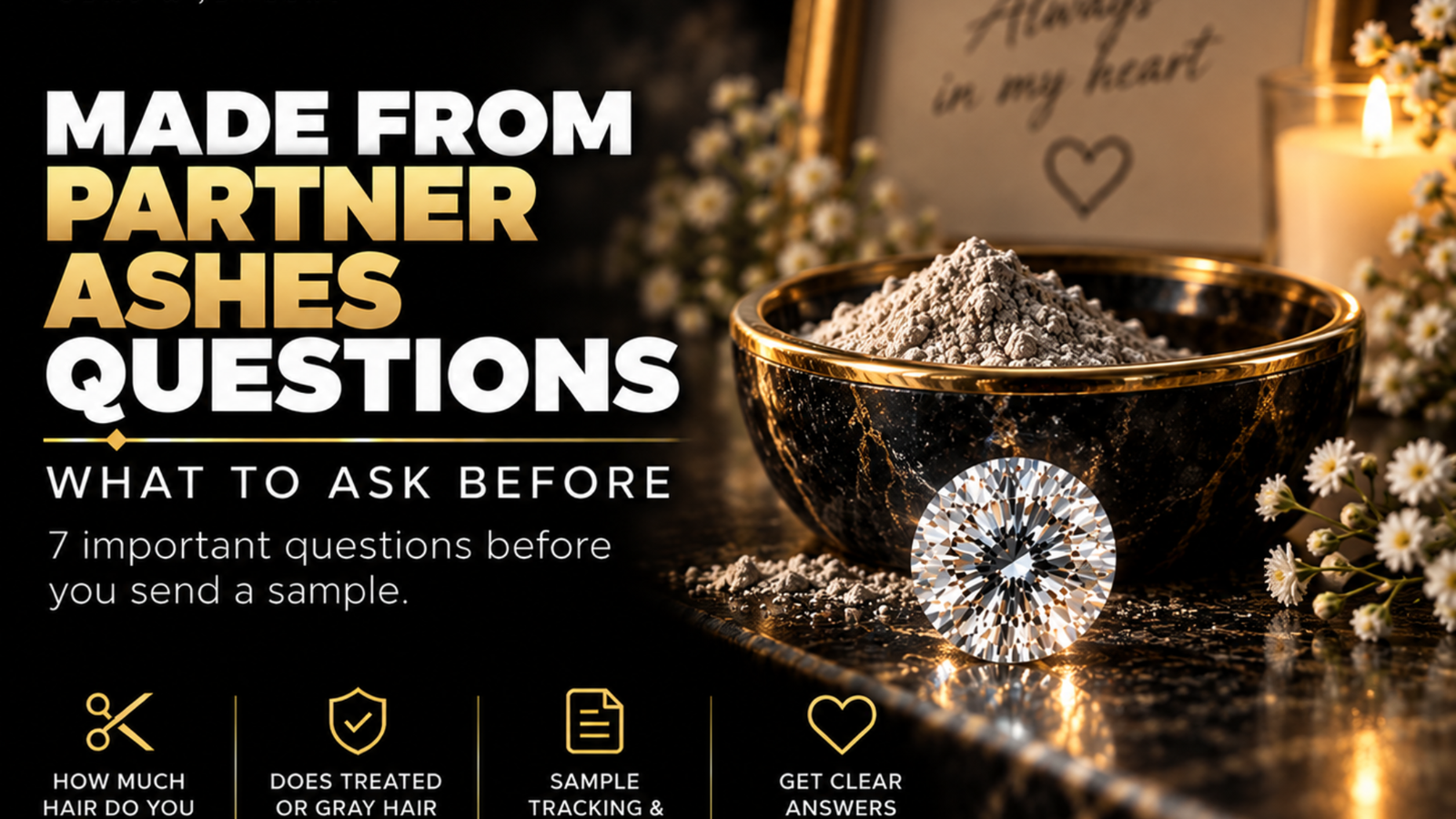
The paperwork runs out eventually, and then the decisions that are genuinely yours begin.
A memorial diamond made from partner ashes is real. The small fraction of carbon inside cremated remains, roughly 0.5% to 4% of ash by weight, is extracted, purified to around 99.9% carbon, converted to graphite at about 2,500 to 2,700°C, and grown into a diamond crystal under something like 6 to 8 GPa of pressure. Seven stages, typically six to ten months industry wide.
What follows is what physically happens to a memorial diamond made from partner ashes at each of those stages, and the part most descriptions skip, exactly where the step sits that cannot be taken back.
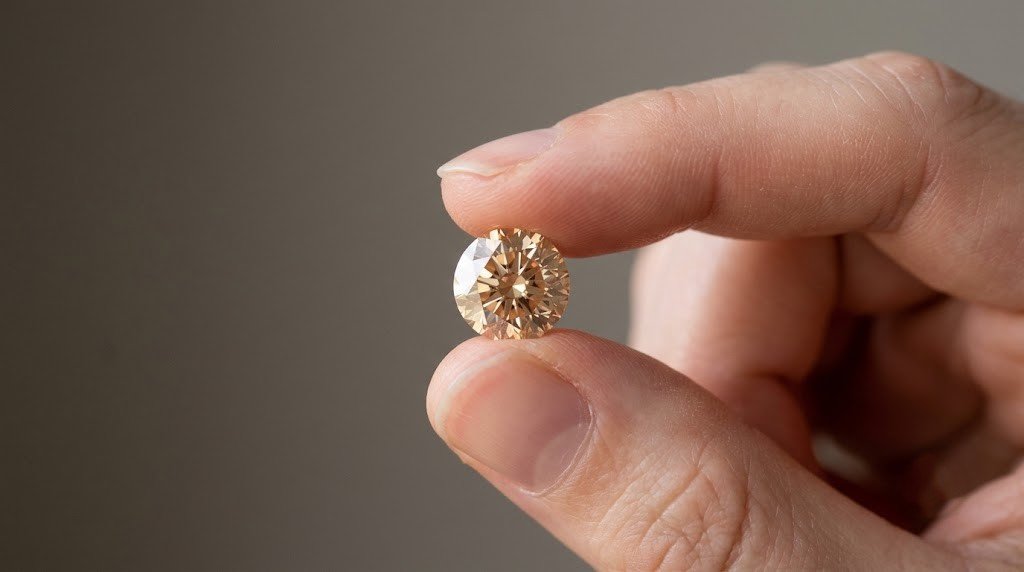
Table of Contents
What Is Actually in the Ashes You Would Be Sending?
Cremated remains are not ash in the campfire sense. What survives a cremation is mostly bone mineral, calcium phosphate, ground to a uniform grit. The soft tissue, and with it most of the body’s carbon, leaves as gas during the cremation itself.
That is why every honest description of a diamond made from partner ashes starts with a percentage rather than a promise. Industry figures put the usable carbon in cremated remains at roughly 0.5% to 4% of the ash by weight, varying with the individual and with how the cremation was run. A few tablespoons of remains contain a genuinely small quantity of recoverable carbon, and that quantity is the raw material a diamond made from partner ashes has to be built from.
This single number explains almost everything else about the process. It explains why a lab asks for a measured portion rather than a pinch. It explains why the extraction stage is long and fussy. And it explains why a stone made from partner ashes is never grown from that carbon alone.
None of that makes the carbon less real. It was in your partner, and it was recovered from what remained of them. But knowing the scale now is better than finding it on a forum in month four.
The Seven Stages of a Memorial Diamond Made From Partner Ashes
The chain is the same across the industry, whatever the marketing language around it. A memorial diamond made from partner ashes passes through these seven stages, in this order.
1. Intake and identification. The portion of ashes arrives, is weighed, and is assigned an identifier that travels with the material through every later stage. Ask what that identifier is and how it is recorded. This is the document that ties the finished stone back to what you sent, and the backbone of any later claim that the stone was made from partner ashes rather than from something substituted along the way.
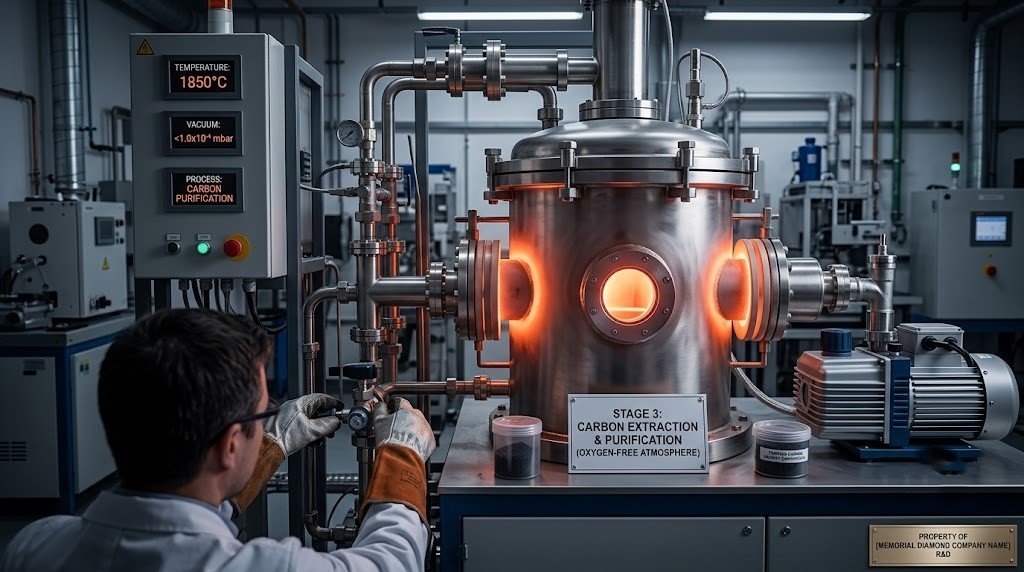
2. Carbon extraction. The remains are heated in a controlled, oxygen free environment so the carbon can be separated without simply burning away. Because a diamond made from partner ashes starts from a material that is only a few percent carbon by weight, this is the stage where most of the submitted mass is removed as mineral residue rather than kept.
3. Purification. The extracted carbon is refined through further stages until it reaches roughly 99.9% or higher carbon purity. Anything left behind at this stage, such as stray minerals or metals from an implant or a casket fitting, will otherwise show up as an inclusion or a color cast in the crystal.
4. Graphitization. The purified carbon is heated to roughly 2,500 to 2,700°C and rearranged into graphite, the crystalline form of carbon that a diamond press can actually use as feedstock. The material that goes into the press for a diamond made from partner ashes is graphite, not ash.
5. Growth. The graphite, combined with supplemental lab grown carbon, is loaded into an HPHT growth cell around a tiny diamond seed and held at roughly 6 to 8 GPa and 1,400 to 2,500°C for weeks to months. Carat size is a function of how long the cell runs, not how much ash you sent.
6. Cutting, polishing, and optional treatment. The rough crystal is cut and polished to a chosen shape. Some providers offer post growth irradiation to shift or intensify color. Ask whether that is being done and whether it will be disclosed on the paperwork.
7. Grading. The finished stone is measured against the same cut, color, clarity, and carat standards used for any diamond, ideally by an independent third party laboratory rather than in house. A stone made from partner ashes is assessed on exactly the same scale as any other diamond, with no separate or softer standard.
Where Is the Point of No Return?
This is the question worth sitting with. For a diamond made from partner ashes the honest answer is that there are two of them, one physical and one domestic, and the domestic one comes first.
The physical point of no return is the extraction furnace, stage two. Up to the moment that furnace is sealed, what a lab holds is still cremated remains. They can be weighed, sealed, and sent back. Once extraction begins, the calcium phosphate is separated off and the carbon is chemically committed. There is no process that reverses a diamond made from partner ashes back into ash. Everything after stage two, including purification, graphitization, growth, and cutting, is refinement of a decision already made.
The domestic point of no return is earlier and quieter. It is the afternoon you open the container and measure a portion out. That act is not reversible either, and it happens at a kitchen table rather than in a lab, usually without anyone present to say “are you sure.” A lab can return an unopened portion. Nobody can return the specific handful you scooped.
So the practical sequence is this. Decide who is involved and whether anyone else in your partner’s life would want to be asked before anything is divided. Decide the carat and the color, because those are cheap to change on paper and impossible to change once a growth run has started. Decide what happens to the ashes that are not used, since a diamond made from partner ashes typically consumes only a fraction of a full cremation. Then portion.
A third, softer boundary sits at stage five. Once the growth cell is sealed, the size you chose is the size that is growing, and changing your mind means starting over. Ask when the specification locks. That timing varies.
What You Can Still Change at Each Stage
| Stage | What Is Physically Happening | Reversible? | What You Can Still Change |
|---|---|---|---|
| 1. Intake | Portion weighed, logged, identified | Yes. Unprocessed material can be returned | Everything, including carat, color, shape, and whether to proceed |
| 2. Extraction | Carbon separated from bone mineral | No. This is the physical point of no return | Carat, color, shape, setting |
| 3. Purification | Carbon refined to approximately 99.9% or higher | No | Carat, color, shape, setting |
| 4. Graphitization | Carbon converted to graphite at 2,500 to 2,700°C | No | Carat and color, if not yet locked. Ask when the lock happens |
| 5. Growth | Crystal built around a seed at 6 to 8 GPa | No. The run is committed once sealed | Shape, polish, setting, engraving |
| 6. Cutting | Rough crystal shaped and polished | Shape choices are one way once cut | Setting, engraving, whether to set it at all |
| 7. Grading | Independent assessment of the 4Cs | Not applicable | Nothing about the stone. Only what you do with it |
Read that table as a calendar for a diamond made from partner ashes rather than as a warning. Nearly every decision that costs money or changes the stone’s appearance is open for the first two stages and closed after the fourth. It is a narrow window, earlier than most people expect.
Why Lab Carbon Is Added to a Diamond Made From Partner Ashes
No stone is grown from ash carbon alone, and any description that implies otherwise is describing something that does not exist. What comes out of purification is a small quantity of carbon, real and really your partner’s, which is then topped up with lab grown carbon until the growth cell holds the volume a crystal of the chosen size actually needs.
That is arithmetic, not a policy any one company invented. A gram or two of recovered carbon cannot become a one carat crystal, so the feedstock charge is made up to volume.
The framing that survives scrutiny is the accurate one. A diamond made from partner ashes is not a symbol of your partner and it is not a stone that is entirely them. It is a crystal that contains, verifiably, carbon that was part of a person, grown into a lattice that exists because they did. That claim holds up to a skeptical relative, a jeweler, and a gemologist, and it is the reason these stones are genuine diamonds rather than lookalikes. “One hundred percent pure” does not.
Every honest account of a diamond made from partner ashes carries that qualification somewhere in it. If a provider will not put the blend in writing, that is worth noticing. The honesty of the answer to this question is a reasonable proxy for how the rest of the work is done.
How Long Does Each Stage Take?
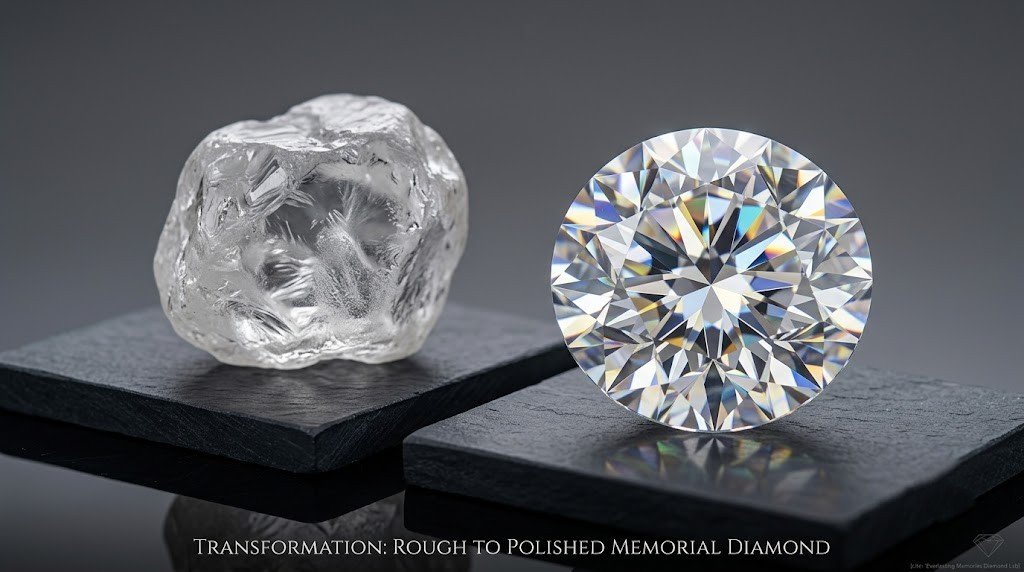
Industry wide, the full sequence for a diamond made from partner ashes typically runs six to ten months, with larger stones or specialty colors sometimes reaching twelve. The stages are wildly uneven in length, which is why the wait feels longer than the number suggests.
Intake, extraction, purification, and graphitization are usually measured in weeks. Growth is the long part, with weeks to months in the press, because carat size is bought as time under pressure, not as a quantity of ash. Cutting, polishing, and grading add several more weeks, and an independent laboratory has its own queue.
Two things make a stone made from partner ashes take longer than a quoted range. One is size. Larger crystals need proportionally longer runs and are more likely to fail during a run and need restarting. The other is a color specification that requires the trace elements to be engineered out rather than accepted.
Ask for the stage you are currently in rather than a completion date. A provider that can tell you “purification finished, cell loading next week” is telling you something real. A provider that only repeats the original estimate is telling you nothing.
Can a Diamond Be Made From Partner Ashes Years Later?
Yes, and this is more common than the timing of most bereavement content suggests. Cremated remains do not decay, spoil, or lose their carbon on a shelf. A portion kept in a closet since 2014 is chemically the same material it was the week it came home, and a diamond made from partner ashes that have sat for a decade goes through the same seven stages as one started the month after the funeral.
That matters for a very ordinary reason. The first year after a death is a terrible time to make a permanent decision, and plenty of people only arrive at this question once the urgent part is over. Nothing has been lost by waiting.
There are two practical differences worth knowing. The first is contamination. Remains that have been transferred between containers, stored somewhere damp, or opened repeatedly can pick up material that was never part of your partner, and purification removes non carbon contaminants rather than sorting one person’s carbon from another’s. Ask what the intake check looks for, and mention the storage history honestly.
The second is interment. If the remains were buried, entombed, or scattered, a diamond made from partner ashes may no longer be open to you. Disinterment rules vary by state and by cemetery. Hair is worth asking about instead, since it needs no cremation and a lock kept in an envelope is frequently still usable.
One thing time does not change is standing. Whoever had authority over the remains still has it. Keeping the urn for eight years does not confer it.
What to Settle Before the Ashes Leave Your Hands
These are the items that become expensive or impossible to revisit once stage two begins.
- Who has standing to authorize this. There is no single national rule here. The state you are in sets who may direct what happens to a person’s remains, and written instructions your partner left behind can move that authority somewhere else again. Being someone’s partner does not by itself put you in that position. Sort this before you divide anything. An order for a diamond made from partner ashes is far easier to place than to unpick.
- Whether anyone else should be asked first. Not consulted, necessarily. Asked. This is a social decision with a physical deadline attached.
- How much of the remains you are prepared to commit. Requirements vary by provider, but a memorial diamond typically uses only a fraction of a full cremation, which means the rest can still be buried, scattered, or kept exactly as planned.
- Carat and color, chosen deliberately. Both are locked early and both drive cost and timeline more than anything else.
- Whether a second stone might be wanted later. Growing two from one shared portion is usually far simpler than reopening the question in three years.
- What documentation you want to exist. An identifier at intake, a record at each handover, and a clear statement of what is being returned to you at the end.
If you are still deciding between materials, it is worth knowing that hair does not require cremation at all and carries far more carbon by weight. It is a different route to the same kind of stone, and one that stays open even if the remains are already interred.
Frequently Asked Questions About a Memorial Diamond Made From Partner Ashes
How much of the finished stone is actually my partner?
A real but minority portion. A diamond made from partner ashes contains carbon recovered from the remains, purified and then combined with lab grown carbon to reach a workable volume, so the personal fraction is meaningful and verifiable rather than total. Ask for that split in writing.
Can the process be stopped once the ashes have been sent?
Until extraction begins, yes. Unprocessed remains can be returned. After the extraction furnace is sealed, the carbon is chemically committed and nothing reverses it. That stage is the true point of no return, and it comes early.
Does sending more ashes make a bigger diamond?
No. The size of a diamond made from partner ashes is set by how long the crystal grows in the press, not by how much material you submitted. Sending a full urn does not produce a larger stone or a faster result. It only commits more of the remains.
What color will it be?
Most stones made from partner ashes trend yellow, blue, or champagne, because nitrogen and boron traces come with an organic carbon source. Colorless requires engineering both out and typically costs more. Nobody can forecast a precise shade in advance.
Will it be certified as a real diamond?
A memorial diamond is chemically and optically a genuine diamond and can be graded on the same 4Cs as any other. Ask whether grading is done by an independent third party laboratory and whether that report is included or priced separately.
Can two people each have a stone from the same ashes?
Often yes, because only a portion of the remains is used for any one stone. Deciding that before submitting is far easier than revisiting it later, when a second portion may mean opening the container again.
Final Thoughts on a Memorial Diamond Made From Partner Ashes
The chain that produces a memorial diamond made from partner ashes is genuinely impressive, but it is not the part that matters most on the day you have to choose. What matters is knowing that the reversible part of this is short, that it sits at the beginning, and that the decisions inside it are yours to take slowly.
Ask the percentage question. Ask when the specification locks. Ask what comes back to you at the end. A provider comfortable answering all three plainly is showing you something more useful than any photograph of a finished stone.
Learn More About Partner Memorial Diamonds
- Partner Ashes Diamond: The Complete Guide
- How to Turn Your Partner’s Ashes Into a Diamond
- Is a Memorial Diamond Really Made From Your Partner’s Ashes?
- How a Memorial Diamond Is Made From Your Partner’s Ashes and Hair
- What Is a Memorial Diamond? The Complete Guide
Talk With Memorial Diamond
If you want to understand what is possible with the ashes you have, reach out to Memorial Diamond and ask about the process, the documentation, and the timeline before committing to anything. Nothing here has to be rushed.
Leave A Comment