
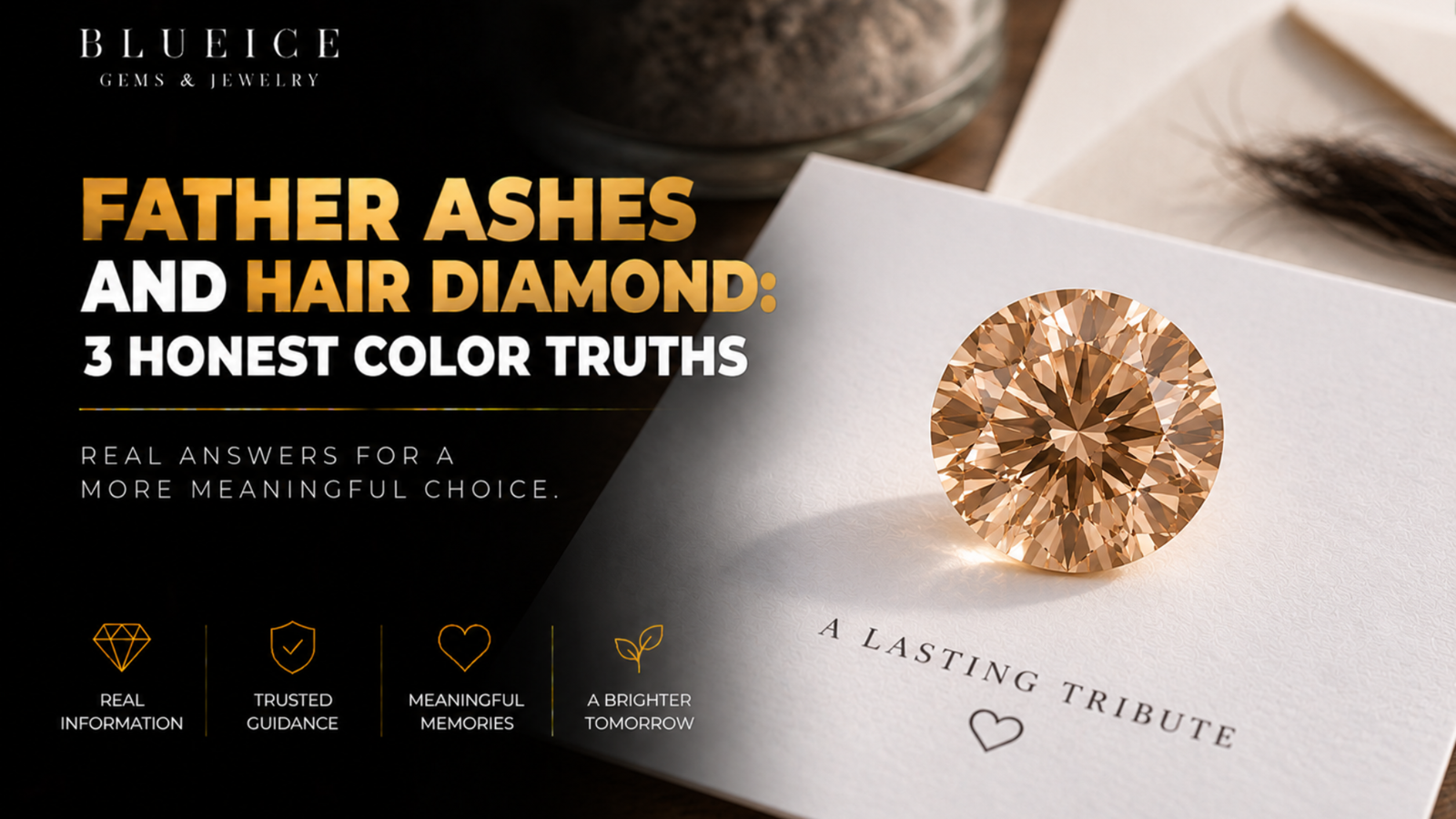
Two materials going into one stone invites a picture: a boundary, a swirl, two tones meeting somewhere in the middle. The stone that comes back has none of that.
A father ashes and hair diamond is a single crystal in a single color, most often yellow, champagne, or blue, or colorless with extra processing. It is not an average of an “ashes color” and a “hair color,” because neither material has one. Both materials are reduced to pigment free carbon before growth, and the stone’s color is set by trace nitrogen or boron in the growth cell, exactly as it would be for either material alone.
Memorial Diamond takes combined ashes and hair orders, so this is a seller explaining a seller’s product. That is the reason to read skeptically, and the reason it tries to earn the read.
What Does a Father Ashes and Hair Diamond Actually Look Like?
Like any other memorial diamond. One even tone throughout, no seam, no gradient, no visible sign that two sources were used. Under a loupe a gemologist will see inclusions and growth features the way they would in any lab grown stone, and nothing that says “ashes here, hair there.”
That is because the two materials stop being two materials before growth begins. Cremated remains go through extraction to remove calcium phosphate and everything else that is not carbon. Hair goes through extraction to remove the non carbon parts of keratin. Each ends as carbon at roughly 99.9% purity. Whatever the two materials contribute, supplemental lab carbon makes up the balance of the growth feedstock, and the finished crystal is genuinely, partially his rather than purely so.
Once blended and grown, every carbon atom in the lattice is the same element in the same structure, whichever container it came from. A father ashes and hair diamond therefore does not display separate visual sections for the two sources.
The three colors most families end up with, yellow, champagne, blue, and the one they can pay extra for, colorless, are the same four available for a father ashes and hair diamond as for any single source stone.
Why the Color Is Not an Average of the Two
An average needs two values to average. Neither ashes nor hair has a “color” in the sense that matters here.
Ashes are gray because of minerals that are removed in extraction. Hair is brown or gray because of melanin, which is also removed. By the time either material is carbon, it is black powder with no pigment, and black carbon powder from ash and black carbon powder from hair are indistinguishable. There is nothing for the stone to split the difference between.
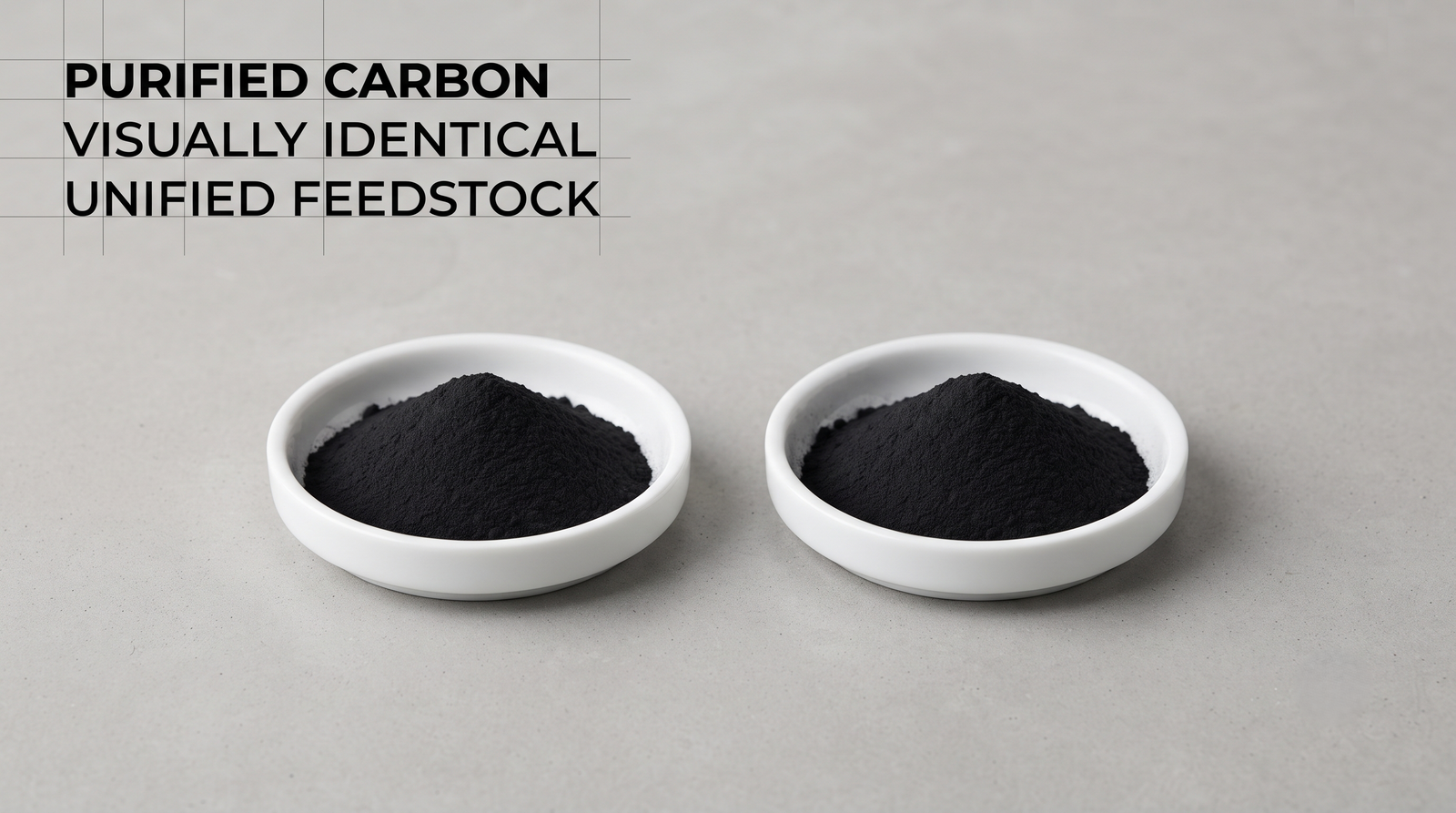
What sets the color is what was in the growth cell besides carbon: nitrogen tints yellow, boron tints blue, and neither gives colorless. Carbon recovered from organic sources tends to carry a little nitrogen along, which is why the whole category leans warm. A combined feedstock is not more or less prone to that than a single one; the chemistry does not know the carbon had two origins.
This means a father ashes and hair diamond does not become a mixture of two visible colors. The final color comes from the growth environment and trace elements rather than the original appearance of the ashes or hair.
For additional information about how diamond quality and grading work, see the GIA Diamond Quality Factors.
Which of the Two Actually Contributes More?
By carbon, hair, by a wide margin per gram. Hair is roughly 50% carbon by weight. Cremated remains yield somewhere between 0.5% and 4%. A lock the size of a fingertip can outweigh, in usable carbon, a considerably larger quantity of ash.
| Material | Approximate carbon yield | What that means in a combined order |
|---|---|---|
| Hair | About 50% by weight | Small samples yield a lot; usually the larger carbon contributor |
| Ashes | About 0.5% to 4% by weight | Larger samples yield little; usually the smaller contributor |
| Lab carbon | Added to reach growth volume | Makes up the balance; the finished stone is typically 10% to 15% personal carbon or less |
None of this shows in the color, and this is the point families sometimes want and cannot have: a father ashes and hair diamond does not come out “more hair colored” because more of its personal carbon came from hair.
The contribution ratio lives in the provider’s records, if they itemize it, and nowhere else. Ask whether they do; it is a fair question and not every provider answers it the same way.
Does Combining Make the Shade Harder to Predict?
No harder than usual, and “usual” already includes some uncertainty. No provider can promise an exact tone before growth for any memorial diamond; trace element levels vary run to run, and two stones ordered as “yellow” can differ in depth.
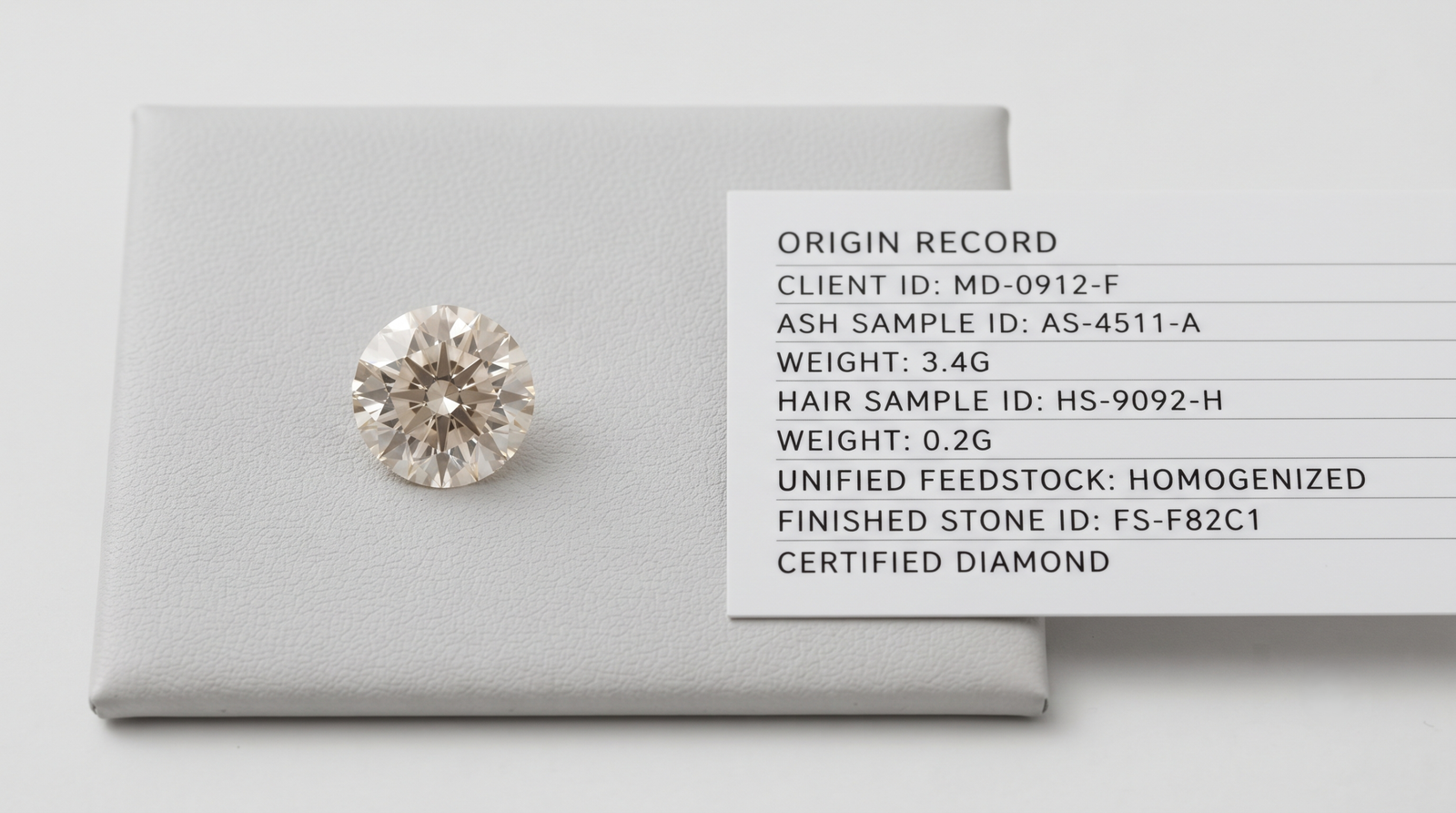
Combining does not add to that variance in any meaningful way, because the feedstock is homogenized before it goes into the press.
What combining does add is a second record to check. If exact shade matters, such as a match to an existing family piece, or two sibling stones that need to sit together, say so before growth, and ask how the provider handles it.
Selection from a run is the usual method; guaranteed identical shade in advance is not something an honest provider offers.
The colors page for a father goes into what a provider’s color words do and do not promise.
What to Settle Before You Order
Three decisions, and none of them is about the ashes or the hair:
- Who keeps the stone and what it goes into. Metal shifts every tint: a yellow stone deepens in yellow gold and reads faintly off white against platinum, while blue and colorless hold steady in any setting. Decide the piece before the shade.
- Grown color or treated color. Yellow, champagne, blue, and colorless are grown; red, pink, green, and black are typically post growth irradiation. Ask which is which on the provider’s menu, and know that a treated color is a treatment, not a reflection of either material.
- What you want written down. For a combined order, ask whether the origin record itemizes each material’s contribution and whether the color is described using a standardized grading scale or the provider’s own words. A father ashes and hair diamond has two chains of custody; make sure the paperwork reflects both.
Frequently Asked Questions
Could the Stone Come Out Two Toned, or Show a Boundary?
No. The ash derived and hair derived carbons are blended into one feedstock before growth, and the crystal grows as a single, uniform lattice. There is no boundary because there is nothing left to mark one; a combined stone looks exactly like a single source stone of the same color.
Would Sending More of One and Less of the Other Change the Color?
No. The proportions change what the provider’s records say about contribution, not the tint. Color is set by trace nitrogen or boron in the growth cell, and the feedstock is homogenized before growth, so the ratio of ash carbon to hair carbon has no visible effect on a father ashes and hair diamond.
Does His Hair Color Affect It, If the Hair Went Gray?
No. Melanin, the pigment that makes hair brown, black, or red, is removed during carbon extraction along with everything else that is not carbon. Gray hair has less melanin, not less carbon, so a gray lock contributes the same pigment free carbon a dark one would.
Is a Combined Stone More Likely to Be Colorless?
No. A colorless crystal needs a growth cell free of nitrogen and boron, and keeping them out is a separate processing step whatever the carbon’s origin. Two organic sources neither help nor hurt that; if you want colorless, order it explicitly and expect it to cost more at the same carat.
Can Two Combined Stones for Two Siblings Be Matched?
Approximately, and only by asking before growth. Trace element levels vary between runs, so two stones ordered in the same color can differ slightly in depth. Providers who match siblings typically select from the same run; ask what the provider can and cannot promise in writing.
Does the Color Say Anything About Which Material Contributed More?
Nothing at all. Hair contributes far more carbon per gram than ashes, but that ratio is invisible in the finished stone. If knowing the contribution matters to you, it has to come from the provider’s origin record. Ask whether they itemize it, because a father ashes and hair diamond will not tell you by its shade.
Final Thoughts on the Color of a Father Ashes and Hair Diamond
The picture of two tones meeting is a natural one, and letting it go is part of understanding what the stone actually is.
A father ashes and hair diamond is one crystal, one color, grown from carbon that no longer remembers which container it arrived in.
The color will suit the ring or the pendant, or it will not, and that is decided by the metal and the person who wears it, not by the ashes, not by the lock.
Where the two sources still exist as two is in the paperwork, and that is worth asking for. The combined question about whether the diamond is really made from both sources is where that record is described.
Learn More About Father Memorial Diamonds
- Father Ashes and Hair Diamond: The Complete Guide
- What Color Will a Diamond Made From Your Father’s Ashes Be?
- What Color Will a Diamond Made From Your Father’s Hair Be?
- Memorial Diamond Colors for a Father: What to Expect
- How Much Ash and Hair Do You Need for a Father Memorial Diamond?
Talk With Memorial Diamond
If you are planning a combined order and want to know what color is realistic for the piece you have in mind, reach out to Memorial Diamond.
Ask which colors are grown and which are treated, and whether the origin record for a father ashes and hair diamond will itemize both materials.