
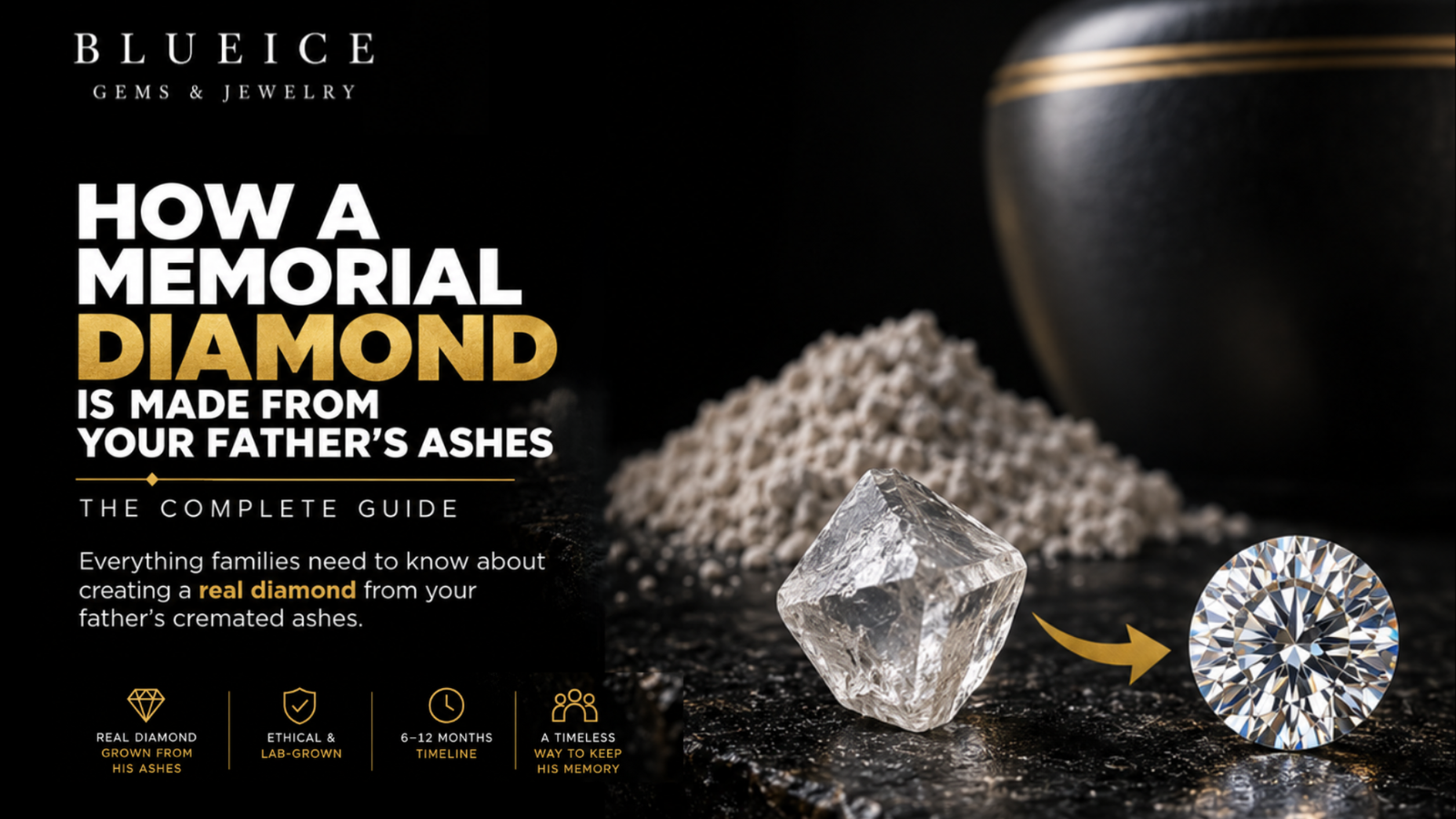

The container from the crematorium is heavier than many people expect. Between that container and a finished diamond in a presentation case sits a carefully controlled chain of laboratory processes.
A memorial diamond made from your father’s ashes begins with a measured portion of cremated remains. The laboratory separates and purifies the carbon, converts that carbon into graphite, prepares the growth material, and creates a genuine diamond crystal under extreme pressure and temperature.
Almost every stage removes something. Understanding what leaves the material, what carries forward, and what happens during diamond growth makes the entire process easier to understand.
In This Article
- What Is Actually in the Cremation Container?
- Which Stages Remove Something, and Which Stage Adds?
- How Is His Carbon Separated From the Bone Mineral?
- Why Is Lab Carbon Added to His?
- What Happens Inside the Growth Press?
- What Varies From One Father to the Next?
- What Comes Back to You Besides the Stone?
- Frequently Asked Questions
- Questions Worth Asking a Lab Directly
What Is Actually in the Cremation Container?
Cremated remains are not ash in the campfire sense. This distinction sets up every stage that follows.
After cremation, the remains consist primarily of mineral material associated with bone, including calcium phosphate. Carbon represents only a small portion of the material that remains after the cremation process.
Industry figures place usable carbon at roughly 0.5% to 4% of cremated remains by weight. The exact amount can vary between individuals and can also vary with the cremation process.
That creates the laboratory’s first challenge. The process does not begin by manufacturing a diamond. It begins by finding and separating a small carbon fraction from a much larger amount of mineral material.
If you want to understand the amount of material families may need to submit, speak directly with the laboratory about its current requirements before sending your father’s ashes.
Which Stages Remove Something, and Which Stage Adds?
It helps to look at the process as a ledger rather than simply a timeline. Each stage has a specific job, and most stages remove material or transform what already exists.
| Stage | What Is Removed or Changed | What Carries Forward |
|---|---|---|
| Intake and inspection | Non-biological material and anything that should not enter the process | A measured and documented portion of the submitted material |
| Extraction and purification | Mineral material and other unwanted components | Purified carbon |
| Graphitization | Original molecular structures | Graphite, a crystalline form of carbon |
| Blending | Nothing is removed | Prepared carbon feedstock |
| Diamond growth | Nothing is intentionally removed | A rough diamond crystal |
| Cutting and polishing | Rough material | The finished diamond |
| Grading | Nothing from the stone | A documented assessment of diamond characteristics |
The key point is that the material changes substantially before it becomes a diamond. The laboratory first separates and purifies the useful carbon, then prepares that carbon for controlled crystal growth.

How Is His Carbon Separated From the Bone Mineral?
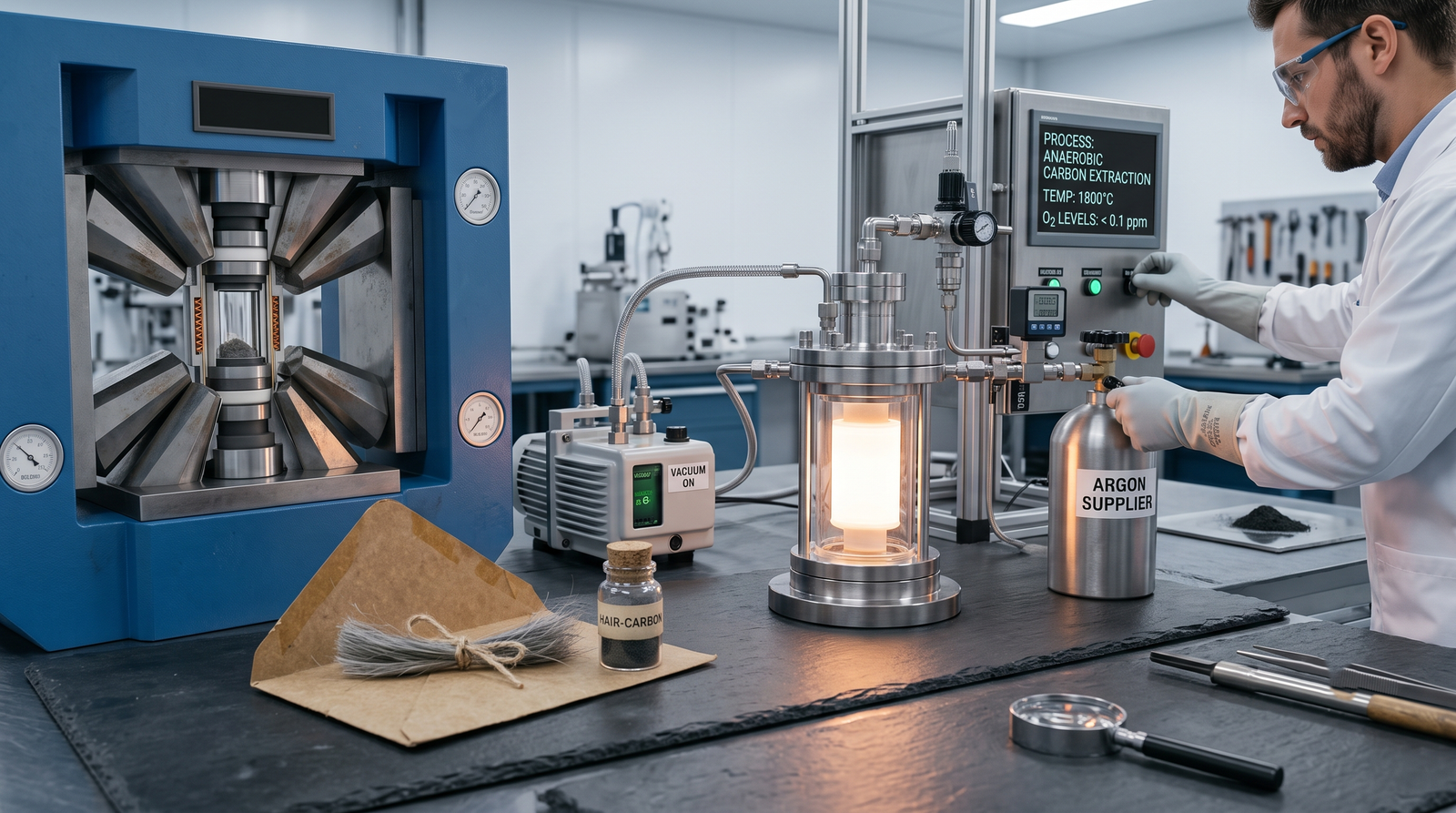
Ordinary burning cannot provide the controlled conditions required for carbon recovery. When carbon reacts with oxygen at high temperatures, it can leave as carbon dioxide. The laboratory therefore needs an oxygen-free environment during the extraction process.
Controlled, sealed heating allows the laboratory to remove much of the unwanted mineral material while retaining the carbon needed for the next stage.
After extraction and purification, the recovered carbon can reach approximately 99.9% or higher carbon purity, according to the process description used for this article.
The purified carbon then moves into the graphitization stage.
At this point, the laboratory has not created a diamond. It has prepared a much purer carbon source that can enter the next stage of the process.
Why Is Lab Carbon Added to His?
The amount of carbon recovered from cremated remains is relatively small. If the laboratory needs additional feedstock for a growth run, it may combine the recovered carbon with laboratory-sourced carbon.
The process brief used for this article describes the personal carbon fraction as typically representing approximately 10–15% of the finished stone’s mass, depending on factors such as stone size and the amount of material submitted.
This distinction matters when you evaluate claims about a memorial diamond. A provider should clearly explain whether it adds supplemental carbon, how it handles the personal carbon fraction, and what it can document.
The source process described for this article treats blending as the only additive stage. The carbon recovered from your father’s remains carries forward into the prepared feedstock, while any additional laboratory-sourced carbon provides the quantity required for the growth process.
Because BlueIce Gems’ current public Memorial Diamond page makes a different claim about using 100% of the loved one’s ashes or hair and not adding generic carbon, confirm the current BlueIce Gems production policy before publishing this section as a company-specific statement.
What Happens Inside the Growth Press?
The diamond-growth stage turns prepared carbon into a diamond crystal.
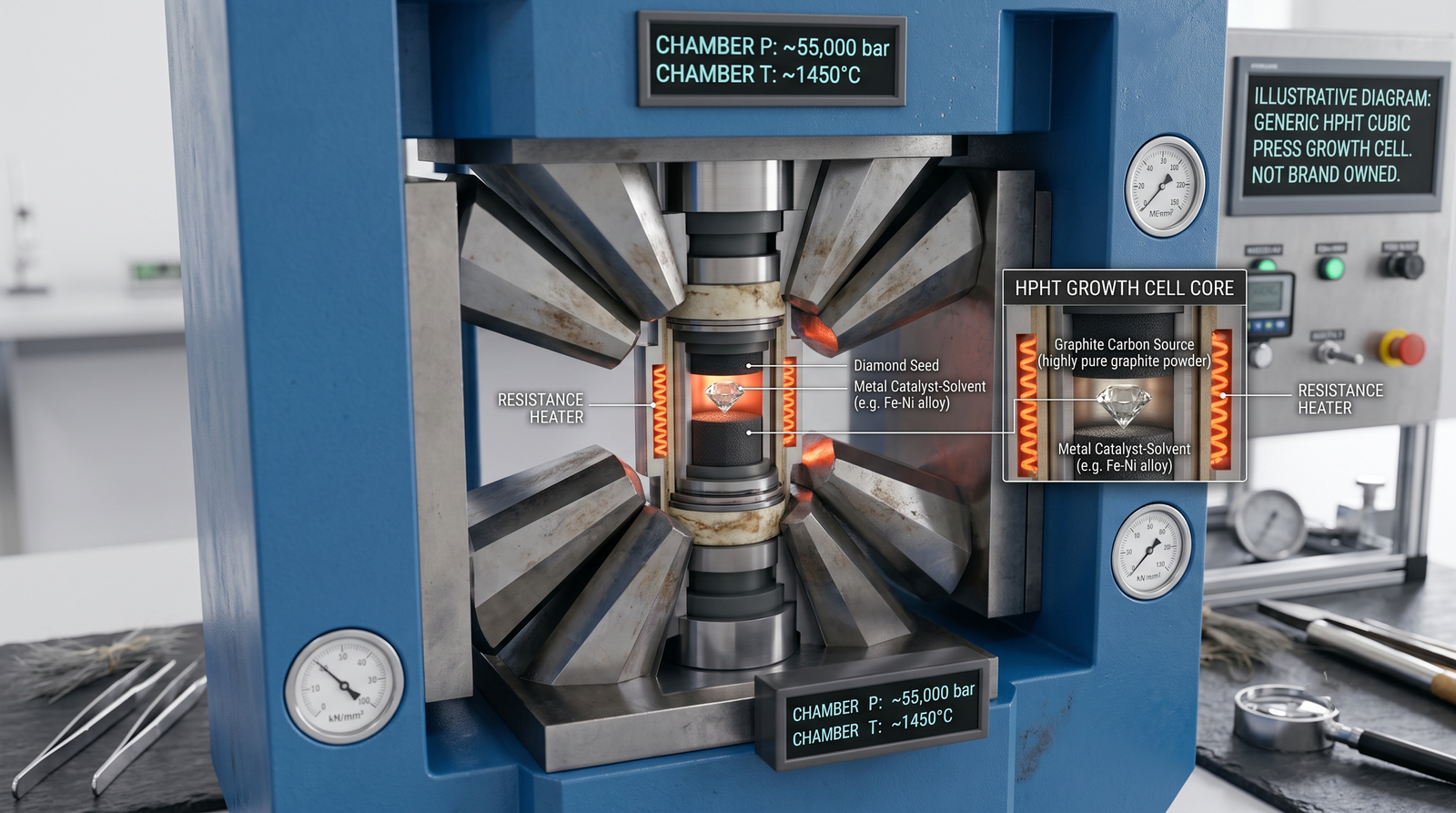
The process described in the source material uses HPHT, or high pressure, high temperature, technology. The growth cell creates extreme pressure and heat that allow carbon to form the diamond crystal structure.
A small diamond seed provides the starting structure. Carbon then crystallizes around that seed under carefully controlled conditions.
Growth conditions can reach approximately 6–8 GPa of pressure and roughly 1,400–2,500°C, depending on the growth system and stage of the process.
The growth itself can take weeks to months. Larger stones generally require more growth time, and a growth run can require additional processing if the intended result is not achieved on the first attempt.
HPHT vs. CVD
HPHT is not the only laboratory diamond-growth method. CVD, or chemical vapor deposition, grows diamond by depositing carbon from a carbon-bearing gas onto a diamond seed inside a controlled chamber.
Both technologies can create genuine diamonds. The important question for a memorial diamond is which process the provider uses and how it handles the personal carbon throughout the process.
What Varies From One Father to the Next?
Not every memorial diamond develops in exactly the same way. The source material and growth conditions can vary from one person to another.
Carbon Recovery
The amount of usable carbon can vary. Published industry figures place the recoverable carbon fraction at roughly 0.5–4% by weight, although the exact result depends on the individual and the cremation process.
Trace Elements
Trace elements can influence the final appearance and color of a diamond. This means a laboratory cannot always predict an exact final shade before the growth process begins.
Diamond Size
The target size affects the growth stage and the amount of rough material required. A larger finished stone generally requires a longer and more demanding growth process.
Cut and Shape
The rough crystal determines how the cutter approaches the final stone. Cutting removes rough material and creates the facets that control how the finished diamond interacts with light.
BlueIce Gems currently lists several memorial diamond cuts, including Brilliant, Emerald, Asscher, Princess, Radiant, and Heart. Explore the current BlueIce Gems Memorial Diamond options.
What Comes Back to You Besides the Stone?
A finished memorial diamond is only one part of the process. Documentation, communication, and the handling of unused material also matter.
Before sending your father’s ashes, ask the provider how it records the submitted material and how it maintains its chain of custody throughout the process.
You should also ask what documentation accompanies the finished diamond. A grading report and an origin or authenticity document can answer different questions, so ask the provider exactly what each document confirms.
Ask about unused cremated remains as well. Find out whether the laboratory returns unused material, stores it, or follows another documented procedure.
If you plan to wear the finished stone, you can also turn it into a custom memorial piece. Our custom pendant design guide explains how personal materials, stones, engraving, and pendant construction can work together.
Frequently Asked Questions
Do Metal Implants or a Pacemaker Affect What the Lab Can Use?
Metal implants do not become part of the carbon feedstock. Materials such as surgical hardware should be separated during intake rather than carried into the carbon extraction process.
Does It Matter If My Father Was Cremated Years Ago?
Cremated remains are stable mineral material, so the passage of time does not automatically make them unusable. A provider can explain its requirements for older cremated remains before you submit the material.
Will the Lab Tell Me How Much Carbon It Recovered?
Ask the provider before ordering. A recovered-yield figure can help you understand how much material the laboratory obtained and how much process information it is willing to document.
Can the Cremation Process Affect Carbon Recovery?
It can contribute to variation in the amount of usable carbon recovered. The source material places the usable carbon range at approximately 0.5–4% by weight and attributes variation to both the individual and the cremation process.
What Happens If the Diamond Growth Run Fails?
Ask the provider before sending your father’s ashes. Find out whether the laboratory makes another attempt, whether it uses remaining material for another run, how the failure affects the timeline, and who covers any additional costs.
Can a Lab Grow a Meaningful-Size Diamond From Only the Ashes?
The answer depends on the laboratory’s process and the amount of recoverable carbon. The source material used for this article states that laboratories commonly blend recovered carbon with additional laboratory-sourced carbon when the recovered amount cannot supply enough feedstock for the intended growth run.
Questions Worth Asking a Lab Directly
Before choosing a provider for a memorial diamond, ask direct questions about the process rather than relying only on marketing language.
- How do you extract carbon from cremated remains?
- Do you use HPHT, CVD, or another diamond-growth method?
- Do you add supplemental laboratory carbon?
- How much carbon do you recover from the submitted material?
- How do you track my father’s ashes throughout the process?
- What happens to unused cremated remains?
- What happens if a growth run fails?
- What documentation will I receive with the finished stone?
- Which diamond colors and cuts can I choose?
- How long should the complete process take?
A transparent laboratory should explain which parts of the process it controls, which characteristics can vary, and what it can document for you.
Understanding the Journey From Ashes to Diamond
Creating a memorial diamond from your father’s ashes involves much more than placing ashes into a machine and waiting for a diamond to appear.
The laboratory first prepares the cremated remains and isolates the usable carbon. It then purifies that carbon and converts it into graphite. The prepared carbon enters a controlled diamond-growth environment, where extreme pressure and temperature allow a crystal to form.
After growth, the rough crystal still needs cutting and polishing. The finished stone can then become a lasting memorial that you preserve privately or set into a ring, pendant, or another piece of jewelry.
The most important step before choosing a provider is asking exactly what happens to the material you submit. Understand the extraction process, growth technology, carbon policy, documentation, timeline, and handling of unused remains before you begin.
For more information about BlueIce Gems’ current memorial diamond process, visit the BlueIce Gems Memorial Diamonds page.