
You may be the sibling who said, almost without thinking, that you would look into it, and now you are trying to work out what that actually involves. To turn brother ashes into a diamond, you confirm who has authority over his remains, agree on a small portion with that person, choose a provider, ship the ashes under tracked chain of custody, pick size and color, and then wait roughly 6–10 months for a real lab-grown diamond that holds part of his carbon.
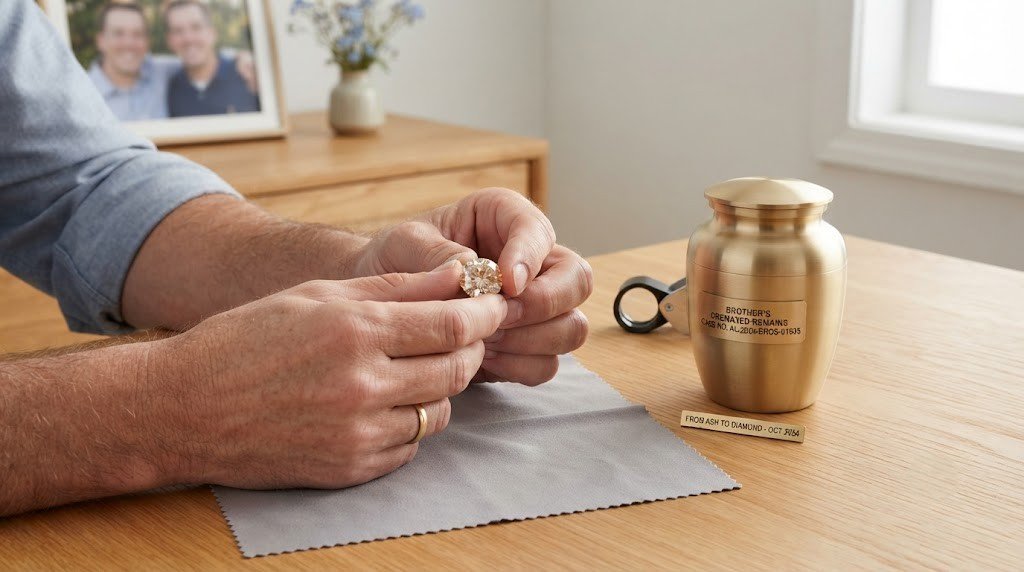
Table of Contents
What Does It Take to Turn Brother Ashes Into a Diamond?
When you turn brother ashes into a diamond, your side of the path involves more conversations and paperwork than science. The lab handles extraction and growth; your part is permission, a few decisions, and a careful handoff. Seeing the whole route laid out at once tends to make it feel less like a maze and more like a list.
Here is the order a sibling typically moves through when deciding to turn brother ashes into a diamond. Providers name their stages a little differently, but the sequence itself rarely changes.
| Step | What you do | Who is usually involved |
|---|---|---|
| 1. Confirm authority | Find out who holds the right to decide about his remains | You, the funeral home, close relatives |
| 2. Agree on a portion | Ask for a small share of the ashes and record the agreement | The person with authority |
| 3. Choose a provider | Compare process honesty, grading options, and written policies | You, plus anyone sharing the cost |
| 4. Send the ashes | Use the provider’s kit and a tracked shipping method | You or the funeral home |
| 5. Make your selections | Choose carat, color, cut, and any setting | You, perhaps with other relatives |
| 6. Wait through production | Receive updates while the carbon is extracted and the stone grows | The provider |
| 7. Receive and check | Match the paperwork, inspect the stone, ask follow-up questions | You |
For some siblings, the first two steps are settled in a single conversation. For others, those two steps take longer than everything after them combined, and that is fine. Nothing in the lab stages depends on rushing the family stages.
If you want a wider view of the whole subject before you start, the complete guide to a brother ashes diamond covers background, options, and common worries in one place. The rest of this page stays practical: what you actually do, step by step, when you set out to turn brother ashes into something you can hold.
Who Decides Whether You Can Turn Brother Ashes Into a Diamond?
Settle this first, because a provider asked to turn brother ashes into a diamond may well ask who authorized the request. Being his sibling does not automatically place the decision with you. Each state writes its own priority list for who may direct the handling of a person’s remains, and siblings frequently appear after other relatives on it.
A common pattern puts a surviving spouse or registered partner first, followed by adult children, then parents. That is a pattern, not a national rule, and the details shift from one state to the next. His own written wishes can also override the usual order: a designated agent named for disposition, a pre-need funeral arrangement, or instructions in a will may hand the decision to a particular person.
If the people ahead of you in that order are not part of the picture, authority may rest with you and any other siblings jointly, and whether siblings in that position must all agree is another detail that differs by state. Because you may not know which of these applies, start with someone who does.
- The funeral home or crematory. Staff know who signed the cremation authorization and can usually say whose consent a release of ashes requires.
- The person currently holding the urn. Possession and authority are not always the same thing, but that person is part of the conversation either way.
- A local estate or probate attorney. If the situation is tangled, a short consultation can clarify the rules for your state.
If you hope to turn brother ashes into a diamond and someone else holds that authority, the road has not closed. Your next step simply becomes a conversation instead of a form.
How Do You Ask for a Small Portion of His Ashes?
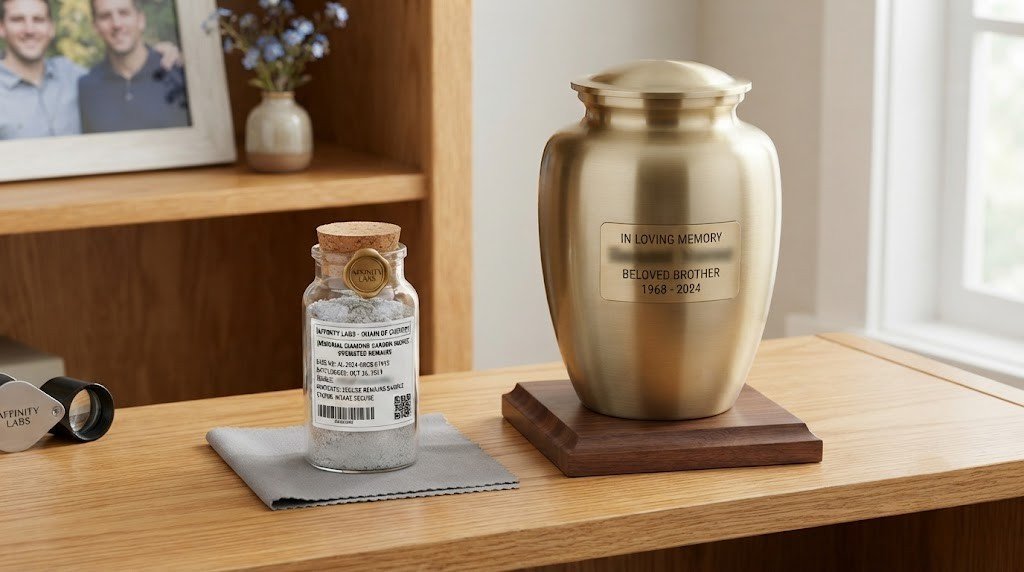
Asking permission to turn brother ashes into a diamond can feel like asking for something you have no claim to. It may help to name exactly what you are requesting: typically a few tablespoons to a few ounces, a modest share of the whole, with everything else kept, scattered, or interred as already planned. Nobody has to give up the urn.
A few things tend to make the request easier to hear:
- Start with why a wearable piece of him matters to you, before any logistics.
- Mention how little a provider typically needs, and that the rest stays exactly where it is.
- Offer to include them: updates as the work progresses, copies of the paperwork, or a stone of their own.
- Put the agreement in writing, even a short email, so the funeral home or provider has a record.
- Leave room for a pause. A “not yet” often means something different from a “no.”
When several siblings share the wish, asking together can help. A shared request to turn brother ashes into a diamond may feel less like a personal favor to the person deciding, and one portion of ashes can often supply more than one stone. Our page on sharing a brother memorial diamond among relatives walks through how that usually works.
If the answer is no, or the timing is wrong, hair is a respectful alternative. A lock saved from a haircut, or trimmed by the funeral home before cremation, needs no ashes at all, and the guide to how to turn brother hair into a diamond explains that route. A lock that stayed in his home or turned up with his possessions could be treated as belonging to his estate, depending on the state, so the same care about permission applies. Hair the funeral home trimmed is generally released through whoever holds authority over his remains, not handed to any relative who asks.
How Much of His Ashes Will a Provider Ask For?
Across the industry, providers typically request somewhere between a few tablespoons and roughly 4 ounces (about 100 grams) of cremated remains. That is a small fraction of what a full cremation returns. Each provider sets its own minimum, so treat these as typical industry figures and confirm the number before you divide anything.
A larger amount does not produce a larger diamond. The finished carat weight follows the length of time the stone is left to grow, and the volume of ash you send has no bearing on it. Before shipping more than the minimum, ask the provider whether it stores, returns, or disposes of anything it does not use, and how.
If you plan to turn brother ashes into more than one stone, for yourself and another relative perhaps, ask whether one shared portion will cover every diamond or whether each needs its own measured amount. The breakdown of how much ash a brother memorial diamond usually needs goes into those quantities in more depth.
A practical tip: once you agree to turn brother ashes into a diamond, ask whoever separates the portion, whether that is the funeral home or the family member keeping the urn, to place it in a clean, sealed container and label it with his full name, unless the provider’s own instructions call for something different. That small step makes the chain of custody clear from the very first moment.
How Do You Choose a Provider and Send the Ashes Safely?
Before you turn brother ashes into a diamond with any company, read how it explains where the carbon comes from. A provider that states plainly that supplemental lab carbon is typically blended in, and gives an honest range for the share that comes from ashes, is telling you how it handles uncomfortable truths. A provider that implies the stone is entirely him is telling you something too.
Questions worth putting to every company you consider:
- How do you track the ashes from arrival to finished stone, and will I receive documentation of each handoff?
- Do you offer an independent grading report, or only an in-house certificate?
- What happens if a growth attempt does not succeed?
- Will unused ashes be returned, and how?
- Which shipping method do you require, and do you supply a kit?
- Who can I contact for updates during production?
Carriers can have their own requirements for cremated remains, so ask the provider which shipping methods it accepts and what, if anything, its kit contains, then follow those instructions exactly. Choose tracking and signature confirmation where they are offered, keep every receipt, and photograph the sealed package before it leaves your hands. If packing remains yourself feels like too much, you can still turn brother ashes into a diamond by asking the funeral home to prepare and send the shipment.
What Choices Do You Make When You Turn Brother Ashes Into a Diamond?
Once the ashes are with the provider, you decide what kind of stone you want to turn brother ashes into. These choices shape both the cost and the timeline, so it helps to make them with clear information rather than in a hurry.
Carat. Memorial diamonds are generally offered from about 0.10 carats up to 5 carats or more. A smaller stone suits everyday wear and a modest budget; a larger stone takes longer to grow and costs considerably more.
Color. Tiny amounts of other elements trapped during growth set the hue. A trace of nitrogen leans the stone yellow and a trace of boron leans it blue; a stone with neither reads as colorless, and getting there means filtering both out, an added step that usually pushes the cost up. Memorial stones commonly finish in yellow, blue, or champagne, and certain providers can treat a finished stone with irradiation to reach red, pink, green, or black. Nobody can tell you ahead of time precisely which shade his carbon will produce. Our page on what color a diamond from your brother’s ashes might be explains why.
Cut and setting. Round, cushion, princess, oval, emerald, and other shapes are common. The setting is entirely personal: a pendant, a ring, earrings, a bracelet charm, cufflinks, a tie bar, or a loose stone kept in a small box. Think about how you will actually wear or keep it, rather than about what anyone else expects a brother memorial to look like. When siblings turn brother ashes into several stones, each person can choose a different setting from the same source.
What Happens to His Ashes Inside the Lab?
Cremated remains are mostly calcium phosphate, the mineral structure of bone, so the lab’s first task when asked to turn brother ashes into a diamond is pulling out the small amount of carbon present. The material goes through a controlled, oxygen-free, multi-stage heating process that removes everything except carbon, bringing it to roughly 99.9% carbon or better.
Next comes graphitization. The purified carbon is heated to about 2,500–2,700°C and converted into graphite, the form a growth press can use as feedstock. That graphite, typically blended with supplemental lab carbon, goes into a growth cell around a tiny diamond seed.
Most memorial providers use HPHT, which recreates conditions deep in the Earth at roughly 6–8 GPa and 1,400–2,500°C. A minority use CVD, building the crystal from carbon-bearing gas inside a vacuum chamber. The general science behind both is described in this overview of how synthetic diamonds are grown. Growth runs for weeks to months, depending on the carat you chose.
After growth, a gemologist cuts and polishes the rough crystal, an optional irradiation step can adjust color, and the stone is graded. For a closer look at each stage, see how a memorial diamond is made from brother ashes. Knowing these stages makes the decision to turn brother ashes into a diamond feel less abstract, because you can picture where his carbon is at every point.
How Much of the Finished Diamond Is Actually Him?
Anyone planning to turn brother ashes into a diamond eventually asks this, sometimes hesitantly. The honest answer: cremated ashes contain only about 0.5% to 4% carbon by weight, depending on the person and the cremation. Because that yield is low, providers typically blend the recovered carbon with supplemental lab carbon to reach a workable volume.
Industry figures put the ash-derived share of a finished stone at roughly 10–15% of its mass, though some providers cite figures as low as about 3%, and the share shifts with stone size and how much ash was supplied. So a diamond made this way is not him alone, and any company suggesting otherwise is overstating the chemistry.
What is true matters more than the overstatement would. A real, verifiable portion of his own carbon is extracted, purified, and locked into the crystal lattice of a stone that exists because of him. It is not a symbol or a photograph of him; part of it physically came from him. When you turn brother ashes into a diamond, that is the plain truth worth holding onto.
If the carbon question is part of why you are weighing options, compare this with hair, which is roughly 50% carbon by weight. Some siblings combine both materials, and the page on how to turn brother ashes and hair into a diamond explains what a blend involves and what remains unknown about it.
How Long Does It Take to Turn Brother Ashes Into a Diamond, and What Does It Cost?
Across the industry, siblings who turn brother ashes into a diamond typically wait 6 to 10 months from the day the provider receives the ashes. Stones above roughly 2 carats, or specialty colors, can take up to about 12 months. The extra time comes from growth in the press, so choosing a larger diamond is choosing a longer wait. The brother memorial diamond timeline explains what the waiting months tend to look like.
General 2026 industry price ranges for the loose stone:
- About 0.10–0.25 carat: roughly 1,500–3,500
- About 0.5–1 carat: roughly 5,000–15,000, with colorless toward the top of that range
- About 2–5+ carats: roughly 20,000–75,000 or more
Grading reports, engraving, fancy cuts, and jewelry settings are usually priced separately. These are industry-wide figures, not a quote, and your final cost depends on carat, color, cut, and whether you add an independent grading report. When relatives turn brother ashes into stones together, each diamond is typically priced on its own.
How Do You Check the Diamond When It Arrives?
The package arriving is its own moment, and you are allowed to open it slowly. When you are ready, a few practical checks confirm that everything matches what you ordered.
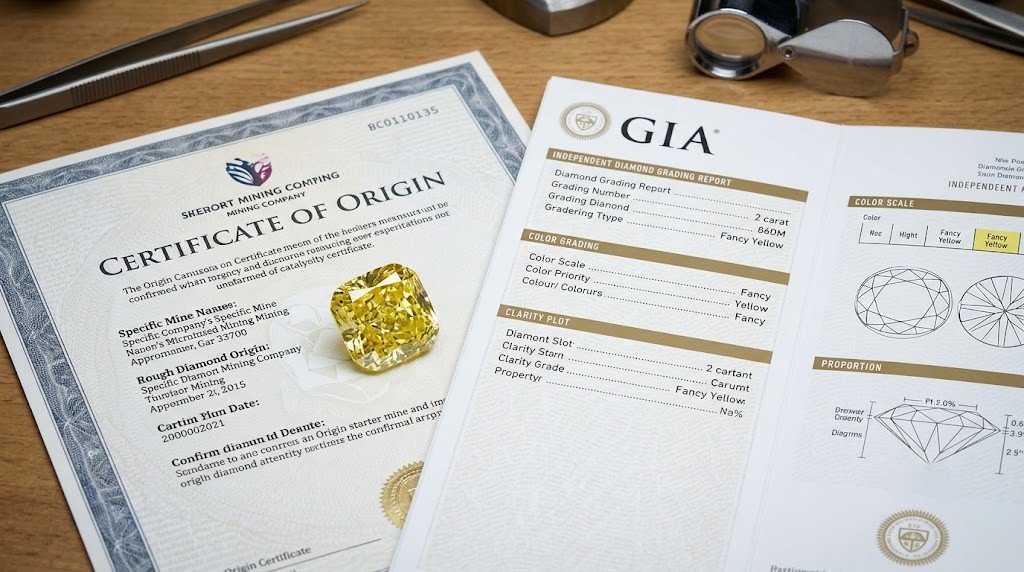
First, look at the two documents a reputable provider usually sends. An origin or authenticity certificate, generally issued in-house, records that the diamond was grown from the carbon you submitted; it is a chain-of-custody record. A grading report, ideally from an independent lab, describes the stone itself using the 4Cs, following standards such as those set out in the GIA’s diamond quality factors. Check that carat weight, color, and shape on both documents match each other and your order.
Then look at the stone. Clarity for memorial diamonds typically falls between SI2 and VVS, so tiny inclusions visible under magnification are normal. A jeweler you trust can confirm the weight and inspect the setting. Diamond sits at 10 on the Mohs hardness scale, yet hardness is not the same as toughness, and a sharp blow can still leave a chip. If you turn brother ashes into a ring or another piece worn daily, talk with your jeweler and insurer about protective settings and coverage first.
If anything does not match, contact the provider promptly with photos. Keep the certificate, the report, and your shipping receipts together; that paper trail is part of what makes the decision to turn brother ashes into a diamond something you can trust years from now.
Frequently Asked Questions
Do I need permission to turn my brother’s ashes into a diamond?
Usually, yes. The person holding authority over his remains, often a spouse, partner, adult child, or parent depending on state rules and his written wishes, typically needs to approve the release. The funeral home can usually tell you whose consent applies.
Can I turn brother ashes into a diamond if the ashes were scattered?
If all of the ashes were scattered, there is nothing left to send. Check whether anyone kept a small portion, because even a few tablespoons may be enough. If none remains, saved hair can be an alternative carbon source.
Will the rest of his ashes still be available for burial or scattering?
Yes. When you turn brother ashes into a diamond, providers typically need only a few tablespoons to about 4 ounces, a small fraction. The remaining ashes can be kept in an urn, interred, or scattered as the family planned, with nothing else changing.
How many diamonds can come from one portion of ashes?
Often more than one, because each stone uses only part of the submitted carbon. Relatives who turn brother ashes into several stones can sometimes share one portion. Ask the provider how many stones its process supports from the amount you plan to send.
Is the diamond a real diamond or a simulant?
Siblings who turn brother ashes into a diamond receive a real, lab-grown diamond with the same chemistry, hardness, and optical properties as any other diamond. It can be graded on the 4Cs by an independent laboratory, unlike glass, resin, or cubic zirconia keepsakes.
Can the funeral home send the ashes to the provider for me?
Often, yes, which lets you turn brother ashes into a diamond without packing anything yourself. Some funeral homes regularly ship cremated remains and may prepare the paperwork. Ask whether they charge for this service and confirm they will use the provider’s kit and tracked shipping.
Final Thoughts on Turning Your Brother’s Ashes Into a Diamond
There is no deadline on any of this. Ashes keep, conversations can wait for a better week, and the lab stages will be just as precise whenever you begin. What matters is that the people who need a say get one, and that you choose a provider honest enough to tell you exactly how much of the stone came from him. If you decide to turn brother ashes into a diamond, you will end up with something real, documented, and quietly his.
Learn More About Turning His Ashes Into a Diamond
- Brother ashes diamond: the complete guide the broad overview, start to finish
- Questions to ask before turning your brother’s ashes into a diamond a checklist for provider conversations
- How much a brother memorial diamond costs price tiers and add-ons explained
- Brother memorial diamond ideas rings, pendants, and keepsakes to consider
Talk With Memorial Diamond
If you are still at the very first step, unsure who to ask or what to say, you are welcome to reach out. Memorial Diamond can talk through what it would take to turn brother ashes into a diamond in your situation, answer questions about the process, and help you think about timing at whatever pace suits your family. Start the conversation at memorialdiamond.us.
Word count: 3,380 words · Reading time: about 17 minutes
Leave A Comment