
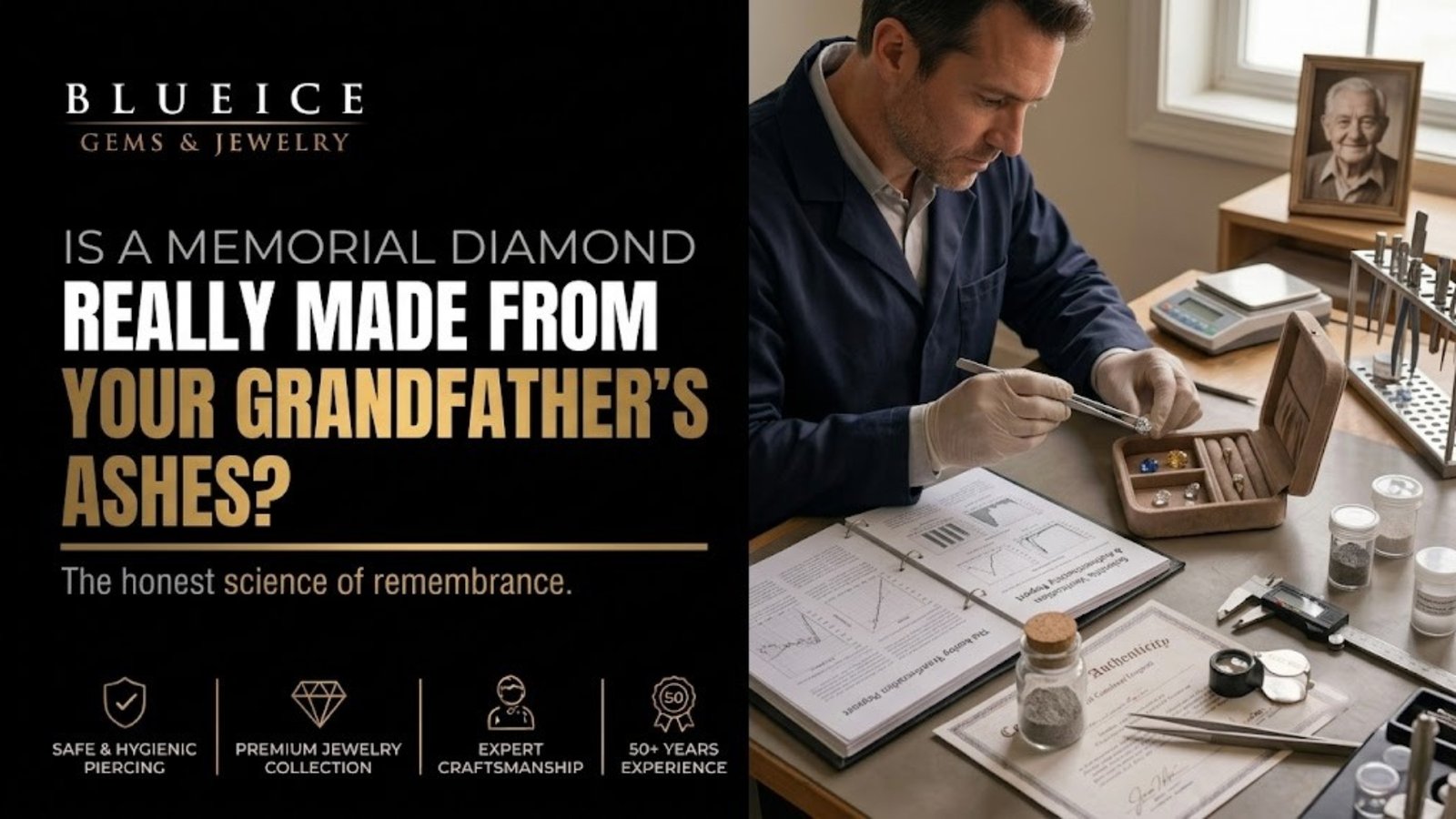
Before you send any part of his ashes to a lab, you are entitled to proof rather than poetry. If you are asking whether a memorial diamond is really made from grandfather ashes, the plain answer is yes, in part. A real, verifiable portion of his carbon is extracted, purified and grown into a genuine lab-grown diamond, typically blended with supplemental lab carbon, so his ash carbon usually makes up around 10–15% of the finished stone’s mass.
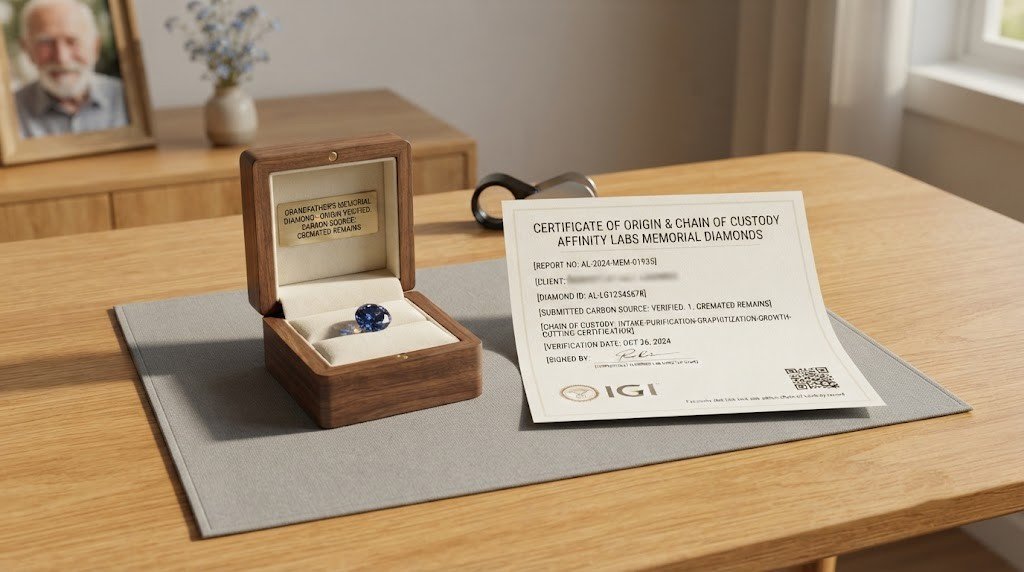
Table of Contents
Is the Diamond Really Made From Grandfather Ashes, or Only Partly?
Partly, and the part is genuine. A stone really made from grandfather ashes holds his carbon inside the crystal itself, bonded into the same lattice as every other carbon atom in it. It is not a pinch of ash sealed under glass, and it is not a symbol standing in for him.
It is not a stone made only of him. Across the industry, carbon recovered from ash usually accounts for around 10–15% of the finished diamond’s mass, with some providers citing an ash carbon share as low as about 3% and others more. The rest is high-purity lab carbon.
Hearing the real figure first lets you decide, with clear eyes, whether a diamond really made from grandfather ashes in this blended sense feels right.
Some people find the blended version still carries what they wanted: a physical piece of him they can hold or wear. Keeping his ashes in an urn, scattering them or interring them are equally valid ways to honor him, and none of them has to be set aside if a small portion goes toward a diamond.
What Are His Ashes Made Of, and Why Is So Little of It Carbon?
Cremated remains are mostly bone mineral, not carbon. Cremation consumes nearly all organic material, leaving chiefly calcium phosphate, the mineral that gives bone its structure, plus smaller amounts of other minerals and salts.
Carbon survives only in traces. Industry figures put the usable carbon in ashes at roughly 0.5% to 4% by weight, varying with the person and with how the cremation was carried out. So the question of whether a stone is really made from grandfather ashes is partly a question of recovery: a lab has to pull a small, precious fraction of carbon out of material that is mostly mineral.
Two practical facts follow. Providers typically request part of his ashes rather than the whole urn, usually somewhere between a few tablespoons and about 4 oz (roughly 100 g). And the carbon recovered from that part is rarely enough on its own to grow a stone of useful size, which is why lab carbon is typically blended into a stone really made from grandfather ashes.
Whatever you do not send stays with your family to keep, scatter or inter as planned, and several stones can often come from one source. What happens to submitted ash left over after processing differs by provider, so ask for that answer in writing.
Why Is His Carbon Blended With Lab Carbon, and Does That Make It Less His?
His carbon is blended because a diamond needs a certain volume of carbon feedstock to grow, and ashes yield very little. Supplemental lab carbon brings the volume up to what the press requires; it does not replace his carbon, and it does not stop the stone from being really made from grandfather ashes.
At the scale of atoms, every carbon atom in a diamond locks into the same rigid framework, so the atoms recovered from his ashes become part of the crystal itself rather than a coating on its surface. A diamond really made from grandfather ashes holds those atoms permanently, whether his ash carbon is 3% of the mass or 15%.
Blending leaves these untouched:
- The stone is no less a diamond, because recovered carbon and lab carbon are the same element.
- Hardness, optical behavior and grading are unchanged.
- His contribution is not decorative; without his carbon, this particular stone would never have been grown.
Where blending matters is transparency: ask the provider in writing what share of the stone will come from his ash carbon at your chosen carat size. If you are told a stone is really made from grandfather ashes but cannot get that ratio on paper, keep asking.
How Does Carbon From His Ashes Become a Diamond?
His carbon moves through a controlled lab sequence in which each stage either removes what is not carbon or rebuilds that carbon as crystal. Understanding the order helps you judge any claim that a stone is really made from grandfather ashes.
- Recovery. In an oxygen-free, multi-stage heating process, the bone mineral is driven off and the carbon is refined until it reaches a purity of about 99.9% or better.
- Conversion to graphite. That refined carbon is taken to roughly 2,500–2,700°C, where it becomes graphite, the feedstock growth presses use.
- Blending and growth. The graphite, typically combined with lab carbon, is placed around a tiny diamond seed. HPHT, the industry-standard method, grows the crystal under roughly 6–8 GPa at 1,400–2,500°C, while CVD is the choice of a smaller group of providers. This overview of synthetic diamond growth by HPHT and CVD covers the general science.
- Finishing. The rough crystal is cut and polished, sometimes treated for color, and graded, ideally by an independent lab.
The sequence also shows where a skeptic should look: the handoff, the recovery stage and the blending stage are the points a credible tracking system must cover. A stone can only be described as really made from grandfather ashes if his material is accounted for at each of them. For each stage in more depth, read how a memorial diamond is made from grandfather ashes.
How Can You Verify a Stone Is Really Made From Grandfather Ashes?
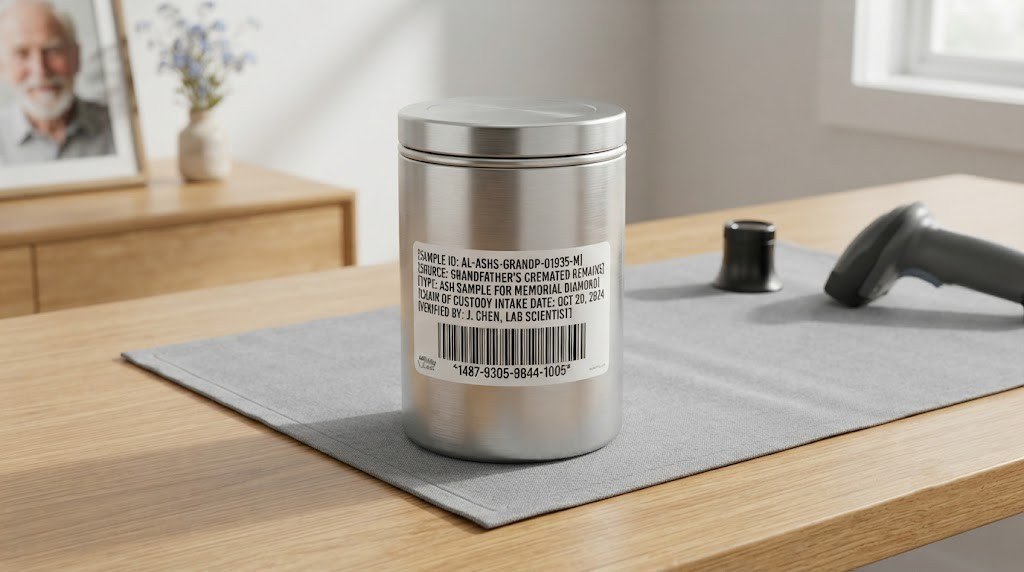
You verify it through chain of custody: a documented trail showing his ashes were identified on arrival, kept apart from other families’ material and tracked into one specific stone. A grading report speaks to quality rather than origin, so the records carry that weight.
A sound system typically assigns a unique identifier on arrival and ends with an origin or authenticity certificate linking it to the finished stone. That certificate, usually issued in-house, is the document that speaks to whether the stone is really made from grandfather ashes rather than from some other source.
Its worth depends on how openly the provider explains its system. Ask these seven questions in writing before you send anything:
- How is his material labeled and tracked from arrival, and can I see that record?
- Is his carbon processed separately from every other family’s material at each stage?
- At the carat size I want, roughly what share of the finished stone’s mass will come from his ash carbon?
- What exactly does your origin certificate state, and what records sit behind it?
- What documentation will I receive during the process, and in what form?
- Is independent grading included, optional or unavailable, and which lab issues it?
- What happens to any of his ashes that are not used?
Clear, specific written answers are a good sign that the stone will be really made from grandfather ashes in the way described; vague reassurance is worth noticing. If you are still choosing a provider, our guide for anyone who wants to turn grandfather ashes into a diamond explains what the handoff typically involves.
Can a Grading Report Prove a Stone Is Really Made From Grandfather Ashes?
No. A grading report documents the stone’s quality, not its origin. An independent gemological lab assesses cut, color, clarity and carat, the same 4Cs used for any diamond; GIA’s guide to the 4Cs of diamond quality explains each factor.
A grading report is simply not designed to answer whose carbon is inside, so it says nothing either way about whether a stone is really made from grandfather ashes. If you want to know whether any laboratory test could add evidence of origin, put that question to the provider in writing.
So the two documents do different jobs, and you may want both:
| Document | Usually issued by | What it tells you | What it does not cover |
|---|---|---|---|
| Origin or authenticity certificate | The provider, in-house | That the stone was grown from your family’s submitted material, per their tracking records | The stone’s quality grades |
| Independent grading report | A third-party lab (GIA standards commonly, sometimes IGI) | Cut, color, clarity and carat | Where the stone’s carbon came from |
Independent grading is generally optional, usually priced separately, and a question for the provider. Read together, the two papers say more about a stone really made from grandfather ashes than either one alone.
Which Memorial Diamond Claims Deserve Your Skepticism?
Be most skeptical of any promise that the stone is entirely him. A “100% him” or “pure ashes” claim does not match how a stone really made from grandfather ashes is grown: ash yields too little carbon, supplemental lab carbon is typically added, and an honest provider will say so plainly.
| What you might hear | What is actually true |
|---|---|
| “The diamond is 100% your grandfather.” | Ash carbon usually makes up around 10–15% of the finished stone’s mass, sometimes as little as about 3%; the rest is typically lab carbon. |
| “More ashes will give you a bigger diamond.” | Growth time sets the carat size, not the amount of ash submitted. |
| “The grading report proves it is his carbon.” | Grading reports the 4Cs; origin is documented separately, through chain-of-custody records. |
| “His ashes will decide the color.” | Color comes from trace elements such as nitrogen (yellow) and boron (blue), and no source makes the final shade predictable. |
| “It is only a keepsake, not a real diamond.” | It is a real lab-grown diamond, rated 10 on the Mohs scale and graded on the same 4Cs. |
| “We need the whole urn.” | A portion is typically enough; requests usually fall between a few tablespoons and about 4 oz. |
| “Your stone will be ready almost immediately.” | The overall timeline typically runs 6–10 months, up to about 12 for larger or specialty-color stones. |
Hearing the real blend does not shrink what a stone really made from grandfather ashes means; it simply tells you what you are holding.
Quieter warning signs, such as vague tracking, no written carbon share or pressure to decide quickly, are each a reason to keep asking whether the stone will be really made from grandfather ashes as promised.
Is a Stone Really Made From Grandfather Ashes a Real Diamond?
Yes. It is a real lab-grown diamond, not glass, resin or a look-alike. It rates 10 on the Mohs scale of mineral hardness, the hardest natural mineral, though a sharp knock at the wrong angle can still chip any diamond, so a protective setting is worth discussing.
It is graded on the same 4Cs as any other diamond, with clarity for memorial stones typically between SI2 and VVS and sizes from about 0.10 carats to 5 or more.
Color is where these stones often differ from a jeweler’s case: memorial stones commonly trend yellow, blue or champagne to brown, colorless usually costs more, and some providers offer post-growth irradiation for red, pink, green or black. Nobody can predict the shade of a stone really made from grandfather ashes, so treat color as a conversation rather than a promise.
What Does It Cost, and How Long Does It Take?
A diamond really made from grandfather ashes is priced like other memorial stones: industry prices in 2026 typically run about 1,500–3,500 for a 0.10–0.25 ct stone, 5,000–15,000 for 0.5–1 ct, and 20,000–75,000 or more for 2–5+ ct, with colorless costing more than colored stones of the same size. Settings, engraving, fancy cuts and independent grading are usually extra. These are category-wide figures.
The overall process typically takes 6–10 months, up to about 12 for stones of around 2 ct and up or specialty colors. Growth time, not the amount of ash, decides the carat. Our complete guide to a grandfather ashes diamond goes deeper on budgets, carats and settings.
Who Has a Say Over How His Ashes Are Used?
That depends on your state and on anything he left in writing. No one national rule governs who decides about cremated remains. Where there is a surviving spouse or partner, that person and his adult children commonly rank ahead of grandchildren, although written wishes can reorder things.
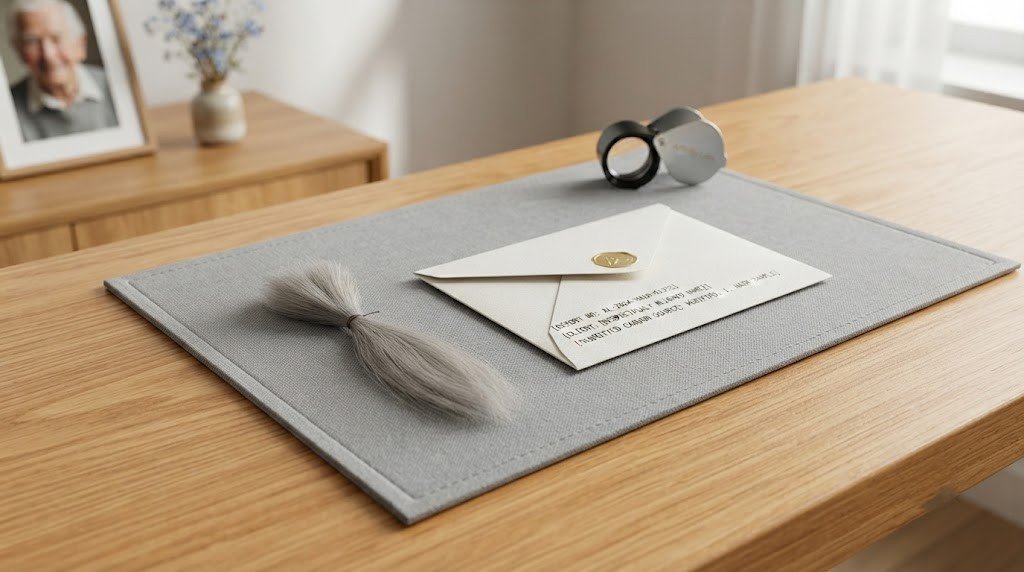
If someone else holds that authority, ask them for a small portion and explain your plans, so a stone really made from grandfather ashes begins as a shared decision. If ashes are not available to you, hair can be another route.
Does Your Family’s Faith Change the Answer?
It might, and your own clergy are the right people to ask whether a stone really made from grandfather ashes sits well with your tradition. Published religious teaching addresses cremation and what happens to ashes afterward; memorial diamonds themselves have not been ruled on by any tradition.
Catholic guidance allows cremation yet asks that ashes stay together in a sacred, church-approved resting place, with a narrow allowance for a minimal portion elsewhere. Orthodox and Conservative Judaism generally prohibit cremation; Reform Judaism leaves more to rabbis and families. Islam’s major schools consider cremation itself impermissible. Because those Islamic and Orthodox or Conservative Jewish objections concern cremation, a stone grown from hair sits outside them. Hindu, Buddhist and Protestant views on dividing ashes vary by community.
Could His Hair Be Used Instead of, or Alongside, His Ashes?
Hair can be a source on its own; whether a provider will also use it alongside his ashes is a question for that provider. If his ashes are not available to you, or you feel unsure about a stone really made from grandfather ashes, hair is worth knowing about.
Hair is roughly 50% carbon by weight, because it is built from keratin, against about 0.5–4% for ashes. That is a starting-material fact only: no finished-stone personal-carbon share is published for hair or for blends, so ask for the provider’s figure in writing.
Hair needs no cremation, so it can work even if he was buried. His hair may be gray, white, short or sparse, or a trimmed beard may be what was saved; whether such hair is accepted, and how much is needed, are questions for the provider.
Laws on remains are aimed at the remains, so a lock you already hold is usually the simpler case in practice. Even so, his belongings may count as part of his estate and state rules differ, and if a relative holds the hair, using it starts with talking to them. See our complete guide to a grandfather hair diamond, how a memorial diamond is made from grandfather hair, and, if you have both materials, our guide to a grandfather ashes and hair diamond.
Frequently Asked Questions
Can a lab test a finished diamond to confirm it holds my grandfather’s carbon?
Not through standard grading, which reports cut, color, clarity and carat rather than origin. Evidence that a stone is really made from grandfather ashes comes from chain-of-custody records and the origin certificate, so ask the provider whether any test could add to that, and what it would show.
Why would a provider add carbon that did not come from him?
Ashes contain only about 0.5–4% carbon by weight, which is rarely enough to grow a stone of a useful size. Supplemental lab carbon brings the feedstock up to the volume the growth press needs, while his recovered carbon remains part of the crystal.
Does a small share of his carbon make the stone less meaningful?
That is a personal judgment only you can make. A stone really made from grandfather ashes holds his atoms in the crystal whether his ash carbon is about 3% or 15% of the mass. Some people find that enough; others prefer an urn or scattering.
Can more than one grandchild have a stone from the same ashes?
Often, yes. Each stone really made from grandfather ashes needs only a portion, so several diamonds can frequently be grown from one source. Agree on it with whoever holds authority over his ashes, and ask the provider how they handle multiple orders.
What should I do if a provider promises the stone is pure ashes?
Ask them to explain, in writing, how a full-size stone could be grown from ashes holding only a few percent carbon. An honest provider describing a stone really made from grandfather ashes will explain the blend and give a realistic range.
Does an origin certificate replace an independent grading report?
No. The origin certificate, usually issued in-house, documents which family’s material the stone was grown from. An independent grading report describes the stone’s cut, color, clarity and carat. They answer different questions, and you may want both before you decide.
Final Thoughts on Whether It Is Really Him
Skepticism here is not disloyalty to him. Asking whether a stone is really made from grandfather ashes is how you make sure whatever you carry rests on something true. A real portion of his carbon locked into a real diamond alongside lab carbon is less tidy than a promise of purity, but you can explain it to your family without hesitation. Take your time, keep the answers in writing, and let the decision be yours.
Learn More About Grandfather Memorial Diamonds
- Everything about a diamond grown from his ashes costs, carat sizes, colors and settings in one place
- Each lab stage, from recovered carbon to cut stone what happens to his ashes inside the lab
- Practical steps when you have both his ashes and his hair sending two materials together
- A diamond from his hair, with no cremation involved the route that works after burial too
Talk With Memorial Diamond
If you would like to ask any of these questions directly, or talk through whether a stone really made from grandfather ashes feels right for your family, you are welcome to reach out through memorialdiamond.us. A conversation commits you to nothing.